
On Christmas morning last year, I walked the reservoir track in New York's Central Park, since the gym was, naturally, closed for you-know-who's birthday. Hundreds of people, most of them armed with cameras, were strolling around the loop in the delicious sunshine. Few of them were speaking English. I stopped to chat with a family of Danes who were typically unaffected, friendly, and charming. Ten minutes after our conversation, I realized I had been using the wrong word for and.
Well, my Danish is admittedly rusty, but with a little application, I can retrieve it, such as it was at my personal best. The last time I needed to do so, I reread four volumes, translated into Danish, of Laura Ingalls Wilder's "Little House" series. The saga of an American pioneer family in which the author grew up has delighted several generations of youngsters world-wide. That's my Danish reading level--a nine-to-twelve-year-old's. I can also manage simple novels for adults--Tove Ditlevsen is an open book to me--as well as Hans Christian Andersen's tales, albeit struggling desperately with the most complex ones. In conversation I'm pretty good--for an American. One-to-one and face-to-face conversation, that is; I make friends at parties but live in terror of round-table meetings and phone calls. I have a keen ear, and therefore a decent accent, so Danish listeners think I'm more capable of expressing myself in their language than I really am.
When I set out, in middle age, to learn Danish, I conveniently forgot that, in my early twenties, I had failed miserably at acquiring German, on which Danish is firmly based. Just a couple of years out of college and newly married, I tackled German only because I would have needed it to earn my Ph.D. in literature. You can understand why I and other American Jews of my generation may still retain uncomfortable associations with the German language. I also thought that it was an "ugly" tongue--harsh and guttural--but that was mostly because I experienced merely six weeks' worth of it before I quit; I had never read (or heard) Germany's great Romantic literature.
It helps to be in love with a language or at least in love with the people who speak it when you're trying to make it part of yourself. At least that's how it was with me, first with French (love of the language) and later with Danish (love of the people). Having neither motivation to sustain me with German, I abandoned the course I'd enrolled in after that ridiculously brief encounter. A few years, two children, and an M.A. later, I realized I didn't want to earn a Ph.D. either. My bourgeois, pre-1960s upbringing had instructed me that a young woman in my position had two career choices--homemaking and teaching. And so I became a housewife (leaving professordom to my husband), a stay-at-home mother (which I'll be glad of forever), and, a decade later, still an innocent, but widening my horizons a jot, a dance writer.
Whatever put it into my head to acquire Danish? Here are my reasons, in descending order of importance:
One: I first visited Denmark for the 1979 Bournonville Festival held on the 100th anniversary of the great choreographer's death. Copenhagen is a balm to an overtaxed New Yorker, and I kept returning in the next few years for work and play. During those sojourns, forging many friendships, I came to know the Danish custom of intimate conversations by candlelight. (There was plenty of time for them, for sure; in winter, twilight sets in at 3:00 in the afternoon.) In these sheltered personal encounters, I discovered, one got to know one's companions' innermost thoughts and feelings--their "secrets"--and, once I'd mastered the rudiments of Danish, I in turn, at heart a reserved person, could confess mine, since I am of the belief that anything you say in a foreign language doesn't count (just as anything you eat abroad will put no superfluous calories on your frame).
Two: At that unforgettable festival, I fell instantly in love--both with the choreography of August Bournonville and Copenhagen itself. The Royal Danish Ballet, given its unique profile by the nineteenth-century ballet master, was still producing dancers who were specialists in his buoyant, fleet-footed classical technique, where bravura feats are modestly veiled by the desire to express the joy of dancing. These performers also proved that one of Bournonville's central achievements was to depict, always with enormous empathy, a wide range of human character and human relationships. As for the city of Copenhagen, it seemed to me an earthly incarnation of a fairytale kingdom.
Three: What's more, I liked languages. At the blithe, visionary age of 20 I had planned to learn a half-dozen foreign languages before I died. I can still remember what they were: Japanese, Italian, ancient Greek, Latin, Yiddish, and American Sign. After an initial six-month struggle in junior high, I had found that I had an affinity with French. I had also been the star of my high school class in elementary Spanish, which isn't saying much, but in those days you needed to have two foreign languages to get into the Seven Sisters colleges (the female equivalent of the Ivy League, which was where I was apparently heading). Recalling these easy successes, I assumed that acquiring Danish would be no problem.
Turns out that what I'm good at is Romance languages. When I embarked upon my Danish caper, I simply repressed the fact that I had, long before, precipitously abandoned German. I was also blissfully unaware of the fact that Danish was then spoken as a native language by a mere five million people, most of whom, these days, are fluent in English. From a practical point of view the acquisition of Danish would be entirely useless to me. But then I wasn't--for that matter, am still not--practical.
To make sure I carried out my plan, I revealed my intention to a number of Royal Danish Ballet dancers who had become friends. That way, I figured, I wouldn't dare cop out, for fear of embarrassment. I was so full of my own purpose that I neglected to understand their response. It was, to a one, "Oh, really?"
Deaf to the Danes' implication that I'd proposed climbing Everest in flip-flops, I set about finding a course, a Danish 101. There weren't any in my multilingual city, it turned out, except, as I discovered belatedly, a very simple introductory one at New York University, the content of which I'd already mastered by the time I discovered its existence.
"Would you like to learn Finnish?" asked the young woman with Valley Girl intonations, who answered the phone at Columbia U. when I was doing my initial search. I was so put off by her assumption that one language could substitute for another, as if it carried neither weight nor personal resonance, that I couldn't resist informing her that Finnish was not a Scandinavian language like Danish, was not even in the huge Indo-European family, but in a more obscure group that contains Hungarian.
I'd just about given up when, discussing the upcoming oral history project I'd concocted on the Royal Danish Ballet and its Bournonville tradition, I mentioned to the Danish consul general in New York that I needed to find some way to learn his native tongue. (The interviews for my project were to be in English, but I thought that knowing some Danish would help with my research and, besides, be a friendly gesture.)
"Oh, you want Anita," the consul general declared confidently.
Who was Anita? A lovely woman in her thirties, it turned out, as benign as mild summer sunshine, whose smile alone could vanquish depression. She worked in a high-end secretarial capacity at the consulate. She took pupils privately, at home. Her fee was entirely reasonable, but after some fifteen lessons from her, my budget for such ventures ran out. We remained fast friends, though, for a long time.
The textbook Anita used, all one could readily find at that time, was written in 1958 and began with several easy-to-read accounts of the lower-middle-class, lower-middlebrow Hansen family, where the Mrs. was firmly kept in her housewifely place. Being an obsessively conscientious student, I nearly memorized the brief texts, and they drove me nuts. "She deserves," declares Mrs. Hansen's spouse, deigning to escort her to a local dance, "to get out and enjoy herself once in a while, since she has so much to take care of at home." He continues in a women-will-be-women tone about how his mate likes pretty clothes and craves an occasion to show herself off in a new dress. The combination of Mr. Hansen's taken-for-granted male authority and unthinking condescension still rankles with me today.
Anita's personality, however, was a boon. She had no actual teaching skills, unless you count--and I did--warmth, optimism, and a reasonable degree of patience. Still, early on, none of that mattered significantly; my problem was the language itself, which rebuffed me. The pronunciation is a killer; Danes themselves call their language "a disease of the throat." I couldn't hear the rhythm or song in the speech pattern and still suspect there is none. Many rules of the grammar seemed punitive and absurd, like the one that requires you to invert the natural order of noun and verb in a clause that follows an introductory subordinate clause. Got it? I didn't, but I refused to give up. Eventually I told Anita I would like to meet some of the New Yorkers she'd taught because I couldn't believe an American could master her language.
So Anita gave a party in her tiny apartment. The food was Danish and magnificent--the traditional three kinds of herring, paper-thin slices of rare roast beef, liver pâté et al., with pickled beets and cucumbers to accessorize them. Danish beers and Aquavit flowed freely, loosening people's tongues. The former students, utterly congenial, constituted a rich assortment of types, but they had all learned Danish for one of two basic reasons--work or love.
A star among the group, Judith Thurman, who won a National Book Award for her biography of Isak Dinesen, told me breezily, "Oh, don't bother about learning any of the genders for the nouns. You'll understand what you need to know without them." But she was already a whiz at languages, could find her way around in at least a handful, I gathered, and was, moreover, clearly an adventurous soul. There was one guy to whom Danish just seemed to have come naturally; he spoke it with the casual ease of a native. Anita told me later that when she gave him a new noun to learn he infallibly intuited its gender. She suspected he had, unbeknownst to himself, some Danish ancestors who'd magically passed on to him the echoes of their voices.
I think it was at this party that I first heard the old saying "The best way to learn a foreign language is on the pillow." Not having a Danish lover at my disposal, I had to resort to more pedestrian arrangements.
Most of my methods for learning Danish were improvised. Even before Anita there was the Berlitz book--a pocket-size item a much-traveled cousin sent over the night before I left for Copenhagen for the first time. It contained practical information, a quartet of picturesque walking tours, and a list of useful vocabulary enhanced by an audiotape so that you could hear the words pronounced. For the rank beginner, the difference between written and spoken Danish was overwhelming. Nevertheless, between trips one and three to Copenhagen, I assiduously memorized everything but the section on cars. (I loathe being in a car and I don't drive.)
Nothing one learns is useless. On that third trip I had an appointment to discuss my oral history project with the head of the Royal Theatre, in the hope of enlisting his support. He had specified the date and hour of our meeting and instructed me to identify myself at the stage door when I arrived, saying he was expecting me. Back then, however, the stage doormen, for reasons best known to themselves, pretended not to understand a word of English.
In vain, I tried to explain my presence and my purpose in English, my panic accelerating, because I had been told it is a grave offense in Denmark not to arrive exactly at the moment one is expected, whether it be for a business meeting or a dinner party. Finally my agitated brain retrieved an applicable sentence from the Berlitz book. It was the curtain line of a scene of escalating tourist discontent with hotel accommodations. Boldly, I declared in Danish, "I would like to see the manager." Duly intimidated, one of the guards phoned upstairs. The head honcho's secretary appeared immediately and delivered me to her boss, who was laughing.
Concurrent with and continuing long after my Anita period, there were the index cards. I never left my house without a 3" x 5" soft plastic box that held several dozen of them, each with a word I was trying to memorize, written in Danish on one side, English on the reverse. I worked these homemade flash cards on subway platforms, in the trains, during intermissions at the ballet, and waiting on line anywhere. I had, at last count, some 2,000 cards, and they each got their turn to be taken out into the great world. If people peered over my shoulder for too long as I used them, I'd turn to the ogler and quietly say "Danish," which seemed to serve as sufficient explanation. One man in a trench coat, who looked very CIA and watched me long enough to make me nervous, replied to my one-word elucidation by explaining in turn, "Actually, I wasn't curious about what language it was. But I'm in a business that manufactures index cards, so I like to find out how people use them."
During this stage of my studies, I paid Anita to make audio tapes of the words and expressions on the index cards. She'd say the word in Danish, leave a silent space in which I could repeat it aloud, then reiterate the word so I could see how my pronunciation matched hers (or failed to), then give the English translation. Making such a tape requires skill (in clarity, timing, and so forth), while it's as brain-deadening as peeling a great many potatoes. The chore is worthy of listing on an application for sainthood. I listened--and responded--to the tapes while performing domestic tasks and, as the French call it, ma toilette. Since I detest earphones, I let the sound have the run of the house. My husband claimed he was picking up Danish by proxy.
Anita's last effort in the tape department was a long dialogue on situations I expected to encounter when I stayed at the home of a generous colleague on one of my visits to Copenhagen to do the oral histories. I wrote the script; Anita translated and recorded it. The result worked like the bilingual vocabulary tapes with the relevant pauses. This tape allowed me to practice the Danish for: "What will you be doing today?" "I'm going to the theater tonight and will be home late." "Shall I get some groceries for tomorrow? Will your friend be here for dinner?" "No, thank you, I don't want any cognac. Don't you remember what happened the last time?"
When I traveled to Copenhagen after some dozen lessons with Anita, she insisted that I visit her parents, who lived in a suburb of the city: the father from whom she'd obviously inherited her life-celebrating personality, and her mother, who managed a pleasant welcome, but was clearly suffering from chronic depression, and withdrawn because of that. Temperamentally, they were a Jack Spratt couple. But we had a wonderful afternoon.
We used their sparse English, my as yet pitifully limited Danish, primitive mime, and great good will. Fueled by copious amounts of delicious strong coffee with Demerara sugar and heavy cream and feather-light pastries galore, aided by the two-volume Danish-English, English-Danish dictionary we placed on the coffee table, Gyldendals Røde Orbøger (Gyldendal's Red Word Books), without which no respectable Danish home is complete, we spent hours in conversation although we essentially had no language in common.
Anita's father showed me around his pride and joy, his magnificent garden and greenhouse (the latter lined with grape vines clinging to the glass ceiling, pendant with fruit). He insisted upon sending some of his tiny snowdrop bulbs to me in America (this is, I think, illegal), where they bloom annually to announce that spring is on its way, undeterred by the heavy snow that the sky may still drop on their delicate heads. Albert Rasmussen is dead now, but whenever those unquenchable flowers appear in my back yard, I think of him and his unquenchable spirit.
One of the rewards of learning Danish is the response of the native speakers once you can utter even a few Danish phrases. As my dance-writing colleague Jack Anderson put it, "They kiss the hem of your dungarees." One evening in London I made one of my very rare trips backstage to congratulate the Danish dancer and ballet master Peter Schaufuss on the premiere of his revival--retrieval, really--of Frederick Ashton's Romeo and Juliet for the London Festival Ballet. Created in 1955 for the Royal Danes, the work had long been considered lost, but Schaufuss's mother, Mona Vangsaae, had been the original Juliet (with his father, Frank Schaufuss, as Mercutio and young Peter playing the Nurse's mischievous page). The celebrated ballet master and character dancer Niels Bjørn Larsen had notated the choreography at the time of its creation using a method of his own invention, supplemented by his amateur film, and Ashton himself was drawn into coaching the ballet he'd created three decades earlier. Schaufuss had imported a number of Danish dancers to lend rich life to the senior character roles and to supervise the mime, an RDB specialty.
I had just enough Danish at that point to string together a couple of original sentences of enthusiasm and praise in the backstage hubbub on opening night. Schaufuss was gratifyingly astonished. Then, holding fast to my arm so I didn't vanish into the crowd of well-wishers, he called out to his compatriots, "Kirsten, Niels Bjørn, Far (father), come over here." When they complied, he turned to me once more: "Say it again, Tobi, say it again."
Over the years, to further my conversational skills, my husband and I invited four young Danish women to live with us, sequentially, for a period of weeks or months. One of them even returned a second time, she enjoyed our household (or the excitements of New York) so much. The deal: They got a room of their own, board, warm attention, mothering when necessary, excursions to the theater, and introductions--with me as the happiest of guides--to New York's small, quirky attractions that tourists don't have time for. In turn, they were to lend a hand with a few minor household chores the way a daughter would and to give me an hour's conversation in Danish--preferably with corrections--over an early breakfast. I came to feel simultaneously like their friend and a favorite aunt and have remained in touch with them ever since, as their lives have expanded into careers, lovers, husbands, and children, with the predictable joys and griefs of those attachments.
The first, Eva (pronounced like Gardner's first name), was a beauty, something of a narcissist, and very effective on stage, where she made her career. She could be silly and fun, too. From her I learned the Danish words for ladybug (mariehøne) and nervous breakdown (nervesammenbrud)--which she uttered spontaneously in a single brief sentence as she, my daughter, and I lay in the sun-drenched grass at the Brooklyn Botanical Garden, annoying the insects that look like Fabergé enamels by tickling them with blades of grass.
Her successor was Marchen, laid back but always game for adventure, who, after her time with us, traveled down the Amazon under ramshackle conditions to learn Portuguese simply because she found the language beautiful. She had the natural singing voice of an angel and a tolerance of her quixotic parents that I thought admirable. It was she who assigned to me as required reading two books by Astrid Lindgren that are not part of the justly beloved "Pippi Longstocking" series. Brødrene Løvehjerte (The Brothers Lionheart) and Ronja Røverdatter (Ronja, the Robber's Daughter) were harder, the former more spiritual, and both as singular as the Pippi books yet emotionally deeper. Always half asleep during our early-morning lessons, Marchen devised a simple, feeble hand signal instead of a voiced correction, which would be too much trouble, to indicate my persistent error of using the wrong order for certain constructions. To this day, when I hear myself making the mistake, I gesture with my own hand, feebly, in her honor.
Next came Anne (pronounced as we'd say "Anna"), shy enough to blush frequently when I first met her. She was the only child of unimpeachably bourgeois parents. I shouldn't have been surprised "when she eventually rebelled by (or, if you will, matured into) taking on an extraordinarily risky marriage. Other aspects of her--she's made a fine career in journalism--remain paragons of equanimity. Anne dutifully taught me a goodly amount of Danish, but the most important lesson she gave me was that people are far more complex than you might at first imagine.
The last, Gudrun, was my secret favorite and the deepest-feeling of them all. Towards others, she was empathy itself. Her personal life has been a litany of loss, beginning with the early death of her mother--just before she came to us--and going on to the decampment of her mate. Yet she tries to focus on life's pleasures (her two daughters, for one thing) and still believes in love. By contrast to the events that have made her, as she puts it, en ekspert i hjertesorg (an expert in heartbreak), her professional success--as an editor--has been impressive, though no more than her talents deserve.
Another aspect of the barter system was the coincidence-laden arrangement I made with Jeannette. We met at a shared table in the dance division of Library for the Performing Arts at Lincoln Center when she asked if she could briefly borrow the dictionary--the Danish-English volume of the Røde Orbøger --I'd brought with me to aid my research.
.
"But it's a Danish dictionary," I replied, puzzled.
"I know," she said.
It turned out that she was earning an M.A. in dance studies at the University of Copenhagen and that her mentor there was none other than the colleague who'd kindly let me board with him--Erik Aschengreen, the long-time dance critic for Berlingske Tidende, one of Copenhagen's two chief newspapers.
During Jeannette's subsequent six-year stay in New York, she and I often traded an hour of conversation in Danish for an hour of instruction in writing about dance. What amazed me was that I'd edited and taught dance writing for so many years, it didn't much matter that the texts she submitted to my ministrations were in a language to which I had only a fragile claim. I was startled, too, the first time we shared my press pair of ballet tickets, to see that while I had scribbled my notes-in-the-dark in English, she'd of course made hers in Danish. I suppose that dance, a wordless language, is instinctively translated into one's mother tongue. Jeannette and I are still fast friends and she has, indeed, published a good bit of writing on dance and other arts as well.
Occasionally I got my comeuppance for the pride I took in my progress, once from Erik Bruhn, whom I had gotten to know slightly way back when. He came to dinner at our house a couple of times and was wonderful with our two then half-grown children; I think he found dining at home with a bourgeois American family a novelty, almost a tourist attraction. Some years later, finding myself seated behind him at the New York State Theater one night, I leaned forward and addressed him in Danish. He turned and, concealing his surprise, said in English, in the deep, cool voice that had made many a heart beat faster: "Very nice. Your a's are a little flat, but then most Danes speak that way these days, even the radio announcers." From this and other such encounters, I've concluded that though one may learn the language, one has to be born and raised in Denmark to master the irony.
Perhaps the high point of my pursuit of Danish was my little acceptance speech when I received a knighthood. Because of the extensive writing I'd done on Bournonville and the Royal Danish Ballet, as well as the oral history project, the government took a moment's notice of me. I was given the choice of journeying to Copenhagen to have the honor presented by the Danish queen or receiving it from the Danish ambassador to the U.S. in Washington D.C. The first choice seemed overkill--time-wise, budget-wise, and keeping-it-modest-wise. I chose to go to D.C., without family or American friends to swell the audience for the event. I did invite a handful of friends from the Royal Danish Ballet, which was performing at Kennedy Center. I knew I would have to make a brief speech of thanks once the medal (which resembled the one I'd received in high school for excellence in French) had duly been pinned to my bosom. Recklessly, just as the ceremony began, I decided to attempt my response in Danish. After I'd done so and the assembled party had retreated to the refreshment table, I took a young Danish friend aside and asked her how I'd done. "B+," she replied succinctly.
Try as one may to subdue them, one's proclivities never vanish. Today, though brutally aware of the effort it takes to learn a language other than one's mother tongue, I may be taking up Spanish again. Starting in September, one of my grands will spend the school year learning a little Spanish, French, and Latin in sequence and then pick the one she wants to continue with through middle school. She has already firmly announced that she will chose Spanish. I was disappointed to hear this; I'd rather hoped for French. I taught her quite a bit of French orally a while back and she was superb at it, with an uncanny memory (typical of children) and an excellent accent (rare). Nevertheless, she's a gal who knows her own mind. Jokingly, I told her that, if she learned Spanish, I'd learn it with her.
Mischievously perhaps, she took that as a promise, so these days when I go to the gym, I stop to chat with the enchanting Ecuadorian woman in charge at the entrance to the women's locker room. So far, Maria of the sweet smile and dancing eyes has taught me how to say things like "Good morning/afternoon/evening," "See you on Wednesday," and "I don't have time to study." (Buenos días, and so on; hasta el miércoles; no tengo el tiempo para estudiar.) It's not much, granted, but it's a start. Maria, by the way, mother of six, seems to have decided that I will be most encouraged if she refrains from correcting my mistakes. So I'm on my own remembering that the Spanish word for and is y.
Postscript: This essay was written in 2008. A year later, Lili announced that her language choice was, after all, Latin.
© 2008, 2010 Tobi Tobias
New York City Ballet / David H. Koch Theater, Lincoln Center, NYC / November 24, 2009 - February 28, 2010
This story has a back story. Let me whisk you through it.
Some two years before the New York City Ballet danced the January 21st world premiere of Alexey Miroshnichenko's The Lady with the Little Dog, negotiations had broken down between Peter Martins, who directs the company, and Alexei Ratmansky, then head of the Bolshoi Ballet in his native Russia. They'd been discussing the possibility of Ratmansky's becoming the City Ballet's Resident Choreographer. (The job had been created a decade ago for Christopher Wheeldon, who, having formed his own small, ambitious company in 2007, subsequently wanted to give it his full attention.) Shortly after Ratmansky's negotiations with City Ballet collapsed, he was snapped up by American Ballet Theatre.
Ratmansky was obviously a catch--he and Wheeldon are widely considered to be by far the most gifted choreographers in classical dance today--and balletomanes entertained the foolish hope that he would prove to be "another Balanchine." Of course he wasn't, but observers were consoled by his abundant gifts: a dance vocabulary that is inventive yet firmly rooted in traditional classical technique; the wit and human warmth of his creations; his respect for (and delight in) the past and his ability to make it new.
When City Ballet announced that this season would see a new ballet commissioned from another Russian, Alexey Miroshnichenko, hopes were more modest, but still unrealistic--that Miroshnichenko would at least prove to be "another Ratmansky." No such luck.

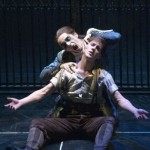
Sterling Hyltin and Andrew Veyette in Alexey Miroshnichenko's The Lady with the Little Dog
Photo © Paul Kolnik
The Lady with the Little Dog is, at best, a sweet Valentine of a ballet--pretty and charming, but without much significance. It was inspired by Chekhov's poignant, similarly titled story in which a man and a woman, each leaving a disappointing spouse behind, visit a seaside resort, ripe, for different reasons, for a passing affair. He's an aging playboy; she's a delicate young thing who craves more from life than a marriage that starves her imagination. Instead they find a fierce attachment (call it love) they can't escape.
Miroshnichenko adopts the names Chekhov used for his main characters, Anna Sergeevna and Dmitri Dmitrievitch, but keeps the proceedings semi-abstract. Sterling Hyltin as Anna has the youth and delicate beauty of the young woman's Chekhovian ancestor, but Andrew Veyette, as Dmitri, is merely a generic attractive young man, as caring and tender as a romantic heroine might wish and a swell dancer to boot.
Boy meets girl when Anna is out walking her fluffy little dog. They are attended by a male octet in short-sleeved gray unitards. The house program calls them Angels, but their movements are often those of adorable puppies. The cuteness factor is not as unbearable as you'd think, but it--and the central part these fellows play in guiding the couple's encounters, even to simulated nudity and intercourse--is enough to remove the ballet decisively from the Chekhovian realm of small truths that, accumulating quietly and inexorably, end by piercing the heart.
The most disheartening part of Miroshnichenko's effort, though, is its lack of interest and invention sheerly as dance. To be sure there are two big pas de deux--obvious choreographic challenges--but the results are invariably banal. In the falling-in-love duet Veyette lifts and turns Hyltin so that her legs swirl out into space, in the familiar way of ice-dancing couples, This "floating on air" is a metaphor for love's ecstasy, but it has become a cliché and Miroshnichenko's bag of tricks is far too full of them.
The score, by the Russian composer Rodion Shchedrin (the husband of the celebrated ballerina Maya Plisetskaya, to whom the ballet is dedicated), couldn't suit the piece better, being as delicate and sweet as a meringue and equally devoid of substance. Philipp Dontsov's scenery is spare, essentially a gauzy front cloth that lifts up and a backdrop that stays put, both broken by pale rectangles, as if to indicate modernity. For variety's sake, the upstage drop is subjected to mood lighting by the City Ballet's Mark Stanley. One can justly accuse Stanley of making most ballets too dim, but he is not often given to the trite ploy of using rhubarb red to indicate erotic passion.
To my mind, the only worthy aspect of The Lady with the Little Dog is its serving as a vehicle for Hyltin, extending her beyond her crisp technique to create a character who is well-nigh irresistible. As I knew you'd want to know, the pale, fleecy scrap of a live lap dog that she walks at the ballet's opening is the dancer's very own, and the vibes between them are indeed delectable.

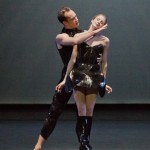
Dancers of the New York City Ballet in Peter Martins's Naïve and Sentimental Music
Photo © Paul Kolnik
Peter Martins's latest ballet, Naïve and Sentimental Music, to the John Adams score from which it takes its name, had its premiere on November 24, 2009, for the gala opening of the City Ballet's season. And it was likely that the choreographer had the grand gesture in mind when he cast nearly all of the company's principal dancers in it. Of the cast's 26 performers, only one, Adrian Danchig-Waring, was still "just" a soloist, but he's clearly headed for the top category and entirely deserving of it.
Unhappily, the grand gesture did little to make Martins's ballet memorable. Yes, it was impeccably performed, yet the choreography adamantly refused to reveal the individual distinctiveness that had made each member of this top-of-the-crop group worthy of the ranking. For Martins, it seemed, the strong, clear technique that almost all of them displayed was sufficient in itself. Is he immune to the love that can be inspired by the particular dancing temperament of an individual artist?
For the record: The piece comprises three sections. The first is the most highly populated, with seven couples elaborating, in different groupings, on Yvonne Borree's opening statement of unfurling a leg now to the front, now to the back. The simple movement develops into many a speedy challenge until the stage looks charged with activity. The women--in beautiful tunics by Liliana Casabal that range through a spectrum of blues and greens--are as light and sharp-edged as a Kleenex; the men, naturally beefier, put more obvious energy into their steps. All of them perform as if "exactitude" were their mantra. But the point of their activity is either invisible or, more likely, non-existent.
The second section is devoted to adagio dancing, with its cast of three couples in pure white taking turns at being in the spotlight while the two remaining pairs do complementary slow duets at a distance in a meditative twilight. It is, as might have been expected, the women who stand out: the luscious Sara Means; Maria Kowroski, the diva of pulled-taffy dancing; and the about-to-retire Darci Kistler, who happens to be the choreographer's wife.
As was also to be expected, the movement is abstract. And then suddenly in the final duet--for Kistler, with Stephen Hanna--the couple is interrupted by a black-clad man who steals Kistler away from her partner and proceeds to conduct her through a rendezvous with death reminiscent of, yet nowhere as powerful as, the macabre and sensuous one in Balanchine's La Valse. Next, unfathomably, the man in black is replaced (not thwarted, simply replaced) by Hanna, and the dance returns to the ineffable rites of a gated (think heavenly) community. Are we to understand, from that brief narrative intrusion, that Kistler is undergoing a near-death experience (perhaps her retirement)? The problem here is that Martins has failed to make his intentions clear.
The third movement, also for three couples, the women costumed in gorgeous shades of red, has the kind of ferocity you'd expect if someone had yelled "Fire!" in a crowd. In response to the music, the movement now blazes, though it is always tamped down a little by Martins's insistence on a seamless flow in the action.
To close the piece, the entire cast assembles for a geometrically ordered finale that has absolutely no dance fervor in it. I saw the ballet twice, and each time, as the curtain came down, I felt I hadn't witnessed anything significant--or even simply entertaining.
After their respective premieres, the Martins and Miroshnichenko ballets appeared on the same program for the City Ballet's annual New Combinations evening, which is meant to honor Balanchine's birthday. Surely, in his lifetime, Mr. B knew one should be wary of choreographers bringing gifts.
© 2010 Tobi Tobias
Noche Flamenca / Lucille Lortel Theatre, NYC / December 24, 2009 - January 16, 2010
What better way to spend New Year's Eve than watching Noche Flamenca?
The Lucille Lortel Theatre, intimate in size, is dark and gloomy, the seats for the onlookers sheathed in a deep red velvet that hints at half-hidden passions. It's not as atmospherically decrepit as the East Village's Theater 80, where the troupe usually gives its extended summer seasons, but it will do.
Besides the change of venue, there's been a change in billing: The name of the company's diva, Soledad Barrio, one of the most thrilling dancers in the world, now towers over the name of the company. With good reason.

Soledad Barrio
Photo: Telam
Barrio is simply more intent than even the most acute dancers. Onstage, she becomes a person who takes everything seriously and personally, beginning with the assumption that life is tragic.
In a solo that climaxed the program, Barrio appeared as a contender with deep, dark forces. Fabulously costumed for the encounter, she wore a black ankle-length dress with long lace sleeves and a lace back that wove a spidery pattern over her flesh. Its artfully layered skirt, glimmering with streaks of jet beading, promised to do its own dancing if provoked by the slightest movement of her hips.
After her entrance, though, Barrio stood perfectly still for a very long time with her back to the public--a feat with which few dancers can command their audience's attention. Her spine was arched, her head placed to present a stern profile. Then, a swift turn, and she faced her watchers directly, her gaze defying its communal gaze at her. She raised one arm, paused, then the other, paused, and finally added a baroque flourish of her fingers. Behind her, singers and instrumentalists waited, as if they were comrades--soul mates, perhaps--with whom she would undertake a perilous journey.
Head swiveling, she stomped halfway across the stage, and a rose that had ornamented her hair dropped to the dingy floor. She saw it fall, gazed at it, as if to acknowledge and pity its fate, and left it where it lay. It was a live rose, I believe, and its loss an accident.
Lifting her skirt to reveal her pale, powerful legs, she used them like pistons, whipping herself into a frenzy of high-voltage footwork. Halting abruptly, she covered her face with both hands for a moment, as if shielding her eyes from an unbearable sight, then emerged from that screen even more fully possessed by her dancing. Her actions no longer seemed to be a performance but rather the work of some primal force of nature being given free rein as we, her observers, ceased to exist for her.
She passed her forearms across her face, then, driving her heels into the floor, raised her arms high over her head, twisting her hands and fingers, transforming them into exotic flowers. She stopped, looked down once more at the maimed rose, then calmly joined the little single-file line formed by the musicians walking offstage, as if to their next pilgrimage.
In the production I saw at the Lortel, Barrio was the only female dancer in the little troupe. Well, what woman could hold a candle to her? In modern dance, Isadora Duncan and Martha Graham. In ballet, maybe Nora Kaye, in her Tudor roles. Certainly no one we can go and see today has Barrio's transformative power.

Soledad Barrio, in the black dress
Photo: Andres D-Elia
The men of the current troupe naturally serve as foils to its star, yet they are extremely accomplished and shown to good advantage. Antonio Jiménez offers an intriguing combination of sturdy legs, scintillating footwork, and delicate gestures of the hands. In his solo, he often hugged his arms tight to his chest, his hands clutching the flaps of his open jacket, like an infant holding on for dear life to its security blanket. And, while he danced, he'd frequently close his eyes, as if to keep his fierce energy within his control. Yet when his solo wound down, he just walked off, matter-of-factly, like an ordinary pedestrian, toward a red light that gleamed in the wings, a fiery sun.
Juan Orgalla opened his solo with a fusillade of footwork. It seemed as if a single step of his boot could kill. His spectators might well have thought, "If he has a heart, you'd never know it; he's all about power and command, about a way of being masculine that's native to flamenco and the culture it stems from." Many a woman has been (and perhaps still is) delighted to submit to the type Orgalla conjures up. A feisty female would laugh him away; a timid innocent would be terrified by the mere idea of being alone in a room with him. Still, when Orgalla segued into a long passage of gentler, more subtle footwork, it became clear that he's not merely a mirror of dominating masculinity but, rather, a canny virtuoso.
Martin Santangelo, the company's founder and director (and, incidentally, Barrio's husband), choreographed the program's two group pieces--Alba (about a band of American heroes in the Spanish Civil War) and Refugiados (inspired by the writings of refugee children in dire circumstances). In the latter, Santangelo's manipulation of dancers, singers, and instrumentalists in the space is a small architectural tour de force. Still, there's no denying the fact that flamenco, when it's truest to its nature, prefers the solo or, at most, duet form. It is non-narrative and shorn even of a particular theme other than the one that lies at its heart--life's proud face-off with death. Flamenco is also essentially improvised and so resists the services of a choreographer. I understood that the solos I watched as the clock inexorably ticked its way toward midnight might look very different in 2010. ¡Feliz Año Nuevo!
Soledad Barrio with musicians of Noche Flamenca
Photo: James Morgan
© 2010 Tobi Tobias
Alvin Ailey American Dance Theater / City Center, NYC / December 2, 2009 - January 3, 2010

Judith Jamison, Artistic Director of the Alvin Ailey American Dance Theater
Photo: Andrew Eccles
Beginning with the opening night gala, I visited the Alvin Ailey American Dance Theater ("The Ailey," to its friends) many times during its month-long City Center season, which celebrated Judith Jamison's 20-year tenure as artistic director. Jamison will become "artistic director emerita" at the end of this year. Her successor has not yet been named, but it will be hard to find her equal--first as a star dancer, then as a leader with unassailable authority, a sharp eye for talent, a tough work ethic, and irresistible charisma.
Opening night felt relatively subdued compared to the high-voltage atmosphere generated by such occasions in recent years. Its first half was devoted to generic speeches, excerpts from Jamison's own so-so choreography, and a pièce d'occasion made in her honor by Robert Battle.
Battle's offering, a male duet titled Anew, may have been about succession. If so, too subtly so. Its only striking element was the poised control, cloaking ferocious energy, of Jamar Roberts and Clifton Brown as they prowled through their space like big cats in the wild. Traditionally, this has been a skill of just about every member of the company, male and female, black and white. Jamison has brought it to a full flowering, as she has the leaps that shoot across uncanny stretches of space; and the sky-high leg extensions from a daringly tilted body. Performance after performance, Jamison's dancers claim the right to be called acrobats of God.
Excitement quickened in the second half of the program, thanks to a knock-out performance of Ailey's own signature piece, the 1960 Revelations. One of its highlights was Amos J. Machanic, Jr.'s exquisite and original rendering of "I Wanna Be Ready," that gut-cruncher of a solo in which the sheer physical challenge (made, of course, to look effortless, even delicate) comes across as a humble, poignant cry of faith. More thrilling yet was the familiar, though never twice the same, sight of Linda Celeste Sims and Glenn Allen Sims performing the "Fix Me, Jesus" duet, which they've evolved to the point of incandescence. She lets herself fall from a succession of precarious positions, trusting he'll there to save her from self-destruction, and he is, but these and many another feat--of coordination, of balance--have become as refined as a silkworm's threads.
Overall, the company's technique seems to be suddenly stronger and clearer than I've ever seen it. Often when this occurs in a dance troupe, the technical "improvement" is accompanied by the sacrifice of the dancers' individuality, the texture of their movement, and that invisible but essential quality of soul. (Today's New York City Ballet is a significant example.) The Ailey, on the other hand, seems to have increased its physical exactitude in order to make the choreographers' (and dancers') visions more piercing.
Repertory remains the Ailey's perennial problem. This was clear from the Best of 20 Years anthology, which presented excerpts from pieces Jamison commissioned, revived (Alvin Ailey's included), or acquired during her two decades as artistic director. The deficiency surfaced again in two of the three works given their premieres this season. If you can look behind the stunning performances the dancers invariably give it, the choreography offered by the Ailey is, with few exceptions, thin in invention, and stymied by prefabricated emotional agendas.

Jamar Roberts in Judith Jamison's Among Us
Photo: Paul Kolnik
Jamison's own Among Us (Private Spaces: Public Places), to music by Eric Lewis, shows us the fantasies of people at an (art) exhibition, the art naïf pictures being by Jamison. Granted, the encounters do include the traditional museum pick-up, but half of them remained inexplicable to me, even on a second viewing. The imaginary shenanigans are encouraged by a genie, played by Clifton Brown, a dancer so beautiful and gifted he can even get away with a tall blue feather waving from the top of his skull.

Linda Celeste in Judith Jamison's Among Us
Photo: Paul Kolnik
The movement vocabulary draws from ballet, jazz, Horton via Ailey, and middle-eastern genres; despite this generous pluralism, the choreography falls flat. The most compelling dancing in the show comes from Linda Celeste Sims, all filigreed whirling in a ravishing flamingo-hued dress with a lushly flared skirt, and Hope Boykin, somberly expressive, in a deep purple business suit with an ingeniously pleated vent in its skirt that allows and draws the eye to her full-bodied movement. As I've indicated, the costumes, by Paul Tazewell, are marvelous, but clothes alone don't make a viable dance.
Uptown, by Matthew Rushing, one of the company's senior and most revered dancers, attempts to chronicle the Harlem Renaissance of the 1920s, in which a confluence of African-Americans made achievements in the arts (Langston Hughes, Josephine Baker) and social concerns (W.E.B Du Bois) that would influence generations to come. Both the street life and partying life of the period were memorably sassy too. Perhaps inevitably, the subject required as much talking as dancing--so the piece has a narrator (the hyper-fueled Abdur-Rahim Jackson at the performance I saw), who both speaks and moves, and recordings of the greats. Not unexpectedly, the choreography often falls prey to the impossible task of miming what is spoken. Overall, the result is more like an educational documentary film than a real live dance. By next season it might be playing to kids in middle school.
Nevertheless, Uptown contains occasional passages--the "Weary Blues" section, for instance--that suggest Rushing has some flair for choreography. So I hope he'll be given another chance--perhaps in a workshop situation, to lessen the pressures of a big, important, and expensive production--to create a work that isn't so dependent on library research.

Matthew Rushing in Ronald K. Brown's Dancing Spirit
Photo: Paul Kolnik
By far the best of the new works was Ronald K. Brown's Dancing Spirit, its title taken from Jamison's 1993 memoir, its score assembled from jazz, rock, and fusion music of then and now. Brown has created works for many companies in addition to the Ailey and maintains a troupe of his own, Evidence. Despite Brown's slew of commitments, Jamison's successor would be a fool not to co-opt him for the position of Choreographer in Residence at the Ailey. The move would benefit all concerned.
Dancing Spirit opens with the entrance of a peaceable man in white, who establishes an area of calm in a teardrop spotlight. A woman follows him, then another man, and so on. The slow procession has a ritualistic air--Brown's dances are often spiritual--and you breathe deeper as it continues.
Then a punchier rhythm invites additional dancers into the stage space. Arms are quietly raised to the heavens, then strike out forcefully on the diagonal. The group's movement suavely incorporates elements from the dances of the African diaspora and American modern dance; there's a touch of jazz here, a hint of ballet there. Torsos ripple, hips sway, inviting the viewer imagine her- or himself part of this community, which depicts the realm of the spirit while giving the Earth its due.
Even so, the loveliest and most remarkable quality of the choreography is Brown's confidence (that of a born architect) with the groupings and patterns the bodies make in space. A penultimate section is all throbbing percussion, but just when you think this climax will escalate until it sets fire to the theater, the dancers arrange themselves gently into a horizontal line downstage, standing still and self-possessed.
NOTE: The above article, commissioned by Voice of Dance, comes to you so late because VOD has held it without posting it since its timely submission on December 24. Not only has VOD failed to post the piece, it has also failed to pay me for it and for my previous article on its site, "Morphoses Falters," a review of Morphoses/The Wheeldon Company, which it did post. Such is the lot of the free-lance dance writer.
© 2010 Tobi Tobias
Pacific Northwest Ballet / Joyce Theater, NYC / January 5-10, 2010
Pacific Northwest Ballet, based in Seattle, is making its first New York appearance in 13 years with a program of four ballets, three of them new to our town. The more substantial of them are Twyla Tharp's Opus 111 and Benjamin Millepied's 3 Movements. Astonishingly, not a one is by George Balanchine, whose works have long been the most significant part of the troupe's astutely chosen repertory.
Founded in 1972, PNB was subsequently led for nearly three decades by the husband-and-wife team Kent Stowell and Francia Russell (he got top billing, but she's the most famous); earlier, both made their performing careers with the New York City Ballet. Russell took charge of PNB'S ever-growing Balanchine acquisitions. Her productions, known to East Coast ballet fans largely by hearsay, were praised for their accurate rendering of the choreography. I saw a couple of them and found them rather dry and dull--the work of a devoted accountant.
Peter Boal, celebrated for the purity of his dancing as a principal with the City Ballet, took over from Stowell and Russell in 2005. You'd think he'd be the first to include Balanchine in an engagement taking place on Balanchine's "home turf"--if only to show the competition how well, how distinctively his company dances the master's creations. Just last year, Miami City Ballet, directed by another important NYCB alumnus, Edward Villella, did just this--thrillingly.
Perhaps Boal was more interested in showing the Tharp and the Millepied works because he commissioned them for the company--both in 2008.

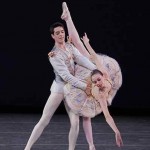
Pacific Northwest Ballet in Twyla Tharp's Opus 111
Photo: Angela Sterling
Tharp's Opus111, named for the Brahms string quintet to which it's set, is easily the best dance on the program. With its cast of twelve, it shows off the soft grace of the PNB dancers and rarely hints at the punitive physical extremes that have been typical of Tharp's major works for years now and the way-cool slouchiness that so disgruntled old-school observers of her early masterworks. Yes, the choreography abounds in Tharp's daredevil lifts and maverick twists of the classical ballet vocabulary, but these elements have been gentled--either by Tharp herself or by the way the PNB dancers perform them--and no longer come across as brash challenges to officialdom.
The main characteristic of Opus111, though, is a complex braininess that has been typical of Tharp from Day One. You can hardly parse it on a first viewing, though you can sense that it underpins the ballet's structure. Here, the choreographer revels in mirror-imaging of all sorts and related complementary juxtapositions, as demonstrated in the lyrical second movement, where the dancing of the main couple is suavely accompanied by, or set off against, the movement of two auxiliary trios and, if I remember rightly, another pair. Tharp operates so smoothly here, she made me think of the secondary groups as the principals' landscape.
The women in the piece wear soft slippers rather than pointe shoes, ballet's traditional way of indicating that they are people of the earth, not members of the aristocracy. And folk motifs, which occur briefly and subtly throughout the piece (echoing qualities in the music), emerge full-force in the finale, where every foot is robustly flexed--as classical ballet imagines peasant-dance style--and with the performers arranged downstage in two parallel lines that stretch from one side of the proscenium arch to the other, presenting themselves guilelessly--fresh-faced, forthright, and smiling.
Opus 111 isn't likely to be considered a landmark in Tharp's career, but for me it saved the evening.
I don't know what to make of Benjamin Millepied--a City Ballet principal--as a choreographer. Ambitious and diligent, he "improves" doggedly, learning how to bring off one basic task of choreography after another. But he hasn't yet made me want to see one of his dances a second time. Au contraire.

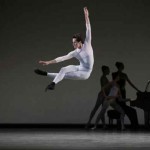
Pacific Northwest Ballet in Benjamin Millepied's 3 Movements
Photo: Angela Sterling
Of late he's been teaching himself to manipulate large numbers of dancers effectively. Earlier, I saw another of his exercises in this vein that resulted in a frantic, blurry mess, like rush hour at Times Square. But 3 Movements, set to Steve Reich's relentless Three Movements for Orchestra and featured as the second "big number" on the Joyce program, was as clear as could be; indeed it looked as if most of it had been designed on graph paper. Like all the Millepied's works I've seen, this one seems hollow in the sense of having no interior life, no imaginative vision, no notion of what makes a ballet unforgettable. The answer lies beyond the realm of efficiency.
The Joyce program is completed by a pair of smaller pieces, no doubt audience pleasers though hardly distinguished works of art. Edwaard Liang's Für Aline, a duet created in 2006, is set to a radically sparse score--single notes separated by silence, constituting a fragment of melody that haunts the memory--by the Estonian composer Arvo Pärt, a favorite among dance makers with a melancholy bent.
Liang gives us a young man apparently unable to relinquish his obsessive memory of the woman he loved, who has died. For him, she exists in the present--as exquisite and delicate as ever, moving with a "being beauteous" quality. Unfortunately, Liang depends on bits and pieces he's (and we've) seen and liked in other, better, choreographers' work, without giving them a meaningful new context and seems devoid of invention when left to the his own devices. What's more, the mood of his piece is woefully sappy. Still I did appreciate the moment in which the lost beloved suggests that she--though presumably now dwelling in the Elysian Fields--misses her partner as much as he misses her.

Pacific Northwest Ballet in Marco Goecke's Mopey
Photo: Chris Bennion
Marco Goecke's 2004 male solo, Mopey, is set to music by C.P.E. Bach, then the theatrical ploy of no sound at all, then to raucous sound from The Cramps. It describes an alienated youth who suffers, violently and picturesquely, from (a) drug addiction; (b) spasmodic hyperactivity caused by Attention Deficit Disorder; (c) an unspecified form of psychosis. Choose one or all of the above. Because of its length, perhaps, and its physical challenges (sheer endurance being just one them), it's made to impress but not, unfortunately, to express anything beneath the surface.
Given the dubious worth of these two pieces, Boal surely would have done better to replace them with--if not a Balanchine contribution--at least one of the several works of Jerome Robbins that he has acquired for PNB in the course of his tenure.
As for PNB's dancers, they make a very good ensemble, but even the best among them, charged with leading roles, lack the ability to thrill your eyes and heart, to "own" the stage as real stars do. This capacity may come with time, but then a lot of time has already passed.
What really broke my heart was the sight of Carla Körbes, justly adored by the New York audience when she was with City Ballet, although she never received the roles her ballerina-qualities seemed to deserve. Now a principal with PNB and dancing leads in three of the opening-night ballets at the Joyce, she looked hampered both by embonpoint and, far more telling, a failure of desire.
© 2010 Tobi Tobias
About
Tobi Tobias lives in New York City, where she writes about dance and other things worth looking at. more
My Books I have written "Obsessed by Dress," a meditation on fashion or--more broadly--clothes, and over two dozen books for children. You can find out more about these diversions from journalism by clicking on (what else?) more
Contact me Click here to send me an email... more
Newsletter Want to be notified when I post a new review? Click here... more
Sitelines
The RÉUNION DES MUSÉES NATIONAUX (The National Museum Association's Photographic Agency) offers a photographic catalogue of some 200,00 holdings of French museums. It can be searched by artist, country, period, subject, and so on. You can make a personal album of your favorites on the site. New York's Metropolitan Museum of Art and D.C.'s National Gallery have similar services, but the French one is the most ambitious and extensive. Text in English as well as French.
AddALL is an ultimate umbrella for finding used and out of print books online. It doesn't have the atmosphere of Foyle's, Powell's, or even the Strand, but it will give you every opportunity to need yet another bookcase.
PROJECT GUTENBERG More books. No bookcase required. Over 6000 free electronic texts.
CALLIGRAPHY LESSONS ONLINE Learn the italic hand and make yourself legible. Don't miss the animation.
Color charts of HERBIN INKS. If you have to ask, you'll never know.
THE NEW YORK TIMES Because it's there.
AJ Ads
AJ Blogs
AJBlogCentral | rssculture
Terry Teachout on the arts in New York City
Andrew Taylor on the business of arts & culture
rock culture approximately
Laura Collins-Hughes on arts, culture and coverage
Richard Kessler on arts education
Douglas McLennan's blog
Dalouge Smith advocates for the Arts
Art from the American Outback
For immediate release: the arts are marketable
No genre is the new genre
David Jays on theatre and dance
Paul Levy measures the Angles
Judith H. Dobrzynski on Culture
John Rockwell on the arts
innovations and impediments in not-for-profit arts
Jan Herman - arts, media & culture with 'tude
dance
Apollinaire Scherr talks about dance
Tobi Tobias on dance et al...
jazz
Howard Mandel's freelance Urban Improvisation
Focus on New Orleans. Jazz and Other Sounds
Doug Ramsey on Jazz and other matters...
media
Jeff Weinstein's Cultural Mixology
Martha Bayles on Film...
classical music
Fresh ideas on building arts communities
Greg Sandow performs a book-in-progress
Harvey Sachs on music, and various digressions
Bruce Brubaker on all things Piano
Kyle Gann on music after the fact
Greg Sandow on the future of Classical Music
Norman Lebrecht on Shifting Sound Worlds
Joe Horowitz on music
publishing
Jerome Weeks on Books
Scott McLemee on books, ideas & trash-culture ephemera
theatre
Wendy Rosenfield: covering drama, onstage and off
Chloe Veltman on how culture will save the world
visual
Public Art, Public Space
Regina Hackett takes her Art To Go
John Perreault's art diary
Lee Rosenbaum's Cultural Commentary
Tyler Green's modern & contemporary art blog