
This article originally appeared in the Culture section of Bloomberg News on July 7, 2008.

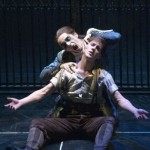
Noah Vinson and Maile Okamura dance during a rehearsal of Mark Morris' "Romeo & Juliet, On Motifs of Shakespeare," in New York, on June 11, 2008. Photographer: Johan Henckens/Mark Morris Dance Group via Bloomberg News
July 7 (Bloomberg) -- Leave it to Mark Morris to create a ``Romeo and Juliet'' danced to Prokofiev that features no balcony, no crypt, no pointe work, plenty of passion and violence, yet no final tragedy. The lovers simply move on to some higher plane, enveloped in a star-studded sky.
Morris, 51, is fanatically committed to presenting his dances with live music, so it's only fitting that this celebrated and controversial choreographer should be the first ever to use Prokofiev's recently recovered original score for the world premiere of ``Romeo and Juliet, On Motifs of Shakespeare'' as part of Bard College's Summerscape Festival.
Material for the reconstruction of the score was recently discovered in a Moscow archive by musicologist Simon Morrison. This original version, occasionally dissonant and rhythmically complex, was intended to show passionate youth challenging feudal conventions about marriage and family. (The blissful-end narrative was worked out with the experimental theater director Sergey Radlov.) It was barred from production by both the Soviet regime and ballet community beginning in 1935.
Desperate to see his work staged, Prokofiev resigned himself in 1940 to a more bombastic and melodramatic alternative, now familiar to dance fans from productions by the Kirov Ballet's Leonid Lavrovsky, then by John Cranko, Kenneth MacMillan and Frederick Ashton, to name a few.
Homemade Air
The production at Bard, in Annandale-on-Hudson, New York, uses the original music and offers many aspects of enchantment, though it hardly eclipses MacMillan's pull-out-the-stops extravaganza. Morris's version is tastefully small -- fewer than 20 dancers and a single set -- and captures the beguiling, homemade air of talented kids putting on a show.
It also relinquishes class distinctions to a great degree. Juliet's parents, for example, mingle with the throngs in the town square as friendly neighbors of women who don't even own shoes. The human intimacy of the whole affair is well matched to Bard's exquisitely proportioned, 500-seat Richard B. Fisher Center for the Performing Arts.
The choreography mixes a rather thin ballet vocabulary with robust modern dance and folk touches and lusty, centuries-old Italian mime -- a typical Morris blend. One of the best elements of the production, rare for this choreographer, is the detail with which the principals reflect the most fleeting emotion.
Tender Romeo
Rita Donahue as Juliet goes from the touching confusion of an inexperienced teen making her social debut to incredulous delight in David Leventhal's Romeo, who has crashed the party. Leventhal, whose initial reticence is wimpy, gains confidence by quick degrees from Juliet's response, assuring us (and her) that he will always treat her tenderly. This is fortunate because, in a unique interpretation, Bradon McDonald's Paris, the suitor with the senior Capulets' approval, acts as if he owns the girl, repelling her with his rough handling.
Lauren Grant is terrific as the Nurse (more of a multipurpose servant who participates in all of the family's affairs). As Prince Escalus, Joe Bowie's putting down the latest melee in the Capulet-Montague feud was my favorite passage. Resplendent in the black and gold of his authority, he faces the crowd in the blood-soaked town square and, with grave, calm gestures, preaches that reconciliation is the only path to peace.
The gender switch in the casting of Amber Darragh as Mercutio and Julie Worden as Tybalt was fun yet unconvincing. The biggest disappointment was the quartet of senior dancers -- now retired from the company, though some of the most memorable artists it has ever had -- summoned back to play the Capulet and Montague parents. Three had nothing meaningful to do; the fourth seemed not to include dramatic imagination among her gifts.
Leon Botstein conducted the American Symphony Orchestra in a sensitive reading of the score. Allen Moyer contributed handsome, clever scenery with a childlike air, raw-looking wood prevailing from swords to miniature houses representing Verona. Martin Pakledinaz was at less than his personal best with the costumes.
Mark Morris Dance Group and American Symphony Orchestra perform ``Romeo and Juliet, On Motifs of Shakespeare'' through July 9 at Bard Summerscape Festival, Annandale-on-Hudson, New York. Information: +1-845-758-7926; http://summerscape.bard.edu.
The $1.1 million production will travel to Berkeley, California, Sept. 25-28; London, Nov. 5-8; Urbana, Illinois, March 13-14; Norfolk, Virginia, May 8-10; New York's Lincoln Center, May 14-17; and Chicago, September 2009.
© 2008 Bloomberg L.P. All rights reserved. Reprinted with permission.
Compagnie Maguy Marin: Umwelt
Joyce Theater, NYC / June 17-22, 2008

Compagnie Maguy Marin in Maguy Marin's Umwelt. Photo by Ganet.
Commentators claim that Marin, inspired by Samuel Beckett, considers the actions banal and underlines that quality by reiterating them obsessively. I suspect she has a trick card up her sleeve. They certainly don't look banal to me; I think they take on an epic radiance. I'd guess that Marin is observing the everyday world and saying "Wow! Just look at that!"
The full article appeared in Voice of Dance (http://www.voiceofdance.org) on June 24, 2008. To read it, click here.
I am in Paris with my husband. I have convinced him that he wants to accompany me to one of the city's legendary flea markets. It is way, way out on the edge of town, a lengthy pilgrimage on the Métro, past stops with names like La Fourche (the fork, as in a road, which it is), Montparnasse-Bienvenüe, Gaîté, Plaisance. Eventually we arrive.
I shop; he watches. After nearly two hours of this, even I--the indefatigable seeker after the old and unusual--get tired. We exit and collapse onto the low, narrow concrete ledge in which the hefty chain-link fence that separates the market from ordinary life has been embedded.
We are both exhausted and the sun is turning brutal. What's more, we're both hungry, a state that can lead to cranky in a matter of minutes. (Has anyone ever studied the effect of low blood sugar on intimate human relationships?) The two of us sit there gathering strength for our next move, which should be lunch--a croque monsieur and a beer, say, if we can find a café that's not too seedy. Meanwhile, my husband has closed his eyes and retreated into the semi-comatose state of men haplessly extended beyond their tolerance.
Suddenly, some 200 yards away, I see a woman walking toward the market. She's nibbling on something she holds in her hand. If we were in the States, I'd assume, from the look of the thing, that it was a hotdog roll. But we are not in the States. We are in the land called Delicious.
As the woman comes nearer, I realize that it's pastry she's holding. Even nearer: Pastry of a lightness and flakiness that are the province of French baking. Very close, just about to pass us: The sublime pastry is coated on top with a gleaming stripe of icing the color of café au lait and filled with a silky-looking cream a shade paler.
"Come on, come on," I say to rouse my somnolent husband. I'm standing now, tugging at his hand, pulling him to his feet. "A coffee éclair! It looked fabulous! We'll just walk in the direction she came from," I urge, pointing to the woman now visible to us only from the back. "The bakery can't be far away." And it isn't. Just about two and half blocks.
"How do you know these things?" my husband asks wearily, as if his question were rhetorical.
"I know everything about things like coffee éclairs," I reply with considerable--if somewhat defensive--dignity. I may not know much about math or science, but I do know literature and dancing and coffee éclairs." (I choose not to reveal to my husband that, as an Agatha Christie addict, I've deduced that the point of purchase must have been close enough for the pastry not to have been fully consumed when the woman passed us.) My husband just shakes his head as we enter the fragrant shop.
Since I'm in charge of French in our marriage, I do the ordering: a coffee éclair for me, a chocolate éclair for him. He dislikes coffee, but I knew chocolate would be available, it being the default mode for éclairs. He pays. He understands foreign money. When I'm alone, I just cross my own palm abundantly with silver and extend it to the seller, hoping he's honest.
Not surprisingly, this is the most delectable éclair I have ever tasted. And it continues, in memory, to hold first place to this day, despite the passing of so many tastings and so many decades.
© 2008 Tobi Tobias
This article originally appeared in the Culture section of Bloomberg News on June 20, 2008.

Damian Woetzel dances in "Prodigal Son (Ballet in Three Scenes)" during his farewell performance with the New York City Ballet at the New York State Theatre at Lincoln Center in New York on June 18, 2008. Woetzel has danced with the NYCB to continual acclaim for 23 years, 19 of them as a principal. Photographer: Paul Kolnik/NYCB via Bloomberg News
June 20 (Bloomberg) -- Damian Woetzel has danced with the New York City Ballet to continual acclaim for 23 years, 19 of them as a principal. Wednesday night, at Lincoln Center's New York State Theater, the 41-year-old gave his farewell performance with the company, thus taking the decisive next step into his future.
Not, however, before both his colleagues and his fans treated him to ovations, bouquets and a shower of confetti that seemed to go on and on, as if doing so would keep the night from ending.
Woetzel belongs to the type best exemplified by Edward Villella -- a regular American guy, tough and likable, with craggy good looks and no fancy airs about him. When virtuosity is called for, he makes it look free and easy. When drama is needed, he projects emotions that are intense and true.
A natural for Jerome Robbins's work, which was what drew him to City Ballet in the first place, Woetzel chose to retire in the company's season-long celebration of the late choreographer on the 90th anniversary of his birth.

Dancers, from left, Joaquin de Luz, Tyler Angle, and Damian Woetzel take part in a performance of "Fancy Free" during Woetzel's farewell performance with the New York City Ballet at the New York State Theatre at Lincoln Center in New York on June 18, 2008. Woetzel has danced with the NYCB to continual acclaim for 23 years, 19 of them as a principal. Photographer: Paul Kolnik/NYCB via Bloomberg News
For his last performance Woetzel appeared in ``Fancy Free,'' the ballet about three sailors on shore leave in New York that put Robbins on the map in 1944 and remains an audience favorite. He danced the role Robbins himself originated -- the guy with a way of seducing girls with his war stories and slinky rumba. His performance -- every move seemingly colloquial -- was a perfect expression of his blithe naturalness, his sense of humor, his sheer pleasure in dancing.
`Prodigal Son'
Of course he performed a landmark George Balanchine work as well. In the 1929 biblically based ``Prodigal Son,'' Woetzel plays a rebellious adolescent who learns humility, respect and love only after leaving home for the freedom of a hellish world. Woetzel's searing encounters with wild drinking, demonic sex and being stripped of everything he owns are capped by his return, bruised, filthy and crawling on his knees into his father's forgiving embrace. Every scene revealed his ability to make a ballet look newborn, and his pathos in the final passages was the most poignant I've ever witnessed.
At the end of the show -- which included Balanchine's ``Rubies,'' with Woetzel, partnering Yvonne Borree, making a surprise appearance -- the packed house stood, clapping and cheering (as they had for ``Fancy Free''). One by one, a bevy of principal dancers, some from friendly rival troupes, presented him with lush bouquets.
Glittering Confetti

Dancer Damian Woetzel, on center stage, bows to the crowd after his farewell performance with the New York City Ballet at the New York State Theatre at Lincoln Center in New York on June 18, 2008. Woetzel has danced with the NYCB to continual acclaim for 23 years, 19 of them as a principal. Photographer: Paul Kolnik/NYCB via Bloomberg News
The rest of his colleagues joined the onstage crowd to applaud him while company director Peter Martins signaled for a shower of glittering confetti to fall from above. Audience members hurled their own floral tributes over the heads of the orchestra, refusing to go home even when the house lights went up.
The hoopla was not simply conventional. Woetzel has earned not just his fans' admiration but their love. You don't have to know the man personally to sense his intelligence and integrity; it glows through his dancing.
What's next? In tandem with the last years of his performing career, Woetzel earned a master's degree in Public Administration at Harvard's John F. Kennedy School of Government -- accepted though he'd never been to college -- and won acclaim as the new artistic director of the Vail International Dance Festival.
With the sensibility he's developed as a dancer combined with the administrative know-how he's acquiring, Woetzel seems a likely successor to Martins. He's already indicated to the press that he'd be very interested in the job -- when the time comes.
The New York City Ballet continues through June 29 at Lincoln Center, Broadway at 65th St. Information: +1-212-721-6500; http://www.nycballet.org.
© 2008 Bloomberg L.P. All rights reserved. Reprinted with permission.
This article originally appeared in the Culture section of Bloomberg News on June 9, 2008.
June 9 (Bloomberg) -- Alexei Ratmansky's ``Concerto DSCH,'' by far the most exciting new ballet I've seen in ages, had its world premiere last week in the New York City Ballet's spring season at Lincoln Center. At first it looks like a mere romp -- Jazz Age youth cavorting on the beach -- but almost immediately its unflaggingly deft and original construction becomes apparent.
Taking its title from its score, Dimitri Shostakovich's Second Piano Concerto, the ballet sets in motion a clear cast of characters, without getting bogged down in introducing them formally. Ratmansky arranges the action so ingeniously that the viewer can identify them even as the dance hurtles on.
Wendy Whelan (a cool mermaid) and Benjamin Millepied (her hopelessly ardent swain) provide fleeting summer romance; virtuosi Ashley Bouder, Joaquin De Luz and Gonzalo Garcia are like rough-and-tumble saltimbanques on speed. The 14-member ensemble, creating whirlwinds as a whole, also fractures into smaller units to serve as demi-soloists.
The marvel of the choreography is that the groupings keep combining and recombining, often very unusually placed on the stage. Ratmansky's virtues don't stop here. His choreography concerns itself with people, not just dancers and their phenomenal physicality.
Crouching God
He knows ballet history and uses it with wit, making a bow to the house he's working in, for example, by extending the ``swimming lesson'' of Balanchine's ``Apollo'': When the god crouches to float Terpsichore on his back, he walks her into the wings in that position. Most charmingly, the lovers' inevitable farewell echoes the separation of child hero and heroine at the end of the Christmas Eve party in Balanchine's ``Nutcracker.''
Earlier this year, Ratmansky said he planned to resign as artistic director of the Bolshoi Ballet in order to devote himself to choreography. His work, accomplished and fresh, is much in demand from world-class companies. City Ballet was considering him as a replacement for company choreographer Christopher Wheeldon, but the arrangement fell through. ``Concerto DSCH'' suggests it's time for the proposition to be reconsidered.
Meanwhile City Ballet continues its season-long celebration of Jerome Robbins. So far, the incontestable highlight has been ``Definitive Chopin,'' a program offering three ballets with music by the composer to whom Robbins repeatedly returned.
Teasing Gaiety

Dancers, from left, Yvonne Borree, Rachel Rutherford, and Abi Stafford perform in the New York City Ballet production "Dances at a Gathering" in New York on May 27, 2007. Performances of the present production continue through June 29, 2008 at the New York State Theater at Lincoln Center. Photographer: Paul Kolnik/NYCB via Bloomberg News
The main entry is the 1969 ``Dances at a Gathering,'' in which the young people of a rural community bond with one another and with the land that is their home. Contentment, a teasing gaiety, emotionally stormy weather tempered by reconciliation, the qualified acceptance of a newcomer among them -- all are tinged with unclouded optimism, undercut by just one tableau that hints at the approaching destruction of war.
The present production is the most technically polished and musically sensitive I've seen since the premiere, which was buoyed by charismatic stars -- Edward Villella, Patricia McBride and Violette Verdy -- who have no equivalent in the company today. Most impressive among the 10 dancers were the radiantly girlish Rachel Rutherford, who was in her element and projected the deepest feeling among the group, and Sara Mearns, who played the flirtatious odd girl out on her own terms.

Dancers, from left, Amar Ramasar, Jonathan Stafford, Jared Angle, Yvonne Borree, and Abi Stafford perform in the New York City Ballet production "Dances at a Gathering" in New York, on May 27, 2007. Performances of the present production continue through June 29, 2008 at the New York State Theater at Lincoln Center. Photographer: Paul Kolnik/NYCB via Bloomberg News
``Other Dances,'' created in 1976 for Natalia Makarova and Mikhail Baryshnikov, has deservedly become a keeper, performed by many stellar successors. Mainly lyrical in mood, it's inflected with middle-European folk-dance motifs, as if to remind us of where the composer came from. It's not a romantic duet but something more remarkable -- an illustration of the intimacy dancers forge with each other through the act of dancing.
Poetic to Absurd
This time out, Damian Woetzel, who retires from the City Ballet this season, partnered Julie Kent, a senior American Ballet Theater ballerina. Woetzel brought all his gifts to the occasion: virtuosic technical command, astute, gracious partnering, keen intelligence and craggy good looks. Kent, all ethereal delicacy, melted in his arms.
``The Concert'' (1956) is that welcome rarity, a successful funny ballet. It depicts the reveries, from poetic to absurd, of the concert-hall audience. Sterling Hyltin, her waist-length wavy blond hair prominent, shone as the production's ditzy siren, while the jokes about all-too-human types and choreographic discombobulation seemed new once again.
Through June 29 at the New York State Theater, Lincoln Center, Broadway at 65th St. Information: +1-212-721-6500; http://www.nycballet.org.
© 2008 Bloomberg L.P. All rights reserved. Reprinted with permission.
About
Tobi Tobias lives in New York City, where she writes about dance and other things worth looking at.
My Books I have written "Obsessed by Dress," a meditation on fashion or--more broadly--clothes, and over two dozen books for children. You can find out more about these diversions from journalism by clicking on (what else?)
Contact me Click here to send me an email...
Newsletter Want to be notified when I post a new review? Click here...
Sitelines
The RÉUNION DES MUSÉES NATIONAUX (The National Museum Association's Photographic Agency) offers a photographic catalogue of some 200,00 holdings of French museums. It can be searched by artist, country, period, subject, and so on. You can make a personal album of your favorites on the site. New York's Metropolitan Museum of Art and D.C.'s National Gallery have similar services, but the French one is the most ambitious and extensive. Text in English as well as French.
AddALL is an ultimate umbrella for finding used and out of print books online. It doesn't have the atmosphere of Foyle's, Powell's, or even the Strand, but it will give you every opportunity to need yet another bookcase.
PROJECT GUTENBERG More books. No bookcase required. Over 6000 free electronic texts.
CALLIGRAPHY LESSONS ONLINE Learn the italic hand and make yourself legible. Don't miss the animation.
Color charts of HERBIN INKS. If you have to ask, you'll never know.
THE NEW YORK TIMES Because it's there.
AJ Ads
AJ Arts Blog Ads
Now you can reach the most discerning arts blog readers on the internet. Target individual blogs or topics in the ArtsJournal ad network.
Advertise Here
AJ Blogs
AJBlogCentral | rssspecial
the blog of the National Performing Arts Convention
Terry Teachout on the arts in New York City
Andrew Taylor on the business of arts & culture
rock culture approximately
Rebuilding Gulf Culture after Katrina
Douglas McLennan's blog
Art from the American Outback
For immediate release: the arts are marketable
No genre is the new genre
John Rockwell on the arts
Jan Herman - arts, media & culture with 'tude
dance
Apollinaire Scherr talks about dance
Tobi Tobias on dance et al...
jazz
Howard Mandel's freelance Urban Improvisation
Focus on New Orleans. Jazz and Other Sounds
Doug Ramsey on Jazz and other matters...
media
Jeff Weinstein's Cultural Mixology
Martha Bayles on Film...
classical music
Greg Sandow performs a book-in-progress
Exploring Orchestras w/ Henry Fogel
Harvey Sachs on music, and various digressions
Kyle Gann on music after the fact
Greg Sandow on the future of Classical Music
Norman Lebrecht on Shifting Sound Worlds
publishing
Jerome Weeks on Books
Scott McLemee on books, ideas & trash-culture ephemera
theatre
Wendy Rosenfield: covering drama, onstage and off
Chloe Veltman on how culture will save the world
Elizabeth Zimmer on time-based art forms
visual
Public Art, Public Space
John Perreault's art diary
Lee Rosenbaum's Cultural Commentary
Tyler Green's modern & contemporary art blog