(Display Name not set)March 2005 Archives
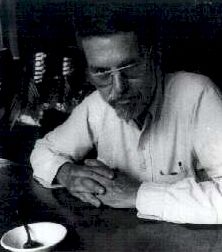 Robert Creeley, who died
yesterday at 78, wrote poetry with a spare minimalism that clarified, condensed and dissolved the
distance between thought and feeling, between the real world and the imagined, between language
and meaning. He was often more explicit than Samuel Beckett and much more approachable, but
no less dense or elusive. Listen to him reading two poems: "Whatever" and
"Thinking." They show both the difficult and
the easy Creeley. When he spoke of the human condition, he never offered false hope:
Robert Creeley, who died
yesterday at 78, wrote poetry with a spare minimalism that clarified, condensed and dissolved the
distance between thought and feeling, between the real world and the imagined, between language
and meaning. He was often more explicit than Samuel Beckett and much more approachable, but
no less dense or elusive. Listen to him reading two poems: "Whatever" and
"Thinking." They show both the difficult and
the easy Creeley. When he spoke of the human condition, he never offered false hope:
THE MIRROR
Seeing is believing.Whatever was thought or said,
these persistent, inexorable deaths
make faith as such absent,
our humanness a question,
a disgust for what we are.
Whatever the hope,
here it is lost.
Because we coveted our difference,
here is the cost.
In a review of "Life & Death," a book of Creeley's poems published in 1998, Tom Clark described his late poetry this way:
The poems have the sound of a mind with time on its hands and nowhere left to go. A life passes unhurriedly before one's eyes -- melancholy, oblique, fading in and out like the late rays of sun slanting through the condo's slatted blinds, as the poet meditates upon "What one supposes/ dead is . . . Will one fly away on angel wings,/ rise like a feather, lift/ in the thin air."
The sound of a mind with time on its hands and nowhere left to go. That's as fine a description as I've seen.
Postscript: A reader writes: "Robert Creeley was a gentle, generous and wonderful person. I had the pleasure to hang out with him. He and Pen [Penelope Highton] were lovely together. I will miss a dear friend. As Bob would say, 'Onward!'" -- Hank Barthel
Another writes: "As a young student, some thirty years ago, I came to know Bob Creeley. I
took classes with him at Buffalo, and spent time hanging out at his place on Fargo Street, above a
small grocery store. Bob was a gentle and extremely
generous soul, with steel within. His
poems have literally walked me through life, and I'll never forget him or stop reading his work. He
is an essential postmodern American." -- Jerry Kelly
Still another: "I was an undergraduate who wrote about Bob Creeley and had the honor of meeting him subsequently in Buffalo. The thing that impresses me the most about him is the generosity of the man in arranging my visit even though we only communicated via email prior to the visit. For a foreigner from Singapore who has an interest in American Lit, this was a better intro to Americans than any guide book. In these days of anti-Americanism, America can well do with such ambassadors of goodwill and generosity. Onward (in peace)." -- Gerard
If the heart won't stir
You must inter.
 The column speaks of the Terri-izing of America, a place
"where dangerous extremists belong to the majority religion and the majority ethnic group, and
wield great political influence":
The column speaks of the Terri-izing of America, a place
"where dangerous extremists belong to the majority religion and the majority ethnic group, and
wield great political influence":
Before he saw the polls, Tom DeLay declared that "one thing that God has brought to us is Terri Schiavo, to help elevate the visibility of what is going on in America." Now he and his party, shocked by the public's negative reaction to their meddling, want to move on. But we shouldn't let them. The Schiavo case is, indeed, a chance to highlight what's going on in America.One thing that's going on is a climate of fear for those who try to enforce laws that religious extremists oppose. Randall Terry, a spokesman for Terri Schiavo's parents, hasn't killed anyone, but one of his former close associates in the anti-abortion movement is serving time for murdering a doctor. George Greer, the judge in the Schiavo case, needs armed bodyguards.
He cites "the rise of politicians willing to violate the spirit of the law, if not yet the letter, to cater to the religious right":
Everyone knows about the attempt to circumvent the courts through "Terri's law." But there has been little national exposure for a Miami Herald report that Jeb Bush sent state law enforcement agents to seize Terri Schiavo from the hospice -- a plan called off when local police said they would enforce the judge's order that she remain there.
He fears that "the future seems all too likely to bring more intimidation in the name of God and more political intervention that undermines the rule of law":
The religious right is already having a big impact on education: 31 percent of teachers surveyed by the National Science Teachers Association feel pressured to present creationism-related material in the classroom.
Above all, he writes, "medical care is the cutting edge of extremism," portending that medical rights will be denied for religious reasons in violation of the law. Citing a report in yesterday's Washington Post, he fears that women especially will be targets. He notes
... the growing number of pharmacists who, on religious grounds, refuse to fill prescriptions for birth control or morning-after pills. These pharmacists talk of personal belief; but the effect is to undermine laws that make these drugs available. And let me make a prediction: soon, wherever the religious right is strong, many pharmacists will be pressured into denying women legal drugs.And it won't stop there. There is a nationwide trend toward "conscience" or "refusal" legislation. Laws in Illinois and Mississippi already allow doctors and other health providers to deny virtually any procedure to any patient. Again, think of how such laws expose doctors to pressure and intimidation.
He fears the next "big step by extremists will be an attempt to eliminate the filibuster, so that the courts can be packed with judges less committed to upholding the law than Mr. Greer."
We can't count on restraint from people like Mr. DeLay, who believes that he's on a mission to bring a "biblical worldview" to American politics, and that God brought him a brain-damaged patient to help him with that mission.
Worse:
America isn't yet a place where liberal politicians, and even conservatives who aren't sufficiently hard-line, fear assassination. But unless moderates take a stand against the growing power of domestic extremists, it can happen here.
Let's say it again: Krugman is indispensible. So's Doug Ireland.
Dear Jan Herman,Thanks very much for your attention to my work! And if you have any doubts that "America" is a pro American text, you can check it out: http://www.america-is.com/press. (It is for your reading only.)
Best,
Paulo José Miranda
Miranda is charging five bucks on the America-is site to read all 99 points of his peculiar "America" essay. But I'm probably doing exactly what he hopes I'd do by offering the free link above to anyone who cares to click on it. [The link is now unlinked. See postscript. -- JH]
In fact, I initially had no doubts that Miranda had created some very weird, well-designed, right-wing propaganda. He seemed to me besotted with America, although I was fairly puzzled and not really sure of what Miranda was after. I now believe he's written a spoof, though it's done so confusingly it is hard to spot. Some of the confusion is the result of his prose style. It is stiffer than a starched collar. Also, points that are seemingly straightforward often hide more overt criticism. Anyway ...
He certainly is anti-French:
28. Every American has the duty of interrupting the love that isn't right. To love someone who doesn't suit us, who doesn't suit the life of any of the two, to love someone who doesn't love us or doesn't know how to love us is to be anti-American. Therefore, America cannot love France, that barrel of envy at the center of Europe. It must respect it and pray for it to fall into step, fall into step with the world.
He reflects the Jann Wenner worldview:
30. Rock music made children and teenagers participate in the world. Before rock appeared, the world was an adult only type of thing. America did more for the non-adults than anyone else in history. Coca-Cola made teenagers sit around a table and talk.31. That which made America greater than the rest was understanding -- for the first time in the world -- those on their way to being adults.
He believes Americans mutilate the world, but their vilest act is stealing its heart:
42. That which is, must be defended with all weapons in the world, even if it means defending it from the very world; even if it means defending it from what eats away on the inside, on the inner side of the worlds body. If need be the world can have an amputation; without a leg the world can live, without the heart it dies.
He deconstructs the way America declares its inviolability in the name of the people:
43. The world took time to reach America. America is the genie of humankind. It is not to be destroyed neither the genie, nor humankind.
He declares America's lack of principles:
44. America loves those who work and those who dont. America loves those who love God and those who dont. America loves those who think and those who dont. America loves those who die for her and those who kill for her. America even loves those who kill inside her and those who traffic inside her and those who prostitute inside her, although, at the same time, she feels free not to love any of these. America loves almost everyone and almost everything.
And criticizes its one-dimensional concepts of good and evil:
45. America doesnt love those who dont love her.
And America's imperial universalism:
46. God or genetics granted ontological freedom to human beings (the need of choice); America granted them social and political freedom. The revolution carried out in France, not only began with the independence of the United States of America but also reached maturity in that country. America is the birthplace of modern democracy inasmuch as Ancient Greece was the birthplace of ancient democracy. The French Revolution that began in America will only fulfill its true objectives when it covers all countries in the world. This is the task of America today. What is right in the world must be right for all. All have the right to be right.
And its obsession with materialism:
47. America didnt invent money; it gave value to money.
No. 48 is very abstract and suggests how the American dream (hope) is its greatest feat of brainwashing:
48. There is hope everywhere. But it definitely grows more in the fertile fields and cities of America. Of necessity, hope grows more where there are more dreams. Hope: that which isn't pulling that which is; that which is still desired imposing on that which is already had. Hope prevents humankind from falling down from itself.
I guess he hasn't spoken with a couple of expatriates I know:
49. No one ever wanted to escape from America.
And our philistinism in art:
50. America had the need to start everything anew. Not only did America start the world anew it also started art anew. American art carries in it already the awareness of entertainment. For America, art draws people forward and doesnt go forward leaving people behind.
And then he gets into shaky ground, which often makes the whole thing confusing:
51. Jazz is music starting anew.
Jazz is overly material and lacks idealism -- though he mixes praise here since Blacks are oppressed Americans:
52. Jazz springs from people into the abstraction of music; ancient music begins already in the heavens, waiting for people to get there.
And American ethnocentricity which is comparable to ancient Greek city-states:
53. After Ancient Greece, only America had the power to create new myths. Aside from all the myths it created, America is in itself a myth. When one says America, meaning the USA, much more is said than a word or a country. To say America is a sort of abracadabra, a magic word. No country, since modern times, was able to achieve this dimension of magic but America. When one says America it is as if an Ancient Greek would say: being or its negation.54. What resembles America the most are the former state-cities of Ancient Greece.
Obviously a poke at Bush's methods of attacking those who criticize his oil war and at the Mccarthyism of old:
55. Much more than death, what scared an Ancient Greek was the possibility of being expelled from his city. What scares an American the most is the possibility of ceasing to be American, the possibility of being accused of betraying the homeland.
He's a pissed guy from a little country:
56. America would be nothing without the world. Only America could be this way, no other country.
Radical will and imperialism is a central part of all Fascism:
61. The American constitution is a written thing; Americas will isnt something you write down. Americas will drives me forward.
Unmitigated capitalism:
62. America knows that bread isnt for all. America knows that reading isnt for all. America knows that learning isnt for all. America knows that money isnt for all. America knows that sitting down isnt for all. America knows that theres way too much cold for all. America knows that rain isnt enough for all. America knows that being born is not for all. America knows that it cannot stop.
Commercialism leads to cultural imperialism:
63. The life of America remains open if we forget to close the refrigerator. The life of America heats up food in two minutes. The life of America is heard from afar. The life of America is seen by all.
He's a European pissed at the loss of cultural autonomy:
64. One who doesnt know what is America doesnt exist.
And on and on. Very European, very contradictory in its insights, but also with elements of envious and sniffling resentments. Once the Portugese had the power and did the same thing -- as in Brazil. If they had the power they would do it again.
Postscript: Miranda mia! He has objected to my posting the link to his 99 points. He considers it an infringement on his property rights: "I believe that a writing text is as important as a piece of land someone owes."[sic] Presumably, he means "owns." So I've unlinked it.
 While I was fussing with MIRANDA WARNING, I
completely missed something much more important. It took my friend Jennie D. to remind
me of it: Eyes Wide Open, a traveling exhibition
organized by the American Friends Service Committee about the human cost of the Iraq war.
Watch the movie. If it moves you, sign the petition. If it doesn't move you, have a listen to Pablo Paredes, who
faces a court martial for refusing to fight in Iraq. Remember him? And then watch
Amy Goodman's interview with Camilo Mejia, an
Army squad-leader-turned-war-resister who has already served a nine-month prison sentence for
refusing to return to Iraq.
While I was fussing with MIRANDA WARNING, I
completely missed something much more important. It took my friend Jennie D. to remind
me of it: Eyes Wide Open, a traveling exhibition
organized by the American Friends Service Committee about the human cost of the Iraq war.
Watch the movie. If it moves you, sign the petition. If it doesn't move you, have a listen to Pablo Paredes, who
faces a court martial for refusing to fight in Iraq. Remember him? And then watch
Amy Goodman's interview with Camilo Mejia, an
Army squad-leader-turned-war-resister who has already served a nine-month prison sentence for
refusing to return to Iraq.
I read your blog regularly and have faith in your critical powers, so I'm a bit dismayed that you didn't see the sharp and obvious irony in José Miranda's "America" project. It's a joke, shot through with sarcasm and parody. How do I know this? I guess I figured it out by reading some of the linked material, including Miranda's poems and the critical articles on his work, which present a highly ironic, pessimistic artistic vision. Of course I could be completely wrong, but Miranda and the others involved with this site (Huguenin, Simões, Felino, etc.) hardly appear to be right-wing triumphalists. Again, I could be wrong, but....PS: Check out Jose Felino's site. Not a big fan of American advertising and culture if you ask me!
PS2: Beware of Alves's and Parada's sites, set up, it appears, by Huguenin, which both shut down my Mozilla Firefox browser!
Dear John Keene --
You may be right. I was fairly puzzled by the whole thing and not really sure what Miranda was after. But I posted my thoughts anyway, probably with too much haste. I'm still not sure what's going on. Miranda's comments about the text, which he separates from his own intentions, do make it sound like the text is a joke, as you say. But Miranda wants to have things both ways, or all ways. And his insistence on metameaning, if that's what it is, confuses the hell out of me. I hadn't seen the ad gallery, which does change the context. You're definitely right about that ad gallery.
For anyone who's interested -- and USA Today has already taken note in its "Hot Sites" Web guide -- here (from an "Ongoing Interview") are some of Miranda's comments about his text:
To write about America without having been there, isn't it a merely
rhetori
cal exercise?
No! America, the text, can be read in several ways. That
is, and in the most obvious and least interesting way, it can be read as a political text. ... [Lots
of pomo meta-sema-suma-something follows. -- JH.] ...
So it may be understood that you reject the political stand associated to the
text?
I only wish to say that the text is not a political text, although it could be read that
way.
And in what way does the author of the text politically read it?
I'm unable to
read it the political way, although I can see that the text could be read only in that way.
What is then your political position?
My political position is irrelevant. The
text is what matters, not its author. Let me give you an example: is the political position of the
author of "Animal Farm" relevant to the reading of the text?
Should I assume
that you don't wish to commit?
You should assume that the political stand of the
author is not relevant to the reading of the text.
Oy. I'd say Orwell's political position is relevant, wouldn't you? It's worth recalling his essay, "Politics and the English Language," in which he speaks about meaningless words. "In certain kinds of writing, particularly in art criticism and literary criticism," Orwell says, "it is normal to come across long passages which are almost completely lacking in meaning." He refers to lots of them. But the sort of language he especially abhors -- the flapdoodle of empty abstractions -- is precisely the kind of language Miranda uses. I don't read Portugese, but I'd be willing to bet "America" in the original is no better than it is in English.
Postscript: Can you believe it? As of March 30, "Broadway 'Charity' Is Now Back On."
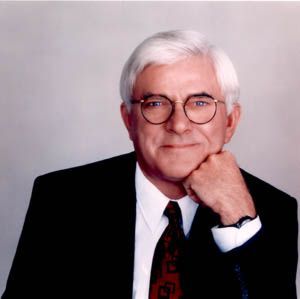 Jean Shepherd was always my
idea of a media rebel. Phil Donahue never was. But he
became one for me this morning on Democracy Now! Donahue, right, smiles easily and calls
himself lucky. He says his success spoiled him, which I'm sure is true. But behind the smile and
the luck there's a gritty malcontent who knows what's wrong and says it vigorously. "Shut up --
and sing!" That, Donahue says, is what Bush regime capo Karl Rove has told the mainstream
media. And it has done so, especially MSNBC, which booted him off the air just before the invasion of Iraq,
ostensibly because of poor ratings but actually because of his liberal, antiwar views and the
platform he offered progressives. What does he say about the right-wing patriots now
running the country? "They can't find enough flags to stand in front of." What does he say about
their God-loving politics? "God himself must be wincing at this pretense and false piety." As soon
as Democracy Now! posts the video segment, I'll put up a link.
Don't miss it.
Jean Shepherd was always my
idea of a media rebel. Phil Donahue never was. But he
became one for me this morning on Democracy Now! Donahue, right, smiles easily and calls
himself lucky. He says his success spoiled him, which I'm sure is true. But behind the smile and
the luck there's a gritty malcontent who knows what's wrong and says it vigorously. "Shut up --
and sing!" That, Donahue says, is what Bush regime capo Karl Rove has told the mainstream
media. And it has done so, especially MSNBC, which booted him off the air just before the invasion of Iraq,
ostensibly because of poor ratings but actually because of his liberal, antiwar views and the
platform he offered progressives. What does he say about the right-wing patriots now
running the country? "They can't find enough flags to stand in front of." What does he say about
their God-loving politics? "God himself must be wincing at this pretense and false piety." As soon
as Democracy Now! posts the video segment, I'll put up a link.
Don't miss it.
Postscript: They've posted the segment. Here tiz. Click on "Watch 256k stream" for broadband.
 As you've doubtless read by
now, Jeff Weise -- a self-described Ojibwe Native American teenager who killed 10 people,
wounded seven others, then committed suicide -- wrote messages on a neo-Nazi web site saying
he had "a natural admiration for Hitler and his ideas"; his tribe needed "more pure bloods"; and his
high school teachers frowned on anyone who espoused "racial purity."
As you've doubtless read by
now, Jeff Weise -- a self-described Ojibwe Native American teenager who killed 10 people,
wounded seven others, then committed suicide -- wrote messages on a neo-Nazi web site saying
he had "a natural admiration for Hitler and his ideas"; his tribe needed "more pure bloods"; and his
high school teachers frowned on anyone who espoused "racial purity."
Apparently taking the names "Todesengel" (Angel of Death) and NativeNazi in e-mails posted in a chat room of the Libertarian National Socialist Green Party, Weise wrote:
When I was growing up, I was taught (like others) that Nazi's were (are) evil and that Hitler was a very evil man ... Of course, not for a second did I believe this. Upon reading up on his actions, the ideals and issues the German Third Reich adressed, I began to see how much of a lie had been painted about them. They truly were doing it for the better.The only one's who oppose my views are the teachers at the high school, and a large portion of the student body who think a Nazi is a Klansman, or a White Supremacist thug.
The alienation that underpinned Weise's anger and distorted his sense of reality is evident in his writings. So is the peculiar irony of a Native American allying himself with neo-Nazi white supremacists. He wrote:
Most of the Natives I know have been poisoned by what they were taught in school. The basic "Nazi = Bad, Jew = Good. Defend Jew at all costs." You get the idea, the public school system has done more harm then good, and as a result it has left many on this reservation misled and misinformed. ...What ways has the Jewish power affected us in General? Ever since the Jewish post-war propaganda has been taught in our school systems (on reservations), a lot have been brainwashed into thinking purity is wrong, at least that's my take on it. ...
The teachers at my school are all white (besides the Ojibwe language teacher), yet the times I have brought up that Native Women and Black men, or White women and Native men shouldn't be together to keep their blood pure, I've been called a racist. When I bring up the point that our tribe (the Ojibwe) is mixed a lot and is in need of more pure bloods, I get the same old argument which seems to be so common around here. "We need to mix all the races, to combine all the strengths ..." ect ect. It gets old real quick when you hear the same argument over and over.
They (teachers) don't openly say that racial purity is wrong, yet when you speak your mind on the subject you get "silence" real quick by the teachers and likeminded school officials ...
Weise makes no mention of Irving, the racist Holocaust denier who argues an elaborately specious case for the Nazis in his lectures to white supremacist groups and in his books. But it wouldn't be surprising if Weise had mentioned him. He says in one message that he has boned up on the Third Reich and Nazism. His ideas have the ring of Irving's themes. In fact, Irving's "scholarship" often serves as a "historical" framework for racists who justify their ideology with a "respectable" rationale to "educate" angry kids like Weise. C-SPAN needn't give Irving a forum. He already has the Internet.
 It's amusing to look back every once at some of the things posted here
over the past 20 months. So says my staff of thousands, which has decided to start a Straight Up
tradition. It begins today with possibly the most entertaining yet pointed commentary about the
2004 election: the Sloganator. Go there. I did on
April 30, 2004, in an item called "Friday Antics." These days, as that site says, "The Sloganator is
dead, but the posters live on." As does their wit. Go here for some history.
It's amusing to look back every once at some of the things posted here
over the past 20 months. So says my staff of thousands, which has decided to start a Straight Up
tradition. It begins today with possibly the most entertaining yet pointed commentary about the
2004 election: the Sloganator. Go there. I did on
April 30, 2004, in an item called "Friday Antics." These days, as that site says, "The Sloganator is
dead, but the posters live on." As does their wit. Go here for some history.
Comment 1 by Biff Cappuccino, March 19,
01:10 AM
Given that Irving is a best-selling author, and given the
significance of the lawsuit he lost to Deborah Lipstadt, I would love to have seen them discuss
issues or at least appear back to back on C-Span. I've read some of Irving's stuff (the first third of
his Hitler biography for example) and he does not strike me as being an admirer of Hitler. Have
you read this book yourself? You can download it free from his website.
On his website he also makes a point of trying to prove that he's not racist. I say try because I don't pretend to speak with any authority as to whether he is racist or not.
I may be wrong, and I haven't read any of Irving's stuff for several years, but I was under the impression that Irving is not a Holocaust denier but believes that the monstrous murder of the Jews was just one of many monstrosities that took place and that the Jews were machine-gunned and so forth, and not gassed.
As to having someone debate slavery from a pro-slave perspective, I would be quite interested if the person could make an at least superficially persuasive case. All of us have had ancestors who were slaves at some point. What is there to be afraid of? You surely don't believe slavery is going to make a comeback anymore than I do. So why the rush to political correctness?
C-Span puts up loonies all the time and lets them rant without interruption for the first ten minutes or so. This is a great service to the community because it allows us to form our own opinions about events and personalities. C-Span did a three-hour special on Chomsky though I can't imagine Brian Lamb can be anything but contemptuous of the old conspiracy theorist. I would love to see Ward Churchill on C-Span as well. Ward is as big a fraud as they come (bogus scholarship, art forgery, faked military record, etc), but he has every right to free speech. I wouldn't dream of writing to C-Span to keep Ward off the air. Why would I be so narrow-minded? With all due respect, you strike me as far too contemptuous of the average person's ability to sensibly form their own judgements.
Comment 2 by Henry, March 19, 03:37
AM
Interesting that nowhere in his magisterial history of the Second
World War does Winston Churchill mention the "Holocaust" of the Jews. Does that make
Churchill a denier?
Comment 3 by Scott Fields, March 19, 12:17
PM
The fundamental kernal of the Holocaust is that a modern
industrial state planned and carried out the mass extermination of a class of people using among
things fixed installation gas chambers.
The Holocaust is not merely a period of Jewish suffering or a period when "bad things" happened to Jews.
The evidence that the Holocaust occurred is mountainous. It is as mountainous as the evidence that there was an Apollo moonshot or the Civil War or "the Eisenhower administration."
David Irving denies that there was any plan to exterminate the Jews or the instruments to carry that out, namely fixed installation gas chambers at such places as Auschwitz and Treblinka.
To Irving, the witnesses are all liars, the confessions of the Nazis were extracted under torture, the documents and photos are all forged. The British court ruled that he lied and falsified evidence to reach these conclusions.
Irving's position is tantamount to saying there was a man named Dwight Eisenhower, he was important during the 1950's but I deny he was President of the USA.
This is not political correctness. It is about providing a valuable public forum to a judicially found liar, racist and anti-Semite. Moreover, his position is an assault on truth and memory.
Irving has his free speech. He has a website. He is not owed a publicly televised forum.
Comment 4 by Biff Cappuccino, March 19,
12:46 PM
I think this is about political correctness. It begins with
statements such as "Falsifiers of history cannot 'balance' histories." Everyone with even a
marginally heterodox view of any aspect or period of history is ipso facto a 'falsifier of history.'
The statement is so clumsily worded because the authors know that they don't have to justify their
reasoning to the majority of readers. This is just as bad as the right-wing attempts to clamp down
on Ward Churchill. Keeping Irving off C-Span is surely C-Span's decision.
You inadvertently play semantic games when you talk about "providing" Irving with a valuable public forum. C-Span wasn't providing him with a forum, they were inviting him on for public interest. They're not his flacks. Ergo, they're not providing him with anything.
What do you mean by a public forum? A street corner or anywhere people congregate is a public forum. And who owes him a publicly televised forum? Does anyone at C-Span believe they "owe" him anything.
Because you're not serious about addressing the issue, you let this sort of slippery verbiage and cliché do your thinking for you. And you do so I believe because you feel secure that the (moral) majority of the public supports you. You don't have to express logic clearly, just morally correct feelings. In my opinion, you're high on political correctness.
Myself, I would be interested in what Irving has to say about the trial. I'm no more a fan of racists than you are, but as a regular viewer of C-Span I'm happy to let C-Span make it's own decisions. They do an excellent job because they steer away from political correctness which they can do because, ironically, so few people (and even fewer busybodies) watch their shows.
Comment 5 by Tom Murphy, March 19, 09:02
PM
Irving is a man who believes that Jews were killed in great
number and has documented specific conversations of Germans talking about the shootings.
Irving is a man who believes that the Jews died in concentration camps. Irving is a man who
believe that Nazis not only killed Jews with mass shootings but also killed Jews in concentration
camps.
Now does that sound like a "Holocaust Denier"?
If your first reaction to what I am writing is that I must be wrong about what Irving thinks then you prove my point that using the term "Holocaust Denier" to describe David Irving is grotesque, manipulative and dishonest. How can anyone think it is not libel?
Comment 6 by Gonzo Marx, March 20, 12:22
AM
Aww c'mon kiddies...
Can you say Zyklon-B?
Sure ya can...
Now how about the entire meeting transcript of Eichmann and cronies that was taken from an administration building in Berlin and used as evidence at the Nuremburg trials ... The details are all there and a matter of public record ... If you hurry ... Because they are aging fast and will not be with us for much longer ... You can actually speak to living people that bear the tattoos, and were actually IN THE CAMPS ... Listen to them describe the "showers" ...
The documentary footage of the Allies arrival in some of the camps, including the empty cannisters of Zyklon-b. ... The production records as well as distribution manifest for aforementioned cannisters of the gas ... And on and on ...
I am all for placing dissenting OPINIONS in political debate ... But this smacks of having some kook that wants to rebuke the Law of Gravity and debate the validity of Thermodynamics ...
To those doubters that are young and naive enough to buy into any of the revisionist crap, might I suggest a trip to the NYC diamond district .?. Ask around ... I am certain you will be able to find a few survivors that can educate you ...
Nuff said?
Comment 7 by Scott Fields, March 20, 09:48
AM
Irving had his day in Court on the question of libel. He lost. No
he was crushed. He was destroyed.
It is a judicially accepted fact that Irving is a liar, manipulator, falsifier, Holocaust denier and anti-Semite. Those were the exact findings of a British court of law.
He is the only man in world history who has had a court of law decide these exact issues.
As a matter of final public record, he is all of these things.
He has lost the libel defense.
Comment 8 by Orest Slepokura, March 20,
10:50 AM
It's always instructive to observe what self-appointed
guardians of the Holocaust will and won't tolerate. A case in point:
During a 1976 state visit to Israel by South Africa's then prime minister John Vorster, the late Yitzhak Rabin invited Vorster, an old Nazi collaborator, unabashed racist and white supremacist, to Yad Vashem to pay homage to Jews murdered in the Holocaust. Vorster should, of course, have been tried as a Nazi collaborator; instead he was welcomed by his Jewish hosts.
Compared to the usual outcries from Jewish groups who zealously guard the dignity of Holocaust remembrance, no less remarkable was the bland equanimity both Israeli and Diaspora Jews also displayed toward the Vorster visit. Vorster left Israel four days later, after forging close commercial and military ties between the Jewish state and Pretoria's apartheid regime.
Different strokes for different folks, I guess.
Comment 9 by Gonzo Marx, March 20, 11:43
AM
Different incident, don't ya mean there, Orest?
I fail to see the correlation between the two ... Though I do acknowledge the possible hypocrisy you are attempting to point out ...
It leaves me wondering if you are trying to engage in the discussion or simply pulling a bait and switch to distract from the matter at hand ...
But thanx for playing ... Please come again.
Comment 10 by Orest Slepokura, March 20,
01:26 PM
I merely showed, using an historical example, how Yad
Vashem welcomed an unreconstructed Nazi to tour its museum and memorial site, one devoted to
memorializing victims of the Nazi Holocaust, and how Israeli law enforcement, normally gung-ho
to arrest Nazi war criminals and collaborators, had shown no interest in arresting Vorster. That a
Nazi diehard was invited to debauch the memory of the victims of the Nazi Holocaust, and did so
with total impunity, to my mind sugggests that so-called Holocaust denial may assume more than
one form. If Jews could graciously welcome Vorster to Yad Vashem, watching David Irving
appear on C-Span for an hour, surely, ought to be far less onerous.
Comment 11 by Gonzo Marx, March
20, 01:42 PM
Duly noted, Orest ... and thanx for
elucidating yer point ...
As for C-SPAN and who they put on ... up to them ...
But to give equal time ... which I am all for ... It might help to use a historian that has NOT been discredited by the British Courts in such a thorough and devastating manner, don't ya think?
And my point against your anecdote is that the two incidents don't show any causal relationship ...
However, I respect your right to bolster your opinion as you see fit, especially since you have produced a factual incident ...
I just disagree with it's relevance ...
Comment 12 by Fred Bortz, March 20, 02:37 PMAfter reading some of these comments, it's no wonder that people still glorify former Nazis who managed to cover for their former allegiance by claiming to be "apolitical." In their case, that translated to opportunistic, kissing-up to whomever has political power.
To quote Tom Lehrer's song "Wernher von Braun" from foggy memory:
"Let the rockets go up
Who cares where they come down?
That's not my
department,"
Says Wernher von Braun.
Two of the reviews on my Science Shelf archive discuss this issue from different perspectives: "Hitler's Scientists: Science, War, and the Devil's Pact" by John Cornwall and "Astro Turf: The Private Life of Rocket Science" by M. G. Lord
Comment 13 by Bill Osborne, March 21, 10:09
AM
C-Span specializes in giving voice to crackpots. It is part of
their style. It is often even useful, if not entertaining, to have a look at what the nuts in our society
have to say.
This debate about C-Span raises other important questions. What is consensus journalism when the norms of society are deeply wrong? What would it have been like, for example, to be a journalist in the 1930s if you were opposed to the Jim Crow laws? How do you speak from the middle when the middle is wrong? Will all dissenters be lumped together with odious people like Irving and simply silenced?
What does it mean, for example, to be a journalist in a society that has discretely committed or abetted mass murder by death squads and unjustified wars for the last 50 years as a matter of foreign policy, especially in Latin America? Only crackpots charge our government with committing or abetting mass murder, but isn't it true? Has the lack of mainstream journalistic dissent become a serious problem, considering our media's corporate consolidation and the way it is manipulated by our government?
Why is it that someone as sober, rational, and even as popular as Noam Chomsky is so completely marginalized by our corporate media? I can certainly sympathize with banishing a malicious crackpot like Irving from C-Span, but how do we know where to draw the lines when it comes to unconventional views?
 So says investigative reporter Greg Palast, left, who was interviewed on Democracy
Now! about his recent BBC Newsnight report detailing secret U.S. plans to
privatize Iraq's oil resources and the political fight it sparked with the oil companies. They resisted
privatization because it would upset the OPEC monopoly and reduce profits for the oil
companies.
So says investigative reporter Greg Palast, left, who was interviewed on Democracy
Now! about his recent BBC Newsnight report detailing secret U.S. plans to
privatize Iraq's oil resources and the political fight it sparked with the oil companies. They resisted
privatization because it would upset the OPEC monopoly and reduce profits for the oil
companies.
 Wolfowitz is being "tossed out" of the Pentagon, Palast says, essentially at the
behest of the supposedly non-partisan James Baker Institute,
which represents Saudi Arabia and the big oil companies among its clients. In his BBC report,
broadcast this morning on D-Now!, Palast interviews Philip J. Carroll, the former CEO of Shell
Oil USA, among others, to back up documents he has obtained about the secret privatization
plans.
Wolfowitz is being "tossed out" of the Pentagon, Palast says, essentially at the
behest of the supposedly non-partisan James Baker Institute,
which represents Saudi Arabia and the big oil companies among its clients. In his BBC report,
broadcast this morning on D-Now!, Palast interviews Philip J. Carroll, the former CEO of Shell
Oil USA, among others, to back up documents he has obtained about the secret privatization
plans.
Carroll, who took control of Iraq's oil production a month after the invasion, "stalled the sell-off scheme," Palast reports, and Carroll's "chosen successor," a Conoco Oil executive, Robert McKee, "ordered up a new plan [from the Baker Institute] for a state oil company preferred by the [oil] industry."
In his BBC story posted last week on the second anniversary of the invasion of Iraq, Palast wrote:
Two years ago today -- when President George Bush announced US, British and Allied forces would begin to bomb Baghdad -- protestors claimed the US had a secret plan for Iraq's oil once Saddam had been conquered.In fact there were two conflicting plans, setting off a hidden policy war between neo-conservatives at the Pentagon, on one side, versus a combination of "Big Oil" executives and US State Department "pragmatists."
"Big Oil" appears to have won. The latest plan, obtained by Newsnight from the US State Department was, we learned, drafted with the help of American oil industry consultants.
In addition to watching his interview on Democracy Now!, you can go to Palast's Web site to see some of the documents. He also links to his BBC online story and to a tease of his magazine story in the April issue of Harper's. "The neo-cons, once in command, are now in full retreat," according to insiders and the documents. "With pipelines exploding daily, the fantasy of remaking Iraq's oil industry also went up in flames."
The tale has so many serpentine twists it's counter-counterintuitive. And Palast shows once again why he is a snake charmer in a class by himself.
 Trouble is, Rutten's column about the D'Arcy/NPR/MoMA
controversy is lodged behind the LAT's Subscription Curtain. So here's some
of what he wrote:
Trouble is, Rutten's column about the D'Arcy/NPR/MoMA
controversy is lodged behind the LAT's Subscription Curtain. So here's some
of what he wrote:
According to D'Arcy, he was questioned in a telephone conference with Barbara Rehm and William K. Marimow, both of whom are managing editors of NPR News. As D'Arcy recalls it, Rehm told him, "'there are real problems with your piece.' I was asked why I didn't confront Lauder directly over the Schiele case. 'You made Ronald Lauder look like a hypocrite,' I was told. [Lauder is chairman of MoMA's Board of Trustees.] Bill Marimow said, 'You made these guys look like bad Jews,' while Rehm hissed 'shabby, shabby' in the background. Then they told me I had violated every rule of journalism.... I don't think they accused me of bombing the World Trade Center, but it may have been slipped in. They asked me for all sorts of off-the-record material. Then, they said, we'll get back to you."
When they did, it was to terminate his contract. With their lawyer listening in on the phone, they also told D'Arcy his editor, Tom Cole, a staffer at "All Things Considered," was "suspended without pay for one day and, Rehm, according to D'Arcy, told him that "Cole agreed with all the criticisms and had showed the appropriate remorse."
Maybe NPR should change its letters to GULAG? How about GITMO? In any case, what did Rehm have to say when Rutten called her for comment on D'Arcy's firing? Zilch. She didn't return his calls. What did Marimow have to say? "We looked into this matter and we issued a correction and that's all I have to say." In other words, more zilch.
"You know how important fairness and balance is at C-SPAN," executive producer Connie Doebele told Washington Post columnist Richard Cohen. "We work very, very hard at this. We ask ourselves, 'Is there an opposing view of this?'"
"As luck would have it, there was," Cohen wrote in his column on Tuesday, "Balance of the Absurd":
To Lipstadt's statements about the Holocaust, there was Irving's rebuttal that it never happened -- no systematic killing of Jews, no Final Solution and, while many people died at Auschwitz of disease and the occasional act of brutality, there were no gas chambers there. "More women died on the back seat of Edward Kennedy's car at Chappaquiddick than ever died in a gas chamber at Auschwitz," Irving once said.
 When Lipstadt learned that C-SPAN's notion of fair and
balanced meant airing her March 16 talk at Harvard along with Irving's March 12 speech at a
diner in Atlanta, she refused to have her talk videotaped for C-SPAN's "Book TV" program. The
program would have helped her promote her recently published "History on
Trial," which chronicles the libel case Irving brought against her for citing
him, in her 1993 book "Denying the Holocaust," as an anti-Semitic racist who
distorts history with lies.
When Lipstadt learned that C-SPAN's notion of fair and
balanced meant airing her March 16 talk at Harvard along with Irving's March 12 speech at a
diner in Atlanta, she refused to have her talk videotaped for C-SPAN's "Book TV" program. The
program would have helped her promote her recently published "History on
Trial," which chronicles the libel case Irving brought against her for citing
him, in her 1993 book "Denying the Holocaust," as an anti-Semitic racist who
distorts history with lies.
Lipstadt proved the truth of her claim to the British court, where the case was tried. The court not only ruled in Lipstadt's favor but, as Cohen notes, also ruled that Irving was "anti-Semitic and racist." In fact, anyone who has followed Irving's career even slightly knows he often appears as an invited speaker at events organized by white supremacists.
Since the publication of Cohen's column, Tamar Lewin reports in this morning's New York Times, more than 200 historians have signed a petition protesting the network's plan to broadcast Irving's speech. "Falsifiers of history cannot 'balance' histories," the petition is quoted as saying. "Falsehoods cannot 'balance' the truth."
Cohen wrote:
C-SPAN's cockeyed version of fairness -- it told Lipstadt that it had bent over backward to ensure its coverage of the presidential election was fair and balanced -- is so mindless that I thought for a moment its producers and I could not be talking about the same thing. This is the "Crossfire" mentality reduced to absurdity, if that's possible. For a book on the evils of slavery, would it counter with someone who thinks it was a benign institution?
The protest petition has been delivered to Doebele, who may be having second thoughts. C-SPAN taped Irving's speech, but a network spokesman now tells Lewin that plans to air it are uncertain. Unfortunately, damage has already been done. As Cohen wrote, "On this occasion, at least, Irving did what he could not do with his libel suit: silence Lipstadt."
Tom Freudenheim, the former deputy director and chief operating officer of the Jewish Museum in Berlin, sends this message -- a tongue-lashing for the Museum of Modern Art over its negligence in the Egon Schiele case and for NPR ombudsman Jeffrey Dworkin over his and NPR's foul treatment of reporter David D'Arcy:
Re the MoMA/NPR/D'Arcy issue: No recent mention has been made of the fact that this entire problem would never have come into being had MoMA requested a Certificate of Immunity from Seizure, which is a guarantee routinely issued by the State Department. That is just plain negligence on the museum's part, and is the reason that the NYState authorities were able to intervene on behalf of the Bondi Family. Had the museum done its job properly, then the issue would have gone back to the Austrian courts, just as MoMA now claims is appropriate. This may well be one reason that MoMA's PR machine is working so hard to cover its bare ass.Meanwhile, Mickey Kaus picked up on yesterday's item in this morning's Kausfiles at Slate and delivers another tongue-lashing that really stings:It should also be noted that the sole inaccuracy in the D'Arcy story was not on D'Arcy's part, but rather in Melissa Block's (i.e., NPR/ATC) erroneous introduction of the story, suggesting that the Schiele painting was part of MoMA's collection (which obviously D'Arcy never even implied).
This is an outrageous situation which should not be permitted to go away easily.
Herewith a copy of my letter to the Ombudsman....
Mr. Dvorkin:
You seem intent on compounding errors in your comment about the MoMA situation. I'm sure you're a very busy man, but it might have helped if you had read through the transcripts of your own broadcast. I am the 'critic' you mention, and what I said was "But I guess the sense of responsibility to museum ownership and the kind of -- oh, I hate -- I guess I can use the word -- greed that museums have about just not letting go of what they have in their little fists trumps any other kind of loyalties or feelings that people have." I was talking about 'museums' and feel quite justified in doing so, having directed various ones for a number of years. Your own Melissa Block suggested in her lead that the painting might belong to the museum, but you have presumably not sanctioned her for the error. The Robert Siegel's follow-up [sort of] clarifies that the painting was actually on loan to the museum. I note that you haven't discarded these two ATC stalwarts (yes, I know they are employees, and D'Arcy was not, and therefore presumably more disposable).
More reprehensible, from my point of view, is your failure to take note of the fact that, as a responsible journalist, D'Arcy contacted MoMA while assembling his story, but the museum would not comment for him. You now state that "MoMA's position is that the Austrian courts must decide the painting's legal owners, since the painting was in the United States only as part of a loan arrangement." And yet the correction that NPR/ATC issued on 27 January stated that "the museum's statement, made to NPR, that it had never taken a position on the question of the painting's ownership." These are opposing statements on the part of NPR, and you ought to address this important contradition responsibly, instead of carping about NPR being accused of caving in under pressure. As a long-time supporter of NPR, I'm waiting to see evidence to the contrary.
Tom Freudenheim
tom@freudenheim.com
Shouldn't NPR President and CEO Kevin Klose (FY 2003 compensation: $377,999**) convene a staff meeting at which he brandishes a stuffed moose? ... Sorry, I mean shouldn't NPR President Kevin Klose defend his organization's position in public in his own words? ... P.P.S.: They pay Dvorkin $181,409**, as of FY 2003. Your pledge dollars at work! ...
I actively dislike Kaus's political agenda, but this time he's right.
On the NPR ombudsman page (scroll
down to "Reporting on the Powerful"), Dvorkin denies that "NPR caved in to pressure from a
powerful cultural institution." He continues, "Sounds like a classic story of big cultural institution
running over the rights of dispossessed owners of great art, right? But the story is more
complicated: the original report did not, in my opinion, fully and accurately present all of the
facts."
Aarrrgghhh!! Now take it from the most comprehensive and damning letter to NPR so far. It comes from Randol Schoenberg, a lawyer and the grandson of the composer Arnold Schoenberg. It's deep, heavy and involved. It was leaked to me by an insider who thinks D'Arcy is getting the shaft. I'm posting it below. It was sent to Dvorkin, so I see no reason not to use it because, for all intents and purposes, it's a matter of public record. It's long, detailed and technical -- so be prepared -- and it makes the case for D'Arcy in spades.
Another point of interest: D'Arcy is a freelancer and the others responsible for overseeing his MoMA report are represented by unions. Who you gonna boot? The employee who is protected and could win this case hands down? Or the independent contractor with no rights?
From: E. Randol Schoenberg randols@bslaw.net
Date: Tue, 15 Mar
2005 23:23:19 -0800
To: jdvorkin@npr.org
Cc: kklose@npr.org>
Subject: David d'Arcy
Dear Mr. Dvorkin,
David d'Arcy has been keeping me informed of the recent controversy surrounding his report on the Schiele case. Since I was interviewed and quoted in the story, I have up to now not commented on what was transpiring, thinking that I would be considered an interested party and therefore not objective. I hope however that you will consider this e-mail in the constructive manner in which it is intended.
First, I have a question: Is it really true that Mr. d'Arcy has been "fired" because of the Schiele piece? I find it hard to believe that this could be the case. The whole dispute seems to me to have been blown completely out of proportion.
When Mr. d'Arcy interviewed me, I was in New York for a talk at Christie's. This was a week before the MoMA opening and so it was on my mind and his as we discussed various issues related to art restitution litigation. (I am fortunate to be involved in several of the leading cases in the field, including Altmann v. Austria which I argued and won before the US Supreme Court last year. NPR has covered my cases on numerous occasions. See http://www.bslaw.net/news.html.) Mr. d'Arcy accurately quoted me in the story and reflected my views concerning MoMA's position in the Schiele case.
I have read your recent response to the story in artnet.com.
You wrote "the original report did not, in my opinion, fully and accurately present all of the facts." No doubt this is true of Mr. d'Arcy's story -- as it is true of each and every story aired on NPR. No 5-minute story "could fully and accurately present all the facts" of a historical case concerning events 65+ years ago, the litigation of which has lasted now for over seven years and generated no less than six court opinions concerning complex legal issues beyond the ken of even NPR's above-average listeners. So your comment, while true, is hardly a criticism. Notably, you fail to mention any inaccuracies in the report. If there are any, they are certainly minor.
You wrote: "Nor did it present MoMA's position on the ownership question." I presume it is true that MoMA declined to be interviewed for the story. That of course makes it more difficult for the reporter. But Mr. d'Arcy did attempt to convey the museum's position, and even found a supporter (Mr. Hawkins) whom he quoted in the story [italics added]:
D'ARCY: None of the parties to the case would be interviewed for this report, not MOMA's lawyer, not the US attorneys, not the Bondi family and not the Leopold Foundation. In motions filed in federal court, Leopold's lawyers argue that Lea Bondi waited too long to claim the portrait; that the Nazi who seized it was acting under laws of the then legal government and that Dr. Leopold never knew it was stolen. When MOMA has discussed the case over the past seven years, the museum has said it's bound by its loan contract to return the painting, and that position is backed by the American Association of Museums, by art museums throughout the country and by Ashton Hawkins, a former museum lawyer who advises dealers and collectors. He contends that the Schiele case has had a chilling effect on international art loans.Mr. ASHTON HAWKINS (Art Adviser): I think that people who would have previously considered lending now simply don't consider it. You can't quantify it very well, but I know from my colleagues who arrange these exhibitions in New York and in other cities that lending to the United States and particularly to New York has been more of a problem than it used to be. It doesn't mean you can't get the loans; you can. But many people just don't want to offer it up.
Mr. Hawkins certainly presented one of MoMA's many arguments concerning this case, namely that if such suits are permitted, lenders will not allow their paintings to be exhibited in shows at American museums. No doubt you agree that through Mr. Hankins, Mr. d'Arcy accurately conveyed one of MoMA's many "positions". See United States v. Portrait of Wally, 2002 U.S. Dist. LEXIS 6445 *18 n4 (S.D.N.Y. 2002) ("MoMA further argues, dubiously in my view, that it is injured because the forfeiture has diminished the likelihood that other art of questionable ownership will be available for loan to MoMA.") That Mr. d'Arcy did not recount all of MoMA's positions cannot seriously be considered a criticism of his story.
You wrote: "The painting has been in federal custody for years." Mr. d'Arcy's story said (more completely and accurately):
When the Bondi family spotted it, authorities were notified, and Manhattan District Attorney Robert Morgenthau subpoenaed the picture on the charge that it was stolen property. A New York state appeals court overruled Morgenthau. At that point the federal government stepped in. US attorneys ordered the painting held again in 1999, preventing its return to Austria.
I take it you do not disagree with Mr. d'Arcy's more accurate report.
You wrote: "and MoMA's position is that the Austrian courts must decide the painting's legal owners, since the painting was in the United States only as part of a loan arrangement." Mr. d'Arcy stated: MOMA opposes a Jewish family's effort to recover the painting.
The two statements are not inconsistent. MoMA clearly does oppose the efforts to recover the painting through the legal action in the United States. The museum has raised numerous legal issues in its filings with the various state and federal courts that have handled the matter. Notably, MoMA filed its own claim in the forfeiture action and filed a motion to dismiss the claim of the Bondi family. See United States v. Portrait of Wally, 2002 U.S. Dist. LEXIS 6445 *12 (S.D.N.Y. 2002) ("The Leopold's and MoMA's motions to dismiss make many of the same or related arguments, and the Leopold has incorporated MoMA's arguments by reference into its own motion.") In its motion, MoMA clearly opposed the Bondi family's claims to recover the painting, under U.S. and Austrian law. Id. *45 ("The Leopold's motion to dismiss begins, logically, with the argument that this court has already decided that Wally is not stolen property, which would preclude a § 2314 violation. (Leopold Mem. 2 at 20) MoMA echoes this argument. (MoMA Mem. 2 at 8)." The Court rejected each and every one of MoMA's arguments. For example, on the argument that the claim is barred by prescription under Austrian law, the Court stated:
MoMA persists that even if Dr. Leopold was aware of Bondi's claim, the Complaint does not rebut the possibility that he may have been a confident owner based on his own investigation of that claim and his conclusion that it was meritless. MoMA cites Dr. Leopold's discussion with the Belvedere regarding Bondi's claim, in which Dr. Garzarolli told him that Bondi never made a claim to the painting and assured him that the painting [*58] was theirs. (Compl. PP 5b) Further, the Leopold and MoMA argue that "Dr. Leopold may also have had confidence in the legality of his ownership of Wally based on the belief that the Belvedere, even if it did not acquire title to Wally directly from the Rieger heirs, had acquired title to Wally by prescription." (MoMA Reply Mem. 1 at 16) So long as Dr. Leopold reasonably believed this, they argue, the fact that the belief was erroneous is not enough to defeat his prescription of the painting. (Id.; Leopold Mem. 2 at 37).
First, to the extent that this theory relies on Dr. Garzarolli's report of his conversation with Dr. Leopold, set out in his letter to Bondi's lawyer, Dr. Garzarolli's contentions are not allegations in the Complaint that are to be taken as true on this motion to dismiss. In fact, as discussed above, they are legitimately suspect. Second, the facts alleged in the Complaint are sufficient to rebut the argument that Dr. Leopold had the requisite confidence to become Wally's legal owner. As noted above, at this stage of the proceedings, the allegation that Bondi told Dr. Leopold of her claim is enough. That Dr. Leopold may have been able to whistle past the graveyard [*59] with enough confidence to fool even himself is a hypothesis I need not indulge at this stage of the case.
Because neither the Belvedere nor Dr. Leopold obtained legal ownership of Wally through prescription, the Leopold did not acquire good title to Wally through its predecessors, and the painting did not lose its taint on that basis.
Mr. d'Arcy accurately referred to this passage of the Court's opinion in his story:
D'ARCY: As the public lines up to enter MOMA's $1/2 billion new home, in court, a federal judge has come close to mocking the Leopold Foundation's position. The judge's ruling that allowed the case to go forward compared Leopold's insistence that the property wasn't stolen to whistling past the graveyard.
Mr. d'Arcy could have also accurately said it was MoMA's position that was being mocked. But he chose to save the museum that embarrassment, In case you are not familiar with Judge Mukasey's opinion, I attach a copy for your review.
Finally, you contend: "Most important, in an issue of journalistic fairness, the report did not give MoMA a chance to respond to specific and direct charges leveled against it by numerous critics." First, this is very unfair, given that Mr. d'Arcy requested an interview and MoMA declined. As a journalist, you certainly know that a party should not be able to "kill" a story simply by refusing to comment. Second, in order to find that Mr. d'Arcy was unfair, you would have to find that something could be said in defense of MoMA's position that was not stated. In other words, the story could have made MoMA look better than it did. But this would have been nearly impossible, because after every argument made by MoMA, Mr. d'Arcy, in all fairness, would have had to point out that the district court had soundly rejected the argument. If anything, MoMA's comments would have only made the museum look worse. Which is exactly why the museum refused to comment in the first place.
You conclude: "The original report was wrongly framed, and NPR was right to air a clarification in early January." I am not sure what "wrongly framed" means, although it sounds damning. After reviewing Judge Mukasey's opinion rejecting MoMA's myriad arguments seeking dismissal of the Bondi family claims, do you really think the report was "wrongly framed"?
As for the so-called "clarification" it read:
Correction: The government, not the museum, has custody of the artwork. The museum says it took no position on the question of the painting's ownership. NPR failed to give the museum a chance to answer allegations about its motivations and actions.
But the story accurately reported "US attorneys ordered the painting held again in 1999, preventing its return to Austria." So that part at least could not be considered a correction. It is of course false to say that the museum "took no position on the question of the painting's ownership" as Judge Mukasey's opinion make clear. Perhaps you have not actually read the opinion or MoMA's pleadings in support of its motion to dismiss. That is the only explanation I can think of for this purported "correction" which isn't one. Finally, the allegation that the museum was not "given a chance to answer allegations about its motivations and actions" is misleading, given that the museum declined an opportunity to take part in the story, and further implies that they would have had some answer to give. What is the answer that was missing?
I simply cannot believe that Mr. d'Arcy could have been "fired" over this story. I have known him for 10 years now, since he came out to Los Angeles to interview me in a story concerning the lawsuit to move my grandfather's archives from the University of Southern California. Mr. d'Arcy told me after that interview that he had come out with a completely different story in mind (one showing the silliness of heirs who try to control legacies) from the one he ultimately aired (showing the mendacity of the University in its dealings with our family). In other words, he had an open mind and was willing to be convinced by the evidence presented. What more could you want from a reporter?
I must say that as much as I have enjoyed being interviewed by NPR, I will now have to think twice before I make myself available for another story. As someone who believes in journalism (I was editor of my high school, college and law school newspapers) I don't think I can support an organization that would treat one of its reporters so unfairly.
Thank you for taking the time to consider this e-mail. I hope that things are not so far along that a reinstatement of Mr. d'Arcy cannot be considered. He is, after all, a loyal and hard-working reporter who has served NPR well for so many years.
E. Randol Schoenberg
Burris & Schoenberg, LLP
12121 Wilshire Blvd., Suite
800
Los Angeles, CA 90025-1168
Tel: (310) 442-5559
Fax: (310)
442-0353
eFax: (425) 740-0483
Email: randols@bslaw.net
http://www.bslaw.net
I hope the letter knocks the wind out of Dvorkin and NPR. I'm out of breath just reading it.
The piece, which started out on the front page of Sunday's New York Times and jumped to a huge inside spread taking up another page and half in the print edition, was so rich in illustrations of government propaganda airing as "news" on presumably independent TV stations that it was difficult to choose which to cite.
I intended to cite the most salient points. This, for instance:
In all, at least 20 federal agencies ... have made and distributed hundreds of television news segments in the past four years, records and interviews show. Many were subsequently broadcast on local stations across the country without any acknowledgement of the government's role in their production. ...In most cases, the "reporters" are careful not to state in the segment that they work for the government. ... Some reports were produced to support the administration's most cherished policy objectives, like regime change in Iraq or Medicare reform. Others focused on less prominent matters. ...
It is a world where government-produced reports disappear into a maze of satellite transmissions, Web portals, syndicated news programs and network feeds, only to emerge cleansed on the other side as "independent" journalism.
I intended to cite this, too:
[I]n three separate opinions in the past year, the Government Accountability Office, an investigative arm of Congress that studies the federal government and its expenditures, has held that government-made news segments may constitute improper "covert propaganda" even if their origin is made clear to the television stations. ...[But] on Friday, the Justice Department and the Office of Management and Budget circulated a memorandum instructing all executive branch agencies to ignore the G.A.O. findings.
Then I tuned into this morning's broadcast of Democracy Now! and decided to let it do the heavy lifting for me. In an interview, John Stauber of PR Watch, which monitors the press, was as impressed with the piece as I was. Noting its wealth of detail about "the widespread use of fake news," he said the piece was "the first mainstream media exposé of any length and depth" on the subject. Additionally, he pointed out that it "really puts the wood to the Bush administration, which has spent $250 million" to create and distribute fake news.
Democracy Now! anchor Amy Goodman noted further what is even more frightening than the fraud perpetrated on viewers of TV news: It's hard to distinguish between the fake news produced by the government and the real news produced by independent TV stations. This was an acute observation the Times piece did not make. (It couldn't be expected to do everything.)
Anyway, I intended to finish right there. But I can't. I feel impelled to cite Karen Ryan -- a former ABC and PBS journalist who became a public relations consultant and impersonated a "reporter" in various government-produced "news" segments -- as the perfect illustration of an unwillingness to take personal responsibility for spreading "covert propaganda."
The Times notes that she "cringes at the phrase." She regards covert propaganda as "words for dictators and spies." She feels uncomfortable being called a "paid shill" for the Bush regime. Yet she says she feels she did nothing wrong. Is she to blame that her "segments on behalf of the government were broadcast a total of at least 64 times in the 40 largest television markets"? Is she to blame that even those, the Times reports, "do not fully capture the reach of her work?"
Ms. Ryan said she was surprised by the number of stations willing to run her government segments without any editing or acknowledgement of origin. As proud as she says she is of her work, she did not hesitate, even for a second, when asked if she would have broadcast one of her government reports if she were a local news director."Absolutely not."
The contradiction is mind-boggling. And Ryan is scarcely alone in failing to take personal responsibility. The Times cites two news directors, Kathy Lehmann Francis (recently of WDRB in Louisville, Ky.) and Mike Stutz (of KGTV in San Diego, Ca.), who claimed they "would never allow their news programs to be co-opted by segments fed from any outside party, let alone the government." Yet taken together, WDRB (a Fox affiliate) and KGTV (an ABC affiliate) showed a total of three dozen government- and corporate-produced "news" segments without revealing their origin to viewers.
One especially fascinating instance of domestic propagandizing came at WHBQ in Memphis, Tenn. The station appeared to have a reporter in Afghanistan interviewing Afghan women when, in fact, she was using footage of interviews conducted by the U.S. State Department. The reporter, furthermore, didn't know the government had produced them. "[She] said it was her impression at the time that the Afghan segment was her station's version of one done first by network correspondents at either Fox News or CNN," the Times reported.
Finally, to wrap up:
The Pentagon Channel, available only inside the Defense Department last year, is now being offered to every cable and satellite operator in the United States. Army public affairs specialists, equipped with portable satellite transmitters, are roaming war zones in Afghanistan and Iraq, beaming news reports, raw video and interviews to TV stations in the United States. All a local news director has to do is log on to a military-financed Web site, www.dvidshub.net, browse a menu of segments and request a free satellite feed.
One unit of 40 military reporters and producers -- the Army and Air Force Hometown News Service -- is "set up to send local stations news segments highlighting the accomplishments of [local] military members." Larry W. Gilliam, the unit's deputy director, told the Times, "We're the 'good news' people." They filed 50 stories last year, which "were broadcast 236 times in all" and reached 41 million U.S. households. Makes the Swift Boat ads look like child's play.
Meantime, Dear Leader and his minions have no intention of backing off. Just the other day, on a separate front, he appointed his Texas crony Karen Hughes to polish up the U.S. image abroad. He has tarnished America's reputation so badly it's doubtful even her well-known skills as a propagandist will help. But if it's any consolation, her job at the State Department -- undersecretary for "public diplomacy" -- will keep her too busy to pull fast ones on news directors in this country.
 Ever hear of the "10-30-30" plan? Probably not, if you don't closely follow
military affairs. But you're doubtless familiar with the well-marketed phrase for a war strategy in
Iraq that has already proved stupid, arrogant and criminal: "shock and awe." Think of 10-30-30 as
the shock-and-awe specifics, "the specs" so to speak. According to the Los Angeles
Times:
Ever hear of the "10-30-30" plan? Probably not, if you don't closely follow
military affairs. But you're doubtless familiar with the well-marketed phrase for a war strategy in
Iraq that has already proved stupid, arrogant and criminal: "shock and awe." Think of 10-30-30 as
the shock-and-awe specifics, "the specs" so to speak. According to the Los Angeles
Times:
As the Pentagon begins a comprehensive review that will map the future of America's armed forces, many Defense Department officials are acknowledging that an intractable Iraqi insurgency they didn't foresee has undermined the military strategy. ...But reality intervened, and now "many Pentagon officials fear that the success Iraqi insurgents have had in preventing a U.S. troop reduction in Iraq could be the new rule, rather than the exception."The 10-30-30 construct said that the U.S. military should plan military actions to seize the initiative within 10 days of the start of an offensive, achieve limited military objectives within 30 days, and be prepared within another 30 days to shift military resources to another area of the world.
The LAT piece is "a good article almost four years late," notes a friend of mine who makes it his business to be militarily well informed. Read the whole thing and see how Dear Leader's stupidity and Rummy Boy's arrogance prevailed.As few enemies choose to fight the U.S. military head-on, they might opt instead to fight protracted rear-guard insurgencies.
"I think that the Pentagon realizes by now that 10-30-30 is largely outdated," said Frank Hoffman of the Marine Corps' Center for Emerging Threats and Opportunities, a contributor to the Defense Science Board study. "It presumes a model of warfare that we ourselves have made obsolete."
My favorite moments came when Schaeffer, working overtime as devil's advocate for the orchestra, was soundly rebuffed by VPo critics Abbie Conant and William Osborne when he asked the tired old question: Is it worth sacrificing musical quality by hiring a woman who places second to a man in an audition for the sake of ending discrimination? They replied by asking, why are we supposed to think women are inferior in the first place? And why -- considering that female graduates from the VPo's feeder school, the Vienna Academy, outnumber male graduates -- are men about 10 times more likely to be hired by the orchestra?
Swed, a gradualist who at least made the case that the VPo must change or become a meaningless institution, unfortunately got some of his facts skewed. He cited the Berlin Philharmonic as an exemplar of positive change, noting that it has filled its ranks with many women when, in fact, women represent 13 percent of the orchestra 24 years after they were first admitted. He said the Vienna Phil now has "people from Japan." In fact, it has just one and he's been dismissed as of the end of the season. Swed also said the VPo has about 200 members. It has 149. And he gave confused details about rehearsal personnel and conductors. For the record, the Vienna Phil has never had a woman conductor. Also for the record, you can listen to the broadcast online here.
Finally, was it irony or lack of shame that prompted Schaeffer to end the segment with an excerpt of the Vienna Phil playing Strauss's "The Emancipated Woman"?
This whitewash is typical of the reports issued by the Bush administration on the abuse, humiliation and torture of prisoners at camps run by the military and the Central Intelligence Agency. Like the others, [this] report concludes that only the lowest-ranking soldiers are to be held accountable, not their commanders or their civilian overseers. ...
[It] said that "none of the pictured abuses at Abu Ghraib bear any resemblance to approved policies at any level, in any theater." [The author] and his investigators must have missed the pictures of prisoners in hoods, forced into stress positions and threatened by dogs. All of those techniques were approved at one time or another by military officials, including Mr. Rumsfeld. Of course, no known Pentagon policy orders the sexual humiliation of prisoners. But that has happened so pervasively that it clearly was not just the perverted antics of one night shift in one cellblock at Abu Ghraib.
The author of the report also must have missed what Douglas Jehl recounts today: "Army Details Scale of Abuse of Prisoners in an Afghan Jail," a front-page news story based on American military documents obtained by Human Rights Watch:
WASHINGTON -- Two Afghan prisoners who died in American custody in Afghanistan in December 2002 were chained to the ceiling, kicked and beaten by American soldiers in sustained assaults that caused their deaths, according to Army criminal investigative reports that have not yet been made public. ...John Sifton, a researcher on Afghanistan for Human Rights Watch, said the documents substantiated the group's own investigations showing that beatings and stress positions were widely used, and that "far from a few isolated cases, abuse at sites in Afghanistan was common in 2002, the rule more than the exception."
Whoops. Seems the author of the Pentagon report has seen those documents after all. It's just that the torture (sorry, he termed it "abuse") that killed those two prisoners "was unrelated to approved interrogation techniques" (his words).
But the documents say four military interrogaters assaulted the two prisoners with "kicks to the groin and leg, shoving or slamming ... into walls/table ... painful, contorted body positions during interview and forcing water into [one's] mouth until he could not breathe." When the two died, Jehl also reports, U.S. military officials said their deaths "were from natural causes." The American commander of allied forces in Afghanistan even "denied that prisoners had been chained to the ceiling" or that their lives had been endangered by their treatment. After a Times investigation, however, "the Army acknowledged that the deaths were homicides."
Everything is A-OK now, though, because of the new rules. The Pentagon says the rules are fine, if secret, and we can take the Pentagon's word for it because this is a democracy.
 Oestreich, who is an apologist for the orchestra in my view, suddenly
cancelled his appearance, claiming he had another appointment. Meantime, a VPo spokesman has
told the program's producer that he would only appear in a separate segment when Conant and
Osborne were not present. Such high-handed treatment apparently comes as no surprise to
Osborne. "We face this kind of ostracism all the time in Germany," he says. "Our advocacy for
women in music is the cause."
Oestreich, who is an apologist for the orchestra in my view, suddenly
cancelled his appearance, claiming he had another appointment. Meantime, a VPo spokesman has
told the program's producer that he would only appear in a separate segment when Conant and
Osborne were not present. Such high-handed treatment apparently comes as no surprise to
Osborne. "We face this kind of ostracism all the time in Germany," he says. "Our advocacy for
women in music is the cause."
It's unclear who will represent the orchestra to defend its exclusionary practices. Although its hiring policy was officially revised under political pressure stirred up by Osborne and others several years ago, it has paid little more than lip service to the revision ever since. Nor is it clear whether Soundcheck has agreed to go along with the VPo's stipulation of separate appearances on the program. Soundcheck's Web site merely says, "We'll also speak with a current member of the orchestra."
I've messaged the producer and am waiting to hear back. Soundcheck, hosted by John Schaeffer, airs at FM 93.9 on weekdays from 2 to 3 p.m. in the New York region. Today's program will also be streamed live here during the broadcast. (For some background about the issues and Osborne's Internet activism, go here: "Taking on the Vienna Philharmonic.") Another segment is to feature a discussion about music and politics at the China Philharmonic.
Sidenote: The concluding chapter of Malcolm ("The Tipping Point") Gladwell's current No. 1 best seller, "Blink," is devoted to Abbie Conant's amazing history at the Munich Philharmonic. Using it to clinch the book's central point about intuitive vs. rigid or conventional thinking, Gladwell tells how she won a blind audition for principal (solo) trombone, the audition committee's shock on learning a woman was the winner, the orchestra's subsequent efforts to get rid of her, and an extraordinary legal battle lasting years, which she also won after being demoted in rank. ("You know the problem," the Munich Phil's music director told her. "We need a man for the solo trombone.")
Hammond Guthrie reflects:
Then
&
Now
(Again)
Then
we had: Zen inspired Beatitudes
&
Now
we have: Wanna-be-Attitudes
Then
we had: FM -- rock & roll and hot rods
&
Now
we have: AM -- talk radio and road rage
Then
we had: intellectual discovery
&
Now
we have: video poker machines
Then
we had: free speech
&
Now
we have: cell phones
Then
we had: insight and dreams
&
Now
we have: incubus and schemes
Then
we had: "Be Here Now..."
&
Now
we have: What Ever...
Question 1: What's wrong with this picture?
Answer 1: Nothing, unfortunately. It's an undoctored photo in need of a Newsweek alteration.
Question 2: Which part of Dear Leader's anatomy is Ms. Mushroom Cloud measuring?
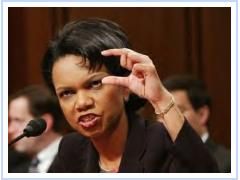
Answer 2: His brain. (Shame on you vulgarians.)
Confused by Alterman's longing for Wolfowitz's approval -- at one point he suggests that Wolfowitz is the "perfect choice" to negotiate a peace settlement between the Israelis and the Palestinians and writes, seemingly in jest, "Somebody please run with this idea so I can go down in history as having lit the spark that solved the Palestinian problem" -- I asked my truly left-wing friend William Osborne to have a look at Alterman's item. This was his response, which pinpoints what's wrong as I could not:
The ironic subtext is that Alterman is very proud of himself for being invited to such an elite party. As Chomsky has noted, a principal function of elite universities is socialization in elitism itself. The status to get to these parties is what people like Alterman live for. All the talk of Harvard, Yale and the University of Chicago combined with such a deluded political atmosphere gives a sense of Washington's phony grandeur. There is something about Wolfowitz that is so tacky it would put off people even in my little hometown in New Mexico. Our country is slowly assuming the odd character of a nouveau-riche Raj in the early stages of a hokey empire. Alterman and the politicos pose with cocktails, so enamored of themselves, and yet the backdrop is so odd: a city with unbelievably massive ghettos, no decent mass transit system, depredation and poverty everywhere outside its grand monuments to power. The list of domestic short comings goes on and on, but never mind, we have our cloddish social Darwinist neo-cons and Doonesbury liberals delighted at being invited to the posh parties of the powerful. Conquering countries is so much more fun than building subways or creating decent high schools. One could sit in a corner at the party and see that history never changes. The march of folly will eventually collapse, rotted within.
Veteran art-news reporter David D'Arcy has been taken off the air by National Public Radio (NPR) after the Museum of Modern Art complained about his report on the long-running controversy over the ownership of Egon Schiele's painting, Portrait of Wally. Though the painting was stolen by the Nazis from Viennese dealer Lea Bondi in 1939, its present owner, the Leopold Foundation in Vienna, refuses to return it to Bondi's heirs, and a contentious court battle has raged ever since the painting turned up in a 1997 MoMA exhibition.
Tyler Green mentioned it this morning in a brief post in his ArtsJournal blog, which is how I learned of the news. Coincidentally, I've just received a message (pointing out the story) from a very unhappy West Coast radio producer who is outraged by NPR's action and is seeking support for D'Arcy:
Jan, This is an awful story about one cultural institution exerting its prestigious might and another, a respected journalistic entity, rolling over and playing dead. It's been roiling for about a month but efforts to resolve the case have not moved NPR to listen to reason.David D'Arcy is one of only a few reporters who understand and have been covering the complex Nazi era art restitution story and he is a respected arts reporter. No print media have yet reported the story [that NPR has dropped him]; artnet.com is the first to report it publicly. You can read who has rallied in support of David, and it's stunning that NPR has refused to reconsider its very weak and unsupportable position. [Morley Safer is among them.-- JH]
This news story is not being sent to you by a disgruntled NPR insider or a right-wing nut out to get the network, or from any Jewish support groups offended by comments in the story, but rather from an organization closely associated with the network that is very concerned about how badly and wrongly the network is handling this.
Artnet News has provided the story and I hope it will be further shared with people who care about what's left of the credibility and integrity of the media. As one of the last bastions of reliability, it is stunning that NPR would allow itself to be bamboozled and buy into becoming part of MOMA's spin machine on this story.
NPR is hiding behind the cover of "it's a personnel matter, we can't discuss it." Well, in fact, D'Arcy has been an independent contractor and has been there 21 years. The chill inside the organization is palpable, and the language flying around about it sounds like that used in Mao-ist "reeducation camps."
Suffice to say, the story ran during the Christmas holiday lull, so the real question is: If there were questions about the story, why weren't they asked by the appropriate editors and managing editors at the time? Who's protecting whom and why?
By the way, there are underwriting spots on NPR's programs, paid for by a foundation that touts the opening of MOMA's new downtown museum.
Full disclosure: David D'Arcy once interviewed me for a report that was broadcast on NPR about William Wyler and a biography I wrote. It was a very long time ago, almost a decade, so I don't think I have any conflict of interest in posting this item.
With the arrival of the Vienna Philharmonic on Friday for three concerts at Carnegie Hall, the orchestra's historic exclusion of women (not to mention its racist ideology) is to be discussed that afternoon on Soundcheck, the WNYC New York Public Radio talk show about music and culture. Invited to air their views about the orchestra's discriminatory practices are two feminists -- the composer and scholar William Osborne, a longtime critic of the VPo's hiring policies, and Abbie Conant, the former principal trombonist of the Munich Philharmonic.
"It would be a chance to look at the history of this issue," Soundcheck producer Brian Wise notes, "where progress has or hasn't been made, the questions of whether female musicians can or can't affect the sound of the orchestra, and where Vienna fits in alongside other European orchestras on this issue."
Another guest with a different point of view from Osborne and Conant is also to appear: James Oestreich, classical music editor of The New York Times, an apologist for the orchestra in my view. Soundcheck broadcasts at FM 93.9 on weekdays from 2 to 3 p.m. in the New York region. Here's the Souncheck archive of past shows. You can listen to them online. For some background about the issues and Osborne's Internet activism, go here: "Taking on the Vienna Philharmonic."
Meantime, yours truly appears on the tube this morning in an hourlong interview about my literary/journalist wanderings on Conversations with Harold Hudson Channer. The program airs 10:30-11:30 a.m. on Channel 34 of the Time/Warner Cable Television Systems in Manhattan and on Channel 107 of the RCN system. "Conversations," which airs Monday to Friday, is also streamed online during the broadcast at MNN.org. (I've never been able to get the link to work. Maybe you can.) Channer's guest in a repeat show on Wednesday will be Andre Schiffrin, who ran Pantheon Books at Random House for 28 years and subsequently co-founded the alternative commerical publishing house The New Press.
 Hammond Guthrie points out that the Guardian in London has a weeklong series,
beginning today, about Robert Crumb. And
Robert Hughes explains his continuing relevance. "It was
always such a treat when Crumb would appear late night al fresco at Enrico's in San Francisco,"
Guthrie messages. "If he knew you or recognized you from the neighborhood he would come up
to your table, glare at you through his coke-bottled eyes, and say: "Comix?" as he opened
his trench coat to flash his little ZAP books attached to the inner lining of the coat."
Hammond Guthrie points out that the Guardian in London has a weeklong series,
beginning today, about Robert Crumb. And
Robert Hughes explains his continuing relevance. "It was
always such a treat when Crumb would appear late night al fresco at Enrico's in San Francisco,"
Guthrie messages. "If he knew you or recognized you from the neighborhood he would come up
to your table, glare at you through his coke-bottled eyes, and say: "Comix?" as he opened
his trench coat to flash his little ZAP books attached to the inner lining of the coat."
I've had my say about neocon Sufi Stephen Schwartz, and several Straight Up readers have had theirs. So here's his say. It arrived in an email message. The header began: "I thought you were dead." The message itself continued downhill from there.
On the evidence I've seen, Schwartz has a faith-based belief in wishful thinking -- primitive thinking, ethnologists might call it, as in magic incantations and sorcery -- so I take his meaning to be: "I wish you were dead." In other words, he was giving me the Evil Eye.
Now to the message:
You were never very bright, but isn't it interesting that you're writing so much about me, but that nobody ever writes about you?
[His bloviating self-importance remains intact. -- JH]I figured you'd somehow get that you were dumb to write off three-piece suits in the hippie era, an interest in surrealism (about which more below), and Sufism as "wrong." Surrealism was not a nonexistent movement then. Lamantia showed up a few years later and we had some interesting, long chats. Your alma mater, City Lights, even installed a surrealism section right by the door. But I'm glad to be your whipping boy, as I have new books coming out from serious publishers, which it seems you don't, and can use the extra publicity.
[No one ever doubted the existence of Surrealism as a European movement in art and literature that grew out of Dada in the 1920s and flourished through the 1940s. A San Francisco surrealist movement in the 1960s is what I doubted. The reference is to Philip Lamantia. If a chat between two people makes a movement ... oh, never mind.]I notice you dis the academy, but brag about placing your archives at Northwestern. Hmmm. I never became an academic. So describing me as an academic proselyte is a little silly.
[Yet another instance of willful incomprehension. Sometimes the worst pedants never make it into the academy.]What's your beef with Sufism? I'd much rather be a navel-gazer than a necrophile off the corpse of Herbert Huncke, of all people. I knew him, too, well enough to see through that scam. I thought nobody had heard of Taylor Mead in at least 20 years. He's still alive, too?
[My beef isn't with Sufism, about which I couldn't care less, but with a particular Sufi. Why am I not surprised that Schwartz, a former obit writer for the San Francisco Chronicle, thinks in terms of corpses and necrophilia? And now he's giving Mead the Evil Eye.]I remember your ridiculous "Answers to Questions from J.J. Lebel." He was a latter-day surrealist, you know -- I met him in Paris later, at the same time as I visited Breton's house and met his widow. You can read about that on THE WEEKLY STANDARD website.
[More advertisements for his inflated self, but I'll give him the link.]
Keep at it, guy. Playing jazz "in your head" sounds suspiciously like making love "in your head," but you're what, at least 65 now, right? That photo of you [left] makes you look real old. A little too old for the salsa clubs, but who am I to judge?
[No sense of humor and an age-ist, too. What difference would it make if I were 65, which I look forward to reaching one day?]Don't bother to answer.
[Aw, shucks.]
Schwartz then followed up with another message:
Making fun of my initials is real clever. Did you know that I became a Sufi in Bosnia where among other things I served as an unpaid investigator of war crimes? I retired from my job at the SAN FRANCISCO CHRONICLE to work in the Balkans. Not as important or as morally worthy as keeping the reputation of Herbert Huncke alive, but it works for me.
[Unpaid investigator of war crimes? Not to be too cynical, how about freelance reporter seeking the main chance?]
But don't take my word for it. Take Clifford Geertz's. In the New York Review of Books Geertz termed him "a strange and outlandish figure," which is putting it mildly. He traced Schwartz's peculiar zig-zags from an anarchist-Trotskyist, who started out by calling himself "Comrade Sandalio," to a cheerleader for Reagan's war in Grenada, as Amir Butler notes. Veering from a self-described "internationally recognized surrealist poet" who believed in "the class struggle" to a New Age rightist, Schwartz was someone whose compass never pointed north. "The only consistency in [his] career has been the frequent ideological shifts that have characterised it," Butler writes.
Schwartz's "strange journey," a message by Pravda.ru writer Bill White that appeared on a Marxist mailing list, gives these details:
[L]ooking into his history -– from his days as a reviled member of San Francisco's far-left anarchist-punk community, to his conversion to Jewish conservatism in the mid-1980s while working on a CIA-funded report on Grenada, to his sudden reappearance on the modern political scene as a spouter of pro-war anti-Muslim hate -– one can see that Schwartz has always been perceived as a blowhard making any ridiculous statements he thinks will impress his audience, without any real convictions or evidence to back them up.
Let's admit that White is a weirdo white supremacist anti-Semite, as Schwartz has pointed out, and that the Marxists on the list had a bitter falling out with their former comrade. So their testimony is highly questionable. But this description by Keith Sorel, from the Winter 1994 issue of Anarchy! Magazine, dovetails with my recollection of Schwartz and strikes me as accurate indeed:
In the summer of 1984 [I] made contact with "Comrade Sandalio," also known as Steve Schwartz [who] claimed he'd found the philosophers stone of the class struggle ... Schwartz claimed that the Russian and German revolutions and all the revolts and uprisings since 1917 [have] been minor footnotes to the union-controlled San Francisco General strike of 1934 ... I began to detect a pattern of screwy activity. Schwartz had a penchant for making grandiloquent statements and later retracting them or refusing to back them up. ... In Caffe Trieste in North Beach he repeatedly bragged loudly that he was "one of the world's leading historians of the Spanish Revolution."
Well, have we had enough of Schwartzy boy? I have. Movin' on.
I sent a copy of my comments about the Weekly Standard article on "Million Dollar Baby" to a friend whose brother's neck was broken in a classic diving board/swimming pool accident 20 years ago and who is now a quadriplegic. She had seen the movie, and it hit her hard -- she said she sobbed uncontrollably during the latter part. I thought you might be interested in her response to the film as well as to the right-wing attacks on it.
 She wrote him that conservative efforts would backfire and actually
boost the movie's popularity just as the Catholic Church's banned-book list helped sell books
during the '50s and '60s. Further, since "Million Dollar Baby" has already won the Oscar for best
picture, conservatives can't hurt it. More important, she added this powerful note:
She wrote him that conservative efforts would backfire and actually
boost the movie's popularity just as the Catholic Church's banned-book list helped sell books
during the '50s and '60s. Further, since "Million Dollar Baby" has already won the Oscar for best
picture, conservatives can't hurt it. More important, she added this powerful note:
I love the way people without experience expound on [the immorality of helping someone die]. Though some quadrapalegics may be living satisfying lives, I don't know any of them. My brother tries to keep up a good front, but it takes him five hours to get up, another five to get into bed -- even with range of motion exercises, etc. -- that is, when an aide shows up to help him. That leaves him about three good hours in each day. He often sleeps in his chair if the night aide doesn't show. He has no control over his bowels, so has to have someone help him go to the bathroom once a week and often has accidents (lots of integrity there). After 20 years post-injury, my brother often cannot sleep at night due to his spasms, because he refuses to take the high dose of Valium prescribed to help him sleep. He is petrified to go into a home, as he fears the treatment he would receive. Believe me, it is no way to live.
She also notes defiantly, "If he had had a leg amputated and such terrible bed sores, and began biting his tongue trying to kill himself [as the Maggie does in the movie], I would consider finding a way to help him."
Meantime, shifting gears to "shallow and satirical," Matt Haber of Low Culture has posted details of the sequel "2 Million Dollar Baby." Be prepared to laugh.
Read "Fear and Loathing: On the Campaign Trail '72" -- the chronicle of his Rolling Stone election coverage -- and you find that his diagnosis of journalistic dysfunction hasn't aged a day: "The most consistent and ultimately damaging failure of political journalism in America has its roots in the clubby/cocktail personal relationships that inevitably develop between politicians and journalists." ...Thompson was out to break the mainstream media's rules. His unruly mix of fact, opinion and masturbatory self-regard may have made him a blogger before there was an Internet, but he was a blogger who had the zeal to leave home and report firsthand and who could write great sentences that made you want to savor what he found out rather than just scroll quickly through screen after screen of minutiae and rant.
And since it's funky Friday, here's a fear-and-loathing poem by Leon Freilich about "the nuclear option," a Republican proposal being considered in the U.S. Senate. It's "a legislative bomb that threatens the rights to dissent, to unlimited debate and to freedom of speech," writes Sen. Robert Byrd, a Democrat from West Virginia who's been around since the days of Cain and Abel.
THE PRESIDENT SPEAKS
The law's the law, the Bible states,
Even when it's nuculer;
The Dems are
anti-legality
While the GOP is scrupuler.
Vox pop, from ancient times till now
Reflecting the Deity,
Proclaims that all the
Dems are damned
To be the minority.
Another Straight Up visitor, citing Schwartz's unfortunate initials "SS," writes of his article: "I love the part where SS trashes Burroughs & Ginsberg as irrelevant to any time but their own. Obviously he hasn't read them recently. They have never been more relevant than right now. We are seeing their visions come to life in front of our eyes."
The item also drew a response from a reader about another Standard article by columnist Wesley J. Smith, which dealt with Clint Eastwood's Oscar-winning flick "Million Dollar Baby":
I am intrigued by how fiercely the conservative media are orchestrating attacks on [it], apparently because it presents a case for euthanasia at the end. In this article -- "A Million Dollar Miss" -- they actually give away the story's ending, probably to dissuade people from bothering to see it. The intent seems to be to sabotage it as much as possible. That, apparently, is how they deal with things that are not in accord with their beliefs. It reminds me of the zealous religious police in countries like Saudi Arabia."
Point taken. But in fact, many reviewers have given away the ending of Eastwood's flick, sometimes warning of spoilers and sometimes not. More to the point is this: The Standard columnist paints the picture as Nazi-style propaganda by drawing a specious parallel between "Million Dollar Baby" and the 1939 German movie "I Accuse" ("Ich Klage An").
"It is striking and disturbing how similar the plotline of "Million Dollar Baby" is to the voluntary euthanasia story in "I Accuse," Smith wrote, while noting that "I Accuse" had "Goebbles's blessing" and "promoted voluntary euthanasia as well as the propriety of killing disabled infants."
I'd like to get away from all the Nazi references that seem to be multiplying right and left, including my own. But these days, for good reason, it's difficult, maybe impossible, even (especially?) in the U.S. Senate.Gawker took note of the Straight Up item about right-wing navel-gazer Stephen Schwartz laying his dead hand on Hunter S. Thompson. Our staff of thousands says thanks to Gawker for boosting traffic and welcome to all you newbies. So, while we have your eyeballs ...
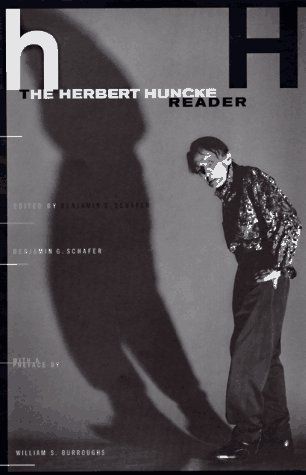 "The 80s: 326 Years of Hip," a group show of four
octogenarian artists at the Clayton Gallery & Outlaw Museum on Manhattan's Lower East Side,
has been extended "due to popular demand," gallery owner and co-curator Clayton Patterson
says. To celebrate, the gallery will host a literary evening on Friday. Readings from the writings of
Beat memoirist Herbert Huncke will feature actress/author Tatum O'Neal, performance artist
Edgar Oliver, writer Jack Walls, video artist Anne Hanavan, screenwriter Jeremiah Newton,
Warhol Superstar Taylor Mead, poet Ira Cohen, photographer Dash Snow, and plenty of others
from the alternative underground. Be there, starting at 7 p.m. (161 Essex St.) (At right, "The Herbert Huncke Reader.")
"The 80s: 326 Years of Hip," a group show of four
octogenarian artists at the Clayton Gallery & Outlaw Museum on Manhattan's Lower East Side,
has been extended "due to popular demand," gallery owner and co-curator Clayton Patterson
says. To celebrate, the gallery will host a literary evening on Friday. Readings from the writings of
Beat memoirist Herbert Huncke will feature actress/author Tatum O'Neal, performance artist
Edgar Oliver, writer Jack Walls, video artist Anne Hanavan, screenwriter Jeremiah Newton,
Warhol Superstar Taylor Mead, poet Ira Cohen, photographer Dash Snow, and plenty of others
from the alternative underground. Be there, starting at 7 p.m. (161 Essex St.) (At right, "The Herbert Huncke Reader.")
The show's opening "was a smash," Patterson says. A jam-packed crowd of more than 100 underground and outsider luminaries showed up, including artist Andre Serrano, poet Gerard Malanga, photographer Ryan McGinley, writer Victor Bockris, writer Larry "Ratso" Sloman, publishers and writers Foxy Kidd and Romy Ashby, and performance artists Edgar Oliver, Penny Arcade and Karen Finley.
Oh yeah, mustn't forget: The octogenarian artists whose works are being exhibited in the show are Mary Beach, Boris Lurie, Taylor Mead and Huncke, who died at 81 in 1996. Have a look at this.
Sites to See
AJ Ads
AJ Blogs
AJBlogCentral | rssculture
Terry Teachout on the arts in New York City
Andrew Taylor on the business of arts & culture
rock culture approximately
Laura Collins-Hughes on arts, culture and coverage
Richard Kessler on arts education
Douglas McLennan's blog
Dalouge Smith advocates for the Arts
Art from the American Outback
For immediate release: the arts are marketable
No genre is the new genre
David Jays on theatre and dance
Paul Levy measures the Angles
Judith H. Dobrzynski on Culture
John Rockwell on the arts
Jan Herman - arts, media & culture with 'tude
dance
Apollinaire Scherr talks about dance
Tobi Tobias on dance et al...
jazz
Howard Mandel's freelance Urban Improvisation
Focus on New Orleans. Jazz and Other Sounds
Doug Ramsey on Jazz and other matters...
media
Jeff Weinstein's Cultural Mixology
Martha Bayles on Film...
classical music
Fresh ideas on building arts communities
Greg Sandow performs a book-in-progress
Exploring Orchestras w/ Henry Fogel
Harvey Sachs on music, and various digressions
Bruce Brubaker on all things Piano
Kyle Gann on music after the fact
Greg Sandow on the future of Classical Music
Norman Lebrecht on Shifting Sound Worlds
publishing
Jerome Weeks on Books
Scott McLemee on books, ideas & trash-culture ephemera
theatre
Wendy Rosenfield: covering drama, onstage and off
Chloe Veltman on how culture will save the world
visual
Public Art, Public Space
Regina Hackett takes her Art To Go
John Perreault's art diary
Lee Rosenbaum's Cultural Commentary
Tyler Green's modern & contemporary art blog
