June 1, 2008

ElliasonWaterfallscaff.jpg

MOMA and PS1 prepare the public for the "Watersfalls" later this month in NYC.  The the scaffolding has been constructed under the Brooklyn bridge. Photo taken on May 26.

From the Bay Area and Boston emerge artworks that are mainly science projects overlaid with pretty colors so they can be called "art".  The interaction is fun for ten minutes and we like to take new visitors as they will marvel.  We fake enthusiasm based on a memory our our first time so that we can truly enjoy their reaction.  But the work fails to provide any personal thrill again.  And for all the statements by the artists and curators, no significant thought comes to mind at all - except the terror of the possible future.


Olafur Eliasson moves between public science project and public art.  Many are science tricks directed toward internal artworld reflections.  A moving colorfield painting in light, the live black&white 3-D movie or the invisible white gallery box inside the white gallery box.    Some are little silly like the reverse cascading waterfall where he sprays the water up from one pool to the next.  


The genius of Eliasson emits from his stubborn battle with the photographic record: still or moving.  He seeks to make works that can only be completely appreciated through "being-in" the artwork.  (I have written about "being-in" regarding the architecture in the northwest USA - a place grounded in Scandinavian culture like Eliasson).  Yet, many of Eliasson's best installations "The Weather Project" at the Tate Modern in London and the 360 Degree Room of All Colours at MOMA generate "artistic" amateur photos in the same way as Gromley's work.   His is a battle, not a rejection.


ElliasonTatel.jpg

Anything claiming to be art requires the in-person experience to be fully appreciated.  If you see a documentary picture or video of an artwork and think the artwork will be the same in person, then in my book you have a problem.  (Of course the LCD monitor or paper magazine can be the intended home of the art.)  The amateur photographs of The Weather Project make me want to be there.  Through the photos, I have a sense, true or not, that the experience would be romantic and enveloping.  Gromley's work makes me want to compete in the undeclared photo taking contest, not necessarily to be in the space.  Eliasson's photos make me dream of the visit.


Two of the works at MOMA are brilliant and the "Take Your Time" room at PS1 exceeds any carnival fun-house of mirror rooms and tricks.  Completely ignored by nearly all visitors, beige moss - of a type used for architectural models - densely covers each inch of the large gallery wall.  Moss Wall is a visual trip over the Amazon Rain forest.  Only by viewing the work from 6-10 inches can it unfold.  As that visual range, the human eye and brain together imagine "depth of field" and a complete 3D visual experience that become physical.  The human brain feels the tiny changes in elevation as you move your head and eyes like an airplane plane. But at 200 or 300 feet above a real forest, the eyes and brain do not feel any 3D effect.  Eliasson discovered that multidimensional physical reactions can be sparked in the body.


ElliasonColorRoom.jpg


360 Degree Room of All Colours turns color into music.  The circular space changes its pastel colors in slow repetition.  The light level is PERFECT for the human eye in that pupil is fully open without the need to squint.  If you stare into the fabric walls from 10 inches, your entire field of vision fills with one color.  Only on a sail-less boat in the sea with a low sun, can you stare at the dome of the sky with a similar full view of blue. I loved it, but this is not the surprising part.  If you sit of floor and a stare, the color change from washed out to very intensive pastel.  My body started to feel the motion of the colors in ways that can only be compared to music. The chemical levels in my body shot up with the swelling of the color intensity.  


Since architecture school, I had been told of psychological power of color, but never the physiological.  Still part science, but like other chemicals in the body, I am hooked and looking for my next dose.  


  ElliasonmirrorFloor.jpg


Elliasonmirrorceiling.jpg

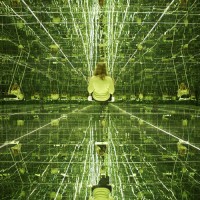
Finally, Take Your Time at PS1.  A huge disc cover red in reflective mylar rotates very slow on the ceiling.  Immediately, everyone dives to floor and looks up.   Your brain tells you that all the people - including yourself - are not lying on the floor, but suspended magically on a vertical wall with less effort that Spiderman.  That is the fun house trick.  The questions is - why do you want to lay there for minutes and minutes?  People don't want to leave. 


The mirror is tilted about 3%.  Patience and 3% is the genius of the work.  The angle causes the reflection of the visitors and the walls of the room to change very, very slightly in a loop.  Again, somehow and for some reason, the brain knows that the view is changing and therefore remains alerts and interested.  Unless you move the very edge of the disk, you can get yourself to consciously recognise the change.   Like the colors in the 360 Degree Room, you body responds - in this case the brain - without consciousness. 


Perhaps Eliasson has invented the first of science of art since gestalt. 


I don't know how other creative people can utilize Eliasson's operational observations, but the work drives home the memory of special sunsets and hours napping adjacent to a waterfall in the forest.  He proves that humans can make the spaces that facilitate these calm and happy moments.  Thank you Mr. Eliasson 


Thank you for the Images

Matt Verzola

AndrewPaulCarr

Giant Flickr Eliasson pool  


ElliasonWaterfallReal.jpg

 The Waterfalls produced by the Public Art Fund.  Opening soon.

June 1, 2008 12:04 PM | | Comments (2)
May 29, 2008

deckchair_img.jpgInstead of the cows, etc, the Royal Parks Foundation has commissioned paintings or prints on the drooping canvas of a classic deck chair.  The Foundations states:  Deckchairs have become a very British icon since the design was patented by Macclesfield businessman, John Moore in 1886.  The Titanic boasted 600 deckchairs - only six of them survived the sinking and one of these, believed to have been used as a makeshift life-raft, was sold at auction in 2001 for £35,000.


The "Celebrity Artists" did a fine job.  One of the artists, Jonathan Yeo, was withdrawn from public display for a clever pun of falling leaves (oak, but think fig) with images of formerly covered genitalia.  The Foundation is displaying and selling the Yeo chair at its website.  See the Guardian.  Bid now on online or attend the auction on June 3 in London


DeckchairsArtists.JPG

But the most interesting part for me is the very, very high quality of the winning children's designs.  Are all children artistic gifted under the age of nine years old?  How does human culture suck this instinct out of our being?

DeckchairsKids.jpg 


May 29, 2008 8:00 AM | | Comments (0)
May 17, 2008

Returning to New York City after a 20-year journey in Seattle and South Florida.  New York taught me how to think art.  

Psychologically, NYC has changed dramatically.   Signs in the subway remind parents to keep baby carriages off the escalator.  Street territory has been reapportioned for small plazas to hangout or walk more comfortably.  Only a few of the former down-and-out residents of the street remain.  The permanent abandonment of former brick tenements has ceased.  Dark windows signal the wrecking ball and renewal, not the hopelessness. 

Of course, the dark hopeless territories still exist, but many, many people can live and work in Manhattan rarely encounter the misery.  In the 1980s when I organized artistic critiques of the civic abandonment, all peoples in Manhattan had to divert their hearts away from the people of the streets or the five stories of broken glass.  We artists were saddened and angry at the diversion- but that anger sparked thought, energy and action through art or body or both. 

On Wednesday, I revisited one of the most dangerous Manhattan zones in the 1980s - the meatpacking district.  Today, the pristine storefronts are so numerous and trendy that both Samantha and Carrie from "Sex in the City" shopped there. I thought I was walking in some kind of strange dream where the fairy godmother swooped her wand and sparkled the filth into beautiful clothes for everyone. 

One art gallery, Leo Keating Gallery, had sponsored an art event to raise money for the new Highline park that will open in a few months.  The use of the old elevated rail tracks was a favorite student architecture project in the 80s and 90s.  One of architect Steven Holl's very early theoretical projects proposed housing on the tracks.  Now after ten years of advocacy and fund raising, the Highline will become a public park - an important part of the literal greening of Manhattan. 

To raise cash, the gallery was selling fluorescent green chalk shoes by Julia Mandle. Earlier in the month, she put shoes on various students from nearby schools and they drew a path on the sidewalk to the Highline.  A simple idea to tell the children, their friends and their parents that the Highline was coming to the neighborhood.  On the night of the gallery opening, she and a friend where making an apparently arbitrary path through the new glamour of the meat packing district.  Following the path that evening would lead you to the gallery or to her on the shoes. 

PathonStreet.jpg

The gallery did not have significant posters about the Highline and the artist was not carrying any information with her.  This absence of information is a very New York thing that does not happen in other parts of the USA.  As I remember from days past, the New York art world believes that explanation apparently degrades the artwork.  Converting the thing from art to advertising. 


PathwithShoes.jpg

My new paying job is to create a consistent public art program for the Times Square Alliance.  Advertising, not art, dominates Times Square.  So my new work takes me straight to conflict between the instinct for ambiguous poetic connotations of art and the directive for the clear targets of advertising. 

Yet the visitors to Times Square desire the unexpected.  The protective judgments about art back home are abandoned in Times Square and the energy of strangeness is embraced.  Instead of secrecy of naughty personal acts in the Vegas slogan "What happens here, stays here", a visit to Times Square might generate a celebratory slogan like "Look what happened to me here".  The visitors snap pictures of every new billboard and ask a friend to record their strange encounters with Naked Cowboy or the two Statues of Liberty that graced Times Square today with a background of Peruvian flutes.  What better place could exist for public art to receive the full acceptance of all types of folks?

CowboyinSquare.jpg

May 17, 2008 7:36 AM | | Comments (3)
March 16, 2008

On April 11 in North Carolina, Glenn Harper, Editor of Sculpture Magazine and Bill Thompson, Editor of Landscape Architecture, and I meet to kick off the "Public Art 360" Conference.  Click Here to Attend.  In the next few weeks, I will publish some of my letters to Harper and Thompson in preparation for the dialogue. 

 
Once in my life, I gave the same ten minute talk back to back.  The same ideas were written for different audiences:  1.  architects and 2. buyers of architect's services.  Everything changed. 
 
Like the other public arts - movies, architecture, landscape, graphic design and fashion -, public art has extremely different conceptual structures for the visual or cultural critic and for the casual, yet serious observer or participant.  And in the middle is the third point of view: the public buyer of public art. 
 
Visual/Cultural Critic:  Very little writing. Most serious writing focuses on temporary works that engage the social/cultural connect of the physical place or community.   Almost no serious writing on permanent works except when prominent museum artists are commissioned.  But this is also rare and many of the museum artists ignore the context in permanent works.  The top professional public artists  are more likely to receive critical assessment from the design critics (architecture, landscape, city planning) than art critics.
 
Casual, yet Serious Observer:  A lot of published writing in local newspapers and online that focuses on the person of the artist, the method by which the artwork came into being and the opinions of citizens and visitors regarding the artwork.  Generally if the artist is known personally and the making of the art was participatory, the opinions will be positive.  If the work was selected and installed, the story will be initiated by negative opinions.  Ignoring the "government should not spend $$ on art or overpaying for art", the negative opinion is "Not appropriate to this community" relating to the content or specific execution of that content.  Another true and valuable concern of the casual observer: the very limited government dollars for art should be spent intelligently.
 
Public buyer of public art:  The buyers started as an introduction of museum art to the general public (education function) and enhancing our public spaces with contemporary artwork (visual function) as had been typical of Roman culture and the neo-classical plaza and city design.  In the 70's buyer's tried homemade work from the community as did the landscape architects.  In the mid-80s, the buyer's changed from neo-classical role to a more universal role of decorating the architecture in collaboration with post-modernism.  In the mid-90's, the buyers started purchasing from "professional public artists".  Today, enhancing the pedestrian experience dominates plus the buying civic icons of a grandscale for the tourist photograph. 
 
As I look over the list above, I realise that I write from the position of the public buyer of public art.  What are new products and new methods? Who has a fresh way of thinking about public art?  What intellectual framework exists for public art evaluation?   Joyful and angry observations.  When my blog sparks a dialogue, it is usually about the validity of the method or elements of the evaluation. 
 
Who is writing for the casual but serious observer?  Is everyone ignoring the client?  Or is the "general" client an impossible task when the functional and fiscal excuses are removed?  Does the best public art only appear where a sub-group of the general public is identified as the client and that is OK within the local political system?
 
Thumbnail image for noexperts.jpg 
FREEE on Thomas Heatherwick sculpture in UK. 
 
For further thoughts, see the dialogue on IXIA, public art think tank, in the UK. David Patten on the failure of public art agencies to let artists fully participate in the early stages of facility planning despite the appearance of participation. The FREEE artists have fun providing labels for public art.  Lorraine Leeson, a community oriented public artist, creates the best list of myths and hopes related to public art. 
 
Also some good commentary among the commenters at Cyburbia blog: Questioning Public Art.   
 
 
monarchs.jpg 
FREEE on Queen Victoria in the UK

LATE ADDITION
The Arizona Republic has created an online opinion of 20 works created for Phoenix since 1988.    After you vote for each work, you can see the results.  All works are recieving supporting from greater than 50% of the voters. 


SEE GOOD COMMENTARY BY RIES IN THE COMMENTS.


Subscribe to Aesthetic Grounds Bi-Weekly Summary:


Digg it...Del.icio.us ...Technorati...Stumble Upon..Reddit
March 16, 2008 9:46 AM | | Comments (1)
March 11, 2008

YellowSpringsTree2008b.jpgAt the end of last week, two public art projects competed for media attention in the USA. In the small town of Yellow Springs, Ohio, a few local women knitted a sweater for ONE tree during a winter day. Any volunteer knitter could climb the eight-foot ladder and add her wrap to the tree trunk or limb. In Las Vegas, two of world's largest resort and gaming corporations announced a $40 million dollar expenditure for fine art at the future CityCenter $8 billion casino and resort. New huge artworks have been commissioned from Jenny Holzer, Nancy Rubins, Maya Lin and Richard Long plus the display of large existing works by Oldenburg/ van Bruggen, Frank Stella and Henry Moore.

Here is the result of "Head to Head" public art media blitz.

Yellow Springs Knitters

· Strategy: Someone must have known a local AP stringer. Stringer pitches story to AP. Report with picture hits the AP wire.

· Results: Multiple publications in daily newspapers across the United States including Washington Post, NY Times, Boston Globe, International Herald Tribune, etc, etc, etc.

· Economic Development: Yellow Springs spreads its reputation as an "artsy" community.

 MGM Mirage and Dubai World

· Strategy: Write the article in the form of a press release and distribute via prnewswire.com. Call up editors and reports at various papers. Push hard.

· Results: One print article outside Nevada in the NY Times with online slide show that was picked up and republished in Taipei. Partial or full posting of prnewswire text on online business or gaming websites.

· Economic Development: Las Vegas has upscale resorts equivilent to Dubai.

  RubinCityCenter.jpg

Nancy Rubin Proposal for CityCenter

 I am interested in why the Yellow Springs knitters out paced MGM Mirage. The greater success Yellow Springs comes from the actual installation of the artwork, not just a story about the future. Real people and their honest reactions could be interviewed on the streets near the tree. The NY Times had to stretch to find a few quotes and a very staged picture of Ms. Lin with a tiny segment of her silver river.

Yellow Springs had other advantages that public art programs might note. The artwork was colorful and clearly understood by a single photograph - strips of knit fabric tightly wrapping the trunk and limbs by local women as a celebration of winter and their own joyful spirit. The visual effect was dynamic on the tree.

Thumbnail image for YellowSpringsTree2008sm.JPGAs reported by AP, Corrine Bayraktaroglu, an artist who helped start the "knitknot tree" project, stated: "People are really, really enjoying it. They're coming from towns to have their photograph taken with the tree."

How many civic art programs strive for this reported comment on an abstract, design-integrated public artwork:    "It looks like Yellow Springs; it's unique, it's colorful, unpredictable," said Lynda Sirk. "It makes me smile. That's what I like." Unique, colorful, unpredictable - all words welcome in any critical commentary on Nancy Rubins, Frank Stella and Oldenburg/van Bruggen in Las Vegas.


knittapleaseSanAntonio.jpg

Houston's Knitta wrapping light poles in San Antonio

I was surprised to learn that knitted artworks for the street are a practiced artform. A group of six artists from Houston called Knitta have been collectively wrapping elements of the street for the last three years. A knittaplease photo collection is available on Flickr.

ColumbusTreesAll.JPG

Tree Cozies in Indiana (photos "The Republic")

Also this winter is the tree cozy competition in Columbus, Indiana. 30 artists wrapped the lower trunk of 30 street trees with knitted works. Alice Dorwsky (spelling help?) of New England has been making beautiful yellow wraps and tree hangings for the last few years.

 citycenterVegas.jpg

CityCenter Design (NY Times Slide Show)

Back to CityCenter in Las Vegas. What to make of the end of bad taste in Sin City? When Steve Wynn added art to his other casinos in the 1990s, the art was tasteful, but not the setting. With CityCenter line up of architects - Foster, Pelli, Vinoly and Libeskind - now the French and other European critics will stop commenting and Japanese youth will stop visiting. Viva Las Vegas might be approaching retirement. Even Las Vegas can become just another flashy resort. What could be worse?

For the record, $40 million is only one-half of a percent (1/2%) of the $8 billion project. So although it sounds and IS a lot of money for art, a typical 1% for art program would receive $80 million.

But still the world was more interested in the $50 dollars of yarn in Yellow Springs this weekend.

OSLOann bergen norway.jpg 

Works by Olsoann in Bergen, Norway


SEE THE EXCELLENT DIALOGUE IN THE COMMENTS AND A NOTE FROM THE ARTISTS IN YELLOW SPRINGS.


Subscribe to Aesthetic Grounds Bi-Weekly Summary:


Digg it...Del.icio.us ...Technorati...Stumble Upon..Reddit
March 11, 2008 11:08 PM | | Comments (6)

About

Aesthetic Grounds The dialogue on public art and public space has almost no American art critics. We need some.

Glenn Weiss Writer in Delray Beach, Florida, and formerly in Seattle and NYC.

Visual essays

www.glennweiss.com

Contact me Click here to send me an email...

Archives

Archives: 105 entries and counting

Linkable

Current Links: October 


Yoko Ono's "Imagine Peace" tower of light was turned on on October 9, 2007.

Chris Doyle's new "The Moons" project is dedicated on October 10, 2007 in Kansas City. Video of 600 residents jumping on trampolines is remixed to give the impression of flying.

more picks

Blogroll

Find recent content on the main index or look in the archives to find all content.

AJ Ads

Introducing
AJ Arts Blog Ads

Now you can reach the most discerning arts blog readers on the internet. Target individual blogs or topics in the ArtsJournal ad network.

Advertise Here

AJ Blogs

AJBlogCentral | rss

special
Program Notes
the blog of the National Performing Arts Convention
culture
About Last Night
Terry Teachout on the arts in New York City
Artful Manager
Andrew Taylor on the business of arts & culture
blog riley
rock culture approximately
CultureGulf
Rebuilding Gulf Culture after Katrina
diacritical
Douglas McLennan's blog
Flyover
Art from the American Outback
Mind the Gap
No genre is the new genre
Rockwell Matters
John Rockwell on the arts
Straight Up |
Jan Herman - arts, media & culture with 'tude

dance
Foot in Mouth
Apollinaire Scherr talks about dance
Seeing Things
Tobi Tobias on dance et al...

jazz
Jazz Beyond Jazz
Howard Mandel's freelance Urban Improvisation
ListenGood
Focus on New Orleans. Jazz and Other Sounds
Rifftides
Doug Ramsey on Jazz and other matters...

media
Out There
Jeff Weinstein's Cultural Mixology
Serious Popcorn
Martha Bayles on Film...

classical music
The Future of Classical Music?
Greg Sandow performs a book-in-progress
On the Record
Exploring Orchestras w/ Henry Fogel
Overflow
Harvey Sachs on music, and various digressions
PostClassic
Kyle Gann on music after the fact
Sandow
Greg Sandow on the future of Classical Music
Slipped Disc
Norman Lebrecht on Shifting Sound Worlds

publishing
book/daddy
Jerome Weeks on Books
Quick Study
Scott McLemee on books, ideas & trash-culture ephemera

theatre
Drama Queen
Wendy Rosenfield: covering drama, onstage and off
lies like truth
Chloe Veltman on how culture will save the world
Stage Write
Elizabeth Zimmer on time-based art forms

visual
Aesthetic Grounds
Public Art, Public Space
Artopia
John Perreault's art diary
CultureGrrl
Lee Rosenbaum's Cultural Commentary
Modern Art Notes
Tyler Green's modern & contemporary art blog
Creative Commons License
This weblog is licensed under a Creative Commons License.