July 5, 2008


neilharpists.jpg

"It's so internal!" my friend Amanda says with admiration about Neil Greenberg's "Really Queer Dance with Harps,"  which premiered a couple of weeks ago at Dance Theater Workshop. One move--a series of changements on half-point--reminded her of a schizophrenic she'd seen outside a hospital in Rome jangling his insides with stiff little jumps.

The insides of Greenberg's dancers are not at risk: they inhabit a whorl of trunk as sturdy as a tree's.  But their bare galumphing feet--smacking the floor exactly as you're taught not to in ballet class--do call to mind Frankenstein's monster (on a good day). They resound not only with social ineptitude but with a rough flamboyance.

Meanwhile, the arms are grace notes of affect and social awareness. So are the flowers in the hair of boys and girls alike. Fragility and delicacy, self-declaration and tribal identification, flitter on the periphery of the body as if the soul and its accessories were butterflies. In one of "Really Queer Dance's" several distinct and disparate phrases, one hand grazes the vulnerable crease of the hip where God forced Jacob to testify (hence, the word testifying), while the other hand reaches overhead like a weather vane or the paw of a disco queen feeling out the scene.

Only the gaze enters the world shed of inwardness--naked. Or tries to enter, anyway. Eyes askew in the head and head askew on the spine as if the effort to meet the world caused all sorts of distortions, the dancers peer at the wall of darkness that separates them from us without recognition--or seduction--in the look.

You know those people who find fault with one lover after another for years on end without it ever occurring to them that the problem might lie in their own conception of love? Well, there's a dance equivalent. It arises from the misconception that dance is the most unmediated of arts, the least artful of arts, a quasi-art that delivers its truths straight. People who believe that they really do like dance, it's only a matter of finding the right dance, are often seeking sheer physicality! sheer feeling! sheer pleasure!  But precisely because dance is physical, which, yes, is tangled up in our minds with pleasure and feeling, it can't only be physical, emotional, pleasurable or it wouldn't be art, it would just be body, feeling, sensation. On the other hand, it has no choice but to present even introspection on the surface. All it has is surface, which does double duty as inside and out.

Greenberg homes in on this poignant paradox--and discovers life sharing it with dance. He not only reveals dance approaching the unconscious via surfaces but even suggests that those surfaces constitute the unconscious.

"Really Queer Dance with Harps" may be no more inward than Greenberg's previous dances. As usual, each dancer is alone with others, never touching (until the goofy coda) and never acknowledging anyone in any conventional sense. And as usual the dancers share a family of gestures that nevertheless means something particular to each of them. It's just that here, the family members are especially distinct. (The eight wonderfully idiosyncratic yet highly trained dancers embodying these moves are Ellen Barnaby, Nicholas Duran, Johnni Durango, Christine Elmo, Paige Martin, Luke Miller, Antonio Ramos, and Colin Stilwell.)

Until recently, Greenberg devised his choreography on his own body, videotaping himself improvising, then editing what he saw for his dancers' consumption. For "Really Queer Dance with Harps" and its companion on the program, the equally glorious though short "Quartet with Three Gay Men," he decided to have the dancers invent most of the phrases. The effect is to intensify the casual-seeming, non-syncopated character of the scene. The phrases seem more than ever like floating idées fixes getting snagged on a person like a plastic bag on a rosebush. Sometimes the gestures get assimilated into her style of being and sometimes they don't.

"Really Queer Dance with Harps" is low key and in no hurry. The movement has more feeling and lusciousness than the Cunningham vocabulary it grew out of. (At this juncture, too many Cunningham dancers treat steps as if they were a task assigned them, above which they can smile at each other, their minds unbothered. Cunningham should get them to commit all of themselves to what they're doing.) And there are, after all, three golden harpists massaging  composer Zeena Parkins' mercurial music into their heart-shaped harps to remind you of the heart. But the dance shares Cunningham's aversion to the conventional dramatic arc, and a present you can sink into and pull back from again and again.

In this respect also, "Really Queer Dance with Harps" is like life.   


For more, here's the esteemed Roslyn Sulcas' excellent review for the New York Times and my friend Nancy Dalva's Danceviewtimes post. For the full monty of previews and views, try Dance Theater Workshop's web site (which has failed to include this blog as well as danceviewtimes, for example, on its blog roll. Sigh. Why even have a blog roll if it's so strictly self-serving?)   


Photo by Julia Cervantes for Dance Theater Workshop.


July 5, 2008 6:12 PM | | Comments (0)
June 19, 2008

harpdancegreenberg.jpg

I should have mentioned Neil Greenberg's show at DTW already, as I've never seen anything by him I haven't liked, if not been deeply moved by. (I'm going Friday, tonight--and may have more to say later). Thankfully, Foot in Mouth contributor Eva Yaa Asantewaa reminded me, with this rave on her blog:

Everybody's thrilled by and writing about Neil Greenberg's new Really Queer Dance with Harps, and you should really queerly or otherwise see it--especially for the radiant trio of harpists, led by composer Zeena Parkins, at the golden heart of the piece. But my own really queer heart has gone and continues to go out to Quartet with Three Gay Men, the 2006 work danced by Greenberg, Luke Miller, Antonio Ramos and Colin Stillwell. It's just--hooray!--11 minutes, and some of that time is spent dancing to RuPaul's "Supermodel (You Better Work)." Can't go wrong, in my book, with RuPaul. And it's a fantastic dance, too, like a prism breaking Greenberg into four avatars who render his spacious movement with luscious, queerforward simplicity. Oh, did I mention it's only 11 minutes? Brevity, the soul of wit.


Dance Theater Workshop
's got Dance By Neil Greenberg through Saturday. Click here to watch a clip of Quartet with Three Gay Men (it's number 4 in the slideshow). Also click here for tickets, preview articles, more rave reviews, and an Artforum piece by Greenberg himself that's really smart. Greenberg should be a big star; the fact that we can see him and his incredible, eccentric dancers up close and for $25 (or less) is amazing for us, whatever it says about the situation of the artist in America. So, Enjoy!


Photo by Erin Baiano; borrowed from The New York Times.

June 19, 2008 11:37 PM | | Comments (1)
June 17, 2008

I try not to resort too often to the common blog tactic of letting other writers do the work, but I won't be able to get anything up until next week and my colleague Joel Lobenthal, of the New York Sun, has written a wonderful tribute to the exceptional Wendy Whelan, of New York City Ballet. So I can't resist. Enjoy! 


whelansotopolyphonia.jpgWhelan and retired principal dancer Jock Soto in Christopher Wheeldon's "Polyphonia." Photo by Paul Kolnik for New York City Ballet.

June 17, 2008 10:46 PM | | Comments (0)
June 11, 2008

I've seen many exciting ballets in the last few weeks--and I knew if I didn't write about them soon (all of them), I'd forget what I was thinking. So this roundup is altogether too long. In order not to fall into a stupor, perhaps you should read it in installments. The photos serve to separate the parts.


concerto dsch.jpg


About Alexei Ratmansky's "Concerto DSCH," my friend Elaine exclaimed, "It's so real!"

    Of course, it's not real, it's ballet. But Ratmansky's eye for what people do together--become voyeurs, perpetrators, flirts, attention-hoggers, rivals, accidental lovers--is so wise and funny that he seems to have lifted scene after scene from life and translated it more perfectly than possible with translation into ballet. It's like when Marge and Homer Simpson become pilgrims--exactly as they've always been except now they're on the Mayflower.

    At one point late in the ballet--the score is Shostakovich's urbanely witty, then brooding, then buoyant Piano Concerto No. 2 in F major--a horde of dancers bursts onto the stage with little flat-footed hops, and everyone laughs, not only because the boing in the step is funny but because, performed en masse, it answers the drama that the dancers have just intruded on. You feel glee --and relief--to find aspects of humanity so instantly recognizable, no matter the language they're spoken in.

    It's tempting to compare Ratmansky to all the other choreographers I admire, not because he's derivative--not at all--but because he ratifies ballet's history by extending it. The choreographer whom he most reminds me of, though, is Jerome Robbins. (I swear, I had this thought before the Robbins festival at New York City Ballet began. Specifically, it was Ratmansky's "Bizet Variations," with its shades of the three rival sailors in "Fancy Free," that clinched the connection for me. That was during the BAM run this winter of Nina Ananiashvili's State Ballet of Georgia, which commissioned the ballet.)

    Ratmansky also makes a real place of the stage. He also is preoccupied with the psychology of the group and of the individual in the group; he also understands the corps not as a corps proper but as a bunch of people, whose relation to one another is constantly in flux. He also recognizes the punctuating power of exits and entrances (like the last word in a sentence or in a line of poetry). Most of all, he succeeds where Robbins desperately wanted to, but only sometimes did: he develops a language that jettisons conventional signs (for Robbins, the "cool" finger-snapping, the maidenly curtsying, the folksy jigs) for what those signs originally conveyed, before they became commonplace. Too often, Robbins got stuck in the middle, retaining the gestures while lifting them from their social context, so they quickly devolved into shtick. Ratmansky saves himself by inventing his own gestures. (He loves inventing steps as only perhaps Balanchine did, and he's got a keen sense of their evocative oomph.) Because the moves are never exactly what you'd see in the world, they offer it with wit and insight.

    On the same program-- it's called Here and Now--is "Rococo Variations," Christopher Wheeldon's last ballet as the company's resident choreographer. I dismissed it at its premiere this winter as even more frou-frou than its Tchaikovsky score, but now, on a third viewing, it seems to have deepened, grown full of mood. Of course I want to think Wheeldon went to work on it, fixing the transitions so that it now feels of a piece, but probably I'm the one who's changed.

    It's embarrassing to be so inconsistent. If I love a piece at first sight, I rarely love it less on a second go, but the other way around happens too often--especially, for some reason, with Wheeldon and Mark Morris.

    It took two visits before I could stand Morris's "Sylvia" and "Mozart Dances." Five for "V." (Believe me, I would have given up by then if the dance hadn't appeared on mixed bills.) Two for Wheeldon's "American in Paris." But I'm not sliding from admiration to adoration here, I'm leaping from impatient dislike to swoony love--a vast distance. 

    Maybe it's a musical thing. Both Wheeldon and Morris respond in detail to their scores, and when their interpretations depart radically from my own dreamy visualizations, I spend the first visit or two simply adjusting--reading the words but not grasping the sentences. I'm glad to have the luxury (the free tickets!) to come again.


Last chance for "Rococo Variations" and "Concerto DSCH" this season: Thursday, 8 pm, State Theater, Lincoln Center. Orchestra, 3rd and 4th ring seats still available. Nycballet.com. (The program consists of four ballets; the ones in the middle are bad, in my humble opinion. You could take a break for dinner and come back for the Ratmansky.) 


Clark_I Do_Stephanie Berger4_partnering.jpg


Speaking of being quickly dismissed--and of music revisited--British choreographer Michael Clark didn't get many reviews for his two programs to Stravinsky scores, presented last week at the Rose Theater as part of Lincoln Center's Great Performers series. So it's nice that the trusty old Times sent a reviewer to both programs--except they sent the same reviewer, Claudia La Rocco, and she didn't like either show! (Once it was clear that Clark irritated her, it was nuts to subject her--and us--to a second drubbing. The Times should have sent someone else.)

    Where La Rocco saw meagerness, sterility, and stale, '80s outrageousness, I found a lot to be intrigued by. (I only saw the second program, which featured "Mmm..." to Stravinsky's "Rite of Spring" and "I Do"--pictured above--to "Les Noces.") But that's neither here nor there: we're entitled to our different views. I do take issue, though, with the bind La Rocco puts an artist in who wants to respond to dance history or even just the music of dance history.

    She concludes her review of "I Do" and "Mmm..." with,

There are neat touches throughout the two works. But Mr. Clark is going up against history here, and neat doesn't quite do the trick.

    If Clark had followed the usual plot line of the ballets, the result would likely be derivative, if not hokey (see: Robbins' "Les Noces"). Instead, he acknowledges the scores' canonical status by assuming we know the story and allowing himself to take a more oblique approach, and he's accused of skirting the issue ("neat touches"). What, then, is there for him to do? This music cries out, as it always has, to be danced to, and we critics should be careful not to muffle that cry.

    For what it's worth, "Mmm..." and "I Do" seemed to me mainly modest and serious (albeit with kinky embroidery), intent on approaching the music in both highly conceptual and highly kinetic and spatial terms (these last two deliciously bound): a difficult approach, which does indeed make success unlikely, but a worthwhile one for its being so unusual.

    While the conventional response to the rhythmic bombast of "Rite" and "Noces" is to meet it beat for beat with percussive steps, Clark translates rhythm into an angularity of the body. The dancers move in flat, Cunninghamesque tilts with right-angled arms. The pieces' necessary texture comes by way of flurries of steps, turns that go against sense, torsos softly abandoning their clear lines to gyre and implode, entrances and exits that materialize unexpectedly (half the time through rotating mirrored panels at the back, which open onto a cement back wall and spotlights beaming directly into our eyes. Ingeniously creepy.).

    The penchant for the planar is very British contemporary-dance-- Richard Alston and Russell Maliphant have it, too--and Americans tend to find it a bit bland. Our strict angles--our Cunningham--is Cunningham, who is more explosive, more suddenly still, whose palette is both larger and more detailed. But the love that the Brits have for the most basic of Cunningham shapes--as if it were a miracle to flatten the body into an X or a Y, how much juice even in that!--is touching and contagious.

    I found the attention the Clark pieces invited was very like that of Cunningham dances, which have no narrative or dramatic arc, either. You get absorbed in the details and are not waiting for anything in particular. But with Clark, anyway, the devastatingly dramatic just may occur. "I Do" ends with the dancers in a tangle on the floor under sickly yellow light, as if they had been downed by poison gas and curled their limbs in to die. (Ah, the spectacle of forever after!) The bride, bedecked in what looks like a tea cozy cum dildo, stands above the wreckage. Trauma and drama presented as incident may be at odds with Stravinsky's "Rite" and "Noces"--all about anticipation, both of them--but so much the better.


Here's a one-minute clip from "Mmm..."  No more Michael Clark for Americans this year, but the company will be touring the Stravinsky fare to Luxembourg, Marseille, Suffolk, and Belfast this summer and fall. Click here for itinerary.


tharprogue.jpg


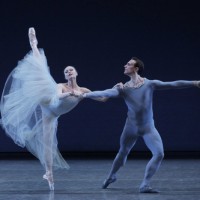
Twyla Tharp's "Rabbit and Rogue" for American Ballet Theatre is all anticipation. You keep waiting for the cartoon roustabouts Rabbit and Rogue and the Balanchinean corps slipping along behind them to either more fully converge or more completely diverge--rather than this semi-demi relationship.

    The premiere last week polarized critics, with more hating it than loving it. I fell somewhere in between, struck when it was over (and it is long) by what a feat it is to make a ballet--a real ballet, which this is, yes--without being struck by wonder at the ballet itself. I was never bored (though I did give way to exhaustion by the very end, having been in a state of anticipation for nearly an hour). But finally it seemed less than the sum of its parts.

    And parts "Rabbit and Rogue" certainly has. The corps is liquid and evanescent, very much in the mode of Tharp's last ballet for American Ballet Theatre, "The Brahms-Hayden Variations," with whatever meaning one derives arriving via the senses. The rapscallions Rabbit and Rogue, on the other hand, belong to the kind of cartoon world that needs a plot. I couldn't find one, but my Artsjournal colleague Tobi Tobias could (hers is my favorite among the reviews I read):

The pair [Rabbit (Herman Cornejo) and Rogue (Ethan Steifel)] sets out to see the world, accompanied by a colorful mix of music by the film composer Danny Elfman. Well, a postmodern idea of the world: They visit Hell, where Gillian Murphy and David Hallberg, alternately quarreling and making love, are the central patrons of a with-it nightclub where the required dress is black, skimpy and spangled. (Outfits by Norma Kamali.)

Next stop is Heaven, a peaceable kingdom, all white gowns and silver trousers, reigned over by Paloma Herrera and Gennadi Saveliev. In this place, one might find serene compatibility, even true love, perhaps bliss. Then the worlds commingle, as in real life.


    I did have the idea that our heroes existed in a different zone from everyone else, though primary colors for R and R, with the black and white for the rest, would have helped. But even this might not have been enough, because for the corps to tell a story, Rabbit and Rogue need one as well, and nothing really happens to them. (Have you ever met a cartoon character who wasn't defined by action? After all, what else do they have?) Rabbit and Rogue, endearingly danced by Cornejo and Steifel, end up seeming like filler in the neoclassical ballet Tharp actually wanted to make.

    Their antics might have at least employed cartoon rhythm. Film composer Danny Elfman's score has been disparaged for "lacking distinction," and it is a hodgepodge. But it starts out with a color and chug--one rhythmic pattern overlapping the next--that demands to be adhered to: Elfman is as dictatorial at the start as his hero Prokofiev. And still Tharp doesn't listen. Given how many of her early works depend on comic timing, it's surprising to find her deaf to it here. Perhaps she had to make the bulk of the dance before the score was finished.

    Besides the corps moving as silkily as a school of fish, the other unalloyed pleasure is Gillian Murphy as half of a "Rag" couple with the acclaimed David Hallberg. Tharp brings out Murphy's silent-movie-star charm; the ballerina returns the favor by inspiring Tharp's most interesting steps.


After roving across Japan and Korea, "Rabbit and Rogue" hops into Orange County in August. Click here for details.


Photos in order of appearance: "Concerto DSCH" by Paul Kolnik for the New York City Ballet; Michael Clark Company in "I Do" to Stravinsky's "Les Noces" for Lincoln Center Great Performers, photo by Stephanie Berger; and "Rabbit and Rogue" by Rosalie O'Connor for American Ballet Theatre.


June 11, 2008 2:37 AM | | Comments (0)
June 9, 2008

To those of you who check in regularly: Thank you, I'm honored. And I apologize for the lull here.

I have a backlog of ballets I'm eager to respond to: Alexei Ratmansky's incredible premiere for New York City Ballet; Michael Clark's worthy Stravinsky nights at Lincoln Center Great Performances, too easily dismissed by the Times (the only paper to review it, I think); Tharp's admirably epic and somehow opaque "Rabbit and Rogue" for American Ballet Theatre, also given a Times beating (I detect a pattern here); and some more thoughts on Robbins--how much he tells you by his dancers' exits and entrances--as the Robbins festival at New York City Ballet continues. But I won't let myself do any of that until I finish a pile of paying work. So, we'll see how much you care by the time I get around to it.

In the meantime--or  in any case--check out regular Times contributor Claudia La Rocco's omnivore blog The Culturist on WNYC's web site: interesting stuff.

And if you're wanting some reflections on ballet while we're in the midst of the spring season, here are a few pieces from the Foot vault: me on "Serenade" (apropos of nothing, I know); and me on what can be done about ABT's "The Sleeping Beauty." Perhaps they have done it! (It's being reprised this month at the Met.)
June 9, 2008 11:24 AM | | Comments (0)

About

Foot In Mouth

This blog's concern is the tricky business of recognizing dance's peculiar language and history without needlessly isolating it from the rest of the culture...(more)


Apollinaire Scherr writes on dance for Newsday. She has written regularly for The New Yorker, The New York Times, and the New York Press, as well as SF Weekly, San Francisco magazine, SFGate (the SF Chronicle's Web version) and the East Bay Express, in the Bay Area. She has contributed to Salon, New York magazine, The Village Voice, Flash Art International, ArtNews, The Art Newspaper, and Art and Auction. She was a five-year Mellon Fellow in the Humanities at Cornell University, where she did graduate work in English and taught writing and literature seminars.


Contact me Click here to send me an email...

Topics on Tap

Apollinaire, Saturday July 5: Neil Greenberg's surface unconscious
Apollinaire, Wednesday June 11: Premieres by the Bolshoi's Alexei Ratmansky, Twyla Tharp, and Michael Clark--lot o' thoughts
Saturday May 17, Apollinaire:  Eleanor Bauer's refreshing and expansive "At Large"
May 10, Lori Ortiz and Apollinaire: war dances and the new Inertia Movement
Tuesday May 6, Apollinaire:  The unbearably anxious "Watermill"
Sunday, May 4, Apollinaire, Paul, and Claire Willey: What's going on with the loss of so many critics?
previous

Contributors

Eva Yaa Asantewaa 

has written dance journalism and criticism since 1976, published most notably in Dance Magazine, Soho News, The Village Voice, The New York Times, The Philadelphia Inquirer, and Gay City News, and on her own blog, InfiniteBody.

Paul Parish 

is a regular contributor to Danceviewtimes and San Francisco magazine, and has contributed to many other publications. He was a Rhodes Scholar same time as Bill Clinton. He lives and dances in Berkeley.

Me Elsewhere

Find recent content on the main index or look in the archives to find all content.

AJ Ads

Introducing
AJ Arts Blog Ads

Now you can reach the most discerning arts blog readers on the internet. Target individual blogs or topics in the ArtsJournal ad network.

Advertise Here

AJ Blogs

AJBlogCentral | rss

special
Program Notes
the blog of the National Performing Arts Convention
culture
About Last Night
Terry Teachout on the arts in New York City
Artful Manager
Andrew Taylor on the business of arts & culture
blog riley
rock culture approximately
CultureGulf
Rebuilding Gulf Culture after Katrina
diacritical
Douglas McLennan's blog
Flyover
Art from the American Outback
Mind the Gap
No genre is the new genre
Rockwell Matters
John Rockwell on the arts
Straight Up |
Jan Herman - arts, media & culture with 'tude

dance
Foot in Mouth
Apollinaire Scherr talks about dance
Seeing Things
Tobi Tobias on dance et al...

jazz
Jazz Beyond Jazz
Howard Mandel's freelance Urban Improvisation
ListenGood
Focus on New Orleans. Jazz and Other Sounds
Rifftides
Doug Ramsey on Jazz and other matters...

media
Out There
Jeff Weinstein's Cultural Mixology
Serious Popcorn
Martha Bayles on Film...

classical music
The Future of Classical Music?
Greg Sandow performs a book-in-progress
On the Record
Exploring Orchestras w/ Henry Fogel
Overflow
Harvey Sachs on music, and various digressions
PostClassic
Kyle Gann on music after the fact
Sandow
Greg Sandow on the future of Classical Music
Slipped Disc
Norman Lebrecht on Shifting Sound Worlds

publishing
book/daddy
Jerome Weeks on Books
Quick Study
Scott McLemee on books, ideas & trash-culture ephemera

theatre
Drama Queen
Wendy Rosenfield: covering drama, onstage and off
lies like truth
Chloe Veltman on how culture will save the world
Stage Write
Elizabeth Zimmer on time-based art forms

visual
Aesthetic Grounds
Public Art, Public Space
Artopia
John Perreault's art diary
CultureGrrl
Lee Rosenbaum's Cultural Commentary
Modern Art Notes
Tyler Green's modern & contemporary art blog
Creative Commons License
This weblog is licensed under a Creative Commons License.