(Display Name not set)April 2005 Archives
 Consider this from Roger Ebert's review of "Enron: The Smartest Guys in the Room":
The most shocking material in the film involves the fact that Enron cynically and knowingly created the phony California energy crisis. ... If the crisis had been created by Al Qaeda, if terrorists had shut down half of California's power plants, consider how we would regard these same events.
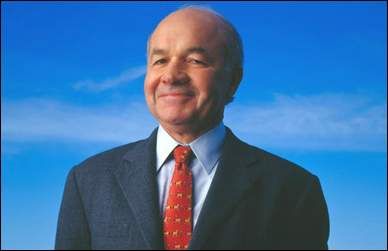
"This is not a political documentary. It is a crime story," Ebert writes. "No matter what your politics, [it] will make you mad." So why is Ken Lay, above, still smiling? Will the jury wipe the smile off his face when he comes to trial in the fall? Or will it say "Well done!" just as the dumbshit electorate did last fall for our Dear Leader?
A couple of misplaced commas in an April 20 New York Times editorial transform a solemn tone into a haughty one: "There is no reason to expect any change, of course, for the church when it comes to matters like birth control, priestly celibacy or homosexuality."
That's a beauty.
Punctuation also counts for Leon ("He's Our Calvin Trillin") Freilich, but so does rhyme. Here's his latest:
E-GRAPEVINE
Word of mouth
Has begun to ebb,
Superseded
By word of web.
PUBLIC SAFETY ANNOUNCEMENT
Orgies are banned -—
Too much of a crowd
For a one-night stand --
But
three's allowed.
 We come finally to "Greenwich Village" in Bill Osborne's video impressions
of New York. It's a festival of storefronts and street corners, monuments and sex boutiques,
mannequins and, most of all, lovely architectural facades -- in all a sweet commentary set to
Ravel's playful "Chants populaires: no 1, Chanson espagnole."
We come finally to "Greenwich Village" in Bill Osborne's video impressions
of New York. It's a festival of storefronts and street corners, monuments and sex boutiques,
mannequins and, most of all, lovely architectural facades -- in all a sweet commentary set to
Ravel's playful "Chants populaires: no 1, Chanson espagnole."
Put on your headphones, click the photo or the title, give the video time to load, and enjoy. As before, the music is performed by Catherine Robbin (mezzo soprano) and André Laplante (piano), with Nora Shulman (flute); Camille Watts (flute); Joaquin Valdepeñas (clarinet); David Bourque (clarinet); Mark Skzainetsky (violin); Mi Hyon Kim (violin); Steven Dann (viola); Thomas Wiebe (cello). It's recorded by the CBC Records/Musica Viva label on the CD "Ravel: Mélodies" (Cat. #: MVCD1128).
If you prefer the videos sequentially more or less as Osborne intended, instead of backwards (per the usual top-down chronological order of posting), just click here from top to bottom:
Part 1: "Times Square at
Night."
Part 2: "Chrysler Building."
Part 3: "Inwood."
Part 4: "Ghost Reflections on Fifth Avenue."
Part 5: "Greenwich Village."
 There are still more videos to see, if you like. Osborne has
posted a half-dozen others on his Website
besides these. Less complete perhaps, they might be considered outtakes. One, "Subway Stalgmite," strikes me as an apt 45-second
commentary on the subway's decrepit infrastructure. Straight Up's staff of thousands suggests it
be used as a public service spot by consumer advocates protesting fare hikes. It doesn't whine. It
doesn't carp. It makes its case with an entertaining tra-la-la.
There are still more videos to see, if you like. Osborne has
posted a half-dozen others on his Website
besides these. Less complete perhaps, they might be considered outtakes. One, "Subway Stalgmite," strikes me as an apt 45-second
commentary on the subway's decrepit infrastructure. Straight Up's staff of thousands suggests it
be used as a public service spot by consumer advocates protesting fare hikes. It doesn't whine. It
doesn't carp. It makes its case with an entertaining tra-la-la.
 Now back to the continuing series of Bill Osborne's video impressions of New York City with "Ghost Reflections on Fifth Avenue," set to Maurice Ravel's indelible music for "Poèmes de Stephane Mallarmé: no 2, Placet futil."
You may have noticed cinéma vérité creeping into the essential forms visually crystallized in "Inwood," à la Mallarmé, and images evoking the style of Edward Hopper toward the end of it. Osborne messages that he's grateful for the staff's reference to Mallarmé's symbolism but, modest to a fault, he adds:
Actually, for the night shots the poor idiot was standing out on the street in a light drizzle trying to figure out how to operate the camera. Half of the original footage is of his own blurry consternated face as he turned the still-running camera around and around trying to figure out how to set the exposure settings. The only perfectly empty forms are clearly between his ears.
In "Ghosts" he apparently figured the exposure settings out, and cinéma vérité begins to take over. Note the fleeting images of pointed social commentary amid the glittering shop windows.
As before, put on your headphones, and click the photo or the title. Give the video time to load. Ravel's music is performed by Catherine Robbin (mezzo soprano) and André Laplante (piano), with Nora Shulman (flute); Camille Watts (flute); Joaquin Valdepeñas (clarinet); David Bourque (clarinet); Mark Skzainetsky (violin); Mi Hyon Kim (violin); Steven Dann (viola); Thomas Wiebe (cello). It's recorded by the CBC Records/Musica Viva label on the CD "Ravel: Mélodies" (Cat. #: MVCD1128).
If you prefer the videos sequentially more or less as Osborne intended, instead of backwards (per the usual top-down chronological order of posting), just click here from top to bottom:
Part 1: "Times Square at Night."
Part 2: "Chrysler Building."
Part 3: "Inwood."
Part 4: "Ghost Reflections on Fifth Avenue."
Postscript: Osborne messages: "On the day I was out shooting those Hopper-looking shots, many of the Inwood locals were looking at me with the greatest amusement -- like I must be some sort of arty nut of a tourist taking pictures of such a place."
The other nine blogs are: AmericaBlog, The Daily Howler, Eschaton (a k a Atrios), James Wolcott, Crooks and Liars, World O'Crap, The Rittenhouse Review, The Tin Man and Cathy's World. All of these, some of which we're familiar with, will now be entered in our own blogroll.
Modesty must have kept Ehrenstein from listing among the top 10 his own David E's Fablog, which really is fabulous, or that of his significant other, Bill Reed's People vs. Dr. Chilledair, both of which we've had in our blogroll because they're so damned good. And have a look at Ehrensteinland. It's a kick.
 And now we come to "Inwood," Bill Osborne's video impressions of the largely Hispanic, upper Manhattan neighborhood where he lived on his recent stay in New York. The images convey a very different city from both the glamorous hustle of Times Square at night, in Part 1, and the austere presence of the art deco Chrysler Building, in Part 2.
The music, by Maurice Ravel, is a setting of "Poèmes de Stephane Mallarmé: no 1, Soupir." Besides expressing his own moody sense of the neighborhood, Osborne illustrates Mallarme's belief that "within the nothingness of reality" there is "an essence of perfect forms," which the poet/artist "crystallizes through a central symbol, idea or metaphor."
Put on your headphones, and click the photo or the title. Give it time to load. The music, by Maurice Ravel, is performed by Catherine Robbin (mezzo soprano) and André Laplante (piano), with Nora Shulman (flute); Camille Watts (flute); Joaquin Valdepeñas (clarinet); David Bourque (clarinet); Mark Skzainetsky (violin); Mi Hyon Kim (violin); Steven Dann (viola); Thomas Wiebe (cello). It's recorded by the CBC Records/Musica Viva label on the CD "Ravel: Mélodies" (Cat. #: MVCD1128).
If you prefer the videos sequentially more or less as Osborne intended, instead of backwards (per the usual top-down chronological order of posting), just click here from top to bottom:
Part 1: "Times Square at Night."
Part 2: "Chrysler Building."
Part 3: "Inwood."
 Since I'm away, my staff of thousands has come up with a
brilliant idea to amuse you and me together: Videos by the composer Bill Osborne, which he
made on the fly while he was in New York not long ago. He thinks of them as improvised Big
Apple portraits, which he's edited to fit selected musical scores. All told, they add up to something
like an essay. The first was posted Friday. Here's the second: "Chrysler Building."
Since I'm away, my staff of thousands has come up with a
brilliant idea to amuse you and me together: Videos by the composer Bill Osborne, which he
made on the fly while he was in New York not long ago. He thinks of them as improvised Big
Apple portraits, which he's edited to fit selected musical scores. All told, they add up to something
like an essay. The first was posted Friday. Here's the second: "Chrysler Building."
Put on your headphones, click the photo or the title, and enjoy. Give it time to load. The music, by Maurice Ravel, is "Melodies hebraiques: no 2, L'enigme eternelle," performed by Catherine Robbin (mezzo soprano) and André Laplante (piano), with Nora Shulman (flute); Camille Watts (flute); Joaquin Valdepeñas (clarinet); David Bourque (clarinet); Mark Skzainetsky (violin); Mi Hyon Kim (violin); Steven Dann (viola); Thomas Wiebe (cello). It's recorded by the CBC Records/Musica Viva label on the CD "Ravel: Mélodies" (Cat. #: MVCD1128).
If you prefer the videos sequentially more or less as Osborne intended -- the staff does -- instead of backwards (per the usual top-down chronological order of posting), just click here from top to bottom:
Part 1: "Times Square at Night."Part 2: "Chrysler Building."
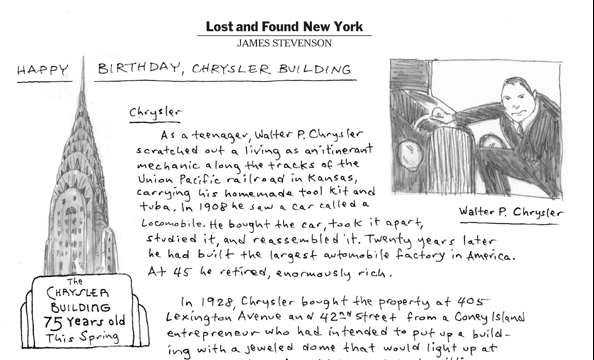
Typically, Osborne takes a modest view of his efforts. "The videos themselves won't sustain much interest (especially given all of the video media that swamps our lives)," he messages, "but they might be a useful small addition or footnote to your usual blogging when you get back to it." The staff begs to disagree. It believes his moody improvisations are more than just footnotes. (He also warns: "Many people won't have the modem speed to watch them." Aaarrgghh.) Coincidentally, the Chrysler Building's 75th anniversary is being celebrated this spring, and James Stevenson has an op-art birthday tribute in this morning's New York Times. It begins like so:
 Since I'm away from the Big Apple, Straight Up's staff of thousands has had a brilliant idea to amuse you and me together. It will be posting a series of short videos made on the fly by my friend, the composer Bill Osborne, while he was in New York not long ago. He thinks of them as improvised Big Apple portraits, which he's edited to fit selected musical scores. All told, they add up to something like an essay. Here's the first one: "Times Square at Night." Put on your headphones, click the photo or the title, and enjoy. Give it time to load. The music, by Maurice Ravel, is from the third movement (presto) of his "Concerto for Piano and Orchestra, in G Major," and was recorded by the Orchestre de la Suisse Romande (Armin Jordan, conductor; Francois-René Duchable, piano) for the Erato label on a two-CD set entitled "Masterpieces of French Impressionism" (Cat.#: 8573-84255-5).
Given Tom DeLay's pious horseshit, Bill Frist's
equally pious participation in an upcoming church-sponsored telecast to
portray the Democratic "opposition to certain judicial nominees" as an assault on "people of faith"
-- not to mention the election of the new pope Benedict XVI -- my
staff of thousands thought it useful to post "God's Total Quality Management Questionnaire,"
even though I'm still on holiday in the Pacific. It arrived by e-mail and is a variation of
God's Total Quality Management Questionnaire
 In order to better serve your needs and the needs of people
of faith, God asks that you take a few moments to answer the following questions.
In order to better serve your needs and the needs of people
of faith, God asks that you take a few moments to answer the following questions.
How did you find out about God?
___ Bible
___ Torah
___ Book of Mormon
___ Koran
___
Television
___ Divine inspiration
___ Word of mouth
___ Dead Sea
scrolls
___ Near-death experience
___ Near-life experience
___ National Public
Radio
___ Burning shrubbery
Which model God did you acquire?
___ Yahweh
___ Jehovah
___ Allah
___ Just plain God
___
Krishna
___ Father, Son & Holy Ghost (Trinity Pak)
___ Zeus and entourage
(Olympus Pak)
___ Odin and entourage (Valhalla Pak)
___ Gaia/Mother Earth/Mother
Nature
Please describe the problems you have encountered with your God.
___ Not eternal
___ Not omniscient
___ Not omnipotent
___ Finite in
space/Does not occupy or inhabit the entire universe
___ Permits sex outside of
marriage
___ Prohibits sex outside of marriage
___ Makes mistakes (Geraldo Rivera,
Jesse Helms)
___ Plays dice with the universe
What factors were relevant in your decision to acquire a God?
___ Indoctrinated by parents
___ Needed a reason to live
___ Indoctrinated by
society
___ Needed target for rage
___ Imaginary friend grew up
___ Hate to
think for self
___ Fear of death
___ To piss off parents
___ Needed to feel
morally superior
Are you currently using any other source of inspiration in addition to God?
__ Self-help books__ Tarot, Astrology
__ Star Trek re-runs
__ Sex, drugs, and rock 'n' roll
__ EST
__ Television
__ Mantras
__ Jimmy Swaggart
__ Crystals (not including Crystal Gayle)
Have you ever worshipped a false God before? If so, which false God fooled you?
___ The Almighty Dollar
___ The Conservative Right
___ Ronald
Reagan
___ Mushrooms
If you believe God attempts to maintain a balanced mix of catastrophes and miracles, please rate God's handling of the following, on a scale of 1 to 5 (1 = unsatisfactory, 5 = excellent):
Natural disasters: 1 2 3 4 5
Man-made calamities: 1 2 3 4 5
Wars: 1 2 3 4
5
Miracles: 1 2 3 4 5
Dubya: 1 2 3 4 5
Inquiring minds wanted to know: Whazzup? Sarah Spitzer, a producer at the Los Angeles radio station, messages, "There really wasn't a time peg" for D'Arcy's report. "Ultimately, we decided to wait on producing it, for a number of reasons that we talked about with David. We don't have immediate plans to reschedule it right this moment (we've got a full slate of shows)."
She did not disclose the reasons, and I haven't been able to reach D'Arcy. She did say she would let us know when the station does resked. Good journalistic practice would require further exploration. But, hey, I'm on holiday in the Pacific. The only reason I'm posting this is because the staff pushed me to it.
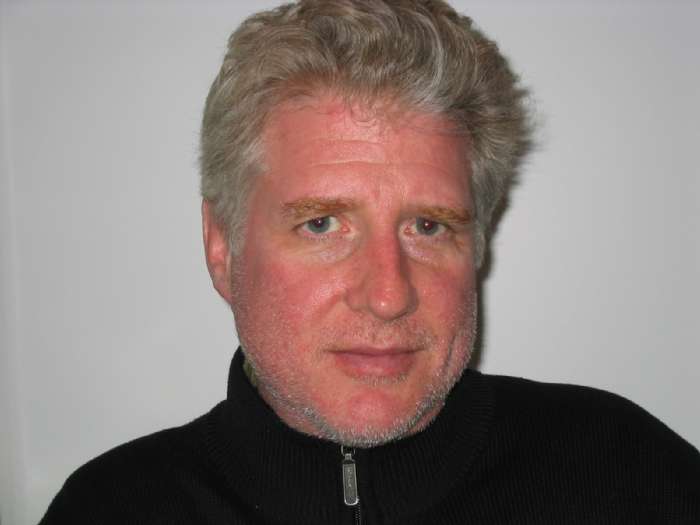 "It will be about the whole issue of the effort to recover the art stolen
by the Nazi and the complications involved in that," D'Arcy, left, tells me. He says he'll report on
"finding out where the art is, and then the greater complications of putting it back into the hands
of the people from whom it was stolen.
"It will be about the whole issue of the effort to recover the art stolen
by the Nazi and the complications involved in that," D'Arcy, left, tells me. He says he'll report on
"finding out where the art is, and then the greater complications of putting it back into the hands
of the people from whom it was stolen.
"What makes this important," he says, "[is that] in a world of relativism people thought the Holocaust was a morally unambiguous subject. But when it becomes a fight over property, it does not bring out nobility.
"Looking at the MoMA case," he continues, "you see most institutions have gone beyond the position of digging in their heels [to avoid returning the stolen art]. And you've got very few journalists who understand the restitution-of-art field, because it involves reading thousands of pages of court testimony. So what I would like to do is just bring out some truth that goes beyond the minimal amount of reporting that's been done."
Despite what happened to him at NPR vis a vis MoMA, about which the network and its ombudsman is in denial, D'Arcy hopes MoMA will participate in the program. I wouldn't bet on that, although I'm told he has no intention of ambushing it or any other museum. He wants rather to give them a platform to explain their positions.
In any case, his firing has sent a chill through the mainstream media, as noted earlier. A recent column by Tim Rutten in the Los Angeles Times will bring you up to speed. (It's been allowed out from behind LAT Calendar's iron curtain for online non-subscribers.)
"What I think is really important about my situation is the story stood well on its own," D'Arcy adds. "The correction [NPR ran under pressure] was misleading and unnecessary. And so I have strong feelings about the MoMA thing. The big problem in my case was that the correction falsified my story. It was a disservice to the listeners who seek information. I warned them not to run the correction. I sent them ample documentation so they knew it would be misleading and unnecessary. And now it's up there [on the NPR Web site], and anyone who has followed this case knows it is false."
Where exactly did the pressure to dump D'Arcy come from? One good guess might be Lauder himself. The Estee Lauder cosmetics heir is chairman of the MoMA board of trustees, an art collector with a special interest in Egon Schiele (whose painting "Portrait of Wally" is at the heart of the MoMA exposé), and he has taken contradictory stands about art restitution. D'Arcy has quoted Lauder on NPR, sometimes commenting skeptically about him, I might add, and he has written elsewhere about Lauder's interests, not always kindly.
One of the many ironies in D'Arcy's situation is this: He "was told that they [MoMA officials], with their lawyer, spent three hours pressuring the NPR editor about what they thought was wrong with [his] story. But they didn't spend two seconds discussing any of these issues when [he] approached them for comment on the Schiele case." Do the math. It's just simple arithmetic.
Prepackaged news stories are complete, audio-video presentations that may be included in video news releases, or VNRs. They are intended to be indistinguishable from news segments broadcast to the public by independent television news organizations. To help accomplish this goal, these stories include actors or others hired to portray "reporters" and may be accompanied by suggested scripts that television news anchors can use to introduce the story during the broadcast. These practices allow prepackaged news stories to be broadcast, without alteration, as television news. [Bold faced added.]
That makes the airwaves safe again for all those TV news directors whose wrists were slapped for being too fond of broadcasting those VNRs as their own in the first place.
Like a lot of Democrats, I get messages from Mark Green, the former public advocate for
New York City and the president of the New
Democracy Project.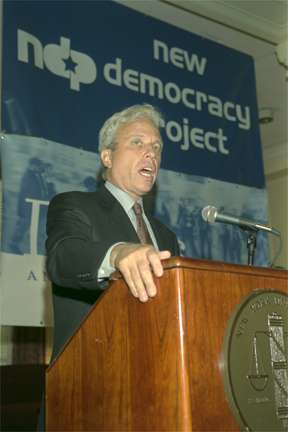 As much as I agree with his low opinion of our Dear Leader, I can't help
noticing: Green's latest message delivered the same old, same old, and did double duty as a promo
for his and Eric Alterman's "The Book on
Bush: How George W. (Mis)leads America."
As much as I agree with his low opinion of our Dear Leader, I can't help
noticing: Green's latest message delivered the same old, same old, and did double duty as a promo
for his and Eric Alterman's "The Book on
Bush: How George W. (Mis)leads America."
May I quote? Dear Leader "a) remains incorrigibly prone to deception and b) major media essentially look the other way." Where have we heard that before? Green, left, does elaborate nicely here:
We have an administration feeling so brazen and immune that it derisively dismisses reporter Ron Suskind as "reality-based," with an aide explaining, "We're an empire now, and when we act, we create our own reality. And while you're studying that reality -- judiciously, as you will -- we'll act again, creating other new realities, which you can study too, and that's how things will sort out. We're history's actors ... and you, all of you, will be left to just study what we do."
Listening to the White House spiel is like being worked over by an old "I'm Chevy Chase and you're not" routine. Worse, according to Green's a and b of it:
The mainstream media cannot or will not point out Bush's inaccuracies and dishonesty as frequently as he practices them. Why? Because a) President Bush knows that our news outlets are afraid of the pain that conservative bloggers, talk show hosts and even the White House can inflict by impugning their impartial reputations, and b) the media likes to report the first three letters of what's news -- i.e. what's new -- and Bush's untruthful recidivism is old stuff.
So what does Green do? "I watch Jon Stewart's "Daily Show" every night," he writes. Fine. But as good as the Stewart show is, the idea of Mark Green glued to the tube to catch it every night is a little scary. You have to wonder whether someone who claims to be a serious politican could be making better use of his time.
Besides, the truth is that the radical press and blogosphere depend on the best of the mainstream media for accurate information. There are times, in fact, when nobody is more forceful in denouncing Dear Leader's regime than the editorial page of the most mainstream newspaper of all, The New York Times.
Last Friday's lead editorial, "A Profile in Timidity," was a case in point. "After more than a year's dithering," it said, the president's commission on intelligence gathering produced "a big dose of political spin that pleased the White House but provided little enlightenment for the public." The commission was bipartisan and toothless, yielding "nothing about the central issue -- how the Bush administration handled the intelligence reports on Iraq's weapons programs and presented them to the public to win support for the invasion of Iraq":
All we get is an excuse: the panel was "not authorized" to look at this question, so it didn't bother. The report says the panel "interviewed a host of current and former policy makers" about the intelligence on Iraq, but did not "review how policy makers subsequently used that information." (We can just see it -- an investigator holding up his hand and declaiming: "Stop right there, Mr. Secretary! We're not authorized to know what you did.")
Yes, the commission said Dear Leader's regime was "dead wrong" about WMD because intelligence analysis "was driven by a predetermined conclusion" that Saddam was a threat. Yes, it said "it is hard to deny that intelligence analysts worked in an environment that did not encourage skepticism about the conventional wisdom." (Love that double negative.)
But it utterly ignored the way President Bush, Vice President Dick Cheney, Defense Secretary Donald Rumsfeld and his team, and Condoleezza Rice, as national security adviser, created that environment by deciding what the facts were and saying so, repeatedly. ...[ And] it loyally maintains the fiction that Mr. Bush was just given bum information by incompetent intelligence agents.
If the commission's report had any value -- apart from serving as a reminder that the Senate Intelligence Committee is still working on its own investigation (don't hold your breath for revelations) -- the Times concluded, "it shows us what the 9/11 panel's report might have looked like if Mr. Bush had succeeded in making Henry Kissinger chairman."
That editorial may not be as funny as "The Daily Show," but it's as strong as anything Jon Stewart has to say. I bet he'd agree, and so would Henry.
In its April Fools' Day issue, Scientific American published a spoof editorial in which it apologized for endorsing the theory of evolution just because it's "the unifying concept for all of biology and one of the greatest scientific ideas of all time," saying that "as editors, we had no business being persuaded by mountains of evidence." And it conceded that it had succumbed "to the easy mistake of thinking that scientists understand their fields better than, say, U.S. senators or best-selling novelists do."
The editorial was titled "O.K., We Give Up." But it could just as well have been called "Why So Few Scientists Are Republicans These Days." Thirty years ago, attacks on science came mostly from the left; these days, they come overwhelmingly from the right, and have the backing of leading Republicans.
Scientific American may think that evolution is supported by mountains of evidence, but President Bush declares that "the jury is still out." Senator James Inhofe dismisses the vast body of research supporting the scientific consensus on climate change as a "gigantic hoax." And conservative pundits like George Will write approvingly about Michael Crichton's anti-environmentalist fantasies.
If you've ever seen Krugman in person or on television, you'll have noticed his darting eyes. They say to me he laughs a lot.
If Malcolm Gladwell had written about you in his latest best seller, "Blink: The Power of Thinking Without Thinking," you'd probably know it in a New York minute. If you were Abbie Conant, who is the subject of the book's final chapter, you wouldn't.
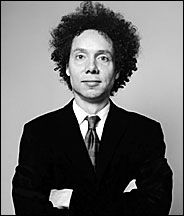 When pressed, Conant recalls speaking with Gladwell (right) by
phone. But she lives in Germany and had only a vague idea of who he was. She didn't subscribe to
The New Yorker, where he's a staff writer, and hadn't read "The Tipping
Point: How Little Things Can Make a Big Difference," his previous best
seller.
When pressed, Conant recalls speaking with Gladwell (right) by
phone. But she lives in Germany and had only a vague idea of who he was. She didn't subscribe to
The New Yorker, where he's a staff writer, and hadn't read "The Tipping
Point: How Little Things Can Make a Big Difference," his previous best
seller.
It took an old friend she knew from Colorado, now a research librarian at Fortune magazine in New York, to break the news to her long after "Blink" had soared to No. 1 on the New York Times Hardcover Nonfiction list. (It's been on the list for 11 weeks, No. 1 for most of them.)
"I hadn't read anything more than a few blurbs about the book," says Susan Kaufman, recalling Gladwell's appearance a while ago at a meeting of the Special Libraries Association. "He was a big draw. The place was packed. It was not the usual." Gladwell told the librarians he wasn't going to read from his book. "He said, "I think it's better if I tell you a story,'" Kaufman remembers. "And then he proceeded to say there was this musician in Germany, and he said her name. It was such an odd thing. Abbie hadn't ever mentioned that he had spoken to her for the book. He went on and on."
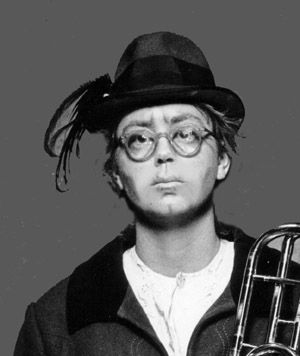
Kaufman (a violist) and Conant (a trombonist) met in the late '70s when they'd played together in the Colorado Philharmonic, a training orchestra. Though they went their separate ways afterward -- Kaufman, who had graduated from Barnard, entered Columbia's library school and took up a research career; Conant graduated from the University of New Mexico and Juilliard into an orchestra career in Turin and Munich and is now a trombone professor -- they'd always kept in touch.
 After Gladwell's lecture, Kaufman says, "I ran up to the front and told
him it just so happens I'm a good friend of Abbie. He kind of looked up. 'Say hello to her,' he said.
... And he signed a book for her, 'To my inspiration.' The funny thing, if I had mentioned this to
any of my colleagues there, nobody would have believed it."
After Gladwell's lecture, Kaufman says, "I ran up to the front and told
him it just so happens I'm a good friend of Abbie. He kind of looked up. 'Say hello to her,' he said.
... And he signed a book for her, 'To my inspiration.' The funny thing, if I had mentioned this to
any of my colleagues there, nobody would have believed it."
Here's the first chapter of "Blink." As for the final chapter, Gladwell credits Conant's husband, composer and musicologist William Osborne, with the most complete version of her amazing story. He recounts and analyzes the discrimination she faced after she won a blind audition, besting 32 male candidates, for principle trombonist in the Munich Philharmonic.
"When she stepped from behind the audition screen, the orchestra was shocked," Osborne explains. "It is a case study perfectly suited to the thesis of Gladwell's book." Now have a listen to Conant performing "Leonore" (above, left), a music theater piece he and Conant wrote in reaction to her experiences in the Munich Philharmonic.
Sites to See
AJ Ads
AJ Blogs
AJBlogCentral | rssculture
Terry Teachout on the arts in New York City
Andrew Taylor on the business of arts & culture
rock culture approximately
Laura Collins-Hughes on arts, culture and coverage
Richard Kessler on arts education
Douglas McLennan's blog
Dalouge Smith advocates for the Arts
Art from the American Outback
For immediate release: the arts are marketable
No genre is the new genre
David Jays on theatre and dance
Paul Levy measures the Angles
Judith H. Dobrzynski on Culture
John Rockwell on the arts
Jan Herman - arts, media & culture with 'tude
dance
Apollinaire Scherr talks about dance
Tobi Tobias on dance et al...
jazz
Howard Mandel's freelance Urban Improvisation
Focus on New Orleans. Jazz and Other Sounds
Doug Ramsey on Jazz and other matters...
media
Jeff Weinstein's Cultural Mixology
Martha Bayles on Film...
classical music
Fresh ideas on building arts communities
Greg Sandow performs a book-in-progress
Exploring Orchestras w/ Henry Fogel
Harvey Sachs on music, and various digressions
Bruce Brubaker on all things Piano
Kyle Gann on music after the fact
Greg Sandow on the future of Classical Music
Norman Lebrecht on Shifting Sound Worlds
publishing
Jerome Weeks on Books
Scott McLemee on books, ideas & trash-culture ephemera
theatre
Wendy Rosenfield: covering drama, onstage and off
Chloe Veltman on how culture will save the world
visual
Public Art, Public Space
Regina Hackett takes her Art To Go
John Perreault's art diary
Lee Rosenbaum's Cultural Commentary
Tyler Green's modern & contemporary art blog
