(Display Name not set)May 2005 Archives

 Carl Conetta lays it out in "Vicious Circle," his research monograph on "The Dynamics
of Occupation and Resistance in Iraq, Part One, Patterns of Popular Discontent" for the Project
on Defense Alternatives. In clear language, the academic sound of the title notwithstanding,
Conetta offers the strongest, most detailed and comprehrensive, fully documented understanding
of the situation that I've come across.
Carl Conetta lays it out in "Vicious Circle," his research monograph on "The Dynamics
of Occupation and Resistance in Iraq, Part One, Patterns of Popular Discontent" for the Project
on Defense Alternatives. In clear language, the academic sound of the title notwithstanding,
Conetta offers the strongest, most detailed and comprehrensive, fully documented understanding
of the situation that I've come across.
His analysis is large as well as granular. It is replete with both historical perspective and polling data. It describes patterns of coalition military activity such as house raids and street patrols, their impact on the Iraqi population, their efficacy in quelling the insurgency. It begins by pointing out, not surprisingly, that "the occupation of Iraq is today less about rolling back Iraqi military power, dislodging a tyrant, or building a stable democracy than it is about fighting an insurgency -- an insurgency that is now driven substantially by the occupation, its practices, and policies." The vicious circle consists of this: "[A]ctions to curtail the insurgency feed the insurgency."

Conetta, above, the co-director of the project, explains why the U.S. regime's do-good pronouncements on Iraqi freedom and liberation -- which Americans seem to have accepted as true, despite their own growing skepticism about the war -- have far less impact in the war theater than was foolishly expected by the neocon instigators of the invasion. "Public discontent is the water in which the insurgents swim," he writes. "Polls show that a large majority of Iraqis have little faith in coalition troops and view them as occupiers, not liberators." Historically,
[a]lthough the power of nationalistic feelings is universally recognized, occupiers often resist the conclusion that their behavior is implicated by these feelings -- especially if the ostensible goals of occupation are humanitarian or paternalistic.
Even Napoleon Bonaparte expected during his 1799 campaign in Egypt and Syria that his army would "increase with the discontented" and "armed masses" of the region because, in accord with the principles of the French revolution, he sought "the abolition of slavery and of the tyrannical government of the pashas". As it turned out, the oppressed masses did not flock to Napoleon's standard. Eight years later he was similarly disappointed in Spain. He entered the country proclaiming that "With my banner bearing the words 'Liberty and Emancipation from Superstition, I shall be regarded as the liberator of Spain." Instead, the Spanish resistance tied down hundreds of thousands of French troops for 5 years, sapping the empire and exposing it to easy attack by the British. (Not incidentally, the Spanish war popularized the term guerilla or "small war" among the British.) It mattered not one wit that the French political and economic system were in many ways preferable to both that of the Ottomans and that of the Spanish. What decided the popular response to Napoleon was his means of engagement: war, conquest, and occupation.
The section on "house raids" and "street patrols" specifies what has gone wrong with the occupation. And all of it, ironically, has been published in the mainstream American or British press, albeit not as widely publicized as it should have been. Here, for example, is Conetta on
House raidsMost of the house raids turn up nothing -- 70 percent according to one officer -- and most of those detained are soon released. Division and brigade units may hold as many as 1,300 detainees at any one time, releasing between 66 percent and 75 percent within a few days. Others are sent to one of several prisons in Iraq controlled by the United States, which hold approximately 9,000 prisoners. Many of these central detainees are also released after six months. The International Committee of the Red Cross reports being told by military intelligence officers that between 70 percent and 90 percent of these were being held by mistake -- an estimate affirmed independently by some who have worked in the system.
In some cases, the scope of the raids has been made intentionally broad so as to affect the wider family, friendship networks, and neighborhoods of suspected insurgents and other wanted individuals. In other cases, entire villages have been sealed off so that residents must enter or leave only through control points. (Some of these practices were already underway during the second-half of 2003 -- long before the insurgency reached its peak levels and long before the devastating fall 2004 attack on Falluja.)
Productive or not, the raids are traumatic events, often mentioned as a motivating factor by those who oppose the US occupation. Anthony Loyd of the London Times reports on several raids conducted in December 2004 in Zangora, a small town near Ramadi. The American troops, after using a shotgun to blast open the door of the target residence,
[S]warmed through the compound, corralling the women and children into one room and the men -- by then cuffed and blindfolded -- into another as the search for munitions and documents began. Household goods were sent clattering to the floor, mattresses and bedding upturned, the contents of cupboards and drawers spilt on to a growing pile of personal effects and domestic items.
But as the soldiers began questioning the blindfolded Iraqis they realized they were in the wrong house. The next target of the night's raids was also mistaken.
Along similar lines, Bill Johnson, an embedded reporter for the RockyMountain News, recounts one of a series of raids that took place in Samarra in December 2003:
The force of the two pounds of C-4 explosive ... collapses the double aluminum doors leading into the courtyard of a house.... An elderly man and two others are left standing exposed in the courtyard. They fall face-first to the ground as a half-dozen M-16s are swung their way. Only their mouths move as they plead in Arabic for the soldiers not to shoot. ... The men of 2nd Platoon race past the burning car, kick open the door of the house and rush inside. Three men lay face down in the front room, adorned only with rugs and pillows. Against a wall, three women and three young children sob uncontrollably. ... [T]he house is thoroughly searched for weapons. None are found. The men are bound with plastic handcuffs and led to a Bradley. ... Prisoners taken earlier have identified the three as major weapons dealers in the city. ... They face days of custody and rigorous interrogation. Lt. Dave Nelson has spent the last few minutes distributing money that command has given him to compensate neighbors whose homes have been damaged by the blasts. The raids have netted more than a half-dozen men, but few weapons. "That ain't the point," a burly sergeant ... says, as we speed away. "We're showing the bad guys we're here, we ain't playing and we damn sure ain't going away."
These third-party eyewitness accounts accord with many of the stories told by Iraqis. Ken Dilanian and Drew Brown, reporters for the Knight Ridder news service, recount the experience of Dr. Talib Abdul Jabar Al Sayeed, whose Baghdad home was raided on 31 July 2003:
At least three dozen American soldiers blazed away for more than 60 minutes in the early morning hours of July 31, the British-trained physician recounted recently, pointing to the hundreds of bullet holes that still mark his stately home. "I shouted at them with all my strength to stop shooting," said Al Sayeed, 62. "I will open the door. Please give me a chance." Eventually, Al Sayeed said, the commanding officer told him he was sorry: They had raided the wrong house. But not before a soldier burst in and struck Al Sayeed with a rifle butt, knocking him down. The soldier kicked him in the ribs - an X-ray later showed they were cracked - and others bound his hands with plastic cuffs as his wife and young nieces cowered in the next room. They also took his three grown sons in for questioning, and they remain in a military jail in the south of Iraq.
Peter Beaumont of the UK Observer offers this report of a 6 September 2003 raid on an apartment complex in Mahmudiya, near Baghdad, during which 18-year-old Farah Fadhil was killed by a hand grenade:
Whatever happened here was one-sided, a wall of fire unleashed at a building packed with sleeping families. Further examination shows powder burns where door locks had been shot off and splintered wood where the doors had been kicked in. All the evidence was that this was a raid that...went horribly wrong. This is what the residents and local police told us had happened: Inside the apartment with Farah were her mother and a brother, Haroon, 13. As the soldiers started smashing doors, they began to kick in Farah's door with no warning. Panicking, and thinking that thieves were breaking into the apartment, Haroon grabbed a gun owned by his father and fired some shots to scare them off. The soldiers outside responded by shooting up the building and throwing grenades into Farah's apartment.
The raids seem to exhibit a general pattern which was summarized in a February 2004 report by the International Committee of the Red Cross, based on its own investigation of reported incidents:
Arresting authorities entered houses usually after dark, breaking down doors, waking up residents roughly, yelling orders, forcing family members into one room under military guard while searching the rest of the house and further breaking doors, cabinets, and other property. They arrested suspects, tying their hands in the back with flexicuffs, hooding them, and taking them away. Sometimes they arrested all adult males in the house, including elderly, handicapped, or sick people. Treatment often included pushing people around, insulting, taking aim with rifles, punching and kicking, and striking with rifles. Individuals were often led away in whatever they happened to be wearing at the time of arrest -- sometimes pyjamas or underwear... In many cases personal belongings were seized during the arrest with no receipt given.... In almost all incidents documented by the ICRC, arresting authorities provided no information about who they were, where their base was located, nor did they explain the cause of arrest. Similarly, they rarely informed the arrestee or his family where he was being taken or for how long, resulting in the defacto disappearance of the arrestee for weeks or even months until contact was finally made.
US units often render some payment to families for collateral damage. It is also common to confiscate "excessive" family money, gold, or other valuables, however -- even in those cases where neither suspects nor banned types or quantities of weapons are found. This, on the theory that the information targeting a family may be at least partially correct and that the family may be financing insurgent activities. Of course, it is hard to ascertain what constitutes "excessive" household valuables in a country with a cash economy but no functioning banking system. Throughout the period of sanctions, war, and occupation, it has been common for Iraqis to invest in gold jewelry as a form of inflation-proof savings. At any rate, the confiscations have generated hundreds of tort claims and add to the Iraqis' sense that the occupying troops are behaving in indefensible ways.
As a Straight Up regular says, "the Americans are quite literally behaving like Nazis." Sadly, he's right. Is there any other way to put it? Meantime, the leaders of the U.S. regime have not been held accountable. Cheney Boy has the unmitigated gall to say he's offended by Amnesty International's comparison of the detention center at Guantanamo to a gulag-style camp, while Dear Leader calls Amnesty's allegations "absurd." What's absurd is that anyone would believe him.
Waving the Flog
Now that Deep Throat's blown his cover,
Eliminating every maybe,
The only
question still remaining
Is what to make of Barbara's Baby.
His devil daddy showed him how
To steal the White House like a thief,
So why'd
the baby move to Gitmo
To be torturer-in-chief?
-- Leon Freilich
 "Preventive Warriors," a documentary about the National Security
Strategy of the United States issued by the White House in September of
2002, is the perfect antidote to Dear Leader's Memorial Day ravings (a pious official proclamation for "a day of prayer for
permanent peace" and an imperial radio address to the nation that the U.S.
will continue to "wage the war on terror and spread freedom across
the world").
"Preventive Warriors," a documentary about the National Security
Strategy of the United States issued by the White House in September of
2002, is the perfect antidote to Dear Leader's Memorial Day ravings (a pious official proclamation for "a day of prayer for
permanent peace" and an imperial radio address to the nation that the U.S.
will continue to "wage the war on terror and spread freedom across
the world").
Watch "Preventive Warriors" online. This 2004 documentary, featured today on "Democracy Now!," presents expert commentary by Chalmers Johnson, Noam Chomsky, Rahul Mahajan, Phyllis Bennis, Mark Lance, Maria Ryan, Michael Klare, Tariq Ali and others on the neocon doctrine of preventive war and the current U.S. regime's ambition to dominate the world, militarily, economically and culturally.
 The doctrine is rational "within a lunatic framework," Chomsky points
out, which is "not so unusual." What is unusual, says Chalmers, is the in-your-face aspect of the
strategy for "military dominance" originally laid out by Paul Wolfowitz in 1992. Chalmers also
says he does not believe neocons are conservatives at all, new or old, but rather "serious radicals
committed to the militarization of the country."
The doctrine is rational "within a lunatic framework," Chomsky points
out, which is "not so unusual." What is unusual, says Chalmers, is the in-your-face aspect of the
strategy for "military dominance" originally laid out by Paul Wolfowitz in 1992. Chalmers also
says he does not believe neocons are conservatives at all, new or old, but rather "serious radicals
committed to the militarization of the country."
Or as Klare notes, there is a "crusading spirit" reflected in all the documents, an implicit belief in American exceptionalism because "we're chosen," and it is "this mode of thinking [that] is deeply embedded in the Bush administration." All of these document, Klare asserts, "are driven by arrogance."
Dear Leader, above, placed a wreath at the Tomb of the Unknowns in Arlington National Cemetery for all Americans to see. But his mismanagement of the war in Iraq -- including poorly armored Humvees, insufficient troop levels and no "peace" planning -- means the deaths of more soldiers whose coffins his regime allows no Americans to see as they are being brought home for burial.
Chicago, America's most underrated metropolis, is the capital of flyover country. So unless you grab one or both of its major dailies while changing planes at O'Hare (or you're a news junkie Web surfer), you're missing out on some entertaining columns. Here's one by Debra Pickett, of the Chicago Sun-Times, headlined "Freedom's just another word for dodging tough questions."
On Friday, wrapping up the news from Washington, Pickett compared it to "a bad Broadway show, the kind that promises to make you laugh and cry and be better than 'Cats.'"
The comedy came first. On Monday, President Bush stood beside Afghan President Hamid Karzai for a "Joint Press Availability." Asked if the Iraqi insurgency was getting more difficult to defeat militarily, Bush answered with a classic Dubya-ism. "No, I don't think so," he said, "I think they're being defeated. And that's why they continue to fight."It's the sort of answer that makes you pause and scratch your head for just long enough to give him a chance to change the subject. ... But Bush's Orwellian logic -- good for only a cynical chuckle -- was definitely not the comic high point of the afternoon. Instead, for sheer free press-thwarting brilliance, Karzai easily won the day.
After the two men made some opening remarks, talking about the glories of bringing democracy to Afghanistan, Bush announced, "And in the spirit of the free press, we'll answer a couple of questions.
All two of them?
The first question dealt with the military's treatment of Afghan prisoners of war. It was full of facts and details and built-in follow-ups, so you could tell the reporter asking it would probably never get called on again. And, after this rocky start, Bush decided to let the American reporters cool their heels for a while. "Somebody from the Afghan press?" he asked next.There was an awkward silence, which Karzai gamely tried to fill in by asking, "Anybody from the Afghan press? Do we have an Afghan press?" Then he spotted the single reporter his government had permitted to travel outside Afghanistan. "Oh, here he is," Karzai said, as the room filled with the not-quite-warm laughter of people who suspect they might actually be the butt of a joke but aren't sure.
Which of course they were, if only because "nine other Afghan reporters who were to have followed Karzai on his U.S. visit" couldn't come because "at the last minute, the Karzai government decided to withhold their travel permits for fear the journalists might try to escape their troubled homeland."
Bush seemed genuinely surprised that the Afghan reporters weren't there -- American journalists had been asked to fill in their empty seats -- so it seems that Karzai forgot to mention to his good friend that the whole free press thing has a slightly different meaning in the burgeoning democracy that is Afghanistan.
Since I favor comedy over tragedy when it comes to appreciating Dear Leader's maneuvers, you'll have to click to the rest of Pickett's column for the crying side of the news (if you haven't already), or as Picket writes, "wringing tears from those who would dare dissent."
A case of plagiarism!
May 20:
"One day historians will ask how we stood by and let this
happen."
-- Straight Up
May 26: "When future historians look back on this period, they will wonder, most
of all, I think, how we let it go without a fight."
-- Altercation
Talk about plagiarism, how about this?
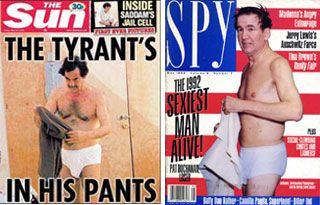 If Pat Buchanan wasn't against the war before, he sure is
now (a k a "The Sexiest Man Alive"). My apology to Matt Haber at Low
Culture. The staff just went and grabbed it for the usual reason: "It was too
good to pass up."
If Pat Buchanan wasn't against the war before, he sure is
now (a k a "The Sexiest Man Alive"). My apology to Matt Haber at Low
Culture. The staff just went and grabbed it for the usual reason: "It was too
good to pass up."
Something else the staff couldn't pass up:

And the latest from Boot Hill.
 We're so late on this it's disgusting. A friend from Mississippi
writes:
We're so late on this it's disgusting. A friend from Mississippi
writes:
Today I was listening to local "Talk Radio" and the topic was about the new Pope, who had just been elected. One woman called in and said, "Oh, I was hoping so much that it would be a Baptist this time!"
My staff of thousands, which forgot to post this earlier, was hoping the same thing.
We're so late on this it's disgusting and ridiculous. A while ago The Washington Post's Mensa Invitational once again asked readers to take any word from the dictionary, alter it by adding, subtracting, or changing one letter, and supply a new definition. Here were this year's winners, which the staff also forgot to post:
1. Intaxication: Euphoria at getting a tax refund, which lasts until
you realize it was your money to start with.
2. Reintarnation:
Coming back to life as a hillbilly.
3. Bozone (n.): The substance
surrounding stupid people that stops bright ideas from penetrating. The bozone layer,
unfortunately, shows little sign of breaking down in the near future.
4.
Cashtration (n.): The act of buying a house, which renders the subject
financially impotent for an indefinite period.
5. Giraffiti:
Vandalism spray-painted very, very high.
6. Sarchasm: The gulf
between the author of sarcastic wit and the person who doesn't get it.
7.
Inoculatte: To take coffee intravenously when you are running
late.
8. Hipatitis: Terminal coolness.
9.
Osteopornosis: A degenerate disease. (This one got extra
credit.)
10. Karmageddon: It's like, when everybody is sending off
all these really bad vibes, right? And then, like, the Earth explodes and it's, like, a serious
bummer.
11. Decafalon (n.): The grueling event of getting
through the day consuming
only things that are good for you.
12.
Glibido: All talk and no action.
13. Dopeler
effect: The tendency of stupid ideas to seem smarter when they come at you
rapidly.
14. Arachnoleptic fit (n.): The frantic dance performed
just after you've accidentally walked through a spider web.
15. Beelzebug
(n.): Satan in the form of a mosquito that gets into your bedroom at three in the
morning and cannot be cast out.
16. Caterpallor (n.): The color
you turn after finding half a worm in the fruit you're eating.
And the pick of the
literature:
17. Ignoranus: A person who's both stupid and an
a$$hole.
 David W. Dunlap: "Juke Joint in the
Sky"
David W. Dunlap: "Juke Joint in the
Sky"
Michael J. Lewis: "Dancing to New Rules, a Rhapsody in
Chrome"
Charles McGrath: "A Lunch Club for the
Higher-Ups"
William L. Hamilton: "On Top of the World, Drafting, Dreaming and
Drilling"
Elaine Louie: "How It Sparkled in the Skyline," with personal
commentaries from Sarah Jessica Parker, Matthew Barney, Robert A.M. Stern, Ron Chernow,
Stephen Bennett Phillips, Ada Louise Huxtable, Paul Goldberger, Alexandros Washburn, Carl
Speilvogel, Theodore Prudon, Dorothy Twining Globus and, saved for nearly last perhaps
because he strikes the only sour note, Jimmy Breslin. "It's nice," he says. But he prefers the
Flatiron Building "a hundred to nothing over the Chrysler."
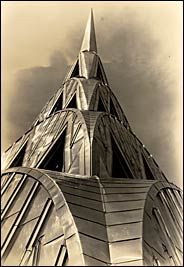
(The Chrysler crown and
spire, above, courtesy of the Margaret Bourke-White Collection, Special Collections Research
Center, Syracuse University Library, via the Times.)
Part 1: "Times Square at
Night."
Part 2: "Chrysler Building."
Part 3: "Inwood."
Part 4: "Ghost Reflections on Fifth Avenue."
Part 5: "Greenwich Village."
It's good to see William Wyler getting his due from Time magazine film critics Richard Schickel and Richard Corliss. In the current issue, they've chosen Wyler's "Dodsworth" as the best flick of the '30s, along with Orson Welles's "Citizen Kane," Roman Polanski's "Chinatown," Quentin Tarantino's "Pulp Fiction," Fritz Lang's "Metropolis," Ingmar Bergman's "Persona," Akira Kurosawa's "Ikiru," Krzysztof Kieslowski's "Decalogue" and Pedro Almodovar's "Talk to Her" as the best of their decades. (Have a look at Time's top 100.)
 They'd get an argument about "Dodsworth" from fans of
"Gone With the Wind," of course -- to say nothing of so many other '30s faves: "The Front Page,"
"Grand Hotel," "It Happened One Night," "The Informer," "All Quiet on the Western Front,"
"Drums Along the Mohawk," "Lost Horizon," "Jezebel," "You Can't Take It With You," the first
full-length animated film "Snow White and the Seven Dwarfs," "The Wizard of Oz,"
"Stagecoach" and "Wuthering Heights."
They'd get an argument about "Dodsworth" from fans of
"Gone With the Wind," of course -- to say nothing of so many other '30s faves: "The Front Page,"
"Grand Hotel," "It Happened One Night," "The Informer," "All Quiet on the Western Front,"
"Drums Along the Mohawk," "Lost Horizon," "Jezebel," "You Can't Take It With You," the first
full-length animated film "Snow White and the Seven Dwarfs," "The Wizard of Oz,"
"Stagecoach" and "Wuthering Heights."
I rank "Dodsworth" among Wyler's best films myself. It has the most poignant moment of visual poetry in his entire canon, a shot that sums up what the film is all about -- failed marriage, illusory dreams, capricious fate -- in a single emblematic image. I also get a special kick out of the film because of an inside joke. If you watch carefully as the camera pans across the tiny orchestra in a Vienna nightclub where Sam Dodsworth's wife has gone dancing with a suitor, you'll glimpse Wyler playing the violin. He's the guy in the middle of the front row.
 Although Wyler is one of Hollywood's greats, with three
Academy Awards for directing on 12 nominations and more Oscar nominations for his films by far
than any other director, he's less famous than Billy Wilder, with whom he's often confused, less
celebrated than Frank Capra and John Ford, who were working at the height of their powers in
the '30s, and even less well-known than his longtime studio boss, the self-aggrandizing Sam
Goldwyn, who went out of his way to take credit for his accomplishments.
Although Wyler is one of Hollywood's greats, with three
Academy Awards for directing on 12 nominations and more Oscar nominations for his films by far
than any other director, he's less famous than Billy Wilder, with whom he's often confused, less
celebrated than Frank Capra and John Ford, who were working at the height of their powers in
the '30s, and even less well-known than his longtime studio boss, the self-aggrandizing Sam
Goldwyn, who went out of his way to take credit for his accomplishments.
(Cheap plug here: Read all about it in my Wyler biography, "A Talent for Trouble.")
Schickel and Corliss rightly point out that the '30s was Hollywood's "highest romantic era" and that "no film achieved more entrancing heights" in that period than "Dodsworth." But they also say it was adapted from Sinclair Lewis's "best novel." Perhaps they were influenced by the fact that "Dodsworth" was published in 1929, and Lewis won the Nobel Prize for Literature in 1930. Literary critics tend to rank it behind such earlier novels as "Babbitt" and "Elmer Gantry."
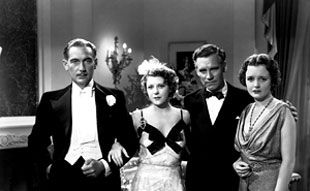 They also seem to think of "the divine Mary Astor" as the
star of the 1936 movie. Divine she is, but it's Walter Huston at the center of everything as Sam
Dodsworth, the self-made automobile magnate from Zenith, Indiana, and Ruth Chatteron, as his
wife Fran, who probably has the most screen time. Huston dominates the movie, which was
actually based not on the novel but on a hit play adapted from the novel that Huston starred in on
Broadway in 1934. It was "the greatest personal triumph of his stage career," to quote myself, and
the play was a smash largely on the strength of his magnetic portrayal.
They also seem to think of "the divine Mary Astor" as the
star of the 1936 movie. Divine she is, but it's Walter Huston at the center of everything as Sam
Dodsworth, the self-made automobile magnate from Zenith, Indiana, and Ruth Chatteron, as his
wife Fran, who probably has the most screen time. Huston dominates the movie, which was
actually based not on the novel but on a hit play adapted from the novel that Huston starred in on
Broadway in 1934. It was "the greatest personal triumph of his stage career," to quote myself, and
the play was a smash largely on the strength of his magnetic portrayal.
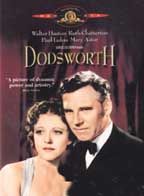
One of the film's many great pleasures is to see Huston reprise the role on screen with all the naturalness that Wyler valued. "No acting ruses, no acting devices," he said of Huston's performance, "just the convincing power that comes from complete understanding of a role." (Above, the cast from right to left: Mary Astor, Walter Huston, Ruth Chatterton, Paul Lukas.)
Anyone with the slightest cognizance of pop culture knows this by now. But back in 2000, when Steve Dollar wrote a piece called "Cracker-rap losers" in Salon, it was not so commonly recognized. Go read the piece. It's a great (and entertaining) example of criticism that captures the reductive core of the culture. The writing is like a surfer tucked into a 50-foot curl. Here are a couple of sample paragraphs:
Sometimes it's hard to know whether Fred Durst really is the angriest dog in the world or just another high school loser getting the last laugh. His lyrics may be dumb, but the joker knows that commodified rage is the surest route to rock star success -- if not a spot on the permanent guest list at the Playboy Mansion. The frontman for Limp Bizkit has become one of pop's most public icons, instantly flagged by his backward, red Yankees baseball cap, his chinful of goat scruff and his ever-present arm candy (today Carmen Electra, tomorrow the world).
And:
Though Durst seems convinced that everyone hates him -- everyone but the fans, man, and the dudes at Napster -- he deserves some kind of due, if only for having the brains or moves to make the music industry work overtime to accommodate one more mediocre blowhard. And he has gotten it: Along with Eminem and Kid Rock, he's part of the wigga holy trinity, even though his straight-outta-the-sandbox raps make Slim Shady sound as eloquent as Shakespeare, and his streak of Puritan misogyny makes Rock's early-morning stoned pimpin' seem like a feminist conspiracy. Like his fellow Caucasian rappers, who each have made bank emulating hip-hop style, Durst belongs to a neo-cracker elite, contributing to a national trailer-park zeitgeist whose prime movers include Howard Stern, a bunch of those bone crushers in the World Wrestling Federation and Wisconsin truck driver Susan Hawk from "Survivor." There's probably no better time to proudly call yourself "a redneck fucker from Jacksonville."
Postscript: My staff of thousands tells me the San Francisco Chronicle picked up the AP story about the folding of the National Arts Journalism Program, which the staff thinks AP picked up from yesterday's item. This thrills the staffers because it makes them feel useful.
The front page of today's ArtsJournal points to a story in Sunday's Los Angeles Times headlined "Critical condition," about the death of arts criticism. The Times subhead summarizes the gist of the story: "Once almighty arbiters of American taste, critics find their power at ebb tide. Is it a dark time for the arts, or the dawn of a new age?"
ArtsJournal's summary gives a more detailed inkling:
Arts critics used to wield tremendous power as American tastemakers, their words forming the crux of the cultural sphere and their opinions read as seriously as those of political commentators. These days, cultural tastes are controlled mainly by savvy marketers, and critics have become ever more marginalized, frequently reduced to bleating from the sidelines and begging for a return to serious cultural discourse.
Coincidentally -- well, not so coincidentally -- ArtsJournal publisher and editor Doug McLennan also reported Sunday on the death of the National Arts Journalism Program. In a mass email to more than 100 former fellows of the program, he confirmed what had been rumored among them:
After an outstanding 11-year record of advocating for and promoting the cause of arts journalism, the National Arts Journalism Program -– the only program in America dedicated to the advocacy of arts journalism -- is being closed down at the Columbia School of Journalism.
 The NAJP's major funding for many years had come from grants from
the Pew Charitable Trusts. But due to a change in Pew's focus and, reportedly, a decline in its
investment income, the grant was not renewed. McLennan's message continued:
The NAJP's major funding for many years had come from grants from
the Pew Charitable Trusts. But due to a change in Pew's focus and, reportedly, a decline in its
investment income, the grant was not renewed. McLennan's message continued:
So what happened? When Pew's generous funding ended a couple of years ago, NAJP was left with the considerable task of raising its entire operating budget from other sources. ... Columbia generously offered some financial help to fill in the gap, but made it clear that it was one-year assistance. The program's budget of $1.6 million in 2002-03 fell to less than half that by the current year. ...
The short version is that the Columbia J-School, like most universities these days, while happy to host and enjoy the prestige of programs, is reluctant to spend money and resources on them. Last year Columbia gave NAJP some financial help to ease the loss of Pew money, but J-School dean Nicholas Lemann says that none of the 30 programs housed at the school (with the exception of the Columbia Journalism Review) is getting money from the school this year.
McLennan, who is on the NAJP advisory board (he's also a former fellow, as I am), noted that the Journalism School would soon be making an official announcement about closing the program. McLennan's message drew responses about the death of the NAJP and its larger meaning from many former fellows and others associated with or interested in the program. Here are several representative ones:
"The news of the demise of the NAJP is very sad indeed, and yet another sign that serious
intellect in this country is continuing to lose ground, along with serious art. It is a tragic time for
the arts and arts criticism, perhaps the most ominous in our history."
-- Robert
Brustein ('03, theater critic, The New Republic)
"At a time when life is becoming ever more drenched in business and politcs of the most
naked and base kind, anything that diminishes the meager beachhead that culture still has in our
lives is to be lamented. I know that there are many universities -- Berkeley among them -- that
would be only too pleased to take this excellent program in. But, alas, it is always a question of
resources. That this country is so awash with such extravagant wealth at the upper reaches of the
sociological food chain, but that a program like this nonetheless languishes and perishes at the
middle reaches, is a reality that seems absurdly bitter."
-- Orville Schell, dean
of the UC Berkeley Graduate School of Journalism
"This is deeply disheartening news -- for a nation, a culture, and a profession that have been receiving quite enough disheartening news as it is. The idea that it could happen in a time when -- despite the growing impoverishment of the general public -- gigantic fortunes are being concentrated in the hands of a few billionaires, many of them in arts-related industries, makes it all the more disheartening.
"It dramatizes for me the state of a society that has deeply misunderstood its values and misplaced its priorities. It represents, along with the abhorrent state of our politics, another lurch on the seismic cultural shift toward a new Dark Age. Those of us who engage in the arts -- and criticism has its place among them -- must be prepared to face a world that is readying itself to abandon its professed values in favor of the worship of money and power.
"My fellowship time at the NAJP -- which came during and after the trauma of 9/11 -- was of
immeasurable importance in my life. It renewed my belief in the value of my work. It has made me
want to keep working. And I want to see the NAJP survive, just as I want to see the arts, and arts
criticism, survive -- 'so that life shouldn't be printed on dollar bills,' as an American playwright
once put it."
-- Michael Feingold ('02, chief theater critic, The Village Voice)
The NAJP fellowship was invaluable for me, too, and I'm deeply grateful for the chance it provided to explore subjects that interested me. Nevertheless, I thought the following opinion, which is not likely to be heard from any of the rest of us, was worth adding to the conversation.
"The critic is the Artist-Prophet's harbinger and apologist. As the cultural phenomenon of the Artist-Prophet dies, so too will the critic. Our traditional style of criticism was formulated by 19th century German literary feuilletonism. That is the period that gave us cultural nationalism with its host of artist-prophets and their critics. These forms of nationalistic elitism were inevitable developments as the bourgeoisie arose. The Internet is just one more medium that helps to dissolve nationalism and elite bourgeois status. As nationalism and class status become less relevant, the critic's function as a spokesman of the elite will die.
"Even in the 'higher' arts, the corporatocracy of global capitalism will require a new kind of feuilletonist -- a sort of generalist gadfly who is part of a marketing apparatus focusing largely on celebrity. Eventually the NYT cultural section, for example, will look a lot like People magazine. Much of The New Yorker is already a kind of People magazine for yuppies -- gossip with a touch of niveau couched in the publication's self-consciously affected urbanity.
"This should not surprise anyone. Art will always be culturally isomorphic with the larger
social structures of society. Mass marketing requires a reductive concept of the human. The
aesthetic values of global capitalism by necessity esteem baseness. The key is for some theorist to
define and codify the new feuilletonism's style, content, social and economic purpose. In the
meantime, we should remember: Blessed are the base, for they shall inherit the
earth.
-- Bill Osborne (composer, musicologist, and an advocate of the
NAJP)
Osborne cites Alex Ross's review of Tristan in the current
New Yorker as "a good example of the critic/artist-prophet relationship." He writes: "Ross and
others like him can't seem to break out of the artist-prophet mold. They try to tone down the
nationalism in the music, but it is a very willful form of blindness and thus leaves entire parts of
the picture missing. Praising prophets is their forte. The problem is there will not be any more new
members of Wagner and Co."
Will the Internet "dissolve nationalism and elite
bourgeois status"? It's an open question.
"Anyone who believes that the Internet is some kind of emancipatory space for resistance --
for artists, critics, bloggers, consumers, or whomever -- is dreaming."
--Gina
Arnold ('00, freelance rock critic)
"Maybe it has diminished the power of the
critic as all-powerful seer by turning every culture-blogger into a niche-critic with their own
diluted following of a few hundred or thousand readers, but as a reader it's often a treat to read
writers I enjoy unencumbered by the editorial filters of a daily paper. Especially now that
'alternative' weeklies -- once the bastion of the juicy loose talk and incisive jabbing you rarely get
in the dailies anymore -- are merely another cog in the corporate money machine, fretting with
'charticles' and blurb-sized reviews and 750-word caps on pieces."
-- Steve
Dollar ('98, freelance cultural writer)
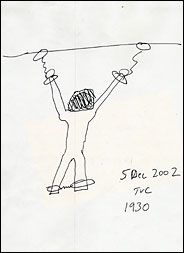 Read much more about the death and torture of Afghan prisoners by
U.S. soldiers in the euphemistically named Bagram Collection Point. This morning's New York
Times has a two-page spread, written by Tim Golden, based on an Army investigation detailed in
a secret "Bagram file," a copy of which was obtained "from a person who was critical of the
methods used at Bagram and the military's response to the deaths" that resulted from those
methods.
Read much more about the death and torture of Afghan prisoners by
U.S. soldiers in the euphemistically named Bagram Collection Point. This morning's New York
Times has a two-page spread, written by Tim Golden, based on an Army investigation detailed in
a secret "Bagram file," a copy of which was obtained "from a person who was critical of the
methods used at Bagram and the military's response to the deaths" that resulted from those
methods.
Because Golden's report will soon disappear into an archive on the Times Web site, available only by paying for it, my staff of thousands insists on posting excerpts for the record, showing that torture was not the exception but the rule, that what has happened under Dear Leader's regime -- with the approval of the American electorate last November -- may be justifiably described as a systemic violation of human rights and a corruption of democratic principles due to an utter lack of accountability at the top of the regime.
For instance:
- "[T]he Bagram file includes ample testimony that harsh treatment by some interrogators was routine, and that guards could strike shackled detainees with virtual impunity."
- "Senior officers frequently toured the detention center, and several of them acknowledged seeing prisoners chained up for punishment or to deprive them of sleep."
- "[M]any of the Bagram interrogators ... were redeployed to Iraq and in July 2003 took charge of interrogations at the Abu Ghraib prison. According to a high-level Army inquiry last year, [the same officer in charge] applied techniques there that were 'remarkably similar' to those used at Bagram."
- "[A] standard procedure" of confinement in "9-foot by 7-foot isolation cells," one military police commander said, included "a policy that detainees were hooded, shackled and isolated for at least the first 24 hours, sometimes 72 hours of captivity."
- "Last October, the Army's Criminal Investigation Command concluded that there was probable cause to charge 27 officers and enlisted personnel with criminal offenses in [one] case ranging from dereliction of duty to maiming and involuntary manslaughter. Fifteen of the same soldiers were also cited for probable criminal responsibility in [another] case. So far, only the seven soldiers have been charged, including four last week. No one has been convicted in either death."
- "[D]ocuments and interviews reveal a striking disparity between the findings of Army investigators and what military officials said in the aftermath of the deaths. Military spokesmen maintained that both men had died of natural causes, even after military coroners had ruled the deaths homicides."
Golden's report hammers home the details of systemic torture, describing such methods as routine sleep deprivation that kept prisoners awake for 32 to 36 hours at a time and "'Fear Up Harsh,' or what one soldier referred to as 'the screaming technique.'" One interrogator, nicknamed "Monster" and "the King of Torture," would intimidate new prisoners "as they stood chained to an overhead pole or lay face down on the floor. ... A military police K-9 unit often brought growling dogs to walk among the new prisoners."
A particularly nasty platoon of guards, nicknamed "the Testosterone Gang," enjoyed listening to one detainee "scream out, 'Allah! Allah! Allah!" when struck by a blow just above the knee designed to cause excruciating pain. "Everybody heard him cry out and thought it was funny," a soldier told investigators. "It became a kind of running joke, and people kept showing up to give this detainee a common peroneal strike just to hear him scream out 'Allah!' It went on over a 24-hour period, and I would think that it was over 100 strikes."After the man died of heart failure, the medical examiner reported that "what caused his heart to fail was 'blunt force injuries to the lower extremities.'" Later, in a military hearing, "one of the coroners [said] the tissue in the young man's legs 'had basically been pulpified.' I've seen similar injuries in an individual run over by a bus."
Had enough? Yeah, yeah, I know, we've heard it all before. Well, go here for more, and click on "Interactive Feature: The Bagram File" in the left column. Golden narrates the story and its background with the help of a slide show. Then hang your head in shame for a criminal U.S. regime that has lied to the people and for a nation that has gone along with its lies.
 Norman Mailer is at the top of his game in "On Sartre's God Problem," an essay that appeared in
Libération, the liberal French daily, which recently marked the centenary of the French
philosopher's birth. Reprinted in the current issue of The Nation, it begins: "I would say that
Sartre, despite his incontestable strengths of mind, talent and character, is still the man who
derailed existentialism, sent it right off the track." Then Mailer lays out his reasons in sweet detail
and leads us to an even sweeter conclusion: "Something immense may now be stirring, but to
meet it we will do better to expect that life will not provide the answers we need so much as it
will offer the privilege of improving our questions."
Norman Mailer is at the top of his game in "On Sartre's God Problem," an essay that appeared in
Libération, the liberal French daily, which recently marked the centenary of the French
philosopher's birth. Reprinted in the current issue of The Nation, it begins: "I would say that
Sartre, despite his incontestable strengths of mind, talent and character, is still the man who
derailed existentialism, sent it right off the track." Then Mailer lays out his reasons in sweet detail
and leads us to an even sweeter conclusion: "Something immense may now be stirring, but to
meet it we will do better to expect that life will not provide the answers we need so much as it
will offer the privilege of improving our questions."
What do John Cusack, Al Franken, Arianna Huffington, Richard Linklater and Aaron Mcgruder agree on? The winner of A Flash Contest to Stop the Republican Social Security Scam. Go there. Click START. It's fun.

Postscript: Score one for Cusack, Franken et al. The business exec whose theory is behind Dear Leader's "plan to trim Social Security benefits in the future" now says the regime should drop the idea of "using part of workers' taxes to pay for individual investment accounts."
Like Welles, though in an earlier time and on a different scale, Keaton was a master filmmaker whose creativity was leached out of him by small-minded producers who at first recognized his genius, then proceeded to undermine him by jealously forcing him to conform to a studio system dominated by businessmen uninterested in his art. It's a familiar story, common to any number of Hollywood's great filmmakers from Erich von Stroheim to Francis Ford Coppola. But Keaton's story is particularly affecting because of the size and versatility of his achievement, and how far he fell from his peak of success.
I wish I'd liked the book, though.
In the mounting catalogue of National Public Radio's recent troubles the David D'Arcy affair ranks lowest in public visibility. In part this is because D'Arcy is an arts reporter, and arts reporting exists in a journalistic ghetto. The arts hold less news interest for the public and for news editors themselves than politics, sports, business or celebrities.
But in terms of importance, the D'Arcy affair ought to rank as high as the Tavis Smiley scandal, the Jeffrey Dvorkin doozie, the Bob Edwards-Scott Simon debacles and, now, the right-wing scrutiny by government watchdogs for supposed liberal bias. What happened to D'Arcy -- a top-notch freelance journalist whose contract was terminated after a piece he did on Holocaust art theft and the Museum of Modern Art sent MoMA board chairman Ron Lauder so far around the bend that museum officials accused D'Arcy of "shabby reporting" and pressured NPR to repudiate it -- illustrates how even a well-meaning, public-spirited news organization can be corrupted by the influence of a big-money institution with huge cultural power and corporate clout.
In addition to dumping D'Arcy and posting a misleading correction about the story on its web site, which D'Arcy and others dispute as itself erroneous, NPR disciplined the staff editor who supervised the D'Arcy piece, Tom Cole, by suspending him for a day without pay. So here's the latest wrinkle: The American Federation of Television and Radio Artists has brought a grievance against NPR for violating disciplinary procedures of the union contract.
"We are vigorously pursuing the grievance because no discipline was warranted," said Kenneth Greene, assistant executive director of AFTRA's Baltimore-Washington chapter. Cole is a member of AFTRA, which represents 2,600 broadcast personnel in Baltimore and Washington, and about 80,000 nationally.
The matter has gone to arbitration following the cancellation of a grievance meeting between NPR and AFTRA that had been scheduled on April 22 to hear the dispute. NPR officials called off the meeting "because the union would not agree to conditions they imposed," Greene told me yesterday. "I have a right to present the grievance. They have no right to force me to acquiesce to their conditions that have no basis in the contract."
Greene said NPR asserted that D'Arcy could not attend the meeting unless Cole did. "It was both or neither," he said. AFTRA wanted D'Arcy, who is not a member of the union, to be at the meeting as a witness in the case, Green said, "because he has facts, first-hand knowledge that refutes a deficient investigation by NPR. We wanted all the relevant facts. Not only was the discipline not warranted, but their whole investigation of the matter ignored due process."
A date for the arbitration has not been formalized, Greene said. The case will be heard no later than the end of July, he said, with a decision expected as soon as early August or by mid-September at the latest.
It is unclear that Cole wants the union to pursue the violation, but Greene says whether he does or not is irrelevant. "Some employees don't want to pursue a violation because it's not worth the trouble for them," Greene noted. "He lost a day's pay. In the grand scheme of things that might not be a big deal to him. But the union has a contract to enforce. It's our guiding light."
Neither Cole nor NPR have returned my phone calls for comments. When I informed Greene I had tried to reach Cole, he said he was going to tell him not to discuss the case with me. D'Arcy, reached in Iceland where he was covering a story, said he preferred not to comment.
Among the many ironies of this story -- including the fact that the union is going to bat for someone who seems to have accepted his suspension and put it behind him -- is that D'Arcy has earned a reputation as one of the nation's most knowledgeable arts reporters, especially when it comes to the issue of Holocaust art theft.
Postscript: Much better head for this item suggested by my staff of thousands: Union Says NPR Flushed Media Ethics Manual Down Toilet, Caved to MoMA, Fired Reporter Over Holocaust Loot Story
 If you do nothing else today, you must watch Bill Moyers's fucking terrific
speech about the accusation of liberal bias made against his old PBS show
"Now" and the Public Broadcasting System by right-wing government creep Kenneth Tomlinson,
chairman of the Corporation for Public Broadcasting. Moyers responded to the charge on Sunday
at the National Conference on Media Reform in St. Louis, recalling Nixon's efforts to shut him up,
too.
If you do nothing else today, you must watch Bill Moyers's fucking terrific
speech about the accusation of liberal bias made against his old PBS show
"Now" and the Public Broadcasting System by right-wing government creep Kenneth Tomlinson,
chairman of the Corporation for Public Broadcasting. Moyers responded to the charge on Sunday
at the National Conference on Media Reform in St. Louis, recalling Nixon's efforts to shut him up,
too.
"They've been after me for years now, and I suspect they will be stomping on my grave to make sure I don't come back from the dead," he said. In the speech, entitled "We Were Getting it Right, But Not Right Wing," he went on to say:
Who are they? I mean the people obsessed with control using the government to threaten and intimidate; I mean the people who are hollowing out middle class security even as they enlist the sons and daughters of the working class to make sure Ahmad Chalabi winds up controlling Iraq's oil; I mean the people who turn faith-based initiatives into Karl Rove's slush fund; who encourage the pious to look heavenward and pray so as not to see the long arm of privilege and power picking their pockets; I mean the people who squelch free speech in an effort to obliterate dissent and consolidate their orthodoxy into the official view of reality from which any deviation becomes unpatriotic heresy. That's who I mean.
If only Moyers wasn't joking when he threatened to come out of retirement. In the meantime, as Dear Leader's appointee, Tomlinson is also going after NPR, about which more later.
Does Greg Palast have influence, or was he simply ahead of the curve as usual? Another possibility: Someone took note of this May 6 item, in which my staff of thousands pointed out that Palast was "pissed off that the American press, unlike the British press, has made so little" of the Downing Street memo leaked to The Times of London and "splashed across [its] front pages" on May 1.
The memo revealed, as Palast wrote, "an elaborate plan by George Bush and British Prime Minister Tony Blair to hoodwink the planet into supporting an attack on Iraq knowing full well the evidence for war was a phony."
Anyway, have a look at Editor & Publisher's May 14 article, which says: "For more than 10 days, the U.S. media nearly ignored it, but finally the so-called 'Downing Street Memo' is finally gaining traction in the U.S. press. The Los Angeles Times featured a lengthy report on Thursday, and Walter Pincus of The Washington Post followed on Friday."
Yesterday WashPost ombudsman Michael Geller wrote, "I have to say I'm amazed that The Post took almost two weeks to follow up on the Times report." This morning Paul Krugman takes note. He writes:
There has been notably little U.S. coverage of the 'Downing Street memo' -- actually the minutes of a British prime minister's meeting on July 23, 2002, during which officials reported on talks with the Bush administration about Iraq. But the memo, which was leaked to The Times of London during the British election campaign, confirms what apologists for the war have always denied: the Bush administration cooked up a case for a war it wanted.Krugman goes on to give the details, including the URL where the entire memo may be read, a wise and Webby thing to do. But he also weaves in the broader implications, as he usually does, about the war that has taken America hostage and "how the tough guys made America weak."
It's not his strongest columm -- not nearly as strong as the one he wrote on April 29, "A Private Obsession," about health care reform being blocked by conservative ideologues who believe in privatization when it is the private system as we know it that is to blame for lousy health care in the first place. But it will have to do for today's fix of Krugman.
Taking care of the nation's business as usual, our Dear Leader was tooling around on his bicycle at noon yesterday, just back from his globe-trotting photo op, when the terror alert went to Code Red, jets were scrambled, the Capitol was cleared and police told everyone: "Run. Get out. Keep running. ... We're under attack."
 Democratic minority leader Nancy Pelosi said police "pulled me out of
my shoes," CNN reported. They whisked
her off, along with other pols, several Supreme Court Justices, and Cheney Boy to secure
locations. MSNBC.com's headline blared, "D.C.'s BIG
SCARE." The Washington Post merely shouted, "Confused Fliers Trigger Capital
Scare." Dear Leader was oblivious to the mad dash for safety because
nobody told him what was
happening until he finished his bicycle ride. Which captured the moment perfectly.
Democratic minority leader Nancy Pelosi said police "pulled me out of
my shoes," CNN reported. They whisked
her off, along with other pols, several Supreme Court Justices, and Cheney Boy to secure
locations. MSNBC.com's headline blared, "D.C.'s BIG
SCARE." The Washington Post merely shouted, "Confused Fliers Trigger Capital
Scare." Dear Leader was oblivious to the mad dash for safety because
nobody told him what was
happening until he finished his bicycle ride. Which captured the moment perfectly.
A TV-viewing friend writes:
So I'm sitting here watching a swarm of squealing piglets flee Capitol Hill from a little Cessna two-seater, not quite the Red Baron's bi-plane. Makes me long for those puny limp-wristed Londoners who refused to run during The Blitz. Red-faced little rotten-toothed cowardly faggots, one and all -- but my kind of folks. And I'm laughing my ass off at this CNN clown, one Joe Johns, a ballsy reporter who's describing his narrow escape. Reminds me of Duke Wayne's heroic WW2 exploits. Is it an axiom that lives without any justification at all are the ones most worth preserving?No charges were filed against the fliers. That, too, captured the spirit of Homeland Security's latest Code Red alert.
City Comforts Blog has picked up on Bill Osborne's commentary about "the delicate, almost imperceptible line that separates good and evil, life and death, guilt and innocence." Meanwhile, Osborne offers a reminder that Kristallnacht, the Night of Broken Glass, November 9, 1938, was almost a year before the start of World War II -- so that no one had any illusions about the abuses going on in Germany -- and yet nothing was done.
Attacks against Jews were not limited to a notoriously anti-Semitic city such as Munich. On that night and the next all across the country:
" 96 Jews were killed and hundreds more injured, more than
1,000 synagogues were burned (and possibly as many as 2,000), [see map], almost 7,500 Jewish
businesses were destroyed, cemeteries and schools were vandalized, and 30,000 Jews were
arrested and sent to concentration camps."
96 Jews were killed and hundreds more injured, more than
1,000 synagogues were burned (and possibly as many as 2,000), [see map], almost 7,500 Jewish
businesses were destroyed, cemeteries and schools were vandalized, and 30,000 Jews were
arrested and sent to concentration camps."
Within days, laws were passed to "Aryanize" the economy, and it wasn't long before:
+ Jews were required to turn over all precious metals to the government.As Osborne points out, the progroms such as Kristallnacht and these utterly extreme laws were not imperceptible lines.
+ Pensions for Jews dismissed from civil service jobs were arbitrarily reduced.
+ Jewish-owned bonds, stocks, jewelry and art works can be willed only to the German state.
+ Jews were physically segregated within German towns.
+ A ban on the Jewish ownership of carrier pigeons.
+ The suspension of Jewish drivers licenses.
+ The confiscation of Jewish-owned radios.
+ A curfew to keep Jews off the streets between 9:00 p.m. and 5:00 a.m. in the summer and 8:00 p.m. and 6:00 a.m. in the winter.
+ Laws protecting tenants were made non-applicable to Jewish tenants.
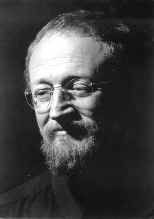 Regarding the Memorial to the Murdered Jews of Europe,
which opens today in Berlin: "I too was struck by Ourousoff's article in the Times," Bill Osborne
messages. "It was far above what one usually reads in the paper, but one of the statements you quoted yesterday really
bothered me:
Regarding the Memorial to the Murdered Jews of Europe,
which opens today in Berlin: "I too was struck by Ourousoff's article in the Times," Bill Osborne
messages. "It was far above what one usually reads in the paper, but one of the statements you quoted yesterday really
bothered me:
The memorial's power lies in its willingness to grapple with the moral ambiguities arising in the Holocaust's shadow. Its focus is on the delicate, almost imperceptible line that separates good and evil, life and death, guilt and innocence.
"Just how 'imperceptible' were the lines that separated good and evil during Germany's persecution of the Jews?" Osborne, above, asks. "Why did the world think it could just overlook the Nuremberg Laws? By 1935, the extreme violence and degradation directed toward the Jews was mind-boggling, and openly practiced for the whole world to see. The actions were obviously evil. The lines that were crossed were not in any way 'imperceptible.' This is important to note, because if the abuses caused by the Nuremberg Laws had been stopped (and this was well before Germany had re-armed,) the Holocaust would never have happened. It would have also put Hitler out of power. How ironic if Berlin's new monument rationalizes the world's willful, numbed blindness.
"But there are important meanings symbolized by the memorial. Once you enter the spiritual labyrinth of the Holocaust, it is difficult to ever fully return. Your perceptions of humanity are too deeply altered. As the memorial symbolizes, you enter at first not knowing quite what you are seeing. You still have an ability to maintain an outside perspective. But as you go deeper and deeper all reference is lost. There is an abyss in our humanity that has never been defined, and which no religion, philosophy or moral system has ever adequately examined. The Holocaust thus remains without any frame of reference from which it can be approached. The impulses that created the Holocaust are very human, but come from a hideous part of the social psyche of which we have almost no knowledge or understanding. It is a labyrinth in which we become lost because it has never been mapped. Among many other things, the memorial is a monument to our lack of knowledge about who and what we really are.
"But that does not mean we do not know evil when we see it. Decent people do not stand by when humans are subjected to beatings, arson, humiliation, radical degradation and systematic disappropriation. Through the Nuremberg Laws, the entire world watched this happen with full knowledge that the actions were evil.
"And little has changed."
As usual, Osborne's perceptions and conscience are far more acute than mine.
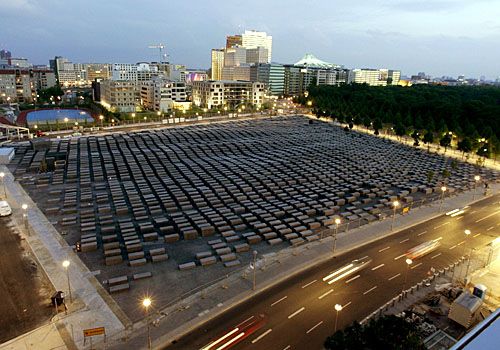 "The memorial's power lies in its willingness to grapple
with the moral ambiguities arising in the Holocaust's shadow," Ourousoff writes in today's New York Times. "Its focus is
on the delicate, almost imperceptible line that separates good and evil, life and death, guilt and
innocence."
"The memorial's power lies in its willingness to grapple
with the moral ambiguities arising in the Holocaust's shadow," Ourousoff writes in today's New York Times. "Its focus is
on the delicate, almost imperceptible line that separates good and evil, life and death, guilt and
innocence."
Echoing Eisenman's own statements about the thin membrane between the mundane and the cosmic, he writes:
[T]he memorial's central theme is the process that allows human beings to accept such evil as part of the normal world -- the incremental decisions that collectively lead to the most murderous acts.
There is no way to glean this from photographs; it can be understood only by experiencing the memorial as a physical space. No clear line, for example, divides the site from the city around it. The pillars along its periphery are roughly the height of park benches. A few scattered linden trees sprout between the pillars along the memorial's western edge; at other points, outlines of pillars are etched onto the sidewalk, so that pedestrians can actually step on them as they walk by.
The sense of ambiguity -- the concerns of everyday life, a world of unspeakable evil -- will only be amplified once the memorial opens to the public [on Tuesday]. It is not hard to imagine Berliners sitting on the pillars at the memorial's edges, reading books or sunning themselves on a spring afternoon. The day I visited the site, a 2-year-old boy was playing atop the pillars -- trying to climb from one to the next as his mother calmly gripped his hand.
These moments speak to one of the Holocaust's most tragic lessons, the ability of human beings to numb themselves to all sorts of suffering -- a feeling that only intensifies as you descend into the site. Paved in uneven cobblestones, the ground between the pillars slopes down as you move deeper in.
At first, you retain glimpses of the city. The rows of pillars frame a distant view of the Reichstag's skeletal glass dome [at right]. To the west, you can glimpse the canopy of trees in the Tiergarten. Then as you descend further, the views begin to disappear. The sound of gravel crunching under your feet gets more perceptible; the gray pillars, their towering forms tilting unsteadily, become more menacing and oppressive. The effect is intentionally disorienting. You are left alone with memories of life outside -- the cheerful child, for example, balanced on the concrete platform.
In other words, you have to be there to sense the true impact of the place. Even so, the photos accompanying this item are worth seeing. From top to bottom: an aerial view showing the memorial bordered by a street and a park within the city (Jockel Finck/AP); a view of the tallest pillars -- all told, the pillars vary in height from mere inches to 15 feet or so -- and a cobblestone lane deep within the memorial (Harf Zimmermann for NYT); a view toward the Reichstag dome from within the memorial (Herbert Knosowski/AP); a large wall display showing Holocaust victims in the documents center located below the memorial (Michael Kappeler/AFP/DDP).
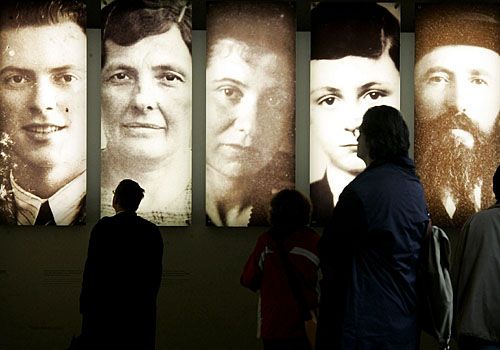 It sounds from Ourousoff's report that Eisenman's design for
memorializing the murdered Jews of Europe easily rises to, and perhaps above. the standard set
by Maya Lin for the Vietnam Veterans Memorial in Washington. Which is as it
should be. One day we'll see what comes of the design for the 9/11 memorial to those who died at
Ground Zero in New York, in a field in Pennsylvania and at the Pentagon in Washington.
It sounds from Ourousoff's report that Eisenman's design for
memorializing the murdered Jews of Europe easily rises to, and perhaps above. the standard set
by Maya Lin for the Vietnam Veterans Memorial in Washington. Which is as it
should be. One day we'll see what comes of the design for the 9/11 memorial to those who died at
Ground Zero in New York, in a field in Pennsylvania and at the Pentagon in Washington.
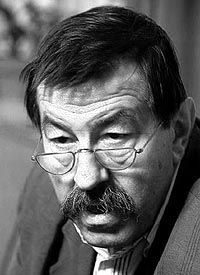 Speaking of things German, like the Berlin Holocaust Memorial ...
Nobel laureate Gunter Grass has much to say about democracy, freedom and capitalism in post-World War II
Germany on the occasion of the "Reich's unconditional surrender" 60 years ago tomorrow:
Speaking of things German, like the Berlin Holocaust Memorial ...
Nobel laureate Gunter Grass has much to say about democracy, freedom and capitalism in post-World War II
Germany on the occasion of the "Reich's unconditional surrender" 60 years ago tomorrow:
[T]he ring of lobbyists with their multifarious interests ... constricts and influences the Federal Parliament and its democratically elected members, placing them under pressure and forcing them into disharmony, even when framing and deciding the content of laws. Consequently, Parliament is no longer sovereign in its decisions. It is steered by the banks and multinational corporations -- which are not subject to any democratic control.What's needed is a democratic desire to protect Parliament against the pressures of the lobbyists by making it inviolable. But are our Parliamentarians still sufficiently free to make a decision that would bring radical democratic constraint? Or is our freedom now no more than a stock market profit?
Sound familiar? Substitute "U.S. Congress" for "Federal Parliament," and "Congressmen and women" for "Parliamentarians," and you'd think Grass was writing about the United States. He's not of course. His essay mainly concerns the as yet unbridgeable divide that still exists between East and West Germans.
But when it comes to corporate influence, lobbyists and the corruption of democracy by unrestrained capitalism, Grass might as well be writing about us. The Web cover line for the essay, which appears on today's New York Times op-ed page, is: "After 60 years, Germans still haven't learned to be free." It's too bad the same may be said for Americans after more than 200 years.
 On Tuesday of next week, as part of the 60th anniversary
celebration of the defeat of Nazi Germany in World War II, the long-awaited Berlin Holocaust
memorial (left) is scheduled to open. But anyone who believes it will be as grim as a cemetary
because its 2,711 gray pillars resemble grave stones, or thinks it will be off limits to picnickers,
skateboarders, games of hide-and-seek and even vandals, hasn't listened to the American-born
architect who designed it.
On Tuesday of next week, as part of the 60th anniversary
celebration of the defeat of Nazi Germany in World War II, the long-awaited Berlin Holocaust
memorial (left) is scheduled to open. But anyone who believes it will be as grim as a cemetary
because its 2,711 gray pillars resemble grave stones, or thinks it will be off limits to picnickers,
skateboarders, games of hide-and-seek and even vandals, hasn't listened to the American-born
architect who designed it.
"I think kids will play tag. I think people will eat their lunch on the pillars," Peter Eisenman told Reuters. "I'm sure skateboarders will use it. People will dance on the top of the pillars. All kinds of unexpected things are going to happen."
"There will be people who attempt to deface it but that's an expression of the people," he added.
 Controversy has dogged the memorial from the beginning.
For instance, a billboard (right) suggesting why people should give money for construction of a
document center beneath the memorial, caused so much outrage that it had to be taken down.
(The large slogan reads, "The Holocaust never
happened." The small type reads: "There are still some who say that. In 20
years, there may be even more. This is why you should give to the memorial to the murdered Jews
of Europe.")
Controversy has dogged the memorial from the beginning.
For instance, a billboard (right) suggesting why people should give money for construction of a
document center beneath the memorial, caused so much outrage that it had to be taken down.
(The large slogan reads, "The Holocaust never
happened." The small type reads: "There are still some who say that. In 20
years, there may be even more. This is why you should give to the memorial to the murdered Jews
of Europe.")
The memorial, facing the site where a new U.S. embassy is being built, is located near Berlin's Brandenburg Gate and is a city block in size. It will be open 24 hours a day, 365 days a year.
"I would like to think it doesn't close off discussion but opens discussion, on issues of anti-Semitism, the Nazi regime and the role of the German people," Eisenman told Reuters. "I see it as a catalyst because of feelings it generates." He added:
A lot of people, especially in Jewish communities, asked what it has to do with the Holocaust. There are no stars, no names. But we didn't want that. A little kid will go in and play hide and seek until he gets lost and starts to scream. You can't stop anyone from doing anything and that was part of the message.
Except for one thing: Eisenman says he wants no Bratwurst stand anywhere near the memorial. According to Deutsche Welle, "commercialization of and profiting from the suffering of the Holocaust is something he adamantly rejects."
Tonight, meanwhile, Nobel Peace Prize laureate Elie Wiesel and other Holocaust survivors are scheduled to talk about their experiences in a pre-recorded conversation to be aired on WNYC at 7 p.m. ET (AM 820 in New York). The conversation, entitled "Never Again! A Holocaust Memorial," is already posted on Only in America.
Finally, Laura Bush attended the National Commemoration of the Days of Remembrance in the Capitol's Rotunda yesterday. According to The Washington Post, she told Holocaust survivors and their liberators in the crowd there: "Your presence is evidence that good will always triumph over evil."
Well, not if you do the math, Laura. Of course, it's not just a matter of the six million who died vs. the tiny fraction of that number who survived. Listen to Elie Wiesel tonight. He'll tell you why he doesn't believe such foolish wisdom either.
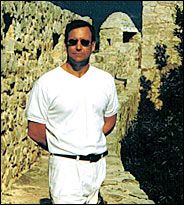 David Ehrenstein does another of his delectable commentaries on a story from The
New York Times, this one called "The Mystery of
Hollywood's Dead Republican," starring R. Gregory Stevens
(right) and Carrie Fisher. When I first read that story -- devoured it, actually -- it occurred to me
that my life is pretty dull. But never mind. Ehrenstein's remarks are delish -- i.e.: "... in the Fruit
Fly Pantheon, Fisher's right up there with Dorothy Dean -- at least insofar as influence and
'networking' goes. (No one touches Dorothy when it comes to wit.)"
David Ehrenstein does another of his delectable commentaries on a story from The
New York Times, this one called "The Mystery of
Hollywood's Dead Republican," starring R. Gregory Stevens
(right) and Carrie Fisher. When I first read that story -- devoured it, actually -- it occurred to me
that my life is pretty dull. But never mind. Ehrenstein's remarks are delish -- i.e.: "... in the Fruit
Fly Pantheon, Fisher's right up there with Dorothy Dean -- at least insofar as influence and
'networking' goes. (No one touches Dorothy when it comes to wit.)"
Postscript: And here's Studs Terkel on Pete Seeger.
This record is extremely sensitive. No further copies should be made. It should be shown only to those with a genuine need to know its contents.Palast believes the memo "has 'IMPEACH HIM' written all over it." Meaning the him in the White House. (Fat chance.) Palast is also pissed off that the American press, unlike the British press, has made so little of the memo.C reported on his recent talks in Washington. ... Bush wanted to remove Saddam, through military action, justified by the conjunction of terrorism and WMD. But the intelligence and facts were being fixed around the policy. The NSC had no patience with the UN route, and no enthusiasm for publishing material on the Iraqi regime's record. There was little discussion in Washington of the aftermath after military action. [Boldface added.]
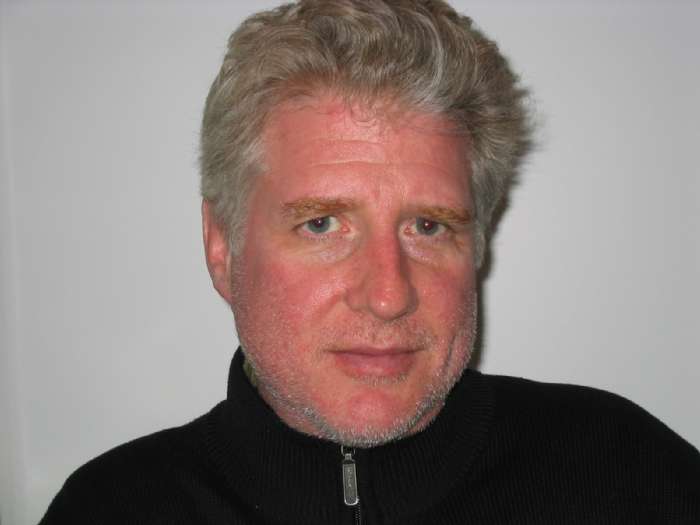 Well, Dan, if NPR's continuing lack of candor about why it axed
longtime arts reporter David D'Arcy (left) is any hint, it looks like more of the same is going to
happen next. As a veteran commentator on national and foreign affairs, Dan, perhaps you recall
what Israeli diplomat Abba Eban used to say about the PLO: "[They] never miss an opportunity
to miss an opportunity." It sounds to me like that applies equally to NPR these days. Given half a
chance, the management magnificos at the network will go on shooting themselves in the
foot.
Well, Dan, if NPR's continuing lack of candor about why it axed
longtime arts reporter David D'Arcy (left) is any hint, it looks like more of the same is going to
happen next. As a veteran commentator on national and foreign affairs, Dan, perhaps you recall
what Israeli diplomat Abba Eban used to say about the PLO: "[They] never miss an opportunity
to miss an opportunity." It sounds to me like that applies equally to NPR these days. Given half a
chance, the management magnificos at the network will go on shooting themselves in the
foot.
James Beck, founder and president of the art preservation organization ArtWatch International, goes further. In e-mail messages to the NPR board chairman and other top network execs, including the NPR ombudsman, Beck claimed that the "situation surrounding the removal" of D'Arcy -- namely pressure on NPR from Museum of Modern Art officials, who complained about D'Arcy's reporting -- causes concern
that independent, disinterested, and uninfluenced reporting about art may be in jeopardy. Even powerful institutions like the Museum of Modern Art should not be allowed to influence transparency and the free reporting of information.
Beck, who is a widely respected art historian at Columbia University -- he recently revealed that the "Madonna of the Pinks" acquired by the London National Gallery, which was hyped in the press, is actually a 19th century copy of the Raphael painting -- asked NPR for "clarification and assurances" about the facts of the D'Arcy case. But according to the latest ArtWatch newsletter, he received nothing more than a pro forma response acknowledging receipt of his e-mails. The newsletter notes further: "It is surprising that Ombudsman Jeffrey Dvorkin did not respond to the letter, but rather sent it along to be handled by the Corporate Communications division." Some ombudsman.
Separately, in a letter obtained by Straight Up, Beck wrote Nick Tinari, an attorney active in arts issues such as the effort to keep the painting collection of the Barnes Foundation in Merion, Pa.:
ArtWatch is concerned about the implications of this [D'Arcy] matter for the larger and critical issue of the freedom of the media to report on the activities of influential cultural institutions. ... I can assure you that we will continue our investigation into this matter, and will post developments on our website. At the crux of this unhealthy situation is the unchecked power of museums, which can and do control information and the press.
Straight Up's staff of thousands also intends to follow up with further developments in the D'Arcy affair in the near future.
The site has been pushing that PR line for years. Friedman is just sucker enough to fall for it. The top editor tells him, "We have a lot of tools in our toolbox for telling a story." But reporters and original reporting -- what real journalism is all about -- don't count for much in that toolbox, since MSNBC.com is mainly a glorified content aggregator. Friedman has nothing to say about that except some hooey on being "liberated from old-fashioned journalism's usual limitations."
A photo is worth at least several thousand words, says Leon ("He's Our Calvin Trillin") Freilich:
CHEZ MSNBC
Words
Are
for the birds.
Photos
Are graphic grab-alls that tell a story with enough color, shading,
design, depth of field and harmony, all achieved on the cheap, to mesmerize, both within and
without Kansas, discerning canine buddies of Toto's.
And a reader sends this message as a memo to the MSNBC.com honchos:
Take it from the aggrieved remark of Oscar Hammerstein's wife: "Richard Rogers didn't write 'Some Enchanted Evening.' He wrote 'La la la la la la.' Nice, but not the same thing."
 Have a look at the stories featured on the fake Newsweek
cover, right, of March 21, 2095. Besides the cover story about California's popularity as an island
off the North American continent 62 years after the Big Quake and "Clones in the Military: Don't
Ask --Don't Tell," the story cover lines read as follows:
Have a look at the stories featured on the fake Newsweek
cover, right, of March 21, 2095. Besides the cover story about California's popularity as an island
off the North American continent 62 years after the Big Quake and "Clones in the Military: Don't
Ask --Don't Tell," the story cover lines read as follows:
Politics: The New Demopublicans
Business: Weekends Reinstated
Religion: Shanghai on just $50K a Day
Science: Cats Develop 10th Life
Sports: Can Yanks Reverse 100 yr. Curse?
The science and sports cover lines really belong to the low-grade mentality of supermarket tabs like News of the World. They long ago infected the newsweeklies with their peculiar fetish for the occult. But c'mon. A-list advertisers don't exactly go for News of the World and its ilk. And by the way, can anyone enlighten me as to what religion has to do with Shanghai on $50k a day? I have no idea.
Here are some other cover lines, according to the Magazine Publishers of America, from "faux" covers of the future:
Parents:
"Pregnant at 75:
The Risks and Rewards"
Reader's
Digest: "Androids
v. Clones: Where Do You Stand?"
Travel +
Leisure:
"Road-Testing the New Self-Packing Luggage"
Smithsonian: "Exploring the Beaches of
Also, have a look at some other "faux" covers to see what else may be in store for us from the wonderful world of print. Then check out the cutes-y futuristic ads. I doubt they're the answer to circulation woes.
Postscript: Last time I looked, MSNBC.com was still using words -- mostly AP's and Reuters's, when not tapping into The Washington Post's and Newsweek's or Forbes's and Businessweek's. To believe Jon Friedman's puff piece, however, you'd think not. You'd think MSNBC.com had re-invented journalism "by using resources other than mere words and still photos." The site has been pushing that PR line for years. Friedman is just sucker enough to fall for it. The top editor tells him, "We have a lot of tools in our toolbox for telling a story." But reporters and original reporting -- what real journalism is all about -- don't count for much in that toolbox, since MSNBC.com is mainly a glorified content aggregator. Friedman has nothing to say about that except some hooey on being "liberated from old-fashioned journalism's usual limitations."
Post-postscript: A photo is worth at least several thousand words, says Leon ("He's Our Calvin Trillin") Freilich:
CHEZ MSNBC
Words
Are
for the birds.
Photos
Are graphic grab-alls that tell a story with enough color, shading,
design, depth of field and harmony, all achieved on the cheap, to mesmerize, both within and
without Kansas, discerning canine buddies of Toto's.
Post-post-postscript: A reader sends this message as a memo to the MSNBC.com honchos:
Take it from the aggrieved remark of Oscar Hammerstein's wife: "Richard Rogers didn't write 'Some Enchanted Evening.' He wrote 'La la la la la la.' Nice, but not the same thing."
Sites to See
AJ Ads
AJ Blogs
AJBlogCentral | rssculture
Terry Teachout on the arts in New York City
Andrew Taylor on the business of arts & culture
rock culture approximately
Laura Collins-Hughes on arts, culture and coverage
Richard Kessler on arts education
Douglas McLennan's blog
Dalouge Smith advocates for the Arts
Art from the American Outback
For immediate release: the arts are marketable
No genre is the new genre
David Jays on theatre and dance
Paul Levy measures the Angles
Judith H. Dobrzynski on Culture
John Rockwell on the arts
Jan Herman - arts, media & culture with 'tude
dance
Apollinaire Scherr talks about dance
Tobi Tobias on dance et al...
jazz
Howard Mandel's freelance Urban Improvisation
Focus on New Orleans. Jazz and Other Sounds
Doug Ramsey on Jazz and other matters...
media
Jeff Weinstein's Cultural Mixology
Martha Bayles on Film...
classical music
Fresh ideas on building arts communities
Greg Sandow performs a book-in-progress
Exploring Orchestras w/ Henry Fogel
Harvey Sachs on music, and various digressions
Bruce Brubaker on all things Piano
Kyle Gann on music after the fact
Greg Sandow on the future of Classical Music
Norman Lebrecht on Shifting Sound Worlds
publishing
Jerome Weeks on Books
Scott McLemee on books, ideas & trash-culture ephemera
theatre
Wendy Rosenfield: covering drama, onstage and off
Chloe Veltman on how culture will save the world
visual
Public Art, Public Space
Regina Hackett takes her Art To Go
John Perreault's art diary
Lee Rosenbaum's Cultural Commentary
Tyler Green's modern & contemporary art blog
