
BERLIN MEMORIAL REVEALS ABYSS, NOT AMBIGUITIES

Regarding the Memorial to the Murdered Jews of Europe, which opens today in Berlin: "I too was struck by Ourousoff's article in the Times," Bill Osborne messages. "It was far above what one usually reads in the paper, but one of the statements you quoted yesterday really bothered me:

The memorial's power lies in its willingness to grapple with the moral ambiguities arising in the Holocaust's shadow. Its focus is on the delicate, almost imperceptible line that separates good and evil, life and death, guilt and innocence.

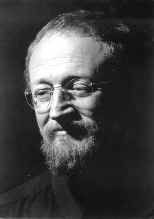
"Just how 'imperceptible' were the lines that separated good and evil during Germany's persecution of the Jews?" Osborne, above, asks. "Why did the world think it could just overlook the Nuremberg Laws? By 1935, the extreme violence and degradation directed toward the Jews was mind-boggling, and openly practiced for the whole world to see. The actions were obviously evil. The lines that were crossed were not in any way 'imperceptible.' This is important to note, because if the abuses caused by the Nuremberg Laws had been stopped (and this was well before Germany had re-armed,) the Holocaust would never have happened. It would have also put Hitler out of power. How ironic if Berlin's new monument rationalizes the world's willful, numbed blindness.

"But there are important meanings symbolized by the memorial. Once you enter the spiritual labyrinth of the Holocaust, it is difficult to ever fully return. Your perceptions of humanity are too deeply altered. As the memorial symbolizes, you enter at first not knowing quite what you are seeing. You still have an ability to maintain an outside perspective. But as you go deeper and deeper all reference is lost. There is an abyss in our humanity that has never been defined, and which no religion, philosophy or moral system has ever adequately examined. The Holocaust thus remains without any frame of reference from which it can be approached. The impulses that created the Holocaust are very human, but come from a hideous part of the social psyche of which we have almost no knowledge or understanding. It is a labyrinth in which we become lost because it has never been mapped. Among many other things, the memorial is a monument to our lack of knowledge about who and what we really are.

"But that does not mean we do not know evil when we see it. Decent people do not stand by when humans are subjected to beatings, arson, humiliation, radical degradation and systematic disappropriation. Through the Nuremberg Laws, the entire world watched this happen with full knowledge that the actions were evil.

"And little has changed."

As usual, Osborne's perceptions and conscience are far more acute than mine.

May 10, 2005 8:48 AM |

Categories:

Me Elsewhere

'WILD SIDE' STILL ROCKS 

Nelson Algren was one of the great American authors of the 20th century, it is no exaggeration to say, and among the most neglected. Consider his underrated classic, "A Walk on the Wild Side." The title -- popularized and co-opted as an idiomatic phrase by Hollywood and Madison Avenue (institutions Algren loathed) -- is familiar to most anyone who speaks English or knows Lou Reed's lyrics. But the novel itself? Hardly.

BUSTER KEATON REVISITED 
Buster Keaton: Tempest in a Flat Hat is not a biography. "This book is merely a fan's notes," Edward McPherson writes in the introduction, although his publisher ignores the disclaimer and calls it a biography on the cover. In fact, the book is a bit of both, a difficult combination to bring off unless you're David Thomson, who set the standard with Rosebud, his penetrating rumination on the life and career of Orson Welles, which was nothing if not a distillation of every obsessive thought he ever had about the myth and the man and all his movies.
LAUREN BACALL, STILL SALTY AT 80 
When Lauren Bacall writes that her singing voice ranges "somewhere between B minus sharp and outer space," she's being candid and funny. It's not every stage star with two Tony Awards for best actress in a musical whose vocal talent offers so little promise. (OK, Harvey Fierstein excepted.) Still less would one admit it.
THE STARS ACCORDING TO BOGDANOVICH 
Peter Bogdanovich's superb collection of movie-star profiles and interviews -- a sequel to Who the Devil Made It, his interviews of top film directors -- begins with an affectionate tale about Orson Welles that reminds us just how intimate the author's connection to Hollywood's greatest has been. But contrary to what we've come to expect from dime-a-dozen celebrities and celebrity interviews not worth two cents, the tale avoids bromidic egotism and journalistic platitudes.
SAMMY'S WHITE DREAMS 
Four decades ago Lenny Bruce sentenced Sammy Davis Jr. to "30 years in Biloxi," stripping him of "his Jewish star" and "his religious statue of Elizabeth Taylor." Now we have two new biographies of Davis that spring him from ridicule, if not from doubts about his legacy, and restore a measure of dignity to a black entertainer whose huge fame and success never overcame his devout wish -- indeed his lifelong effort -- to be white.
more picks

Sites to See

About this Entry

This page contains a single entry by CriticalMASS published on May 10, 2005 8:48 AM.

FOR THE MURDERED JEWS OF EUROPE was the previous entry in this blog.

IMPERCEPTIBLE LINES OF BROKEN GLASS is the next entry in this blog.

Find recent content on the main index or look in the archives to find all content.

Creative Commons License
This weblog is licensed under a Creative Commons License.