SCHICKEL & CORLISS: RATING THE BEST FLICKS

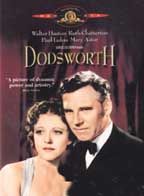
It's good to see William Wyler getting his due from Time magazine film critics Richard Schickel and Richard Corliss. In the current issue, they've chosen Wyler's "Dodsworth" as the best flick of the '30s, along with Orson Welles's "Citizen Kane," Roman Polanski's "Chinatown," Quentin Tarantino's "Pulp Fiction," Fritz Lang's "Metropolis," Ingmar Bergman's "Persona," Akira Kurosawa's "Ikiru," Krzysztof Kieslowski's "Decalogue" and Pedro Almodovar's "Talk to Her" as the best of their decades. (Have a look at Time's top 100.)

They'd get an argument about "Dodsworth" from fans of "Gone With the Wind," of course -- to say nothing of so many other '30s faves: "The Front Page," "Grand Hotel," "It Happened One Night," "The Informer," "All Quiet on the Western Front," "Drums Along the Mohawk," "Lost Horizon," "Jezebel," "You Can't Take It With You," the first full-length animated film "Snow White and the Seven Dwarfs," "The Wizard of Oz," "Stagecoach" and "Wuthering Heights."

I rank "Dodsworth" among Wyler's best films myself. It has the most poignant moment of visual poetry in his entire canon, a shot that sums up what the film is all about -- failed marriage, illusory dreams, capricious fate -- in a single emblematic image. I also get a special kick out of the film because of an inside joke. If you watch carefully as the camera pans across the tiny orchestra in a Vienna nightclub where Sam Dodsworth's wife has gone dancing with a suitor, you'll glimpse Wyler playing the violin. He's the guy in the middle of the front row.
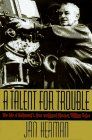
Although Wyler is one of Hollywood's greats, with three Academy Awards for directing on 12 nominations and more Oscar nominations for his films by far than any other director, he's less famous than Billy Wilder, with whom he's often confused, less celebrated than Frank Capra and John Ford, who were working at the height of their powers in the '30s, and even less well-known than his longtime studio boss, the self-aggrandizing Sam Goldwyn, who went out of his way to take credit for his accomplishments.

(Cheap plug here: Read all about it in my Wyler biography, "A Talent for Trouble.")

Schickel and Corliss rightly point out that the '30s was Hollywood's "highest romantic era" and that "no film achieved more entrancing heights" in that period than "Dodsworth." But they also say it was adapted from Sinclair Lewis's "best novel." Perhaps they were influenced by the fact that "Dodsworth" was published in 1929, and Lewis won the Nobel Prize for Literature in 1930. Literary critics tend to rank it behind such earlier novels as "Babbitt" and "Elmer Gantry."

They also seem to think of "the divine Mary Astor" as the star of the 1936 movie. Divine she is, but it's Walter Huston at the center of everything as Sam Dodsworth, the self-made automobile magnate from Zenith, Indiana, and Ruth Chatteron, as his wife Fran, who probably has the most screen time. Huston dominates the movie, which was actually based not on the novel but on a hit play adapted from the novel that Huston starred in on Broadway in 1934. It was "the greatest personal triumph of his stage career," to quote myself, and the play was a smash largely on the strength of his magnetic portrayal.

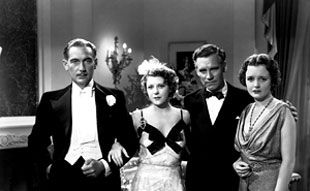
One of the film's many great pleasures is to see Huston reprise the role on screen with all the naturalness that Wyler valued. "No acting ruses, no acting devices," he said of Huston's performance, "just the convincing power that comes from complete understanding of a role." (Above, the cast from right to left: Mary Astor, Walter Huston, Ruth Chatterton, Paul Lukas.)

May 25, 2005 1:14 AM |

Categories:

Me Elsewhere

'WILD SIDE' STILL ROCKS 

Nelson Algren was one of the great American authors of the 20th century, it is no exaggeration to say, and among the most neglected. Consider his underrated classic, "A Walk on the Wild Side." The title -- popularized and co-opted as an idiomatic phrase by Hollywood and Madison Avenue (institutions Algren loathed) -- is familiar to most anyone who speaks English or knows Lou Reed's lyrics. But the novel itself? Hardly.

BUSTER KEATON REVISITED 
Buster Keaton: Tempest in a Flat Hat is not a biography. "This book is merely a fan's notes," Edward McPherson writes in the introduction, although his publisher ignores the disclaimer and calls it a biography on the cover. In fact, the book is a bit of both, a difficult combination to bring off unless you're David Thomson, who set the standard with Rosebud, his penetrating rumination on the life and career of Orson Welles, which was nothing if not a distillation of every obsessive thought he ever had about the myth and the man and all his movies.
LAUREN BACALL, STILL SALTY AT 80 
When Lauren Bacall writes that her singing voice ranges "somewhere between B minus sharp and outer space," she's being candid and funny. It's not every stage star with two Tony Awards for best actress in a musical whose vocal talent offers so little promise. (OK, Harvey Fierstein excepted.) Still less would one admit it.
THE STARS ACCORDING TO BOGDANOVICH 
Peter Bogdanovich's superb collection of movie-star profiles and interviews -- a sequel to Who the Devil Made It, his interviews of top film directors -- begins with an affectionate tale about Orson Welles that reminds us just how intimate the author's connection to Hollywood's greatest has been. But contrary to what we've come to expect from dime-a-dozen celebrities and celebrity interviews not worth two cents, the tale avoids bromidic egotism and journalistic platitudes.
HERMAN WOUK'S LATEST 
It's hard to say which comes off worse in Herman Wouk's latest novel, his first in a decade: the U.S. Congress or the American press. "A Hole in Texas" offers the choice between two emblematic stereotypes: a red-faced opportunist who heads the House Armed Services Committee and a mustachioed investigative reporter for the Washington Post.
more picks

Sites to See

About this Entry

This page contains a single entry by published on May 25, 2005 1:14 AM.

TUCKED INTO THE CURL was the previous entry in this blog.

SWOONING FOR ART DECO ON A GRAND SCALE is the next entry in this blog.

Find recent content on the main index or look in the archives to find all content.

AJ Blogs

AJBlogCentral | rss

culture
About Last Night
Terry Teachout on the arts in New York City
Artful Manager
Andrew Taylor on the business of arts & culture
blog riley
rock culture approximately
CultureGulf
Rebuilding Gulf Culture after Katrina
diacritical
Douglas McLennan's blog
Flyover
Art from the American Outback
Rockwell Matters
John Rockwell on the arts
Straight Up |
Jan Herman - arts, media & culture with 'tude

dance
Foot in Mouth
Apollinaire Scherr talks about dance
Seeing Things
Tobi Tobias on dance et al...

media
Out There
Jeff Weinstein's Cultural Mixology
Serious Popcorn
Martha Bayles on Film...

music
The Future of Classical Music?
Greg Sandow performs a book-in-progress
Jazz Beyond Jazz
Howard Mandel's freelance Urban Improvisation
ListenGood
Focus on New Orleans. Jazz and Other Sounds
On the Record
Exploring Orchestras w/ Henry Fogel
PostClassic
Kyle Gann on music after the fact
Rifftides
Doug Ramsey on Jazz and other matters...
Sandow
Greg Sandow on the future of Classical Music
Slipped Disc
Norman Lebrecht on Shifting Sound Worlds

publishing
book/daddy
Jerome Weeks on Books
Quick Study
Scott McLemee on books, ideas & trash-culture ephemera

theatre
Stage Write
Elizabeth Zimmer on time-based art forms

visual
Aesthetic Grounds
Public Art, Public Space
Artopia
John Perreault's art diary
CultureGrrl
Lee Rosenbaum's Cultural Commentary
Modern Art Notes
Tyler Green's modern & contemporary art blog
Creative Commons License
This weblog is licensed under a Creative Commons License.