
Like a lot of Democrats, I get messages from Mark Green, the former public advocate for
New York City and the president of the New
Democracy Project.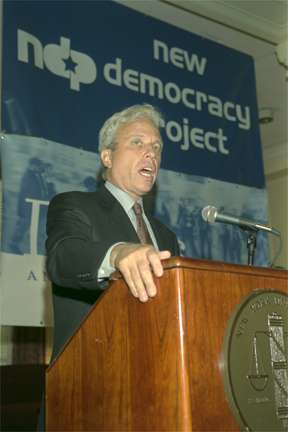 As much as I agree with his low opinion of our Dear Leader, I can’t help
noticing: Green’s latest message delivered the same old, same old, and did double duty as a promo
for his and Eric Alterman’s “The Book on
Bush: How George W. (Mis)leads America.”
May I quote? Dear Leader “a) remains incorrigibly prone to deception and b) major media
essentially look the other way.” Where have we heard that before? Green, left, does elaborate
nicely here:
We have an administration feeling so brazen and immune that it derisively
dismisses reporter Ron Suskind as “reality-based,” with an aide explaining, “We’re an empire now,
and when we act, we create our own reality. And while you’re studying that reality — judiciously,
as you will — we’ll act again, creating other new realities, which you can study too, and that’s how
things will sort out. We’re history’s actors … and you, all of you, will be left to just study what we
do.”
Listening to the White House spiel is like being worked over by an old “I’m Chevy Chase and
you’re not” routine. Worse, according to Green’s a and b of it:
The mainstream media cannot or will not point out Bush’s inaccuracies and
dishonesty as frequently as he practices them. Why? Because a) President Bush knows that our
news outlets are afraid of the pain that conservative bloggers, talk show hosts and even the White
House can inflict by impugning their impartial reputations, and b) the media likes to report the
first three letters of what’s news — i.e. what’s new — and Bush’s untruthful recidivism is old
stuff.
So what does Green do? “I watch Jon Stewart’s “Daily Show” every night,” he writes. Fine.
But as good as the Stewart show is, the idea of Mark Green glued to the tube to catch it every
night is a little scary. You have to wonder whether someone who claims to be a serious politican
could be making better use of his time.
Besides, the truth is that the radical press and blogosphere depend on the best of the
mainstream media for accurate information. There are times, in fact, when nobody is more
forceful in denouncing Dear Leader’s regime than the editorial page of the most mainstream
newspaper of all, The New York Times.
Last Friday’s lead editorial, “A Profile in
Timidity,” was a case in point. “After more than a year’s dithering,” it said,
the president’s commission on intelligence gathering produced “a big dose of political spin that
pleased the White House but provided little enlightenment for the public.” The commission was
bipartisan and toothless, yielding “nothing about the central issue — how the Bush administration
handled the intelligence reports on Iraq’s weapons programs and presented them to the public to
win support for the invasion of Iraq”:
All we get is an excuse: the panel was “not authorized” to look at this
question, so it didn’t bother. The report says the panel “interviewed a host of current and former
policy makers” about the intelligence on Iraq, but did not “review how policy makers
subsequently used that information.” (We can just see it — an investigator holding up his hand and
declaiming: “Stop right there, Mr. Secretary! We’re not authorized to know what you
did.”)
Yes, the commission said Dear Leader’s regime was “dead wrong” about WMD because
intelligence analysis “was driven by a predetermined conclusion” that Saddam was a threat. Yes, it
said “it is hard to deny that intelligence analysts worked in an environment that did not encourage
skepticism about the conventional wisdom.” (Love that double negative.)
But it utterly ignored the way President Bush, Vice President Dick Cheney,
Defense Secretary Donald Rumsfeld and his team, and Condoleezza Rice, as national security
adviser, created that environment by deciding what the facts were and saying so, repeatedly. …[
And] it loyally maintains the fiction that Mr. Bush was just given bum information by incompetent
intelligence agents.
If the commission’s report had any value — apart from serving as a reminder that the Senate
Intelligence Committee is still working on its own investigation (don’t hold your breath for
revelations) — the Times concluded, “it shows us what the 9/11 panel’s report might have looked
like if Mr. Bush had succeeded in making Henry Kissinger chairman.”
That editorial may not be as funny as “The Daily Show,” but it’s as strong as anything Jon
Stewart has to say. I bet he’d agree, and so would Henry.