(Display Name not set)February 2005 Archives
James Wolcott puts it aptly in LIPSTICK FASCISM: "Conservatism and sadism have become indivisible." (The stimulus is Ann Coulter's comment in re: Gannon/Guckert: "Press passes can't be that hard to come by if the White House allows that old Arab Helen Thomas to sit within yards of the president.") Meantime, Bob Herbert reminds us this morning in his column: "It's Called Torture."
I'm a great admirer of Louis Menand's take on things -- usually. This morning I'm not so crazy about his lukewarm take on Hunter S. Thompson in the New Yorker, but I can live with it. Not so with Stephen Schwartz's hatchet job in The Weekly Standard, which is something else entirely. It concludes: Thompson "was flattered to be described as chronicler of 'the death of the American dream.' In reality, he described a nightmare from which America awoke years ago."
Well, Schwartz must still be having nightmares. I remember him as a teenage freak who used to come into the City Lights Bookstore in 1966 and '67, spouting Surrealist doctrine and declaring himself the San Francisco incarnation of a Surrealist movement that didn't exist. His freakishness consisted of a three-piece suit, not some hippie garb, the intense babble of an academic proselyte and a self-regard bordering on the autistic. (He eventually converted to Sufism.) He was wrong then. He's wrong now. And my bet is he'll always be wrong.
Postscript: If you cared about last night's Oscars show, here's why you shouldn't have.
So, tonight's the Oscars? Who cares. Coincidentally, here's a review in today's Chicago Sun-Times of one Oscar non-winner's latest memoir. Not exactly heavyweight reviewing, but it pays for a few groceries. "Lauren Bacall, still salty at 80" begins:
When Lauren Bacall writes th
at her singing voice ranges "somewhere between B minus sharp and outer space," she's being candid and funny. It's not every stage star with two Tony Awards for best actress in a musical whose vocal talent offers so little promise. (OK, Harvey Fierstein excepted.) Still less would one admit it.
But Bacall, who is one of a kind, always made the most of what she had, as this memoir proves for the second time. The first time was more than a quarter century ago, when By Myself was originally published to much praise, including a National Book Award.
That memoir ended with the early 1980s, half a dozen years after her return to New York from abroad and a decade after her divorce from her second husband, Jason Robards Jr. She had married Robards after the death of her first husband, Humphrey Bogart, and a post-Bogie love affair with Frank Sinatra, who'd asked her to marry him but suddenly "chickened out" (her term) when his proposal made the gossip columns. Not that we're keeping score, but let's face it -- Bacall certainly has -- her serial love life is one of the most fascinating aspects of her career
Go read the rest. It's reprinted here.
From: Jason Leopold
To: Jan
Herman
Date: Thu, 24 Feb 2005 19:35:11
I respect
your opinion. However, your review of my book appeared to be filled with anger. I spent a lot of
time berating myself for all of the carnage I left behind so I am not quite sure how I am the "sad
victim of an ego grandstanding to the bitter end." For a person who cites Burroughs as one of his
favorite authors I am surprised that you were so repulsed by my book. Moreover, I never
presented myself as a Hunter S. Thompson or anyone close to him. I'm simply a mild-mannered
journalist who had a story to tell.
If it's the subtitle of my book that was annoying you I suggest you read this past Sunday's NYT Book Review article about subtitles.
I will continue to read Blogcritics because I love it so much. So no hard feelings. I'm sorry that you felt you were misled.
[Leopold's Blogcritics reference is to another site where STRAIGHT UP is also posted. The Sunday NYT Book Review article about subtitles is by Ben Yagoda, who writes: "They are a sort of lottery ticket in the economics of nonfiction book marketing. Publishers throw all kinds of elements in them -- vogue words and phrases, features of the book the title didn't get around to mentioning, talismanic locutions ... in the (almost always) vain hope that something will pay off."]
From: Jason Leopold
To: Jan
Herman
Date: Thu, 24 Feb 2005 19:44:56
What I
find fascinating is that people who claim to adore Burroughs, Kerouac, Hunter S., and others like
them can't stand to read about someone in the 21st century who is, let's be honest here, not that
much different than they were in their time.
I ask you what's so different between Hunter S and me? He dropped acid. I snorted coke. Burroughs shot heroin (and his wife). I stole CDs. Hunter S. reported on the scandalous Nixon administration. I was obsessed with nailing Bush and Enron.
From: Jan Herman
Date: Fri, 25 Feb 2005 10:15:26
It was not the drugs that bothered me. Not in the least. It was the rampant egomania. You "simply a mild-mannered journalist"? You're joking, no?
Burroughs, as I knew him, was not an egomaniac -- far from it. I concede that Hunter S. Thompson was, but his egomania didn't put me off. And the Kerouac I like best is the Kerouac of "The Vanity of Duloz," subtitled "The Adventurous Education of a Young Man." It's the polar opposite of egomania. (It's also a book so little read that it's out of print.) [The title actually is "Vanity of Duluoz: an adventurous education, 1935-46."]
Can you clarify for me what is happening with the legal issue raised in the Voice article? [It wonders whether the threat of a defamation suit will hinder the release of "Off the Record." I've seen various publication dates listed, first for February, then for March and now for April.]
Also, I'd like to post your messages in response to my "review," including the [blurb] from Greg Palast.
From: Jan
Herman
To: Jason Leopold
Date: Fri, 25 Feb 2005
10:39:48
and about the subtitle of yr book. it's true that it
set up expectations that i felt went unfulfilled. for that -- if it was yr publisher who came up with it
-- i do apologize. i should have remembered my own chagrin at the subtitle a publisher gave my
biography of william wyler. i disliked it, thought it created wrong expectations. but i went along
because the publisher was so dead set on it as a marketing tool. i regretted going along from the
beginning and even more when some reviewers took me to task for it. so, my apology for
presuming the subtitle was yours.
From: Jason
Leopold
To: Jan Herman
Date: Thu, 24 Feb 2005
20:48:17
Why would you
question the authenticity of an author blurb? That seems petty. However, I'll provide you with my
correspondence with Greg.
From: Greg Palast
"I love this book. I love
Jason Leopold. When other US reporters were licking Ken Lay's loafers, Leopold went for
Enron's thieving throat. But Leopold is a fool, and a fascinating readable one at that: a journalist
who insists on real investigative reporting -- inside documents, inside sources, hard
knife-in-the-gut evidence -- detective-style reporting that is just about illegal in the USA. In "Off
The Record," you'll get a hard-core story of a true investigative journalist hunted down and
professionally exterminated, a hero cut down by the lazy fat pricks we call 'mainstream reporters.'
The book is worth the price just for exposing the craven toadies of the New York Times who
open their pages to White House hatchet jobs against offending reporters. Bravo and my personal
Pulitzer to Jason Leopold. Every journalist in America should read this, then quit or riot."
Sent: Monday, November 29, 2004
10:02 PM
To: Brenda Hadenfeldt
Cc: Jason
Leopold
Thanks, Greg
From: Jason Leopold
Can you give me an example of "rampant egomania"? What in my book, or what have you read, heard, anything you can identify that would back up "rampant egomania." Please point me to the page number.
From: Jason Leopold
From: Jason
Leopold
From: Jan Herman
Reviews are opinions, and maybe I should have
said rampaging narcissism (a syndrome characterized by grandiose delusions) instead of rampant
egomania. Here are some citations:
p. 18: "I seem to have this ability to light up a room and become the center of attention in a way that attracts people to me like flies to shit. More than that, I have an innocence and a naivete that attract people and make them want to help me. There's a vulnerable sweetness that comes through my rough exterior and makes people feel safe around me. You can hear it in my voice when I ask questions and you can see it in my eyes when I understand the answer."
p. 20: "I naively hope that each time I broke news on the California energy crisis, the other reporters covering the story would see me as the next Bob Woodward or Carl Bernstein."
p: 30: "I danced around the office and started boxing with my reflection in the window. I started singing the theme song from Rocky III. Then I introduced myself to my imaginary audience. "Ladies and gentlemen will you please welcome the undisputed heavyweight champion, JASON LEOPOLD."
p. 193: "I felt that Fastow and I shared a common bond, not just as Jews but also as criminals." [The reference is to Andrew Fastow, the former chief financial officer of Enron.]
p. 194: "I led each camp to believe that I was its inside source and the only journalist willing to vindicate either of them if they spoke to me exclusively." [A clever, if unethical tactic, but it also illustrates the egomania.]
p. 200: "I felt bad, but at that moment I didn't give a shit about my brother's second marriage. All I cared about was this story and the look of shock on Rebecca's face when she saw my byline on it." [The Rebecca reference is to a rival reporter.]
p. 212: "I felt I'd outdone myself once again. The feeling of power was running through my veins. It went straight to my head."
p. 213: "When it hit cyberspace it didn't make a sound. It just sat out there. Two weeks went by. No impact. I was frustrated. I wanted some attention. I had started the biggest fire and no one seemed to notice that it was burning."
p. 215: "I was completely unprepared for and overwhelmed by the firestorm that came about as a result of this story. It was burning out of control. Salon celebrated the moment. There was talk of awards. I felt like a modern-day version of Woodward or Bernstein."
p. 222: "He made me so angry that I started to wonder how I could get my revenge. I thought about sending him a dozen pizza pies or mailing him a bag of shit. I went to a web site that supposedly sells all kinds of shit, cow shit, dog shit, deer shit, horse shit, and will wrap it up in a box with a bow and mail it to your worst enemy without it ever being traced back to you. I settled on elephant shit, two big logs. But when it came to enter my credit card information, I lost my nerve. I told Carr that he had it all wrong about me. I told him I was a star reporter. ..."
p. 230: "Ever since I was a kid I've had this uncontrollable desire to protect people from persecution."
p. 231: "I'll admit there were times when the only thing I was interested in was advancing my own journalism career. Breaking news is a perfect example. Whenever news broke and I was nearby, I stopped caring about the people affected. I kept a camera and notebook with me and hoped that if I saw a car crash I would be the first one on the scene and report the story and get the Pulitzer Prize-winning story. Then I'd try to literally save lives and be the hero, too."
These citations don't give the anecdotal context of each of them (i.e. the quote from p. 213 expressing frustration about your story not being noticed. That's a common feeling for many reporters. But then you compare yourself to a pyromaniac. I don't doubt that you feel you're being totally honest and that you understand your grandiosity is compensation for the many insecurities you write about. But I'm not sure you really see how much you've rationalized your motives. The book shows either how clever and smart you were (which you are) or how foolish and devious you were. But the tale is always all about me, me, me -- and that wore thin.
Maybe I'm all wet. And anyway, it's only one man's opinion. I wish you the best, too.
PS: You forgot to answer to my question: What is happening with the legal issue raised in the Voice article?
 Whoa! Is there another Hunter S. Thompson in our midst? I
messaged back (How could I not?): "Thank you for letting me know about OFF THE RECORD.
I was unaware of it. I'd love to have a look at a review copy." I said I was duping the message to
the publisher's publicist and added: "That's quite a rave from Greg Palast." Leopold replied:
"Thanks so much for getting back to me. I love your work. [Ah, flattery.] I will make sure a
galley is sent to you this week."
Whoa! Is there another Hunter S. Thompson in our midst? I
messaged back (How could I not?): "Thank you for letting me know about OFF THE RECORD.
I was unaware of it. I'd love to have a look at a review copy." I said I was duping the message to
the publisher's publicist and added: "That's quite a rave from Greg Palast." Leopold replied:
"Thanks so much for getting back to me. I love your work. [Ah, flattery.] I will make sure a
galley is sent to you this week."
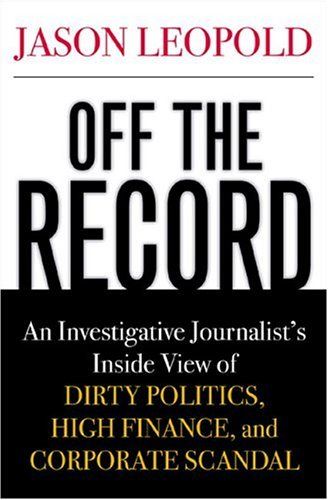
I considered messaging Palast to make sure his blurb was authentic. But then I thought, what the hell, I'll read the book and make up my own mind. The galley proof arrived. The subtitle promised "An Investigative Journalist's Inside View of DIRTY POLITICS, CORPORATE SCANDAL, and A DOUBLE LIFE EXPOSED." I began reading and kept wondering, where's the inside view of dirty politics and corporate scandal? There was almost nothing about that. The opening chapter teased me into believing there would be. The closing chapter pretended there had been. Everything in between was about one subject only: dirty, scandalous Jason Leopold, a conman who'd had a major story retracted and who bore no resemblance to Hunter S. Thompson.
It turns out "Off the Record" is the tale of a reporter investigating his own obsessions, not the corruption at Enron or the dirty dealings of public officials, except tangentially, when they concerned Leopold's manic transgressions as a person and a journalist (two states of being which, for him, were mutually exclusive). Where was the promised inside view of anything but his own head? The book was compulsive reading, I'll grant it that. It made me feel like a lookey lu who can't stop staring at the wreckage of a fatal crash. I kept watching the bodies being pulled out -- in this case just one body, Jason Leopold's, sad victim of an ego still grandstanding to the bitter end.
Postscript: This week's Village Voice has a piece on Leopold and the book, which concludes by "questioning whether 'Off the Record' will make it to store shelves," due to a potential defamation suit, or whether "Leopold will suffer yet another retraction." The book is listed for online pre-orders at both Amazon.com (linked above) and Barnes & Noble.com but hasn't been released.
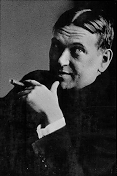 As H.L. Mencken wrote, "It is the national custom to sentimentalize
the dead." By now you've probably seen Tom Wolfe on Hunter S. Thompson. If you haven't, you
should. It's terrific. It was fast. And it doesn't sentimentalize him. Wolfe makes the apt literary
connection between Thompson and Mark Twain. Here's a connection -- my thanks to Roger
Groening -- he didn't make: Thompson and Mencken.
As H.L. Mencken wrote, "It is the national custom to sentimentalize
the dead." By now you've probably seen Tom Wolfe on Hunter S. Thompson. If you haven't, you
should. It's terrific. It was fast. And it doesn't sentimentalize him. Wolfe makes the apt literary
connection between Thompson and Mark Twain. Here's a connection -- my thanks to Roger
Groening -- he didn't make: Thompson and Mencken.
The sage of Baltimore, right, wrote one of the two best, most devastating obituaries of the 20th century, possibly ever. Thompson wrote the other. Mencken's flayed William Jennings Bryan. Thompson's disposed of Richard M. Nixon. Both obits were merciless, justifiably vicious, entertaining and, it goes without saying, brilliant.
Thompson's begins:
Richard Nixon is gone now and I am poorer for it. He was the real thing -- a political monster straight out of Grendel and a very dangerous enemy. He could shake your hand and stab you in the back at the same time. He lied to his friends and betrayed the trust of his family. Not even Gerald Ford, the unhappy ex-president who pardoned Nixon and kept him out of prison, was immune to the evil fallout. Ford, who believes strongly in Heaven and Hell, has told more than one of his celebrity golf partners that "I know I will go to hell, because I pardoned Richard Nixon."I have had my own bloody relationship with Nixon for many years, but I am not worried about it landing me in hell with him. I have already been there with that bastard, and I am a better person for it. Nixon had the unique ability to make his enemies seem honorable, and we developed a keen sense of fraternity. Some of my best friends have hated Nixon all their lives. My mother hates Nixon, my son hates Nixon, I hate Nixon, and this hatred has brought us together.
It continues:
Kissinger was only one of the many historians who suddenly came to see Nixon as more than the sum of his many squalid parts. He seemed to be saying that History will not have to absolve Nixon, because he has already done it himself in a massive act of will and crazed arrogance that already ranks him supreme, along with other Nietzschean supermen like Hitler, Jesus, Bismarck and the Emperor Hirohito. These revisionists have catapulted Nixon to the status of an American Caesar, claiming that when the definitive history of the 20th century is written, no other president will come close to Nixon in stature. "He will dwarf FDR and Truman," according to one scholar from Duke University.It was all gibberish, of course. Nixon was no more a Saint than he was a Great President. He was more like Sammy Glick than Winston Churchill. He was a cheap crook and a merciless war criminal who bombed more people to death in Laos and Cambodia than the U.S. Army lost in all of World War II, and he denied it to the day of his death. When students at Kent State University, in Ohio, protested the bombing, he connived to have them attacked and slain by troops from the National Guard.
Go read the whole thing. It ran in Rolling Stone on June 16, 1994, was written as a memo dated May 1, nine days after Nixon died, and goes on for nearly 3,000 inimitable words.
Here's the way Mencken's begins, recalling the Scopes trial:
It was plain to everyone, when Bryan came to Dayton, that his great days were behind him -- that he was now definitely an old man, and headed at last for silence. There was a vague, unpleasant manginess about his appearance; he somehow seemed dirty, though a close glance showed him carefully shaved, and clad in immaculate linen. All the hair was gone from the dome of his head, and it had begun to fall out, too, behind his ears, like that of the late Samuel Gompers. The old resonance had departed from his voice: what was once a bugle blast had become reedy and quavering. Who knows that, like Demosthenes, he had a lisp? In his prime, under the magic of his eloquence, no one noticed it. But when he spoke at Dayton it was always audible.When I first encountered him, on the sidewalk in front of the Hicks brothers law office, the trial was yet to begin, and so he was still expansive and amiable. I had printed in the Nation, a week or so before, an article arguing that the anti-evolution law, whatever its unwisdom, was at least constitutional -- that policing school teachers was certainly not putting down free speech. The old boy professed to be delighted with the argument, and gave the gaping bystanders to understand that I was a talented publicist. In turn I admired the curious shirt he wore -- sleeveless and with the neck cut very low. We parted in the manner of two Spanish ambassadors.
But that was the last touch of affability that I was destined to see in Bryan. The next day the battle joined and his face became hard. By the end of the first week he was simply a walking malignancy. Hour by hour he grew more bitter. What the Christian Scientists call malicious animal magnetism seemed to radiate from him like heat from a stove. From my place in the court-room, standing upon a table, I looked directly down upon him, sweating horribly and pumping his palm-leaf fan. His eyes fascinated me: I watched them all day long. They were blazing points of hatred. They glittered like occult and sinister gems. Now and then they wandered to me, and I got my share. It was like coming under fire.
And here's the way it ends:
Bryan was a vulgar and common man, a cad undiluted. He was ignorant, bigoted, self-seeking, blatant and dishonest. His career brought him in contact with the first men of his time; he preferred the company of rustic ignoramuses. It was hard to believe, watching him at Dayton, that he had traveled, that he had been received in civilized societies, that he had been a high officer of state. He seemed only a poor clod like those around him, deluded by a childish theology, full of an almost pathological hatred of all learning, all human dignity, all beauty, all fine and noble things. He was a peasant come home to the dung-pile. Imagine a gentleman, and you have imagined everything that he was not.
Go read the whole thing. It ran in The Baltimore Evening Sun, July 27, 1925, the day after Bryan died, and goes on for roughly 1,600 gorgeous words.
Mencken and Thompson: So different from each other in personality, yet so close in spirit.
When I first read CIA director Porter Goss's recent Congressional testimony that "Islamic extremists are exploiting the Iraqi conflict to recruit new anti-U.S. jihadists" and "these jihadists who survive will leave Iraq experienced and focus on acts of urban terrorism," I intended to post an item about Dear Leader's Big Lie that the invasion of Iraq would quell terrorism. But I never got around to it. And now I don't have to, because Bob Herbert has done it for me in his column this morning, "Iraq, Then And Now."
Herbert writes: "So tell me again. What was this war about? In terms of the fight against terror,the war in Iraq has been a big loss. We've energized the enemy." And as anyone with sense would be, he's dismayed by the sheer hypocrisy of Dear Leader's regime:
[T]he administration has taken every opportunity since since Sept. 11, 2001, to utilize the lofty language of freedom, democracy and the rule of law while secretly pursuing policies that are both unjust and profoundly inhumane. ...It may be that most Americans would prefer not to know about these practices, which are nothing less than malignant cells that are already spreading in the nation's soul. Denial is often the first response to the most painful realities."
If you don't believe that, think of what the Germans who came after the Holocaust have experienced with collective guilt. Germany's first response was denial. Among some Germans it still is. But among many more it is not. Now think of us Americans, who have yet to accept the idea of collective guilt for black slavery and the decimation of Native American peoples.
I'm willing to bet the majority of Americans by far still have not come to grips with America's own genocidal history. Even the horrific atrocities of Vietnam have receded in memory, as if they are part of someone else's remote past -- to the point where this nation has allowed itself to be misled into a war in which new crimes against humanity again bear witness against its ideals.
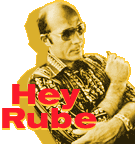 A lot of people didn't know of the Page 2 column he wrote on the Web for
ESPN.com. But Hey, Rube was treasured by
many of us who were not necessarily sports fans. His column, "Death in the afternoon," which was about the meaning of
auto racing champ Dale Earnhardt's violent end, looks in hindsight like a gonzo premonition. It
probably wasn't, yet it reads as though it might have been written about his own death.
A lot of people didn't know of the Page 2 column he wrote on the Web for
ESPN.com. But Hey, Rube was treasured by
many of us who were not necessarily sports fans. His column, "Death in the afternoon," which was about the meaning of
auto racing champ Dale Earnhardt's violent end, looks in hindsight like a gonzo premonition. It
probably wasn't, yet it reads as though it might have been written about his own death.
Here's part of the lede:
It seemed to send a message, an urgent warning signal that something with a meaning beyond the sum of its parts had gone Wrong & would go Wrong again if something big wasn't cured -- not just in racing, but in the machinery of the American nation.
Thompson's death won't be mourned as widely as Earnhardt's. The same thing could be said of it, however, if not as a warning -- Thompson's whole career was a warning -- at least as confirmation that something in the machinery is way out of whack.
Here -- from another column -- you can see how Thompson turns a piece on the unworthiness of the XFL and its lousy TV ratings to more serious account.
The doomed league's TV ratings slipped another 25 percent for the weekend -- down 71 percent in the four quick weeks since Opening Day -- and that steep a slide is fatal.
If the Dow Jones Index plunged that many points in four weeks, the sidewalks of Wall Street would be littered with the broken bodies of Stockbrokers. Five-hundred people a day would be leaping to their deaths off the Golden Gate bridge.
The horrible reality of suddenly being stone broke and homeless is more than most people in this country can handle. They will literally seize up and go mad. Your everyday Nervous Breakdown is nothing compared to the hopeless Craziness of a man who woke up in the morning as a Prince and went to bed as a Toad.
That is a guaranteed overweening shock to the Central Nervous System; if you don't go insane from suddenly having to see everything in the world from a point only two inches high, your brain will be churned into cream by having to crawl, head-first, with your eyes open, down a muddy hole in the ground, just to have a place to sleep.
Nobody could handle a situation like That. It is Unacceptable. It is worse than any dream that ever happened in the worst and most tortured hallucinations ever suffered by the most pitiful LSD victim. ... I spent a lot of time with Allen Ginsberg, and I have swapped gruesome tales over whiskey at night with William Burroughs, and neither one of them ever even mentioned a vision so horrible as being instantly changed from a rich and powerful human like Donald Trump into a common leaping toad.
And here, too, you can see in hindsight a gonzo premonition of suicide. It is Thompson writing about himself but also about all of us in a steep, perhaps fatal slide, and a nation's seizure of madness.
-- David Ehrenstein.
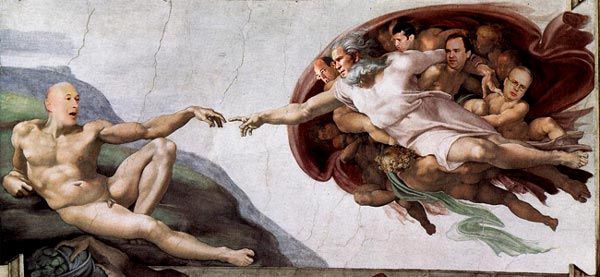
Illustration from Billmon's Whiskey Bar.
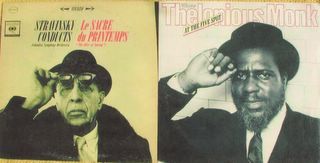
 Jazz has influenced classical music, though not usually the
other way around. But have a look at these Igor Stravinsky / Thelonious Monk album covers, courtesy of Bill Reed. The
influence seems mutual. "I took note of this easily 30 years ago," Reed messages, "then promptly
forgot about it [until I was] scrambling for something to put up on my blog." He also wonders
whether Olive Oyl and Ms. Mushroom Cloud were separated at birth.
Jazz has influenced classical music, though not usually the
other way around. But have a look at these Igor Stravinsky / Thelonious Monk album covers, courtesy of Bill Reed. The
influence seems mutual. "I took note of this easily 30 years ago," Reed messages, "then promptly
forgot about it [until I was] scrambling for something to put up on my blog." He also wonders
whether Olive Oyl and Ms. Mushroom Cloud were separated at birth.
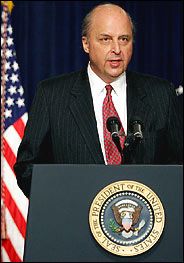 You won't find those details in today's New York Times reports on
John Negroponte's nomination. Instead, you'll find this ass-covering piece of boilerplate in two
largely favorable pieces about him and the appointment:
You won't find those details in today's New York Times reports on
John Negroponte's nomination. Instead, you'll find this ass-covering piece of boilerplate in two
largely favorable pieces about him and the appointment:
Mr. Negroponte is not an entirely uncontroversial choice: in his previous confirmation hearings, he was questioned about his performance as ambassador to Honduras in the 1980's. At that time the C.I.A. station and the embassy were accused of turning a blind eye to torture and other abuses by the Hondurans, and of shading reports of the situation in the country for political or ideological reasons.
That graf, from David Sanger's Man in the News commentary, "An Old Hand in New Terrain" (which reports that Negroponte, above, will be "a stabilizing force"), appears again in the main news story (relegated to sidebar status on the Website), like so:
In his previous confirmation hearings, Mr. Negroponte was asked about his time in Honduras in the 1980's. At that time the C.I.A. station and the embassy were accused of turning a blind eye to abuses by the Hondurans, and of shading reports of the situation in the country for political or ideological reasons.
You have to wonder about Sanger's soft-pedalling phrase "not entirely uncontroversial choice" and the notion that Negroponte was accused of merely "turning a blind eye" in light of the commentary by Peter Kornbluh, a senior analyst at the National Security Archive, who said this morning on Democracy Now! that when Negroponte was the U.S. ambassador in Honduras he was "active in running the paramilitary war" and that he subsequently lied to the Congress about it. That's a tad more than "turning a blind eye."
Further, how does the Times reconcile the ass-covering boilerplate with this, which appeared in the main news story just a few paragraphs earlier?
"Negroponte is not a guy who polishes up his reports so that they make people feel good, and he has the ability to speak very honestly to his superiors, without hedging things, and the president likes that," a Republican close to the White House said.
Speaks very honestly? Oh, really? Doesn't polish up his reports? Uh-huh. Dear Leader likes to hear the truth? Come again? And what about this? The Times highlights a pullquote in the print edition saying that Dear Leader regards Negroponte's "time in Iraq" as beneficial and "will aid him in the new post" of national intelligence director. Yet the main news story also says Negroponte was "known to be eager to leave Baghdad" and quotes an unnamed "senior administration official" as saying he "made clear to everyone every time he came back that 'I've got to get out of there.'"
What's that all about? Iraq was bad for his career? Bad for the U.S? He had a change of heart about torture? Who knows? The Times offers no further explanation. Could be a can of worms. Could be some apple polishing. Could be something "not entirely uncontroversial."
We're all familiar with Dear Leader's bogus claims, and those of his cronies, that torture of prisoners (or if you prefer the euphemism, abuse) was limited to a few "bad apples" and that systemic torture was never, never the case.
Now comes major evidence in a new report in this morning's London Guardian that "US forces in Afghanistan engaged in widespread Abu Ghraib-style abuse, taking 'trophy photographs' of detainees and carrying out rape and sexual humiliation" -- and then destroying the photos to cover it up after the scandal in Iraq.
According to the Guardian, documents it obtained "contain evidence that such abuses took place in the main detention centre at Bagram, near the capital Kabul, as well as at a smaller US installation near the southern city of Kandahar." Further:
[P]hotographs taken in southern Afghanistan showing US soldiers from the 22nd Infantry Battalion posing in mock executions of blindfolded and bound detainees, were purposely destroyed after the Abu Ghraib scandal to avoid "another public outrage", the documents show. ...In a separate case, which the Guardian reveals today, two former prisoners of the US in Afghanistan have come forward with claims against their American captors.
In sworn affidavits to a British-American human rights lawyer, a Palestinian says he was sodomised by American soldiers in Afghanistan. Another former prisoner of US forces, a Jordanian, describes a form of torture which involved being hung in a cage from a rope for days.
Go read the complete story.
To my knowledge the evidence of systematic torture at Bagram, and the attempt to cover it up, have yet to appear in the American press. Fancy that! I'm checking further. When I have more definitive knowledge, I'll post it.
Whoops, I take that back. It's been reported all over. The Associated Press has it. Reuters has it. The Boston Globe has it. The New York Times has it. The Washington Post has it. And here's one in The Times of London.
The Guardian story and the rest are based on information released by the American Civil Liberties Union, which has posted the incriminating documents here. The 1,000 pages of "evidence from U.S. army investigations released to the American Civil Liberties Union" about torture of prisoners in Iraq -- to which the Guardian refers -- have also been reported on in the American press. The ACLU has dripped the documents out to generate a huge number of stories.
Meanwhile, have a look at "'Nobody is talking,'" another Guardian story this morning, which details how "9/11 created the will for new, harsher interrogation techniques of foreign suspects by the US and led to the abuses in Guantánamo, Iraq, Afghanistan and beyond." Not incidentally, "it is the British who refined these methods and who have provided the precedent for legalised torture."
The story is occasioned by British publication of American journalist Mark Danner's book, "Torture and Truth," and another book, "The Torture Papers," edited by two American lawyers, Karen Greenberg and Joshua Dratel. Both books have been reported on in the American press. But the Guardian lays out the themes and details better than I've seen anywhere else.
Postscript: Hammond Guthrie gives visual meaning to the misrule of the empty suits.
Name one of the other websites registered to Jeff Gannon/James Guckert besides "jeffgannon.com".
+ zombo.com
+ hotmilitarystuds.com
+ bloggermann.msnbc.com
+ mulletsgalore.com
 The
correct answer, of course, is "hotmilitarystuds.com" -- although, as Maureen Dowd notes this morning in "Bush's Barberini
Faun" in The New York Times, Gannon/Guckert (now, courtesy of Dowd, a k a B'sBF) was also
associated with Workingboys.net, Militaryescorts.com, MilitaryescortsM4M.com and
Meetlocalmen.com. How does such "an enterprising young man ... get to question the president
of the United States?" she asks. (The real Barberini Faun, at right.)
The
correct answer, of course, is "hotmilitarystuds.com" -- although, as Maureen Dowd notes this morning in "Bush's Barberini
Faun" in The New York Times, Gannon/Guckert (now, courtesy of Dowd, a k a B'sBF) was also
associated with Workingboys.net, Militaryescorts.com, MilitaryescortsM4M.com and
Meetlocalmen.com. How does such "an enterprising young man ... get to question the president
of the United States?" she asks. (The real Barberini Faun, at right.)
Well, here other various mainstreamers explaining it: Howard Kurtz yesterday in The Washington Post; Joe Strupp yesterday in Editor & Publisher; Jim Shea yesterday in the Hartford Courant; Joe Conason yesterday in the New York Observer; Sidney Blumenthal yesterday in London's Guardian; and Frank Rich coming on Sunday in the Times -- to name just a half dozen, all of whom are playing catchup.
Dowd answers the question with her own question:
I was rejected for a White House press pass at the start of the Bush administration, but someone with an alias, a tax evasion problem and Internet pictures where he posed like the "Barberini Faun" is credentialed to cover a White House that won a second term by mining homophobia and preaching family values?
Which pretty much explains how fishy things are. The Bush regime is "waging a jihad against journalists," Dowd notes -- and she's exactly right -- "buying them off so they'll promote administration programs, trying to put them in jail for doing their jobs and replacing them with ringers."
Our poet in residence Leon Freilich makes light of the issue:
I.D., I.D., HO
Who're the plants and who're the shills?
Try to guess --
Welcome all to Capitol
Hill's
Meet the Press.
But that's whistling past the graveyard, if you ask me.
Postscript: Freilich's retort:
FAKE REPORTERS COVERING A FAKE PRESIDENT
And if I laugh at any mortal thing,
'Tis that I may not weep.
--Lord
Byron
To laugh rather than to barf,
Is a far better thing by harf.
--Lowly
Me
Not too long ago, writing about the death of Nelson Algren, I recalled a scene in Sag Harbor with Roy "Big Blue" Finer, the 6-foot-6 NYC homicide detective, who was Algren's friend.
 Another friend of Algren's, Roger Groening, sent the following message, which --
given the stupid controversy surrounding best-picture Oscar contender "Million Dollar Baby" -- is worth sharing because it has
everything to do with boxing and nothing to do with the stupid controversy. As Frankie (Clint
Eastwood) tells Maggie (Hilary Swank), who wants him to turn her into a boxer, "Girlie -- tough
ain't enough."
Another friend of Algren's, Roger Groening, sent the following message, which --
given the stupid controversy surrounding best-picture Oscar contender "Million Dollar Baby" -- is worth sharing because it has
everything to do with boxing and nothing to do with the stupid controversy. As Frankie (Clint
Eastwood) tells Maggie (Hilary Swank), who wants him to turn her into a boxer, "Girlie -- tough
ain't enough."
But sometimes it is:
Jan -- Roy Finer and I became Golden Gloves entries in the early fall of 1960, both trained by Tony the Barber, ex-welterweight pro and part-time evangelist. In "the Cretin," as we all called Roy, Tony saw a prospect. So we worked out every morning, running along Northern Boulevard from Utopia Parkway to Flushing's Main Street and back, Tony at our side, Roy cool in newly purchased Modell's athletic gear, Bum's cap tilted rakishly to the side, puffing one cigarette after another, gasping hideously, since the remainder of his regimen was a quart of Scotch and two packs of Pall Malls daily. Tony was undeterred. He thought my own attitude lacked enthusiasm and was pleased with my early retirement.
He now devoted himself to the refinement of the Big Fella's skills, keeping him working at the big and little bags hanging in the room behind his shop. They were going to the top. And it looked that way. Roy won the first few fights by KOs in a walk, opponents terrified by his size. The next he easily took on points, though there was a question about his stamina. But his record was enough to make him the toast of Jimmy Rutha's, the bar where we were most at home. "Hey, Champ, let me buy you a drink" was a constant refrain. He was the most celebrated guy in the neighborhood.
Then he ran into Arnold Silverstein, taxi-driver from Brooklyn, in the fifth fight. Silverstein was about 5-foot-7 but built like a tank and covered with a pelt of Neanderthal hair, and he gave the appearance of being a very angry man. The first two rounds went fairly well for Roy, although he was clutching and clearly winded from the Taxi man's short-armed but furious aggression. The champ from Flushing looked confused between rounds. The third was it. Roy charged from his corner, Arnold sidestepped -- and hit him with a left hook I can still hear. A double sound of impact, like the echo of a rifle shot. Finer is down! Flailing, helpless, in a night of his own. Finer is counted out! Minutes pass. Smelling salts are applied. They have great difficulty removing him from the ring. He is carried away in a stretcher.
The double concussion I heard was caused by the snapping bones in his left leg as he hit the canvas. The great thing is that there is a record of this fiasco. Bill Gallo, the sports cartoonist for The Daily News, was there that night, and in the next day's paper there was a drawing of a felled giant, legs and arms spread over every rope in the ring, and a small hairy figure glaring triumphantly at the audience, foot propped on his victim's chest. Roy wore a leg cast for three months after that episode. So much for boxing glory.
Now go watch "Fat City," John Huston's 1972 fight flick, or go read "Fat City," the 1969 novel it was based on, by Leonard Gardner, for the real truth of the fight game. Both Huston and Gardner make Clint Eastwood's "Million Dollar Baby," look like a Hollywood fantasy. Which of course it is, all its spare, "art-house" virtues notwithstanding.
Reuters goes on to say:
The sight of far-right marchers angered and dismayed many residents, who later spelled out in flickering candlelight "This city is sick of Nazis" in letters five yards high. [See photo.]And here's der Spiegel's take. In the meantime, Bill Osborne, whose notes on honky myopia I cited yesterday, sent this message in response to BAD DAY IN DRESDEN:
Jan -- There are more and more people in Germany who are not Nazis, but who would say, "Hiroshima, Nagasaki, Dresden and today Baghdad." I regularly heard similar comments even during the first Gulf War, and they were from people throughout the political spectrum.
As you note, the whole line of thought is fraught with problems. The concept of total war -- which includes massive bombings of civilian populations -- is one of the 20th century's contributions to history, but no one really understands this issue and all that it means and implies. It will take much more time for us to morally define the concept of total war. But it is revealing that the United States of America is the only country that has continued bombing cities after World War II.
Twenty-five years ago, few in Germany spoke of the bombings as wrong or as war crimes, but that has slowly changed, based in part on historical research completed since then. Of course, Germans shy away from saying the bombings might have been wrong when they see Nazis harping on it, because they do not want to be associated with such loathsome people and all of their hidden agendas and specious arguments.
It would, however, be an error to let aversion to the Nazis influence any discussion. They deserve no influence at all. Instead, the bombings should be considered in thoughtful ways, and the neo-Nazis simply recognized for their loathsome arguments and falsifications of history. And then they should be ignored.
For their part, Americans need to at least be aware of the increasing belief even among average Germans that the bombings [of Dresden] were in some respects wrong. Based on what I have seen, it is a theme that might become more important than we might suspect. Americans need to think about how they are going to address this issue.
They also need to think more about a lot of other things. But as Bob Herbert writes this morning in his column about Arthur Miller, "The Public Thinker," the odds are heavily against their thinking about anything unless it can be said "in 30 seconds."
Thinking itself is "a notion that appears to have gone the way of the rotary phone," he notes. "Americans not only seem to be doing less serious thinking lately, they seem to have less and less tolerance for those who spend their time wrestling with important and complex matters."
Ignorance is in. The nation is at war and its appetite for torture may be undermining the very essence of the American character, but the public at large seems much more interested in what Martha will do when she gets out of prison and what Jacko will do if he has to go in.
Herbert goes on to say:
Mr. Miller understood early that keeping the population entertained was becoming the paramount imperative of the U.S. We're now all but buried in entertainment and the republic is running amok. Mr. Miller is gone, and if we're not wise enough to pay attention, his uncomfortable truths will die with him. (He felt, among other things, that most men and women knew "little or nothing" about the forces manipulating their lives.)Anyway, the Grammys were last night and Michael Jackson's trial resumes today.
Having fun yet?
 For an opening-day news story about the "The Gates" in New York's Central Park,
you might as well read the London Guardian's report, which offers a
more than adequate overview. For an opening-day appraisal, you might as well read the
front-page appraisal in The New York Times by art critic Michael
Kimmelman, who spares no purple prose: "In the winter light,
the bright fabric seemed to warm the fields, flickering like a flame against the barren
trees." The image, right, from the front page of New York's Daily News, also tells the
story.)
For an opening-day news story about the "The Gates" in New York's Central Park,
you might as well read the London Guardian's report, which offers a
more than adequate overview. For an opening-day appraisal, you might as well read the
front-page appraisal in The New York Times by art critic Michael
Kimmelman, who spares no purple prose: "In the winter light,
the bright fabric seemed to warm the fields, flickering like a flame against the barren
trees." The image, right, from the front page of New York's Daily News, also tells the
story.)
"I don't know a critic who penetrates to the center of anything," the late, great playwright Arthur Miller once said, according to his front-page obituary in The New York Times.
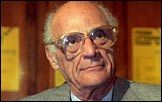 But it would be hard to find a better understanding of what was central in Miller's work
than this morning's appreciation, "A Morality That Stared Down
Sanctimony," by Charles Isherwood, a Times drama critic. He writes:
But it would be hard to find a better understanding of what was central in Miller's work
than this morning's appreciation, "A Morality That Stared Down
Sanctimony," by Charles Isherwood, a Times drama critic. He writes:
Arthur Miller may or may not be the greatest playwright America has produced -- Eugene O'Neill and Tennessee Williams both have equal, if not more, claim to that phantom title -- but he is certainly the most American of the country's greatest playwrights.He was the moralist of the three, and America, as some recent pollsters rushed to remind us, is a country that likes moralists. The irony, of course, is that Mr. Miller's strongest plays are fired by convictions that assail some of the central ideals enshrined in American culture.
If O'Neill's concerns were more cosmic, and Williams' more psychological, Miller wrote most forcefully of man in conflict with society. His characters have no existence outside the context of their culture; they live only in relation to other men. Indeed, it was a fierce belief in man's responsibility to his fellow man -- and the self-destruction that followed on his betrayal of that responsibility -- that animated Mr. Miller's most significant work.
His greatest concerns, in the handful of major plays on which his reputation will last, were with the moral corruption brought on by bending one's ideals to society's dictates, buying into the values of a group when they conflict with the voice of personal conscience. To sell out your brother is to sell out yourself, Mr. Miller firmly believed.
At a time when America has sold itself out -- the jury's guilty verdict against Lynne Stewart earlier this week is only the latest instance -- the central meaning of Miller's work couldn't be more exemplary, nor Isherwood's appreciation more appropriate.
Americans less brave than Lynne Stewart -- which, frankly, means the rest of us -- are easily cowed. It doesn't take much to scare the shit out of people. As William Burroughs once wrote, "anyone who can pick up a frying pan owns death," and Dear Leader owns the biggest frying pan of all.
 Of the news stories I've read about the conviction yesterday of Stewart, the civil rights
defense attorney and left-wing activist, on charges of helping Islamic terrorists and deceiving the
U.S. government, I prefer the Los Angeles Times
report because it began this way: "In a case with broad implications for civil
liberties and America's war on terrorism ..." and because, further down in the story, it followed
through this way:
Of the news stories I've read about the conviction yesterday of Stewart, the civil rights
defense attorney and left-wing activist, on charges of helping Islamic terrorists and deceiving the
U.S. government, I prefer the Los Angeles Times
report because it began this way: "In a case with broad implications for civil
liberties and America's war on terrorism ..." and because, further down in the story, it followed
through this way:
[C]ivil liberties experts warned that the case represented a dangerous attack on the rights of lawyers to represent their clients and an erosion of the attorney-client privilege that could prevent other lawyers from representing unpopular figures."We have all in our lifetimes seen well-meaning juries get caught up in the media-dominated government rhetoric of their time, based mostly on fear," said Michael Tigar, Stewart's lawyer, after the verdicts were announced. "I do not criticize these jurors. ... I have every confidence this verdict will be set aside."
Michael Ratner, president of the Center for Constitutional Rights, said the government had prosecuted Stewart for political reasons.
The overriding goal of the case, he suggested, "was to send a message to lawyers who represent alleged terrorists that it's dangerous to do so."
The story acknowledged opposite opinions, such as those of Steven Lubet, professor and director of the Program on Advocacy and Professionalism at Northwestern University School of Law, who "was skeptical of Stewart's claim that she was simply doing her job as a lawyer," and of James Cohen, a criminal law professor at Fordham Law School, who said: "I don't think this verdict will discourage potential defense attorneys in the future from taking on widely unpopular clients, because what she did was outside of a lawyer's role."
But the LA Times did not "balance" the story by going overboard in support of the government's view, as I believe other news stories did. In any case, here's The New York Times report, the AP report and The Washington Post report.
The NY Times covered the story most extensively, with several sidebars and the longest mainbar. All the news stories necessarily offered many of the same details. Anyway, read them and weep for the country, especially when you see Attorney General Alberto Gonzales's widely quoted, bullying threat -- couched, naturally, in sanctimonious terms -- that the convictions of Stewart and her two co-defendants "send a clear, unmistakable message that this department will pursue both those who carry out acts of terrorism and those who assist them with their murderous goals."
Americans who still believe in civil rights have been warned to get out of the way. Our self-righteous U.S. regime will go on braying and scapegoating until it's either thrown out of office due to some unlikely development (war-crimes convictions? indictments à la Pinochet?) or succeeds in a crackdown so complete, so intimidating, so Big Brother, that it only needs to whisper.
Postscript: Democracy Now! devoted its broadcast this morning to Stewart, who was interviewed with her attorney Michael Tigar and former U.S. Attorney General Ramsey Clark, who testified at her trial. Go watch and/or listen.
Arthur Miller was a writer of genius. He made plays with the grandeur and power of high tragedy, revealing what he called, in the opening stage directions of "Death of a Salesman," the "dream rising out of reality." With the profound resonance of characters such as "Salesman"'s Willy Loman, "The Crucible"'s Abigail Williams or Eddie Carbone in "A View from the Bridge," these works have strong claims to immortality.
He was also a man of true moral stature, a rare quality in these degraded days. Writing meant, for him, an "effort to locate in the human species a counterforce to the randomness of victimization." He added, with his characteristic dry humor: "As history has taught, that counterforce can only be moral. Unfortunately."
In 2001, as Emeritus President of International PEN and Honorary Chair of PEN American Center, he said: "When political people have finished with repression and violence PEN can indeed be forgotten.... Needless to add, we shall need extraordinarily long lives to see that noble day."
Today at American PEN we mourn his passing. But we also continue to be inspired by his example, and will strive to meet the standards of intellectual and personal integrity he embodied for so long. I was lucky enough to know him a little, to observe how lightly he wore his greatness, and to see the mischievous twinkle in his eye.
I comfort myself with the thought that although the man has left us, the work is here to stay.
"Rushdie's comments were echoed in London, the headquarters of International PEN. where Miller is remembered as an invaluable voice for freedom of expression," according to a press release from the PEN American Center. "Time and again he used his influence on behalf of writers who face persecution, not only during his tenure as International PEN president but before and after, when he joined PEN delegations to countries where writers were under threat and spoke out countless times against violations of the freedom to write. At times it was Miller's [personal stature] alone that saved writers in danger."
For the record:
From Name: Jim in Texas
Email Address: ---------
Comments: Noam Chomsky is a lying evil whore of Zarqawi's murdering criminals and mass murdering lying tyrants like Fidel Castro, Kim Il Sung, and Saddam Hussein and we are going to send every last one of his leftwing Fascist thug's to Hell. In a century from now Chomsky will be an unremembered footnote in history burning in Hell like a pre-Civil War whitewasher of slavery, as you will be.
Dear Jim --
Thanks so much for your enlightened opposition.
-- Straight Up's staff
of thousands
The sane rationality of Noam Chomsky's words and tone of voice offers a tonic to anyone who still has hopes for American idealism. Listening to him this morning on Democracy Now!, which broadcast a talk he gave recently in Santa Fe, N.M., I jotted down some notes.
 Chomsky, right, spoke about imperialism, Iraq, terrorism, pre-emptive war, the U.S.
press, war crimes, nuclear missiles, American military "ownership" of space, and the paradoxical
U.S. view of democracy in "old" and "new" Europe. All his comments made eminent sense and
led up to final remarks that struck me as the most significant in terms of U.S. democracy. (His
talk begins about two minutes into the audio/video clip.)
Chomsky, right, spoke about imperialism, Iraq, terrorism, pre-emptive war, the U.S.
press, war crimes, nuclear missiles, American military "ownership" of space, and the paradoxical
U.S. view of democracy in "old" and "new" Europe. All his comments made eminent sense and
led up to final remarks that struck me as the most significant in terms of U.S. democracy. (His
talk begins about two minutes into the audio/video clip.)
Chomsky pointed out that our "Dear Leader" and his entire regime has a supreme faith in PR as "an instrument of deceit." This is illustrated by many things, most recently by his push to dismantle the Social Security system through privatization. As Chomsky said, the claim that the Social Security is facing an imminent crisis is "an exercise in fraud that is truly awesome," not unlike the original justification for invading Iraq.
"The con game about Social Security is a striking, stunning example really, of the power of public relations as an instrument of deceit," he said. It shows our Dear Leader's "sheer audacity and contempt for the population." More important, "the commitment to deceive is pursued with real fanaticism" by the current regime in all aspects of governance, from domestic rule to economic and foreign policy. In fact, U.S. administrations have pursued this commitment for decades, evidenced by secret conniving that at one point avoided global nuclear war only by miraculous luck.
The sole difference now in the commitment to deceive is the degree of fanaticism, which has been taken to the extreme and which increases "the likelihood of terminal nuclear war, environmental catastrophe and an enhanced threat of terrorism." Worst of all, with its supreme "faith in the powers of deceit" and in "the enormous power of public relations" -- witness the use of advertising to spread propaganda -- the "state corporate system threatens the viability of American democracy."
Chomsky spoke on Jan. 26 at a forum sponsored by the Lannan Foundation to celebrate the 25th anniversary of the International Relations Center. You can hear more of what he said at the forum about Iraq and the Middle East in conversation with Tariq Ali, a historical novelist and political scholar of Islam. Chomsky's website links to the texts of 25 talks he's given elsewhere over the years.
Matt Haber, in typical shallow fashion, has posted the titles of the other books on Georgie Boy's reading list. Unlike the much-bruited "His Excellency: George Washington" by Joseph P. Ellis, "Alexander Hamilton" by Ron Chernow, the holy Bible, Tom Wolfe's "I Am Charlotte Simmons" and (who could forget?) Natan Sharansky's "The Case for Democracy" -- none of which, I believe George Boy has actually read except maybe the Bible -- these are the ones the White House doesn't want you to know about. According to Haber, they include the post-Clausewitz classic "The Five Thousand Dead Iraqi People You Meet in Heaven," the prisoner-of-war primer "Beats, Shoots & Leaves: The Zero Tolerance Approach to Abu Ghraib," the unconventional life story "Me Talk Pretty One Day," the memoir "Dreams from My Father: A Story of Golf and Inheritance" and the philosophy handbook "This I Believe: An A to B of a Life."
Postscript: This is one reason why I don't believe Georgie Boy has read any of the books he claims to have read. The man can't think straight, let alone read. He's unintelligible.
When a majority of American voters re-installed Georgie Boy in the White House, it signalled not just a callous affirmation of his criminal regime, or a foul disregard of human rights at home and abroad, but most of all an overarching moral hypocrisy. Well, it's payback time for the majority's willingness to look the other way when odious policies are carried out in its name. Ironically, none other than Georgie Boy -- a man you can trust to screw the stupid American people -- and his minions have come up with the all-time monster payback.
Last week's item, Welcome to the dark ages, concluded: "Who said you can't turn back the clock?" This morning, Paul Krugman writes in The New York Times, "... now that the right is running Washington, it's trying to turn the clock back to 1932." Which is all part of Georgie Boy's payback. "The attempt to 'jab a spear' through Social Security complements the strategy of 'starve the beast,' long advocated by right-wing intellectuals: cut taxes, then use the resulting deficits as an excuse for cuts in social spending." I think of it as America's comeuppance. And who better to deliver the screwing than Georgie Boy.
Give him enough rope and he'll hang all of us. See Jane Mayer's "OUTSOURCING TORTURE" in the current New Yorker and Michiko Kakutani's "Following A Paper Trail To the Roots Of Torture," also in this morning's Times, for more reasons to detest him, his regime's war crimes and America's moral hypocrisy.
In his recent book on the Scottish Enlightenment James Buchan writes of Edinburgh in the early eighteenth century, "Men and women were coming to suspect that knowledge acquired through skepticism might be more useful in this world below than knowledge 'revealed' by scripture." It is a painful thought that in the United States in the twenty-first century we might be turning away from the world of the Enlightenment which inspired the Founding Fathers. Of all the thoughts provoked by [Anatol] Lieven's book ["America Right or Wrong: An Anatomy of American Nationalism"] this is the most disturbing, both for America and for the world. Since religious freedom and popular elections are both sacrosanct rights of the American people, it is a particularly delicate one. Is it possible that America could eventually vote to go back on the Enlightenment?
Might be turning away? Is it possible? Eventually? So politely put. How about, with Georgie Boy elected to the White House last November, is it a done deal?
It sure seems so. Look no further than "Evolution Takes A Back Seat in U.S. Classes," which appeared earlier this week in the Science section of The New York Times.
In [school] districts around the country, even when evolution is in the curriculum it may not be in the classroom, according to researchers who follow the issue.Teaching guides and textbooks may meet the approval of biologists, but superintendents or principals discourage teachers from discussing it. Or teachers themselves avoid the topic, fearing protests from fundamentalists in their communities.
Dr. John Frandsen, a retired zoologist and former chairman of the committee on science and public policy of the Alabama Academy of Science, told reporter Cornelia Dean this fear made it impossible to say precisely how many teachers avoid the topic. But he believed the practice of avoiding the topic was widespread, particularly in districts where many people adhere to fundamentalist faiths.
"You can imagine how difficult it would be to teach evolution as the standards prescribe in ever so many little towns, not only in Alabama but in the rest of the South, the Midwest -- all over," Dr. Frandsen told her.
Dean points out that a 2001 survey by the National Science Foundation found that just 53 percent of Americans agreed with the statement "human beings, as we know them, developed from earlier species of animals," despite the fact that there is "no credible scientific challenge to the idea that all living things evolved from common ancestors, that evolution on earth has been going on for billions of years and that evolution can be and has been tested and confirmed by the methods of science."
Believe it or not, this was regarded as "good news to the foundation" because "it was the first time one of its regular surveys showed a majority of Americans had accepted the idea."
According to the foundation report, polls consistently show that a plurality of Americans believe that God created humans in their present form about 10,000 years ago, and about two-thirds believe that this belief should be taught along with evolution in public schools.
If that doesn't astonish you, how about this?
These findings set the United States apart from all other industrialized nations, said Dr. Jon Miller, director of the Center for Biomedical Communications at Northwestern University, who has studied public attitudes toward science. ... In other industrialized countries, Dr. Miller said, 80 percent or more typically accept evolution, most of the others say they are not sure and very few people reject the idea outright.
Or this, in this morning's Times editorial about Dean's report, "Afraid to Discuss Evolution":
And the news only gets worse. Luis Lugo, director of the Pew Forum on Religion and Public
Life, told Dean that the teaching of evolution was portrayed not as scientific instruction but as "an
assault of the secular elite on the values of God-fearing people." Consequently, the politicians are
afraid to touch the issue. Furthermore, Dean reports, "scriptural literalists are moving beyond evolution to challenge
the teaching of geology and physics on issues like the age of the earth and the origin of the
universe," according to Dr. Miller, and "they have now decided the Big Bang has to be wrong.
There are now a lot of people who are insisting that that be called only a theory without evidence
and so on ...." Who said you can't turn back the clock?
In some areas of the country, many biology teachers are themselves believers
in creationism. A 1998 doctoral dissertation found that 24 percent of the biology teachers sampled
in Louisiana said that creationism had a scientific foundation and that 17 percent were not sure.
Several surveys have shown that many teachers give at least some instructional time to
creationism or intelligent design out of a sense of fairness.
Carol Reed was "a passable journeyman who could sometimes push a story along." So sayeth Christopher Byron in The Sunday Times of London, referred to earlier.
Jan -- After Hitchcock left to work for Selznick, Carol Reed was the best director in England,
and made some excellent movies before he went to war -- "Midshipman Easy," "Kipps,"
"Night Train to
Munich" -- clever entertainment, very watchable and pleasing
today. But in '46 he became a serious man. 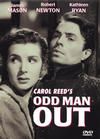 "Odd Man Out," with James
Mason as a dying Irish revolutionary looking for salvation in a heartless nightmare city, is a great
film. Then comes his first collaboration with Greene, "The
Fallen Idol," another bleak tale of disillusion. Sure, he's spellbound by the
dark allure of Welles in "The Third Man"; but no
journeyman could have made those movies, or "Outcast of the Islands," or "The
Man Between" (Mason again). In the '50s, Reed became a lost man himself,
caught between big Hollywood assignments like "Trapeze" -- not a bad flick -- and spiritless hired-hand jobs.
But even "Oliver!," Dickens travesty that
it is, has marvelous moments, and a great Bill Sykes (played by his nephew Oliver Reed). So he
can't be dismissed as a hack. My calling, after all, is to rescue and celebrate the
neglected.
"Odd Man Out," with James
Mason as a dying Irish revolutionary looking for salvation in a heartless nightmare city, is a great
film. Then comes his first collaboration with Greene, "The
Fallen Idol," another bleak tale of disillusion. Sure, he's spellbound by the
dark allure of Welles in "The Third Man"; but no
journeyman could have made those movies, or "Outcast of the Islands," or "The
Man Between" (Mason again). In the '50s, Reed became a lost man himself,
caught between big Hollywood assignments like "Trapeze" -- not a bad flick -- and spiritless hired-hand jobs.
But even "Oliver!," Dickens travesty that
it is, has marvelous moments, and a great Bill Sykes (played by his nephew Oliver Reed). So he
can't be dismissed as a hack. My calling, after all, is to rescue and celebrate the
neglected.
-- Mr. Cheer
The Journal was the only one with the balls to lay out the most significant fact and what it means, so that the reader understands, in the very first sentence, the decision's importance without having to be a legal expert. Neither the Times nor the Post were as bold or clear.
This was the Journal lede:
The Bush administration failed to comply with a Supreme Court decision giving Guantanamo Bay, Cuba, prisoners the right to challenge their detention, a federal judge in Washington ruled.
Notice that the regime's flouting of the court is the focus of sentence. Here's the Times lede:
A federal judge ruled against the Bush administration on Monday, declaring that detainees at Guantánamo Bay, Cuba, were clearly entitled to have federal courts examine whether they have been lawfully detained.
Notice that the judge is the focus and the "prisoners" are mere "detainees." Then contrast the economy of words: the Journal's "right to challenge their detention" vs. the Times's "clearly entitled to have federal courts examine whether they have been lawfully detained."
Here's The Post lede:
A federal judge ruled yesterday that the Bush administration must allow prisoners at the military prison at Guantanamo Bay, Cuba, to contest their detention in U.S. courts, concluding that special military reviews established by the Pentagon as an alternative are illegal.
Again, the judge is the focus. The economy of words "to contest their detention" is similar to the Journal's, but there's an unnecessary phrase: "in U.S. courts." (Where else?) And then in the attempt to add more information, which is not a bad idea in itself, there's an error (only grammatical, admittedly, but committed so often that most wouldn't notice), i.e., the dangling clause (a k a the misplaced participle) of "concluding that special military reviews established by the Pentagon as an alternative are illegal." (I'm not going to explain why it's wrong. Go look it up.)
On to the Journal's second graf:
District Judge Joyce Hens Green ruled that the system of military hearings the Defense Department set up after the high court's ruling in June was unconstitutional because it denied prisoners access to evidence against them and to legal assistance in making their cases. If upheld on appeal, Judge Green's decision renders moot the hearings the Pentagon convened at the offshore prison after the high court's ruling. Of 330 cases whose results have been made public, all but three prisoners were found to be "enemy combatants."
That tells us a lot, and all in layman's language. And it gives specific information that 330 cases would be ruled unconstitutional. Here's the Times's second graf:
The judge, Joyce Hens Green of Federal District Court in Washington, rejected the argument that federal courts could not issue writs of habeas corpus for Guantánamo that would require the government to justify the detentions before a judge.
Boy! What a mess. It doesn't advance the narrative very much, does it? And it resorts to legal terminology, as it will throughout the rest of the story -- jargon, if you will -- as though written for lawyers instead of a general readership.
The Post does better than the Times. Avoiding jargon, the second graf speaks as clearly as the Journal and also gives specific information about those whom the ruling may effect.
U.S. District Judge Joyce Hens Green said that the approximately 550 men held as "enemy combatants" are entitled to the advice of lawyers and to confront the evidence against them in those proceedings. But, she found, the Defense Department has largely denied them these "most basic fundamental rights" during the reviews conducted at Guantanamo Bay, in the name of protecting the United States from terrorism.
The Journal, however, went further and shows a better grasp of the subject by indicating the actual number of known hearings and, in only a few more words, gives the telling detail that "all but three prisoners were found to be 'enemy combatants'." Why telling? Because, without actually making the claim that the military hearings are kangaroo courts, it presents evidence that they are.
Then in its third graf, the Journal narrative expands by alerting the reader to the broader context of the judge's ruling in relation to key events, policies and players that have led up to it.
The 75-page opinion specifically rejects legal theories advanced by Alberto Gonzales, the White House counsel whom President Bush nominated for attorney general. On Mr. Gonzales's advice, the president in 2002 issued a blanket ruling that no suspected Taliban or al Qaeda prisoners were protected by the Geneva Conventions, which normally require that captives receive prisoner-of-war status unless stripped of it by a "competent tribunal." POW status includes certain protections, such as freedom from coercive interrogations and access to delegations of the International Red Cross.
The Times, in its third graf, goes lame:
Judge Green said that although the Guantánamo base was in Cuba, the Supreme Court definitively ruled in June that it was not out of the reach of American law as administration officials have argued.
The Post simply changes direction without developing the thrust of the narrative it led off with:
Green's ruling directly conflicts with one issued by another federal court judge in Washington two weeks ago. U.S. District Judge Richard J. Leon, who heard the case of a smaller group of detainees, wrote that their bid for freedom is supported by "no viable legal theory." Green went beyond the question of whether detainees had rights and found the "combatant status review tribunals" illegal.
That's an option, of course, and the Post story elaborates on potential appeals and legal battles in its fourth graf. A 75-page judicial opinion (only the Journal tells us its size) leaves much to the reporter's judgment in terms of emphasis and priority of information, of course. But I think I can hear a Post news editor demanding that the reporter insert so-called balance before the reader gets the "wrong" idea that the story has just one side. Hell, we're not even into the fourth graf.
So again, the Journal is the only one to lay down a narrative that follows a clear line from the beginning. In its fourth graf, it drives home the point of the lede by quoting a dramatic passage directly from the written opinion, which addresses precisely why the judge ruled as she did.
"Nothing ... authorizes the president of the United States to rule by fiat that an entire group of fighters covered by the Third Geneva Convention falls outside the treaty's definitions of 'prisoners-of-war,'" Judge Green wrote. Another federal judge in Washington, James Robertson, reached a similar conclusion in November, when he struck down a system of military commissions [hearings] the administration established to prosecute a subset of Guantanamo prisoners for war crimes. The government has appealed that decision.
I could go on, but I won't. The ultimate point is that both the Times and Post reports read, under close examination, as unintended apologies for the administration through dullness, jargon and the obfuscation of a wobbly narrative in the service of so-called balance, while the Journal gives the facts in plain, strong terms, makes no apologies and does not ignore the required balance of reporting Leon's contrary ruling, which is placed lower down in the story, where I'd say it belongs. (After all, his ruling is in the minority, and it may be more significant that two other federal judges specifically rejected Gonzales's theory about the Geneva Conventions, a point worth making while he's in the news.)
Judge for yourselves. Here's the Times's story and here's the Post's. Unfortunately, I can't link to the Journal's. But believe me, it's sharper and tighter -- 540 or so words vs. the Times's 967 and the Post's 936 -- as well as more enlightening.
Today is Groundhog Day and, as history has it, James Joyce's birthday.
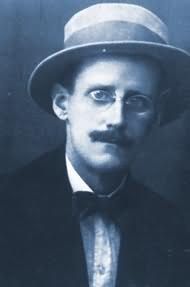 FINNEGANS BASH
"Tell me now, then, is it your
shadow,
You're seeking, Punxsutawney Phil?
If so, you'd best be looking
poorly,
Else we're stuck with the full winter's drill.
"Follow the modus op of that
slacker
Finnegan Seamus Patrick Dougherty
(Who thumbed his nose at enslavement to
duty)
And hoist a few at my birthday pougherty.
"There's be shadows aplenty, I
promise you:
Stephen and Molly, both in accord
With Leopold Bloom -- going to
Blazes;
I promise you, boyo, you won't be boared."
-- Leon Freilich
"If it were a political blog," he writes, "more power to them. But it is actually a listing of arts and letters that is owned by the Chronicle of Higher Education. College students should not read just one side of the story, not left or right. That's just bad journalism, and bad education. "On the other hand," he added, "maybe that's what education is. In the past it has been a culture war against stupid bigotry. In that sense, my college education very much helped me. Now the bigots are firing back. Underneath is a hidden ethos that reads, Long live the old South etc., even if they try to hide it with tokenism."
When I joked that perhaps ALD was turning over a new leaf, having just listed an article by Ramsey Clark, the former U.S. attorney general under Lyndon Johnson -- it gives his reasons for wanting to be part of Saddam Hussein's legal defense team -- Bill replied, "It doesn't surprise me that they linked to that article. The site occasionally includes articles from the left if it feels they will be seen as ludicrous. Scragly old Ramsey Clark eccentrically defending Sadam makes a perfect foil. As I said, it is disappointing that the Chronicle of Higher Education hosts that site. Yes, ALD includes some good stuff if it isn't on the left, but to put together such an overtly biased assemblage in the name of the Chonicle damages the Chronicle's reputation."
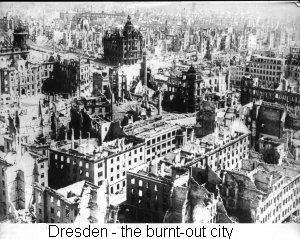 In any case, Bill's irritation was on full display the other day in response to Theodore
Dalrymple, "The Specters Haunting
Dresden," which had been linked from the neocon magazine
City Journal. ALD had alerted me to the article. After reading it, I asked Bill to have a look at it
because he has lived in Germany for more than a quarter centruy and has made a deep study of
German culture. The relevance of Dalrymple's subject to post-9/11 America is not stated
explicitly, and an upfront reference to the current bombing of Falluja would perhaps be
overdrawn. Yet some parallels are implicit. (Burnt-out Dresden, above. Bombed-out Falluja,
below.)
In any case, Bill's irritation was on full display the other day in response to Theodore
Dalrymple, "The Specters Haunting
Dresden," which had been linked from the neocon magazine
City Journal. ALD had alerted me to the article. After reading it, I asked Bill to have a look at it
because he has lived in Germany for more than a quarter centruy and has made a deep study of
German culture. The relevance of Dalrymple's subject to post-9/11 America is not stated
explicitly, and an upfront reference to the current bombing of Falluja would perhaps be
overdrawn. Yet some parallels are implicit. (Burnt-out Dresden, above. Bombed-out Falluja,
below.)
Dalrymple writes: "Nowhere in the world (except, perhaps, in Israel or Russia) does history weigh as heavily, as palpably, upon ordinary people as in Germany." But in a statement that made me flinch, he also notes that "the shame of German history is greater than any cultural achievement, not because that achievement fails to balance the shame, but because it is more recent than any achievement, and furthermore was committed by a generation either still living or still existent well within living memory."
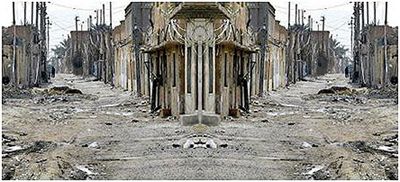 I
flinched because Dalrymple implies that, in fact, the achievement could somehow balance
the shame. Bill's reply was pointed: "Yeah, what balances genocide? If you're cultured enough, it
is sort of OK. What a logic!" But here's his message in full:
I
flinched because Dalrymple implies that, in fact, the achievement could somehow balance
the shame. Bill's reply was pointed: "Yeah, what balances genocide? If you're cultured enough, it
is sort of OK. What a logic!" But here's his message in full:
"I started by glancing at the City Journal site as a whole, so I would know where the author might be coming from. I found this in another author's article about pomo history --or something along those lines":
It is still suicidal to meet the United States in a conventional war at least for any enemy that has not fully adopted Western arms, discipline, logistics, and military organization. The recent abrupt collapse of both the Taliban and Saddam Husseins regime amply proves the folly of fighting America in direct conflicts. The military dynamism that enables the United States to intervene militarily in the Middle East in a manner in which even the richest Middle Eastern countries could not intervene in North America is not an accident of geography or a reflection of genes, but a result of culture. Our classical Western approaches to politics, religion, and economics including consensual government, free markets, secularism, a strong middle class, and individual freedom eventually translate on the battlefield into better-equipped, motivated, disciplined, and supported soldiers.
"We are going to get our asses seriously kicked in Iraq. When will these idiots figure out that Sadam's army dissovled by plan and that the weapons and funding caches were also all carefully laid out. After the lessons of the first Gulf War the Iraqis knew they had to avoid a tactical war and fight a strategic one. And when will that honky figure out that steam-rollering over impoverished Third World countries is not a test of military might. Dick-brained hubris.
"Now that we know we cannot successfully occupy Iraq, we are going to follow the second standard operation procedure of U.S military/economic strategy. We will so thoroughly destroy the country that it will remain incapacitated for at least a hundred years.
"But on to the article by Dalrymple you mentioned. Yeah, what balances genocide? If you're cultured enough, it is sort of OK. What a logic!"
Nowhere in the world (except, perhaps, in Israel or Russia) does history weigh as heavily, as palpably, upon ordinary people as in Germany.
"Maybe that honky should spend the next two years living on [Manhattan's] 130th street. The legacy of human slavery and all that has followed it has all but destroyed every major American city. But then, he is right, from his perspective. History vanishes in the suburbs. Honkies have no history. On the other hand, talk to blacks, or Hispanics and Native Americans of the Southwest. They have some issues called history. Dalrymple is suffering from what might be thought of as honky myopia. No wonder neocons talk about the end of history.
"It astounds me how even the basic infrastructure of our cities is decaying or even non-existent. Think of how the New York subways are so out of date and also allowed to rot to hell. The repairs on the A train will take three to five years because the old switches that have to be replaced are of 1930s vintage and have to now be hand made."
The estimate of the time needed for repairs has declined since our exchange, from years to months to weeks. But Bill's point still holds.
"I study ghetto subway stalagtites as a hobby," he continued. "Eventually the ugly oozing leaks that cause them will cause the walls to collapse. The honky goes on to tell about how after the Nazis communism also destroyed German cities. In reality, there never was destruction and squalor in the East Block that even remotely approaches the American ghettos. When whites make that remarkable transformation to being honkies they always end up seeing only one side of the tortilla."
Sixty years after the end of the Second World War, the disaster of Nazism is still unmistakably and inescapably inscribed upon almost every town and cityscape, in whichever direction you look. The urban environment of Germany, whose towns and cities were once among the most beautiful in the world ...
"But this is a good point and one many Americans don't fully understand, though it takes about one day to notice it if you go to Germany."
Well-stocked shops do not supply meaning or purpose. Beauty, at least in its man-made form, has left the land [Germany] for good; and such remnants of past glories as remain serve only as a constant, nagging reminder of what has been lost, destroyed, utterly and irretrievably smashed up.
"Up here in Ghettoville, people say, my kingdom for a decent shop. And let's not talk about all the once beautiful, upscale parts of our cities that are now rat-infested, human dumping grounds. My God, the honky has forgotten that Philadelphia has 14,000 buildings in a dangerous state of collapse. But anyway, lets go get American meaning, beauty and purpose from the local Wal-Mart, which in many towns these days is all that's left. Honkies get so astute in their cultural observations once they are abroad and looking at another country."
We started it [the war], she said. We got what we deserved [the bombing.]
"Well, I think Dalrymple doesn't understand that Germans have official pat responses when talking to naive Americans. There is a very considerable movement in Germany to define the carpet bombing of the cities as a war crime. It has even been the subject of several nationally broadcast German TV programs. They admit their own guilt, but feel that doesn't mean that the other side might have made bad decisions. (I'm torn two ways on this subject, but leaning toward the war-crime side. Hiroshima tilts the scales.)
The moral impossibility of patriotism worries Germans of conservative instinct or temperament.
"Yes, that is very true and especially affects young people. But I feel this guy hasn't lived in Europe very long, if at all. All Europeans share the same concerns, if not the negative attitude, toward nationalism. Nationalism cost them about 80 million lives in the 20th century alone, and the almost complete destruction of many of its cities far beyond Germany. All the honky flag-waving in America would be seen in Europe as completely uncouth, almost to the point of being bonko. But I like his attempt to explain German Anglophilia. He's on to something there.
"Well, I am going to read on and not comment anymore if I can help it. Maybe you can see why I don't belong in the U.S. Something happened to my honkiness. [Bill was born and raised in rural New Mexico in a family that lived near or below the poverty line.] And of course, you know how I feel about Germany. I am utterly dislocated on this whole goddamn planet. I might be able to make a go of it in Italy, but that is iffy too."
The impossibility of patriotism does not extinguish the need to belong, however. No man is, or can be, an island; everyone, no matter how egotistical, needs to belong to a collectivity larger than himself. A young German once said to me, I don't feel German, I feel European. This sounded false to my ears: it had the same effect upon me as the squeal of chalk on a blackboard, and sent a shiver down my spine. One might as well say, I dont feel human, I feel mammalian. We do not, and cannot, feel all that we are: so that while we who live in Europe are European, we dont feel European.
"Oh geez, I can't stop with such choking remarks as this. This guy has a terminal case of red, white and blue honkitis. No nationalism and flags to wave and he hears chalk scraping and loses his humanity. What a fucking asshole. He ought to feel mammalian. He's a chimp."
In any case, can a German feel European unilaterally, without the Portuguese (for example) similarly and reciprocally feeling European rather than Portuguese? From my observations of the French, they still feel French, indeed quite strongly so.
"The man is an imbecile. Germans are so German they reek of it. They just have the discretion not to strut it. When they do, people like the French, Dutch, Poles and Russians turn white and reach for the guns. After all, one in five Poles died in World War II (6 million). And 18 million people died in the Soviet Union. By comparison, less than 300,000 Americans died fighting both Japan and Germany. That's about a 60th the number in the Soviet Union.
"But of course, we claim that we defeated the Germans. The history of the war shows the Red Army did about 80 percent of the work. Such idiotic misperceptions of history as America's have a lot to do with the different perspectives about nationalism and this country's deep infection of honkiness."
A common European identity therefore has to be forged deliberately and artificially ...
"Uh, you mean like almost all nationalism? Gee, you're brilliant. OK kids, let's all stand and say the pledge of allegiance and then go home and watch John Wayne and Sylvester Stallone shoot Indians and gooks. Is/was Stallone just a natural cultural phenomenon and not an artificial nationalistic construct??"
Eighteen years after the end of the war, in 1963, the pro-Nazi historian David Irving published his first book, "The Destruction of Dresden." In those days, he was either less pro-Nazi than he later became or more circumspect -- the memory of the war still being fresh -- but it was probably not entirely a coincidence that he devoted his first attention to an event that Churchill suspected might be a blot on the British escutcheon. ...There were faint signs of Irving's later acceptance of the Nazi worldview in this book, though they probably went unnoticed at the time. Describing the state of medical services in Dresden after the bombing, he mentioned that "a vast euthanasia-hospital for mentally incurables" was transformed into a hospital for the wounded, without any remark upon the very concept of a "euthanasia-hospital for mentally incurables" ... Irving's book was influential, however, precisely because he hid, or had not yet fully developed, his Nazi sympathies.
It achieved its greatest influence through "Slaughterhouse Five," Kurt Vonnegut's famous countercultural antiwar novel, published six years later, which makes grateful acknowledgment of Irving's book, whose inflated estimate of the death toll of the bombing it unquestioningly accepts. Vonnegut, an American soldier who was a prisoner of war in Dresden at the time of the bombing, having been captured during the land offensive in the west, writes of the war and the bombing itself as if it took place in no context, as if it were just an arbitrary and absurd quarrel between rivals, between Tweedledum and Tweedledee, with no internal content or moral meaning -- a quarrel that nevertheless resulted in one of the rivals cruelly and thoughtlessly destroying a beautiful city of the other.
But Vonnegut, to whom it did not occur that his subject matter was uniquely unsuited to facetious, adolescent literary experimentation, was writing an antiwar tract in the form of a postmodern novel, not a historical reexamination of the bombing of Dresden or of Germany as a whole. The problem that has bedeviled any such re-examination is fear that sympathy for the victims, or regret that so much of aesthetic and cultural value was destroyed, might be taken as sympathy for Nazism itself. The difficulty of disentangling individual from collective responsibility for the evils perpetrated by the Nazi regime is unresolved even now, and perhaps is inherently unresolvable.
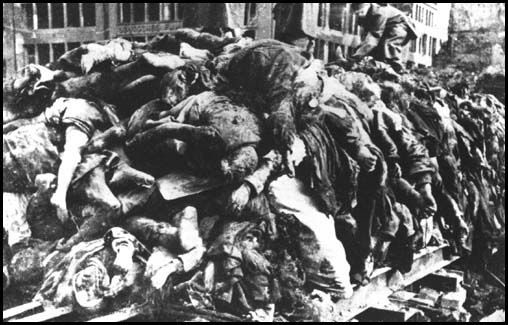 "Dalrymple's summations of Vonnegut might be one-sided and full of stupid
innuendo. I read "Slaughter House Five" when I was young and might see it very differently now,
but I think people would be hard pressed to say that Vonnegut isn't a writer who thinks about
things fairly deeply. His cynicism is pretty dangerous stuff -- almost worse than Beckett's
-- because he mixes it with such odd humor and poor taste. But so is my disgust at "honky"
myopia. I should politlely say White America.
"Dalrymple's summations of Vonnegut might be one-sided and full of stupid
innuendo. I read "Slaughter House Five" when I was young and might see it very differently now,
but I think people would be hard pressed to say that Vonnegut isn't a writer who thinks about
things fairly deeply. His cynicism is pretty dangerous stuff -- almost worse than Beckett's
-- because he mixes it with such odd humor and poor taste. But so is my disgust at "honky"
myopia. I should politlely say White America.
"Well, I skimmed on over the rest of the article. It is not information about Germany for me, but information about how intelligent but naive Americans try to understand it. I've been there and done that myself. [Vonnegut] saw Dresden the day after the bombing. He was part of a body brigade. (Piles of dead bodies in the streets of burnt-out Dresdon, above.) Charred corpses of children by the hundreds affect you, whether your conclusions are right or wrong. Maybe I need to write about Americans who write about Germany."
Seems to me you've just done that, Bill.
In fairness, it should be noted that, according to Policy magazine, Dalrymple "is a psychiatric doctor working in an inner city area in Britain where he is attached to a large hospital and a prison. His columns report on the lifestyles and ways of thinking of Britain's growing underclass, and in his [2002] book 'Life at the Bottom,' he warns that this underclass culture is spreading through the whole society." To clarify further, Publisher's Weekly says the book is essentially a conservative "critique of liberalism and the welfare state."
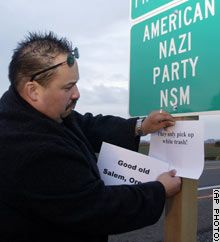
PORTLAND, Oregon (Reuters) -- The American Nazi Party has volunteered to pick up trash along a quiet stretch of rural road in Oregon state, causing an uproar after getting a sign placed there crediting its work.
And they've got some fine little helpers.
The sign, on a quiet stretch of road near Salem, Oregon, also lists the initials "NSM," which stands for the National Socialists Movement, another white supremacist group.
Maybe it's an Aryan trend?
A branch of the Klu Klux Klan has "adopted" a stretch of road in Missouri. After several legal battles, U.S. courts ruled that attempts to block the white supremacists from the litter program was a violation of its free speech rights.
If it weren't so laughable, you might think they were all good little Boy Scouts. Makes you feel as warm and cozy as these high school students.
Sites to See
AJ Ads
AJ Blogs
AJBlogCentral | rssculture
Terry Teachout on the arts in New York City
Andrew Taylor on the business of arts & culture
rock culture approximately
Laura Collins-Hughes on arts, culture and coverage
Richard Kessler on arts education
Douglas McLennan's blog
Dalouge Smith advocates for the Arts
Art from the American Outback
For immediate release: the arts are marketable
No genre is the new genre
David Jays on theatre and dance
Paul Levy measures the Angles
Judith H. Dobrzynski on Culture
John Rockwell on the arts
Jan Herman - arts, media & culture with 'tude
dance
Apollinaire Scherr talks about dance
Tobi Tobias on dance et al...
jazz
Howard Mandel's freelance Urban Improvisation
Focus on New Orleans. Jazz and Other Sounds
Doug Ramsey on Jazz and other matters...
media
Jeff Weinstein's Cultural Mixology
Martha Bayles on Film...
classical music
Fresh ideas on building arts communities
Greg Sandow performs a book-in-progress
Exploring Orchestras w/ Henry Fogel
Harvey Sachs on music, and various digressions
Bruce Brubaker on all things Piano
Kyle Gann on music after the fact
Greg Sandow on the future of Classical Music
Norman Lebrecht on Shifting Sound Worlds
publishing
Jerome Weeks on Books
Scott McLemee on books, ideas & trash-culture ephemera
theatre
Wendy Rosenfield: covering drama, onstage and off
Chloe Veltman on how culture will save the world
visual
Public Art, Public Space
Regina Hackett takes her Art To Go
John Perreault's art diary
Lee Rosenbaum's Cultural Commentary
Tyler Green's modern & contemporary art blog
