
The suicide of Hunter S. Thompson
is a huge, irreplaceable loss. 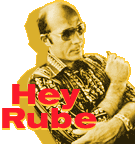 A lot of people didn’t know of the Page 2 column he wrote on the Web for
ESPN.com. But Hey, Rube was treasured by
many of us who were not necessarily sports fans. His column, “Death in the afternoon,” which was about the meaning of
auto racing champ Dale Earnhardt’s violent end, looks in hindsight like a gonzo premonition. It
probably wasn’t, yet it reads as though it might have been written about his own death.
Here’s part of the lede:
It seemed to send a message, an urgent warning signal that something with a
meaning beyond the sum of its parts had gone Wrong & would go Wrong again if something big
wasn’t cured — not just in racing, but in the machinery of the American
nation.
Thompson’s death won’t be mourned as widely as Earnhardt’s. The same thing could be said
of it, however, if not as a warning — Thompson’s whole career was a warning — at least as
confirmation that something in the machinery is way out of whack.
Here — from another column — you can see
how Thompson turns a piece on the unworthiness of the XFL and its lousy TV ratings to more
serious account.
The doomed league’s TV ratings slipped another 25 percent for the weekend — down 71
percent in the four quick weeks since Opening Day — and that steep a slide is fatal.
If the Dow Jones Index plunged that many points in four weeks, the sidewalks of Wall Street
would be littered with the broken bodies of Stockbrokers. Five-hundred people a day would be
leaping to their deaths off the Golden Gate bridge.
The horrible reality of suddenly being stone broke and homeless is more than most people in
this country can handle. They will literally seize up and go mad. Your everyday Nervous
Breakdown is nothing compared to the hopeless Craziness of a man who woke up in the morning
as a Prince and went to bed as a Toad.
That is a guaranteed overweening shock to the Central Nervous System; if you don’t go
insane from suddenly having to see everything in the world from a point only two inches high,
your brain will be churned into cream by having to crawl, head-first, with your eyes open, down a
muddy hole in the ground, just to have a place to sleep.
Nobody could handle a situation like That. It is Unacceptable. It is worse than any dream that
ever happened in the worst and most tortured hallucinations ever suffered by the most pitiful LSD
victim. … I spent a lot of time with Allen Ginsberg, and I have swapped gruesome tales over
whiskey at night with William Burroughs, and neither one of them ever even mentioned a vision
so horrible as being instantly changed from a rich and powerful human like Donald Trump into a
common leaping toad.
And here, too, you can see in hindsight a gonzo premonition of suicide. It is Thompson
writing about himself but also about all of us in a steep, perhaps fatal slide, and a nation’s seizure
of madness.