
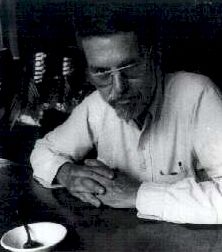
 Robert Creeley, who died yesterday at 78, wrote poetry with a spare minimalism that clarified, condensed and dissolved the distance between thought and feeling, between the real world and the imagined, between language and meaning. He was often more explicit than Samuel Beckett and much more approachable, but no less dense or elusive. Listen to him reading two poems: “Whatever” and “Thinking.” They show both the difficult and the easy Creeley. When he spoke of the human condition, he never offered false hope:
THE MIRROR
Seeing is believing.
Whatever was
thought or said,
these persistent, inexorable deaths
make faith as such absent,
our humanness a question,
a disgust for what we are.
Whatever the hope,
here it is lost.
Because we coveted our difference,
here is the cost.
In a review of “Life & Death,” a book of Creeley’s poems published in 1998, Tom Clark described his late poetry this way:
The poems have the sound of a mind with time on its hands and nowhere left to go. A life passes unhurriedly before one’s eyes — melancholy, oblique, fading in and out like the late rays of sun slanting through the condo’s slatted blinds, as the poet meditates upon “What one supposes/ dead is . . . Will one fly away on angel wings,/ rise like a feather, lift/ in the thin air.”
The sound of a mind with time on its hands and nowhere left to go. That’s as fine a description as I’ve seen.
Postscript: A reader writes: “Robert Creeley was a gentle, generous and wonderful person. I had the pleasure to hang out with him. He and Pen [Penelope Highton] were lovely together. I will miss a dear friend. As Bob would say, ‘Onward!'” — Hank Barthel
Another writes: “As a young student, some thirty years ago, I came to know Bob Creeley. I took classes with him at Buffalo, and spent time hanging out at his place on Fargo Street, above a small grocery store. Bob was a gentle and extremely generous soul, with steel within. His poems have literally walked me through life, and I’ll never forget him or stop reading his work. He is an essential postmodern American.” — Jerry Kelly
Still another: “I was an undergraduate who wrote about Bob Creeley and had the honor of meeting him subsequently in Buffalo. The thing that impresses me the most about him is the generosity of the man in arranging my visit even though we only communicated via email prior to the visit. For a foreigner from Singapore who has an interest in American Lit, this was a better intro to Americans than any guide book. In these days of anti-Americanism, America can well do with such ambassadors of goodwill and generosity. Onward (in peace).” — Gerard