(Display Name not set)September 2004 Archives
Now that "the best debater since Cicero"(1) and the White House dolt who's "won every debate he's ever had"(2) have finished their warmups for tonight's face-off, are we ready for the "naked moments"(3) live from Miami?
Will there really be any "naked moments," instead of stock phrases and mini-stump speeches? Doubtful. But please remember, "We're not electing a class president or head cheerleader."(4) Don't forget, "Too many wrongs do not make him right."(5) And watch out for the spinmeisters, who will crown the victor according to raised or lowered expectations.
(1) Top Bush strategist Matthew Dowd's description of John
Kerry.
(2) Kerry's characterization of the prevaricating
ninny.
(3) American Enterprise Institute polling expert Karlyn
Bowman's characterization of presidential debates.
(4) Senior
Kerry adviser Michael McCurry's reminder to the American
electorate.
(5) Straight Up's worst nightmare.
American Public Radio's Marketplace has a great new feature, Power Trips, which gives the lowdown on Congressional travel. Produced by Steve Henn, it tells who has accepted the most trips, and how much they spent. Here's the top 100. Here's who picks up the tab. Here are the destinations: "Hideaways tucked up in the mountains. Oceanside resorts. Wine-tasting on the West Coast. Tours of Europe's great cities." Here's how the parties compare:
Democratic Party
Number of trips: 2735
Total spent: $7,819,281.79
Republican Party
Number of trips: 2090
Total spent: $6,503,546.43
Independent Party
Number of trips: 22
Total spent on party:
$53,830.93
And here's where to look up your own congressman/woman or senator.
Seven years from now, California will ban foie gras if it comes from force-fed geese.
Ahnold found it in his steroid heart yesterday to sign a bill ending "the force
feeding of ducks, geese and other birds to produce the gourmet liver product." The ban is to take
effect in 2012. That answers the question: Will Ahnold have his goose
cooked?"
Timothy Noah's story about the Smithsonian's new travesty -- under the headline "The National Museum of Ben Nighthorse Campbell" -- is a devastating account of what's wrong with the National Museum of the American Indian in Washington, D.C. He writes:
The new museum stubbornly refuses to impose any recognizable standard of scholarship, or even value, on the items in its galleries. Precious artifacts are mingled with present-day kitsch, with few if any clues provided about what makes them significant. The museum's curators regard the very notion of a Native American cultural heritage as anathema because it clashes with the museum's boosterish message that Native American culture is as vibrant today as it ever was. This isn't a museum; it's a public service announcement.
Also, without addressing the issue, Noah lends implicit support to criticism by the activist American Indian Movement that the museum ignores the history of the "holocaust" carried out against Native American Indians by the U.S. government. One of Straight Up's readers had a different response, not to the museum itself but to the Native American Indians she encountered on their way to D.C. last week for the opening of the museum.
The Nincompoop in Chief has been wrong on so much so often -- the war in Iraq and the disastrous post-war situation, finding weapons of mass destruction, finding Osama bin Laden, democratizing Afghanistan, retaining European allies, U.S. foreign policy in general, preventing the spread of nuclear weapons via Pakistan, containing North Korea's nuclear ambitions and now Iran's, the U.S. economy, lost jobs, tax cuts for the rich, privatizing Social Security, the rising cost of Medicare, the high price of drugs, stem-cell research, separation of church and state, abortion, global warming, environmental conservation, corporate corruption -- that if you attack him on everything he's been wrong about, you appear unfocused and you sound diffuse. But if you narrow your attack to only one or two of his mistakes, you give him a pass on all the others. So how do you demonstrate that the ninny has been a disaster on all counts, without giving him a pass on anything, and yet seem clear, on point and forceful? Is it not weird -- to believe the polls --that the ninny's failures are working in his favor? Any sentient human being would expect the opposite. Is the American electorate sentient? Will it surprise us? Are the pollsters wrong? Beats the shit out of me.
It's one of those I-told-you-so mornings. Is Sen. Kennedy and/or his staff reading Straight Up? Doubtful. But I couldn't help noticing Kennedy's reference to the "rhetorical double-twisting back flips President Bush performs" in a speech he gave yesterday. He also called our Nincompoop in Chief "the world record-holder for flip-flops."
Earlier this month, an item here, ON FLIP-FLOPS AND SHARP SHIFTS, suggested news ledes to reflect reality, such as: "President Bush did a triple somersault belly flop ..." and "President Bush yesterday did a back flip ..." and "President Bush reversed himself in a belly flop ..."
This was in answer to the question: "How come when the ninny makes a U-turn, does a back flip, lands a belly flop, or pulls his head out of his ass, it's called crossing a bridge, making a concession, embracing a new position, or acknowledging a recommendation?"
Whomever Kennedy and his staff are reading, it's good to know they get it.
Postscript: In re: yesterday's FACIAL MANEUVERS, have a look at Paul Krugman's column this morning about the upcoming presidential debate and "the temptation [for reporters] to revert to drama criticism -- to emphasize how the candidates looked and acted" instead of their substance. He cites Adam Clymer's op-ed piece. Everybody's all over the subject. Let's see if it has any impact.
James Wolcott has had it up to here with the mummified pundits:
Unlike political pundits, sports guys have to know their stuff and be able to back it up on cross exam; whereas William Safire and Andrea Mitchell can spin cobwebs every time they speak without losing oracle status. Meet the Press had a political panel this weekend that looked like a poker game for mummies.
Read the transcript of the mummies.
They're not the only jokers who get him steamed. The other day, he lambasted this year's recent Emmy Award winners, not as mummies but as their opposite: dithering idiots.
These are supposedly professional actors who, stepping on stage to accept an award, babble and hyperventilate and act like they just won a high school contest. Cynthia Nixon "umm'd" between every other word in her acceptance speech. Sarah Jessica Parker went from her egregious giggly bit into near hysterics.
The West Wing's Alison Janney was "truly thoughtless." The "appalling" Elaine Stritch "howled like a screech monkey," a prime example of "no-class." Meantime, Meryl Streep was "so steeped in 'class,' she's metamorphosing into Greer Garson."
Which took the words right out of my mouth.
Wisdom of the ages from Straight Up's poet laureate in re: "Hu Takes Full Power in China As He Gains Control of Military."
WWWWW&H, COLUMN B
[China's president is Hu Jintao and its
premier is Wen Jiabao.]
Confused over Why
China does what it does,
With every wrenching
change
Leading to further fuzz?
Mystified by How
Capitalism's sprung
Seemingly full-grown
Like
instant egg fu yung?
Unsure about just Where
To find Hubei, Yunan,
Shanxi, Jilin,
Zhejiang,
Even Sichuan and Hunan?
Wondering just What
Direction China'll take
As it charges straight ahead
From social quake to quake?
One thing's for certain: Hu
Presides at the top. Amen!
And his trusty
number two,
At least today, is Wen.
Remember the Endangered Species Menu at THE ENDANGERED SPECIES RESTAURANT in Jackson Hole, Wyoming? I forgot to mention the Wine List. Shameful. Because in many ways it is the restaurant's greatest attraction. For wine connoiseurs with cultish tastes, the list is short but choice:
1. Genoa Blood Red Chianti, 2001 -- Fullbodied, curious coagulants, redolent of teargas and buckshot2. Quebec Cabernet Sauvignon, 2001 -- Furious palette cleanser, olde-world aura, secretive and cryptic aftertaste
3. Bohemian Sekt, 2000 -- A sparkling white, haunting effervescent allure w/ traces of burning tires and a barely discernible rumble of paramilitary operations
4. Seattle 'Johannesburg' Riesling, 1999 -- All-satisfying Rhineland bouquet, excellent w/ irradiated salmon and poached triple-yolk eggs on a bed of synthesized lettuce
5. Sarajevo Modoc Surprise, 1999 -- A rare blend of Albanian and Montenegran grapes, handpicked by Croatian virgins, brutally squeezed by Serbian police
officers, unusually sweaty aroma, best served late at night (House Wine)
As the restaurant staff says, à votre santé.
With the presidential election in the balance, prep talk about Thursday's debate has entered the realm of the fantastical. The Nincompoop in Chief is praised as "a great debater" by Democratic National Committee Chairman Terry McAuliffe.
Even The Washington Post claims the ninny's got great facial maneuvers: Although "many people recoil at his famous smirk," the ninny "knows how to signal incredulity with a slightly cocked head and a flicker of eyebrow-arch." And let's not forget:
His more emphatic brows-raised, lips-puckered look says: 'Get a load of that blowhard.' He has a half-wink that signals he is about to land a punch and a half-squint that says, 'I really, really mean what I'm saying now.'"
Whoops. The Democrats forgot to negotiate a Botox clause for the 32 pages of rules dictating the debate format. Is it too late to renegotiate? John ("Stone Face") Kerry has built-in Botox. Fair is fair. Level the playing field: Botox the ninny.
A friend writes:
Here's An Excellent Exposition of the Nature, Power, and Value of Rhetoric in a Context of National Importance. It's an article by Stanley Fish, which is timely beyond words (almost).In speaking of George Bush's rhetoric, for instance, Fish notes: "There is of course no logical relationship between the repetition of a sound and the soundness of an argument, but if it is skillfully employed repetition can enhance a logical point or even give the illusion of one when none is present."
It gives me hope.
Ain't it peculiar? That article left me with the exact opposite feeling. It gave me unhope. True, when it comes to our Nincompoop in Chief, I'm a congential unhopeist. And what hope can an unhopeist take from Fish's concluding paragraph?
Nervous Democrats who see their candidate slipping in the polls console themselves by saying, "Just wait, the debates are coming." As someone who will vote for John Kerry even though I voted against him in my class, that's just what I'm worried about.
"There IS hope," my friend insisted.
Deficiency in rhetoric is fixable. Deficiency in judgment is another matter. Fish's article itself may help. Some of Kerry's advisors are sure to read it. I find it more than sufficiently clear and pointed to force them to think.Also, Fish pulls the curtain back on the key Bush means for convincing many that white is black: "... if it is skillfully employed repetition can enhance a logical point or even give the illusion of one when none is present."
The Bush use of such rhetorical devices to make points when there are none is constant. The media, especially television, not only do not question it let alone ridicule it, they quote it and discuss it as though the "point" was there to make and he made it.
That is why Fish gives me hope. Unfortunately, your concern is valid, too.
A reasonable friend he is. I replied, this gives me hope:
In heavily Democratic areas -- 60 ZIP codes mostly in the core of big cities like Cleveland, Dayton, Columbus and Youngstown that voted two to one or better against Mr. Bush -- new registrations have more than tripled over 2000, to 63,000 from 17,000.In Florida, where The [New York] Times was able to analyze data from 60 of the state's 67 counties, new registrations this year also are running far ahead of the 2000 pace, with Republican areas trailing Democratic ones. In the 150 ZIP codes that voted most heavily for Mr. Bush, 96,000 new voters have registered this year, up from 86,000 in 2000, an increase of about 12 percent.
But in the heaviest of Democratic areas, 110 ZIP codes that gave two-thirds or more of their votes to Al Gore, new registrations have increased to 125, 000 from 77,000, a jump of more than 60 percent. ... [And] in Duval County, where a confusing ballot design in 2000 helped disqualify thousands of ballots in black precincts, new registrations by black voters are up 150 percent over the pace of 2000.
How 'bout that?
Test your knowledge of Iraq:
1) Hepatitis is on the march, spread by sewage-contaminated water.
2) Freedom is on
the march, spread by the U.S.-led coalition.
Correct answers:
1) True
In 2003, 70 percent more cases of hepatitis of all types were reported across Iraq than in the year before. During the first six months of 2004, as many cases were reported as in all of 2002. In yet another indication of the deteriorating safety of water and food in Iraq, the number of reported cases of typhoid fever is up sharply this year. ...Those reports come as the Bush administration has proposed shifting $3.46 billion in reconstruction money for Iraq to programs that would train and equip tens of thousands of additional police officers, border guards and national guardsmen in hopes of regaining control of the security situation. The shift, which needs approval by Congress, would gut what had been an ambitious program to rebuild Iraq's crumbling water and sewage systems. ...
2) False
"We are succeeding in Iraq," Dr. Allawi boldly announced to the Congress, describing the rebels as a desperate bunch on the run.[But] American troops leave their forts only in armed convoys. Simply to hand out food and candy in a relatively quiet neighborhood in Baghdad the other day, they felt compelled to first set up a defensive perimeter.
Score: 100% = informed. 50% = uninformed. 0% = neocon.
So much has happened this week that plenty of essential reading went unmentioned here. First on the list: "With Trembling Fingers," an angry, bitter, and most of all, truthful invective by Hal Crowther, who won the H.L. Mencken Award for column writing in 1993. A former writer for Time and Newsweek, his column has appeared for years in the Independent Weekly.
Crowther is fed up with the sort of commentary represented by Maureen Dowd or Molly Ivins. He doesn't name them, but whom else does he mean when he writes of "the columnist who trades in snide one-liners"?
If this is not the worst year yet to be an American, it's the worst year by far to be one of those hag-ridden wretches who comment on the American scene. The columnist who trades in snide one-liners flounders like a stupid comic with a tired audience; TV comedians and talk-show hosts who try to treat 2004 like any zany election year have become grotesque, almost loathsome.
He goes on to say:
Our most serious, responsible newspaper columnists are so stunned by the disaster in Iraq that they've begun to quote poetry by Rupert Brooke and Wilfred Owen. They lower their voices; they sound like Army chaplains delivering eulogies over ranks of flag-draped coffins, under a hard rain from an iron sky.
I don't know what he'd say about Straight Up. He must loathe all my one-liners (or my attempts anyway, though I doubt he's read them), and in self-defense I could point out that I quoted Wilfred Owen long ago in "The Juice," which preceded this blog. At the same time, Crowther is not above cracking wise himself:
I come from a family of veterans and commissioned officers; I understand patriots in wartime. If a spotted hyena stepped out of Air Force One wearing a baby-blue necktie, most Americans would salute and sing "Hail to the Chief."
He believes that Iraq is this generation's Vietnam, which is the conventional wisdom on the left -- and rightly so. But he offers this striking historical context, and he's such a fucking good writer:
Vietnam proved conclusively that no modern war of occupation will ever be won. Every occupation is doomed. The only way you "win" a war of occupation is the old-fashioned way, the way Rome finally defeated the Carthaginians: kill all the fighters, enslave everyone else, raze the cities and sow the fields with salt.
He goes even further, contending that Iraq is worse than Vietnam:
Every Iraqi, every Muslim we kill or torture or humiliate is a precious shot of adrenaline for Osama and al Qaeda. The irreducible truth is that the invasion of Iraq was the worst blunder, the most staggering miscarriage of judgment, the most fateful, egregious, deceitful abuse of power in the history of American foreign policy. If you don't believe it yet, just keep watching.
If memory serves, Lyndon Johnson didn't do a bad job of deceiving the Congress and abusing power. In view of the millions of Vietnamese and tens of thousands of Americans who died in that war of occupation, it's going a bit too far to say the invasion of Iraq is the "worst blunder" ever. But in terms of what it means for the future, with nuclear terrorism on the horizon, Crowther may be right.
Next on the list -- especially after witnessing yesterday's "badass swagger" in the Rose Garden -- is George Packer's commentary, which said it all earlier this week:
He forced a congressional vote on the war just before the 2002 midterm elections. He trumpeted selective and misleading intelligence. He displayed intense devotion to classifying government documents, except when there was political advantage in declassifying them. He fired or sidelined government officials and military officers who told the American public what the Administration didn't want it to hear. He released forecasts of the war's cost that quickly became obsolete, and then he ignored the need for massive expenditures until a crucial half year in Iraq had been lost. His communications office in Baghdad issued frequently incredible accounts of the progress of the war and the reconstruction. He staffed the occupation with large numbers of political loyalists who turned out to be incompetent. According to Marine officers and American officials in Iraq, he ordered and then called off critical military operations in Falluja against the wishes of his commanders, with no apparent strategic plan. He made sure that blame for the abuses at Abu Ghraib settled almost entirely on the shoulders of low-ranking troops.
We all know who "he" is. Go read the rest. Packer was just getting started.
Then there's John Powers in the Village Voice on Kitty Kelley. And I couldn't help noticing that the maker of Twinkies and Wonder Bread, two of the 20th century's most recognizable brands, has filed for bankruptcy protection. What does this mean in a broader historical context? I can think of lots of things, but they all sound ridiculous.
We should have mentioned the National Museum of the American Indian, which opened Tuesday in Washington, D.C. Here are some images from the opening ceremony. The First Americans Festival continues through Sunday.
A friend writes:
On Monday, I just happened to be enroute home from a weekend trip and changed planes in Memphis, where more than a few participants boarded my flight to D.C. I was really struck by how much this museum means to them. This may sound corny, but I was moved to tears by their enthusiasm and pride. The museum was 15 years in the making and it will be the Smithsonian's last museum. The last museum for the first Americans.About 20,000 Native Americans marched in the Procession of Nations on opening day. It is said to be the largest gathering of the tribes in history. Most were dressed in full tribal regalia as they walked together to the dedication of the museum. The word "awesome" -- these days completely overused -- really applies here. It will take more than a museum to heal their wounds, but what a great start.
Roughly half of the $219-million museum ($119 million) was funded by the federal government. Private contributions made up the rest of the funding. "Three tribes with thriving casino operations together raised $30 million," the Christian Science Monitor reported. Some 8,000 artifacts from 24 tribes, representing 10,000 years from the pre-Columbian era through the beginning of the 20th century, will be on permanent exhibit. Overall holdings include 800,000 objects and 125,000 photographs.
"Not all Native Americans have embraced the new museum," however:
The American Indian Movement, an activist group, issued a statement claiming the museum failed to display the tragic history of the U.S. government's "holocaust" against the nations and peoples of the Americas.
The brothel creeper is just as good as Belle de Jour ever was, maybe better. (Not to be confused with Robert Crumb's grammatically correct Belle d'un jour.) But creeper is a one-time shot. Belle was there for us every day of the year. Sad, sad that she's gone. (The Pentagon must have been reading her. It's taken the romance out of joining up. See the clamp down on prostitution.) Also gone: The Minor Fall, the Major Lift. Or was it The Minor Lift, the Major Fall. Uh, The Major Fall, the Minor Lift? I've forgotten already. Whatever, more sadness.
Yeah, yeah, the Guardian in London and the Washington Post now have "Best Blog" competitions. "There's hardly a major newspaper -- from the Observer and the Evening Standard [also in London] to the New York Times and USA Today -- that hasn't published at least one lengthy feature on the growing influence of blogs," Paul Carr writes in an article on "Why bloggers are good for profits."
Professors love blogging, too. It's caught on in academe, the Chicago Tribune reports in a recent article that rolled out the usual suspects: Law professors Eugene Volokh, Glenn Reynolds, Lawrence Lessig, and some others (Russell Arben Fox, Tim Burke, Brad DeLong). The Trib hasn't put that article online, so no link. Funny, huh? And we've heard The Wall Street Journal loves bloggers, too (some more than others). Yeah, yeah, blogging has reached sea level.
Postscript: Some have claimed the mysterious Belle is Martin Amis in drag. But
according to the poet Leon Freilich, Belle is really
Bella:
Bella, Bella,
Charged a fella;
He wanted gash,
Hadda pay
cash.
And really, why not?
She's hot, he's hot;
When ya gotta get in,
It ain't
no sin.
Guy knows virtue
Can really hurt you.
Suffer no more --
Hire a
whore.
That's what St. Augustine used to say before he took the gloomy
pledge.
Paul McCartney wants Arnold Schwarzenegger to give geese a chance (second item). Jeannette Walls reports:
The former Beatle has written the former action star, asking him to ban foie gras production in California.A bill outlawing the force-feeding of geese to produce the delicacy is on Governor Schwarzenegger's desk, and Sir Paul McCartney, a member of VIVA!, an animal-rights group pushing the bill, is hoping the governor will sign it.
"Your signature could be the one that ends the suffering of these poor animals," McCartney wrote to the "Terminator" star in a letter dated Sept. 20. "I feel sure that your natural feelings of compassion will encourage you to sign this basic humane bill into law."
I wouldn't feel so sure. If Ahnold finds it in his steroid heart to sign the bill, he'd be doing more for geese than for California's undereducated children -- and somebody might point that out to cook his political goose. But if he doesn't sign the bill, the Endangered Species Menu at THE ENDANGERED SPECIES RESTAURANT in Jackson Hole, Wyoming, might persuade him the next time Paul and VIVA! come knocking.
According to Hammond Guthrie, appetizers include a variety of Invertebrate Specialties such as Alamosa Spring Snails (in a thick agave sauce) and Giant Kangaroo Rat Tails (served on a lush bed of Palos Verde Blue Butterfly Wings). Ahnold, they also serve a paté of Aleutian Canadian Goose.
Mammalian entrées include Ocelot Flank Steak (char broiled), Baby Kit Fox (oven roasted), Carolina Northern Flying Squirrel (wings clipped), and Miscellaneous Entrails with Sea Biscuits. Among the fowl entrées are Brown Pelican Stew (served in beak), California Condor, Spotted Owl (with old-growth moss garnish). "All dishes are served with complimentary Bald Eagle feathers." Fish entrées include Irradiated Coho Salmon and Aged Blue Whale Blubber (in Champagne broth).
The restaurant also offers an à la carte Multinational Menu. And Ahnold, don't miss the Special Events. There might be political mileage in them.
The difference between a lead ballon and making nice at the United Nations may be the distance between the East Coast and the West Coast. Some might even think it's the difference between smart and stupid.
In the opinion of The New York Times, "Bush delivered an inexplicably defiant campaign speech" yesterday at the U.N. His "tone-deaf speechwriters achieved a perverse kind of alchemy, transforming a golden opportunity into a lead balloon." In the opinion of the Los Angeles Times, "Bush on Tuesday dispensed with the red-meat phrases beloved by his supporters on the campaign trail. ... Instead, the president was conciliatory, intent to show that he can play with others."
We looked online for editorials about the speech in The Washington Post, The Wall Street Journal, USA Today, the Chicago Tribune, the Boston Globe, the Houston Chronicle, the Dallas Morning News, the Atlanta Constitution and the Miami Herald. There were none. Most were still stuck on the CBS flap.
Newsday's milquetoast editorial was less of an opinion than a news analysis with a pussyfoot headline: "President's rosy view of region's fate is belied by government reports." The writer must have had Super Sugar Crisp cereal for breakfast: "Bush reiterated that the world was better off without Saddam Hussein in power and that Iraq was on its way to becoming a democracy." Gee whillikens, imagine that.
Did I forget to mention the Washington Times? Nah, here's their worthless opinion: The "president forcefully rebutted assertions that the United States had rushed to war last year in order to remove Saddam Hussein from power."
And then there was the New York Post. No milquetoast pussyfooting for Murdoch's minions. The headline "DUBYA IN THE DESPOT'S DEN" came up short of "HEADLESS BODY IN TOPLESS BAR." But their opinion was that "Bush, for his part, got it exactly right at the United Nations yesterday." We all know the New York Post exists in a parallel universe, don't we?
There's no ignoring the CBS flap, which doesn't surprise the unflappable Roger Repulski, a loyal Straight Up reader. "The big story," he says, "is the amazing connection -- four hours -- between Dan Rather's report and the blog world's fact-check pounding. Something vile here. I suspect everyone."
If you're looking for in-depth commentary on the flap, however, look no further than Bruce Fierstein (channeling Jonathan Swift), who offers these wise words:
Go left, young Dan.Give up the ghost, stop ridin' that dead horse. Come out of the closet, drop this objectivity thing, and take the only sane, rational course: Turn CBS into the antidote to Fox News.
-- Starting Monday night, retitle the CBS evening news The CBS Essential Truths.
-- Co-opt the Fox News slogan: Instead of "We report, you decide," try "We decide, the bloggers report." (Just think of the money you'll save on forensic document experts.)
-- Bring back Edward R. Murrow. Sure, he's dead. But I hear his secretary's grandaughter's second cousin (twice removed) knows exactly what he thinks about John Kerry (war hero) and George Bush (draft dodger).
-- Continue the CBS Evening News tradition of news by anecdote: Nobody will complain any more when the Bush administration's economic figures point up—and you manage to find the one guy in Elkhart, Ind., who's just lost his job, house, wife and dog.
I think Repulski would agree.
We've been asking all along: When will American voters get it? When will they realize they were hoodwinked, bamboozled, suckered, tricked, fooled, misled into the war in Iraq? When will they recognize that their thuggish Nincompoop in Chief and his gang conspired with the British high command against their own and the world's best interests?
Yes, conspired. When you read about the secret British documents, which surfaced Saturday, showing that "frantic transatlantic discussions" between U.S. and British officials "were dictated by the imperative of making the war appear legal," how else would you describe those officials except as conspirators?
According to the documents, Peter Ricketts, political director at the [British] Foreign Office, described the US as "scrambling to establish a link between Iraq and al-Qaida", a link that was "so far frankly unconvincing." He told [British Foreign Secretary] Jack Straw: "We have to be convincing that the threat is so serious/imminent that it is worth sending our troops to die for. Regime change does not stack up. It sounds like a grudge match between Bush and Saddam."
Questions about the "legality" of the war were raised recently by U.N. Secretary General Kofi Annan,
which has done him no good with the conspirators. But Annan only said in public what officials at
the highest level of the British government have been saying in secret. As The Guardian in
London notes, the documents "have revealed the depth of official fears about the legality of the
Iraq invasion -- and the disaster it presaged."
Will political niceties about whether the
war was "legal" register with American voters? Or will such questions be trumped by the rhetoric
of the Nincompoop's wishful thinking? He continues to argue that he should be elected for ridding
the world of Saddam Hussein. But "regime change on its own was illegal," as the documents
indicate, "and there was no justification in terms of 'self-defence against an imminent threat.'"
This, the documents said, made "moving quickly to invade legally very difficult."
Consequently, the conspirators (chief among them, British Prime Minister Tony Blair) devised the strategy that "a war would be legal [based] on an interpretation that U.N. Security Council resolutions" had been violated by the Iraqi regime. That the regime had not complied with the resolutions is beyond doubt. But the emergence of that strategy was simply an excuse, or as the Guardian put it, a way "to wrongfoot Saddam."
Will John Kerry's speech yesterday about the war -- his "Harshest Critique Yet" -- help voters realize they've been hoodwinked?
The Washington Post reports that Kerry accused the Nincompoop "of deception in taking the country to war in Iraq and historic miscalculations since the invasion ended, arguing that Saddam Hussein posed no imminent threat and that his removal has turned Iraq into a terrorist breeding ground that has left the United States even less secure." The New York Times reports that he accused the Nincompoop of "stubborn incompetence" and "colossal failures of judgment." Kerry charged that our prevaricating gunslinger "misled, miscalculated and mismanaged every aspect of the war."
Kerry has said this before, but never with such force and coherence. If today's editorials and op-ed columns are right about his speech, maybe it will be part of a turning point. In the opinion of the Times, he "laid out a well-grounded, intellectually straightforward and powerful critique" and "finally seems to have found his voice on what ought to be the central issue of this year's election: the mismanaged war in Iraq and how to bring it to an acceptable conclusion."
Robert Scheer writes in today's Los Angeles Times that "moderate Republicans and consistent conservatives would be supporting John Kerry" if they would stick to their own principles. And he quotes three top Republicans who've been telling us for a while that they don't trust the White House and the Pentagon. Sen. Chuck Hagel: "The fact is, we're in deep trouble in Iraq." Sen. John McCain: "We made serious mistakes." Sen. Richard G. Lugar, who blames "the incompetence in the administration" for what Scheer terms "the glaring failures in Iraq."
Coming from a vociferous liberal columnist like Scheer, that's to be expected. But even the conservative columnist David "Bobo" Brooks -- who claims idiotically that Kerry's speech "substantively" was "completely irresponsible" -- concludes: "This country has long needed to have a straight up-or-down debate on the war. Now that Kerry has positioned himself as the antiwar candidate, it can."
Bring on the debates. And let's have three of them, not just the two that the White House is pushing for. Karl Rove has good reason for knocking back the number. He wants to limit the potential damage. Without a teleprompter (even with one), his candidate is capable of screwing up what he's been trained to say.
In his response yesterday to Kerry's point that U.S. troops should leave Iraq, for example, the Nincompoop trapped himself with one of his typical slips of the tongue. He said in rebuttal (and I quote from the video), "It will be better off if we did leave." Oops. Realizing his mistake quickly (I'll give him that), he reversed himself: "If we didn't -- if we left, the world would be worse." And on he sailed. Nobody in his friendly pre-screened audience seemed to notice the slip. In the debates that will be different, right?
Postscript: Glad to see I wasn't the only one who noticed. Here's Dan Frumkin, reporting in The Washington Post:
Bush was talking about the situation in Iraq, which critics say he is sugarcoating."It's tough as heck in Iraq right now because people are trying to stop democracy," he said. "That's what you're seeing. And Iraqis are losing lives, and so are some of our soldiers. And it breaks my heart to see the loss of innocent life and to see brave troops in combat lose their life. It just breaks my heart. But I understand what's going on. These people are trying to shake the will of the Iraqi citizens, and they want us to leave. That's what they want us to do."
Then, he said: "And I think the world would be better off if we did leave." Pause. "If we didn't -- if we left, the world would be worse," he corrected himself.
What a sorry excuse for a president. Does anybody really believe his soap opera of a broken heart? Come on. The prevaricating "bring it on" gunslinger must have gotten his signals crossed with an episode of "As the World Turns."
Have a look at Steve Bell's "Apes of Wrath," which skewers Dummy Boy. It sees him as "a pouting simian, his tunnel-vision peepers merged almost into one, his lips forming a red, fleshy proboscis from which absurdities bubble." The monkeyshines begin with Going to Yurp. ("Is this Yurp?" "Are these people Yurpeans?" "Where am I?") Click the images to enlarge them. Go here for more Steve Bell cartoons, and get a really good look at this one. And this one and this one and this one ... (Help, I can't stop linking ...)
The reason for the magazine piece was an old, warmed-over subject: Marilyn Monroe. But Arthur Miller, whose new play "Finishing the Picture" begins previews on Tuesday in Chicago, had much more wisdom to impart about other subjects than his former wife.
This caught my attention: "History," he said, "is like some gigantic beast -- it simply wriggles its back and throws off whatever is on it." Helluva a remark ... would catch anybody's attention. Miller was ruminating about whether his writing would be remembered. Here's the full context:
You do what you can do, and the rest is up to the zeitgeist. I'll probably be forgotten completely. Most of the work in the world is forgotten completely; 99.99 percent of all artwork is forgotten. There have been so many writers who dominated a period and then slipped off. History is like some gigantic beast -- it simply wriggles its back and throws off whatever is on it.
He said something else that struck me, mediated by the magazine reporter:
In conversation, Miller [who turns 89 next month] seems fully attentive to the present and its preoccupations. ... An unreconstructed leftist, he still subscribes to The Nation. ("How can the polls be neck and neck when I don't know one Bush supporter?" he asked with apparent earnestness.)
I'd bet a lot of earnest subscribers to The Nation feel that way. I know I do. If Nov. 2 turns out to be a horror show, as looks increasingly likely -- i.e., Dummy Boy is ahead in the polls (scroll down) -- Miller will have to go sit in the corner with the rest of us.
Let the debates begin. Maybe they will save us.
A friend writes:
The New York Historical Society, a short walk down Central Park West from the Musem of Natural History, can't be missed now, even from outer space. It's a limestone building whose facade takes up an entire block -- and the entire facade is covered by a cloth sign proclaiming the Alexander Hamilton exhibition within. Enormous. With Hamilton's $10 picture dead center. Though it must be one of the largest signs in the world, I've seen no newspaper photos suggesting its enormity.Inside, for your ten bucks you see the Constitution he signed, his neat letters from age 12, his notes for Federalist essays and Washington's farewell address. And lifesize bronze statues of Hamilton and Aaron Burr, 20 paces apart, pointing dueling pistols at each other. Hamilton was 5'7", Burr 5'6". So Hamilton presented a bigger target -- it's dangerous to be big, just as my mom always said.
The catalogue comes in the form of an issue of the New York Post, written in breathless Post style but quoting original documents verbatim. The main room is overly dark and overly quiet; could use some 18th century music. I expected hordes of people because of the wide advertising and the current interest in Hamilton, but it was like being in the Brooklyn Museum, which, despite the new look, is drawing few visitors. But then, Kerry also may find too few visitors to his voting-booth lever. The American people, they are a strange posse.
Many items were posted over the weekend. See, for example, GRUDGE MATCH.
He must be snorting something. Dummy Boy insists, "I'm pleased with the progress" in Iraq. That's what he told a New Hampshire newspaper in an interview published Saturday, the same day a suicide car bomb killed 19 people and wounded 67, when it "plowed into a crowd of men seeking jobs with the Iraqi National Guard" in Kirkuk.
Never mind that it was the third bomb of the week "aimed at Iraqi security forces." Never mind that "attacks on state officials have become common." Never mind the kidnappings of foreigners. Never mind the sabotaged oil pipelines. Never mind the campaign "to cripple the institutions of the interim government."
Never mind that insurgents control Falluja. Never mind that "American forces have lost control over at least one provincial capital, Ramadi, and have only a tenuous grip over a second, Baquba," another provincial capital near Baghdad. Never mind that "other large cities in the region, like Samarra, are largely in the hands of insurgents."
Never mind that "polls show increasing anti-U.S. sentiment and a growing sense that American forces should get out and leave things to the Iraqis." Especially never mind the National Intelligence Estimate that says civil war could erupt down the road. (See DARK DAYS AHEAD.) Why shouldn't he be "pleased with the progress" in Iraq?
Re: "Our Exagmination Round His Factification for Incamination of Work in Progress" and James Joyces's "Finnegan's Wake" (see CATCHING UP WITH LEON and scroll to the postscript), a message arrived from Hammond Guthrie, who is a poet, artist, screenwriter, editor (The 3rd Page) and intrepid autobiographer ("AsEverWas: Memoirs of a Beat Survivor"):
I wanted to read the very text that these authors (Beckett et al) read in order to write their reviews (views) of "Anna Livia Plurabelle" -- pre publication of the "Wake." I searched the Joyce sites but all I could find were post-publication versions of same. So I began searching university libraries. Finally I got a note from some university guy in Boston who said he would forward my request along the university grapevine.A few weeks later I get a letter from some university in Texas (can't remember which off-hand, but I have it filed). They indeed had in their collection the original document that was sent to the various authors of "Exagmination" -- which I could read only if I came to Texas, as it had never been copied. I said that was out of the question. I was told my only option was to approach the Joyce Estate -- which I did via the university librarian -- filling out all sorts of forms.
Weeks went by -- and then one day I get a package from the university. The estate had given their permission for me to have a copy! It is the only copy of the original document -- which I had to promise in writing not to publish, and which I haven't. Yet I do have the copy at hand. Interesting, eh what?
"Eh what?" Among his many expatriate adventures, Hammond lived in England once upon a time.
The 3rd Page commemorates Donald M. Allen, the anthologist, poetry publisher and friend of poets who recently died in San Francisco. Literary polymath Richard Kostelanetz writes that Allen's ground-breaking "The New American Poetry: 1945-1960," was "one of the few anthologies that collected disparate materials into a persuasively coherent presentation, making visible what was previously invisible, creating taste instead of sweeping up enthusiasms promoted by others, which is what most lesser anthologies do." Amen to that. And have a look, too, at the poet Robert Creeley's warm tribute entitled simply, in his typical understated style, Don.
New verse has arrived about soon-to-be Prisoner of the Year:
MARTYR MARTHA
Martha Stewart: "There are many, many good
people who have gone to prison. Look at Nelson Mandela."
Send me to jail,
Martha pleads,
Even though I'm a star;
Nothing I did was wrong -- that's
Where
the good people are.
-- Leon Freilich
It has also not escaped our notice that The New York Times keeps copping our stuff. This time they copped Straight Up's poet laureate, although, it must be said, not without his collusion.
Here's what happened: Earlier this week reporter Michael Luo wrote a story about etiquette on the New York subway, "Excuse Me. May I Have Your Seat?'" As Luo put it, the story explored -- take a deep breath -- "the web of unwritten rules that govern behavior underground, including the universally understood and seldom challenged first-come-first-served equity of subway seating."
This fascinating tale of guilt and dread and a thousand other human emotions drew letters to the editor from interested subway riders, not surprisingly, and from one weird guy who hails from Illinois. They were published under the headline "Is Chivalry Dead? Or Is It Underground? (6 Letters)" One of the letters went like this:
To the Editor:
Tension filled the humid air,
With subway riders looking beat,
As fearless reporters
took the dare:
"Brother, can you spare a seat?''
-- Leon Freilich
Brooklyn, Sept. 14, 2004
I think it's wonderful that the Letters to the Editor editor of the Times recognizes the value of Leon's sublime poetry. But I hope, with all due respect, Leon doesn't go getting himself a swelled head.
Postscript: In the spirit of Beckett and others on Joyce ("Our Exagmination Round His Factification for Incamination of Work in Progress"), the poet responds:
Pinhead one day,
Swelled head the next;
Only a saint
Would not be
vexed.
Secret British government papers leaked to The Telegraph in London reveal that before the invasion of Iraq British officials believed "President George W. Bush merely wanted to complete his father's 'unfinished business' in a 'grudge match' against Saddam," the newspaper reported Saturday.
The report said further that British Prime Minister Tony Blair's foreign policy adviser, Sir David Manning, who had returned from talks in Washington in mid-March 2002, "did not see terrorism as being a major element in American decision-making." Manning also warned Blair in a letter marked "Secret -- strictly personal" that Bush "still has to find answers to the big questions", which included "what happens on the morning after?"
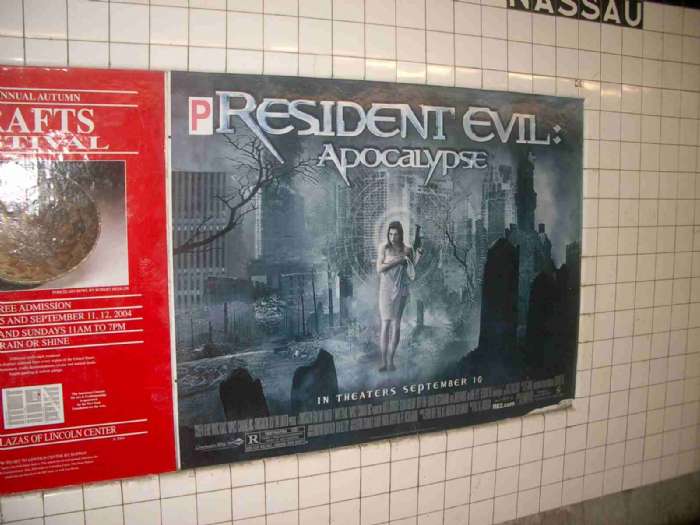
Found editorial: Photo was taken at the Nassau Avenue subway station in Brooklyn, N.Y., by "a loyal reader."
The Telegram, a politically conservative newspaper, quotes Manning's letter saying further, "I think there is a real risk that the administration underestimates the difficulties. They may agree that failure isn't an option, but this does not mean they will necessarily avoid it."
As we've known for a long time now -- although, to believe the latest New York Times / CBS poll, the American electorate doesn't seem to care -- Dummy Boy and his minions did underestimate the risks and never did find the answers. Just as they never found the weapons of mass destruction they bragged they would find. Just as they have so far not found Osama bin Laden, who has eluded capture, according to the CIA officer who once headed the hunt, because they've been too busy screwing up in Iraq.
The turning point of the presidential campaign? The blockbuster that changes minds? The clincher that tells the truth? It ought to be. Iraq is a disaster -- at best unstable for years to come, at worst headed for civil war. As noted yesterday in DARK DAYS AHEAD, that's what the Nincompoop in Chief was told in July by his top intelligence people. That's not what he's telling the American people. He's telling the exact opposite. "Freedom is on the march," he says. The man is lying. It's more basic than living in a "fantasy world of spin." (Great phrase, but too polite by half.) "He failed to tell you the truth." Full stop.
Postscript: James Wolcott makes the point nicely in "Attack Pussy."
Rosh Hashanah, the Jewish New Year, marked the beginning of 5765. But it also marked the end of Belle de Jour. "I'm afraid, darlings, the time has come for me to go," she writes. The news is crushing. Her Diary of a London Call Girl was a favorite blog of mine.
My interview with Kitty Kelley in her Georgetown home, an ante-bellum Southern mansion, took place on a sun-baked afternoon back in the Stone Age (to be exact August of 1986). We sipped diet Coca-Cola, not mint juleps. She answered many questions, at one point "swiveling her body on the loveseat in her living room like a petite artillery gun." Yesterday the interview was posted here (scroll down to second item).
So what happens today? Frank Bruni offers a rare peek at her Georgetown home in this morning's House & Home section of The New York Times. (Kelley loves her privacy, Bruni writes, so reporters don't usually get to see her home.)
Not much has changed from what I recall. She still loves big colors (though the color scheme has been redesigned). She still has her glass menagerie (though she's no Amanda). The furniture has been re-arranged, the loveseat re-upholstered, and topiary added to the garden. She still has a fondness for editorial cartoons and political caricatures, momentos of her career that decorate a first-floor bathroom (and, when I was there, the upstairs hall).
Here's what I wrote so long, long ago:
It is an imposing house. The freshly painted black window shutters are immaculate against the tan siding. The slate roof, with many peaks and chimneys, looks like something out of a fairy tale. An American flag hangs on a pole set at a rakish angle over the front porch.In the front yard, set back from Dunbarton Street, behind a vine-covered wall ... Matthew, the Caribbean gardner, is clipping the shrubbery beneath a towering magnolia tree. Around the side and back of the house is a vast, red-brick patio dotted with white, wrought-iron garden chairs and tables. A block beyond the wood fence is the brick steeple of the Episcopal Church, whose chimes announce God's presence every Sunday morning. ("I love to listen, but I don't go," says Kelley.)
It is a distinguished house. U.S. Supreme Court Justice William J. Brennan lived here for 25 years. Kelley still gets mail for him. ...
Nothing on the outside of the house prepares you for the inside. A sculpted, horn-blowing cherub, à la Chagall, greets you from a wall in the living room, which is overseen by a devilish, green-faced Balinese idol with rainbow-colored wings. It sits on a brass sea chest across the room from a 7-foot giraffe, also brass, which stands in the parlor near two Chinese Fu dogs perched on a windowsill. Meanwhile, a veritable Noah's Ark of miniature crystal animals crowd the coffee table, and an elaborate stash of giant starfish fossils fill the shelves by the fireplace.
Kelley [has an] insatiable taste for primary colors: blue walls for the living room, where the dark wood floor is polished to a glossy sheen and the white throw rug matches the trim white molding; red for the flower-patterned loveseats, where we are sitting; red for the foyer with the white Victorian armoire; red again for the parlor and the carpet on the stairway leading upstairs; yellow for the dining room, a cheerful sort of breakfast nook with toy parrots hanging from the ceiling; and green for the kitchen, where Kelley's living pets, two stiped alley cats named Darling and Runt, like to hang out. ("I'd have a burro in the backyard if I could," she says.)
Here's what Bruni saw on his "recent visit to her tall, tan house, built in the early 19th century":
A brass giraffe, about six feet tall, stands in her foyer. The mantel above the white marble fireplace in her living room supports a teeming glass menagerie, including a bunny, a bear, a squirrel and an elephant.A crystal cat has its own niche on an end table nearby.
The red paint on the living room walls is so glossy it looks candied, as does the royal blue paint in the dining room, where one of many vintage French posters hangs. The poster, like another, depicts a dancing party girl.
This copycat stuff is getting to be a habit with the Times. See what I mean here. Love it. Keep it coming.
Headlines don't say it all, but this subhead comes close: "Civil War Called Possible -- Tone
Differs From Public Statements." It's missing from the online edition of the story,
which uses the main head only: "U.S. Intelligence Shows Pessimism on Iraq's
Future." Taken together, their
meaning is this: Our Nincompoop in Chief and his minions have been lying about the
war in Iraq.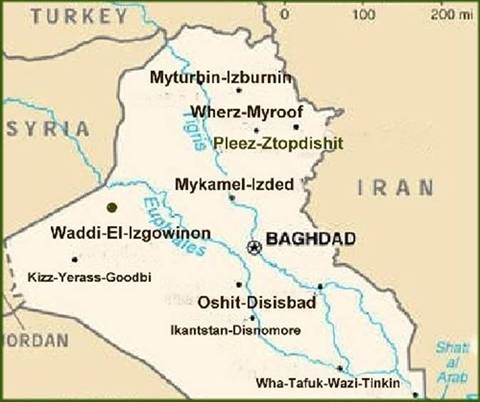
Douglas Jehl reports that "a classified National Intelligence Estimate prepared for President Bush in late July spells out a dark assessment of prospects for Iraq" and that "the pessimistic tone of the new estimate stands in contrast to recent statements by Bush administration officials, including comments on Wednesday by Scott McClellan, the White House spokesman, who asserted that progress was being made."
Does this sound like progress? "The estimate outlines three possibilities for Iraq through the end of 2005, with the worst case being developments that could lead to civil war. ... The most favorable outcome described is an Iraq whose stability would remain tenuous in political, economic and security terms."
Maybe Dummy Boy, Bunker Boy and Rummy Boy haven't taken a good look at the map of Iraq lately. When John Kerry says Dummy Boy is living in a "fantasy world of spin," he's being charitable.
Now that Matt Lauer has done himself proud with his sanctimonious interview of Kitty Kelley -- a holier-than-thou attempt to prove that a "Today" show co-host who shills for every piece of NBC Entertainment drek imaginable can be mistaken for a legitimate journalist -- I'm going to post a profile I did of Kitty Kelly that never appeared in English.
I wrote it for a German magazine many years ago, when her unauthorized biography of Frank Sinatra, "His Way," was published. After interviewing her at length at her home, which was then in Georgetown, I came away impressed. Despite the somewhat sarcastic tone of my piece, I had a sneaking admiration for her, and I think it shows. I also think she hasn't changed a bit.
While I'm typing the profile into the system, divert yourself with an excerpt from Kelley's latest unauthorized book, "The Family: The Real Story of the Bush Dynasty," which had the Pecksniffian Lauer so exercised. "Today" is not above posting it on its Web site. (And scroll down for the Lauer vs. Kelley video.)
Here's the way that profile of mine begins:
For a professional snoop, Kitty Kelley harbors a remarkably decorous feeling about her work. The least suggestion that she takes a certain pleasure in exposing the sexual peccadillos of her high and mighty targets brings an intense glare to her china-blue eyes.Maybe it's because she wants to convey the idea that she suffers for her work. The mere supposition that she enjoys tattling about the drug addictions and the desperate boozing of the rich and famous -- worse, that she has become a millionaire by holding their private tragedies up to public ridicule -- puts a wounded expression on her face and a solemn tone in her voice.
"Take pleasure?" she asks, hardly able to contain her sense of injury. "I don't do that kind of thing in my writing. I've established a reputation as an unauthorized biographer, but that doesn't give me license. I have to be very fair. And I have to abide by the laws of libel, which I do. I let the reader make up his mind."
By now Kelley has a small, tight smile on her face. Not content with this rather academic defense, the 44-year-old author of "Jackie Oh!," "Elizabeth Taylor: The Last Star," and "His Way," swivels her body on the loveseat in her Georgetown living room like a petite artillery gun.
She's now 62 and still a pistol. Hang on, the rest is coming. Read it here.
If I don't say it, nobody else will: It's gratifying to see the editorial page of The New York Times taking advice from Straight Up. Yesterday's lead editorial began like so: "It was good news when President Bush flip-flopped on intelligence reform and endorsed giving the proposed new post of national intelligence director some real authority." (Boldface added.)
Last Thursday, a Straight Up item, ON FLIP-FLOPS AND SHARP SHIFTS, led off like so: "How come when Kerry does it, it's called "a flip-flop," but when the Nincompoop in Chief does it, it's termed 'a sharp shift from an earlier position'?" The question referred to the lede in the Times's top news story that morning.
I suggested the lede might have read: "President Bush flip-flopped on Wednesday, saying he wanted to give a new national intelligence director 'full budgetary authority' in a U-turn from his position five weeks ago when he declined to go along with a major recommendation of the Sept. 11 commission." (Boldface added.)
Because there's a difference between news and opinion, it was a tongue-in-cheek suggestion (although offered seriously). I knew the Times could not have written that in a news story. Nor could the other papers -- The Washington Post, the Los Angeles Times or the Chicago Tribune -- whose news ledes I rewrote that day.
On yesterday's evidence, however -- and in the cause of honesty and candor -- let me repeat myself: Flippancy has its rewards. The evidence might just be a matter of coincidence, of course. But to concede that would defeat the purpose of this item, wouldn't it?
In a really important essay, Carlin Romano reviews a concept described this way: "It is worshiped like a god, and as little understood. It is the cause of untold strife and bloodshed. Genocide is perpetrated in its sacred name. It is at once a source of power and of power's abuse, of order and of anarchy. It can be noble and it can be shameful. It is sovereignty." The description comes from "The Sovereignty Revolution," by Alan Cranston, the former U.S. Senator from California who died in 2000. Thanks to Arts & Letters Daily for the tip.
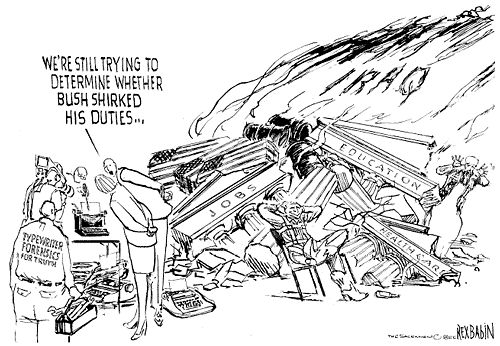 David Remnick describes, in this week's New Yorker, "a paranoid President who refuses
the burdens of democratic accountability and the need to reshape a policy that is good for little
but more bloodshed." Remnick's subject is not our Maximum Leader. He's talking about Vladimir
Putin. But it's eery. Consider the top story in the print edition of this morning's New York Times:
"Putin Issues Plan to Tighten Grasp, Citing
Terrorism." And the top story in this morning's Washington Post: "Dozens Killed in Baghdad Car
Bombing." Meanwhile, the Museum of Bad Art has solved the mystery of "Sunday on the Pot With
George." The portrait is based on none other than John Ashcroft.
David Remnick describes, in this week's New Yorker, "a paranoid President who refuses
the burdens of democratic accountability and the need to reshape a policy that is good for little
but more bloodshed." Remnick's subject is not our Maximum Leader. He's talking about Vladimir
Putin. But it's eery. Consider the top story in the print edition of this morning's New York Times:
"Putin Issues Plan to Tighten Grasp, Citing
Terrorism." And the top story in this morning's Washington Post: "Dozens Killed in Baghdad Car
Bombing." Meanwhile, the Museum of Bad Art has solved the mystery of "Sunday on the Pot With
George." The portrait is based on none other than John Ashcroft.

Apropos The stars according to Peter Bogdanovich, who cites John Wayne, James Stewart and Henry Fonda as stars able to make audiences "instantly suspend their disbelief" -- which many of today's stars can't do -- David Nuzum writes that he'd rather see unknowns.
When he saw "Maria Full of Grace," he says, he "totally forgot" the lead actress was acting. "I thought she was the character. I attributed it to the fact that she was an unknown. I much prefer films with unknowns for precisely this reason.
"That John Wayne, Stewart and Fonda were able to achieve suspension of disbelief in spite of their stardom is indeed remarkable," Nuzum adds. "But I think the comparison to contemporary actors is unfair. For one thing, those guys frequently played the same types of characters, in contrast with somebody like Tom Hanks, as Bogdanovich mentions.
"I'm no fan of Tom Hanks, but it's a lot harder to achieve suspension of disbelief when you're playing a FedEx employee (somebody who could be my neighbor) stranded on a deserted island; it's comparatively easy when you're telling a story set in the Wild West. Even the use of B&W film and mono sound must've created a kind of alternate reality for audiences, in which anything was possible."
Point taken, particularly the idea of an alternate reality in black and white.
A friend writes: "I haven't see "Open Water" (the shark film), but articles about it attributed its effectiveness, in part, to the casting of unknowns who play an ordinary couple with whom viewers could more readily identify (than with, say, Cameron Diaz and Matt Damon). In this case, the unknowns intensify the horror element of the film."
Couldn't agree more. Nobody would believe in Cam and Matt actually floating around in the middle of the ocean surrounded by sharks, still less the possibility they might not survive. Besides, no production company would have paid the risk insurance.
The San Diego Union-Tribune has a story headlined "Bloggers hoping to become fabulously wealthy may have a long wait." Hell, how about just plain wealthy? I posted this a month ago: "A pal of mine who writes for CounterPunch complains that the Web site doesn't pay anything. Face it, pal, about a million other sites don't pay anything either."
Think the AP reporter got the news from Straight Up? Very doubtful, because, as was also mentioned: "If you haven't heard that before, you haven't been listening. ... Making a living on the Internet as an artist or as a critic won't happen for a long, long time."
And yet ... and yet ... Doug McLennan, the publisher and editor in chief of ArtsJournal, has defied the odds. Today is ArtsJournal's 5th Birthday. That's not a sign of wealth, maybe not even a living. But it's a helluva start.
Sy Hersh is getting the royal treatment from Rummy Boy & Co. Here, just for fun, is the official Department of Defense Statement on the Seymour Hersh Book. It's not often an author gets such a send-off, even if the title of the book, "Chain of Command : The Road from 9/11 to Abu Ghraib," goes unmentioned. See why and why and especially why: an excerpt from the book telling how Rummy Boy "gave the green light to a secret unit authorized to torture terrorist suspects."
What's weirder? Time's poll last week, showing that the idiot in the White House continues to lead John Kerry by double digits among likely voters, or Time's interview, showing that the double-digit leader has a double-digit ego telling him: "It's all about me."
This is how the interview began:
TIME: What's the most important thing you've learned from the past four years?
BUSH: I've learned I really enjoy the job. It's a fantastic moment in my life, obviously. There's a lot of ups and downs. There's a lot of high drama and not much calm so far. But I've enjoyed doing it, to the point where I'd like to do it again.
That's what he considers the most important thing he learned? That it's a fantastic moment in his life and, gee, it's a thrilling ride? He sounds like a 10-year-old on a roller coaster. That's got to be weirder than his double-digit lead, until you wonder who the hell would vote for such an idiot?
A friend from Berkeley, Ca., writes:
My own parents, who are educated and read books & newspapers [and who live in Iowa], voice opinions on every topic (except abortion) which are very nearly my own. They're horrified by corporate malfeasance, pollution, global warming, the thought of shedding American blood for oil. But they'll be voting for Dopey and Dick in November. Go figure: I can't.Neither can we.
Seymour Hersh hit the airwaves this morning on "Meet the Press" and is scheduled tonight on "Dateline NBC" to talk about (OK, promote) his new book "Chain of Command: The Road from 9/11 to Abu Ghraib," which is being released Monday.
I didn't watch "Meet the Press" because it had Colin Powell about to do his spiel. Having just seen his non-responsive interview with George Stephanopoulos an hour earlier on "This Week," I thought, "No point in listening to that all over again." Wish I'd known Hersh was scheduled, too (along with Bob Woodward). So I'll tune in tonight to catch him on "Dateline." (West Coasters still have a chance to tune in to "Meet the Press" this morning.)
In any case, an early glimpse of the book was offered in Sunday's New York Times in a news story headlined, "New Book Says Bush Officials Were Told of Detainee Abuse." Among other things, it reports:
Mr. Hersh asserts that a Central Intelligence Agency analyst who visited the detention center at Guantánamo Bay, Cuba, in the late summer of 2002 filed a report of abuses there that drew the attention of Gen. John A. Gordon, a deputy to Condoleezza Rice, the White House national security adviser. But when General Gordon called the matter to her attention and she discussed it with other senior officials, including Defense Secretary Donald H. Rumsfeld, no significant change resulted.
Times reporter John H. Cushman Jr. offers the caveat that "Mr. Hersh's account is based on anonymous sources, some secondhand, and could not be independently verified." I offer a reminder of our rant three weeks ago, DON'T MAKE SY HERSH LAUGH, about "systemic failure, the fondly brandished euphemism for failure to take personal responsibility," being used as cover for the criminal judgments of the top brass in the White House and the Pentagon.
Yours truly has a review of "Who the Hell's in It" in today's Chicago Sun-Times. It begins:
Peter Bogdanovich's superb collection of movie-star profiles and interviews -- a sequel to "Who the Devil Made It," his interviews of top film directors -- begins with an affectionate tale about Orson Welles that reminds us of just how intimate the author's connection to Hollywood's greatest has been. But contrary to what we've come to expect from dime-a-dozen celebrities and celebrity interviews not worth two cents, the tale avoids bromidic egotism and journalistic platitudes. Rather, it introduces the collection's main theme, "the essential paradox about actors," as Bogdanovich puts it.
Read the rest here.
On the third anniversary of 9/11, the best way for Americans to honor the dead is to look to the future by realizing that the upcoming presidential election will be a referendum not on the candidates for the White House but on the conscience and convictions of the electorate itself.
Will there be no accountability on Abu Ghraib from the Bush gang, for example, as has become apparent, because voters do not have the moral spine to hold it responsible for the prevaricating "miscalculations" in Iraq?
Will American voters accept -- and by accepting, approve of -- the gang's "pattern of dishonesty" (Paul Krugman's term) in everything from character issues like the Maximum Leader's sketchy evasions about his own military service to policy issues like the cooked books of the federal budget deficit?
American voters ought to heed the advice of former Secretary of Defense Harold Brown, who participated in an investigation of the Abu Ghraib scandal that found a failure of leadership from top to bottom in the chain of command. Although Brown refused to call for the appropriate resignations of the top brass, as he should have, he said in Congressional testimony quoted Friday by the New York Times that, as the Times paraphrased it, judgments about the conduct of the war in Iraq, on Abu Ghraib and other matters, were up to voters to make. (Italics added.)
"When it comes to overall performance, there's another way of dealing with it, and that's called an election," Brown said.
Do Americans realize that by not holding the Bush gang accountable for gross violations of democratic principles of governance they would be condoning what has happened and blackening their own reputation? That by giving the Bush gang "four more years" they would be stamping their approval on the historic anomaly of the 2000 election, when the U.S. Supreme Court mistakenly appointed an unelected president?
To elect the Bush gang, truly for the first time, would be tantamount to shrugging off the American ideals for which the terrorists of 9/11 had such revulsion. It would be the worst way to honor the nearly 3,000 people in New York, Washington and Pennsylvania who died on 9/11.
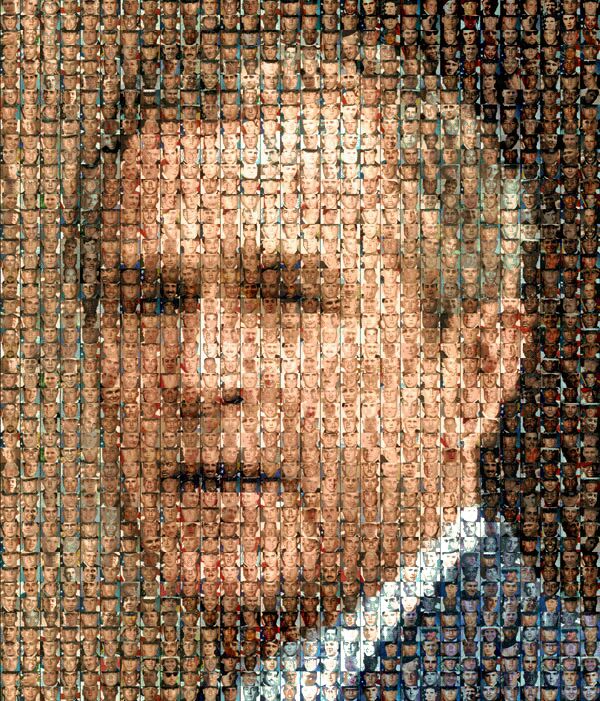
This portrait of George W. Bush is composed of photos of American
soldiers who have died in Iraq. It is our version of "The Roster of the
Dead," a two-and-a-half page spread of 900 photos
published yesterday in The New York Times. We don't know who created the GWB
death mask. It came to us in g-mail -- uncredited -- from a friend. But here's a
fitting caption from Bob Herbert's column this morning: "How
many thousands more will have to die before we acknowledge that
Postscript: Have a look at Mort Subiet's "Boot Count," another staggering death roster. This one gains visual impact by scrolling through it. The faster you scroll, the more dazzling it is. Subiet gives overdue meaning to the phrase "boots on the ground."
How come when Kerry does it, it's called "a flip-flop," but when the Nincompoop in Chief does it, it's termed "a sharp shift from an earlier position"? How come when the ninny makes a U-turn, does a back flip, lands a belly flop, or pulls his head out of his ass, it's called crossing a bridge, making a concession, embracing a new position, or acknowledging a recommendation?
Here's the lede on the top story, headlined "Bush Now Backs Budget Powers in New Spy Post," in this morning's New York Times.
WASHINGTON, Sept. 8 -- President Bush said on Wednesday that he wanted to give a new national intelligence director "full budgetary authority," a sharp shift from an earlier position and an acquiescence to a major recommendation of the Sept. 11 commission.
It might have read:
WASHINGTON, Sept. 8 -- President Bush flip-flopped on Wednesday, saying he wanted to give a new national intelligence director "full budgetary authority" in a U-turn from his position five weeks ago when he declined to go along with a major recommendation of the Sept. 11 commission.
Here, in order of increasing timidity, are other ledes. On the same story, headlined "Bush Plan Draws on Advice of 9/11 Panel," in this morning's Washington Post:
President Bush yesterday proposed giving a new national intelligence director broad powers to plan intelligence agencies' spending priorities and clandestine activities, making a concession to lawmakers moving to implement the more sweeping proposals of the Sept. 11 commission.
It might have read:
After dismissing the idea five weeks ago, President Bush yesterday did a back flip and agreed on giving a new national intelligence director broad powers to plan intelligence agencies' spending priorities and clandestine activities, while refusing to admit he was making a concession to lawmakers moving to implement the more sweeping proposals of the Sept. 11 commission.
The lede on the same story, headlined "Bush Now Backs Stronger Spy Czar," in this morning's Los Angeles Times:
WASHINGTON -- President Bush, moving toward embracing a key element of the Sept. 11 commission's recommendations, said Wednesday that a new national intelligence director should have authority over more than half of the U.S. intelligence community's estimated $40-billion annual budget.
It might have read:
WASHINGTON -- President Bush reversed himself in a belly flop on a key element of the Sept. 11 commission's recommendations, saying Wednesday that a new national intelligence director should have authority over more than half of the U.S. intelligence community's estimated $40-billion annual budget.
And the lede on the same story, headlined "Bush backs plan to give spy chief budget control," in this morning's Chicago Tribune:
WASHINGTON -- Acknowledging a key recommendation of the Sept. 11 commission, President Bush urged congressional leaders Wednesday to create a national intelligence director with "full budgetary authority" over much of the nation's intelligence community.
It might have read:
WASHINGTON -- Pulling his head out of his ass on a key recommendation of the Sept. 11 commission, President Bush did a triple somersault belly flop when he urged congressional leaders Wednesday to create a national intelligence director with "full budgetary authority" over much of the nation's intelligence community.
Got any more euphemisms?
Is anybody listening? More than 1,000 dead U.S. soldiers and $132 billion
already spent in Iraq, with insurgents in control of key regions. Bunker Boy's
latest scare
tactics. A record federal budget deficit. Medicare
data illegally withheld from
Congress. Freshly detailed charges of a 9/11 cover-up by the White
House. A Bush the Cokehead scandal brewing, with attendant media caution, and new doubts about his National Guard
duty.
How could anybody not be listening? Yet even if
they are, it doesn't matter, according to Richard Reeves, who writes: "Forget about this
presidential election for the next four weeks. The conventions are over and, as things stand now,
the next major wave of political events will begin with the first televised debate between President
Bush and Senator John Kerry on September 30 in Coral Gables, Florida. If history is a guide, the
election will be settled that night. Or, it will be settled in the second and third debates on October
8 in St. Louis and October 13 in Tempe, Arizona.
I trust Reeves. He's experienced, and he's smart, and he knows what he's talking about. But if he's right, that means until the debates come around the rest of us are just flapping our lips.
Postscript: And yet ... and yet ... listen to Patrick Coburn, of the London Independent, speaking from Baghdad to Democracy Now's Amy Goodman about the significance of the U.S. death toll and the intensification of the war in Iraq.
"We look too much at the number of dead," he says. "We should also look at the number of wounded -- 7,000. And many of these people have suffered terrible wounds, and they would have died in previous wars. People who've lost all their limbs, people who will never move out of wheelchairs in future. ...
"What's very noticeable, and maybe hasn't impressed the outside world, but it's a war on two fronts. American soldiers are dying at the hands of Shiite Muslims, which wasn't true six months ago, as well as these continuing guerrilla attacks by Sunni Muslims." Iraq, he says, "is now a much more potent base for militant Islamic groups than Afghanistan ever was."
Coburn's report is devastating about other developments, too. If American voters put Dummy
Boy, Bunker Boy and Rummy Boy back in office for four more years, they can't say they weren't
warned.
He's not the only "impoverished Caribbean orphan who immigrated to the United States," as the flack for the New York Historical Society describes him in a press release. But I'd bet he's the only one ever to be given an exhibition by the society. The reason, of course, is that this particular impoverished Caribbean orphan immigrant was Alexander Hamilton.
"Alexander Hamilton: The Man Who Made Modern America" explores his life and times, and offers what is described as "an unprecedented array of more than 150 original documents, letters, paintings and artifacts -- many of which have not previously been publicly displayed." The exhibition is to include:
+ The pistols used in the duel with Vice President Aaron Burr, who killed
him.
+ A rare version of the Declaration of Independence printed in Boston in July
1776.
+ Benjamin Franklin's signed, personal copy of the
Constitution of the United States.
+ The Federalist Papers.
+ More than
30 portraits of leading figures from the founding era, including iconic portraits of
Jefferson and Washington by Rembrandt Peale.
+ Minutes from the New York Manumission
Society, which remain unpublished to this day.
+ Hamilton's handwritten drafts for
Washington's Farewell Address, which he ghostwrote.
Some of them would make me go "Ooooh!" So if you'd like to see them and learn more about 1) "the force behind the ratification of the Constitution"; 2) the "financial genius" who founded the Bank of the United States"; 3) "an ardent opponent of slavery and a founding member of the New York Manumission Society"; and 4) the "hard-hitting journalist who founded the New York Post" a couple of centuries before Rupert Murdoch tucked it like a toy whistle into his pocket, get thee to 170 Central Park West (between 76th and 77th Streets). The exhibition opens Friday and runs through Feb. 28, 2005.
Don't have the time? Don't live in New York and can't get here for it? You'll have to settle for a virtual tour of the exhibition, or you could settle in at home with either Ron Chernow's recent biography or Robert Brookhiser's earlier biography. Fair warning: Chernow's the liberal, Brookhiser's the conservative.
Doing it the Putin way, here's a new approach to the "war on terror": During School Siege, Russia Took Captives in Chechnya: "Soldiers entered homes of rebel leaders' relatives and seized 40 people, including children. ... One day into the seizure of more than 1,000 hostages by suspected Chechen separatists in the town of Beslan, Russia now had its own hostages."
And now for an irresponsible video report from Iraq that might make you laugh.
But seriously, without subtitles, take your pick:
Thomas Powers on How Bush Got It Wrong: "No tyrannical father presiding over an intimidated household was ever tiptoed around with greater caution than is the figure of President George W. Bush in the Senate Intelligence Committee's fat report of its investigation into the scary stories about Saddam Hussein's weapons of mass destruction ..."
Arthur Schlesinger Jr. on The Making of a Mess: "Who got us into this mess anyway—our headlong plunge into preventive war against Iraq? The formal, and facile, answer is George W. Bush. But our president campaigned four years ago on a promise of humility in foreign policy and a rejection of nation-building as social work. Who persuaded him to change his mind?"
Peter W. Galbraith on Iraq: The Bungled Transition: Interim Prime Minister "Iyad Allawy is America's man in Iraq. ... According to an April public opinion survey commissioned by the US government, Allawi is one of Iraq's least popular politicians, and is strongly opposed by some 61 percent of the population (a finding that seems to have carried no weight with the Bush administration, which both commissioned the poll and chose Allawi)."
Richard Perle is offering the old "I was misled" dodge to explain his role in the Hollinger "corporate kleptocracy." We thought Kenny Boy had sucked all the helium out of that stratagem.
If any further proof were needed after Zell Miller's pit bull performance the other night that reality and Republicans do not share the same universe, it was demonstrated once again from the podium in Madison Square Garden by a president so proud of his Texas swagger that he inevitably creates the impression of a prevaricating gunslinger.
"There was nothing in the speech last night that suggested a new era of frankness from the White House, or hope that any ... fundamental problems" -- immigration reform, stem cell research, polarization of the electorate, to name just three -- "would be approached with anything but the 'my way or the highway' attitude Mr. Bush has used on issues like tax cuts and Iraq."
So said this morning's negative editorial in The New York Times, which described his domestic, so-called proposals for the future as "extremely vague concepts" and "troubled, half-finished initiatives." As for his judgment of current conditions, it consists of outlandish exaggerations. For example, "he presented the dangerous and chaotic situation in Iraq as a picture of triumphant foreign policy on a par with the Marshall Plan."
The Washington Post had a mixed editorial -- mixed only because it began by saying he "offered a robust defense of his first term and a forceful case for giving him a second," but then proceeded to undermine its own premise. "The chief difficulty with Mr. Bush's speech," it said, "wasn't so much what he put in, but what he left out: the missteps and difficulties that have marred his first term and will make many of the goals he cited difficult to obtain."
The Post said his domestic proposals "were short on detail." For instance, he failed to say that reforming Social Security his way "would cost $1 trillion or more over the next decade" and would be "daunting" -- to put it mildly -- now that his "tax cuts have piled up record deficits." Deficits? What deficits? He never mentioned them, even though he "promised to make his reckless tax cuts permanent." And while railing "against federal spending," he "proposed a raft of new spending programs and tax credits."
In the Midwest, the Chicago Sun-Times did not have an editorial -- at least not online. The positive editorial in the Chicago Tribune, however, begged to differ with its Eastern rivals. It hailed "the agenda Bush outlined" as "a refreshing balm for voters frustrated by decades of nanny-state proposals that hinge on big government solutions" and said his notion of a so-called "ownership society" would "offer intriguing alternatives."
In the West, The Los Angeles Times headlined its negative editorial "Consistently Inconsistent" and pointed out in the first paragraph: "His well-written speech would have been more convincing if he had not actually been president for the last four years."
I don't see a Wall Street Journal editorial about the speech online, not even for paying subscribers, which is just as well. I can imagine what it would say, but I'd rather not. It would ruin my Labor Day weekend.
Postscript: New York City was held in contempt of court and ordered to release hundreds of anti-Bush protesters following "one of the largest mass arrests in the country's history," far exceeding the number arrested at the 1968 Democratic Convention in Chicago. A judge ruled that the city had failed to provide the speedy justice required by law. In New York, detainees under arrest must be arraigned within 24 hours or be released.
Watch Democracy Now's report and its interview with the protesters who managed to make it into this week's Republic Convention. The authorities -- police, Secret Service and Homeland Security -- were pissed off at them, they said, because by infiltrating the convention they had shown that the vaunted security measures were less effective than claimed. In other words, if the protesters could do it, terrorists could have.
PPS: Just caught up with William Saletin's take, in Slate, on the little fucker's spew. It strikes me as especially good. "This was a speech all about what Bush will do, and what will happen, if he becomes president," Saletin writes. "Except he already is president." (Italics added.)
Saletin draws a bead on the sublime contradiction of the rhetoric, singling out the tricky metaphor that "Americans have been given hills to climb":
Recession. Unemployment. Corporate fraud. A war based on false premises that has cost us $200 billion and nearly a thousand American lives. They're all hills we've "been given to climb." It's as though Bush wasn't president. As though he didn't get the tax cuts he wanted. As though he didn't bring about postwar Iraq and authorize the planning for it. All this was "given," and now Bush can show up, three and a half years into his term, and start solving the problems some other president left behind.
But Saletin's favorite moment -- because it was laden with unintended irony -- came when the prez touted the No Child Left Behind Act, which demands that students pass required tests for promotion. "We are insisting on accountability, the prez boasted. LOL. "Shouldn't the president have to show results, too?" Saletin asks.
The Republican Convention starred two different kinds of demagogues last night: Zell Miller, a pit bull who looked as ugly and vicious as he sounded, and Dick Cheney, an oily conman who played the role of wise old grandpa. But their goal was the same: the character assassination of John Kerry.
Miller -- who had the gall to demand, "Where is the bipartisanship in this country when we need it most?" -- delivered a rant of outright lies about the Democratic nominee for president, i.e., "Senator Kerry has made it clear that he would use military force only if approved by the United Nations. Kerry would let Paris decide when America needs defending."
Cheney -- a notorious grump who climbed out of his bunker for the election campaign -- peppered his attack with canned laugh lines like this: "On Iraq, Senator Kerry has disagreed with many of his fellow Democrats. But [his] liveliest disagreement is with himself."
Bunker Boy also had the gall to claim that the smirking cock of the walk in the White House is a gentle "person of loyalty and kindness" who "brings out these qualities in those around him." Hard as it is to believe his Republican bunk -- see Exhibit A -- he also claimed, against all evidence, that the cock of the walk is "a man with a heart for the weak, and the vulnerable, and the afflicted" who "has acted with patience and calm."
If River City had a Harold Hill Hokum Award, that performance would win it hands down.
The report of another "corporate kleptocracy" is making news this morning. It's not Kenny Boy's Enron or Bunker Boy's former company, Halliburton, or any of the no-bid contract players in Iraq. This time it's Hollinger International, a media company formerly led by Conrad Black and F. David Radler with the connivance of a board of directors featuring -- you guessed it -- none other than that neoconservative for all seasons, Richard Perle, "who is excoriated in the strongest terms" for "putting his own interests above those of Hollinger's shareholders."
Remember Richard Perle? The right-wing ideologue who advocates what might be termed a holy crusade in the Middle East and elsewhere? The intellectual guru of the "axis-of-evil" hardliners in foreign policy? The guy who used to be chairman of the private Defense Policy Board, which advises Rummy Boy? The guy who stepped down as chairman and then resigned from that board altogether to avoid having his views associated with the administration's or the Defense Department's during the Nincompoop in Chief's re-election campaign?
Oh, and let's not forget the other heavyweights on the Hollinger board, such as former U.S. Secretary of State Henry Kissinger, former head of the Democratic National Committee Robert Strauss and former U.S. ambassador to Germany Richard Burt, who were let off by the 513-page report "with little more than a rebuke" for showing their lack of curiosity about the "systematic looting" by Black and Radler of "virtually all the company's $400 million in earnings over seven years."
Compared to that amount, Perle's take was chicken feed -- a mere $3.1 million -- on "an unusual deal" that gave him and other insiders "a share of profits from good investments without requiring those amounts to be offset by losses from bad investments," according to New York Times financial columnist Floyd Norris. But the downside for the company was much greater than that. As chairman of Hollinger's Internet investing subsidiary, "Mr. Perle was responsible for $63.6 million in Hollinger investments, on which the company lost a net $49 million," Norris notes in his description of the report, which was filed as part of an attempt by Hollinger to recover $1.25 billion from Black and others.
The polite honorific "Mr." is a Times custom. The Hollinger report is much less polite, essentially calling Perle an incompetent and a thief who owes the company $5.4 million and maybe more. "Perle's own description of his performance on the executive committee was stunning," the report states, referring to a triumvirate that consisted of Black, Radler and Perle. Perle admitted he often didn't read documents presented to him but signed them anyway and never discussed them with his two cohorts, who stood to gain the most from them. The report says, according to Norris:
It is difficult to imagine a more flagrant abdication of duty than a director rubber-stamping transactions that directly benefit a controlling shareholder without any thought, comprehension or analysis. In fact, many of the consents that Perle signed as an executive committee member approved related-party transactions that unfairly benefited Black and Radler, and cost Hollinger millions.So let's remember: This is the guy who has had "profound influence over Bush policies and officials in the competition for the hearts of the president and his national security adviser, Condoleezza Rice," according to Dana Milbank of The Washington Post. This is the guy whose reckless advice to the nation on how to win the war on terror is called "An End to Evil." Coming from a guy with his own evil touch, a guy who has put the touch on thousands of shareholders to the tune of millions of dollars, that's chutzpah.
Here, from mild-mannered poet Leon Freilich, is what mild-mannered Laura Bush and Arnold Schwarzenegger didn't talk about last night in their speeches to the Republican National Convention:
BUSH'S PROGRESS
W. triumphed over boozing,
Denouncing it as a force he hated;
Raising a question
not of his choosing:
Could sobriety be over-rated?
-- George W. Bush, 2002
Sites to See
AJ Ads
AJ Blogs
AJBlogCentral | rssculture
Terry Teachout on the arts in New York City
Andrew Taylor on the business of arts & culture
rock culture approximately
Laura Collins-Hughes on arts, culture and coverage
Richard Kessler on arts education
Douglas McLennan's blog
Dalouge Smith advocates for the Arts
Art from the American Outback
For immediate release: the arts are marketable
No genre is the new genre
David Jays on theatre and dance
Paul Levy measures the Angles
Judith H. Dobrzynski on Culture
John Rockwell on the arts
Jan Herman - arts, media & culture with 'tude
dance
Apollinaire Scherr talks about dance
Tobi Tobias on dance et al...
jazz
Howard Mandel's freelance Urban Improvisation
Focus on New Orleans. Jazz and Other Sounds
Doug Ramsey on Jazz and other matters...
media
Jeff Weinstein's Cultural Mixology
Martha Bayles on Film...
classical music
Fresh ideas on building arts communities
Greg Sandow performs a book-in-progress
Exploring Orchestras w/ Henry Fogel
Harvey Sachs on music, and various digressions
Bruce Brubaker on all things Piano
Kyle Gann on music after the fact
Greg Sandow on the future of Classical Music
Norman Lebrecht on Shifting Sound Worlds
publishing
Jerome Weeks on Books
Scott McLemee on books, ideas & trash-culture ephemera
theatre
Wendy Rosenfield: covering drama, onstage and off
Chloe Veltman on how culture will save the world
visual
Public Art, Public Space
Regina Hackett takes her Art To Go
John Perreault's art diary
Lee Rosenbaum's Cultural Commentary
Tyler Green's modern & contemporary art blog
