(Display Name not set)January 2005 Archives
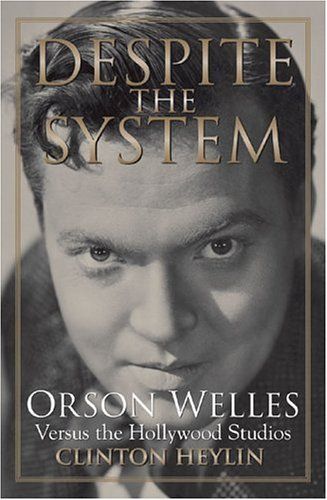 Jan -- Read the review, and he's right. Genius or not, the Big Boy was the engineer of
his doom. I have an audiotape where his pals (John Houseman, notably, because he was the only
man who could control the boy wizard) reminisce about the early theatrical triumphs, when
Welles was dilatory and frequently drunk, but as magnetically inspirational as Jesus. In the sudden
discipline of live radio, where the clock was merciless, no escape, he would conduct gifted actors
in hastily improvised scripts, with few seconds to spare, and could inspire amazing compressed
performances, all on time. He would mount a podium, baton in hand, Svengali eyes like the
searching beam of a lighthouse, and guide something that existed only in his mind, making these
folks his hypnotized puppets. Then he would collapse, drink a flagon of Scotch, and eat about five
pheasants, feathers and all. An amazing character.
Jan -- Read the review, and he's right. Genius or not, the Big Boy was the engineer of
his doom. I have an audiotape where his pals (John Houseman, notably, because he was the only
man who could control the boy wizard) reminisce about the early theatrical triumphs, when
Welles was dilatory and frequently drunk, but as magnetically inspirational as Jesus. In the sudden
discipline of live radio, where the clock was merciless, no escape, he would conduct gifted actors
in hastily improvised scripts, with few seconds to spare, and could inspire amazing compressed
performances, all on time. He would mount a podium, baton in hand, Svengali eyes like the
searching beam of a lighthouse, and guide something that existed only in his mind, making these
folks his hypnotized puppets. Then he would collapse, drink a flagon of Scotch, and eat about five
pheasants, feathers and all. An amazing character.
Thanks for re-opening the door to my Welles obsession. Thought I'd put it to sleep. My old man took me to see "The Third Man" in 1950, largely because he wanted to hear the zither music of Anton Karras. (My old man's mother played the instrument.) OK. But something happened in that theater -- I saw the knowing, witty, corrupt grin of Harry Lime, and it's never left me. A hideous introduction to the adult world. The cat is at his feet, a car goes by, a window is opened, light is spilled -- and there he is: Harry Lime. Think about the name -- that's what they use to cover the disposable dead. Well sir, there is no greater moment in all of movies, and Welles's career follows Lime's, except that Welles was essentially an innocent. Doom, man, Doom.
-- Mr. Cheer
As Mr. Cheer has often reminded me, Welles improvised Limes's most celebrated piece of dialogue in the great Ferris wheel scene when he's confronted by Holly Martins (played by Joseph Cotten) about his abhorrent criminal behavior (such as selling medicine on the black market, thus depriving sick children of medication and resulting in many deaths). "In Italy," Lime replies, "for 30 years under the Borgias they had warfare, terror, murder, bloodshed -- but they produced Michelangelo, Leonardo da Vinci and the Renaissance. In Switzerland they had brotherly love, 500 years of democracy and what did that produce? The cuckoo clock!"
Dear friends,
I am writing to friends, colleagues, and anyone I can think [of who] might be interested in knowing that our film indicting media coverage of the Iraq war will be opening in New York at the Village East Theater (12th and Second Avenue) on Friday evening (Feb. 4) for a week or more, depending on the turnout.
 Winning a theatrical run for a hard-hitting low-budget film on the role of our media is
not easy. Working with Cinema Libre (the same company that distributed "OutFoxed") we have been
showing the film in cinemas, festivals and screenings worldwide. The response has been fabulous,
and coming just a few days after the U.S.-imposed "elections" in Iraq, "WMD" can't be more
timely. Despite a few mea-culpas for [its] pre-war reporting, much of the TV coverage continues
to ignore civilian casualties and war crimes.
Winning a theatrical run for a hard-hitting low-budget film on the role of our media is
not easy. Working with Cinema Libre (the same company that distributed "OutFoxed") we have been
showing the film in cinemas, festivals and screenings worldwide. The response has been fabulous,
and coming just a few days after the U.S.-imposed "elections" in Iraq, "WMD" can't be more
timely. Despite a few mea-culpas for [its] pre-war reporting, much of the TV coverage continues
to ignore civilian casualties and war crimes.
We need your help in getting the word out through your email lists and personal contacts. We don't have the kind of marketing budget you need to make a splash in New York. We do know many grass-roots networks, media groups and anti-war organizations who could help us pack the theater.
While some jaded reviewers defensively dismiss "WMD" for "telling us what we already know" (even though it has largely not been reported) others have been very supportive: The Chicago Reader calls "WMD" "a comprehensive and devastating critique of the TV news networks' complacency and complicity in the war on Iraq ... brilliantly argued and scrupulously documented ... a must see"
Doug Ireland writes: "In this film -- which is much more meticulously documented and more accurate than Michael Moore's "Fahrenheit 9/11," and therefore infinitely more devastating -- Schechter shows with precision how U.S. mass media have been recruited as part and parcel of the Pentagon's war-propaganda machine." Vanity Fair's Michael Wolff calls "WMD" "something of a comic masterpiece." You can read more reviews online at WMDtheFilm.com and see the trailer narrated by Academy Award winner Tim Robins.
"WMD" will soon be touring campuses and other communities. The DVD will be on sale March 8th to mark the anniversary of the war. We have a "Teachers Guide" for classroom use as well. If you can help us promote the film, write David@wmdthefilm.com.
I will have more updates on my newly revamped daily blog at Mediachannel.org. You can reach me at dissector@mediachannel.org. Thanks for your solidarity and
support,
Always unembedded and independent,
Danny Schechter, News Dissector
Editor,
Mediachannel.org
GLOBALVISION
575 8th Avenue, New York, NY l0018 212
246-0202x3006
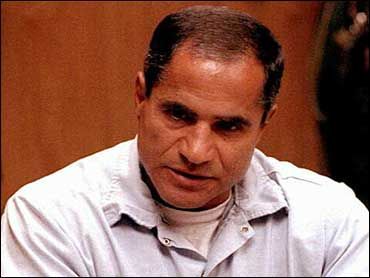
Sirhan Sirhan joined a conservationist suit, as noted in December, to preserve the Ambassador Hotel in Los Angeles, where Robert F. Kennedy was assassinated. Why? Because he and his lawyers believe that bullets still lodged in the hotel walls would prove he was not Kennedy's assassin. (Sirhan, below, in 1997.)
 Now comes news that he may have a case, according to a new book,
"Nemesis," which revives the theory that he was a patsy. British journalist John Hiscock writes in today's
Los Angeles Times:
Now comes news that he may have a case, according to a new book,
"Nemesis," which revives the theory that he was a patsy. British journalist John Hiscock writes in today's
Los Angeles Times:
Ever since he was seized with a .22-caliber revolver in his hand in the pantry of the Ambassador Hotel in June 1968, Sirhan Sirhan has maintained he was hypnotized into shooting Sen. Robert F. Kennedy.The contention was discounted by the jury, which, after deliberating for 16-1/2 hours, found him "alone and not in concert with anyone else" guilty of murder in the first degree. Almost everyone who studied the case subsequently agreed.
But nearly 40 years later, the story refuses to die. In recent months, several people have emerged to suggest that Sirhan may have been telling the truth; that he may have been hypnotized into becoming a "Manchurian Candidate"-style assassin.
The author of the book, Peter Evans, "using CIA documents and interviews," Hiscock writes, "claims to have identified the hypnotist as Dr. William Joseph Bryan, who had worked on CIA mind-control programs and who was later found dead in a Las Vegas hotel room in mysterious circumstances."
 Believers in the theory, who include journalist Dominick Dunne and actor Robert
Vaughn, who was a good friend of Kennedy, are asking to have the case re-opened. Evans and
Sirhan's attorney, Lawrence Teeter, maintain that Sirhan was set up either to be arrested or,
"preferably, shot to death by police while the real assassin escaped." Both admit that "Sirhan fired
some shots before he was wrestled down," but they contend that "none of them hit Kennedy."
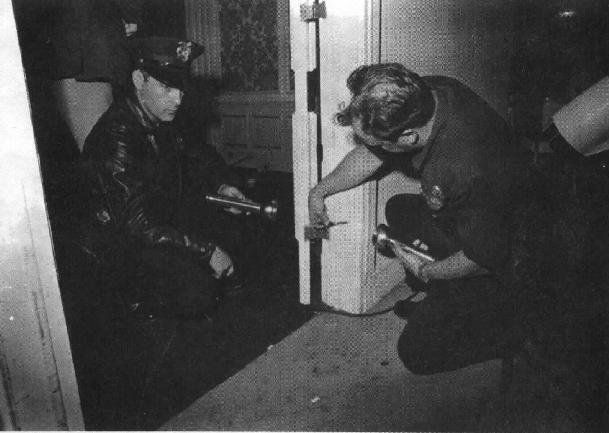
(Above, police officers examine bullet holes in a doorjamb at the crime scene.)
Believers in the theory, who include journalist Dominick Dunne and actor Robert
Vaughn, who was a good friend of Kennedy, are asking to have the case re-opened. Evans and
Sirhan's attorney, Lawrence Teeter, maintain that Sirhan was set up either to be arrested or,
"preferably, shot to death by police while the real assassin escaped." Both admit that "Sirhan fired
some shots before he was wrestled down," but they contend that "none of them hit Kennedy."
(Above, police officers examine bullet holes in a doorjamb at the crime scene.)
There have been plenty of theories about the bullets that killed Robert Kennedy, just as there were about the bullets that killed John Kennedy. Have a look at the list of trial exhibits kept in the California State Archive. It mentions roughly three dozen involving bullets, casings, ballistics, gun powder traces, Sirhan's gun, and so on. There's no mention of hypnosis, at least not on that list.
Last night I went to a concert of John Zorn's music at the Miller Theater at Columbia University. It is a fairly large hall and it was full. I would guess that 500 people or so were in attendance, and most seemed to be fans. Before the concert there was an hour-long interview with the composer conducted by George Steel.
 Zorn (left) repeatedly stressed that his music comes from some sort of higher power.
He said that it would not have been possible for him to complete over 300 of his Masadic
melodies during a very short time period without some sort of supernatural help. In the program,
he writes that composition is at its best "when the piece is seemingly writing itself and the
composer is merely an observer. He says that some of his works, "transcend my expectations and
my abilities. I cannot explain them. They are part of the Mystery."
Zorn (left) repeatedly stressed that his music comes from some sort of higher power.
He said that it would not have been possible for him to complete over 300 of his Masadic
melodies during a very short time period without some sort of supernatural help. In the program,
he writes that composition is at its best "when the piece is seemingly writing itself and the
composer is merely an observer. He says that some of his works, "transcend my expectations and
my abilities. I cannot explain them. They are part of the Mystery."
Well, so much for my speculation about downtowners not seeing themselves as artist-prophets. And I might add that the NYC public seems to view Zorn as a sort of voice of the people -- jazz, rock, pop, cartoons and all. John Cage was an artist-prophet who declared an end to artist-prophets, but it seems that at least some downtowners, like Zorn, weren't listening that closely.
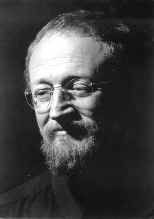 The music at the concert was not very affecting for me (Bill Oborne,
right), but it was technically brilliant and stunningly performed by a group of about 20 well-known
performers with whom Zorn has long worked. I had not heard his music before and was very
surprised. I have lived abroad for 25 years and could only read about his music in journals or on
the Web. I was expecting a sort of scontchy downtown free improv, but the works presented
were extended, highly chromatic, rhythmically complex, precisely notated and formally structured
works that sounded almost completely uptown -- except that it was much better uptown music
than what I heard when I lived in NYC in the late '70s.
The music at the concert was not very affecting for me (Bill Oborne,
right), but it was technically brilliant and stunningly performed by a group of about 20 well-known
performers with whom Zorn has long worked. I had not heard his music before and was very
surprised. I have lived abroad for 25 years and could only read about his music in journals or on
the Web. I was expecting a sort of scontchy downtown free improv, but the works presented
were extended, highly chromatic, rhythmically complex, precisely notated and formally structured
works that sounded almost completely uptown -- except that it was much better uptown music
than what I heard when I lived in NYC in the late '70s.
It is interesting that a "downtown" composer like Zorn, who never completed college, has ended up writing very virtuosic, complex and widely recognized uptown-sounding music, while so many hundreds of talented and extremely ambitious composers who went through advanced degrees at Columbia, Princeton, Juilliard, etc. have all vanished into relative oblivion.
Well-informed critics like Kyle Gann still speak of a downtown and uptown music; but based on most of the concerts I have heard in NYC of late, the two aesthetic encampments are no longer all that distinct from one another. There seems to be just one broad, rather eclectic concept of music-making in the city.
Anyway, I am still wondering if it would turn out that fewer women composers than men are likely to claim they are transcendentally inspired. As women reach equality [see Where Are the Women? -- JH], will a matriarchy evolve that follows the general patterns of patriarchy? Who knows? A good example of a matriarchal composer might be Pauline Oliveros.
Hastily written thoughts for nothing...
-- Bill
Postscript: Kyle Gann, whose self-deprecation is one of his many charms as a critic, writes: "As you can imagine, Bill's note sent me into reflexive paroxysms of self-justification." Here's Kyle: Exaggerated Rumors of Downtown's Cooptation.
 Still rolling along as it has been all
week, yesterday's Democracy Now! broadcast was another stunner, this time featuring an interview with William
Arkin, whose new book, "Code Names," exposes the obsessive secrecy of the U.S.
government and its apotheosis under the current regime.
Still rolling along as it has been all
week, yesterday's Democracy Now! broadcast was another stunner, this time featuring an interview with William
Arkin, whose new book, "Code Names," exposes the obsessive secrecy of the U.S.
government and its apotheosis under the current regime.
 Arkin, at right, a longtime investigative journalist and military-affairs analyst, has
delved more deeply than anyone, including Sy Hersh, into the hidden corners of the Defense
Department and the intelligence agencies, according to observers like Steven Aftergood, who
writes Secrecy News, the newsletter of the Federation of American Scientists, and Charles
Horner, former commander of the U.S. Space Command and the former Air Force general who
led the coalition air forces in Operation Desert Storm.
Arkin, at right, a longtime investigative journalist and military-affairs analyst, has
delved more deeply than anyone, including Sy Hersh, into the hidden corners of the Defense
Department and the intelligence agencies, according to observers like Steven Aftergood, who
writes Secrecy News, the newsletter of the Federation of American Scientists, and Charles
Horner, former commander of the U.S. Space Command and the former Air Force general who
led the coalition air forces in Operation Desert Storm.
Hersh himself says in a blurb for the book that Arkin "makes amateurs of all of us who think we know something about America's constantly expanding hidden world." But you know what? Arkin offers a ray of hope in spite of his well-earned skepticism about the covert practices vs. the public declarations of the U.S. government -- indeed, of all governments. When asked to assess the war in Iraq right now, he replied:
Though the U.S. military is sort of marching in lockstep (at least the leadership) saying, "We're going to be there for another one or two years" (and they're probably holding their breath hoping that it ain't any longer than that), the truth of the matter is that I think there's been a sea change inside the American military in the last year where their enthusiasm for the process of democratization and the mission in Iraq has really evaporated. And since I'm close to the military and follow the military, when I see something like that happen I really recognize that the Bush administration is operating on an ideological platform only [with just] tentative support from its own military leadership. ...It's a sad day for America when, in October and November before an election, you have more retired generals and admirals calling for the withdrawal of U.S. forces from Iraq than you have Democratic candidates. ...[T]he truth of the matter is that [in the military] there's a tremendous amount of discomfort as there has been from day one with the ideology of the Bush administration. The professional military has been shunted aside and has been ignored and their advice has been not taken seriously.
Arkin continued:
Americans should pay much more attention to the fact that there are high-ranking officials, knowledgeable people, who formerly were high-level commanders in the military who are deeply concerned about, not just Iraq, but the way in which we are pursuing the war on terrorism and this notion that we're going to win the war on terrorism by killing terrorists one at a time Wild West-style. ...[W]hen you have so many retired ambassadors, retired generals and admirals and others who are themselves speaking out in an environment right now in which people are fearful of speaking out, that's really a significant sea change. And though those people were not willing to speak out before the Iraq war, unfortunately, I really think we've seen a significant change in the past year since Fallujah, April, '04 where they have said, "This is going nowhere."
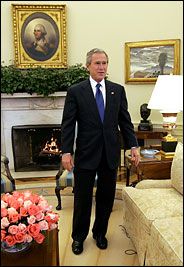 That's not what Georgie Boy or Condi Baby want to hear, of course. And
certainly not what they want us to hear. Especially not with the Iraq national election just two
days away. Let's see what the American regime's grandiose freedom hype brings on Sunday. Yesterday, speaking of the
upcoming election, Georgie Boy told The New York Times, "We're watching history being made,
history that will change the world." Apparently he thinks he's starring in a movie. Get a load of his
John Wayne pose in the Oval Office. (Photo by Doug Mills/The New York
Times)
That's not what Georgie Boy or Condi Baby want to hear, of course. And
certainly not what they want us to hear. Especially not with the Iraq national election just two
days away. Let's see what the American regime's grandiose freedom hype brings on Sunday. Yesterday, speaking of the
upcoming election, Georgie Boy told The New York Times, "We're watching history being made,
history that will change the world." Apparently he thinks he's starring in a movie. Get a load of his
John Wayne pose in the Oval Office. (Photo by Doug Mills/The New York
Times)
Today, when the liberation of Auschwitz-Birkenau is recalled with "the mournful whistle of an imaginary [death] train," the little-known No!Art art of Boris Lurie looms like a signal from the remembered depths. See, for example, his Red Shit Sculpture (below), or Immigrant's Box, or New York-Rumbula (bottom), or Bowl of Chains, or his Immigrant's Suitcase series.
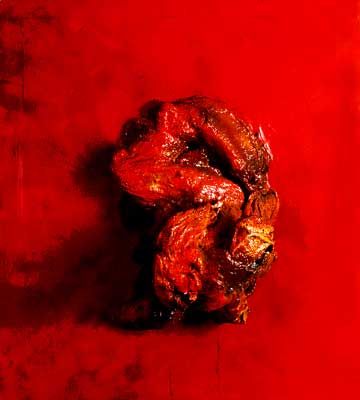 One terrible irony of Lurie's art is that it is "beautiful" in spite
of itself, an aesthetic effect alien to his experience as a survivor of Buchenwald-Magdeburg and
other concentration camps, where he was enslaved for four years and where human degradation
knew no bounds. But Lurie has probed the human abyss not only with his art but with his words.
Here, for example, is the conclusion of his essay about vaporous girlie pin-ups for a 1960
exhibition, "Les Lions," which describes the Holocaust in terms most of us can understand:
One terrible irony of Lurie's art is that it is "beautiful" in spite
of itself, an aesthetic effect alien to his experience as a survivor of Buchenwald-Magdeburg and
other concentration camps, where he was enslaved for four years and where human degradation
knew no bounds. But Lurie has probed the human abyss not only with his art but with his words.
Here, for example, is the conclusion of his essay about vaporous girlie pin-ups for a 1960
exhibition, "Les Lions," which describes the Holocaust in terms most of us can understand:
The stray dogs in my backyard are perennially hungry. The Monster makes them act out their frustration through formal well-rehearsed action. The dogs beg: they throw their paws around wildly, they run around in circles. Then the Monster throws them some bones. The meat had been all but completely eaten away, but the dogs devour them greedily and fall asleep. And in their dog-dreams they imagine themselves as superb great masters, far away in time and space, performing never ending ritual gestures. But soon they awaken, and they are as hungry as before, and the yard is as dirty as before. I have a painting in front of me. Legibly printed on its right side are the words: Liberty or Lice.
In German, I'm told, this passage is even stronger. Hunde
(dog) has much more power, says my German-speaking friend Bill Osborne, "because it is a very
strong insult." 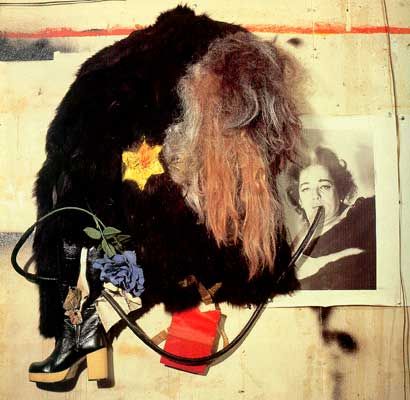 The idea, of course, is that "humans behave likedogs -- clawing, shitting, wallowing in their own filth, devouring raw
meat, bones and all." Ungehauer (monster) is stronger still, "because it refers to an entity
that is undefinable, horrible, beyond description," Osborne adds. "It is a very German word,
coming from a forest people's perception of something unspeakable in the darkness of the trees at
night." And verschlingen (devour) is far more potent "because it describes the way dogs
ravenously slaver over and swallow things whole like bones. The hard, guttural sounds and
pounding rhythm of the words increase the starkness of the effect."
The idea, of course, is that "humans behave likedogs -- clawing, shitting, wallowing in their own filth, devouring raw
meat, bones and all." Ungehauer (monster) is stronger still, "because it refers to an entity
that is undefinable, horrible, beyond description," Osborne adds. "It is a very German word,
coming from a forest people's perception of something unspeakable in the darkness of the trees at
night." And verschlingen (devour) is far more potent "because it describes the way dogs
ravenously slaver over and swallow things whole like bones. The hard, guttural sounds and
pounding rhythm of the words increase the starkness of the effect."
By a nice coincidence the Clayton Gallery & Outlaw Museum on Manhattan's Lower East Side is exhibiting some of Lurie's work in a group show that runs through Feb. 27 (161 Essex St., 212-477-1363). The other artists in the show are Mary Beach, Taylor Mead and Herbert Huncke.
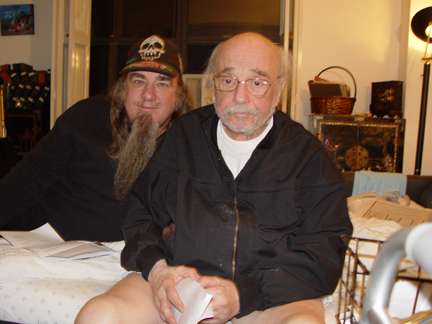 Postscript: The opening of the show was jammed. Gallery owner, co-curator (and, I might add, a warm and generous host) Clayton Patterson sent along some photos of the guests. Boris Lurie, left, couldn't make it to the opening because he was recovering from heart by-pass surgery.
  That's him sitting on the bed at home, with Clayton behind him. There's Mary Beach, right, with the writer Victor Bockris at the gallery. Taylor Mead was having a ball prancing and
dancing for guests who came loaded with cameras.
That's him sitting on the bed at home, with Clayton behind him. There's Mary Beach, right, with the writer Victor Bockris at the gallery. Taylor Mead was having a ball prancing and
dancing for guests who came loaded with cameras.  Before the opening Mead and a friend were singing songs and strumming banjos at a party in The Pink Pony, a friendly neighborhood restaurant around the corner from the gallery. Come to think of it, Mead might have been playing a miniature guitar. There he is (left) at the gallery with the artist Andre Serrano (far left). Behind them are some of Mead's acrylics on
canvas.
Before the opening Mead and a friend were singing songs and strumming banjos at a party in The Pink Pony, a friendly neighborhood restaurant around the corner from the gallery. Come to think of it, Mead might have been playing a miniature guitar. There he is (left) at the gallery with the artist Andre Serrano (far left). Behind them are some of Mead's acrylics on
canvas.
Alas, I've seen it before, the Calamity that comes when a Lifetime of Happy Dreams is crushed against the Rocks of Despair. Yes, we mistake Hapless Twits for villains. We choose the Wrong Folks for enemies in a hot Hong Kong fantasy of Karate Rage: Carson, who only made multitudes smile and never hurt anyone he didn't know, and the pathetic Thomson, once valuable but now a Bloviating Jackass. Shame on you.What you need is blood. I can sense it. And the Sacrifice of Flesh in a Righteous Cause, which brings so many satisfactions: the surprisingly easy penetration of the knife or pick, the sudden limp collapse of your victim, the simple taste of his crimson as you lick your hand. Yessir, there's much to be said for taking a life.
You need a Target of Note, or you'll never find peace. I suggest Joe Lieberman. He should be Easy Prey, walking his $3,000 dog on the sunny Connecticut street where he lives, lost in his smarmy world of kindly self-approval. Then you can leave an insider's signature, the mask of PIG placed on his still grinning face, just as Guy Grand would do if he were still around.
-- Repulski
He adds that he's begun a round of steroid therapy. By spring he expects to be either Steve Reeves or Grandma Moses.
Carson's obit, beginning on the front page, runs to 3,700 words (more than 10 times the length of Nowak-Jezioranski's) and takes up a full inside page. It is accompanied by a 663-word appreciation and a 553-word report on Carson's inability to quit writing jokes even in retirement. Over all, the Times print edition devoted 4,916 words and nine photos to his life and career.
Nowak-Jezioranski got 357 words, one photo and placement in the middle of an inside page, below the obit of Rose Mary Woods, the former secretary to Richard Nixon, who got 690 words and a photo.
Which, according to the Times's ranking, makes Nowak-Jezioranski about twice as unimportant as Woods and 10 times less important than Carson.
Nowak-Jezioranski's "most famous achievement," according to his obit, "was as the 'Courier from Warsaw,' making death-defying trips to London from Warsaw to bring news of the Polish resistance's activities to the government in exile and the Allies." Among other activities, he "took part in the failed 1944 Warsaw Uprising, in which 150,000 civilians were killed" and later campaigned "for improved Polish-Jewish relations," repeatedly calling "for Poland to apologize for the 1941 massacre of hundreds of Jews in a northern town, Jedwabne."
Not incidentally, for the first time in its history, the U.N. marks the liberation of the Nazi death camps with today's special session of the General Assembly commemorating the 60th anniversary of the liberation of Auschwitz (in Poland) by Soviet troops on Jan. 27, 1945.
The greatest achievement of Woods's career was to "accidentally" erase a key portion of a secret Oval Office audiotape that recorded a June 20, 1972, conversation between Nixon and his White House chief of staff, H.R. Haldeman, three days after the Watergate break-in. But Woods was modest about that accomplishment. She claimed she was responsible for "only about five minutes" of the infamous 18-1/2 minute gap in the tape, according to her obit.
Carson's achievements were so many, it would be tedious to list them all. But according to his obit, they included comedy sketches for "a variety of characters" such as "Art Fern, an untrustworthy salesman; Floyd R. Turbo, an opinionated bumpkin; Carnac the Magnificent, an all-knowing seer; and Aunt Blabby, a gossipy old woman" [and] foils to which Mr. Carson returned time and time again ... his doctor, Al Bendova; his accountants, H&R Goniff; and his lawyer, Bombastic Bushkin."
The Washington Post was even less moderate about Carson. It ran a total of 5,030 words between his obit and an appreciation by Tom Shales. As might have been expected, the D.C. daily considered Woods almost twice as important as the Times did, giving her 1,016 words. But as far as the Post is concerned, both were less important than Nowak-Jezioranski, whose death was smartly singled out in an editorial.
Writing about Georgie Boy's $40 million inauguration and his overrated speech, David Brooks noted in his Saturday column, headlined "Ideals And Reality": "What you saw in Washington that day is what you see in America so often -- this weird intermingling of high ideals with gross materialism, the lofty and the vulgar cheek to cheek." Anyone who believes in Georgie Boy's high ideals needs a brain tune-up.
Count on Brooks to get it exactly backwards. (See Greg Palast's fabulous "Oaf of Office.") As he almost always does, Brooks drew the wrong conclusion: "The people who detest America take a look at this odd conjunction and assume the materialistic America is the real America; the ideals are a sham. ... But of course they've got it exactly backward. It's the ideals that are real."
What about this? And this? And this?
"Because of that speech," Brooks wrote, "it will be harder for the U.S. government to do what we did to Latin Americans for so many decades -- support strongmen to rule over them because they happened to be our strongmen. ...
"It will be harder for future diplomats to sit on couches flattering dictators, the way we used to flatter Hafez al-Assad of Syria decade after decade. From now on, the borders established by any peace process will be less important than the character of the regimes in that process."
What about this? And this? And this? Yes, really.
Now see Orlando Patterson's op-ed piece, "The Speech Misheard Round the World," which appeared on the same day and on the same page as Brooks's rose-tinted nonsense, for the actual meaning of Georgie Boy's inaugural address.Yardley also quoted other similarly uninformed or skeptical students. One -- asked about Zhao Ziyang, the former Communist Party chief who died last Monday after living under house arrest for nearly 16 years and who was written out of the history books because he had opposed using force against student protesters -- said: "I don't know who he is. I've never heard of him." Yardley concluded the story, Nor had she ever heard of the Tiananmen protests. [Italics added.]
So what to make of this story today in the Times's Week in Review section, headlined "The Ghost of Tiananmen Continues to Haunt China's Rulers"? It has a prominent pullquote in the print edition that says: The leaders can't erase the memory of what happened in 1989. [Italics added.] Huh? They seemed to be doing a pretty good job of it the day before. The story itself acknowledges that many students "have only hazy notions of what happened" but concludes by quoting Wu Jiaxiang, who worked in the party's central committee in 1989: "The whole Tiananmen affair is like a giant spring that the party keeps repressing. But it is getting harder, not easier, and it is making the party tired."
Blogging's really not that new,
Dating back to Thomas Paine;
He championed the
cause of liberty
In a pamphlet attacking British reign.
"Common Sense," which Paine self-published,
Forty-seven stirring pages,
Set the
model for today's bloggers,
Creating a medium for the ages.
That sums things up nicely for the moment (more later about Georgie Boy's inaugural address) and also relates to Blogging, Journalism & Credibility, the blog conference that Harvard has been hosting this weekend. (Click the link and listen to a live audio stream of the sessions. They've been terrific so far. Although most of the conference is over by now, tune in anyway. The next session, a free-for-all, begins at 1:30 p.m. ET. After the conference ends, an archived audio link will be posted here.)
Read about the conference here. The participants include many of the usual suspects -- Jill Abramson, Jack Shafer, Jeff Jarvis, Alex Jones, Tom Rosenstiel, Orville Schell, John Palfrey, Joe Trippi, Dave Winer -- and plenty of others worth hearing. Thank you, Rebecca MacKinnon, for all the info.
 The invitation said, "They're Old, they're Cool, they're Wise, and they all
lived on the Lower East Side." Needless to say, it was not an invitation to Georgie Boy's
inauguration. It was an invitation to a group show, and "they" are octegenarians -- Mary Beach,
whose 1998 collage "Pepper Head" (right) illustrates the invitation,
Taylor Mead, Boris Lurie and Herbert Huncke, who died in 1996 at age 81. But more than age,
they have in common the status of artist outsiders.
The invitation said, "They're Old, they're Cool, they're Wise, and they all
lived on the Lower East Side." Needless to say, it was not an invitation to Georgie Boy's
inauguration. It was an invitation to a group show, and "they" are octegenarians -- Mary Beach,
whose 1998 collage "Pepper Head" (right) illustrates the invitation,
Taylor Mead, Boris Lurie and Herbert Huncke, who died in 1996 at age 81. But more than age,
they have in common the status of artist outsiders.
The Clayton Gallery & Outlaw Museum previews the show tonight with a reception for the artists from 6 to 8 p.m. The show opens Friday in Manhattan on the Lower East Side and runs through Feb. 27 (161 Essex St. between Stanton and Houston, 212-477-1363).
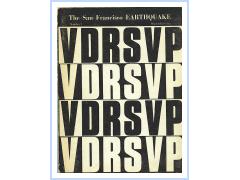 Once upon a time Mary Beach and I collaborated on a San Francisco literary magazine
(left), together with Claude Pelieu, Carl Weissner and Norman Mustill. (See this item from last July.) Her life
and work, like Mead's, Lurie's and Huncke's, cover a lot of ground -- mostly the alternative
underground. From the 1930s on, the gallery notes, their combined experience includes
"everything from the distant art world of prewar Europe to the literary Beat scene of New York;
from Nazi prison and concentratrion camps to the Surrealist, Pop and No! Art movements; from
the first Holocaust art to the streets, galleries and museums of Paris, Berlin, New York, London
and San Francisco."
Once upon a time Mary Beach and I collaborated on a San Francisco literary magazine
(left), together with Claude Pelieu, Carl Weissner and Norman Mustill. (See this item from last July.) Her life
and work, like Mead's, Lurie's and Huncke's, cover a lot of ground -- mostly the alternative
underground. From the 1930s on, the gallery notes, their combined experience includes
"everything from the distant art world of prewar Europe to the literary Beat scene of New York;
from Nazi prison and concentratrion camps to the Surrealist, Pop and No! Art movements; from
the first Holocaust art to the streets, galleries and museums of Paris, Berlin, New York, London
and San Francisco."
Of the four, Herbert Huncke and Taylor Mead are probably the best known -- Huncke because of his association with Bill Burroughs, Allen Ginsberg and Jack Kerouac; Mead because of his association with Andy Warhol. (An actor and poet, Mead was one of Warhol's superstars.) Boris Lurie, who survived four years in concentration camps (including Magdeburg, a satellite of Buchenwald), is perhaps least known in or out of the downtown scene. I discovered him only in 1973, when he sent an essay over the transom to the Something Else Press for an anthology I was editing. I loved the piece and published it. Here's how it began:
SHIT NO! TEN YEARS AFTERThe art world is in deep crisis and has been for some time. Artificial cultivation of decorative "esthetic" values, reckless investment speculation aided by large numbers of collaborating artists have brought about a situation very much like the last stage of a bull market on the stock exchange. Esthetically and philosophically the bottom has already dropped out. The mini-movements cultivating minor esthetic modes by-passed by the pioneers of modern art are being groomed, refined, enlarged and overstated all out of proportion to their real value. Even amputated splinters of the old rebellious Dada have been converted into saleable parlor games. ...
The "theoretical" part of the art market is supported by museum curators eager to please trustees and to promote large attendance by the uneducated public. It is indebted to artist-producers who operate manufacting enterprises out of mammoth lofts in New York. But the sanctity and reliability of art critics and art publications, whose full page, awe-inspiring ads and color covers have lost their magic, convince the public no longer. The museums are finally accepted for what they really are: corporate entities & private organizations controlled by a small number of not-distinguished trustees whose conflicting interests in the art market should be opened to question.
Such Sanctum Sanctorums have only been picketed; a general clean-up must begin in earnest. And many artists do understand now that their field is not just the production of art. In the most extreme cases, political confrontation has become an art form. Some are in flight from marketable objects in what is viewed as an exaggerated reaction to their unhappy findings. To many, unfortunately, all art has become useless and corrupt.
The hope is that some place, some day, a truly unmanipulated art will appear, that younger artists will become free of the art world hang-ups of their older brothers and sisters of the Fifties and Sixties, and of the poisonous atmosphere of establishment-fostered art. Let's hope they will know better how to handle the success-monster, the ego-monster, the competition-monster, and the monster of in-group camp. These nasy monsters have always had a habit of reappearing.
The first rebellion always begins out of desperation, triggered perhaps by the realization that isolation and inwardness must be broken. The artist who understands this is free only in rebellion.
Lurie went on to describe the history of his and other downtown artists's shows, such as "Adieu Amerique" (1959), his farewell "statement of rejection" when he was about to leave the country for good, he thought; group shows such as, "Les Lions," at the time of the Algerian war in a cooperative basement gallery on the Lower East Side, the "Vulgar Show," the "Involvement Show," the "Doom Show" in 1962, which he described as "a direct attack on the danger of atomic war at the time of the Kennedy-Kruschev confrontation over Cuba, when basement air raid shelters were introduced for unprotected homes and hysteria swept the country."
Mary Beach and Taylor Mead will be at the gallery reception tonight. Lurie, unfortunately, will not. He's recovering from successful heart by-pass surgery, says Clayton Patterson, who curated the group show with Anne Loretto and James Rasin.
Postscript: The opening of the show was jammed.
Gallery owner, co-curator (and, I might add, a warm and generous host) Clayton Patterson sent
along some photos of the guests. There's Boris Lurie, left, sitting on his bed at home, with Clayton behind him. There's Mary Beach, right, with
the writer Victor Bockris at the gallery. Taylor Mead was having a ball prancing and dancing for
guests who came loaded with cameras. Before the opening Mead and a friend were singing songs and strumming banjos at a
party in The Pink Pony, a friendly neighborhood restaurant around the corner from the gallery.
Come to think of it, Mead might have been playing a miniature guitar. There he is (left) at the
gallery with the artist Andre Serrano (far left). Behind them are some of Mead's acrylics
canvas.
Today's national holiday marks the birthday of Martin Luther King Jr., who would have been 76 on Saturday. King's legacy more than three decades after his assassination in Memphis, Tenn., on April 4, 1968, at the age of 39, lives on despite the contempt shown by a majority of American voters in electing a right-wing president who is about to be inaugurated and whose reactionary policies oppose everything King stood for.
Read and listen to King's greatest address, the "I have a dream" speech of Aug. 28, 1963, delivered from the steps of the Lincoln Memorial in Washington, D.C. Read, too, his peerless "Letter from Birmingham Jail," of April 16, 1963, in which he defends direct-action nonviolence, explains its principles, expresses his disappointment with white moderates and reminds us all, "We are caught in an inescapable network of mutuality, tied in a single garment of destiny."
Corporations have replaced Nazis as the politically correct villains of the age -- and just in time, because it was getting increasingly difficult to produce Nazis who survived into the 21st century."
With young Prince Harry doing his thing, Roger, you might want reconsider the second part of that lede.
AFTER THE BALL IS OVER
What will be left after the waltzing
And Bush has had his inauguration?
When
forty million has been splashed,
What will be the mood of the nation?
With war in Iraq draining five billion
Each month, and the certainty of
slashes
Looming in Social Security
What will be left but the taste of ashes?
Alas, the friends of Incurious George,
Ogling the mounting spoils of war,
Have no
complaint and no regret --
They have the keys to the candy store.
John Rockwell's dance review this morning on page B2, "Through a Dada Forest ...," is only the latest. On Thursday Allan Kozinn had a review of the New York Philharmonic on B4, and the day before that Jeremy Eichler had one on a Philadelphia Orchestra concert, also on B2.
How long will it be before arts organizations start complaining -- if they haven't begun to already -- that overnights on inside pages of the Metro section are, well, buried! and they'd rather see the reviews appear in the arts section a day later, if necessary, where culture vultures expect them?
Here's why we need an alternative press: Compare Doug Ireland's piece today in the L.A. Weekly, "Mike Chertoff's Dirty Little Secrets," about the nominee for Secretary of Homeland Security -- as well as Ireland and Elaine Cassel's comments about Chertoff in interviews this morning on Democracy Now! -- with Eric Lichtblau's piece on Chertoff in The New York Times.
Also not to be missed: Sixteen minutes into the interview, Ireland's comments on the appointment last week of black reactionary Claude Allen as Georgie Boy's chief domestic policy adviser. Allen's appointment is even more chilling than Chertoff's nomination, Ireland believes, because it signals "the aggressive nature across the board" of a second Bush regime. Ireland speaks of the billions of dollars in faith-based initiatives as, in effect, a "religious tax" and sees Allen's installation as part of a would-be "Bush theocracy."
Unfortunately, the Democracy Now! link to Cassel's article of a year ago in Counterpunch, "Michael Chertoff: Ashcroft's Top Gremlin," is dead. (Maybe somebody at Counterpunch will revive it, please?) In the meantime, here's a link that works.
By a nice coincidence, The Washington Post reports today that the hunt for WMD has finally ended and that the so-called interim report submitted to Congress last September by the chief U.S. weapons inspector Charles Duelfer -- which "contradicted nearly every prewar assertion about Iraq made by top Bush administration officials" -- will stand as the "final conclusions" of the Iraq Survey Group "and will be published this spring." [Italics added.]
One other point, sadly a minor one: Hundreds of millions of dollars were spent on the WMD wild goose chase but, as the Post also reports, "there has been no public accounting of the money." Nor will there be. "A spokesman for the Pentagon's Defense Intelligence Agency said the entire budget and the expenditures would remain classified." So much for accountability as we head toward the inauguration behind barbed wire of the biggest liar of them all.
Somebody should extend the inquiry. The independent panel -- Louis Boccardi and Dick Thornburgh -- ought to be asked to take a look into a) the Bush regime itself for its rush to war in Iraq, and b) The New York Times for its faulty reporting on WMD before and during the invasion.
Five will get you 50 they would find the same sort of flaws found at CBS -- "myopic zeal," poor judgment, rushed decisions, executives cowed by their superiors, failure to do rudimentary fact-checking, and a "rigid and blind" defense when shown errors.
The Times did eventually report on its own flaws, although Steven Rendall of Fairness & Accuracy in Reporting makes the widely noted but nonetheless telling point that the paper failed to discipline anyone on a much more important story than CBS's.
Moreover, Rendall suggested this morning on Democracy Now! that the disparity in the measures taken by CBS and the Times, has to do with right-wing political pressure and "following the script" about liberal media bias: CBS's faulty report opposed the Bush regime (and could have hurt Georgie Boy's re-election chances), while the Times's faulty WMD reporting supported the Bush regime (and its rationale for war in Iraq). Therefore, CBS had to prove it took seriously allegations of liberal bias, even though the inquiry found no conclusive evidence of that, but the Times did not have to prove anything of the kind.
Postscript: Yes, I've avoided mentioning Dan Rather. He was let off, and so was CBS News President Andrew Heyward. But, in fact, Rather will be departing as CBS news anchor in a couple of months. And speculation already has Heyward's head about to roll.Postscript: The D-Now! segment. Journalist-activist Allan Nairn offers extensive background in an interview.
Lippman then messaged a response, which has not been posted. Here 'tiz:
As you know, Tom Shales in the Washington Post pointed out that a common sin of the left is piety, and it could be applied to Bill Moyers, but that "it wasn't much of a character flaw," which is true in general, but not in a journalist.Piety has a tendency not only to close the mind, but also closes off the possibility of serious discussion or debate. "You are a fascist" tends to be a conversation stopper.
Unfortunately, this character flaw is often associated with a mental defect -- the inability to make distinctions. If intelligence consists in the mind's ability to both generalize and make distinctions the leftist mind is often half-brained.This mind has no problem in detecting similarities and making generalizations from them, but it often has trouble noticing differences.
Bill Osborne is a good example of the leftist writer's tendency to fuse piety with half-brainedness -- Nazis bad. Goebbels a Nazi. Both Limbaugh and Goebbels recognized the power of radio to influence the political landscape.Therefore Limbaugh a dangerous incipient Nazi. No, I am not worried, and I am not moving to Canada.
Happy holidays and a wonderful New Year.
I forwarded Lippman's message to Osborne for his response. Here 'tiz:
I see what Larry is trying to say. Nazi is used as a sort of hippie epithet for rednecks and the like, but I refer to German history for other reasons. After all, I have lived in Germany for the last 25 years, and have written numerous articles about the culture, including one published by the MIT Press on how Hitler manipulated the symphony orchestra for propaganda purposes. Germans and their history are a living reality for me. [Read the article. -- JH]Starting a war with false fears about WMDs is clearly fear mongering for political purposes. It led to the extreme of war. This fear mongering was taken up by rightwing radio. Using the media this way has important historical correlations people should carefully consider.
I think it is a little superficial to try to discredit Moyers as pious. It sounds like Larry is being made a little uncomfortable by what he said. He can't attack the substance, so he attacks a presumed style. And that is to say nothing of the fact that the right's political base is Christian fundamentalists. What is more pious than a president who literally mimics the rhetorical style of Southern fundamentalists, and who wants to turn over many government programs to faith-based initiatives?
Larry is overlooking a few things. I wish someone could find a way to help these folks see how they come off. Maybe they would would become a little more moderate.
The front-page headline says: "Gonzales Speaks Against Torture During Hearing." Well, as Rummy Boy might say, golly gee willikers. How noble of Mr. Gonzales. Give that man a medal. Better yet, make that man attorney general. After all, he says he understands the difference between being White House counsel, his current job, and being the nation's top law enforcer.
If he's confirmed, he says he'll represent all the people instead of just the president. Well, golly gee again. Does that also sorta mean by implication that he sorta believed in torture when he repped the Maximum Leader and drafted a memorandum calling the Geneva Conventions irrelevant? And that Georgie Boy sorta believed in torture, too?
Others besides Straight Up's staff of thousands have not been taken in by Gonzales's softspeak. Bob Herbert also casts a cold eye this morning. "The Bush administration and Mr. Gonzales are trying to sell the fiction that they've seen the light," he writes in "Promoting Torture's Promoter." Herbert points to a recent story in The Washington Post that the Bush regime is even now making plans to negate the due process of law by possibly imprisoning suspected terrorists for life without ever bringing charges against them in court.
Citing last month's ruling by Britain's highest court that, as one of the justices wrote, such detentions "call into question the very existence of an ancient liberty of which this country has until now been very proud: freedom from arbitrary arrest and detention," Herbert concludes: "That's a sentiment completely lost on Alberto Gonzales or George W. Bush."
And as the lead editorial in this morning's New York Times so nicely put it, speaking of Gonzales and his sense of responsibility:
Even vows of allegiance to the rule of law were rather peculiar. He said that as White House counsel, he had represented "only the White House," while as attorney general, he "would have a far broader responsibility: to pursue justice for all the people of our great nation, to see that the laws are enforced in a fair and impartial manner for all Americans." We thought that was also the obligation of the president and his staff.
Postscript: The Washington Post's news story this morning is worth reading for these paragraphs:
Gonzales declined to answer many questions and said he could not recall details in relation to many others, prompting complaints from some Democrats on the committee."We're looking for you, when we ask you questions, to give us an answer, which you haven't done yet," Sen. Joseph R. Biden Jr. (D-Del.) told Gonzales. "I love you, but you're not very candid so far."
Four different senators tried to pin down Gonzales on the August 2002 memo's controversial assertion that a president had the power to authorize torture in unusual circumstances, but Gonzales deflected that, saying it was a "hypothetical question." ...
At the same time, Gonzales did not rule out reaching such a conclusion in the future. "I would have to know what . . . is the national interest that the president may have to consider," he told Sen. Russell Feingold (D-Wis.).
The Los Angeles Times news story was also worth a read for these grafs:
"What was lacking in this hearing was a fuller measure of accountability, something that has long been lacking from this administration," said Vermont Sen. Patrick J. Leahy, senior Democrat on the Judiciary Committee. "The Bush administration's torture policy seems to have been created through spontaneous combustion. No one will take responsibility for it."Pressed by several Democrats about whether he personally agreed with the conclusions of the memo, Gonzales demurred, noting that a new opinion on the subject from the Justice Department issued last week rejected the most controversial aspects of the earlier document -- albeit more than two years after it was issued.
The original memo "does not represent the views of the executive branch. It has been replaced by a new opinion . . . and so as far as I am concerned it is not an issue," Gonzales said.
Democrats said he had a legal and moral duty to speak up sooner. "You never repudiated it. That's the record. You never repudiated it," said Sen. Edward M. Kennedy of Massachusetts, adding that the failure to do so made "hollow" the president's directive that soldiers act humanely.
Hollow indeed. The professed right to authorize torture no longer counts because "it has been replaced by a new opinion." The regime's m.o., as represented by Gonzales, is a triumph of something worse than sophistry -- unmitigated gall.
Alberto Gonzales has added softspeak, a modification of newspeak, to the Orwellian lexicon, although Sen. Joe Biden had another term for it: "Pure malarkey!" That's how Biden, fed up with Gonzales's lack of candor, characterized the Attorney General nominee's testimony in this morning's Senate hearing. (A big tip of the hat, too, to Sen. Ted Kennedy for not pussyfooting around.)
Here's how softspeak works: Asked by Sen. Pat Leahy whether he believes in holding policy makers accountable for their decisions -- in this case military and civilian leaders who condoned torture -- Gonzales replied: "If there's an allegation that we've done something wrong, we investigate it." He then listed a handful of investigations into the torture at Abu Ghraib, Guantanamo and other military detention camps. What Gonzales failed to say was that, of the "requisite half-dozen investigations, none [were] empowered to touch those who devised the policies," as Mark Danner writes this morning in "We Are All Torturers."
Newspeak, you may recall, is the official language of Oceania and is commonly defined as ambiguous and contradictory language that deliberately misleads and manipulates the public. Thus softspeak may be defined as direct and unambiguous language that nonetheless deliberately misleads and manipulates the public to draw a false conclusion -- in this case, that he and the Bush regime believe in accountability.
Postscript: Now that I've checked the CNN account of the hearing and The New York Times account (as of 2:15 pm ET), I see that both ignore Biden's great piece of plainspeak, which just happened to be the most galvanizing moment of the morning session. Both reports read like softspeak press releases.Two essays -- one by Kurt Vonnegut, the other by Studs Terkel -- appeared on New Year's day in The Guardian in London. They're both about Nelson Algren, who was, it is no exaggeration to say, one of the great American authors of the 20th century, and among the most neglected. "Like James Joyce," Vonnegut writes, "he had become an exile from his homeland after writing that his neighbours were perhaps not as noble and intelligent and kindly as they liked to think they were."
I've always valued Vonnegut's loyalty to Algren. Vonnegut not only promoted him whenever he could in literary establishments that Algren spurned out of contempt and humiliation; he also payed homage to Algren as his superior, which is no small thing.
Vonnegut's essay is excerpted from a new British edition of Algren's classic 1949 novel "The Man With the Golden Arm." I suspect it's a re-issue of the 50th anniversary critical edition published in this country by Seven Stories Press, with essays and appreciations by Mike Royko, John Clellon Holmes, Maxwell Geismar and others, as well as Vonnegut's and Terkel's.
![British paperback edition of 'The Man With The Golden Arm' [Canongate Books Ltd]](http://www.artsjournal.com/herman/archives/manwithgoldenarm.jpg) Vonnegut tells how he intended to bring Salman Rushdie, who was visiting him in Sagaponack, Long Island, to a cocktail party that Algren had decided to throw. Rushdie was eager to meet Algren because, of all the American reviews of his debut novel, "Midnight's Children," Algren's had struck him as the most insightful.
Vonnegut tells how he intended to bring Salman Rushdie, who was visiting him in Sagaponack, Long Island, to a cocktail party that Algren had decided to throw. Rushdie was eager to meet Algren because, of all the American reviews of his debut novel, "Midnight's Children," Algren's had struck him as the most insightful.
Vonnegut writes:
I said that Algren was bitter about how little he had been paid over the years ... and especially for the movie rights to what may be his masterpiece, The Man with the Golden Arm, which made huge amounts of money as a Frank Sinatra film. Not a scrap of the profits had come to him, and I heard him say one time, "I am the penny whistle of American literature."When we got up from lunch, I went to the phone and dialled Algren's number. A man answered and said, "Sag Harbor Police Department."
"Sorry," I said. "Wrong number."
"Who were you calling?" he said.
"Nelson Algren," I said.
"This is his house," he said, "but Mr Algren is dead." A heart attack that morning had killed Algren at the age of 72.
He is buried in Sag Harbor -- without a widow or descendants, hundreds and hundreds of miles from Chicago, Illinois, which had given him to the world and with whose underbelly he had been so long identified.
A curious fact: When the phone rang that day -- May 9, 1981 -- I was standing in Nelson's rented saltbox house in Sag Harbor, L.I., commiserating with "Big Blue," a hulking New York City homicide detective by the name of Roy Finer, who had found Nelson dead on the bathroom floor. Nelson had asked Roy and me, both friends of his, to come before the party was to begin. It's almost unimaginable to see a massive, 6-foot-6-inch NYC homicide cop shed tears. But Roy's eyes that day were red rimmed, and this time not from a hangover.
Of all Nelson's friends, it's Studs Terkel who probably understood Nelson best. He knew him longest, shared his Chicago sensibility, and lent him money whenever he needed it. Studs recounts how way back in 1956 he took Nelson along with him to an interview with Billie Holiday in a cellar jazz club on Chicago's South Side:
And when the conversation ended, as casually as it had begun, and the waiter had brought her a tumbler of gin -- "Lemon peel, baby" -- she indicated the man in the shadows, Nelson Algren. She had been aware of his presence from the beginning; there had been mumbled introductions. Now she murmured inquiringly, "Who's that man?" Algren explained that she and he had the same publisher. The Man with the Golden Arm and Lady Sings the Blues had both been put out by Doubleday."You're all right," she said to him.
"How do you know?" he asked.
"You're wearin' glasses."
He laughed softly. "I know some people with glasses who got dollar signs for eyes."
Another curious fact: When Nelson died, Studs held his I.O.U. for $3,000. The heirs to the estate, relatives whom Nelson had long ago disowned, put on their glasses to examine the I.O.U. for a notary's stamp, then refused to pay. That they'd inherited Nelson's estate only because he'd failed to leave a will, much less notarize an I.O.U., was the final Algrenian irony of Nelson's sad, funny, glorious, tragicomic life.
Sites to See
AJ Ads
AJ Blogs
AJBlogCentral | rssculture
Terry Teachout on the arts in New York City
Andrew Taylor on the business of arts & culture
rock culture approximately
Laura Collins-Hughes on arts, culture and coverage
Richard Kessler on arts education
Douglas McLennan's blog
Dalouge Smith advocates for the Arts
Art from the American Outback
For immediate release: the arts are marketable
No genre is the new genre
David Jays on theatre and dance
Paul Levy measures the Angles
Judith H. Dobrzynski on Culture
John Rockwell on the arts
Jan Herman - arts, media & culture with 'tude
dance
Apollinaire Scherr talks about dance
Tobi Tobias on dance et al...
jazz
Howard Mandel's freelance Urban Improvisation
Focus on New Orleans. Jazz and Other Sounds
Doug Ramsey on Jazz and other matters...
media
Jeff Weinstein's Cultural Mixology
Martha Bayles on Film...
classical music
Fresh ideas on building arts communities
Greg Sandow performs a book-in-progress
Exploring Orchestras w/ Henry Fogel
Harvey Sachs on music, and various digressions
Bruce Brubaker on all things Piano
Kyle Gann on music after the fact
Greg Sandow on the future of Classical Music
Norman Lebrecht on Shifting Sound Worlds
publishing
Jerome Weeks on Books
Scott McLemee on books, ideas & trash-culture ephemera
theatre
Wendy Rosenfield: covering drama, onstage and off
Chloe Veltman on how culture will save the world
visual
Public Art, Public Space
Regina Hackett takes her Art To Go
John Perreault's art diary
Lee Rosenbaum's Cultural Commentary
Tyler Green's modern & contemporary art blog
