DOWNTOWN TRANSCENDENTALISM

Jan -- A few days ago Elizabeth Hinkle-Turner pointed out that women seemed to represent about 50 percent of the downtown electronic music composers. I wondered why there seem to be more women in that scene (if there are). I speculated that it might be because the downtowners have possibly rejected the concept of the artist-prophet -- a sort of patriarchal, transcendentally inspired artist who is either seen as a voice of the people, or a voice beyond the people.

Last night I went to a concert of John Zorn's music at the Miller Theater at Columbia University. It is a fairly large hall and it was full. I would guess that 500 people or so were in attendance, and most seemed to be fans. Before the concert there was an hour-long interview with the composer conducted by George Steel.
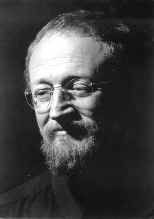
Zorn (left) repeatedly stressed that his music comes from some sort of higher power. He said that it would not have been possible for him to complete over 300 of his Masadic melodies during a very short time period without some sort of supernatural help. In the program, he writes that composition is at its best "when the piece is seemingly writing itself and the composer is merely an observer. He says that some of his works, "transcend my expectations and my abilities. I cannot explain them. They are part of the Mystery."

Well, so much for my speculation about downtowners not seeing themselves as artist-prophets. And I might add that the NYC public seems to view Zorn as a sort of voice of the people -- jazz, rock, pop, cartoons and all. John Cage was an artist-prophet who declared an end to artist-prophets, but it seems that at least some downtowners, like Zorn, weren't listening that closely.

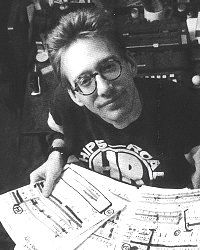
The music at the concert was not very affecting for me (Bill Oborne, right), but it was technically brilliant and stunningly performed by a group of about 20 well-known performers with whom Zorn has long worked. I had not heard his music before and was very surprised. I have lived abroad for 25 years and could only read about his music in journals or on the Web. I was expecting a sort of scontchy downtown free improv, but the works presented were extended, highly chromatic, rhythmically complex, precisely notated and formally structured works that sounded almost completely uptown -- except that it was much better uptown music than what I heard when I lived in NYC in the late '70s.

It is interesting that a "downtown" composer like Zorn, who never completed college, has ended up writing very virtuosic, complex and widely recognized uptown-sounding music, while so many hundreds of talented and extremely ambitious composers who went through advanced degrees at Columbia, Princeton, Juilliard, etc. have all vanished into relative oblivion.

Well-informed critics like Kyle Gann still speak of a downtown and uptown music; but based on most of the concerts I have heard in NYC of late, the two aesthetic encampments are no longer all that distinct from one another. There seems to be just one broad, rather eclectic concept of music-making in the city.

Anyway, I am still wondering if it would turn out that fewer women composers than men are likely to claim they are transcendentally inspired. As women reach equality [see Where Are the Women? -- JH], will a matriarchy evolve that follows the general patterns of patriarchy? Who knows? A good example of a matriarchal composer might be Pauline Oliveros.

Hastily written thoughts for nothing...

-- Bill

Postscript: Kyle Gann, whose self-deprecation is one of his many charms as a critic, writes: "As you can imagine, Bill's note sent me into reflexive paroxysms of self-justification." Here's Kyle: Exaggerated Rumors of Downtown's Cooptation.

January 30, 2005 12:04 PM |

Categories:

Me Elsewhere

'WILD SIDE' STILL ROCKS 

Nelson Algren was one of the great American authors of the 20th century, it is no exaggeration to say, and among the most neglected. Consider his underrated classic, "A Walk on the Wild Side." The title -- popularized and co-opted as an idiomatic phrase by Hollywood and Madison Avenue (institutions Algren loathed) -- is familiar to most anyone who speaks English or knows Lou Reed's lyrics. But the novel itself? Hardly.

BUSTER KEATON REVISITED 
Buster Keaton: Tempest in a Flat Hat is not a biography. "This book is merely a fan's notes," Edward McPherson writes in the introduction, although his publisher ignores the disclaimer and calls it a biography on the cover. In fact, the book is a bit of both, a difficult combination to bring off unless you're David Thomson, who set the standard with Rosebud, his penetrating rumination on the life and career of Orson Welles, which was nothing if not a distillation of every obsessive thought he ever had about the myth and the man and all his movies.
LAUREN BACALL, STILL SALTY AT 80 
When Lauren Bacall writes that her singing voice ranges "somewhere between B minus sharp and outer space," she's being candid and funny. It's not every stage star with two Tony Awards for best actress in a musical whose vocal talent offers so little promise. (OK, Harvey Fierstein excepted.) Still less would one admit it.
THE STARS ACCORDING TO BOGDANOVICH 
Peter Bogdanovich's superb collection of movie-star profiles and interviews -- a sequel to Who the Devil Made It, his interviews of top film directors -- begins with an affectionate tale about Orson Welles that reminds us just how intimate the author's connection to Hollywood's greatest has been. But contrary to what we've come to expect from dime-a-dozen celebrities and celebrity interviews not worth two cents, the tale avoids bromidic egotism and journalistic platitudes.
HERMAN WOUK'S LATEST 
It's hard to say which comes off worse in Herman Wouk's latest novel, his first in a decade: the U.S. Congress or the American press. "A Hole in Texas" offers the choice between two emblematic stereotypes: a red-faced opportunist who heads the House Armed Services Committee and a mustachioed investigative reporter for the Washington Post.
more picks

Sites to See

About this Entry

This page contains a single entry by published on January 30, 2005 12:04 PM.

SECRET SECRETS was the previous entry in this blog.

SIRHAN SIRHAN: 'MANCHURIAN CANDIDATE'? is the next entry in this blog.

Find recent content on the main index or look in the archives to find all content.

AJ Blogs

AJBlogCentral | rss

culture
About Last Night
Terry Teachout on the arts in New York City
Artful Manager
Andrew Taylor on the business of arts & culture
blog riley
rock culture approximately
CultureGulf
Rebuilding Gulf Culture after Katrina
diacritical
Douglas McLennan's blog
Flyover
Art from the American Outback
Rockwell Matters
John Rockwell on the arts
Straight Up |
Jan Herman - arts, media & culture with 'tude

dance
Foot in Mouth
Apollinaire Scherr talks about dance
Seeing Things
Tobi Tobias on dance et al...

media
Out There
Jeff Weinstein's Cultural Mixology
Serious Popcorn
Martha Bayles on Film...

music
The Future of Classical Music?
Greg Sandow performs a book-in-progress
Jazz Beyond Jazz
Howard Mandel's freelance Urban Improvisation
ListenGood
Focus on New Orleans. Jazz and Other Sounds
On the Record
Exploring Orchestras w/ Henry Fogel
PostClassic
Kyle Gann on music after the fact
Rifftides
Doug Ramsey on Jazz and other matters...
Sandow
Greg Sandow on the future of Classical Music
Slipped Disc
Norman Lebrecht on Shifting Sound Worlds

publishing
book/daddy
Jerome Weeks on Books
Quick Study
Scott McLemee on books, ideas & trash-culture ephemera

theatre
Stage Write
Elizabeth Zimmer on time-based art forms

visual
Aesthetic Grounds
Public Art, Public Space
Artopia
John Perreault's art diary
CultureGrrl
Lee Rosenbaum's Cultural Commentary
Modern Art Notes
Tyler Green's modern & contemporary art blog
Creative Commons License
This weblog is licensed under a Creative Commons License.