(Display Name not set)January 2004 Archives
The big "if." It's the only reason to tune into the Super Bowl pre-game show this Sunday, as far as I'm concerned. If Willie Nelson sings his war-protest song, "Whatever Happened to Peace on Earth," it might even make up for the craven CBS refusal to air "Child's Pay," moveon.org's 30-second commercial, during the Super Bowl.
Willie is scheduled on the pre-game show, although you'd hardly know it from the pre-game show Web site, which hypes Aerosmith's headline appearance instead of the only thing anybody with a brain might want to know: Will there be a face-off between Willie Nelson and Toby Keith, who is also scheduled on the show?
The odds are probably against it happening, given the CBS attitude toward fair play, but it would be the thing to hear: Willie singing his protest and Keith singing his prowar anthem, "Courtesy of the Red, White and Blue (The Angry American)." Instead, we'll more than likely get their duet from "Beer for My Horses" from Keith's "Unleashed" album. It would be great to be proved wrong, though.
Postscript: This op-ed piece in the Los Angeles Times, "One Thing That Won't Be Tackled on Sunday: Issues," explains everything you need to know about CBS's corporate self-interest.
Paul Krugman and Bob Herbert deliver a one-two punch this morning. Krugman wants to know: "Where's The Apology?" He doesn't see any: "George Bush promised to bring honor and integrity back to the White House. Instead, he got rid of accountability." Two key grafs:
As far as I can tell, nobody in the Bush administration has ever paid a price for being wrong. Instead, people are severely punished for telling inconvenient truths. And administration officials have consistently sought to freeze out, undermine or intimidate anyone who might try to check up on their performance.In "The Halliburton Shuffle," Herbert reminds us of that megacompany's scandalous avoidance of corporate income taxes by establishing off-shore tax shelters in the Cayman Islands, Bermuda, Trinidad and Tobago, Panama, Liechtenstein, and Vanadu.If you're with them, you pay no penalty for being wrong. If you don't tell them what they want to hear, you're an enemy, and being right is no excuse.
Herbert writes: "When I asked how much Halliburton paid in federal income taxes last year, a company spokeswoman, Wendy Hall, said, 'After foreign tax credit utilization, we paid just over $15 million to the I.R.S. for our 2002 tax liability.'"
Compare that amount to the billions of dollars Halliburton is earning from U.S. government contracts in Iraq alone. And what a nice corporate phrase for a tax dodge: "foreign tax credit utilization." Give that woman a language transplant. The dodge is legal, of course, but how about Halliburton's "foreign bribe and overcharge utilization?"
CBS won't budge. More than 340,000 emails and phone calls since Friday have had no effect. The network is still refusing to run moveon.org's 30-second ad "Child's Pay" during the Super Bowl on Sunday. Yet it's "allowing the Bush White House to run an advocacy ad of its own," moveon.org says. Apparently that's the CBS version of fair play.

"The First Amendment doesn't mean a whole lot" when CBS flouts its "constitutional obligation to air opposing points of view," Moveon.org adds.
Meantime, CBS is charging an average of $2.3 million for 30-second Super Bowl spots. Who's paying for the privilege? The usual suspects: Budweiser, FedEx, General Motors, I.B.M., Procter & Gamble, Pepsico, Walt Disney, Sony Pictures, Lay's potato chips, Cialis and Levitra erectile-dysfunction drugs.
Full disclosure: We didn't call CBS for comment. We're playing by its rules. And doncha just
love
Postscript: A reader wants to know, Is CBS really flouting its constitutional obligation or merely acting within its right to air what it wants? Good question. I doubt that CBS is violating the letter of the law, or its legal advisers aren't worth a dime. But I'd say it's certainly violating the spirit of the law.
Hailed as the latest big deal from the art world, John Currin's first solo show at a U.S. museum is still at the Whitney in New York. The show's roughly 40 figurative paintings, many of them satirical, wowed the critics for their cartoonish sensibility, their provocative take on female beauty, and their technical brilliance. (Click on the slide show.)
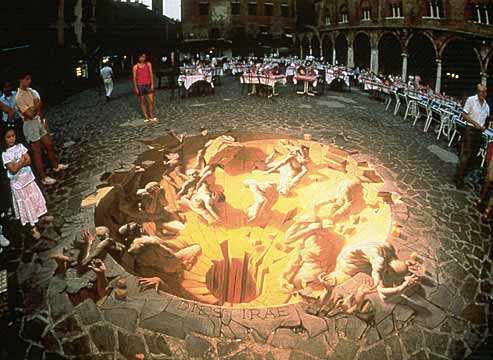
We liked them, too, though we couldn't see any of them hanging on our living-room wall. Even if we did, we couldn't afford them. But if you like figurative art painted in a Baroque Renaissance style, the work of Kurt Wenner may be an alternative. Though it lacks satire and cartoonish provocation, it is no less technically brilliant from the look of it on the Web (the figuration, to say nothing of the trompe l'eoil, is amazing). And, I presume, it's a helluva lot less expensive.
Wenner, who was born in Michigan and raised in California, has a fascinating background. He bills himself as "Master Street Painter." A friend of mine says: "He is to streets what Michelangelo was to ceilings." Have a look at these: Deposition by Barocci (Santa Barbara, Calif.); Muses, original composition (Lucerne, Switzerland); Cocito, original composition (Padadena, Calif.); Holy Family by Bronzino (Messina, Italy); Concert of Angels (Saarbrucken, Germany); Dies Irae, original composition (Mantova, Italy). All of them are "painted" with pastel chalk.
If nothing else, Wenner's religiosity would be a big hit at the White House.
It's hard to know which is the bigger news-related activities program: the Oscar nominations, the weapons inspector David Kay, the Democratic presidential candidate John Kerry, or the author Carrie Fisher? And that's not counting Martha Stewart.
Let's see. ... In the wake of Sunday's Golden Globules, this morning's Oscar nods seem slow off the mark, suprises notwithstanding. Meantime, Kay, who finally admits the United States won't be finding any weapons of mass destruction in Iraq, is making excuses for our know-nothing Maximum Leader, claiming he was duped and abused -- OK, misled -- by the intelligence community.
Asked if Mr. Gee Whiz owes the nation an apology for the gaps between his warnings
and Kay's findings -- OK, an explanation --
Fisher gets my vote. She signed books last night across the street from Lincoln Center in a publicity event for her latest Hollywood novel, "The Best Awful." The bookstore was packed with fans and celebrities who are fans. Even that furious glitteratus himself showed up. No, it was not the great author-about-town Jay McInerney. "As Ms. Fisher signed her last autograph, Salman Rushdie slipped into the room ..." < FONT color=#003399>Anthony Ramirez reports. If anybody wants an explanation for my vote, I apologize in advance.
The staff thought you'd be interested in this darling guitar tidbit from Jim Washburn's Lost in OC column, The Music Industry Descends on Anaheim and Gives it a Hickey: "The 171-year-old Martin company unveiled its one-millionth guitar, a commemorative model so ornately resplendent with mother of pearl and jewels that it could double as a lighthouse reflector. One million, by the way, is a lot of guitars: Dave Matthews plays the same brand Mark Twain and Hank Williams did; Martins were played during the Civil War and soldiers today have taken them to Iraq; Dylan and others protested the Vietnam War with a Martin, and Willie Nelson is opposing the current one with his."
And how about this darling toy tidbit from Paul Krassner's Zen Bastard column, Rat Pack of One? "Talking Presidents, the toy company that manufactures talking action figures at $30 each, is now marketing a Dennis Miller doll, to go along with the George W. Bush doll ('You're working hard to put food on your family'), the Bill Clinton doll ('It depends upon what the meaning of the word is is'), the Donald Rumsfeld doll ('I believe what I said yesterday -- I don't know what I said, but I know what I think and I assume it's what I said') and the Ann Coulter doll ('Swing voters are more appropriately known as the idiot voters because they have no set of philosophical principles -- by the age of 14, you're either a conservative or a liberal if you have an IQ above a toaster').
Here's a bonus: the George W.H. Bush doll ('I'm President of the United States and I'm not going to eat any more broccoli'). But the Rummy doll gets my vote.
What NASA didn't tell us: Here's the first Mars photo from the Opportunity showing signs of a primitive life form that apparently migrated to Earth. Puzzled scientists are still trying to figure out how to explain what they've seen.
I would offer more this morning, but my greedy Internet Service Provider -- TimeWarner's
overpriced RoadRunner, if you want to know -- has gone on the blink. Back later (I
hope).
If this is true, we're in deeper shit than we thought: "During this year's Super Bowl, you'll see ads sponsored by beer companies, tobacco companies, and the Bush White House. But you won't see the winning ad in MoveOn.org Voter Fund's Bush in 30 Seconds ad contest. CBS refuses to air it." That message just arrived from moveon.org's Eli Pariser.
Pariser also writes: "This isn't even a progressive-vs.-conservative issue. The airwaves are publicly owned, so we have a fundamental right to hear viewpoints from across the ideological spectrum. That's why we need to let CBS know that this practice of arbitrarily turning down ads that may be 'controversial' -- especially if they're controversial simply because they take on the President -- just isn't right."
Controversial? Have a look at "Child's Pay," the winning 30-second ad, and
judge for yourself. I can understand why CBS would not, if it were asked, broadcast
something like the hilarious "Bush in
41.2 Seconds," a parody by liberaloasis.com. But "Child's Pay"?
C'mon. Moveon.org is asking people to sign a free-speech petition, to be delivered directly to
CBS headquarters. If you feel so inclined
In his weblog here at artsjournal.com Greg Sandow recently wrote a stunning blind item, "Dangerous Ground," about an American classical-music megastar's rumored pedophilia. Among other things, he argued that classical musicians, their "artistic piety" and "pretense of loftiness" notwithstanding, should be judged by the same moral standards as the rest of us and, by implication, should not be treated differently from pop stars. In light of the Michael Jackson trial, the item is especially timely.
Sandow wrote that he is regularly asked:
Why ... do critics so often and so strongly praise a musician widely said to be a pedophile? Though "widely said," in this context, isn't putting the case strongly enough. This musician is an international celebrity, one of the most famous names in the business. He's wildly popular in New York and elsewhere, and has worked for years with one of the most powerful institutions in classical music. ... Shouldn't they deplore him and expose him?
They should, Sandow believes. But he points out, correctly, that to write an exposé you need evidence not hearsay, however widespread, such as a victim willing to speak on the record, or eye-witness testimony, or police documents and so on. He also asserts that he and other music writers don't have the resources of investigative reporters or the time it would take to delve deeply enough to find the evidence, if any.
He goes on to point out how he would conduct a probe if he could, but inexplicably fails to mention that when the musician in question was hired by a well-known European orchestra, the appointment became a controversial issue in the German press, more so than in the American press, and that in an obvious response to the rumors, the Green Party (in the city where the appointment was made) demanded that the star's moral conduct be vetted by the New York Police Department. The debate was also mentioned in major German music publications.
Admittedly, much of the controversy centered on the high salary to be paid him. But it's certainly newsworthy when an American megastar takes a position with a European orchestra and is confronted with such serious concerns as he faced about possible criminal behavior. American music journalists, including Sandow, could easily have written about this.
In fact, some of them did. One major American music critic I know of reported at the time that the musician had to present "a certificate of 'good behavior,' i.e., proof that he has not been convicted of a criminal offense or that any such charges may be pending." The critic did not get more specific about why this demand had been made -- he never mentioned the rumored pedophilia. On the contrary, he sympathized with the musician, calling the demand "outrageous," and wondered why he agreed to take the job despite such an insult.
"The German press was far more frank than the American press, but I think it was still somewhat hazy," the critic told me Monday. "It's always been a taboo subject, an almost impossible subject to write about," he said of the pedophile rumors. "Many have tried. Also, nobody cares. Everybody knows who Michael Jackson is. Nobody in the wide world outside of classical music knows who [this person] is. He's completely closeted and will not even admit he's gay."
Another thing about Sandow's blind item is puzzling: Why didn't he mention a well-known book recently out in paperback, which reports that investigative reporters from The New York Times, Newsday, New York magazine and The New Yorker "probed police reports" and came up with nothing? The book recounts the rumors, terming them "scurrilous gossip." And while the book's tone is guarded, it's also fairly explicit. For instance, it names the person (though I won't): "The gist of the stories was that [the star in question] was guilty of criminal behavior" and that the board of directors of the institution for which he worked "had condoned [it] by paying off the aggrieved parties." One tale "had [the star] soliciting a child in Pittsburgh," but the book points out he was, at the time, in Boston. Another tale "with the same theme had the New York subway as its location." Here again the author doubts the story.
The most devastating rumor -- it was "particularly persistent," according to the book -- was that the musician "had had a relationship with a boy whose parents had gone to the [institution's] board, threatening to expose the situation. Supposedly the board had authorized a major payoff to the family." This was "adamantly and consistently denied," the book says. It adds a footnote that in the author's own interviews with board members, they "all denied that the payoff ever happened." This included one board member who had resigned over his disagreement with the star's professional judgments, not over his rumored sexual behavior. Further, the author relates, investigative reporters checked into the institution's "financial statements" and did not find evidence of any illicit payment. And the musician, moreover, "denied the accusation as a total fabrication" in an interview with the Times.
So we're left with the same dilemma now as ever. Musicians are terribly vicious gossips, and it's very possible the stories are untrue. What a ridiculous thing that would be, especially considering that many still credit them almost without question (including me). Everyone repeats these stories, but no one knows who the source ever was. It's important to consider the issue that such widespread rumors continue to raise, but it's also important to speak publicly only with concrete knowledge.
We're good little Nazis now: "Republican students at the University of Colorado launched a Web site to gather complaints about left-leaning faculty members, saying they want to document discrimination against conservative students and indoctrination to the liberal viewpoint." This is scary stuff.
It reminds me of the atmosphere of "Berlin Noir," Philip Kerr's trilogy of detective novels, which take place during the Third Reich just before World War II. They've been my great reading pleasure these days.
The central character is Bernhard Gunther (Bernie to his friends), a former detective who quit the force before he "got weeded out" by the Nazi party. Now he's a private eye. What is particularly good about "Berlin Noir" is that it gives an authentic picture of life under Hitler and his minions. It's full of small details rarely found in history books except as abstractions. And it explodes the widespread myth of German efficiency and brilliance, replacing it with the reality of corruption and stupidity.
Here's a taste of "March Violets," the first in the trilogy:
"You're Gunther, the detective?""That's right," I said, "and you must be --" I pretended to read his business card, "-- Dr Fritz Schemm, German lawyer." I uttered the word "German" with a deliberately sarcastic emphasis. I've always hated it on business cards and signs because of the implication of racial respectability; and even more so now that -- at least as far as lawyers are concerned -- it is quite redundant, since Jews are forbidden to practice law anyway. I would no more describe myself as a "German Private Investigator' than I would call myself a "Lutheran Private Investigator" or an "Antisocial Private Investigator" or a "Widowed Private Investigator," even though I am, or was at one time, all of these things (these days I am not often seen in church). It's true that a lot of my clients are Jews. Their business is very profitable (they pay on the nail), and it's always the same -- Missing Persons. The results are pretty much the same too: a body dumped in the Landwehr Canal courtesy of the Gestapo or the SA; a lonely suicide in a rowboat on the Wansee; or a name on a police list of convicts sent to a KZ, a Concentration Camp. So right away I didn't like this lawyer, this German lawyer.
Speaking of favorite novels, I was reminded of another by Tunku Varadarajan, who wrote in the Wall Street Journal the other day: "It's not possible to spend an hour in urban India without ingesting life's unfairness. ... Luck and grueling effort are the main safety nets in places like India, and poor children aren't spared the legion of woes that their parents face daily."
I don't know about "ingesting" it -- how about "absorbing" it -- and I don't appreciate Varadarajan's smugness in the telling of it, but he makes me relish all the more Clive James's "The Silver Castle," which traces an urchin's life from the Bombay slums to Bollywood, and which I highly recommend (a helluva lot more than Salman Rushdie's "Midnight's Children").
So you're alone in the chauffer-driven limo, toking on a joint. But the limo is speeding. A state trooper clocks it, pulls its over on Route 28 not far from Woodstock, N.Y., and gets a whiff of that joint you were smoking. You are Art Garfunkel, pop star. Next thing you know you're being searched, and the trooper finds marijuana in your right pocket. Not to worry, you won't be doing time. It's a $100 fine, max, and you just have to mail it in. But here's the really embarrassing part, as reported by the local newspaper: "State police Capt. Louis Barbaria Jr. said the trooper didn't realize who he arrested until later, even though Garfunkel identified himself as a celebrity."
The headlines have moved on, but people still haven't gotten over Howard Dean's concession speech on Monday night. That's the water-cooler chat, not Tuesday night's State of the Union address. Jodi Wilgoren's front-page report, written on deadline, caught Dean's embarrassing performance with an exactness worth a thousand pictures. Every perfectly chosen word was right:
WEST DES MOINES, Iowa, Jan. 19 -- He burst into the ballroom, fists thrust in the air, and slapped a string of high-fives with the dozens of labor union members standing onstage. He grabbed hold of Senator Tom Harkin of Iowa and yanked his hand up, too. He whipped off his suit coat and rolled his sleeves up as far as they would go.
This is how Howard Dean marked the first loss of his charmed political life. "We will not give up," he bellowed to the fiery crowd, grabbing one of the American flags being waved and thrashing it around.
Shouting himself hoarse, Dr. Dean readopted some of the growling, angry outsider tone that had propelled his earlier insurgency as he spun through the list of states where he planned to fight the next rounds: from New Hampshire
to South Carolina to Massachusetts and North Carolina, the latter two the homes of the men who beat him here.With a fierce grin and a red face, he vowed, "We will not quit now or ever!"
The performance masked what must have been disappointment for Dr. Dean, who until a couple of weeks ago seemed almost invincible and on his way to a clear-cut victory here, but ended up with 18 percent of the vote, only enough
for the bronze.
Dean's behavior struck his critics as a meltdown. The
politerati object to his angry, volatile display as proof that he lacks presidential temperament.
Maybe so. He certainly lacked grace under pressure. As Dave Letterman put it, he came off like a
In case you missed this on Friday, here it is again: "Bush in 41.2 Seconds." It's a great way to prep for tonight's State of the Union address. And if it doesn't make you laugh, you're either a) a Republican, b) a sourpuss, c) a Republican sourpuss, or d) George Bush's mother.
Der Gropenfuhrer has assembled what columnist Jim Washburn calls a Dynamic Oligarchy to rule California's lemmings. "The beauty of Dynamic Oligarchy," Washburn writes, "is that it works where it's needed most. ... If you're an 'unfit' member of society struggling to meet your meek goals, it zeroes right in on you."
Washburn recalls seeing the Grope "crush a car with a wrecking ball" during his campaign for governor. "I'll never tire of his quote at the time, which ranks with Thomas Jefferson and Tom Paine's best: 'In movies, I played a character that if I didn't like something, I destroyed it! I viped it out!'"
That's just what he's doing to education, health care and social services. "How did we know that the special interests Arnold was complaining about were our kids and our poor and ailing elderly?" Washburn asks. Nobody says the Grope's job is easy. But his so-called solutions to California's fiscal problems are heartless and no better than those of his predecessor, Gray Davis.
And how about George Pataki, New York's governor? He doesn't want to be left out of the running for heartless. To save New York state all of $9 million, he plans to cut assistance to the poor who are physically disabled. "In a state budget of more than $90 billion, the total savings would be minimal but at least 26,700 families could be affected," The New York Times reports this morning.
The report noted that those households "would lose $90 per month on average, according to an estimate provided in the proposal. For a family with a fixed monthly income of only several hundred dollars, that loss could have a significant impact, advocates for the poor said."
Nice, huh? That piece of cheery news comes just in time to celebrate today's federal holiday honoring Martin Luther King, Jr.
This fisherman has come in from the cold. It's so frigid outside there's no point in dangling bait through a hole in the ice. The fish are frozen, too. But it's not much warmer indoors, and there's even the risk of an energy blackout here in the Northeast.
If the electricity stays on, I may warm myself by the heat of London call girl Belle de Jour's
weblog, and frankly I don't care whether she's really Martin
Amis in drag. I've been enjoying
her recent postings about her favorite sexual kinks,
her fondness for anal sex
and her first real date since
becoming a call girl. You might enjoy them. She's very entertaining, even if her French is lousy.
And she sets a standard of sexual candor that "The L
Word" is unlikely to match in its premiere Sunday night.
If Belle is too lowbrow for you, try The Talk bulletin board at the Guardian. It's brimming with hot topics like the Parthenon marbles -- should they be returned to Greece in time for Athens 2004 Olympics? and Is John Cage having a laugh? If that's too highbrow, try popping some bubble wrap.
Mark Spittle's parody of moveon.org's "Bush in 30 Seconds" ad contest is the funniest video I've seen since the sword-and-sandal epic "Hercubush." Have a look and turn up the sound: "Bush in 41.2 Seconds." I'm coming late to the party, but no matter. A laugh like this is never too late.
The Imam's defense lawyer contends that his client was wrongly sentenced to prison for encouraging violence against women. Why? Because he was merely following Islamic teaching. "Freedom of expression wasn't the right argument, it was freedom of religion that had to be protected," he said.
Ain't religion grand? Hell, the Imam isn't a total brute. He urged husbands "not to hit their wives on sensitive parts of the body" and to be gentle enough "so that the blows don't leave scars or bruises."
Here's a link to get the brain working, "No Road From Munich To Iraq," by my favorite historian, Gerhard Weinberg: It's an old article, from before the invasion ordered by our Maximum Leader. But it's typically knowledgeable, thoroughly enlightening and not a bad corrective to dumb thinking.
And if you didn't believe what I said yesterday about blabbermouth blogging, check this out: "Breakfast With Cereffusion" (third item down, Jan. 13), the saga in words and photos of a blogger's breakfast "in the world-famous Friendly Toast restaurant."
Not incidentally, why is it so damned cold here in the Northeast? Blame it on California.
Made by a 38-year-old ad executive from Denver, according to a moveon.org press release, the 30-second spot "features young children working in difficult service and manufacturing jobs -- washing dishes, hauling trash, repairing tires, cleaning offices, assembly-line processing and grocery checking, followed by the [printed] line: 'Guess who's going to pay off President Bush's $1 trillion deficit?'" Side note: Fisher used to be a registered Republican.
The other winners were all consolation prizes. The Funniest Ad ("If Parents Acted Like Bush"), though cute, is not really funny; the Best Animation Ad ("What I Been Up To ...") is not very imaginative, though it's marginally better than its rivals, which isn't saying much; and Best Youth Ad ("Bring It On"), though it's superbly done, matches the Maximum Leader's own stridency and is unlikely to persuade anyone not already convinced of its argument.
Finally, since I made such a big deal about it yesterday, I feel obligated to report that last night's live Webcast from the Hammerstein Ballroom was pretty boring unless you liked the noise that passed for music. I didn't. The only part of the show I did enjoy were Al Franken's remarks about what the Maximum Leader knew, if he knew it, and whether he understood what he knew or didn't know.
Postscript: Here's a thoroughly reported and far more sympathetic review of the evening than mine.
Tonight's a big one for moveon.org's "Bush in 30 Seconds" ad contest. The liberal advocacy group will name the winner on its Website. For those unfamiliar with the competition, here's the dope. The jury is looking for "the ad that best tells the truth about President Bush's failed policies" in 30 seconds.
The winning ad is to be broadcast 30 times next week on national television to coincide with the Maximum Leader's State of the Union message, moveon.org announced. Meantime, you can still vote here for the "Funniest Ad," "Best Youth Ad," and "Best Animation" in the contest.
This brings to mind Jim Washburn, who writes an opinion column for an alternative weekly in the benighted Republican stronghold of Orange County, California. It's called "Lost in OC." Washburn dipped into Santa's Mailbag over the Christmas holiday to answer questions about current political realities and in one piece of advice cited moveon.org as a good place to seek wisdom.
Washburn quoted a message from a California lemming asking Santa to clear up his confusion about der Gropenfuhrer, for whom he'd voted. Since his election, the Grope has broken various promises, the lemming wrote, and "now he says it's time to 'move on.' I remember the president 'moved on' from lying about the war, and from not really being elected, and from ever finding the staffer who outed the CIA agent, and from a bunch of other zany confusing stuff. Moving on really seemed to settle his hash.
"Am I getting this right, that moving on is good to do, like if I hit your car and you're bleeding on the dash and not looking so good, I can just 'move on' and everything's okay?" the disillusioned lemming asked. "Is 'moving on' different from 'getting a move on' or 'busting a move'? If there's a book, with pictures, that shows me how to move on, that's what I'd like, Santa." And he signed the message: "I Can't Tell You My Name Because the Nametag's Upside Down."
Santa's reply, as noted, was: "Dear Upside Down: There's no such book, but looking in my crystal ball I see there's a website called MoveOn.org. Maybe it can help you to understand things."
Some Americans would object that Santa's response was partisan and therefore divisive, which is unworthy of a saint. But others would defend Saint Nick's right to preach against Republicans, especially against der Gropenfuhrer and the Maximum Leader. That's the difference between democracy and theocracy, even for citizens who pledge allegiance to "one nation under God."
Washburn doesn't just stick to politics. He spreads his wisdom around. Here he is on Internet telecommunications consumer blight. For more of the political wisdom he and Santa recommend, however, tune in tonight to the live Webcast of "Bush in 30 Seconds," to be linked here at 7:30 p.m. ET from the Hammerstein Ballroom in New York City. The winners will be posted here at 11 p.m.
Prompted by yesterday's item, "Catching Up With Willie Nelson," a reader writes:
"It occurs to me that people, especially Toby Keith, won't fuck with Willie like they did the Dixie Chicks. His talent, eloquence and commercial power are formidable and have stood the test of time. Willie's influence within the industry is enormous. Moreover, there is a fundamental personal integrity to the man that common people recognize and respect. This combination of factors should cause his potential detractors to carefully consider their actions."
Much as I'd like to think so, I have to disagree. The Toby Keiths of the world lack many things, prudence not the least of them.
Let's end the week with Paul Krassner's predictions for 2004. He has taken the culture's pulse for so long and with such accuracy that his prescience should surprise no one.
It's a tough game, making predictions. He knows that as well as anybody, except for Our Maximum Leader, who ought to be eating his words about now for predicting we'd find weapons of mass destruction in Iraq, Colin Powell's defense notwithstanding.
So Krassner has done a wise thing. He's made his predictions wickedly amusing. Here are some of them:
1. Michael Jackson and Kobe Bryant will be cellmates.
2. Charles Manson will be
released on parole and announce that he's looking forward to spending more time with his
family.
3. Fidel Castro will come out for term limits.
4. Wal-Mart will move its
corporate headquarters to China.
5. Saddam Hussein will be sentenced to a lifetime of
community service.
6. The stunt doubles for Ben Affleck and Jennifer Lopez will get
married.
7. The world's tallest building, to be built at the site of the World Trade Center,
will be sponsored by the Target chain, whose corporate logo of a bulls-eye a few floors below the
spire will be visible for miles.
8. The Patriot Act will be expanded to include thought
crimes.
9. The ACLU and PETA will combine forces to fight for the civil liberties of all
animals.
10. Strom Thurmond will be tried posthumously for statutory rape.
11. Jesse
Jackson and Johnny Cochran will compete against each other in a national poetry slam.
12.
Bottled water will be imported from Mars.
13. Monica Lewinsky and Paris Hilton will enter
a convent and become nuns for a reality-tv series.
14. Sen. Joe Lieberman will convert to
Islam.
15. God will at last be given credit for creating evolution.
News item: The New York Times reported that CBS "in effect" paid Michael Jackson $1 million to sit for a "60 Minutes" interview. The report, based on an anonymous source, was vehemently denied by the network. Poet-punster Leon Freilich offers this commentary:
TIFFANY TRASH?
The Jackson "interview"
Has critics singing the
blues,
Wondering if CBS
Is guilty of molesting the news.
Let's consider some recent high-profile liars and the lies they told. A reader writes: "William Jefferson Clinton lied about a blow job in the oval office. Cost to the American public: Embarrassment and wasted millions in federal funds for the Starr investigation. Cost to Clinton: He was impeached, but not convicted, and lost his license to practice law.
"Martha Stewart is accused of lying about information that may have motivated her to sell her shares of Imclone immediately preceding their decline in value. Cost to the American public: Difficult to determine. One could make the case that, if guilty, she undermined faith in the stock market. Cost to Stewart: A jury in her upcoming criminal trial could send her to prison.
"Pete Rose bet on baseball and lied about it. Cost to the American public: Disillusionment. Cost to Rose: He is forever banned from the sport (so far), and possibly a spot in the Hall of Fame.
"George W.
Have you heard, or heard about, Willie Nelson's new antiwar song? It's called "Whatever Happened to Peace On Earth," and he sang it last week in Austin, Texas, at a fund-raising concert for Democratic presidential candidate Dennis Kucinich. "That's only the second protest song I've ever written," Nelson told the Austin American-Stateman, "but it just came pouring out."
There aren't many performers around with Nelson's courage, and that includes the Dixie Chicks. It's not just the outspoken lyrics of his new song that resonate with deep conviction; it's his unwillingness to back away from them that evinces rare belief and even rarer bravery. Here's the song:
What Ever Happened To Peace On Earth
There's so many things going on in the world
Babies dying
Mothers
crying
How much oil is one human life worth
And what ever happened to peace on
earth
We believe everything that they tell us
They're gonna' kill us
So we gotta' kill them
first
But I remember a commandment
Thou shall not kill
How much is that
soldier's life worth
And whatever happened to peace on earth
(Bridge)
And the bewildered herd is still believing
Everything we've been told from
our birth
Hell they won't lie to me
Not on my own damn TV
But how much is a
liar's word worth
And whatever happened to peace on earth
So I guess it's just
Do unto others before they do it to you
Let's just kill em' all and
let God sort em' out
Is this what God wants us to do
(Repeat Bridge)
And the bewildered herd is still believing
Everything we've been
told from our birth
Hell they won't lie to me
Not on my own damn TV
But how
much is a liar's word worth
And whatever happened to peace on earth
Now you probably won't hear this on your radio
Probably not on your local
TV
But if there's a time, and if you're ever so inclined
You can always hear it from
me
How much is one picker's word worth
And whatever happened to peace on
earth
But don't confuse caring for weakness
You can't put that label on me
The truth is
my weapon of mass protection
And I believe truth sets you free
(Bridge)
And the bewildered herd is still believing
Everything we've been told from
our birth
Hell they won't lie to me
Not on my own damn TV
But how much is a
liar's word worth
And whatever happened to peace on earth
American-Statesman reporter Michael Corcoran asked Nelson whether he was concerned that "such biting questions as 'How much oil is one human life worth?' and 'How much is a liar's word worth?' might cause a backlash with conservative country music fans." Nelson replied, "I sure hope so. I don't care if people say, 'Who the hell does he think he is?' I know who I am."
The song does not have to identify the liar. We know who he is. Nor does it have to identify the guitar picker. We know him, too. And when it asks, "How much is one picker's word worth?," we know the answer to that: Plenty. Although I've heard from one correspondent that Nelson did not plan to record the song, Corcoran reports otherwise.
Nelson's first antiwar song, in case you're interested, was the powerful, elegaic "Jimmy's Road," which he sang at peace rallies during the 1991 Gulf War. It was released in 1992 on the not easily available, two-disc set "The IRS Tapes: Who'll Buy My Memories?" You can hear Nelson singing "Jimmy's Road" here. Have patience -- it takes time to load -- and turn up the sound.
Here are the 15 finalists in moveon.org voter fund's amateur "Bush in 30 Seconds" political ad contest. To watch the ads, just click on the high- or low-bandwith versions (and don't forget to click the left arrow when the screen comes up). Some of them are terrific. For a quick taste, here's a random sample of photo stills from six of the 30-second spots: "Child's Play," "Polygraph," "Bring 'Em On," "Human Cost of War," "Leave No Child Behind" and "Gone in 30 Seconds."
Moveon.org says it created the ad contest "to bring new talent and new messages into the world of mainstream political advertising" and is seeking "the ad that best explains what [the Maximum Leader] and his policies are really about -- in only 30 seconds."
My favorites among the finalists are "Child's Play," "Desktop," "Bush's Repair Shop" and "Gone in 30 Seconds." Oh, and here's a minute-long, must-see cartoon ad for Halliburton by Mark Fiore. It's not part of the contest, but it would make a funny spot.
The winner, to be chosen by a jury, will be announced on Monday. The jurors include various show-biz types (Jack Black, Benny Boom, Margaret Cho, Hector Alizondo, Al Franken, Janeane Garofalo, Ted Hope, Michael Mann, Moby, Michael Moore, Tony Shalhoub, Russell Simmons, Michael Stipe, Gus Van Sant), two political strategists (Donna Brazille and James Carville), one pollster (Stan Greenberg), one intellectual (Katrina Vanden Heuvel), and -- to lend authority -- a partridge in a pear tree.
The rumor that American Media's tabloid queen, Bonnie Fuller, shelled out $100,000 for a wedding photo of Britney Spears and ex-groom, reminds me to get cracking on the tabloid thriller I've been dawdling over. It's called "Shooter," and here's how it begins:
"Laszlo was a fabulist who put great store in truth-telling because the truth, as all fabulists will tell you, is stranger than fiction. A tall, lean refugee from wealth and privilege when Mona first met him, he was often high on speed, always riffing, full of imagination, his sardonic humor tinged with bitter taunts. Of all the shooters she'd known, Laszlo was the cleverest. He had a flippant, street-smart intellect, brilliant at picking up on the latest youth trends. His listeners appreciated the ambling, long-limbed version of personal history that he passed off as truth-telling. He did not paint himself heroically, so much as an observer of the heroic. His was the glancing perspective of a momentary participant, someone who had witnessed history at crucial moments – Paris in '68, the Berlin Wall in '89, the Velvet Revolution, the Rwanda genocide … the list went on. When he riffed, his ice-blue eyes would flare with irony. He was sly yet self-deprecating. His best disguise, of course, was modesty -- which made him more seductive. Laszlo's style extended even to his diet. He ate no wheat or dairy products, in keeping with his fabulism.
"She and Laszlo had met in New York, in the early '80s, working at a supermarket tabloid where, as you might expect, nobody gave a damn about the truth. Though most of the staff had come to The World from the respectable press, they were a ragtag collection of scribblers. Laszlo was their prime freelance shooter, the go-to guy whenever the cover editor needed something special: Ted Kennedy and Elizabeth Taylor in the same frame, looking like two blimps on Martha's Vineyard, or Elton John nuzzling David Bowie on the beach at St. Tropez, or Simon and Garfunkel caught in a backstage argument at their Central Park reunion concert."
If there are any publishers out there who'd like a further look, please contact my agent. There's more where that came from.
Meantime, the rumored Fuller payment seems like peanuts compared with a reputed $1 million offer to Britney's buddy, Jason Allen Alexander, for a video of the two of them taking their short-lived wedding vows.
I don't know what got Mugs started. It could be our conversations about Eric Ambler, who I've been reading lately with an avidity bordering on madness. Some Amblers remain in print, about a half dozen. Many more are out of print. When you find them, they're shelved among the mystery and thriller novels. Mugs says that's the equivalent of putting Conrad in the naval section or shelving Melville under oceanography.
If you think that's an exaggeration, consider this from Christopher Hitchens in the December issue of The Atlantic Monthly: "The best novel of the postwar Stalinist purges -- the ones that spread to Eastern Europe -- is Eric Ambler's Judgment on Deltchev (1951)." Hitchens has long held that opinion and written it before.
Anyway, whatever got Mugs started really doesn't matter. He invariably offers a combination of outrage, insight and nostalgia. His memories, in this case literary memories, recall a city that has long since disappeared.
Ladies and gents, Mr. Mugs McGuiness: "I remember my early experiments with hookey trips to the Big Town, frequently climaxing at the second-hand magazine store on the north side of 42nd Street about 200 feet east of 8th Avenue. My obsession with science fiction -- another zone of futile expertise -- led me there. The place was about the size of a baseball diamond, all of it stacked with mags except for maybe nine cubic feet. The covers of those ancient pulps tore my pablum brain to shreds with erotic dreams, revenge fantasies and space-going escapes.
"I knew all of the $50-per cover boys when I was 15: Virgil Finley, Frank Paul, Ed Emsh, the lot. And the drama of the damned things led me to the still un-pulped mystery monthlies -- Spicy Detective, Dime Detective, Dime Novels, ancient Black Masks; into the fantasy game with Wierd Stories, starring endless reprints of H.P. Lovecraft's stuff. Christ, it was great. Gave me my first push into slobism. I've never recovered.
"The goddam magazines were 5 cents per, 25 for a buck, and wrapped discretely in a grocery bag. I'd land in those piles of decaying wonder with five bucks, spend three hours and about $4.70, leaving just enough to arrive home penniless and complaining like a crucified man about the torments of the schoolroom -- after stashing my stash at Artie Shapiro's house. It was pure heaven.
"It ain't nostalgia to know that kids today haven't a prayer of playing in those lost reader's leagues -- Book Row on 4th Avenue, the Marboro Books stores, and a crazy gypsy lady on 46th near the Algonquin, who would describe your past, read your fortune, and give you a vivid look at her breasts -- all for fifty cents. What a town."
And whatta guy.
Three generations of American playwrights, each playwright considered by many to be the best of his generation, each writing prose for the page and not the stage. Here's Arthur Miller on Fidel Castro, David Mamet on the power of names, Tony Kushner on Eugene O'Neill. How nice.
Any year that begins with Cuba's incomparable jazz pianist Chucho Valdes at the Village Vanguard has to be an auspicious one. When Chucho also surrounds himself with three hand-picked New York musicians (especially the sensational Cuban drummer Dafnis Prieto) and then invites Mexican-American trombone great Steve Turre to sit in on several numbers, it's more than auspicious: It's over-the-top pleasure, mind-bending musical enlightenment, and worth every nanosecond of the hour-long wait in a cold drizzle with dozens of fellow "standbys," who like me were too dumb or too late to make reservations ahead of time. So, yes, I made it into the 11 o'clock set last night, the final one in Chucho's six-night engagement at the Vanguard. I found myself in complete agreement with jazz critic Ben Ratliff (see below) and, against all odds, managed to celebrate the turning of the year in style.
I see that Sharon Waxman, of The New York Times, and Foxnews.com's Roger Friedman are feuding over stories they wrote about the influence of the Nation of Islam on Michael Jackson. The New York Post's Page Six says Friedman is howling that Waxman ripped him off. She in turn accuses him of being inaccurate. What I find particularly interesting is Waxman's complaint that "Roger Friedman is clearly not the kind of reporter to check his stories as he never called me."
As I recall from my days as entertainment editor at MSNBC.com, Waxman wrote a story in March 2002 that appeared on the front page of the Washington Post Style section, when she was a Post reporter, alleging there was a "smear campaign" against DreamWorks/Universal's "A Beautiful Mind" by rival studios hoping to knock it out of the Oscar race. You remember that, no? Everybody was writing about it at the time. As evidence of the campaign, Waxman cited a number of stories about the movie, including one written by MSNBC.com gossip columnist Jeannette Walls.
Waxman wrote that "the New York Post's gossip page quoted an Internet report from MSNBC.com in which nurse Eleanor Stier, who had a child with Nash, is quoted as saying, 'He's really sort of mean.' "
Walls, in her column The Scoop, had tracked down Stier and asked her what she thought of the film and its depiction of Nash. She told Walls she didn't like the movie. When Walls called Waxman (after Waxman's story appeared) to make it clear that she, Walls, wasn't working at the behest of any studio, Waxman said, and this is not a direct quote but I'm told it's pretty close: "Do you expect me to believe that you did all that reporting on your own?"
I'm told that Walls replied, "Well, I can't help what you do or don't believe, but the truth is that, yes, I did it all on my own. And if you had called me, I would have told you that."
Waxman practically called Walls a liar, my source says. Walls told Waxman if she had at least called for her comment, Walls' position could have been represented in Waxman's article. Waxman's reply? She said to Walls, and these, I'm told, were Waxman's exact words, "I felt it did not behoove me to call you."
Full disclosure: I was unbehooved to call Waxman for her side of the story.
Jazz critic Ben Ratliff made my day on New Year's with a gorgeous, appreciative review of Chucho Valdes and his New York-based quartet at Manhattan's Village Vanguard.
"You can start to take the virtuosity of Cuban musicians for granted sometimes, especially when they're playing material that binds itself in technique," he began. "One example is Chucho Valdes, the pianist who is the dean of Latin jazz." The first set of the six-night stand, which ends tonight, "was one of the best shows I had heard all year," Ratliff went on. The group's "genuinely fresh" spontaneity, he pointed out, may have resulted in part from having had only two rehearsals.
A friend of mine who was in from Seattle managed to get reservations. I still haven't heard whether she actually got in. The Vanguard is a small club, and Chucho has a huge following. I imagine the show was sold out long before Ratliff's review. After it ran, the Vanguard simply stopped answering the phone -- or so it seemed.
But this morning, I finally managed to get through to a recording. The only way to wrangle a seat, for anyone who's interested, is to get to the club about 30 to 40 minutes before the set starts. There are two sets tonight, at 9 and 11. You might luck out on standby in case of no-shows. "If you're among the first 10 or 15 people on line," the recording said, "you have a decent chance of getting in."
See you there.
Sites to See
AJ Ads
AJ Blogs
AJBlogCentral | rssculture
Terry Teachout on the arts in New York City
Andrew Taylor on the business of arts & culture
rock culture approximately
Laura Collins-Hughes on arts, culture and coverage
Richard Kessler on arts education
Douglas McLennan's blog
Dalouge Smith advocates for the Arts
Art from the American Outback
For immediate release: the arts are marketable
No genre is the new genre
David Jays on theatre and dance
Paul Levy measures the Angles
Judith H. Dobrzynski on Culture
John Rockwell on the arts
Jan Herman - arts, media & culture with 'tude
dance
Apollinaire Scherr talks about dance
Tobi Tobias on dance et al...
jazz
Howard Mandel's freelance Urban Improvisation
Focus on New Orleans. Jazz and Other Sounds
Doug Ramsey on Jazz and other matters...
media
Jeff Weinstein's Cultural Mixology
Martha Bayles on Film...
classical music
Fresh ideas on building arts communities
Greg Sandow performs a book-in-progress
Exploring Orchestras w/ Henry Fogel
Harvey Sachs on music, and various digressions
Bruce Brubaker on all things Piano
Kyle Gann on music after the fact
Greg Sandow on the future of Classical Music
Norman Lebrecht on Shifting Sound Worlds
publishing
Jerome Weeks on Books
Scott McLemee on books, ideas & trash-culture ephemera
theatre
Wendy Rosenfield: covering drama, onstage and off
Chloe Veltman on how culture will save the world
visual
Public Art, Public Space
Regina Hackett takes her Art To Go
John Perreault's art diary
Lee Rosenbaum's Cultural Commentary
Tyler Green's modern & contemporary art blog