November 20, 2009

Continuing what I started in my last post.

3, Recent history, art and music.

Music. Atonal composers started dominating composition -- in prestige, grant-worthiness, faculty hiring, and, retrospectively, in the way classical music history has been written -- sometime in the 1950s. (Though we know they didn't dominate --- outside the new music ghetto -- in the number of performances they got, or didn't get.) (I'd also say that this is a US-centric description. The atonal composers seemed also to lead in prestige in Europe, but I don't know whether they lead in getting grants or in getting hired for university jobs, or even whether those things were as important in Europe and elsewhere as they were in the US.)

By the time I went to graduate school, in the early '70s, that dominance was complete. (As has been written about, especially by aggrieved post-atonal composers, over and over and over again.) And yes, there were composers like George Crumb who broke the atonal mold but were celebrated in prestige circles anyway, but they were the exception.

And then, inevitably. came change. Two prominent atonalists -- George Rochberg and David Del Tredici -- broke away from atonality. Both wrote tonal, expressive, even romantic scores. Rochberg even said he did it because, after the death of his son, the 12-tone music he'd been writing didn't feel expressive enough.

This unleashed a return to tonality that many composers embraced. But we also had minimalism, which arose outside the mainstream compositional world, in a downtown music scene in New York that was closely tied to the visual art world. Art audiences were a lot friendlier to Steve Reich and Philip Glass than classical music audiences were. The composition establishment derided minimalism, as I well remember even from the '80s, when Glass and Reich started to cross over into mainstream classical venues. ("Philip Glass only writes his music to make money!" "How do you know that?" "Just listen to it! It's cheap and tawdry." I had that conversation numerous times, with people from the mainstream -- atonal -- composition world.)

The minimalists also had something new to contemporary classical music -- an avid audience.

And then, after minimalism, we've had at least two generations of alt-classical music. In New York terms, you could define one by Bang on a Can (and maybe especially by the music that the Bang on a Can All-Stars play, even more than the music by the three Bang on a Can composers, David Lang, Julia Wolfe, and Michael Gordon). And you could define (or, better, typify) the other by naming Nico Muhly and the composers who founded New Amsterdam records. And alt-classical work, like minimalism before it, has an audience outside the classical music world.

This is all very simplified, of course. But central to the entire historical sweep here -- new tonal music, minimalism, alt-classical -- is a return to tonal harmony and a return to a steady rhythmic pulse. And, following those two developments, an opening toward popular culture and, as part of that, pop music (which couldn't have happened without first opening the door to triads and regular rhythms). And a meeting of the musical minds between classical composers and people in indie rock bands. (Which probably fulfills the long dance of high art and popular culture drawing closer together, as Bernard Gendron so evocatively chronicles in his book Between Montmartre and the Mudd Club: Popular Music and the Avant-Garde, covering what happened from the 19th century to the 1980s).

And now look at visual art. (Again I'll of course simplify.) In the '50s, abstract expressionist painting dominated. (But, parenthetically, there didn't seem to be much link between the painters and the atonal composers. Cage and Feldman would have been the composers closest to these painters, I think, to the extent that they paid attention to classical music at all. Jackson Pollock was in love with jazz, and fueled himself with it while he painted.)

And then, essentially in parallel to developments in music, we had a return to realism. And minimalism. And then an explosion into where we are now, an art world in which just about anything goes, where artists seem just as likely to create constructions and installations and videos as to paint pictures or make sculptures, and where popular culture suffuses new art.

But look at the crucial difference between what happened in music, and what happened in visual art. In music, new composers (in Europe, anyway) still write in the old modernist styles. Important classical music institutions still promote those styles. And sometimes, important people talk as if change had never happened!

That was why I was amazed at Magnus Lindberg, who talked at a New York Philharmonic concert about starting to compose with triads, without a word to acknowledge that a generation of composers had done that before him. Modernist music is to some degree a style of the present -- and so much so that composers like Lindberg (he's not the only one who's talked this way, in the past generation) can talk and compose as if the return to tonality, minimalism, and the alt-classical explosion never even existed. Of course he knows they exist. But he and others will talk sometimes as if these other things were off on the side somewhere, not really mattering.

That would never happen in visual art. Contemporart art shows, whether in galleries or musuems, tend to be (both individually and taken all together) a riot of genuinely contemporary styles. If you went to any recent Whitney Biennial (the every other year show in which the Whitney Museum tries to define what's going on in contemporary art), you wouldn't see any large amount of work that evokes the abstract expressionists. Instead, you see installations, videos, conceptual stuff, surprises, pop culture references, some of it not successful at all, of course (and why would we expect it to be?), but all of it representing some plausible vision of where the current art world really is. (Which doesn't mean that some people in the art world don't howl with rage at what's emphasized or deemphasized, but that all happens within a totally contemporary framework.)

So -- art and music. Similar evolutions, in the last generation. But a very different picture presented to the world at large. Mainstream art institutions embrace the places contemporary art has gone. Mainstream classical music institutions don't equally embrace the places contemporary music has gone, but to a great degree stick to what contemporary music used to be.

You think this doesn't make a difference in how the outside world looks at contemporary art, versus contemporary classical music?

Note, though, that the art world has always been ahead of the classical music world. One of New York's top art museums is -- obviously -- the Museum of Modern Art. Do we have a Modern Music Orchestra, with equivalent status? (Sound of wry laughter.)

I've seen lines around the block for a Jackson Pollock show at MOMA. But not, obviously, for the Stockhausen retrospective the New York Philharmonic somehow never gets around to. Lincoln Center did do well with a Golijov retrospective, which surely is the exception that proves my rule. Because Golijov writes music in a fully contemporary style, the kind of style that, generally speaking, is the current point that the evolution of classical music has gotten to. If the classical music world were like the art world, work like his would be roughly at the center of our understanding of contemporary music.

(Which wouldn't exclude attention to older styles. But I'll go into that in my next and final installment.)

(And not that the art world isn't free of struggle. Are films, for instance, given the internal prestige at MOMA that other kinds of visual art are? I've heard that they aren't.)

4. Museums. Museums are sometimes evoked, in the classical music world, as examples of an alleged conservatism that shows the classical world in a favorable light. See? It's not just us. Museums do it, too.

As if they concentrated on art from the past.

But they don't. Maybe, of course, most people who go to the Metropolitan Museum in New York want to see the impressionists, or Egyptian art, or suits of armor. But once when I went to their website, here's what they were advertising:

A Raphael show

A Jeff Koons show (contemporary art, highly erotic, verging -- as I believe the artist would be the first to suggest -- on soft porn)

A Costume Collection show, tracing the influence of superhero costumes on fashion.

Show me where in the classical music world we'd see a major large institution featuring anything like this assortment (two contemporary shows versus one show of old art, and the contemporary shows entering the pop culture arena, far from the old ideas of high art that we still tend to find in mainstream contemporary classical music).

On the day I'm writing this, the Met's home page offers -- as "Today's Featured Work of Art" -- a photograph, showing a Mexican man "moments before his execution." Click the "enter [the site] here" link, and you find yourself on a page featuring three shows, "American Stories: Paintings of Everyday Life, 1765-1915," "Art of the Samurai," and "Looking In: Robert Frank's The Americans," which celebrates Frank's photos taken 50 years ago on a road trip through the US.

Show me, once more, how this resembles anything a bigtime classical music institution would be likely to feature on its website.

Next (among other things): How if you want to find an audience for Webern and Matthias Pintscher, you should play them for the alt-classical audience. Which you can't attract without doing large chunks of alt-classical music.
November 20, 2009 12:24 PM | | Comments (3)
November 19, 2009

I'm going to write again about new music and orchestras, because -- in the present state of these discussions -- it's easy for me to be misunderstood. This isn't my fault, or the fault of the people who misunderstand me. It's more, I think, because the discussion is very new, and the context I mean to put it in is (naturally!) more familiar to me than to others.

So no blame to anyone here. I'll try to explain why (at least as I see it) I'm not simply voicing a personal preference when I say that orchestras should do much more alt-classical new music, and why I'm also not saying (when I note that this music has a large actual and potential audience) that popularity should be the guide to what orchestras program.

The overall problem, I think, is that the situation of new music in the classical music world is very odd -- and, maybe, more than odd. Unnatural, distorted, and unhealthy, especially when we compare it to the role new work plays in other arts. But at the same time, this situation is so familiar to many of us that we don't easily see through it, or beyond it. I was that way myself, for many years, and I couldn't say how, exactly, I began seeing things from another perspective.

Which, I'll hasten to say, everyone is free to disagree with. But I'll observe that, generally, from outside the classical music world, classical music and the various ways it functions don't look much like the way they look inside our world. And that we can learn a lot from taking both perspectives seriously.

So -- new classical music. We think of it, often, as an honorable, important, even crucial enterprise, something we have to foster, especially since it has only an uneasy home at most mainstream classical performances. And we might also feel -- understandably -- that new music can be compared to new work in other arts.

But in that last thought, I think that we're not quite right. To show why, let me show some snapshots from its history.

Modernist music and modernism in the other arts. Atonal music developed around the same time as abstract painting, and in fact two great pioneers in both fields -- Schoenberg in music, Kandinsky in painting -- were close friends and artistic allies. Modernist composers have also made connections to literary modernism, Boulez, for instance, in his prominent settings of Mallarmé (who we might call an abstract poet, because in his poems he doesn't name tangible objects or situations).

And Elliott Carter has taken inspiration from Joyce, from the fleeting play of consciousness in both Ulysses and Finnegans Wake.

But there's a big difference between Carter and Joyce, and in fact between Joyce and just about any modernist composer you can name. Joyce, no matter how radical his writing might be -- and Finnegans Wake is surely as impenetrable for most readers as Carter's music is for most listeners, if not more so -- is always grounded in everyday culture. It's not enough to say that his books are filled with references to popular songs, advertisements, bars, food, sex, and the ordinary things of life. These things are the soil they grow from. They're suffused with everyday things.

Which doesn't happen in Carter, or Boulez, or even in someone looser and more playful like Berio. You won't find these composers quoting popular songs. Carter may love the floating, darting stream of consciousness in Joyce, but at least in his music, he gives no sign that his consciousness darts to the places Joyce's fleeting thoughts go to. Which restricts the cultural resonance of his music (same for many other modernist composers), and may help explain why this music hasn't caught on even with artists and intellectuals, let alone with a more general audience. (And in fact that's the biggest problem with modernist new music, that it doesn't have an audience among non-music people who have a deep love of contemporary art, or who are artists themselves.)

Modernist music in Paris, c. 1960. This is an important, even cherished time for people who support modernist classical music, because it's the time when Boulez was catching fire. But who, exactly, did he catch fire with? This isn't a question we often ask about this kind of music, maybe because -- and I'm not being cynical here, just (I hope) factual -- it hasn't had much audience, and the so the whole subject of an audience might be better avoided. The music is presumed to have intrinsic value, and the audience can come later.

But Boulez, in Paris, c. 1960, didn't have much audience, as far as I know. He had a small group of glittering supporters, whom he carefully cultivated (especially those with money). And clearly his cultivation worked. He developed a major reputation as a composer, and later, as we know, got the French government to stake him to an entire new music institution, IRCAM.

He also, back in those days, was at least briefly involved in an intellectual controversy over serialism, whose linguistic claims -- claims that serial procedures could be looked on as a language -- were derided by Claude Levi-Strauss.

But the modernist energy in Paris at that time came from film, from Truffaut and Godard. This is what artistic and intellectual people paid attention to, and were inspired by. I won't make claims to my own artistic or intellectual status, but the same was true of me at that time, and in the years just afterward. From the fall of 1961 on, I was at college, and art films -- which I'd started going to in high school -- became a serious part of my life.

Boulez actually visited my school (and I even met him), but his music was nowhere on my horizon, even though I cared more about music than anything else, and ignored my coursework for it. Art films, though -- Antonioni and Fellini as well as Truffaut and Godard -- touched me very deeply. They resonated with who I thought I was, and what I thought the world was. Or rather they both reflected my ideas on these things, and taught me new ones. This was the art that, to draw on Joyce's famous phrase from Portrait of an Artist, seemed to be forging the uncreated conscience of whatever I thought my race was.

And when I look back at that era now, it seems transparently obvious that these films -- and my favorite now is Godard -- were the most crucial art of their time, and certainly far more central than music. They created a revolution in film, and were part of a developing revolution in consciousness. Their influence was gigantic. They created -- as Mark Harris documents in his indispensable book (indispensable to anyone who wants to understand how our culture got where it is now) Pictures at a Revolution -- a revolution in Hollywood, and if we now have art-house films and can expect to see even major studio films that can be taken seriously intellectually and artistically, it's because of these films which mattered so much more to the culture at large than Boulez (I fear) ever will.

Boulez likes to talk about the need for a new musical language, to express new emotions. (This is part of his reason for thinking tonal music written in our time can be nothing more than nostalgic.) But he never, to my knowledge, says what those new emotions are. Or showed us in any way (again as far as I know) how his music could guide us through new conditions of life, or even reflect those conditions.

Godard, in film after film, named what the new emotions (and new thoughts, and new life situations) of that time were, and explored them in depth. Another reason why those films -- which are often difficult for many people to take (look at the abstract, and in many ways unyielding formalistic dance of La Chinoise, for instance) -- were widely watched, in spite of their difficulty. And why they had an importance, in the development of the culture of their time, that Boulez could never claim.

Do you see where I'm going with this? Modernist composition (and, as it gained influence, just about all of the most prestigious new classical music) somehow got divorced from the culture of its time, even from the advanced artistic culture that was going on in other fields. Or in other words it got left behind. In effect, it built itself a walled community, and the classical music world has suffered from this ever since.

More in my next post. (What I'm writing here builds on what I said in my post about alt-classical composers at the Chicago Symphony and elaborates on a response I posted to a thoughtful comment someone in the Chicago Symphony made.)
November 19, 2009 4:28 PM | | Comments (6)
November 16, 2009

This one, you'll see, is a little different from the last two. I expand into some writing that has, maybe, the length and detail l'll have in the finished book.

And no, this isn't the actual book text. Still just a riff, but partly expanded. You'll see that I'm asking you if my plunge into a new subject -- the classical music tradition, and what's not just good, but profoundly wonderful about it -- makes sense, at this early stage of the book. Remember that I'm riffing my way through the first chapter. The plan: maybe one more first chapter riff, and then I move onto chapter two -- while writing chapter one for real.

The book so far:

Rebirth: The Future of Classical Music

Outline

Riff 1

Riff 2

The new riff:

    Greg Sandow
     
    Rebirth: The Future of Classical Music
     
    [third riff from chapter one]
 
 
And so now we'd better talk about resistance to classical music change.
 
Of course there's resistance. There always is, to just about any kind of change.
 
But in classical music, resistance to change -- at least for some people -- seems to go very deep. Maybe that's in part because music touches us so deeply. But I've seen people, when the public radio station in New York cut back on classical music broadcasting, literally howl with rage. And then we'd see implausible op-ed pieces in the New York Times, urging that the broadcasts be restored, without giving any reason that would convince anyone who wasn't in love with classical music already.
 
One classical music leader I know -- an important person in the orchestra world -- privately said he and others might need grief counseling, if classical music as they knew it was going to disappear. And Pinchas Zukerman, in a wild explosion to a writer for the Denver Post, said that if classical music disappeared from our culture, we'd no longer be civilized, and we'd have riots, as we did in the '60s.
 
(A really crazy notion, I can't resist noting. The '60s riots, first of all, came at a time when classical music was much more central in our culture than it is now. And they were caused -- as a government study done afterwards showed - by racism. And classical music hasn't exactly taken the lead in fighting racism, has it?)
 
So objections to classical music change -- at least as I see them - can have some exaggeration built into them. How, then, should I treat them in my book? How much space should I give them? In some ways, they're extraneous. History is moving on, and classical music is changing, no matter how much anybody howls. Howlers, in any case, are in a minority, as is never more clearly shown than when they scream at classical music cutbacks on public radio. They're a small minority of public radio listeners. That's why the stations cut back on the broadcasts.
 
But I spend a lot of time -- in my blog, for instance -- arguing with people who don't like change. Which tells me, I think, that they're still a significant obstacle. I'm sure the same arguments go on in many classical music institutions, and slow the pace of change, if they don't block it entirely.
 
So I think I should address this. We all should remember that opinions come in more than two flavors. They're not either black or white, for change or against it. They exist on a spectrum, and many people aren't quite sure where they themselves stand, on one hand seeing reasons for change, and on the other thinking that change might be bad.
 
And then even people who wholeheartedly want change may live and work with others who aren't so sure. So I think I do need to deal with the resistance at least at reasonable length, because people who do want change may need help and encouragement, which I might be able to give them.
 
(Comments on all of this are welcome, by the way. And, of course, on anything else I write.) But my tone needs to be cheerful. And also sympathetic. I don't want to slam into anyone, and I have to acknowledge that, much as I long for change, there's also something that we have to try to preserve.
 
And that's the classical music tradition, or at least its essence. This, as I'll note later in the book, is a complex business, because classical music as we know it today (with, for instance, reverent silence at classical performances) is relatively new, historically. The musical world that Mozart knew -- with the audience talking while music was played, and applauding the moment they heard anything they liked (right in the middle of a piece), while the musicians improvised freely -- surely wouldn't make today's traditionalists very happy.
 
That said, though, our idea of classical music tradition (however recent it might, historically, be) does carry a lot of force that isn't purely nostalgic. I myself grew up in it, as a music student and musician.
 
And so I want to take time in the book to describe it authentically. To talk, for instance, about the discipline involved in playing classical masterworks, about how a great musician works for years -- for an entire lifetime -- to get the music right. And how precisely because the music is genuinely great, the challenges it offers can never be fully mastered.
 
I can quote here from any number of books by or about great classical musicians, especially those of a generation or two ago, when the tradition still carried all of its force. And I can also talk about my own experience. I started in classical music as a singer, and though I never made a professional career, I got into the music very deeply.
 
Here I segue into something longer than a riff. It's much closer - in length and detail -- to the kind of writing that might actually appear in the book. So it might seem out of proportion. I might seem to be spending too much time on what it's about, as if I'd pulled the flow of my writing out of shape.
     
But I hope you'll indulge me. I've said that I want to put a lot of music in the book - to bring music alive with my writing, music that's both classical and nonclassical. I want to do this with classical music first because the best argument for classical music is always, in the end, the music itself, so I want to establish its power as vividly as I can. And then the book is not just for people who already care about classical music. It's also aimed at a wider audience, at (for instance) people who more or less like classical music, but don't pay much attention to it, and maybe wonder why. Or, more generally, for people who might wonder why such a great and venerable art form means so much less to them than theater, novels, painting, or film.
     
And I'll write about nonclassical music to establish its artistic quality, in a classical context, to show that it's not inferior to classical music. That's a point I'm going to make forcefully in the book, so I need to have music that isn't classical come alive in the text to support my argument. And since I'll also say that classical music, in my view, can't survive unless it's willing to coexist - and mingle - with music that isn't classical, I need to make that happen in my writing, to show what I mean, and what the benefits can be.
    
Finally, I want the book to have me in it, to include a lot of my own experience. What follows is one way to do that, and I have to say that it comes from my heart.
     
Having said all this, I'll get back to the riff.
 
I can quote here from any number of books by or about great classical musicians, especially those of a generation or two ago, when the great classical music tradition still carried all of its force. And I can also talk about my own experience. I started in classical music as a singer, and though I never made a professional career, I got into the music very deeply.
 
At one point, for instance, I sang large chunks of Verdi's great opera Otello, singing the baritone role of Iago. In an opera, a composer (as I came to see) plays many roles. He or she is, in effect, a playwright, creating a work for the stage.
 
But the composer also does more than a playwright. Because music has, in so many ways, so much more power than words, the composer creates not just the play, but the performance of the play. The opera's libretto -- its written text -- might, for instance, specify that a scene takes place in the top of a mountain. Or in the American gold rush, as in Puccini's La fanciulla del West, or at the bottom of the river Rhine, as in Wagner's Ring.
 
So, having established those things, the composer then writes music to describe them. And so we don't just get any mountain top, but a particular one, the one the composer imagines, working now not just as a playwright, but as, in effect, also the set and lighting designer.
 
And when it comes to acting -- the way the characters speak and move -- the composer is even more specific. He or she sets the tone and the pacing. Do you, as the actor, pause before saying a particular line? in a play, that's up to you and the director. In an opera, it's written into the score.
 
So when I sang Iago, I felt that Verdi had gotten there before me -- as of course he should have -- and had made choices better than any I'd (at least at first) be likely to make. My first job, then, was to understand the choices he'd made, the tone and mood and flow and emphasis he'd given every moment of my part, to understand what he'd set down for me, and quite honestly to try to be equal to it, before making any creative choices of my own.
 
To be more precise, the creative choices of course might show up at any moment. The process isn't linear, Verdi first, and then whatever I can bring. I'm interacting with Verdi at every moment I study his score. But he has to come first, not because of any ritualistic respect for a great composer, but because the way he wrote my part shows me, right in my face, how great he was.
 
And so there were places I pondered, so strongly that I remember them to this day, more than 40 years later. Take the place where Iago, making Otello jealous, talks in the most quiet but insinuating way -- lying, burrowing under Otello's skin -- about a handkerchief Otello had  given his wife. "That handkerchief," Iago sings, "I saw it in the hands of Cassio!"
 
Or in other words in the hands of the man I want Otello to believe his wife is unfaithful with.
 
So how should I sing that? When the name "Cassio" shows up Verdi writes two simple notes, nothing dramatic, just the standard way any musical phrase in his music might end. But then he puts accent marks over those notes, indicating that they should should be sung with some amount of emphasis.
 
But how much emphasis? Some baritones don't sing these notes. Instead, they shout out the name, not singing at all, ignoring the written notes, sounding like they're throwing the name right in Otello's face, or maybe even jumping up and knocking him down. They're not just telling a forceful lie. They're dramatizing their point, showing how strong it is, flaunting their triumph.
 
Is that the right thing to do? It's not always wrong, in opera, to speak or shout instead of singing. There's a famous moment in Tosca, when Tosca, having murdered the ghastly police chief Scarpia, stands over his body and says, "And all of Rome used to tremble before him." Puccini directs these words -- in Italian, "E avani a lui tremava tutta Roma" -- to be intoned on a single note, to be sung, in other words, but in the manner of speech. It's now the custom, though, to speak the words instead of singing them, and -- as I saw forcefully demonstrated, when a soprano at the Met actually did sing them -- speaking is far more effective, far more truthful dramatically.  More stark, more biting, more vulnerable, and more exposed. (But with the danger, if you speak in too stagey a way, of sounding falsely theatrical.)
 
So if someone wants to speak or shout those last two Iago notes, there's nothing in principle wrong with that. But to me it seems wrong. For one thing, Verdi marks the passage, before those two notes, to be sung very quietly (pianissimo), darkly (cupo), and slowly (lento). He doesn't say to get louder on the last two notes. And while composers can be wrong about such things, or at least not implacably right, beyond any reconsideration, we should take his direction seriously.
 
And Verdi also once wrote a letter, saying how he thought Iago should speak, not at this moment, but in general. Iago, he said, while manipulating everyone, and spreading horrible lies, should do it all in the most easy, natural, unremarkable tone, so that if anyone objected, he could simply shrug, and in effect reply (like Gilda Radner), "Oh, never mind."
 
All this suggests to be that I shouldn't shout the two notes, but instead should deliver them naturally. And not too loudly. And yet with emphasis! So the search for the exactly right amount of emphasis becomes long and consuming, a matter of trial and error, informed, beyond all this, by my knowledge -- looking now at more than my own part -- that the real blowup comes when Otello, now finally in my power, reacts to what I say, and that my two notes are only one step in ramping toward his explosion.
 
(The loudness alone, by the way, becomes a problem in itself. What does it mean to sing softly, but with emphasis, and does adding emphasis mean that you have to sing louder? And would the answer be the same for every singer, and in every staging? Maybe, if you're standing upstage, far from the audience, you might have to sing a little louder, so your point comes across.)
 
I've used this operatic example -- maybe an obvious one -- from my own performing experience. People who play Beethoven piano sonatas, or string quartets, or who conduct Beethoven symphonies, have to make these choices at just about every moment, and without words to give them any guidance. But always sensing that Beethoven had something in mind, stronger than most of what we might think of, and that if we go off the track, the entire piece starts sounding wrong.
 
I love and honor this tradition, and if people think that it -- and the reverent silence that surrounds it -- is being hurt by the way classical music is changing -- I really do sympathize.
 
A question. Is this something I should spend this much time on, this early in the book? Remember that the other sections of this chapter, the ones I've riffed on earlier, will be equally long, so this one, with any luck, won't jump up to take more space than it should.

But still: Do you think it's something I should spend time with here? And should I write about it in this way? I'm planning to add some things from great classical musicians, about how they approach the music they sing and play, and compose. But I'm thinking the bulk of this section will be about me.
     
Comments are more than welcome.
     
Next: a closer look at resistance to change. What forms it takes, what the resisters believe, and the short version of why I think they're wrong. The long version, of course, is the book itself.
 
This work is licensed under a Creative Commons Attribution-Noncommercial-No Derivative Works 3.0 United States License. Which means that you may share this, redistribute it, and put it on your own blog or website, and in fact circulate it as widely as you want, as long as you don't change it in any way. You also can't charge money for it, or use it for any other commercial purpose. And you must give me credit, which means naming me as the author, and providing a link to my blog, where this riff will also appear. (The link will be http://www.artsjournal.com/sandow/2009/11/third_book_riff.html)


November 16, 2009 3:12 PM | | Comments (5)
No, not my next book riff, though that's coming very soon.

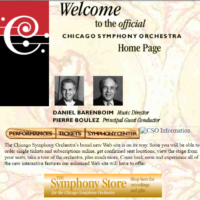
What's long overdue are two things -- first, major classical music institutions seriously acknowledging alt-classical composers, and, second, a little celebration, here in my blog, for the Chicago Symphony doing just that. A month ago! I should have posted this much sooner.

So what happened? The Chicago Symphony appointed Mason Bates and Anna Clyne as its two composers in residence next season. Here's their press release. In it, they say:

Both Mason Bates and Anna Clyne are artists who write from the heart, who defy categorization and who reach across all barriers and boundaries" commented CSO Music Director Designate Riccardo Muti. "Their compositions are meant to be played by great musicians and listened to by enthusiastic audiences no matter what their background."
That's exactly right. These aren't typical classical composers. Mason, for instance (when he was at Juilliard, he took my course on the future of classical music), doubles as an electronica DJ, under the name Masonic. So he's one of the new generation of composers who mingle classical music and  pop. You can listen to his music on his website, but maybe the best place to start is with his performance with the YouTube Symphony, which maybe was the best moment in their big Carnegie Hall concert. They played his piece Warehouse Medicine from B-Sides, with him as DJ soloist. (Playing a keyboard, and, I'd guess, doing some live programming of electronic sounds.) Feel the beat, hear the cheers. That's something you normally can't say when new classical music is played.

Anna Clynes, too,  isn't a standard-issue classical composer. There's less beat in her music, less obvious crossover into pop culture, but her music has immediate break-out-of-the-classical-concert hall appeal, as you can hear if you follow the link I just gave, and listen to a few moments of anything she offers. Or for a longer immersion, go to Carnegie Hall's page about the piece they commissioned from her, where you can hear it at full length. For anyone who doesn't normally like new classical music, bear with it a while, something I don't think I need to say about the pieces on her own website (which is where the "her music" link above takes you).

So let me get contentious here. For years, the BIg Five orchestras -- New York, Chicago, Cleveland, Philly, Boston -- featured modernist new music. Boulez, Matthias Pintscher, Birtwistle (a Cleveland favorite), Magnus Lindberg currently in New York, Carter and Babbitt currently in Boston. Along with a welcome dose of John Adams, but the emphasis was modernist. Or, in other words, on music that hardly anyone likes (whatever its virtues might be), music the normal audience can't respond to, and which also has no base (for instance among artists in other fields, or younger people) outside the classical audience. It's music like this, I think, which leads orchestras to conclude that new music doesn't -- no matter what many people might expect -- attract a young audience.

But of course there's another kind of new music that a young audience really does like, and that's what Mason Bates writes, and I'd think also what Anna Clyne writes. I've called that style alt-classical in endless posts here, pointed out that it has an audience (in New York, quite a large one), and challenged mainstream classical music institutions to wake up and start programming it. There are many, many, many composers who write in this style -- and now (in a clear break from the past) they're embraced by the Chicago Symphony. And evidently by Riccardo Muti himself, a music director I wouldn't have guessed would go in this direction.

This is a good thing. A great sign for the future. Or better still, another piece of the future, here with us now. Let's see where they go with it!

(Footnote: Many thanks to Carnegie Hall, for putting the music they've commissioned on the web. Complete with links to hear it!)
November 16, 2009 1:39 PM | | Comments (20)
November 11, 2009

Janis, who comments often on my posts (and who wants to be known here just by her first name), e-mailed me with a fabulous idea. In a moment, I'm going to turn this post over to her, and simply show you what she e-mailed. (Abridged a little, but I didn't leave out anything crucial. And of course i'm doing this with her permission.)

But before I give her center stage, I want to say that I went to the Star Wars Uncut website she mentions, and believe me -- it's everything she says it is, and more. Such an outpouring of fun and creativity, from so many people, something which we haven't yet learned how to bring into classical music. But we could!

Here's Janis:

Take a well-known shortish piece of music (not an obscure one, one that a lot of people know, like a nice standalone piece of Beethoven's 9th or the end of the William Tell overture), and break it up into bits, perhaps twelve measures apiece.

Open them up to being "claimed" by people online, probably students. Each student claims a chunk of the music ... and interprets it however they want.  Some will play it straight on an oboe or violin.  Others may whistle it.  Others will use synths, others can hum it, still others can bang on kitchen pots.  They upload their "chunks."

Then ... stitch the pieces together and play it.

My roommate, bless her, proceeded to inform me that this was exactly what's happening at the moment with that old war-horse "Star Wars."  There is a project called "Star Wars Uncut" that illustrates this PERFECTLY, as an example of how a culture composed of people who have never met and have only a love of shared source material in common can come together and collaborate in an artistic creation via fannish riffing.

The URL is http://www.starwarsuncut.com/ -- it's amazing.  It's entirely fan-driven, completely outside the realm of "legitimate" work, and created on the fly by people who don't know one another, and who have totally different ideas of how to interpret the source material.

They have some scenes uploaded already -- click on "Watch a Finished Scene."  However, I must advise you to watch at least five of them.  This will give you a massive shock in terms of the abysses between how each person or group of people chose to interpret their "chunk."  There are some conventional interps where people and their friends wore homemade costumes, but there are others that took the opportunity to take it to incredible places.  Scene 23 alone will blow your mind.  Scene 407 uses lego figures!  Scene 221 will have you bellylaughing or gaping in bemusement, hard to tell.

Imagine doing this with a piece of music!  Then stitching it together!  Do it with the sponsorship of a major orchestra, which provides the servers or the money, or better yet the marketing.  The orchestra can inaugurate the project at the start of its season by playing the chosen piece (or the start of the school year for a conservatory), and leave it up for the entire season or semester.

Then, at the end of the semester ... the orchestra plays the chosen piece again.  Then it plays the resulting MP3.  And puts it up for download on its website.  FOR FREE.  (All participants are made to understand that their work will be made available under a creative commons license.)

If you really want to be daring, allow digital artists or cinema students/animators to add video to their chosen twelve-bar bit of Beethoven's 9th or the WT overture.  Show the video when you play the assembled music.

And the "SW Uncut" project demonstrates that you need no control over who does this.  The scenes that are being uploaded to that site are being freely chosen by people ALL OVER THE WORLD, and no one blessed off on it.  Globally distributed, and uploaded freely.  Without any controls at all.  The whole thing was spread quite literally by word of mouth.

Now, getting the word out for something like this in the classical music world would be a challenge; SW already comes with a massive, world-wide fan base of people who are quite used to grabbing their beloved source material and messing with it with absolute entitlement.  Beethoven and Rossini don't come with that (yet).  That's why doing it with a group of students in a collaboration with other professors might be the way to go for a proof of concept; you can make people participate by assigning twelve-measure chunks to them. 

And again, the idea is NOT to have one person play their tiny bit perfectly on their perfectly tuned violin followed by someone else playing the next bit perfectly on their perfectly tuned violin.  The idea is to have people go hog-wild.  Twelve measures hummed, then twelve measures played conventionally, then twelve measures played on a synth, then twelve measures on a kazoo, then twelve measures on a uke, then twelve measures on ... Literally however people want to play it.  You probably don't want to use a huge chunk of the music or else it might get tedious.

"Beethoven Uncut."  "William Tell Uncut."  Claim your chunk, and upload your mp3! 
I think we might not need to start with students, to create a proof of concept, and that in fact we'd get the most varied results by bringing in the world at large. Which, I think, would be ready to jump in the moment they heard of it.

Forget that, though. What a wonderful idea. Thanks, Janis!


November 11, 2009 11:40 PM | | Comments (10)
November 9, 2009

I've been forgetting to mention my course at Juilliard this fall, about music criticism.

The link takes you to the week by week assignments, which include classical music criticism by George Bernard Shaw and Virgil Thomson, as well as some rock and jazz criticism, and some unusual writing about music, by Nick Hornby, Tom Johnson, Jack Kerouac, and E.M Forster. (That last link takes you to my blog post about how wonderfully Forster wrote about music.)

Each week, one of the students brings a New York Times music review to class each week, and takes the lead in dissecting it. Interesting experience for me, to say the least, during the seven years when my wife wrote for the Times, and the chosen review might have been one of hers. A good test of my objectivity. But then they read me, too, and I encourage them to be critical.

The reason for reading me, by the way, is simple, and has nothing to do with whether I'm any model for what critics should (or shouldn't) do. It's that if I'm going to hold forth about criticism, they have a right to see what kind of critic I myself have been. Maybe they'll decide I have no standing to be sounding off, which would be completely their right to think.

But the main purpose of the course, as it's evolved over the years, isn't to teach about criticism, interesting though that can be. (Especially since the students themselves will be reviewed, as their careers progress, and often have been reviewed already.)  You can read the course overview, where I say the real point of the course is to learn how to talk about music.

This is no trivial thing. Music professionals have to talk about music all the time. Think of the staff and board of an orchestra, trying to decide who should be the next music director, and comparing how the candidates conduct. Or -- as one of the students pointed out this fall -- musicians playing chamber music, and needing to critique each other, and also say how each thinks the music should go.

Of course any musician already has some skill at doing this. But it's impressive to see how reticent people can be, even professionals, and how they often feel they don't have the words to describe something about a piece or a performance, especially if it involves emotional subtleties, or is in an idiom they're not familiar with.

The job then is simply to describe what you hear, preferably in very simple language. And this is the first lesson I teach in the course. I bring in music each week, play it, and ask the students to describe it. Not in any fancy, published-writing kind of way, but informally, the way they might describe it to a friend. "You've just heard this piece at a concert, and your roommate asks you what it was like. What do you tell them?"

The first lesson is to say the most obvious, most basic things. It's surprising how often the students at first don't do this. I've typically started the course with the slow movement of John Cage's String Quartet in Four Parts (from 1950), in which the same few sounds keep recurring, with spaces in between. Students will sometimes tie themselves in knots trying to say what they think the structure of the piece is, when the first thing they might say -- at least if the goal is to give someone else an idea of how the piece sounds -- is that the music is slow and repetitious.

From there you can go on to complexities, if you've really heard them. (Or in the case of the Cage, to guesses about its subtleties, because the deep rhythmic structure of the piece is something not many people are likely to catch purely by ear.)

This year, to give myself some variety, I played them the beginning of Sufjan Stevens's BQE (the multimedia piece, featuring 30 minutes of orchestra music, which he was commissioned to create for the Brooklyn Academy of Music, and which turned out to be, along with Jonny Greenwood's Popcorn Superhet Receiver, one of the most successful -- no, triumphant -- classical pieces ever written by someone from the rock world.

Again that offered a simple enough descriptive problem. But here the emotional reactions to the music -- and, more generally, the descriptions of how it flowed -- were easier to get at, and so we had the more interesting (and more advanced) problem of both objectively describing what you hear, and noting also your subjective impressions. And then tying the two together, so that someone you talk to knows why you judged the piece the way you did. They may or may not agree with you, but at least they know what you reacted to, what it was about the music that you liked, or didn't like, or felt ambivalent about.

Other music I've brought in: one of the tracks from the live Thelonious Monk/John Coltrane album, recorded live in 1957. And Ibrahim Ferrer, singing "Silencio," a wistful (or at least that's my word for it) from his first solo album, the assignment then being to describe exactly what emotion, or shade of emotion, you hear in the music. The Venice Baroque Orchestra playing part of The Four Seasons, a very individual performance, full of unexpected tempo shifts.

The start of the first Glenn Gould recording of the Goldberg Variations, which poses a very difficult problem in description. Almost everyone agrees that the performance is beyond wonderful, but how do you describe how wonderful it is, without falling into clichés? And how do you describe what you think makes it so wonderful? And, most wonderfully, there was one student who didn't like it, and then had the fascinating job of saying why.

Also Franco Corelli singing "E lucevan le stelle," from Tosca, in honor of the new production at the Met, a performance which divided the class in half, between students who thought Corelli took far too many liberties, and those who found his emotion compelling. Which was exactly how opinion divided about him in the '60s and '70s, when he was one of the world's top opera stars.

And most recently the opening of Wagner's Ring cycle, the beginning of Das Rheingold, which reprises the problem the Sufjan Stevens piece presented, of music that both stays in one place, and also changes. And which you're likely to react to in some very personal way. By now, the students had, I thought, learned a lot about how to phrase a more or less precise description of what they hear, and to tie their emotional reactions -- and, in this case, the stories or pictures that came to their minds -- to what they heard.

My reaction to the Rheingold excerpt, which I hadn't heard for a while: Well, yes, it's pathbreaking, a long stretch of music on a single chord, which besides being striking in itself also suggests the vast time-scale of the operas that follow. But I also suddenly heard it as a piece of romantic exuberance, something that builds to a pulsing rhythmic climax in much the way that music of its time with many chords does. Something that works in very familiar, old ways, in other words, at the same time as it's doing something radically new.
November 9, 2009 11:11 PM | | Comments (6)
November 6, 2009

Last night I went to the gala season-opening show at the New York City Opera. That was a night with special meaning, obviously, because the company was coming back from the dead, with a new directo, a refurbished theater, and a new point of view. Let's wish them luck.

But in past weeks I also went (without addressing them here) to the season openers at the Met and the New York Philharmonic, which of course are the other two big classical music performing institutions in New York. And, looking back, as I sat in the audience last night, it struck me that all three events had something in common -- a lack of star power.

The Met, maybe, came closest, partly because it's the Met, and has inherent starry institutional heft. And because celebrities were there. And also because a big-time opera production is, even if it fails, something with heft of its own.

But there wasn't much star power on stage. I guess -- especially given the Met's current artistic strategy, which is to bring itself into the contemporary theatrical world -- the new Tosca production mgiht have been the star. But it wasn't. I'm not going to get into the silly fight over how non-traditional it was. Better just to look at it as we'd look at a new movie, or a new production of a classic play. It was (by any reasonable measure) drab, and not really convincing.

And then there was Karita Mattila, in the title role. She's a serious artist, with a major voice, and real dramatic force. The only thing she doesn't have is star power, that unmistakable magic, which, if she had it, would make space seem to curve in her direction. Which in Tosca is more than a casual problem, because the music (as in almost any leading soprano role in Italian opera) more or less demands that kind of force, simply to deliver its musical punch. And also because the character herself is a diva, a star (as we're told in the piece, and as she shows by how she behaves) does make space curve.

The Philharmonic? Well, there the idea might have been to show that the orchestra was serious, musically. So we had, on the first half of the program, a world premiere (by Magnus Lindberg), and a major and not often performed modern piece (Messiaen's song cycle Poèmes pour Mi). Clearly not the programming of some bimbo orchestra, that mostly wants to play blockbusters for adoring fans.

But the Lindberg piece...well, I've said that I didn't like it ("drab" might again be the word), but of course other people did. What no one can deny, though, is that it didn't create much excitement. It came and went. The Messiaen offered a top classical name, Renée Fleming, but she was miscast in music that needs a bigger voice and especially a stronger lower range, and so she made an impression for serious artistry (and serious work, which I completely respect, to overcome the vocal problems the piece threw at her).

But no star power came through, especially -- and this was the biggest problem -- since the work itself asks to be sung and played with utter transparent sincerity, and no amount of seriousness, even at a very high level, can substitute for that. On supertitles over the stage were translations of the text, all glowing with simple and radiant Catholic faith. The performance had none of that, nor even a point of view on what Messiaen believed with every fiber of his soul. So -- judged by the standard Messiaen himself was visibly giving us -- the performance fell flat.

After intermission, we had the standard rep blockbuster, the Symphonie Fantastique, and here we come up against the Alan Gilbert problem, the question of what, exactly, he's bringing to his new job as music director of the orchestra. There are various views on that (the ones I hear privately in the business being none too favorable), but even if you liked his Berlioz on opening night, you couldn't pretend that it jumped off the stage.

So again, no star power. Especially compared to Dudamel's inauguration in Los Angeles, which I wasn't at, but which by all reports had enough star power to light up the sky all the way to Mars. Dudamel got a ten-minute ovation, one review said. While Gilbert got respectful applause, no more (or very little more) than a good guest conductor would have gotten in the middle of the season. (With, unless I missed something, not so much as a tap of the bow from anyone in the orchestra.)

City Opera. Again, the plan, I think, was seriousness. The gala program was a celebration of American music, from Bernstein to Rufus Wainwright. The opening looked terrific on paper. First Stravinsky's Fanfare for a New Theater, written for the opening of Lincoln Center lo these many years ago, and of course appropriate here, because the theater we were in had been renewed.

And then a premiere, a new fanfare by Peter Lieberson. And then one of Bernstein's irresistible orchestral pieces from On the Town. All played without pause. Except that none of it was played very well, especially the Stravinsky (he's legitimately an adopted American composer), blatted out by a small brass ensemble with every note seemingly getting equal emphasis. Which is about the last thing you want to do in an atonal piece, where listeners who don't know the piece or the idiom can't supply the musical ebb and flow on their own.

The program ended with another choice that looked good on paper, a song called "Take Care of This House" (get it?), from 1600 Pennsylvania Avenue, one of the many later Leonard Bernstein pieces that has never caught on. And so here there were two problems. First, it maybe wasn't strong enough to end the program, though Joyce DiDonato sang it gorgeously (and I do mean gorgeously). But even if you liked it (and opinions can legitimately differ), nothing led up to it, and in fact the whole gala seemed to flow more or less at random.

And, on top of that, with the pieces not in the order that was shown in the program book, something that was never explained or even mentioned, either from the stage or in any kind of program insert. (There was in fact an insert, but all it said was that Anthony Dean Griffey wouldn't be singing. It didn't even state that the piece he was scheduled to do -- "Singin' in the Rain" -- would be dropped.)

The gala, in the end, didn't feel very gala-like. I didn't sense excitement, or even a sense of celebration. The musical numbers came and went. In the old days, you'd have opera galas with genuine stars, so not much planning might be needed. Someone new would came out on stage, and often enough, space curved. I remember one Met gala in the '80s when Leonie Rysanek crashed in flames in "Suicidio!" (from La Gioconda), but -- she was Leonie Rysanek, so even her train wrecks were compelling. City Opera had some good singers, and Lauren Flanigan really did  curve space a bit, but she was singing an aria from Samuel Barber's Vanessa, music that's certainly classy, but doesn't curve space on its own.

So really -- some stage direction was badly needed, to give the gala from spark. And I haven't even talked about the music, which often didn't rise to the occasion. We can talk piously about an American opera canon, and we can even believe we mean it, but put a scene from Carlisle Floyd's Susannah on a program with "Billly's Soliloquy" from Carousel, and -- if you're honest with yourself -- I think you discover (as I did when I saw the South Pacific revival at Lincoln Center) that Richard Rodgers is the real deal, the unforgettable composer, whose music grabs you, makes you smile, makes you get teary, and most of all sticks with you. As Leonard Bernstein said years ago, our American operatic heritage is really our musicals. (Well, that's not quite how he put it, but he pointed that way.) 

One piece that really did grab me was an excerpt from Rufus Wainwright's opera, Prima Donna, which the Met apparently declined to produce (after commissioning it), and which apparently didn't have all that much success when it was premiered abroad. I can't speak to any of that, but the excerpt struck me as lovely and quite original.

One more problem was the singer in the Carousel piece, who was perfectly charming, coming off like a sweet guy you'd love to have as a next-door neighbor, which if you know the show tells you that he didn't even begin to fill his character's shoes. And he couldn't get the high notes the soliloquy ends with, so apart from the big burst of love that Richard Rodgers drew from me, the excerpt fell flat.

Bottom line -- not much star power. I don't think this is good. Star power isn't all that classical music needs, or should have, but without it, our art is falling behind in yet another way. The Rock & Roll Hall of Fame anniversary celebration had star power, and so did the world series (to name two big events that happened in New York this fall). If classical music -- especially since, like it or not, people look toward it for glamour and romanice -- doesn't make space curve, if it merely, even at gala moments, puts on nice serious, professional shows, then something's wrong. It wasn't like this in the past.
November 6, 2009 11:31 AM | | Comments (9)
November 5, 2009

From my wife Anne Midgette's probing review of classical music in the White House, in today's Washington Post:

...what becomes clearer, in this presentation, is that classical music no longer automatically holds a position of predominance among today's power elite. The day's message was, "Look, classical music can be fun," even though this message is also a tacit admission of the widespread assumption that it isn't.

President Obama reflected that, indeed, in his opening remarks, joking that newcomers to classical music shouldn't worry if they weren't sure where to applaud: President Kennedy had the same difficulty, said Obama, who noted that he himself fortunately had Michelle to cue him properly. It was not exactly a hopeful sign of classical music's artistic significance, though to judge from the hearty laughs, it resonated with many in the audience. 

Anne has a lot more to say, all of it true and valuable, about how classical music strains to make itself seem easy and natural, even though everyone involved doesn't quite believe that's true. And how classical music falls back on a vague sense that it's passionate, in order to explain what it means and where it fits

See my last blog post. Zombieland did it so much better! Classical music really did seem natural when it showed up in that film. Also look at the sweet Amex commercial with the smiley and frowny faces, where a Bach cello suite sounds like the most natural thing in the world:


November 5, 2009 11:49 AM | | Comments (11)
November 4, 2009

In Zombieland (a delectable movie), there's a scene where the four dysfunctional people we're learning to love smash up a store full of tacky western-style souvenirs. And have loads of fun doing it. They're allowed to, because as far as we and they know, they're the only human beings left in the US. It's them against millions of zombies.

And what do we hear on the soundtrack while they're smashing the souvenirs? The Marriage of Figaro overture, sounding like wild, crazy fun, just as it ought to in the opera. (It would work even better in the film if they'd chosen a better performance.)

This is another example of the new use of classical music on soundtracks and in commercials. It's chosen, apparently, simply for its sound, without any overlay of classical music romance or pomp.

Compare this to the last movement of the Brahms Violin Concerto during an especially violent murder scene in There Will Be Blood. Again, the music suggests wild and crazy fun, though this time with a biting ironic edge, and without any overlap with anything Brahms most likely had in mind. (It's a much more violent scene than anything in Zombieland, even though -- or maybe because -- the only monster around is human.)
November 4, 2009 5:06 PM | | Comments (5)
Three quick notes about things I learned in Tunis. 

First: Composers in Guatemala incorporated Afro-Caribbean music into their compositions -- in the 18th century! I learned this from Dieter Lehnhoff, an Austrian violinist and conductor who's been living in Guatemala for many years, and has studied, published, and recorded Guatemalan compositions from past centuries. There are recordings of some of these pieces with the Afro-Caribbean influence, but they're not (I gather) available outside Guatemala. Dieter says the composers used pizzicato strings to mimic the sound of the local marimbas, which played a large role in the local music. 

Of course, most of us think this kind of fusion has happened only in our own time. But apparently not!

Second. I learned about one kind of Australian aboriginal music, in which there are separate rhythmic and melodic cycles that fit together very freely. (I don't claim to be an expert on world music, and I'm only repeating here what I was told. If I've gotten it wrong, I'm sure it's my own fault.)

What this means: there would, in this style of music, be cycles of note-lengths. Maybe a note four pulses long, then a note one pulse long, then two pulses, then three pulses. I'm making this up, just to give an example of how it might work. 

And then meanwhile there would be independent melodic cycles, little repeated melodies. Or rather repeated collections of pitches, because the pitches don't become a melody until they're joined with a rhythm.

How does that happen? Like this, I gather: Someone starts singing. And then everyone else says, without having to think about it very hard, "Oh, OK,  he started the rhythmic cycle on the fourth note, and the melodic cycle on the third note. And then everyone joins in, continuing what the first singer did, easily fitting the melodic and rhythmic cycles together. Something I can't believe a western-trained musician would be able to do at all. (There's a similarity here, in the western tradition to procedures in serial music, and also in medieval music.)

Third: I learned to hear microtones in Tunisian music. For some people, that wouldn't have been an achievement. I know people in the new music world (the contemporary branch of classical music) who live and breathe microtones. But I never got them. 

Here's how I learned. A Tunisian speaker mentioned, in an offhand way, that in former times Tunisian music had over 100 modes. That seemed impossible to many of us. How many arrangements can there be of the standard tones of the scale? Which is how we understand modes, in the western tradition. They're scales, different from our familiar major and minor scales, but still drawn from the same notes. 

The answer turned out to be simple. Tunisian modes use microtones. The Tunisians had set up a display table, with books and CDs for sale. I browsed through a thick book on Tunisian music, and found descriptions of traditional Tunisian modes. They used microtones. There seemed to be four inflections for each note -- the natural version (a white key on our pianos), and a version of the note that's half a tone lower (this would be one of our black keys). And then notes that fall into the cracks between our piano keys, notes either a quarter tone or three quarters of a tone lower than the note on the white key.

These microtones change the game. I had my netbook with me, and Sibelius, the notation software I use, installed on it. Sibelius can play these Tunisian microtones. So I got it to play one the Tunisian modes, a scale that goes like this: D, E quarter flat, F sharp, G, A, B quarter flat, C, D. 

Up to that point, I would have thought that these quarter tones were inflections of western pitches. That, in other words, the scale might just as well be written D, E flat, F sharp, G, A, B flat, C, D, with the understanding that E flat and B flat would be sung and played just a little higher than we'd sing and play them. 

But that's not right at all, as I found out when I listened to Sibelius play the mode first as I've just given it in western pitches, and then in its proper Tunisian form. The Tunisian notes aren't just inflections of the western ones. They're an entirely different pitch system. The interval between E quarter flat and F sharp, especially, is something rich and individual, not at all familiar to western ears. I've put what Sibelius played online, so you can hear it yourself. First the Tunisian mode in standard western pitches, and then with the proper Tunisian ones. 

This opened my ears, and I began hearing the microtones that Tunisian musicians were singing and playing. Maybe not as many as they would have used generations ago (one study of music in the Congo showed that recent Congo recordings have more western pitches than recordings made decades ago). But the microtones are certainly there. 

There also are long rhythmic cycles. I began to be aware of them, simply by listening. The singers and musicians would embark on one of their characteristic long and subtle unison melodies, which would curve upward, wonderfully ornamented, and then eventually sink back toward the keynote of the mode. I tried counting how many beats this took, and kept getting lost, though it was clear that more than 100 beats would pass till the keynote returned. Later I learned that Tunisian music routinely incorporates rhythmic cycles of more than 100 notes, cycles whose length is predetermined or otherwise agreed on (if I understand this correctly). 

Again that's a concept we don't have in the west. And most of us, I suspect -- even if we can easily improvise over, let's say, a blues progression, or something more complex from a standard pop song -- would get lost following rhythmic cycles of more than 100 beats.

Again, please note: I'm not, not, not offering myself here as any kind of authority on world music. I'm recounting all this as a narrative of my very elementary but for me very striking world music education. If it helps others understand how different from ours other musics can be, then I'll have done some good. 
November 4, 2009 4:08 PM | | Comments (4)
November 2, 2009

We hear a lot about classical music in Finland -- about how many orchestras they have, how they train and nourish musicians, how many fine composers they have. Etc.

But apparently they have no more luck getting younger people to go to classical concerts than we do. Timo Cantell, an arts management professor at the Sibelius Academy in Helsinki, gave a paper in Tunis about this. He interviewed people in their 20s and 30s who don't go to classical concerts. He asked them, among many other things, about advertisements for classical concerts:

"A typical advertisement [for a classical concert] might have a black-and-white picture of a soloist or conductor or ancient composer and the text might read: Bach - Beethoven - Sibelius. This format does not communicate to the non-attendees at all."

One of the non-attendees got off a terrific one-liner. He called these ads "obituaries."

***
The Australian Music Council has links on its website to stats about classical concert attendance in various countries, Australia of course included.

This is good news and bad news. It's good news that any numbers at all are available, and that the Australian Music Council took the trouble to collect them, and  make them available. I've asked people in various countries if they know of any stats like these, and the answer has always been no.

But the bad news is that I don't know what these stats are worth. It's fascinating -- or ought to be -- to learn that classical music attendance is down in Ireland and up in Spain (and that it's down in 8 of the 13 countries listed). But what do the numbers actually mean? Are they comparable from country to country?

As the website drily observes:

"[T]he data available from the various countries differs considerably. In some cases we are given audience numbers - although it is not always clear whether this is the total number of individual people attending, the total number of attendances (paid and free), or the number of tickets sold. In some cases we are given a percentage, presumably the percentage of population attending. But we do not necessarily know whether this is total population or adult population and in some instances, the percentage is so high that there is some question as to whether these are percentages of total population or, for instance, percentage of population that attends the performing arts. Finally, of course, in some cases we might be reading the results of sampling surveys and in others, the results of e.g. census questions to the entire population."

In Australia, the performing arts audience has been getting older, with the classical music audience taking the lead. "In 1991, the highest attendance rates [this is for all the performing arts] were among the 35-44 and 45-54 year age groups, both at 10.2%. By 1995, the peak had shifted to the 45-54 year group, by 1999 to the 45-54 and 55-64 year groups, with a further aging peaking on the 55-64 year age group in 2006." Which is more or less exactly what NEA statistics show for classical music in the US, during more or less the same period.

One surprise is the reported increase in classical concert attendance between 1991 and 2006, while attendance at other performing arts events -- even rock concerts! -- was going down. But an Australian told me privately that this increase apparently was due to crossover events produced by orchestras, so (if this is true) the numbers are deceptive. They don't show an increase in classical attendance. They show an increase in nonclassical events produced by classical music organizations, with the sales figures for the nonclassical concerts folded into an overall total.

Which once more shows that we have to look at numbers like these very carefully.
November 2, 2009 10:19 PM | | Comments (7)
Two more posts on Tunisia, before I get back to business as usual, including my book. (My other posts on the Third World Forum on Music, held in Tunis, and which I spoke at, are here and here.)

I'd mentioned international issues in music, and discussed -- a familiar subject here -- music advocacy, which the organized international music community likes to talk about. Another one, more important, I think, is cultural diversity. Countries around the world want to preserve their local musical cultures, whether that's their ancient musical tradition, or else their contemporary styles.

And one way to preserve these things, as I understand it (this is mostly new to me, and I may be getting some of it wrong), might be to reserve, by law, some percentage of air time on local radio for music produced locally. I know that Canada has a law like this, and at one time reserved, I believe, 30% of its music broadcasts for Canadian music.

So who's the big opponent of this, worldwide? I was surprised -- though, I admit, not astonished -- to learn this. It's my own country, the United States. In the name of free trade, the US has opposed these local laws, and its weapon against them has been trade agreements. NAFTA, for instance.

When NAFTA was passed, bringing the US, Canada, and Mexico into a free trade zone, there was lots of controversy, and even demonstrations against the agreement in the US. But I never heard anyone object to its music provisions. In order to get freer access to US markets, Canada, at least, had to ease up on its "Canadian content" laws, the laws that guaranteed a certain percentage of air time for Canadian music. Or so I was told in Tunis. I was also told that Australia, negotiating its own free trade agreement with the US, had to make a similar concession.

The US, in other words, is using free trade agreements to protect big global record companies. One irony is that only some of these are American. Sony, for instance, is Japanese (though its CEO is British), and Universal is currently owned by a French conglomerate. (Though stay tuned: Universal has changed hands before, and may do so again.) Still, the US protects them. There was talk, on a panel about cultural diversity, of a UN vote that did no more than encourage UN member countries to protect their local music. Only two nations voted against it -- the US and Israel.

These are complex issues. By protecting local music, countries might also isolate themselves from the rest of the world, including authentic musical developments that their own citizens might want to embrace. Which includes the blend of local traditions with international music, which on one hand can be schlocky, but on the other can lead to really exciting new styles, including Algerian Rai music (a meld of Algerian music and dance beats) and the many varieties of African pop. Not to mention the way Chinese traditional instruments have been used by Chinese classical composers, or the many stars on all kinds of traditionall instruments who've done creative collaborations with people in pop and jazz.

But I can't say I like the position my own country takes on all of this. It doesn't exactly make me proud to be American.
November 2, 2009 11:23 AM | | Comments (8)
October 27, 2009

More about Tunis, following my earlier post on what I presented at the conference there.

This is about the group that presented the conference, the International Music Council. And about international issues in music.

The IMC was founded long ago, in 1949, by UNESCO. It considers international music issues, and advocates positions on them.

So what are the issues?

I won't claim to be an expert, but I noticed two. One is music advocacy, which we're certainly familiar with here in the US. And, in particular, advocacy for music education.

Here we run into the same problems, I think, that I've talked about in arts advocacy, which can include a sense of entitlement, and grandly specious claims made for the power of art. Especially its moral power.

So in Tunis we had (on a panel on music education), a hopeful presentation on the power of music, which the presenter (from an Asian country) felt could be a tremendous force for good. At one point he stopped to note that music education had to encourage not just love and knowledge of music, but also critical thinking, so that students could resist any use of music as propaganda.

Which, if you ask me, undercut his claims for music's moral force. If music can also be used immorally, then why should we be so certain of its moral power? The speaker then went on to celebrate an event in which massed schoolchildren sang a song in the presence of his country's leader -- but probably without much critical thinking about the politics involved.

Two speakers presented terrific correctives to this. One was David Price, a consultant from Britain, who talked about music education programs he'd taken part in, which essentially were guided by the students. That is, you find out what music the students like, what use they're making of music, and you try to build programs around that. Rather than, for instance, teaching them about the music you think they should care about. (Classical music advocates, are you listening?) These programs, Price said, were a great success, and I can well believe it.

The other corrective came from Wayne Bowman, professor of music education at the school of music at Brandon University in Manitoba. "All too often," he said, "advocacy claims sound like last gasp efforts to defend instructional practices that have simply failed to keep pace with social and musical change."

He challenged all kinds of conventional wisdom -- music, he says, can't honestly be said to make you smarter, to enhance critical thinking, to develop confidence, or to enhance communication. (In fact, anyone who sees how music works in the real world will notice that it often blocks communication, when people like widely diverse musical genres, and see someone else's preference as a sign that the person isn't worth talking to.)

I loved his paper, and Wayne very kindly agreed to let me put it online, which I've done. You can read it here. I highly recommend it.

Wayne, by the way, makes a pointed distinction between music training and music education. What's the difference? A musician who can play the classical piano repertoire note perfectly, backwards and forwards, but who hasn't heard even a single Charlie Parker recording is trained, but not educated. (My example, not his, though I think I can say he agrees with it.)

More tomorrow, about international music politics -- more proof, by the way, that music doesn't necessarily bring people together.
October 27, 2009 10:59 AM | | Comments (17)
October 26, 2009

Well, I'm back. I attended the Third World Forum on Music (as in the third they've held, not a forum about third world music), sponsored by the International Music Council.

More later about what that all is, about the international music scene I learned about (with some major issues being debated, one of them involving the US in not a very pretty role). And about Tunisia, a westernized culture whose Arab roots are never all that far below the surface. And about all kinds of crosscultural moments, including a distinguished older singer from Afghanistan whose music i heard on (of all places) her MySpace page. And my friendship with an Australian who works with aboriginal music, which comes from a culture (musically and otherwise) very, very far from our own.

And the phenomenal way younger Tunisians sing and play their own traditional styles, complete with microtones and long rhythmic cycles (more than 100 beats), that western musicians probably couldn't keep up with.

But later for that. Because it's most germane to this blog, I thought I'd start with my own presentation, though that wasn't the most important moment for me while I was there. I should say, first, that (as I only found out after I'd been there a few days) I'd been invited because of this blog. An official of the IMC reads it, and thought I'd be a good choice to talk about (what else) the future of classical music.

So I spoke on a panel about art music and its future, called "Challenges to Art Music: In a world overrun by celebrity and superficiality, is there an audience for the disciplines and profound truths of art music?"

Faithful readers can imagine how little I liked that premise. But in an international context, it turned out to have a special meaning: "In a world overrun by bad American music, and by greedy pop record companies whose interests are promoted by US policy..." I'll have more to say about that in a later post.

And the art music the panel discussed wasn't only western. One speaker talked about Indian classical music, another about Tunisian traditional styles. And another about a specific niche for western classical music, in Ugandan Catholic churches. The speaker, a Ugandan, didn't endear herself to other Africans at the meeting when she said she thought western musical instruments are harder to play than African ones.

You can hear a recording of what I said here. I found myself reacting to earlier panels I'd attended, about "riding the digital tiger" and about music education, where one speaker talked about a "paradigm shift" necessary, he thought, for people who run conservatories, and who teach at them. I began by telling stories, about innovations in music, many of them involving online technology. In part I wanted to get away from the abstractions most other speakers provided, but I also wanted, as vividly as possible, to emphasize two things:

  • That the digital eruption is only a tiger to those who stand outside it. Inside, it can be a happy riot of hopeful possibilities.
  • And that "paradigm shift" doesn't go far enough. There's been nothing short of a revolution in our culture.
I noted that the innovations I talked about (I'll list them another time) all happened outside the mainstream classical world. And then I moved on to the ways in which classical music is losing ground in our culture these days, a familar topic in this blog. (I talked, for instance, about the dire data that the NEA recently released.)

I did add something, for the international audience, something I haven't stressed here, but which I'll certainly say in my book: That the decline of classical music is -- in the last analysis -- caused by the end of western cultural (and political) hegemony. How, for instance, can we insist that white European culture is preeminent, musically, in a world that's largely non-white and non-European? Or in my own country, the US, which is headed toward a non-white majority?

The rise of rock and jazz is, in many ways, a non-western challenge to European music and its former rule. That's because rock and jazz rhythms ultimately come from African music, and imply a culture that's not European at all. (On this, see Christopher Small's Music of the Common Tongue, and Michael Ventura's essay "Hear the Long Snake Moan," in his book Shadow Dancing in the USA.)

I ended by telling more stories, about the ways that classical music might change. My favorite is something I thought of at the conference, after a conversation with someone in Europe who runs an organization that deals with classical music competitions. She said she was trying to find new things for competitions to do. And it suddenly occured to me -- classical music competitions could reshape themselves as reality shows.

I'm serious. I'm thinking of reality shows like Project Runway, where contestants -- in Project Runway's case, fashion designers -- are given challenges each week. Make a garment entirely from newspaper, design an outfit for recent graduates to wear to their first job interview (in collaboration with the graduates themselves, and their mothers), design something extravagant for Cristina Aguilera to wear to an event, with Aguilera herself as one of the judges.

So why not give challenges to musicians in competitions? Competitions, as I think we all know, can be dull. The winners are often consensus choices; musicians with real flair get left out, because some judge might dislike them. And -- something I haven't heard said, but which is obvious, when you think of it -- there's no guarantee that a competition winner will make any impact on the outside world.

So -- challenges! Serious ones, that would show what kind of musician each competitor really is. For instance:

  • One week give the contestants a short piece to play. The judges then pick the one whose playing they like the most. And then, the next week (I'm imagining this as an actual reality show on TV, with weekly episodes), bring the contestants back to play the same piece, but with instructions to play it in an entirely different way. They'd have no advance warning of this, or any other challenge. We'd see in an instant how adaptable and imaginative each one was.
  • Give the contestants a wildly difficult, outrageous, even wildly ugly short passage written for their instrument. They'd have 30 seconds to look at it, and then they'd have to play it. We'd see who came closest to getting it right -- and to making music with it. (The competition could provide reference recordings, made by people who'd taken time to learn the music.)
  • Give the contestants a new piece, without expressive markings of any sort -- no tempo indication, no dynamics, no phrase marks, not even any articulations. Now we'd see who could make the best music from what would look, in musical notation, like something pretty close to an undifferentiated mass of notes.This would show us who had true musical imagination, and would expose -- mercilessly, I think -- the kind of competition entrant who can only play what he or she has been taught. (This isn't my idea. I'll happily give credit to the man who invented it, Ben Verdery, guitar teacher at the Yale School of Music, who told me he gives this challenge to guitarists who audition to get into the school. It's a brilliant idea.)
Of course we could think of many more challenges. These are just the first that came to my mind. We could have musicians forced to make instruments to play on, musicians challenged to improvise, musicians given most of a new piece (written in a famliar style), and then challenged to make up the ending. Or musicians given something beautiful from the standard repertoire to play, and then challenged to play it again, even more beautifully. (This comes from one of Tom Johnson's pieces from the '80s, called, collectively, Music for Unrehearsed Performers, if I remember correctly. He wrote one of these pieces for Richard Stoltzman, and that was one of the things Stoltzman had to do.)

I really like this idea. It could be done on TV, but could also be done live. I suspect that the winners would be almost guaranteed to be interesting, if the challenges were potent enough.

Two footnotes. First, nearly everyone I met, when I told them I worked on the future of classical music, said classical music had to change, maybe drastically. This included people whose positions might make you think they'd be far more conservative.

Second, I recorded my talk on my iPhone. I'm amazed at the quality of recordings I can make with it. And it's always in my pocket, so there's no need for any presentation I give to go unrecorded.

October 26, 2009 12:39 PM | | Comments (7)

About

Me Though I've been known for many years as a critic, most of my work these days is composing or consulting, or teaching, or doing projects with classical music institutions, especially music schools. more

What's Happening Here Is classical music dying? No way -- I think it's going to be reborn, reconnect with the world around it, and become a truly contemporary art. But this is a big topic, and there's resistance to the changes that are taking place. more

Elsewhere Some other past and current projects ...(coming) more

My ongoing book Over the past two years, I performed a book-in-progress, about the future of classical music, improvising a new episode of it every two weeks. It's on hiatus now, as I thoroughly revise everything I've done. But you can read the old episodes here. They're certainly lively. more

Contact me Click here to send me an email... more

Archives

Archives: 771 entries and counting

Resources

Age of the audience 
Conventional wisdom: the classical music audience has always been the age it is now. Reality: It used to be younger -- dramatically younger, in fact. Here's some evidence -- primary sources (actual texts of old studies, links to NEA studies) -- plus two of my blog posts on this subject, and some anecdotal data.
more

earlier resources

Things I like

Find recent content on the main index or look in the archives to find all content.

AJ Ads

Introducing
AJ Arts Blog Ads

Now you can reach the most discerning arts blog readers on the internet. Target individual blogs or topics in the ArtsJournal ad network.

Advertise Here

AJ Blogs

AJBlogCentral | rss

culture
About Last Night
Terry Teachout on the arts in New York City
Artful Manager
Andrew Taylor on the business of arts & culture
blog riley
rock culture approximately
critical difference
Laura Collins-Hughes on arts, culture and coverage
Dewey21C
Richard Kessler on arts education
diacritical
Douglas McLennan's blog
Dog Days
Dalouge Smith advocates for the Arts
Flyover
Art from the American Outback
Life's a Pitch
For immediate release: the arts are marketable
Mind the Gap
No genre is the new genre
Performance Monkey
David Jays on theatre and dance
Plain English
Paul Levy measures the Angles
Real Clear Arts
Judith H. Dobrzynski on Culture
Rockwell Matters
John Rockwell on the arts
Straight Up |
Jan Herman - arts, media & culture with 'tude

dance
Foot in Mouth
Apollinaire Scherr talks about dance
Seeing Things
Tobi Tobias on dance et al...

jazz
Jazz Beyond Jazz
Howard Mandel's freelance Urban Improvisation
ListenGood
Focus on New Orleans. Jazz and Other Sounds
Rifftides
Doug Ramsey on Jazz and other matters...

media
Out There
Jeff Weinstein's Cultural Mixology
Serious Popcorn
Martha Bayles on Film...

classical music
Creative Destruction
Fresh ideas on building arts communities
The Future of Classical Music?
Greg Sandow performs a book-in-progress
On the Record
Exploring Orchestras w/ Henry Fogel
Overflow
Harvey Sachs on music, and various digressions
PianoMorphosis
Bruce Brubaker on all things Piano
PostClassic
Kyle Gann on music after the fact
Sandow
Greg Sandow on the future of Classical Music
Slipped Disc
Norman Lebrecht on Shifting Sound Worlds

publishing
book/daddy
Jerome Weeks on Books
Quick Study
Scott McLemee on books, ideas & trash-culture ephemera

theatre
Drama Queen
Wendy Rosenfield: covering drama, onstage and off
lies like truth
Chloe Veltman on how culture will save the world

visual
Aesthetic Grounds
Public Art, Public Space
Another Bouncing Ball
Regina Hackett takes her Art To Go
Artopia
John Perreault's art diary
CultureGrrl
Lee Rosenbaum's Cultural Commentary
Modern Art Notes
Tyler Green's modern & contemporary art blog
Creative Commons License
This weblog is licensed under a Creative Commons License.