
I distinctly remember when I discovered that Rachmaninoff was a great composer. It happened decades ago, when twentieth century music meant Stravinsky and Schoenberg. I was driving and the Rhapsody on a Theme by Paganini came up on the radio. The piece was hardly new to me, but I had never paid much attention. This music has all the Stravinsky virtues, I thought: concision, originality, wit. And yet the range of color and feeling is more expansive. And – as almost never in Stravinsky – the inspiration never sags. As I have subsequently discovered, it also wears well. It’s a twentieth century masterpiece.
Rachmaninoff himself regarded Benno Moiseiwitsch as the supreme interpreter of his Rhapsody. And Moisewitsch’s 1938 recording, notwithstanding a scrappy accompaniment by the London Philharmonic under Basil Cameron, remains magical. This pianist’s distinctive touch is soft, subtle, lucid. His elegance and sophistication are bewitching. But the recording’s coup is the Rhapsody’s most famous moment (start at 13:30): the transition from the Hades darkness of the seventeenth variation to the healing D-flat major of variation eighteen. Independently savoring every melodic strand, Moiseiwitsch navigates the immortal tune toward its climax – and then, unforgettably, inverts the intended dynamic swell and drops to pianissimo. Never in recorded history was a piano more beautifully played.
Rachmaninoff’s own premiere recording, four years earlier with Leopold Stokowski and the Philadelphia Orchestra, is notably different: heavier, more heroic, sometimes acerbic, rigorously unsentimental. No other pianist in my experience attains a comparable gravitas in this music.
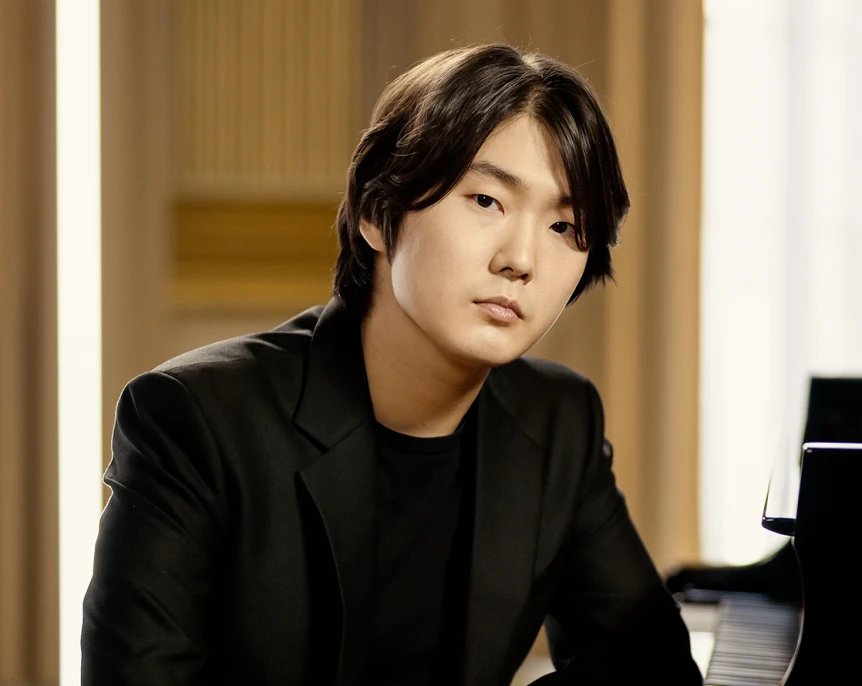
Wednesday night at Carnegie Hall, Seong-Jin Cho assayed the Rhapsody on a Theme by Paganini in collaboration with Manfred Honeck and the Pittsburgh Symphony. Born and raised in Korea, now 31 years old, he is perhaps the most knowingly acclaimed pianist of his generation. I was hearing him in live performance for the first time. What first impresses is the keenness and subtlety of his ear: his precise calibration of voicing and tone, of pedaling and dynamics. Pummeling the keys at full throttle, sustaining a rapt quietude at the softest possible volume, his poise remains imperturbable. In comparison to the recordings of Moiseiwitsch or Rachmaninoff, Cho was super-fast in the faster variations. Perhaps something was lost in clarity of articulation (I was sitting downstairs, where the sound swims). But because Cho never seemed rushed or pressed, the thrill of the chase prevailed. The lyric variations were breathtaking.
In a series of recent blogs, I’ve found myself pondering the rapid disappearance from the keyboard world of “national” schools of interpretation. To my ears, Jean-Efflam Bavouzet’s Ravel thrives on “French” clarity of rhythm and articulation, enforced with aesthetic rigor. Sergei Babayan’s heroic sonorities and sweeping rubatos sustain a “Russian” school. Yunchan Lim – a 21-year-old Korean already as famous as Cho – also goes his own way with poetic sincerity. But his new recording of Tchaikovsky’s The Seasons is a mistake – these are pieces, it seems to me, that need to sound “Russian” in order to cast a spell.
Cho’s Rach/Pag is original, not remotely “Russian.” But I find that I do not care: even juxtaposing Moiseiwitsch and Rachmaninoff, it’s evident that the Paganini Rhapsody (composed in 1934, by which time Rachmaninoff had long been abroad and even absorbed a whiff of American jazz) invites a range of approaches. Crucially, Wednesday’s performance was deeply collaborative. Cho’s sonic imagination, his quicksilver range of color and sensibility, his affinity for stillness on the verge of silence, were acutely partnered by Honeck and his players.
The concert closed with Shostakovich’s Fifth. This 1937 symphony, composed in a spirit of repentance, is often regarded as a kind of cop-out. Re-encountering it for the first time in years, I have to agree. It’s tighter and simpler than the sprawling Shostakovich of Nos. 4, 7, 8, and 10 – and less enveloping. Its most remarkable feature – also its most controversial – is a slow-motion stentorian ending. An unforgettable description, by the composer himself (in Solomon Volkov’s Testimony: The Memoirs of Dmitri Shostakovich), likens these final pounding measures to “forced rejoicing.” To fully register in performance, they demand a bleak machine intensity from the violins, itself predicated on a condition of hyper-commitment that I do not associate with today’s American orchestras. For hyper-commitment, listen to old broadcasts by Serge Koussevitzky and the Boston Symphony (try their Francesca da Rimini), or Dmitri Mitropoulos in Minneapolis or New York, or Toscanini with his NBC Symphony, or the Metropolitan Opera Orchestra under Ettore Panizza and Artur Bodanzky. The most astounding orchestra I ever encountered in live performance was Evgeny Mravinsky’s Leningrad Philharmonic when it toured the US in 1962. I missed the program with Shostakovich’s Eighth – but I’m sure it was the real deal. Today’s Berlin Philharmonic has a first violin section that looks and sounds like a congregation of concertmasters. That’s what can clinch Shostakovich’s Fifth. Otherwise, Honeck and his Pittsburgh players were formidable. They have forged a unity. Their purposes, moment to moment, are never in doubt. In my experience, no other American orchestra regularly enjoys the services of a conductor as gifted in the standard repertoire.
A cavil: the concert began with a New York premiere: Lera Auerbach’s Frozen Dreams, 12 minutes long. That is: it hewed to a tired template: a token new work, then furniture moving, then a concerto, intermission, and a symphony. The first half might have begun with the piano already onstage, and Rachmaninoff’s Vocalise as a magical prelude to the Rhapsody.
P.S. – Seong-Jin Cho returns to Carnegie for a solo recital on April 12. His program is nothing if not original:
Bach B-flat Partita
Schoenberg: Suite, Op. 25
Schumann: Faschingsschwank aus Wien
Chopin: Waltzes (complete)
For a related blog about Yunchan Lim, click here.
About Sergei Babayan, here
About Jean-Efflam Bavouzet, here
About Yuja Wang, here
About Rachmaninoff – use this blog’s finding aid. I am still recuperating from modernist caricatures of a great composer who was also a great man.
If you think the Berlin Philharmonic’s violin section consists of concertmasters, then hear the whole orchestra play anything under Kiril Petrenko and you have experienced the best orchestra in the world. And anyone can see and hear over 800 concerts in the best digital video and sound for a mere $200. Seeing what you hear has been a revelation for me.