
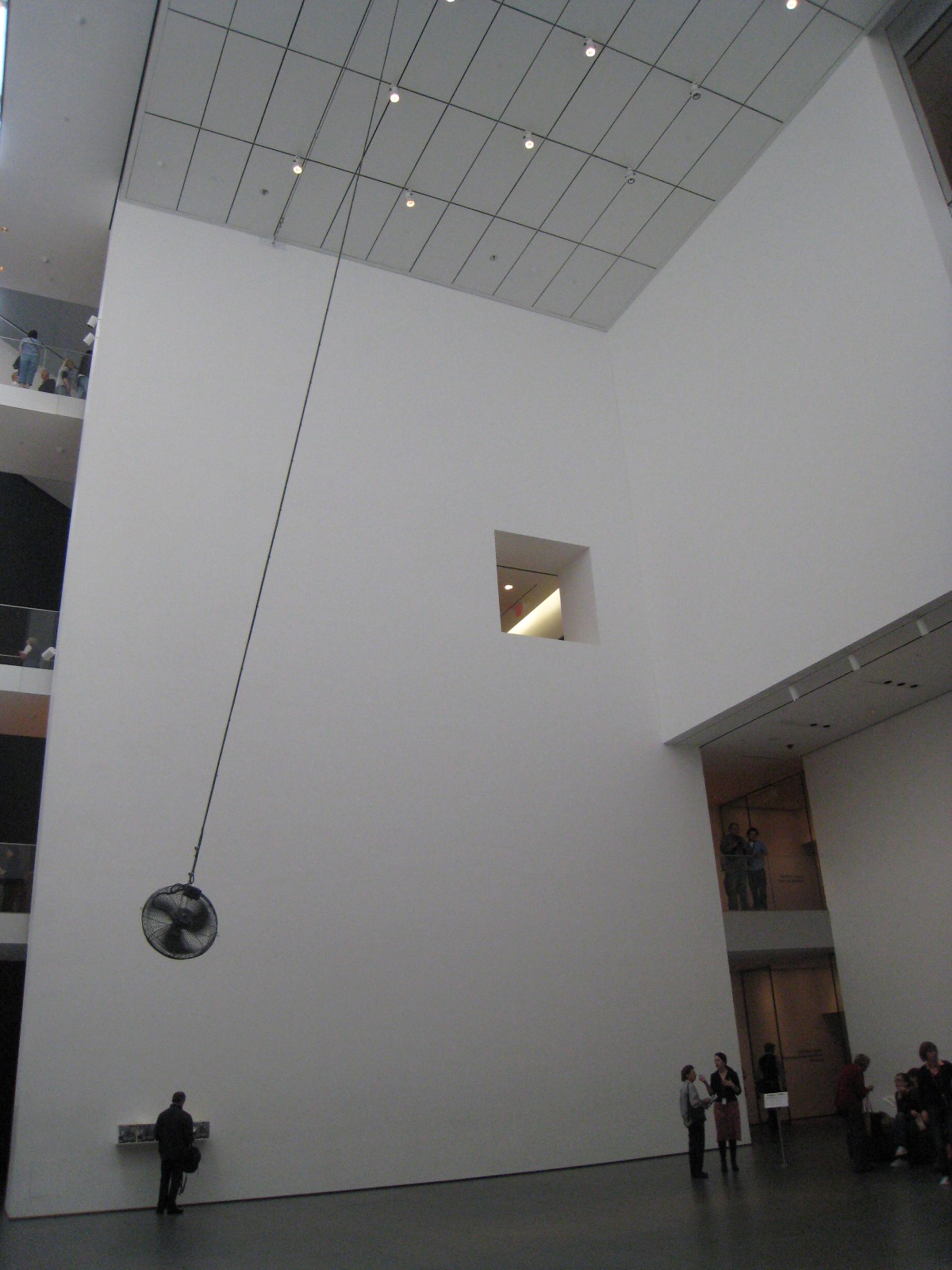
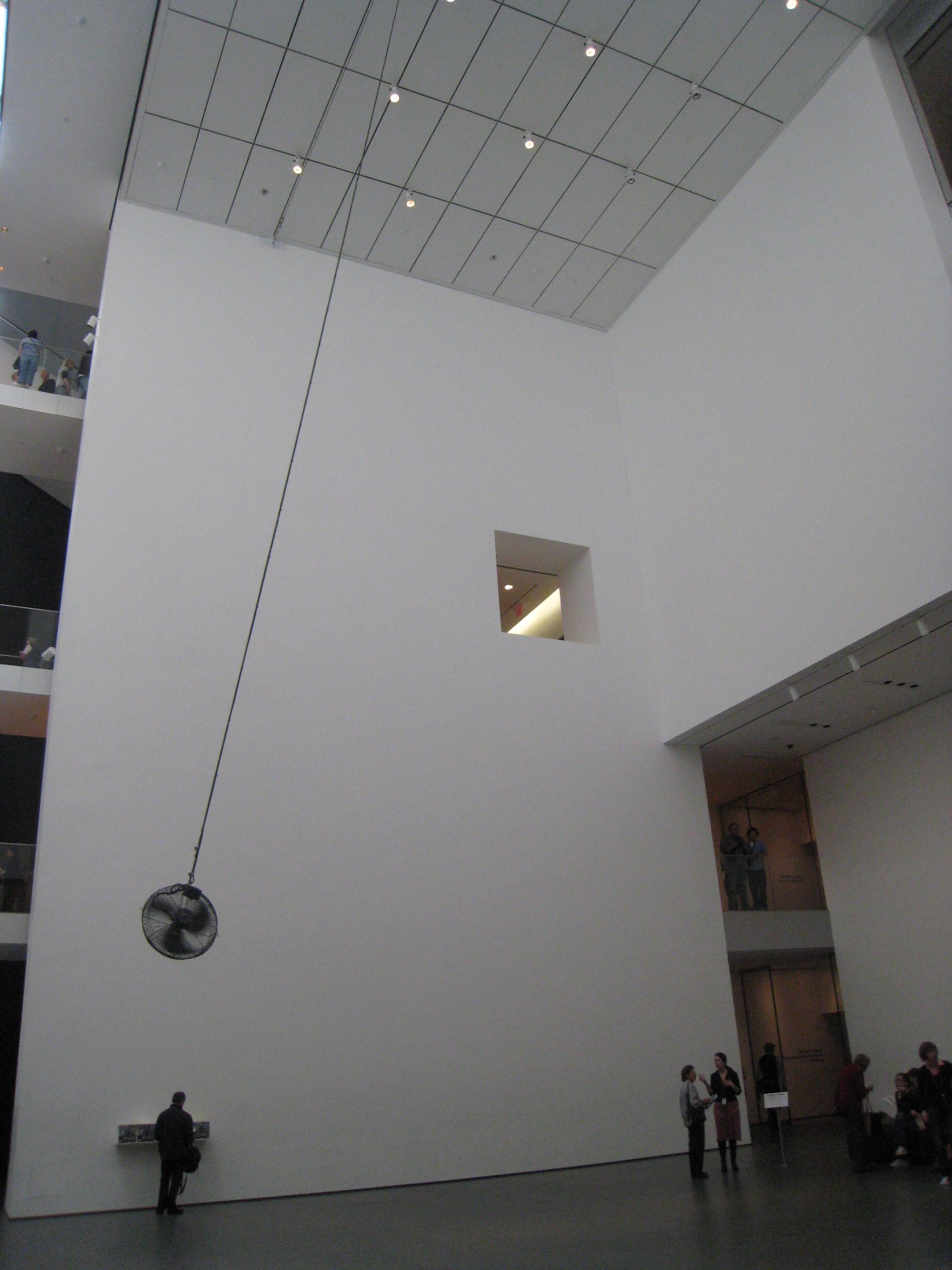
Olafur Eliasson: Ventilator, 1997
For weeks now my Eliasson Problem has loomed. MoMA and its satellite P.S.1 —- the annexation is complete; founder Alanna Heiss has been retired — devote so much real estate to the work of this Icelandic Dane that every art critic worth his or her bile must weigh in.
I was predisposed to liking work purported to be Minimal, spiritual, nature-loving, color-delving, light-obsessed. And certainly (with some rather raggedy exceptions) if not anti-object, at least product-neutral. And, as constant readers may know, I love everything Icelandic. Well, I probably will not like Alcoa’s aluminum smelting complex. Ore is shipped in from abroad then processed, using Iceland’s cheap, geothermal-derived energy. That which drives the smelting is what keeps the winter sidewalks ice-free. The slightly sulfuric hot water from below the rugged landscape heats all of indoors, including greenhouses, and the sidewalks of Reykjavik, so there is no danger of slipping when you are gazing up at the Northern Lights.
I don’t know why I continue to be fascinated by heating where no heating has been before. Once, when I was stationed in an art museum in a certain gloomy city in upstate New York, I was amazed that the elegant assistant director, even in the dead of winter, arrived without a coat. Sturdy stock, I thought. She was not a native, but born and bred in the Brooklyn. I lived closer to the museum in a high-rise and had resorted to using ice clamps on my boots in order to brave my treacherous route across a wind-swept plaza of solid ice.
But in truth, my mentor’s suburban kitchen opened directly on to her heated garage with its remote-controlled roll-up door; and, of course, the driveway was kept clear of ice by radiant heat coils inside the paving. And then on to the museum’s underground parking.
The exotic is closer than you think.
But where else except Iceland could there be a national referendum concerning the rental of the national gene pool for scientific purposes? I think it was perfectly all right for Iceland to offer up its meticulous genealogy for genetic research. As might be expected in a country where your father’s first name makes up the first part of your last name, record-keeping has always been essential. My name would be the equivalent of John Jean’s Son. And get this: girls get their mother’s names. And then too the gene pool itself, I’ve read, is remarkably pure: modern day Icelanders are descended from Vikings and their Irish slaves. Earlier than the Vikings, there were Irish anchorites, but of course they did not reproduce. And that’s pretty much it.
According to poet W. H. Auden, Hitler sent spies to confirm Icelandic racial purity; he needed more Siegfrieds for his Master Race. The spies reported a high-percentage of tall and good-looking blonds, but unfortunately Icelanders were incorrigible drunks. You may not know this, but the national Icelandic drink is potato-derived, cumin-flavored brennivin, also known as The Black Death.
All of this windswept wind-up is for nought, because for all practical purposes Eliasson is more Danish than Icelandic; although he was born in Iceland and offers a series of landscape photographs of my beloved island, he grew up in Denmark. Denmark! Iceland was a Danish colony for over 300 years.
* * *
Eliasson’s “Take your time” (through June 30 at the Museum of Modern Art and P.S. 1) gobbles up space. At MoMA in particular I felt I was in some time-warp. I was visiting enlarged versions of some of the trippy, kinetic light-works favored by the Howard Wise Gallery in its heyday in the late ’60s. Or was I being bathed in disco décor?
Surely a hallway bathed in noxious yellow light turns everyone into zombies, but it also reveals — accidentally – one of MoMA’s design flaws. Too much precious space is gulped up by crowd control and getting viewers from one place to another. The artist’s yellowing of that hallway reveals its true size. I am sometimes annoyed by the Metropolitan Museum’s warren of little interlocking galleries or by the Guggenheim slope, but MoMA feels like a World’s Fair pavilion awaiting the entire population of Minneapolis all at once. In the public areas, I would wager almost half the space is geared to people-moving (or in the lobby, people-waiting). Surely, thanks to Eliasson, I will never love yellow again.
On the other hand, Eliasson’s 1997 Ventilator installed in the Atrium is the best use ever of that really ungainly space: a single, self-propelled electric fan swings on its electric cord back and forth, seemingly at random, seemingly dangerously just above visitors’ heads. Otherwise, there is so little to view in the various Eliasson lighting displays and mirror tricks that you look desperately for something to see. The art tourists themselves, front and center, are not in themselves interesting, either. They are grim and respectful, wearing their next-best clothes, just short of attending a wedding or a funeral.
Searching for something to look at, you notice that the restroom signage includes an icon labeled Baby Change, tinged yellow by the spill from the yellow hallway. Is this where you can exchange your baby? Or is it where you can turn your toddler in and get a basketful of smaller infants? And inside the men’s, the commodes are labeled Toto. But I was definitely not in Oz, in spite of the buzz. I was in installation hell.
Is Ventilator Eliasson’s only credible work?
* * *
A similar effect haunts P.S. 1. The funky charm – more and more smoothed over since the MoMA takeover – sticks out under Eliasson’s lightworks. One piece I actually liked, one that lived up to some of the curatorial claims. Alas, The natural light setup, 2008, was punctured by anomalies: a hump of pipes that looked like Baroness Elsa von Freytag-Loringhoven’s God of 1913; a sealed electric socket, and a small door like a line drawing with visible hinges and no knob. This is in an all-white room where the light from the flawlessly covered ceiling changes slowly in brightness, perhaps from dawn to dusk and back again. The lesson here is that minimal is not easy; emptiness qua emptiness has to be perfect. If the artist is not after emptiness, however, then I am not interested.
The good thing is that P.S. 1 was parceled Beauty (1993), a kind of rainbow within a proscenium and the 1998 Reversed waterfall, which is placed in the grotto that opens from the first floor to the basement.
And the eye-catcher-that-everybody-loves? Well, let’s put it this way: Take your time (2008) — which gives the exhibition its title — uses a gigantic, revolving mirror on the ceiling of the biggest of the exhibition rooms on the 3rd floor. It is less boring than watching paint dry, but not by much. With the exception of the gridded landscape photographs (I do love Iceland), everything else is kind of a waste of time. Worst choices: The poorly made spheres and other paraphernalia that clutter the rooms flanking Take your time. Just because P.S. 1 is an old schoolhouse doesn’t mean we need to be lulled by science projects. Art is about alchemy, not astronomy. Art is about LIGHT, not light.
So the Eliasson Problem is this: What do you do with an obviously talented but totally uneven artist? Hey, even Picasso produced a lot of junk. Most artists need editing.
If the exhibition consisted of fewer works, we would have had something worth talking about. Instead, what we need to talk about is how the curators (Madeleine Grynsztejn, formerly of SFMoMA and now the director of Chicago’s Museum of Contemporary Art, and Roxana Marcoci and Klaus Biesenbach at MoMA) put together this disappointing survey. It may be that some of Eliasson’s best works are not transportable or impossible to recreate, so we can only hope that the artist will survive this listless extravaganza and that his forthcoming East River project – New York City Waterfalls — will be so wonderful that his reputation will be revived.
FOR AN AUTOMATIC ARTOPIA ALERT WITH EACH NEW ENTRY, E-MAIL YOUR REQUEST TO PERREAULT@AOL.COM