
Father’s Day 2008
Majid Majidi’s The Willow Tree (2004) is an art-house tearjerker about answered prayers. A blind man is able to see. As a crowd of well-wishers throws flowers to greet our newly sighted Professor Youssef at the Tehran airport, the camera lingers briefly on his wife’s face as she hopes he will find her appealing. But she discovers, of course, that he cannot even recognize her, which is an amazing feat of acting and/or directing. That is one of the many variations on the meanings of seeing and not seeing. And, oh yes, the professor teaches the works of Rumi, the great Persian saint/poet.
Willow is an allegory. Not a shot is wasted, not a metaphor avoided. Ambiguity is embraced — standing for what cannot be said, or seen? The camera’s eye becomes your ears and the tips of your fingers.
So, although Majidi is in many ways a conventional director, I had to see what films of his were in stock at Kim’s, my amazing neighborhood video/DVD rental outlet. It was Father’s Day and, as fate would have it, I grabbed The Color of Paradise (1999), a kind of prequel to Willow, and reportedly the largest grossing Iranian film in the U.S. It tracks the sad and transcendent tale of a blind boy named Mohammad who, like the professor in Willow, walks carefully, very carefully, lifting each leg by the knee, gently placing down each foot as if he were about to go over a cliff. Fingers are antennae.
Paradise is full of cinematic synesthesia; not only are we aware of frail Mohammad’s world of sounds and moving air, we see him (he is precocious and might grow up to be a professor of literature specializing in Rumi) reading small portions of the world, bits of texture, running his fingers over stones and leaves as if the world were Braille. Which of course it is (if you are Baudelaire or Rimbaud). And when he hears geese, he asks what they are saying to each other. Everything is in code.
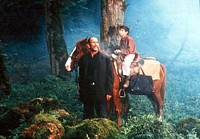
Majid Majidi: The Color of Paradise, 1999 (publicity still)
In many ways, whether or not Majidi is part of the Iranian New Wave or, as some blind film critics assert, the Iranian Disney, The Color of Paradise is the perfect Father’s Day movie, an antidote to that sentimental holiday, seemingly created by or for the greeting-card industry soon after the creation of Mother’s Day early in the last century.
Mohammad’s poor, bedraggled, ice-cold, single-parent dad spends most of the movie trying to get rid of his son. Mohammad will not support him in his old age; Mohammad might stand in the way of a new, possibly financially rewarding marriage.
Happy Father’s Day.
More Male Art
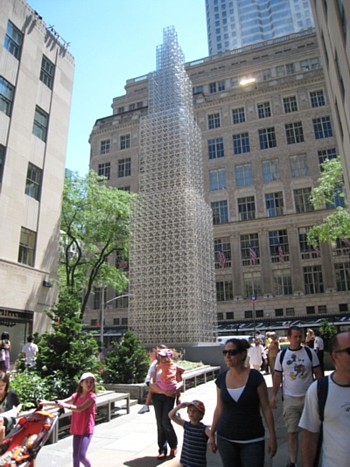
Chris Burden’s What My Father Got Me is a 65-foot-high monument to fatherhood and the Erector Set, a tower/building constructed of enlarged Erector Set parts, based on the first G. S. Gilbert module girders. It sits until July 19 at the Fifth Avenue entrance to Rockefeller Plaza. If you plant yourself in front of it in a certain way and if you are my height and pretend you are a camera, you can spy Paul Manship’s golden, art deco Prometheus through the girders. Or do you still prefer Jeff Koons’ Flower Puppy, once placed behind and above Prometheus?
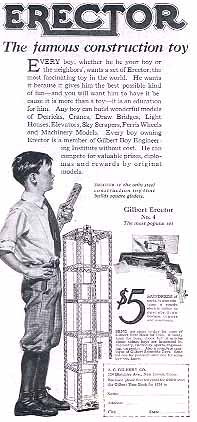
Every male of a certain age will know what an Erector Set is. It came in a bright red-metal “briefcase.” Inside, a pamphlet gave easy-to-follow instructions for all the bridges, buildings, and Ferris wheels you might want to make out of the pint-size girders and the tiny nuts and bolts. I have yet to see any evidence that anyone, man or boy, ever made anything not in the pamphlet, such as a Batman and Robin or a collie.
Do I have to say it? “Erector” has a semantic and, more importantly, an oneiric relationship to “erection,” as in an erect penis. Was there ever a more Freudian boy’s toy?
Oddly enough, I had no interest in the Erector Set my father bought me. I assume it was the gift he had wanted when he was a boy and/or the All-American product he thought would make a man of a son who was more interested in dreaming up costume dramas for anyone nutty enough to want to cavort in crepe-paper capes.
I wouldn’t go near the Lilliputian girders.
Dad was clearly disappointed in my lack of interest, but happily — almost too happily — stepped in to spend hours building a tabletop, motorized Ferris wheel. Later, no one had the nerve – neither my mother who thought all toys were foolish nor my sister, who was still at the dolly stage – to dismantle my father’s engineering triumph. Certainly not I; in fact, it was a relief not to have to deal with something so boring as linking girders with tiny nuts and bolts. The Ferris wheel had fortunately used up all the supplies.
For my birthday, I announced, I wanted a chemistry set.
That put my poor Dad at ease. He probably was afraid I would ask for a sewing machine or a paint-by-number kit. He sprung for the Gilbert chemistry set, and hid it in the attic. I knew exactly where it was, but I waited patiently for August 26 to come around. By then, fortunately Daddy had shipped out again: he was a cook on a supply ship on its way to Africa, suffering, I later discovered, from acute sea-sickness. So much for my fancied Viking roots in Brittany. Vikings do not get seasick.
I don’t think my father ever found out there were only two things I wanted to make with the chemistry set: explosives and perfume. I certainly didn’t mention it when we spoke on short-wave radio. Neither bombs nor perfume were included in its pamphlet, but I did manage to have some fun putting matches to magnesium. And I did make a bomb of sorts that left the devilish sulfuric odor of rotten eggs.
Alas, although I thought I could make perfume by boiling roses or steeping them in alcohol, neither process really worked. Besides, where was I going to get my hands on musk or priceless ambergris? I was fascinated by ambergris, particularly when I read that it was really whale phlegm. I did have hopes of finding some nearby on the Belmar, New Jersey beach. If others had found Nazi mines washed ashore and Japanese balloons that had reached the California coastline, then anything was possible.
The Art of Being Famous
If you know about contemporary art, then you must know Chris Burden. A latecomer by a few minutes to the Body Art thing and the Scandal Ploy — succeeding Bruce Nauman, who was in turn succeeded by Vito Acconci – Burden achieved notoriety (1) for having himself shot in the arm and (2) for getting nailed to the hood of a Volkswagen.
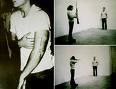
Chris Burden: Shoot (1971)
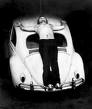
Burden: Tans-fixed (1974)
As it happens, yours truly spent a week with Mr. Burden and a few other art stars on the Micronesian island of Ponape in 1979. This art spree was in celebration of – and produced by — a small but very smart art operation on the West Coast called Crown Point Press. Burden, unlike John Cage, Pat Steir, Robert Kushner, Laurie Anderson and most of the other artists (all of whom had made prints for Crown Point) didn’t say much. He was almost as silent as William T. Wiley, but without the lean demeanor and California-cowboy aura.
We were also, I think, celebrating the forthcoming decade. And the artists had to sing for their suppers by forecasting what was going to happen in the ’80s. No one predicted the rambunctious commercialization of art or the so-called return to painting, which, in the greater scheme of things, lasted a New York minute.
Ponape, by the way, has mysterious ruins, “temples” and “canals” seemingly constructed of basalt logs.
In the evenings, after the artist presentations and flown-in beefsteak dinners, we traversed the passageway beneath the dining-room deck. The passageway was jammed with hundreds of outsize, croaking frogs.
Composer John Cage had brought his own brown rice in little plastic bags, and the previous cook, fed up with such things as those beefsteak airlifts, left for the island of Truk and then abandoned Truk for Saipan, in search of a South Pacific untouched by luxurious scuba-diver compounds.
Our grass huts, complete with mildew-resistant water beds, were arrayed on the slope of what looked like a Hollywood back-lot lagoon. Some in our group also sampled a narcotic that the islanders made by chewing up the root of a certain native pepper plant and spitting out the juice; this phlegm broth was sipped for its numbing effect and hallucinogenic buzz.
But who needed hallucinations? One day, when we waded into the murky, lukewarm lagoon, I was unpleasantly surprised by a floor of living, slimy sea cucumbers. Another day, while tramping through the jungle, I came upon a shack, obviously occupied by a Catholic priest. The tangled sheets were still warm. Missionary? Anchorite? I never found out.
And whatever happened to Chris Burden?
I really admired his 1975 B-Car:
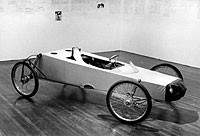
“I set the goal of completing the car for two shows in Europe. I saw buidling the car as a means toward the end of driving it between galleries in Amsterdam and Paris as a performance. When I arrived in Amsterdam, I knew that the accomplishment of constructing the car had beome for me the essential expwrience. I had already realized the most elaborate fantasy of my life. Driving the car as a performance was not important after the ordeal of bringing it into existence.” Chris Burden
And I fondly remember his 1990 Medusa’s Head, a suspended globe encrusted with train sets.
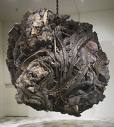
Leading up to his hymn to the skyscraper, Burden has been building bridges out of these same stainless-steel versions of A. C. Gilbert’s girders. He built a outsized model of New York’s Hell Gate Bridge in 1998 and one of the Indo-china Bridge in 20002.
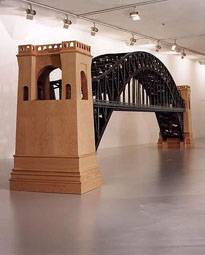 Now, of course, he is adored for the vintage streetlight collection permanently installed in front of the updated Los Angeles County Museum.
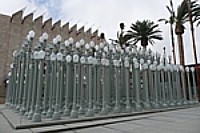
Infantilissmo?
Try as I may, although Burden has had many one-man exhibitions worldwide, I can’t find any evidence of a retrospective. Or do we really need to go through the trouble of slam-bang, expensive extravaganzas when all we require is a website to show off the images? Art is all about images anyway. Or maybe about ideas. Surprisingly little art is better in real life than it is in a photograph.
When I teach contemporary art I usually mention my dream assignment: install an exhibition of known masterpieces in such a way that they all look awful. This has been done in real life by professionals, more times than I wish to say. The implication, which usually does not have to be spelled out, is that you can also show bad artworks in such a way that they will be mistaken for masterpieces. ?.
Next time around, if the art devil is ever allowed to teach again, I will actually make the assignment, but transfer it to using the camera.
That trickster Marcel Duchamp made sure that his last work was virtually unphotographable. At the Philadelphia Museum of Art, you have to look at his posthumous, allegorical tableau (Given: The Illuminating Gas…) through a peephole, thus changing it into a virtual photograph. Even if you had a real photograph of the full tableau — the spread-eagled maiden, the hokey waterfall, etc. — you would not be seeing the allegorical display through the peephole; the waterfall would not be “moving” like the image of water in a vintage beer sign.
On the other hand, without my camera and without actually visiting Rockefeller Center, would I have known that you could peer through What My Father Got Me and spy the Paul Manship nearly a block away?
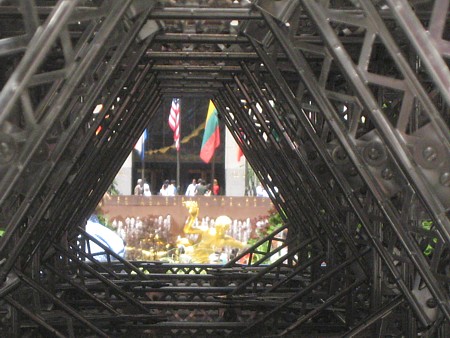
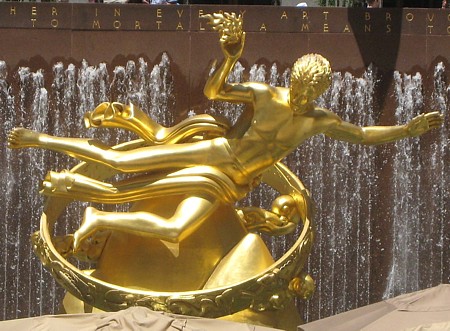
If I hadn’t been angling about with my camera, I would not have discovered the particular perspective that allows a comparison with the pointy penis of St. Patrick’s.
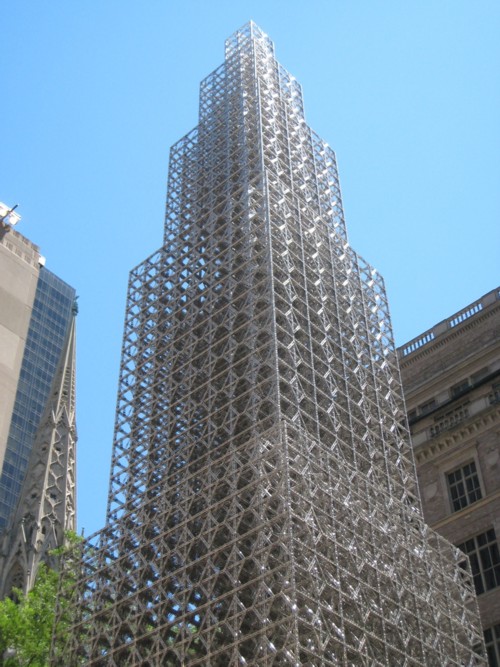 Yet, as even my own snapshots prove, What My Father Got Me is certainly one of Burden’s masterpieces. Can we now place him, along with Koons, in my new category of Infantilism (which could also be called Infantilissmo) and make him into yet another descendent of Claes Oldenburg? In regard to Burden’s well-placed penis, if Neo-Pop it’s not, then it’s certainly Infantilissmo.
FOR AN AUTOMATIC ARTOPIA NEW ENTRY ALERT
EMAIL YOUR REQUEST TO perreault@aol.com