
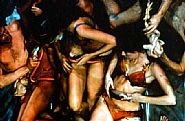
Carolee Schneemann: Meat Joy, 1964
A Living Legend
Performance Art – that is, Performances, Events, Happenings, nonmatrixed artists’ theater (in Michael Kirby’s excellent term) – are not plays, dances, or operas, although they may partake of some characteristics of these, particularly in that they occur in time with a person or persons as the presenter(s). Like plays, dances, or operas, performances are very difficult to write about. There is usually not a script or much of one and, to recast Kirby, the performers are pretty much themselves (though types crop up, even gods and goddesses if the artist is not careful). The place is here, the time is now. Words may be spoken, but they are rarely central. Most often – and I think ideally – the artist is the “actor,” but not necessarily the only one, and everyone isn’t acting but being.
Performance-type art is almost impossible to write about because it is so — well, I have to say it — ephemeral. Unless we have actually seen the damned things and have very good memories to boot, what we write and say about Performance Art usually has to do with written and oral accounts and, of course, photography and movies. The latter, of course, is in itself also difficult to capture in words.
There are even some Performances or Performance-type artworks that dispense with the immediate audience entirely in favor of the one mediated by the camera. I am thinking of the many of the early street and body works of Vito Acconci and certainly most of the body works of Ana Mendieta. It is not that their bodies became sculptures, but that images of their bodies did. I don’t want to be a purist, but there is some sense that if you know a Performance only through photos and maybe videos and/or film, you know only these photos, videos or films.
The recent efforts of Marina Abramovic to perform the Performances of others — although I believe there is a Fluxus precedence for this — is a partial solution. Fluxus events, like most of Yoko Ono’s instruction pieces (but unlike her Cut, in which the audience is invited to cut off her clothing), do not rely on the artist’s presence; theoretically they can be done by anyone. Also, in trying to imagine Abramovic’s Entering the Other Side at the Guggenheim performed by someone else, I can only imagine a piece-about-a-piece, or else, like her version of Beuys’ How to Explain Pictures to a Dead Hare, a farce.
I once perpetuated a series of performances (and related street works) myself, so as well as observing a number of these, I have an inside insight. And I have also been an actor in some small way (playing Vincent van Gogh on Dutch television). There is, I can attest, a difference between holding your own, becoming a living sculpture in front of an audience, and playing a role — forgetting for the moment that being an artist (or a poet or an art critic) is also playing a role.
When, however, do you move from being yourself to being a type? More to the point: when do you move, if ever, from being a type or a personification to becoming an archetype?
I suspect you can tell when you are an archetype when people find meanings in everything you say, in every move and turn of events in your life, meanings you did not exactly intend. You become a mirror for the needs of others. The scary part is that it can happen without your knowing it. Here’s an example. I remember that an older poet (Kenneth Koch) in a workshop I was taking stated very clearly that the whole universe was a vast machine for the creation of poems. I thought, as a young poet, that was the most inspiring thing I had ever heard. Years later I told him at a party that one statement of his had influenced me more than anything else. He said he had never said such a thing. Why on earth, he asserted, would he say such a thing that was so preposterous and pompous.
In her earth/merge body sculptures, Mendieta was, I think, consciously playing with archetypes. Andy Warhol, probably through no fault of his own, became one, at least in the eyes of Valerie Solanas, who shot him as the personification of the evil demiurge.
But let us just say that Schneemann, if not an archetype, is at least a living legend; this is primarily because of Meat Joy (1964) and Interior Scroll (1975).
* * *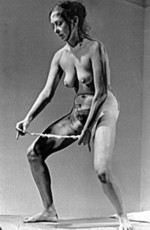
Scheemann: Interior Scroll, 1975
Our Goddess?
Before there was Abramovic, before there was Hannah Wilke, before there was Mendieta, there was Carolee Schneemann. I know for a fact, having been a friend of hers (also her teacher in Iowa State University), that Mendieta acknowledged Schneemann’s influence. Schneemann probably influenced some male artists: Acconci, in his classic Body Art phase, comes to mind. But who was an influence on Schneemann? Antonin Artaud! The collage paintings would indicate de Kooning and Rauschenberg. The performances might lead you to suspect Kaprow, Rauschenberg, and in some cases Hermann Nitsch. But who is to say? I mention these men because I can think of no woman artist that might have been an inspiration.
Schneemann herself has been under a kind of anti-essentialist feminist cloud: it is not exactly accidental that male artists within the Dada/ neo-Dada./post-Fluxus fold have referred to her as Our Goddess. Although her art and her writings are not directly essentialist, she has a Goddess aura. I can remember a time when anti-essentialists feminists disparaged both her and the late Wilke (another beauty) as pandering to the male gaze.
There is, however, not much to be served in re-rehearsing these now ancient feuds between the essentialists and social constructionists among us. If you are not a woman, the only way you can relate to the conflict is by translating it into another form. Is there an innate maleness to heterosexual males? A gay essential to gay males? No. Or is gender totally socially constructed, a product of the environment and culture? No. Language interferes with reality.
Well, that’s all over. And we can begin to look at Schneemann neither as exclusively a Goddess nor as an art world pin-up, but as a serious artist. And although the line of expressionist, body-centered women’s performance may have temporarily come to a halt, it will never be seen as merely a small incident in art history. If it takes a man to say it, then so be it. The conservatives in politics (and, alas, in art) may have gained some modicum of control, but we will not have women held back by fear of their own bodies.
If there is a level of the mythic in Schneemann’s work and persona, then why can’t we accept this in the same way we accept the mythic in Joseph Beuys? Men will just have to accept – and this is very difficult – that if you have to have a Goddess, she is also going to be poet Robert Graves’ scary White Goddess. Sex is sacred. Well, sort of. In a world that is disastrously overpopulated, it is fortunately also entertainment.
Now on top of all of this, Schneemann has never been shy about the political, either. Her rage at the atrocities in Viet Nam was early: her film Viet Flakes (1965) is still powerful and, alas, pertinent.
* * *
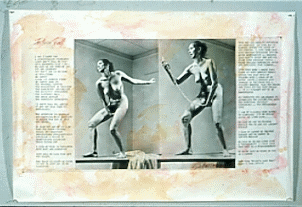
Why She Reigns
Some of these thoughts are inspired by an exhibition of mostly photo-pieces by Schneemann now at P.P.O.W. (555 West 25th Street, to February 11). It is by no means a retrospective, but several pieces effectively recall Schneemann’s import. There are no photos of her Kinetic Theater masterpiece Meat Joy (1964) that utilized nudity, paint, words, projections, songs and raw fish, chickens, and sausages. But a new edition of the photographs that compose the 1963 Eye Body: 36 Transformative Actions documents her seminal Body Art efforts. The photos were taken by Icelandic Pop artist Erró. Also, in the form of painted-over and scribbled stills of Interior Scroll (1975), that radical work is documented. In Interior Scroll, naked, she slowly pulled a long paper scroll from her vagina, reading the words: “if you are a woman (and things are not utterly changed/ they will almost never believe you really did it/(what you did do)/ they will worship you they will ignore you/ they will malign you they will pamper you/ they will try to take what you did as their own….” I am copying this from the text in Carolee Schneemann: Imaging Her Erotics (MIT Press).
Viet Flakes is also part of the exhibition, as are Hand/ Heart for Ana Mendieta (1986) based on a dream she had about Mendieta right after her death caused by “falling” from an apartment house window, and Terminal Velocity (2001), altered newspaper photos of bodies falling from the World Trade Towers. Difficult stuff.
Thanks to the Muse (God or Goddess) of art criticism, you can see the actual Schneemann Scroll as part of Carlo McCormick’s jazzy and inclusive The Downtown Show (The New York Art Scene 1974-1984). Compare this if if you dare the New Museum East Village show in 2004. The new survey is through April 1, at NYU’s Grey Art Gallery (100 Washington Square East) and the Fales Library, (70 Washington Square South) where there are works by Mendieta and Wilke. The Scroll is part of the Library branch of the exhibition. Be forewarned: both the Library wing of the exhibition and the piggy-backing design show called Anarchy to Affluence at Parsons/New School are not open on Saturdays. The NYU show received funding from the Andy Warhol and Robert Mapplethorpe Foundations and the New York State Council of the Arts; especially in light of the latter, shouldn’t the Fales addendum be open to the public on Saturdays? Or is it only for students, who, I guess, disappear on weekends?