
As a service to loyal readers, Artopia can now offer notification of new installments of John Perreault’s Art Diary as they are made available. If you should desire an Artopia Alert, please send an e-mail to that effect to perreault@aol.com.
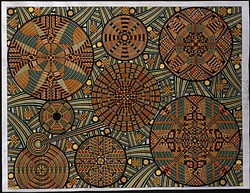

Eugene Andolsek, Untitled.
When Outsiders Come Inside
If work by the five artists presented in “Obsessive Drawing” (American Folk Art Museum, 45 W. 53rd St., to March 19) were displayed in a Chelsea Gallery sans Outsider i.d., would we know the artists were self-taught?
For argument’s sake — and since, alas, there is no catalog — let’s at first limit ourselves to the biographical information in the handout. Chris Hipkiss was born in France in 1964, but now lives in Great Britain; Hioyuki Doi, born in Japan in 1946, is a trained chef and cooking teacher. Martin Thompson: born 1956 in New Zealand; Charles Benefiel, born 1967, Santa Monica; and Eugene Andolesek, born 1921, now lives in a home for senior citizens. In terms of the latter, surely you know that even some trained artists might end up in a senior home in spite of their MFA certifications. As for Hioyuki Doi, it is not unheard of that trained artists have day jobs; his just happens to involve food.
Fortunately, the wall texts provide more information and interpretation, and if for some reason you didn’t know where you were, reading would clue you in. Although the artists are tagged as emerging (an art-world term), you’d understand that this was not art-school art.
We learn that “like the other artists in this exhibition, Thompson works on his drawings as part of a self-development system for survival. It helps him negotiate the world, which he calls ‘a mindless distraction.’ “
The world is indeed a mindless distraction.
Further: “Like Charles Benefiel, Thompson also recites a mathematical equation while making his marks.”
I am a student of wall texts. Curator Brooke Davis Anderson’s texts (which he either wrote or certainly approved) are masterful compared to: “The rolling locks of Saint Luke’s beard flow like smoky puffs, defining spatial volume yet lending an otherworldly quality to the massive form.” This choice bit of poppycock can be found in on the walls of the Metropolitan Museum of Art as part of “Prague: The Crown of Bohemia” (to January 3), an exhibition more about gold than anything else: Jan Hus the iconoclastic “heretic” is mentioned in passing, and the Jews of Prague are represented by a photo of the Old New Cemetery. Hus, after all, was against idolatry. And the Jews, it would appear, did nothing except die.
The truly crowd-pleasing, but ultimately boring, “Vincent Van Gogh: The Drawings” at the same institution has an introductory wall text that calls him a self-taught artist. Well, technically, I suppose so. Although it seems hard to imagine he learned nothing about art from Theo, his mainstay and art dealer brother. I should know.
Not only is Vincent my art world great uncle, I played him on Dutch television in artist Les Levine’s 1980 Analyze Lovers: The Story of Vincent. Levine was miffed that the reporters at the press conference were more interested in the wonderful new actor playing van Gogh than the layering of multiple interviews on the tape. And although Levine credits himself as script-writer, I made up my own lines and, more importantly, knew enough to hold back true expressiveness until I was asked to talk about cutting off my ear. Levine was a good sport. He brought back a T-shirt with a picture of me as Vincent on it and the words: “I found him an art critic and I made him a star.”
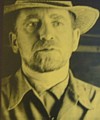
Les Levine: Analyse Lovers (John Perreault as Vincent), 1990
And the Winner Is…
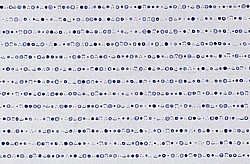
Charles Benefiel: Random Numeric Repeater #9 (detail)
Since it falls to me to make the cut (as I did recently when it comes to the appropriation artists), I will conclude that in terms of the art in “Obsessive Drawing” at the Folk Art Museum or more correctly the Museum of Self-Taught Artists Excluding Van Gogh, Hipkiss’ huge narrative scroll moves me not nearly as much as violent, pedophilic, apocalyptic Henry Darger, well-represented in the this museum with his novelistic mayhem. Hiroyuki Doi’s wispy drawings, using thousands of tiny circles, cannot match the now-classic dots of Kusama, who, by the way, is an art-world artist who has assigned herself to live in a sanitarium. Andolsek has the black outlines that I associate with Cply, and Thompson’s graph-paper exercises work only where his scalpel-hewn corrections interfere with the flatness of the grid.
This leaves Benefiel, whose code drawing stretches out line after line, not like some kooky Agnes Martin, but a text to be spoken aloud or sung. I was so enamored of this nonvisual act of drawing that I copied the code in my notebook: one dot is BA, two is MA, three in a triangle formation is TE; a circle is DA; a half a circle facing up like a smile with a dot is LE; a filled-in circle with a white dot at the center is KA; an upside down half circle with two eye-like dots is PE; a small black circle is FA. A circle with a black dot at its center is ME; a bigger black dot, all filled in is NA.
Without the Folk Art Museum context and without the wall texts, I don’t think we could distinguish any of this work from the postgraduate art we see in Chelsea and Williamsburg. With the exception of Benefiel.
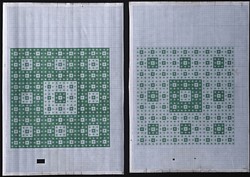
Martin Thompson, Untitled.
Another Theoretical Transplant
Could we do the reverse? Choose “obsessive” work by postgraduate artists and, placing it in the Folk Art Museum, have that art taken as Outsider, Visionary, Self-Taught? You bet.
Could it be that going to art school makes no difference? Or — and here is a more complicated thought – that art schools (and I include college and university art departments) now teach perfectly respectable, middle-class artist wannabes to imitate the personal, anguished, obsessive, visionary art of the untrained, inadequately socialized, demented or inspired Outsider Artist?
We have been Dubuffeted. Jean Dubuffet was a wine merchant and collector of what he called Art Brut (i.e., art of the institutionalized). Influenced by his surrealist wine customers — who, like Max Ernst, had made careers of imitating the insane – he himself suddenly started making pseudo-Art Brut. Every high school student with artistic sensibilities is infected with tales of van Gogh and Gauguin: the first shot himself and the second, his equally deranged friend, ran away to Tahiti. The first sentence of the wall-text intro to the Met’s blockbuster “Drawings of Van Gogh” (through Dec. 31) deems him a self-taught artist! What an odd thing to emphasize. When academically institutionalized, some young artists now get infected by tales of Ernst and Dubuffet. You don’t have to be insane, you can imitate the insane. I suppose this is progress.
Or is it that “trained” artists can also be demented, visionary outsiders and may have ended up in art schools because there’s no other place for them?
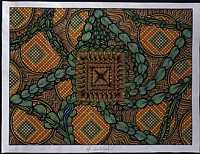
EugeneAndolsek, Untitled
The Name Game
Can we tell the difference between the work in “Obsessive Drawing” and the folk art on the other floors of the Folk Art Museum? Certainly, the work in this concise and thoughtful exhibition looks more like contemporary art than most of what previously we have known as folk art. Will anyone be confused? Probably not, until the question of what these drawings are doing in a museum once devoted to folk art.
Usually I am for the breaking and blurring of categories, but here I have some doubts. The self-taught common denominator appears to be a ruse to lure both funding and audience. Outsider Art, given the success of the annual N.Y. Outsider Art Fair, is wildly popular. Since there is little left to collect, Folk Art has had its day. However, folk artists are not self-taught; they are academically untrained, but they are usually taught as apprentices.
Across the street at the Museum of Arts and Design (M.A.D., indeed) we have an even worse problem, since this new name of the American Craft Museum – where I am obligated to disclose I once worked – does not mean anything at all. Talk about a loss of identity! Hey, craft by any other name is still craft. It can indeed be art, but it is never design per se. Design is something you usually do before you make something, or, more particularly, it is both the planning and the result of industrial production. Design is not handmade by the artist himself or herself.
Language!
And if the former American Craft Museum, in a total betrayal of the American Craft Movement, is now going to be a design museum, there’s some pretty tough competition already in place, in the form of MoMA and the Cooper-Hewitt, to name but two already up-and-running gift-shop platforms.
Isn’t there some law against false advertising? Or can we call any holding of objects anything: as long as the name satisfies some funder, is a response to focus groups, or seeks some imaginary, magical, money-bearing public? If so, based on various fantasy demographics and purposes I propose:
The Museum of NOT-Craft
The Museum of Insider Art, Postal Service, and Postgraduate Installations
The Museum of Nudes and Clothing
The Museum of Dead Grandmothers
The Museum of Dead Boards of Directors
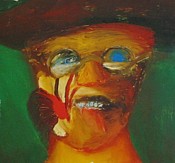
Sir Sydney Nolan, Ern Malley (detail)
The Sound Track Like a Trail of Saliva
Are there fake Outsider artists? Of course. An informant has it that a college-professor artist he knows shows every year at the Outsider Art Fair and is now making enough money to retire…so he can pursue his “real” art?
How can you tell the difference between Outsider Art and Art School Art? You can’t really, except by intuition and additional information.
And does it matter? Sincerity cannot be seen or measured.
When I was barely out of high school, I was able to visit the studio of my first “real” artist. He made his living by producing “Madonna and Child” paintings for the Washington Square Outdoor Art Show. But when with great fanfare he showed us his “real” art, abstract paintings of no interest, it was clear that the only real art he was producing was his “Madonna and Child” paintings.
I am also reminded of Ern Malley, my favorite Australian modernist poet. He was invented one afternoon in 1943 by two antimodernist wags by the name of James McAuley and Harold Stewart. But here’s the rub: the fake poems (rather like a combination of T. S. Eliot and Edward Lear), are actually more interesting than any serious poems produced by these naughty hoaxers. The Ern Malley Affair by Michael Heyward, University of Queensland Press, includes all 16 Malley poems. And a lot more.
So which do you prefer?
How often have I sat at evening
Under the painted alcove of the sun
The secretary of its facile flame!
— James McAuley
Or:
Innumerable images
The register of birth and dying
Under the carved rococo porch
The Tigris – Venice – Melbourne – the Che’en Plain –
And the sound track like a trail of saliva.
— Ern Malley
* * *
If art can save you from madness, can it also cause madness? Or is it the art world that does this?
For more on Outsider Art (Judith Scott’s wrapped sculptures) go to johnperreault.com.
Note: Next week Artopia goes on vacation.