
“I am a Modern artist dying of Modernism.” Robert Smithson, 1961
(in a letter quoted by Thomas Crow)
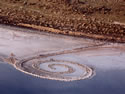
Robert Smithson: Spiral Jetty, 1970
Developing the Negatives
The death of Robert Smithson in a plane crash in 1973 was not only the loss of an important artist (and the art he might have made), but the loss of his dialectic of negativity, an acid skepticism that was part of his charm.
Smithson, however, was not a Duchampian. Smithson found Duchamp too French, too elitist, and no doubt too spiritual. That ironist too spiritual? Arturo Swartz was right all along: Duchamp was an adept.
I am reminded of Duchamp’s alchemical goals by a much-quoted interchange between Smithson and Marcel, as nailed down by historian Moira Roth’s 1972 interview, reprinted in the catalogue to the current Smithson retrospective now at the Whitney (945 Madison Ave. at 75th Street, through Oct. 23).
Upon meeting Duchamp for the first and only time (at a gallery opening), Smithson told Roth: “I just said one thing to him. I said, ‘I see you are interested in alchemy,’ and he said, ‘Yes, I am.’ “
And basically that was that.
Certainly Smithson’s science-fiction vision of vast stretches of geological time reeks of the Gnostic; but once he overcame the ugly Catholic imagery in his early work, most at the time would have been hard-pressed to find any evidence of spirituality in his oeuvre. Of course, Gnosticism, the heresy that would not go away, nowadays counts as spirituality. Ask literary critic Harold Bloom. Once you read or, in my case, reread Smithson’s dense essays, it’s easy to see entropy (his favorite trope) morphing into eschatology.
Smithson and I shared a love of the extremities of science fiction, noir films (along with our mutual friend art critic Lawrence Alloway, who wrote Violent America for MoMA), love of argument, contempt for late Clement Greenberg, and, oddly enough, a deep respect for Frederick Law Olmsted, the creator of Prospect Park in Brooklyn and co-creator of Central Park in Manhattan as well as other masterpieces. (I once called Olmsted the greatest American artist of the 19th century.)
There were other things we shared. We shared New Jersey. He grew up in Clifton, where the poet William Carlos Williams was his pediatrician. I once lived in nearby Paterson, with its water-courses designed by Alexander Hamilton, its derelict silk mills, and the famous falls that figures so largely in Williams’ epic (or anti-epic) poem Paterson.
As young men we had worked in bookstores: he at the legendary 8th Street Book Shop and yours truly at Brentano’s on 5th Avenue, with the likes of underground filmmaker Gregory Markopoulos and a mad Cuban who was dating the ex-wife of a famous surrealist painter, and a former valet who in Great Britain as a young man had dug senseless ditches as a spiritual exercise under Gurdjieff’s disciple Ouspensky. Furthermore, I was thrilled to work in the same bookstore that had once employed the poet Hart Crane and, let us not forget, a workplace where most of the sales staff actually knew who Crane was and had read his poems.
But back to spirituality, which I usually count as essential to artistic importance, no matter how unfashionable that stand. Might we see Earth Art (of which Smithson’s efforts are the most complex manifestation) as “spiritual”? In the last few years of his life he was so anti-ecology and pro-corporate — or at least actively pursuing corporate funding for his schemes to renovate strip-mining sites — that I fear a spiritual tag now would cause him to rise from his grave in wrath. Post-Dwan Gallery, his rejected proposal to place a pool with four jetty-curls at the bottom of an enormous cooper mining pit I now think would have been terrific. I am sure if he were alive he would gleefully point out all the sappiness (if you will excuse the expression) of naked hikers and tree-huggers with their Rolex watches and I-pods. But how would he have dealt with global warming? Would he have enjoyed photographing New Orleans under water?
When Smithson Became Smithson
Because I am not particularly interested in Smithson’s extensive juvenilia, in evidence at the Whitney for, I assume, educational rather than aesthetic purposes, I had to ask myself when exactly Smithson became Smithson. He did not have a good “hand.” Even his Earth Art sketches show that. It makes perfect sense that he ended up outsourcing whatever sheet-metal work he needed and that he favored the camera and bulldozer over the chisel or paintbrush. In any case, by the late ’60s, “touch” was anathema and had been thoroughly demythologized. Or so it was thought.
Smithson became Smithson with the Enaniomorphic Chambers of 1965. These are, as some have pointed out, mirrors that do not reflect the viewer, infinity boxes that are larger inside than outside — and I maintain an early slap at the face of minimalism.
I like minimalism, but it is not sacred. In some sense, it is just another move in the art game; as is Smithson’s antiminimalism.
The current retrospective proves that his mature work, such as the1966 geometric sculptures Alogon and Plunge, and Leaning Strata of 1968, holds up. Although, as some have pointed out, the graduated-unit structures are more Tony Smith than Don Judd, even in relationship to Smith’s crystalline three-dimensional doodles Smithson’s odd sculptures are disconcerting, disturbing. Simple, arithmetic progressions become hallucinatory.
The Nonsites and the mirror pieces that follow, to use a very un-Smithonian term, are sublime. And we all know that the Spiral Jetty is a masterpiece, even though most of us will see it only in photographs or on film.
I am not sure it is fair to butt him up against his on-again/off-again friends and elders, the hard-core minimalists. He had contempt for the unsophisticated Marxism of the well-known Marxist-manqué in that elite group; he often nastily referred to Sol LeWitt as Saint Sol. Robert Morris, of course, he ended up finding too Duchampian.
Before the breakthrough nonsites, with their astounding dialectical premise, pieces such as Alogon were already edging toward what would be called postminimalism. So-called objecthood and literalism were out the window.
With the Nonsites — “demonstrating” dialectical relationships between indoors and outdoors, art spaces and open spaces, nature and culture, verbal and visual, image and thing — he pushed us into the void. His self-proclaimed dialectic is not Hegelian or post-Marxist, but a trilectical/trinitarian synthesis of Heidegger and Wittgenstein (both of whom Smithson read), and Sam Peckinpah.
Dialectic was indeed one of Smithson’s favorite words or, I would more correctly announce, one of his favorite concepts — as was entropy. But his sense of the dialectical was not academic or rigidly Hegelian or Marxist (certainly not Marxist). He wanted to get at interrelationships, as opposed to dualistic oppositions. He was not an either/or type of guy. How would I characterize the Smithsonian Dialectic? Thesis and antithesis are always clearly presented, but the synthesis is free-floating, elusive, anxious.
In 1969, for an article in New York magazine, I went with Smithson to an abandoned quarry in New Jersey that overlooked the Turnpike. He was re-photographing blow-ups of the snapshots he took for Six Stops on a Section at the original sites as “displacements” or ” photo-markers.” I quoted him as saying: “My Nonsites take the outdoors and bring it inside in containers. This starts a dialectic. These photo-markers do the reverse. I am using the environment to frame something artificial. In the gallery, History frames time. Here the reverse happens.”
When Ranking Must Be Done
So, in the realm of postminimalism, what happens when we compare Smithson to Eva Hesse, Richard Serra, and Ana Mendieta? Who wins? Richard Serra is, these days, way beyond postminimalism with his magnificent rolled-steel sculptures. Hesse, as much as we like her work, did not have Smithson’s cosmic ambition; only Mendieta did, but she was not as early in the game as Smithson. And the other so-called Earth Artists? They made a few good examples, here and there. But what are their ideas?
Another way you judge artists is by their influence. In her catalogue essay, called “A Lurid Presence: Smithson’s Legacy and Post-Studio Art,” Cornelia Butler takes a stab at it, highlighting Smithson as the initiator of what is now called post-studio art (if you are a Brit, post-studio “practice”) and nomadism. Except for Rirkrit Tiravanija, the citation of proposed heirs is disappointing. Since, if you will excuse the expression, we judge the tree by its fruit, someone had better come up with better examples of post-studio art fast, and nomadism really fast. The current issue of Arforum does no better. And though in terms of Smithson’s oeuvre there is still a lot to be mined, his art, even his attempt to exploit mining pits, was founded on his dialectical methodology: he was not a simple-minded man making simple-minded art. He had an apocalyptic vision.
When Virginia Dwan, Smithson’s dealer and patron, closed her gallery in 1971, he went around saying “the party’s over,” referencing, as it were, a song sung by Judy Holliday in the Broadway musical/movie Bells Are Ringing. Oh, that Smithson; what a wit. Nowadays we have a different question: when is the party going to start?
As is well-known, in the late ’60s Smithson held forth at his table in the front room of the now legendary Max’s Kansas City. There you could meet the minimalists and any visiting earth artist who happened to be in town. And sometimes Tuesday Weld or Dennis Hopper. Andy Warhol had the back room for his salon. But at least there was an art bar. There are no known art bars now. Which probably means that there are no longer any art feuds, arguments, or even much talk. What is there to talk about? Real estate?
Next installment: Smithson’s Library and Mine