
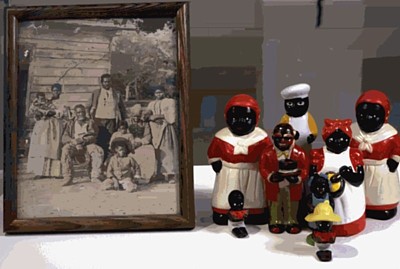
Fred Wilson: Mine/Yours, 1995. Collection: Whitney Museum
How Objects Get Their Meanings
Artist Fred Wilson has worked in various museum education departments: at the Metropolitan Museum of Art, the American Craft Museum, the Whitney. Therefore it may seem only natural that his main subject appears to be museums, and most particularly how museums present, and in doing so either consciously or unintentionally interpret, the objects they put on public display. I have worked in museums too, so of course I am interested in the subject.
But why should anyone not directly connected to museums care about art that calls attention to museum practice? Aren’t museums just nice places to look at art?
When I was briefly the chief curator at the Everson Museum of Art in Syracuse, N. Y., I helped to negotiate the trade of several Onondaga sacred ceremonial False Face masks for works by contemporary Iroquois artists. Although the museum had purchased the masks from a former Onondaga tribesman, they are meant to be seen only in religious rituals and were truly part of the Onondaga Nation sacred heritage. (Let us not go into how or why the woven-bead belt used to seal the dubious agreement between the seven Iroquois Nations and the U.S. has mysteriously disappeared from the N.Y. State Museum in Albany.)
At the American Craft Museum (where I was senior curator), it was a battle only half-won to get non-European and even non-New England craft traditions represented in a purported history of American Crafts.
As a student of material culture, I knew the importance of allowing objects and their makers to speak. As a poet and fiction writer I know that stories can kill as well as cure.
Wilson works with actual museum collections to expose the perhaps unconscious racist fictions employed in their gathering and display. In other, less site-specific, works he uses the trappings of museum presentation — the cases, labels, lighting — to reveal similar instances of injustice. A survey of his thought-provoking, but surprisingly emotional, art called “Fred Wilson: Objects of Installations,” is at the Studio Museum in Harlem (144 W. 125th St.) until July 4. Since Wilson tends to work in very large and thematic exhibition formats, often inspired by specific sites and/or temporal contexts, this midcareer retrospective is out of necessity composed of fragments and set pieces from his bigger statements.
Although there had been much soul-searching in the museum field and theorizing galore about this topic, nothing fired up the field’s collective imagination as much as Wilson’s ground-breaking 1992 intervention, “Mining the Museum: An Installation” at the Maryland Historical Society. It took an artist to “objectify” a not exactly unknown museum critique: museums house hidden agendas and may often repress historical truths. Paradoxically, the impact of Wilson’s efforts show how important museum exhibitions can be. He went through the Maryland Historical Society’s permanent collection and highlighted and juxtaposed certain images and objects to bring out the story that was not being told — thus exposing the real story that was being told.
In regard to paintings of well-to-do-households — there were, of course, no others, the poor always in the background — Wilson put spotlights on the black servants hovering in the shadows. More shockingly, he placed slave shackles in a case with Baltimore Repousse-style silver hollowware made in the same period. Also, very photogenically, he displayed fancy side-chairs with an actual whipping post that had also been “buried” in the permanent collection. Currently (but inadvertently more relevant to the headlines than one might like), one can get a taste of Wilson’s Baltimore show at the Studio Museum, where Cabinet Making stands for his whole effort by displaying four chairs arranged as if an audience is about to look or has looked at the actions represented by the self-same whipping post.
Not all of Wilson’s works are as notoriously and dramatically site-specific as “Mining the Museum.” But because his work is about context and display as much as the meanings of objects, and since his work, like my own, is more interrogatory than accusatory, it will do us well to note the following questions, not all of which are rhetorical:
Do we have to know that Wilson is of African American and Caribbean heritage and has brown skin to understand his use of black collectibles (perhaps more correctly called Derogatory Art)? In Me & It (1995), we do see the artist in a videotape trying to imitate the facial expressions of some of the nearby derogatory figurines, while simultaneously we see a taped closeup of someone smashing similar figures. Is it important to know how much an Aunt Jemima giveaway is now worth? Why do some black people collect this Derogatory Art? Why do some white people still find racial stereotypes amusing, the way some people, including those of color, find anti-Semitic jokes and gay jokes hysterically funny?
Do the four museum-guard uniforms on dark-skinned but headless manikins (Guarded View, 1991) mean something more or something less in a museum in Harlem, where the guards, also black, are more casually dressed? Why does a spiffy uniform equal invisible? Why do we have to read the catalogue to find out that Wilson once gave a gallery lecture at the Whitney dressed as a guard? Why did people he had talked to a few hours earlier not recognize him until he began speaking? What does it mean that Guarded View is now in the permanent collection of the Whitney Museum?
Shouldn’t we know that both Wilson’s photo blowup of Les Demoiselles d’Avignon with an African mask implant (Picasso/Whose Rules, 1991) and his family of plastic skeletons (Friendly Natives, variously, “shockingly” labeled “Someone’s Mother/Sister,” “Someone’s Father/Brother,” “Someone’s Grandfather/Uncle,” and “Someone’s Grandmother/Aunt”) were shown in a commercial gallery as a response to the notorious Primitivism exhibition at MoMA? What other labels would be equally upsetting? “Methodist Minister,” “Uncle Stanley’s Lifelong Male Partner,” “Republican Lesbian Grandmother,” “Art Critic and Poet?” Does the ordinary viewer know that the piece refers to the once common practice of showing the bones of non-Western peoples with impunity, as if they had been animals?
Do Wilson’s “beautiful” Artemis/Bast, 1992, in which a black Egyptian cat head replaces the toppled Artemis head nearby, and his white-to-black, five plaster Nefertiti busts of the following year confirm Martin Bernal’s Black Athena thesis that Greece and thereby Western civilization owes more to Africa than has been acceptable? Or is the artist making fun of street-corner Egyptianism?
Do the “objects” in this exhibition, removed from their original installation contexts lose meaning? Gain other meanings? Is this rather like what happens to all non-Western or pre-modern Western art that is shown in museums, derived of context?
What about the installations that are not represented? It is understandable that only a photo in the catalog can represent Wilson’s uncovering of slave tombstones under the floorboards of the historic St. Philip’s Church in Old Salem, North Carolina, but why do we not have any evidence in the exhibition itself of Wilson’s 1993 Capp Street project An Invisible Life: A View Into the World of a 120 Year Old Man? Is it that Wilson’s fictional Baldwin Antinous Stein had too many lovingly collected photographs of his male friends?
And what about what might be called the “context of the viewer?” Do I, a white viewer, see the show differently from a nonwhite one? Furthermore, do I see the artworks differently because they are being displayed in a small museum in Harlem and not in the Whitney Biennial or at the Metro Pictures gallery?
* * *
Beyond the institutional critique he offers, Wilson makes objects speak, in a post-Duchampian way, not so much by creating new thoughts for objects and images (which is what the great Marcel liked to say he was doing), but by revealing the meanings these objects and images already have. But it isn’t all analysis. Wilson now has a language through which truth pushes him beyond analysis.
A case in point is the new addition to the exhibition: four movie versions of the climactic murder scene in Othello. All the actors playing Othello (one is Orson Welles) are in “tan” makeup. The theoretically identical scenes are shown simultaneously, and backwards. Does it matter that this piece was in Wilson’s Venice Biennale show last year, focused on the theme of the representation of blacks in Venetian art and culture? That Shakespeare’s Othello takes place in Venice? That Wilson meant this as a response to 9/11, thus explaining why the scenes are running in reverse, as if to undo intolerable history?
Oh, Synecdoche, why are you art’s middle name?
Let me explain. The Greeks had a word for it: synecdoche. Synecdoche is not exactly a symbol or a metaphor: it is a figure of speech in which, most commonly, a part stands for the whole. Wilson uses found objects synecdochically. In other words, a pair of crude slave shackles stands for slavery and the repression of its meaning and history; a tiny Aunt Jemima pancake-package figurine posed facing and dominated by a much larger, white female doll (Conversation II, 1996) not only stands for racism and class domination, but also for the commercialization and appropriation of “the other,” as well as for media trivialization of servitude and oppression. Of course, some of Wilson’s found objects are art objects. And when two or more synecdoches are juxtaposed, as often happens, you get explosions of meanings.
I understand why it may be appropriate for the Wilson exhibition to be at the Studio Museum. Wilson is, after all, a highly successful artist who can serve as a role model, and his subject matter might have particular resonance for Harlem residents. But here is the biggest question of all: Why wasn’t an expansion of this show or a new installation simultaneously in one of the downtown museums? Does Wilson’s art ask too many questions?