
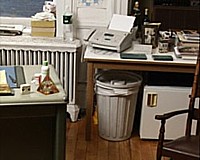
Ruppersberg: (detail) The New Five Foot Shelf
Why Leave Home?
He lives there in two rooms which he had covered ceiling to floor with the most strange and troubling designs that made certain distinguished critics repeat for the thousandth time: It is nothing but Literature!
— Giorgio de Chirico, quoted at the beginning of each book in
Ruppersberg’s The New Five Foot Shelf
I like to keep my eye on new forms as they grow and mutate. In the deep, dark past I did that with conceptual art, performance, and video art. Now I’m watching Internet Art, the liveliest subset of Cyber Art (i.e., computer-based art), which, as of yet, is not saying much. I am not sure if mere PhotoShop manipulation of digital images qualifies as Cyber Art, since the electronic darkroom is still “a darkroom by any other name.”
But wait. I don’t want to be a formalist by insisting that each art form must exploit characteristics unique to itself and not others. Nevertheless, it is a place to start, bearing in mind the McLuhan principle that new technology initially imitates its predecessor: early automobilesmimicked the forms of horse-drawn carriages, hence the nickname “horseless carriage.”
As we now know, video moved unpredictably from single-monitor to multiple-monitor installations and then to DVD wall-projections. Sometimes, when I go to galleries or museums, I feel I am still trapped in the 1964 N.Y. World’s Fair, which featured multiple-screen movie projections everywhere.
Seeing a computer in a gallery or a museum makes most people want to turn around and run. If I am out on the town, I want to be in a gallery or a museum, not in a library or at work. Most of all, there is something too humbling and too revealing about being seen in public clicking away at keys in front of an IBM or Mac.
Nevertheless, Internet Art is a fact. The Whitney, S.F. MoMA, the Walker Art Center, and the DIA Museum all have Internet Art websites. Internet Art so far is like cable TV, but free. It’s like photography in a book, or a poem read to yourself, or the usual way people look at pornography. It’s for one person at a time. It’s private and, I suppose, could be contemplative — though mostly it is not.
That said, all kinds of hell can break loose: The hell of boredom, the hell of self-indulgence, the hell of cartoon and stick-figure subart, and the hell of unwarranted complexity. Perhaps some day soon, when we all have giant, flat screens we can plug our computers into, Internet Art will look more like DVD projections in galleries and museums: rent-a-painting, rent-a-photo, rent-a-performance art epic of ice cubes melting. Turn your bedroom wall into awebcast of the Brooklyn Bridge.
* * *
All of this is but a prelude to an artwork by Allen Ruppersberg launched by the DIA Art Foundation just this past week. Ruppersberg’s The New Five Foot Shelf, we learn from the press release, is based on “an edition and installation” completed in 2001. We are not informed where, when, or if the installation was on public view. Ruppersberg, however, is hardly a newcomer and has shown his conceptualistic pieces all over the place, ranging from MoMA New York and the New Museum to ArtPace in San Antonio.
On the surface, The New Five Foot Shelf is about Dr. William Eliot’s 1910 Five Foot Shelf of Books, the Harvard Classics that purported to be the equivalent of “a Harvard Education.” Ruppersberg’s version includes a replica of Eliot’s preface that begins: You remember perhaps, President Garfield’s reply when asked for a definition of college. “My idea of college”, he said, “would be Mark Hopkins on one end of a log and a student on the other.” We do know who President Garfield was, but we’ll have to Google Mark Hopkins, won’t we?
(Hopkins was one of the founders of the Central Pacific Railroad, but why this qualifies him for this particular metaphor or what it means would need further research. Was he the Trump of his day? Will Trump someday need to be Googled too?)
Now the bindings of at least one edition of Dr. Eliot’s education populizerhold Ruppersberg’s own amalgam of texts. Five simultaneously running screeds go from page to page on your screen. You can select each volume and then read each, page by page. Or, if adventurous, read down the page for a wild collage. There are the equivalent of 800 pages.
Volume numbers on the spines are not the same as the volume numbers on the inside of the “books.” The former are at random; the latter in order. Be forewarned also that the first volume (a facsimile of Eliot’s introduction to the original Five Foot Shelf) requires Adobe Reader. If you are on dial-up, loading pages and images can be rather slow. Arrows to turn pages are at the bottom of the book window.
The table of contents, repeated like the de Chirico quote at the front of each volume, will convey the flavor of the entries:
1. Honey, I rearranged the collection
2. When In Doubt Go to the Movies
3. ONCE UPON A TIME WHEN BOOKS WERE FAMOUS
4. The Three Marcels [Duchamp, Proust, and Broodthaers]
5. THE MASTER OF THE FAMILIAR (PRIVATE)
One can also elect to scan images of the artist’s former Manhattan hideout at 611 Broadway (1986 to 2001), all four walls, rectangle by rectangle. These have been made into life-size posters that if assembled would exactly replicate the original space: with images of books, postcards, radiator, stuff and more stuff. You can find your way through all of this using MapQuest-type arrows. There are also a number of rectangular views you can download for use as wallpaper on your computer or, I suppose, if you were ambitious and wanted to spend the money for color-ink cartridges, as real wallpaper for your very own digs.
This is not an easy work to describe, although I can notate it by going back and forth between my Word screen and the online DIA site. I hope the reader enjoys the irony. Reading all the Ruppersberg pages will take forever, so perhaps the best thing to do is use the texts like the I Ching or read them like a novel. It is, after all, subtitled Memoir/Novel/Index.
I can also look at a little bit of it now and then, some more later — and so can you. It is much better to deal with text-based art on your computer than in a gallery.
I found The New Five Foot Shelf engaging on several different levels, which is always a good sign. Is it safe to say that everyone interested in art is in some sense a voyeur? Sure enough. Therefore, artists conversely must be exhibitionists. Ruppersberg is playing with our curiosity about where someone else lives and what someone else reads or writes. This turns out to make him a poet of the ordinary: That radiator is too familiar. That “what am I going to do with all my books?” feeling is too universal. Those Duchamp references are too reader-friendly. And yet we keep going through the pages of the books and keep scanning these long-gone walls and shelves. Hoping for what? A corpse? A book of one’s own? Where are those conceptual art anthologies I am in?
Clearly, Ruppersberg isn’t a techno-visionary, not here at least. He does not propose a new use for the internet. Instead, he capitalizes on what most people do with the internet: find texts to read and pictures to look at. Although I learned that Ruppersberg is as big a pack rat as I am, we do not really learn anything more about the artist himself. But we didn’t want to, anyway. He reads the same books as everyone else. Reading lists are not an identikit; only evil government forces think they are. Specific books, bundles of postcards, quotations, funeral notices and so forth are in themselves of no particular interest, but it is the mass of them and the retrieval system that is. All we needed to have confirmed is that the best place to hide is within the quotidian.