
First he took on the Polish government, which claims he’s stereotyping Poles as anti-Semites, a charge he denies. Now he’s taking on a bigger fish — The New York Times, which has declined to review his play.
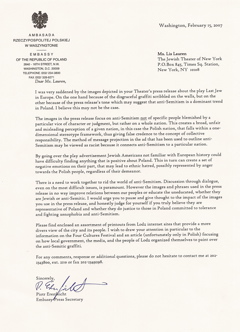 In an open letter to news media, Tuvia Tenenbom accuses The Times of doing “the Polish government’s bidding … by refusing to allow Times critics to review ‘Last Jew in Europe.’” The play opened last week in an off-Broadway theater on Manhattan’s Upper West Side.
The letter also calls for the firing of the recently appointed chief of The Times theater department, Rick Lyman, whom Tenenbom deems responsible for “censorship by omission” and an attempt to “stifle free speech.”
I phoned Lyman for his response. He declined to comment, referred me to The Times spokeswoman Catherine Mathis, and hung up on me in mid-sentence. She was unavailable. (See PPS, below.)
Several major European newspapers and magazines have written about the play, in largely laudatory terms, including the top German weekly news magazine Der Spiegel (“Das Drama mit dem Antisemitismus”), the Frankfurt daily Frankfurter Rundschau (“Tuvia & Erika”), and Italy’s most respected daily Corriere della Sera (“Teatro d’accusa”).
“It never occurred to us that The New York Times would join with anti-Semites so easily,” Tenenbom writes. “We did not ask for a ‘good’ review; all we asked for was that this important project not be ignored.” He contends that the paper’s unwillingness to write about the play is a “slap in the face on an issue of utmost concern to millions of American Jews, many of whom are faithful readers of the Times.” The paper has covered other plays of his.
Full disclosure: I reviewed the play last week.
Further intelligence: Princeton University professor Jan T. Gross, the author of “Fear: Anti-Semitism in Poland after Auschwitz: An Essay in Historical Interpretation” and “Neighbors: The Destruction of the Jewish Community in Jedwabne, Poland,” will participate in a post-show panel discussion with the author Thane Rosenbaum, who teaches human rights law at Fordham University Law School, on March 27 at The Triad Theater, where “Last Jew in Europe” is being produced. (A spokesman for the Church of Latter-Day Saints who was to participate has dropped out.)
Here is Tenenbom’s letter in full:
For Immediate Release
The JTNY, 212.494.0050
The Jewish Theater of New York calls on The New York Times to Remove Rick Lyman from his new post of Theater Editor.The Polish government, using its embassy in Washington D.C. and its Consulate General in New York, is investing resources and time in order to discredit our new show, LAST JEW IN EUROPE. According to the Polish government the show, which uses authentic documentary materials to illuminate the newly resurgent anti-Semitism in the heart of modern-day Europe, could “create a set of negative emotions” in American Jews towards Poland. To prevent this from happening, they urge our theater not to use the documentary materials we collected while in Poland. If we fail to do so, they insinuate, we are “racist.” This bizarre intervention by a foreign government in the affairs of an American theater should not be allowed to succeed and will not; we will continue to present our show. However, we are shocked to learn that the Theater Department of the New York Times, under the new leadership of Mr. Rick Lyman, decided to do the Polish government’s bidding and do its share to kill the show by refusing to allow Times’ critics to review LAST JEW IN EUROPE. This slap in the face on an issue of utmost concern to millions of American Jews, many of whom are faithful readers of the Times, was so important to Mr. Lyman that he issued his order on the second day on the job. To achieve this dubious goal, Mr. Lyman and some of the administrators in the Theater Department engaged in outright lies while speaking to our Artistic Director, Mr. Tuvia Tenenbom.
After being notified that “we’ll pass on reviewing” the LAST JEW IN EUROPE because “not one of our critics wants to review” the show, Mr. Tenenbom personally called a few critics. They flatly denied that they ever refused to review the show and claimed that they were not given the opportunity to do so by Mr. Lyman; in addition, they expressed their own opinion that LAST JEW IN EUROPE should indeed be reviewed. Some even asked Mr. Lyman to change his mind, but he refused. Mr. Tenenbom also spoke with Ms. Patricia Cohen, the Theater Editor prior to March 1, 2007 and was told by her that this was “Rick’s decision; I can’t do anything about it, I’m no longer the editor.” But Rick Lyman is not Patricia Cohen. In an angry and uncontrolled outburst that followed days later, Mr. Lyman told our Artistic Director that since the “last two reviews by the Times were negative, we won’t review your theater this year.”
Commenting on this patently lame excuse, Mr. Tenenbom said: “His words were so strange that my ears could hardly tolerate listening to him. This is not about “good” reviews, this is about abhorring censorship. In our theater we regularly deal with sensitive political issues, where the chance of negative review is higher. We understand it, and we never complained about a bad review; why does he? We are the only English-speaking Jewish theater in the city, all the others closed down years ago. What does he want, to close us down as well?”
What the New York Times is doing in this case is censorship by omission as it tries to stifle free speech. It never occurred to us that The New York Times would join with anti-Semites so easily. We did not ask for a “good” review; all we asked for was that this important project not be ignored. But after more than a decade of continuous coverage by the Times, this new editor flexes his muscles, aided by outrageous lies, and all-too-gladly joins racist censors of the Polish government.
We understand the risk we take by making this story public. After all, the Times’ Theater Department is the unquestionable lodestone of most theater people in this city. But we cannot be silent in the face of rising anti-Semitism in Europe and the New York Times’ attempts to keep it out of the public awareness. The rise of anti-Semitism in Europe should not, and will not, be kept a secret from millions of New Yorkers just because of one man.
The New York Times, due to its enormous influence, has obligations to the public that it must meet. If it refuses to do so, it is our obligation to make this story public. It is our belief that if the New York Times wants to be a liberal paper it should never support either racism or censorship.
LAST JEW IN EUROPE was just recently reviewed by some of the most prestigious publications in Europe. The New York Times can do no less. It is a well known fact that during WWII the New York Times wrote as little as possible about the horrors that befell the Jews during the Holocaust. Indeed, the outstanding order at the time was not to have Holocaust stories on the front pages. Is the New York Times returning to the same patterns? Is every mistake bound to repeat itself?We hope that our call won’t be a voice calling in the wilderness and that the top echelon of the Times will rise to the occasion and either fire Mr. Lyman or revoke his boycott of our show immediately. We also urge the other critics in our city to not follow Mr. Lyman’s example. If one man chooses to be blind, the rest of you are still allowed to open your eyes and see. Judge for yourselves. Judge us harshly if you wish, but judge us!
With hope for better times to come,
The Jewish Theater of New York
Postscript: A reader writes, “I guess Lyman picked up on Clive’s take on totgeschwiegen and put it to use.”
Here’s the reader’s reference, from an item called GERMAN LESSONS in Dwight Garner’s column in The New York Times Book Review of March 11, 2007:
Leave it to Clive James, the London-based critic and poet — his new book, ”Cultural Amnesia: Necessary Memories From History and the Arts,” is due out any minute — to remind us that the Germans have yet another useful word Americans should be more familiar with. It is totgeschwiegen, which James defines this way: ”Killed by not being mentioned.”
PPS: Sam Sifton, culture editor of
The Times, replied in an email late this afternoon to my request for a response. He wrote:
The New York Times has by no means decided not to review shows put on by The Jewish Theater of New York. Instead, we are adopting the same policy that we use when evaluating which books to review, or musical performances (or recordings), or art shows, or restaurants. There’s simply no room for them all. And in this instance the editors have decided to take a pass.
Moving right along: A reader writes, “Yes, I have seen how things can be totgeschwiegen in the NYT — like the half a million people protesting the Iraq War in NYC before the war began.”


