Another Bouncing Ball: September 2009 Archives
From C-Monster:
The graffiti artist who stole a buncha pencils from a Hirst installation at the Tate Modern is now threatening to sharpen them.In response to my reposting C-Monster, an artist emailed me:
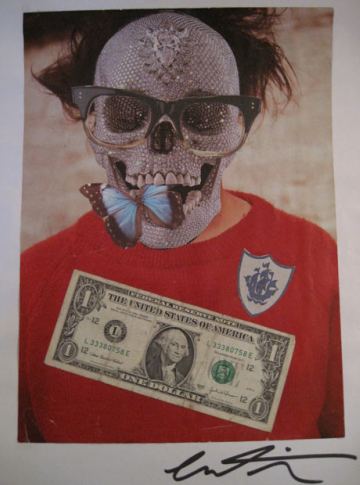
That's cute, Regina, but you're missing the point. One artist vandalized the work of another. The pencils aren't just pencils, any more than Claes Oldenburg's bat is just a bat. In a more rational world than the one shaping up online, art critics would support the artist, not the vandal.I think it's worth remembering that Damien Hirst started this fight when he took teenage street artist Cartrain to court for copyright infringement, and, in an astonishing miscarriage of justice, won.
Copyright? Cartrain's collages are satires.
An example of what Cartrain was forced to hand over to Hirst's lawyers, posted by Jonathan Jones:
 I love Hirst's work, but he's in danger of becoming the Dick Cheney of the art world.
As Jones wrote:
Damien Hirst's feud with teenage street artist Cartrain could yet become the most controversial story of Hirst's career. It really is vile for a rich man to use his power to bully someone who, after all, is just trying to emulate him by making art with found materials.
Presumably, what irks Hirst is that Cartrain used Hirst's diamond skull in a series of collaged portraits of the skull's creator. Hirst successfully demanded that all the young artist's works incorporating the diamond skull should be handed over, presumably to be destroyed. (more)
(That's two presumablys in one paragraph. Doesn't the Guardian employ editors?) Of course Cartrain should give Hirst back his dick pencils. But Hirst needs to stop being such a dick. One Cheney is more than enough.
 More on Betty Bowen Award for Northwest artists here, now in its 31st year. Faught receives $15,000. Seattle's Jenny Heishman and Matthew Offenbacher each get $2,500 special recognition awards. The trio will speak at the Seattle Art Museum Oct. 23, 6-7, followed by a reception. Free admission.
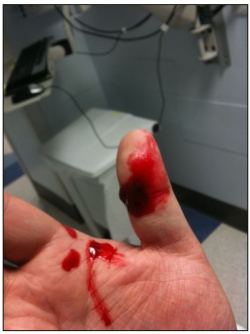
When it is time to pick up your kids, try pulling a root beer from the back of the refrigerator. Watch the glass milk bottle slip and fall. Try to catch it! Watch it break into large, clear pieces. Watch the milk, glass and blood pour through your fingers. Drop your keys into the recycling can. (You will find them in a few days! They will be sticky.)It could happen to anybody, but it tends to happen to glass artists, maybe especially artists who are only dabbling in the medium.
Run to the bathroom, leaving a trail. Decorate the entire bathroom in red. Watch the toilet paper disintegrate into bright red mush. Put on more and more toilet paper. Try to figure out how to stop the bleeding in two different hands at the same time. Try to dial a cell phone to call your spouse. Hear the fear you've put into her. Try paper towels. Watch them turn cherry red.
Ride shotgun and fetch the kids and a pizza. Watch as others clean up the milk and glass. (Clean up the crime scene yourself.) Study the wounds. Find slashes on pinky of left and thumb of right. Tape them up. Try learning to a) go to the bathroom b) wash hands effectively when the leftmost digit of each extremity is bandaged. That night, watch The Wrestler. Sit back and relax as our harassed hero begins to slice meat at the deli counter. Ahhhhhhhhhhhhhhh!!!!!!!
Take Jason Hirata at the Dirty Shed. (Story here.) Below, he and Sol Hashemi improvise with florescent tubes.
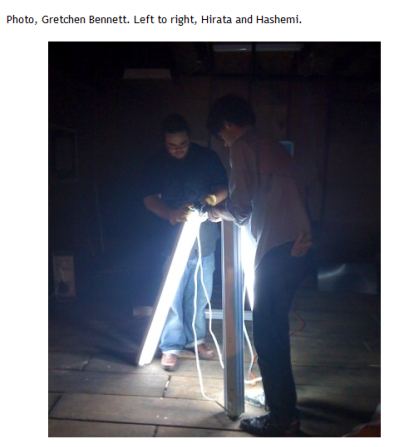 That's the told story. The untold story is that Hirata dropped a light tube and caught it as it crashed, turning the shards red.
 I know an artist who almost bled out when a glass shard cut into her thigh. Fortunately she called 911 before fainting. In Hirata's far less serious case, no harm done.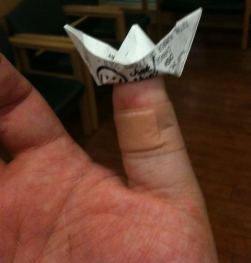
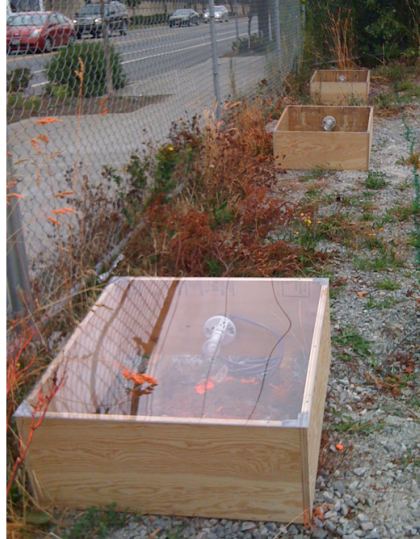
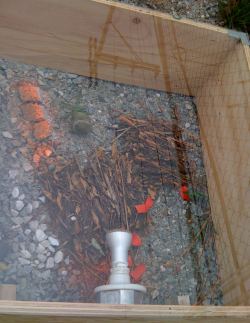
(A project for Capitol Hill Housing with assistance from Steve Zielke.)
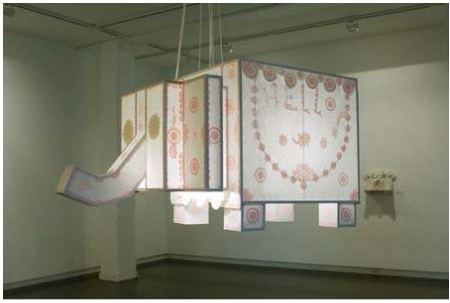
Mitchell:
 McMakin :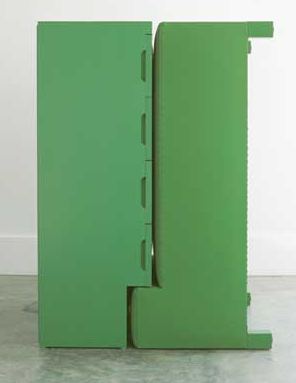
I will walk upon the beach... (via)
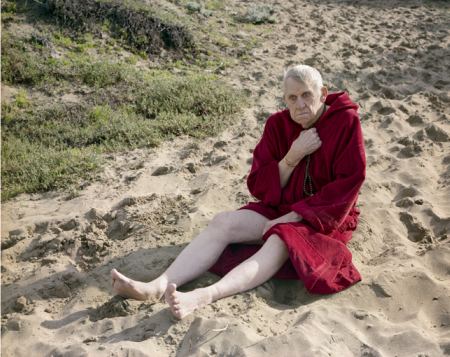 Zoe Strauss
Bare ruin'd choirs where late the
sweet birds sang (via)

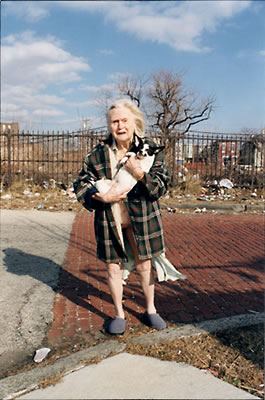
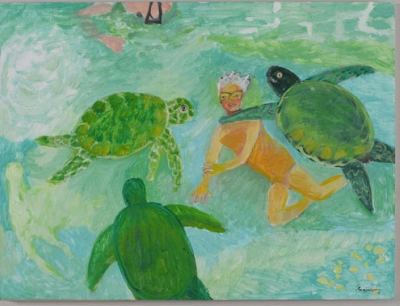
I have heard the mermaids singing, each to each.Sometimes they do.
I do not think that they will sing to me.(via)
Elizabeth Sandvig
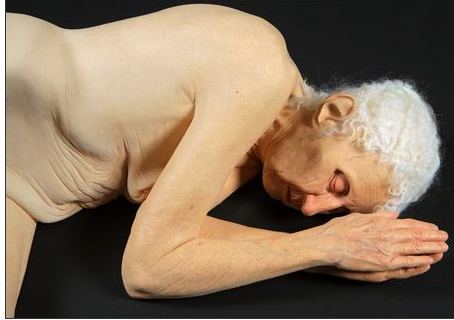
The NYTimes recently published an image of Ambroella trichopoda as the sole surviving member of the oldest extant family of flowering plants, "a small shrub found only on the island of New Caledonia in the South Pacific."
I am reminded of our good friend Wes and his accosting Kathryn Hepburn on the stairs of the Burke Museum, giving her a fossil flower from Republic, and in his charming but star-struck manner, inadvertently comparing her to same.
Ou sont les fleurs d'antan?

I responded:
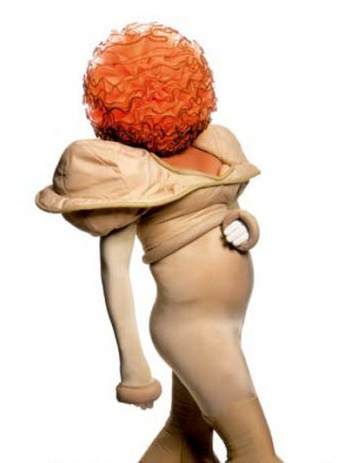
Wes was so star-struck. Reminds me of the Leigh Bowery-Mick Jagger exchange. Late one night in a bar in London, Bowery turned around and bumped into Jagger. Jagger said, "Out of my way, freak." Bowery responded, "Out of my way, fossil." (Image via)
The graffiti artist who stole a buncha pencils from a Hirst installation at the Tate Modern is now threatening to sharpen them.
(Jonathan Jones opines. Art Observed.)
Rafael Lozano-Hemmer (via)
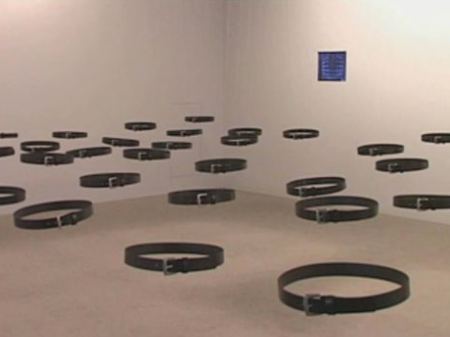
Standards and Double Standards is an interactive installation created by Rafael Lozano-Hemmer which is comprised of fifty buckled belts that hang from motors in the ceiling and a computerized tracking system. The belts will slowly turn so that the buckles face people walking by. If only one person is in the space, all the buckles will face him or her. If several people are present and moving around, there is more movement, as the belts closest are the ones influenced by each new presence. The belts are at waist height, so the effect is of a crowd of ghosts wearing belts whose invisibility wore off. An interesting idea presented by Lozano-Hemmer is that the belts represent a fetish of paternal authority.Debra Baxter, at Or Gallery through Oct. 17. Earlier review here.
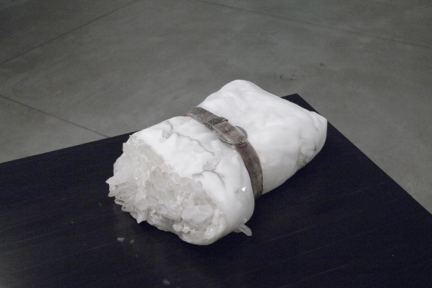
Cerny is well-known in Seattle for her drawings. What she's showing north of her home town is new.
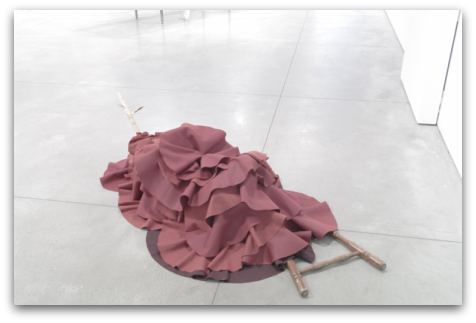
Seattle Art Museum, opening Oct. 15.
Alexander Calder: A Balancing Act
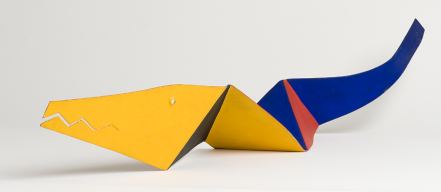 Plus, Michelangelo Public and Private: Drawings for the Sistine Chapel and Other Treasures from the Casa Buonarroti
Nice, but nothing people are going to fly in to see, especially considering the recent flurry of Calder exhibits in New York. The fly-in show opens May 13: Kurt.
Henry Art Gallery
Vortexhibition Polyphonica, opening Oct. 3. Great idea. The Henry looks for interconnections within its collections.
Though the Henry is recognized as the region's preeminent contemporary art museum, its holdings include 19th-century paintings, contemporary art and photography, textiles and costumes, ceramics, and many other art objects that are little known.You bet they're little known. If they're not photographs from the collection, the Henry rarely shows them, and there is a lot to see.
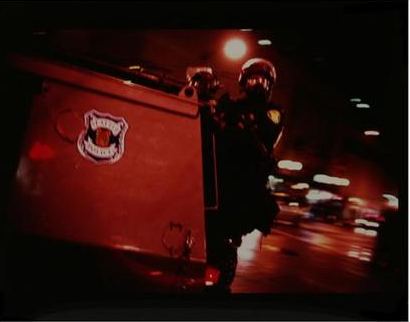
Alan Sekula: Waiting for the Tear Gas, photo survey opening Oct. 8. Take a trip down memory lane, back to when Seattle did the World Trade Organization to the sounds of breaking glass and the screams of the wounded, accompanied by the smell of tear gas in the morning.
 Polaroids: Mapplethorpe opens Oct. 24. Henry director Sylvia Wolf curated this show for the Whitney last year before she was Henry director, or she would have curated it for the Henry.
Below, Venice, 1903
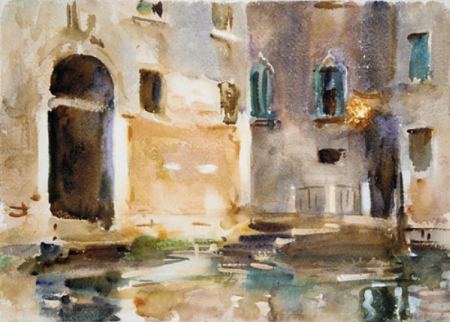 Charles LaBelle also makes art as he travels, but in his case, he makes it everywhere he travels, at least in places with structures on them.
Since September of 1997 I have maintained a database of every building that I have physically entered. A record of each building is made upon entering the building for the first time. This information is subsequently entered into the database. Additionally, the database is supplemented by a photographic archive of each building. Each building is photographed, if possible, before entering it. However if a building is not for any reason photographed, it is still recorded in the database. The database includes the date and time I entered the building and the building location (street, city, state and country). As of January 2009 there are approximately 9,200 buildings in the database with additional buildings being added almost daily. The photographs themselves are never to be shown. They exist as raw supplementary data only. Rather, the project, whose true site is the realm of perception and consciousness, is represented by the database itself and occasional drawings of individual buildings made from the photographs. When executed, each drawing is done in brown watercolor pencil on sheets of paper ranging in size from 4 x 4" to 9" x 12." It is not important that the drawing be done at all.Archaeologies of the future here, 268 drawings and counting. They are part of his continuing exploration of psychogeographics, the relation between place and the person in it, him. I love the rough drafts he's posting on Facebook:
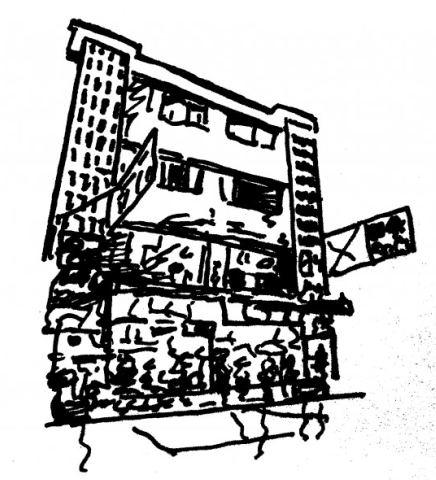 He describes them as:
 a limit of space, not a space: the limit where space becomes pure time, but where pure time annuls the event. No passage, no coming, no departure, no birth or death, no attraction or excitation of a new subject, and consequently no disappearance of the new, no abolition of its novelty in its other absolute novelty that is its empty place or its tomb. No not.
Joel Dean:
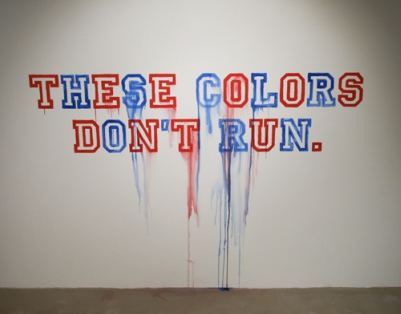
Chas Bowie's review of Jeffry Mitchell and Roy McMakin's collaboration in Portland:
"Joy and Reffry," on view at Pulliam Gallery, sounds at first like a curatorial sendup of "The Odd Couple" recast with two of Seattle's most highly regarded artists.
Playing the role of neat freak Felix Ungar in our contemporary incarnation is master craftsman Roy McMakin --artist, furniture designer and architect, whose impeccable sense of formal restraint and subtle humor have led to international success in both the art and design communities. McMakin's free-spirited foil in "Joy and Reffry" --his Oscar Madison, if you will --is genre-twisting ceramic artist Jeffry Mitchell, whose showy, neo-Rococo sculptures of pachyderm romance and irrepressible curlicues would seem stylistically antithetical to the deadpan austerity of McMakin's furniture-art.
McMakin and Mitchell's first collaboration, however, finds the unlikely duo's well-honed voices layered in a rich harmony, with "Joy and Reffry" humming a lovesick tune about long-lost objects, invented memories, mournful absences and tactile pleasures. (more)
I read it with interest and mounting dismay. To my knowledge, this show attracted only one other review to date - mine. Bowie's reached a deeper level and did it with ease. His Oscar and Felix conceit is on target. I comfort myself with the idea that having one day in Portland, I reviewed the show at the opening, always tricky. But McMakin and Mitchell are Seattle artists. I wasn't seeing their work for the first time. Maybe I'm posting too many images and not enough text.
Speaking of good reviews, there's also Douglas Britt's in the Houston Chronicle, titled, Houston can take cues from Seattle exhibit:
The Seattle Art Museum's Target Practice: Painting Under Attack 1949-78, which closed on Labor Day, was the kind of ambitious show that deserved to spend the next couple years on tour. Maybe in a better economic climate it would have. But other museums -- perhaps daunted by the cost of shipping major works borrowed from more than 70 lenders around the world -- passed. They missed a chance to present that rarest of birds: a crowd-pleasing survey of some of art history's most difficult material for audiences to understand, let alone appreciate and enjoy. (more)
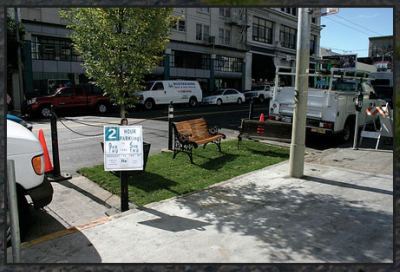 Origins here. Participants in Seattle include Crawl Space and the Seattle Art Museum, which is going all out:
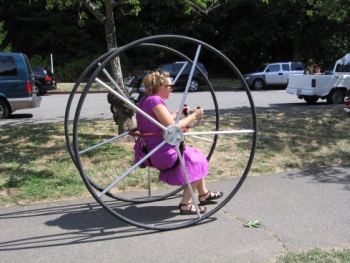
Parking spaces near the Seattle Art Museum (SAM), on University Street between First and Second Avenues, will be transformed into a temporary "park" replete with sod, art activities and exhibitions, performances and even a chance to test drive the "Walk and Roll" low-impact vehicle, on national PARK(ing) Day, Friday, Sept. 18, from 10 am-2 pm.
Game critic alert: Jen Graves tried out Peter Reiquam's Walk and Roll last month at aLIVe. (Photo credit and story here.)


 From Crawl Space:
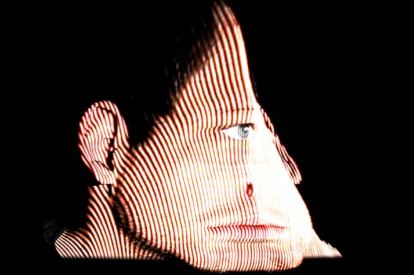
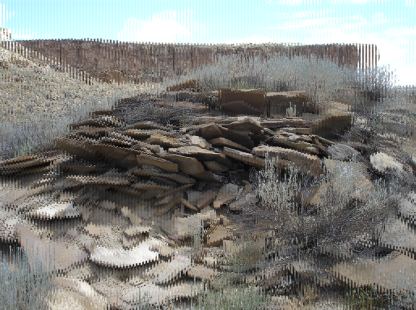
Jansen explores the space between premeditated experience and the choices that presuppose modes of depiction. As his title (No Chasm, No Cleft) alludes -- referring by way of negation to the location where ancient Greek oracles tapped into the unseen, mysterious, and infinite -- Jansen is searching for new ways of conceiving or understanding the world by breaking down the photograph, the most prevalent archetype of representation in the present day. Although the work in the show makes use of several photographic processes such as recording, scanning, slicing, editing and projecting, combined together in several unique techniques, Jansen captures not only the flat appearances of the picture plane but also structural information from multiple and fixed viewpoints. The work is also premised on the notion that how we choose to represent what engages us in the world is inextricably linked to how we understand our place in reference to it, conscious of the limitations of our points of view.There is a chasm, of course, but it's the uncertainty afflicting those who examine the unreliability of perception, a terra not firma. In art, few subjects are as well trod. Jansen stakes a believable claim, even if he's staking it in the wrong medium.
He began as a painter working from photos but lost faith in his ability to undermine the solidity of their depictions. Hence, video, which is in hands is a dubious prospect.
In the insistence of their flickering lights, his videos berate the audience with what it doesn't know, which being an art audience, it knows already. Unlike Doug Aitken's Electric Earth, scoring on the same theme in 1999, Jansen's videos are both painful and obvious. If they were just painful and offered something not done better elsewhere, that's one thing, but painful and obvious is not worth the anti-pleasure price he's asking.
What works are the stills from the videos. He's really a photographer, and video should be part of his process at arriving at his final product, a means to what could be his significant end.
His self-portrait in chalk, which glows in the dark:
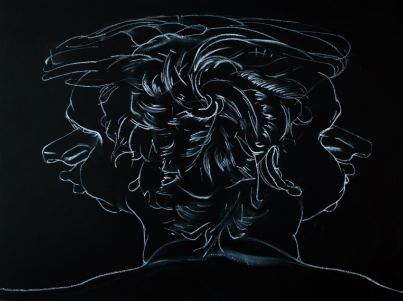 Through Oct. 11.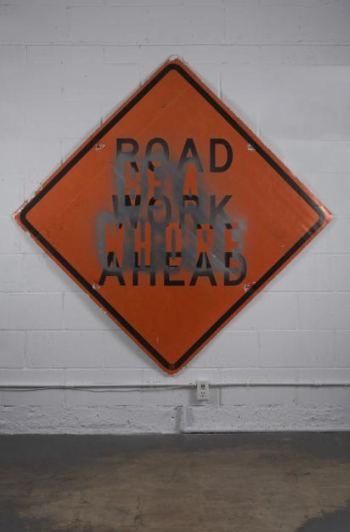
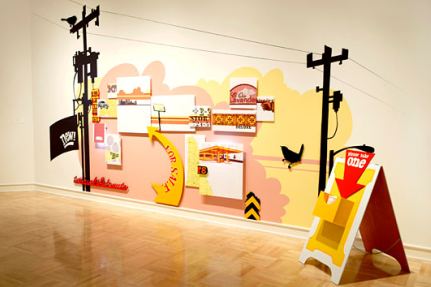
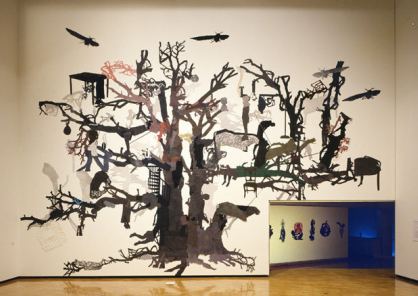
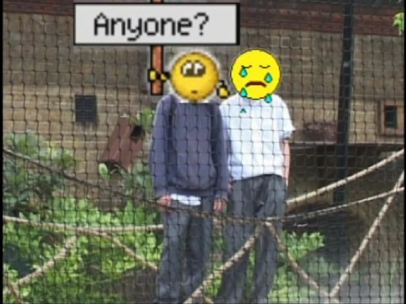
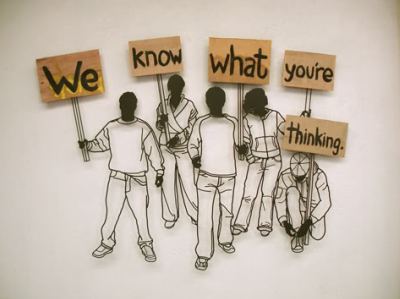
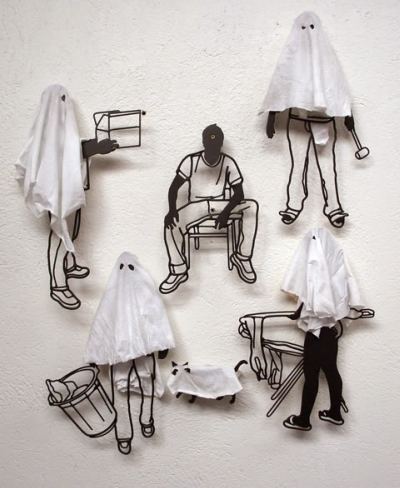
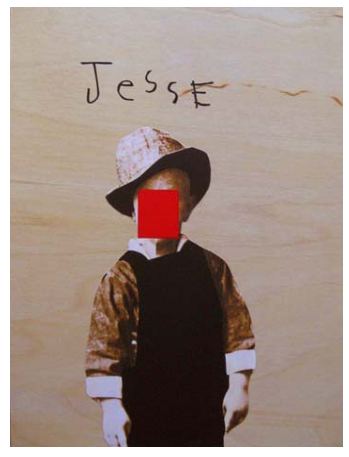
 The peerless Boyle Family. Not photographs. Random pieces of random streets recreated as sculptures on the wall.
(Image via)
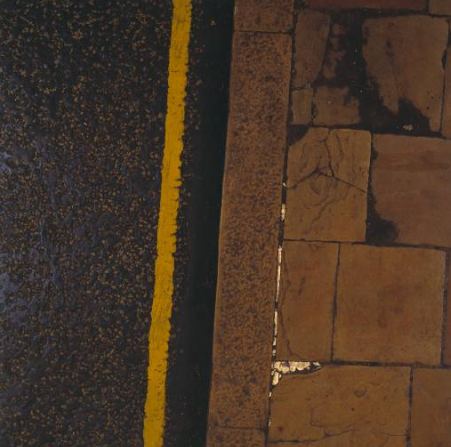 (Image via)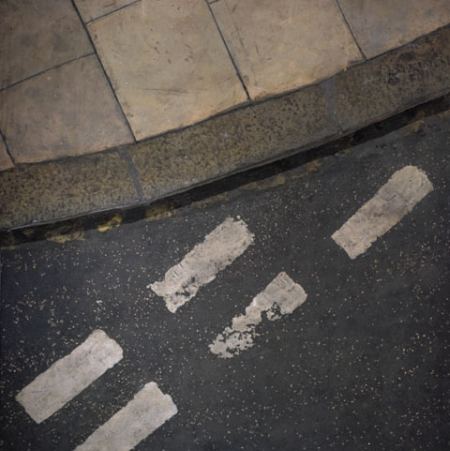

Contemporary visual artists see opportunity in what many bemoan as the twilight of the age of the book. John Latham (1921-2006), Hubertus Gojowczyk, Doug Beube and others have treated books as sculptural stuff. But no one whose work I have seen tops that of Atlanta artist Brian Dettmer at Toomey Tourell.Dettmer was featured this year in the Book Borrowers at the Bellevue Arts Museum.
In the mural-scale wall piece "Americana" (2009), Dettmer has carved up and layered the volumes of a vintage encyclopedia to produce something kaleidoscopic. World maps in polar hemispheric projection punctuate the array, with an occluding effect reminiscent of the changing images on an old View-Master. (more)

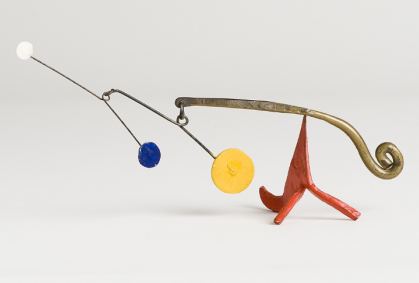 Not in the show: Jennifer Zwick: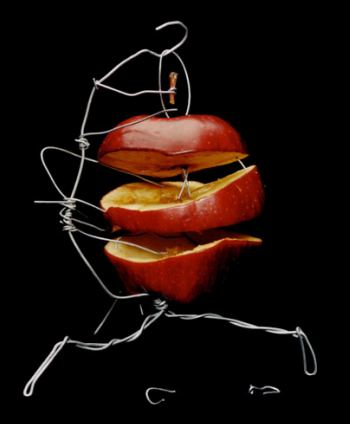
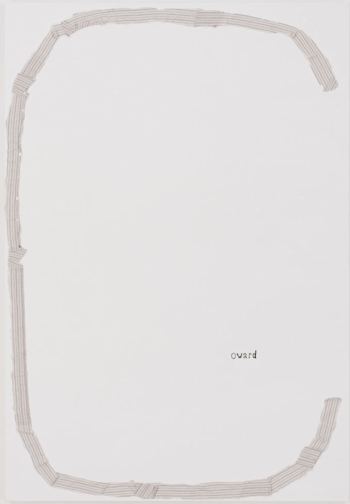
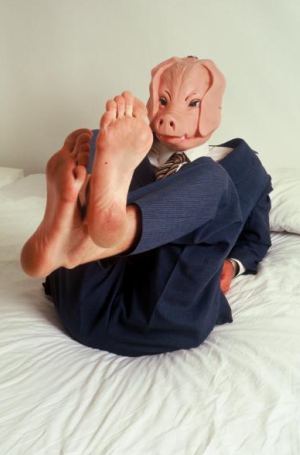
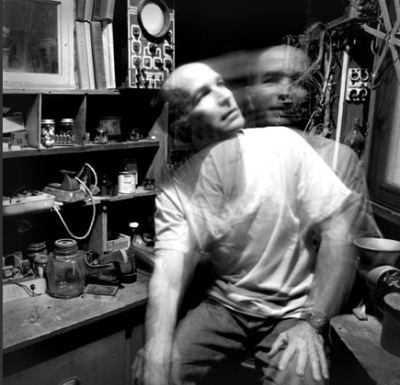
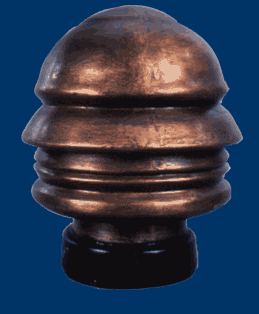 Aside from the Linda Blair head spin in The Exorcist (evil, evil, evil), the idea of a mind moving a head in directions its physical structure did not intend persists in art as philosophical speculation. Will the real head please stand up? (What real head?)
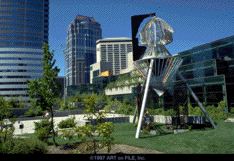
From 1989, Buster Simpson's Seattle George Monument is an emblem of the city's divided heart. Twenty-eight feet tall and 12 feet in diameter, its base is a trellis or open cube, above which hangs a Boeing 707 nose cone suspended on a tripod. Just above the cone is a multifaceted monument head - 24 aluminum profiles of Chief Seattle, an armature for English ivy. A sharpened template turning in the wind cuts the ivy into Washington's profile, which, when the ivy thickens, hides Chief Seattle in the greenery.
 From 1999, Kumi Yamashita's Video of Dialogue.
From 2005, Tim Noble & Sue Webster, Spinning Heads, (via)
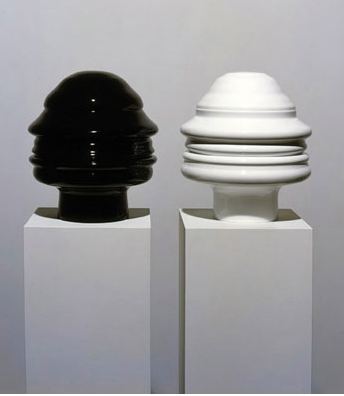 Tony Cragg (image via)
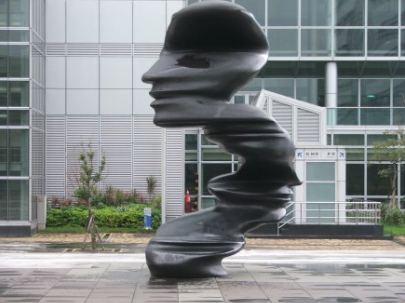 To evoke a burning candle, Barry X Ball (via)
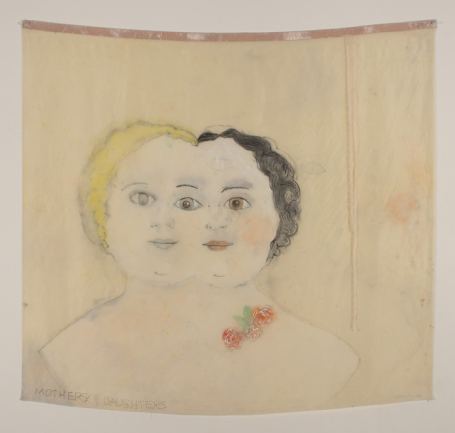
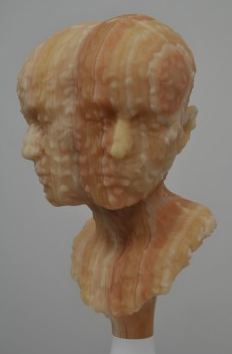 From 2007, memory merges you with others. Sherry Markovitz, Mothers and Daughters. (via)
 Time's inconsistent personal arc, Ari Young's portrait of Michael C. McMillen, (via)
 Jackie Anderson, via
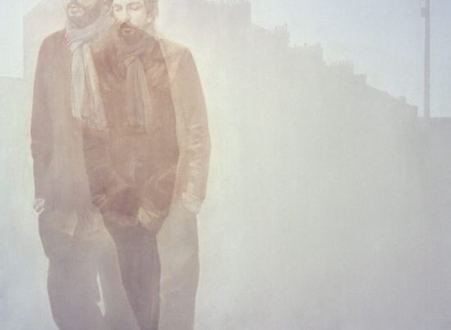 From 1996, sometimes the two of you are stuck with each other. Johan Urban Bergquist (via)
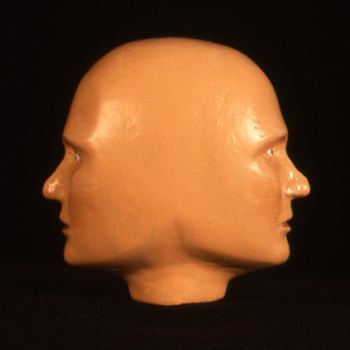 Which makes it hard to get through the day. Harold Haydon, Untitled, 1946. (via)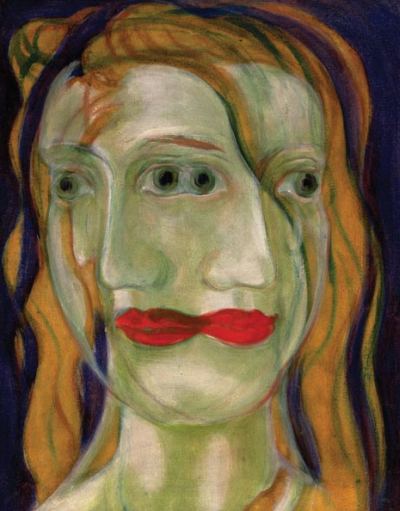
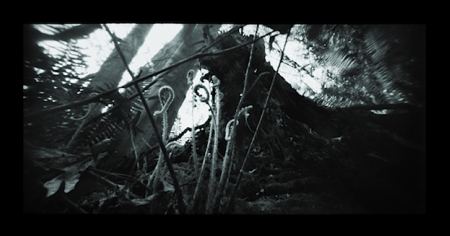
draws on that of an early-20th-century German biologist, Jakob von Uexküll, who proposed that "anyone who wants to understand the life of an animal must begin by considering what he called their umvelt . . . : their subjective or 'self-world.' " Hard as we may try, a dog's-eye view is not immediately accessible to us, however, for we reside within our own umwelt, our own self-world bubble, which clouds our vision. (more)Seattle photographer Ford Gilbreath cracked the canine umwelt in 2000 with a series shot from its point of view.
Just my own naked self and the stars breathing down, it's beautiful.The Basketball Diaries
Some artists are expected to die young. Hats off to Jim Carroll, one of their number. He stuck with it into his 60s and died last Friday, not of his volition.
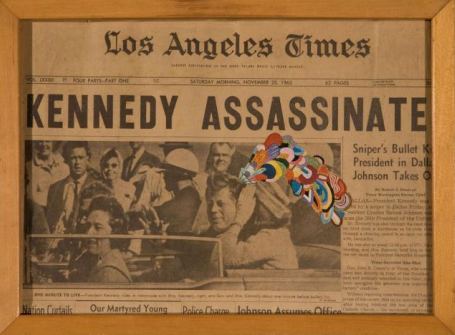
If only Dash Snow had followed his excellent example. (Image via)
 Among many others, Seattle poet Jesse Bernstein could have used more time.
 More Noise, Please!
I live on a street
where there are many
many cars
and trucks
and factories
that pump
and bang and
grind all night
and day.
It is a miracle
that I can write poetry
or sleep or
talk on the telephone
or that
my lover will
visit me here
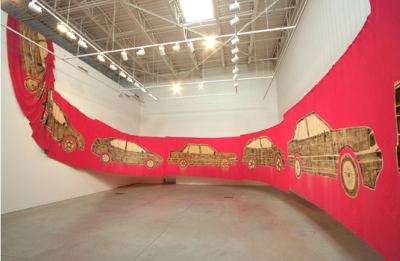
In the velvet realm, everyone's a star or at least can gather together with others who are equally inept to become one: volume, volume, volume. Velvet in quantity dispenses with the notion of quality. Case in point, Velveteria in Portland, which attracts more national attention than any other museum in the region.
Seattle made a stab at a black velvet painting museum (Villa Velour) in the late 1990s, which still exists online. It went wrong by focusing on the classical best in bad velvet. (Cynthia Rose story here.)
Where does this leave more conventionally-defined good painters, as opposed to a version held by the velvet underground? If they're willing to be nappy, they're looking good. The mainstream is unlikely to embrace the racist, sexist cornball Edgar William Leeteg (see Villa Velour link), but others who add just a touch of Leeteg can ride out of time to a mythical carny world.
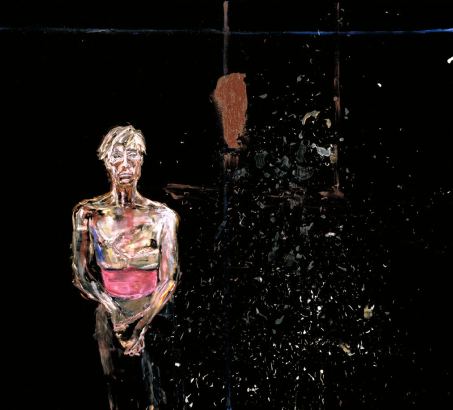
Julian Schnabel:
Did I ever tell you the story of the twentieth-century man in a third-century church, his hand resting on an eighteenth-century banister?No, but when he tells his tales on velvet, he has everyone's attention.
Schnabel, Portrait of Andy Warhol, 1982, oil/velvet, via.
 Colored velvet works if you're Polly Apfelbaum... (Image via)
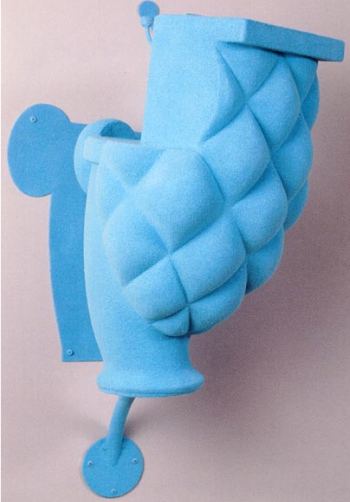
 Or Claudia Fitch. (sculpture covered in blue flocking, which is velvet's tighter twin. Image via)
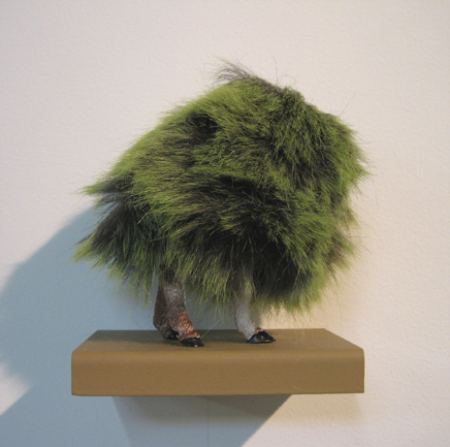
 Can a shaggy version of velvet ride its coattails? (Misako Inaoka)
 Back to black, always in style. As Joseph Park aptly observed, "You cannot take this shit too lightly. I'm psyching myself up to try it again." Below, his gorgeous portrait of Seattle art dealer Kirsten Anderson.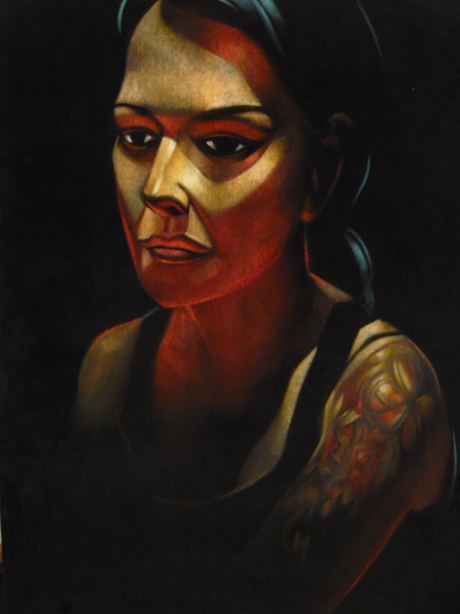
His title - Dumbfucks at the Beach, at Peres Project. Swimming with ducks qualifies you for inclusion in his title.
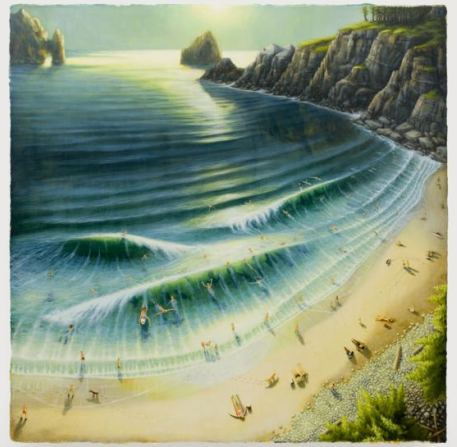
Not Robert Yoder:
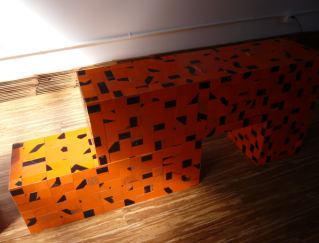 Robert Yoder: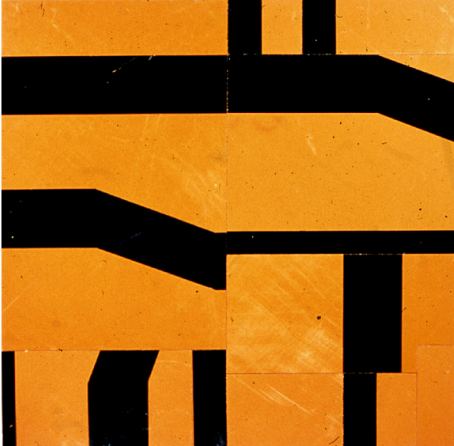
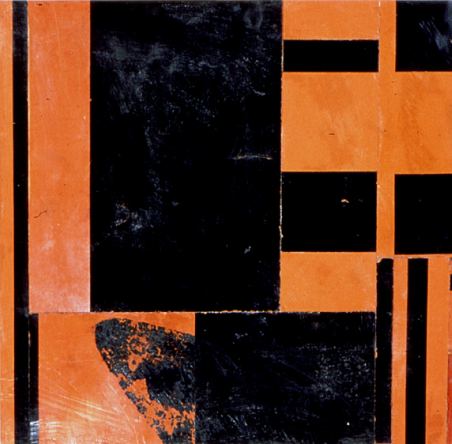 One artist unlikely to imitate Robert Yoder's early work is Robert Yoder. He has moved on.
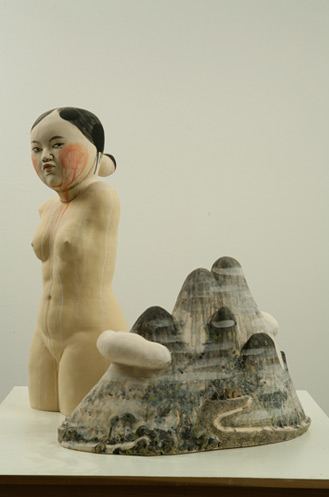
 Akio Takamori creates figures that appear to be lost in thought, caught in that brief moment during any day when the body pauses and the mind drifts across its own mental sky. Born and raised in Japan, Seattle's Takamori pays his country of origin the honor of taking it lightly. Simply, even bluntly made with deft, loose color washes, his figures include spirit babies with oversize heads, priests, warriors, peasants and royalty with the folds of their gowns flapping. (more here)Or no gowns at all.
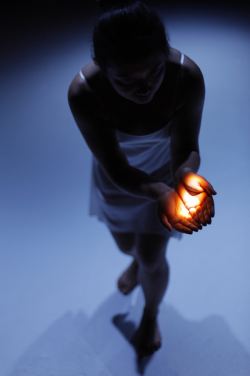 Lee's contributions to For these Unclosings at Seattle's Theatre Off Jackson last night (the last night) were riveting, but then there was everything else. Lee worked with a classy ensemble; nobody stank up the place. The problem arose in what they chose to do with their abilities.
 Emily Greenleaf accompanied herself on accordion with Meredith Monk-style vocalizations. Greenleaf is great, and I was grateful that I wouldn't have to hear her be great for more than the 45-minute duration. This is music for teenage intellectuals who think that pleasure is suspect and shallow. Somebody has to perform it for that audience; others need to be warned at the door.
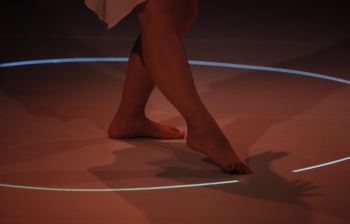
Although Ying Zhou is a lovely dancer, she served as choreographer for a piece that is indistinguishable from Martha Graham-influenced mime. (Emote! Emote!)
Success was all about the light. It burned and fondled, quite beyond its station, in a real-time interaction with the dancer.
Below, Ying Zhou erases it with her toe.
 Photos, Cliff DesPeaux. Costume, Catherine Cabeen. Wizard-level video assistance, Andy Wilson, Emily Greenleaf, Keeara Rhoades and Reina Solunaya. Technical director, Okazawa M.
For a contrary view (including an elaboration on process), see Jen Graves.
DiCioccio
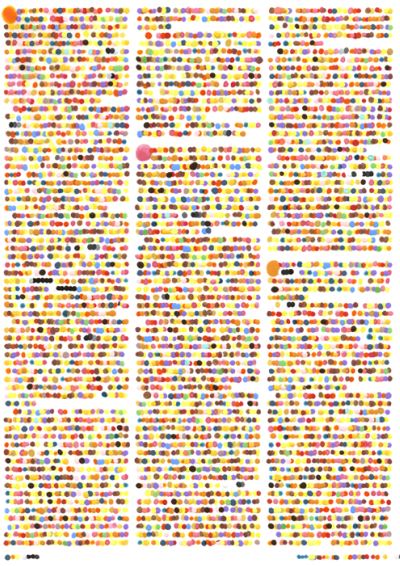
I make sculptures and paintings about my anticipatory nostalgia for obsolescing paper media objects. The softness of a read newspaper page and the glossy slickness of a fresh magazine page are sensations embedded in our physical memory -- the familiarity of touching these objects allows a relationship to form in the process of consuming the information they provide. When these objects disappear from our culture and assume the homogeneous texture of a back-lit screen, I fear that some of our intimacy with the process of reading will fade.
Ben Lawson
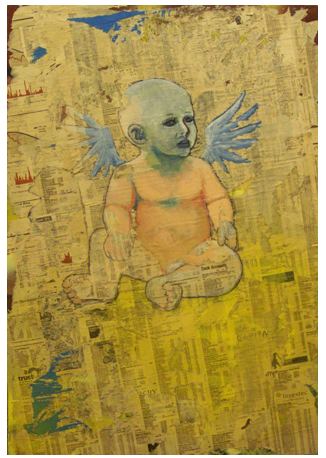 National Summit On Arts Journalism takes place Oct. 2.
M. K. Guth's Terrain Change at Portland's Elizabeth Leach Gallery is a survey of aesthetic ideas realized more fully by others.
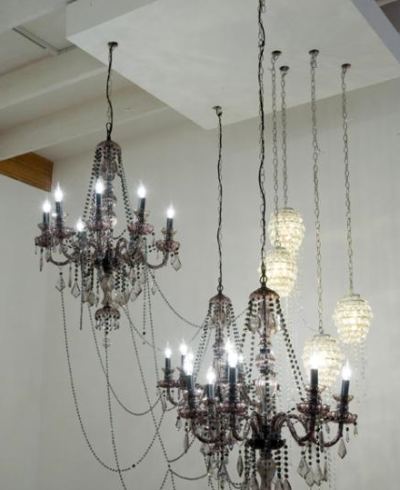
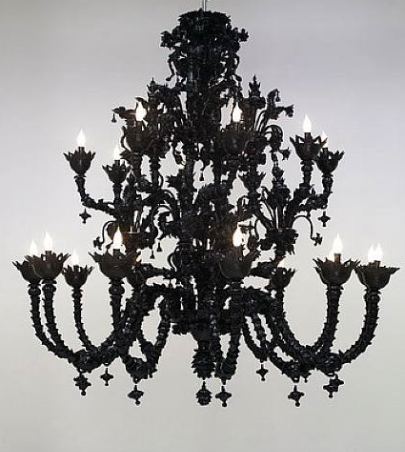
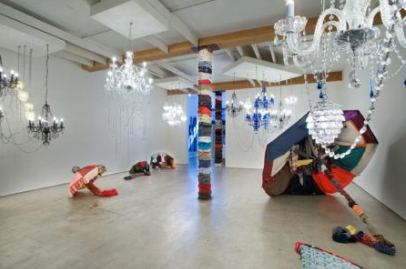 Pillars dressed in sweaters and jackets evoke Knitta. Guth's umbrellas made of clothing are the best thing about the show, although overly dependent on early work by Cris Bruch. About her chandeliers, little can be said. I've seen their better.
Guth:
 Fred Wilson:
 I wouldn't review this show were it not for the sorry fact that Guth was the only Northwest artist included in the 2008 Whitney Biennial, where she had a room which she called "a unique opportunity to this particular place." (Guth's Whitney video interview here.)
Her Whitney debut was a shabby (and didactic) version of Ann Hamilton in the 1980s, but I repeat myself, and I'm not the only one.
Guth's version of relational aesthetics comes down to patting the audience on the head and giving it a simple-minded chore, like Yoko Ono at her worst. While I realize Northwest curators and critics (as a group) could easily have a view of NW art not shared in New York, picking Guth was a slam on far more interesting artists who engage the Whitney's abject, multimedia installation theme, if it qualified as a theme.
Guth at Elizabeth Leach through Sept. 26.
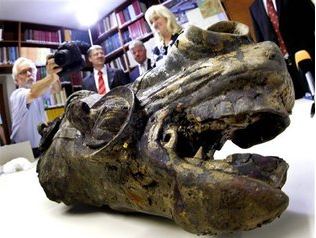
Roman horse head made from bronze and plated in gold (2,000 years old) found at an archaeological site in Germany. (Story here.)
 Scott Fife, at Platform Gallery through Oct. 10.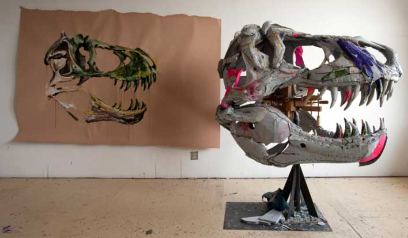
Ficus #2, 2009, oil/canvas, 30 inches square
The reproduced image does not serve painters such as Eric Elliott, now on view at James Harris Gallery. Reproduced, what is fluid becomes static.
 Elliott is interested in where the viewer stands in relation to his painting. In shaggy, blue-gray to dark-green tones, he reexamines Seurat's working methods: daubs of color laid side by side that dissolve to abstraction when viewed up close but assume the contours of representational form in the distance.
 What doesn't interest him is Seurat's shimmering lights. Aside from Ficus 2, reproduced above, in his present show Elliott is happy to root around in painterly mud. Ficus 2 offers slender gleams of brighter shades buried subtly in the center, like fleeting hallucinations.
For Elliott, air is a contagion. It sticks to leaves and cramps their blooms, which press powerfully back to hold their own. He animates sludge, which is no small thing.
Through Oct. 3.
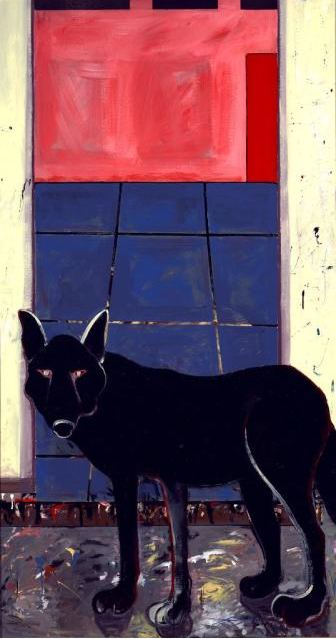 In Annie Marie Musselman's Finding Trust series (2002-2009) at the Sarvey Wildlife Rehabilitation Center, the wild thing is in trouble. (via)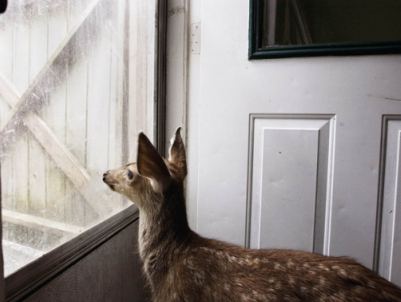
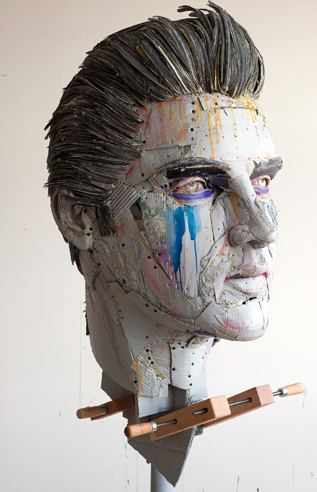 The rough scaffolding of Scott Fife's cardboard construction allows for complexity within the portrait of a notable. As Lear replied to the Earl of Gloucester, who had asked to shake the king's hand:
Let me wipe it first. It smells of mortality.And yet, painting is pivotal. Without it, what would Elvis be? Flat for all his volume. The streak of the blues that run down a cheek, the pinks for bloom and bloodshot, the yellow dripping from glue: They make him bloom.
At Platform Gallery through Oct. 10.
Laughing at bunglers is the best way to keep them at bay, looking down from an Olympian height at their hapless struggles to improve. Comic strip fools and fall guys are rarely allowed to rise to the level of tragedy, and yet the best strip artists, from George Herriman to Robert Crumb, play with the formula by forcing the audience to acknowledge - at least unconsciously - a kinship.
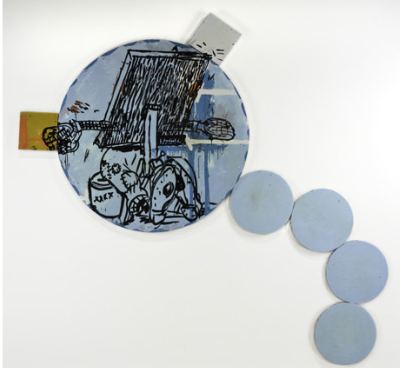
Comic or otherwise, artists always link to chains. Even the newest new is rooted in the old. Now on view at Howard House, Karen Ganz's paintings were begat by Herriman and Crumb, Philip Guston, Elizabeth Murray, Keith Haring and Michael Spafford.
In other words, her sad sacks have art-saturated, stumblebum rhythms.
Moving Target, #1 The figure seems to be a painter, buried her work, incapable of proceeding.
 Detail:
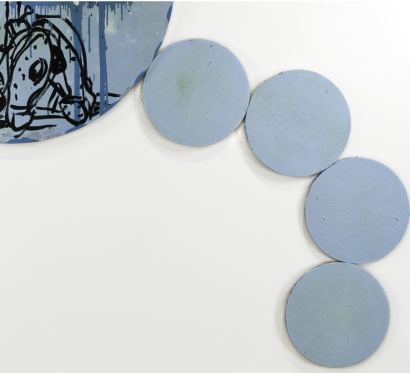 I love this show, her best pulp fictions in years. It's beautifully hung, and the paintings appear to be in forward motion, right off the walls.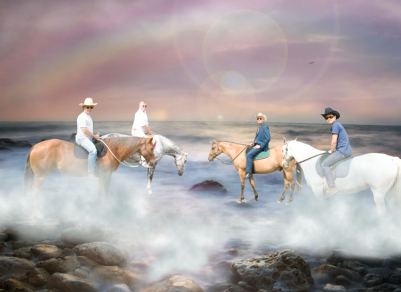
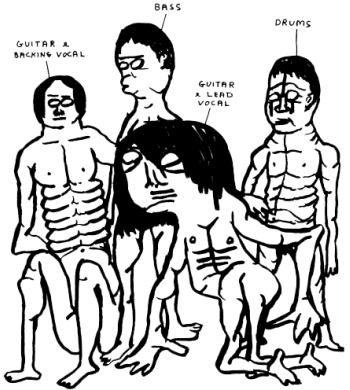
Opening at Ambach & Rice Saturday night, 7-9, From Whence the Rainbow Came. Rumor has it that the artists will play at the opening: Webb on power bass, Mitchell vocals, Zervas accordion and Park, who plays the violin and piano, on guitar or maybe drums? Guitar, I'm pretty sure.
David Shrigley's version of such events, descending the evolutionary ladder to a 4/4 beat.
 Charles Kitchings of Ambach & Rice:
This exhibit is a celebration of friendship and camaraderie among four artists who have stuck it out in Seattle, which as well all know, is no easy task. I told them from the beginning that I wanted the show to resemble having dinner or getting drinks with them, four distinct personalities connected and apart. It is my belief that this was their intention from the get go. Lots and lots of love between these guys...This team has one member missing: Leo Saul Berk. What happened? Did they run out of horses or guitars? He is the youngest, by far. As all younger people know, they're the first to go.
Update: Joey Veltcamp has images from the show with a group interview with artists, here.
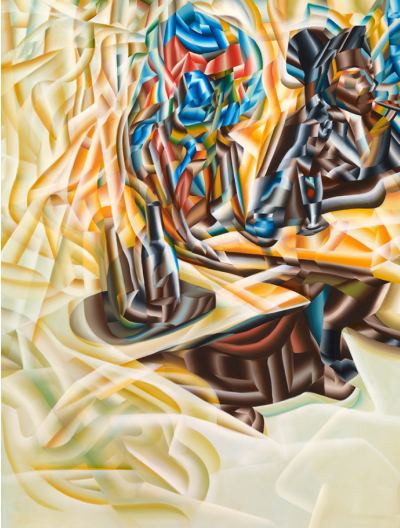 The subject of Joseph Park's Absinthe is, most obviously, a homage to Degas' Absinthe Drinker and to Picasso's Arlequin, but the subject of references is not his root subject. Park deals with the world that paintings make: how they can be constructed like crystallized
growth clumps or shards to accumulate over an image.
The subject of Joseph Park's Absinthe is, most obviously, a homage to Degas' Absinthe Drinker and to Picasso's Arlequin, but the subject of references is not his root subject. Park deals with the world that paintings make: how they can be constructed like crystallized
growth clumps or shards to accumulate over an image.With his immaculate surfaces, tightly controlled tonal range, fluid brushwork and ability to animate empty space, Park brings an embalmer's gifts to his cultural critiques. The first impression he makes is of vitality. The second is vitality strangled. It's that sinister backbeat coupled with an undertow of bleak beauty that moves us in the end.
Park's facility can be off-putting to those committed to more rugged representations. About Park's current exhibit at the Portland Art Museum, Chas Bowie wrote:
The critical hazard of making dazzling artworks, of course, is that you fall so in love with your refined flourishes that you fail to notice that you've drifted into the unseemly realm of razzle-dazzle. (more)Why is facility an unseemly realm? Fragonard put up with this sort of thing towards the end of his career. But who today looks at The Swing and sees only a razzle-dazzle version of an upper-class, covet dalliance? No, it's the slipper crafted on earth that floats in the air, pink rising above the larger pink of a desirable women to claim a place amid the artist's lights and shades.
Art requires the facility it requires, different in every case.
Waiting for Claude: (The Claude to whom the title refers is worth the wait.)
An artist was all I wanted to be; it was the obsession. A Working Woman in New York City, I instead maintained a wannabe status, if only in my mind. Help and time was the ultimate Nirvana. My boyfriend told me that any help came with strings attached and the whole thing was impossible anyway. He said he had given up the game and didn't even want to go to openings, which was sort of odd because that was where we met. My response at the time was that my job at Bergdorf Goodman had all kinds of strings attached anyway - I can dream, can't I? (more)
About the much-commented rantings of Glenn Beck as art critic: Christopher Knight offered the best reality check rebuttal (here), but Lee Rosenbaum (Culture Grrl) was tops on a bigger issue, one on which Beck is right. We don't want the NEA to become the National Endowment for Good Works. Culture Grrl below:
The Beck clip that deserves notice (below, via) addresses the Obama administration's attempt to rally the art brigades around its social-service agenda. Particularly noteworthy is the audio recording played about six minutes into the clip---the voice of Yosi Sergant, director communications for the National Endowment for the Arts, saying the following to the members of the arts community who participated in the White House's United We Serve conference call on Aug. 10:
Rosenbaum's update here.Bear with us as we learn the language so that we can speak to each other safely. And we can really work together to move the needle to get stuff done. (more)
Richard Dorment Charles LeDray in London:
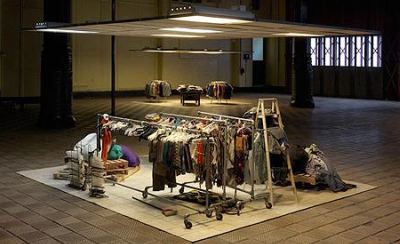
The enormous prestige accorded to American artist Charles LeDray over the years is closely correlated to the strangeness of his working methods and the rarity of his work. LeDray did not train as a fine artist. A former museum security guard, he's a self-taught craftsman whose work looks like no one else's I can think of. Mens Suits, sponsored by Artangel and shown in a disused Edwardian fire station in the depths of Marylebone, west London, is his first show in this country. When you see it, you will instantly understand why it took him three years of full-time work to make it. (more)Richard B. Woodward makes a good case against Jean Luc Mylayne, an artist I continue to admire:
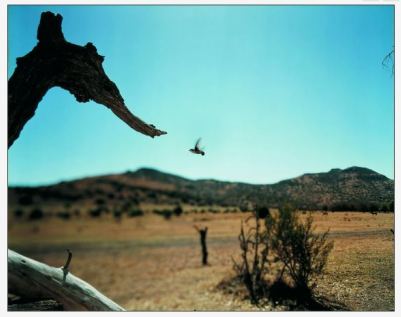
For an artist whose work is devoted to enlarging our sense of ourselves within nature, he seems rigidly focused on his own experience. Even his attention to unshowy species seems confined to showcasing them against rural backdrops. If nature in all of its humbling variety is his subject, where are his photographs investigating our urban relationship to gulls and pigeons? ...Brent Burket on the Met's inability to exhibit Damien Hirst, titled, The Aesthetic Possibility of Killing Something When It's Already Dead:
Just because an artist gets high on his own inflated oratory is no reason a curator has to participate in a folie à deux. The museum here neither serves a public skeptical about the opacity of contemporary art nor does Mr. Mylayne any favors by framing his modest, if persistent, achievement under crushing layers of grandiloquent hokum. ( more. In contrast, my review of an an exhibit last year here.)
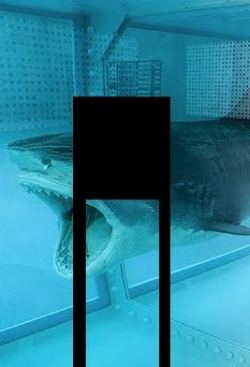
What is it about Damien Hirst's The Physical Impossibility of Death in the Mind of Someone Living that makes the staff at the Met--a seemingly intelligent group of people--so blindingly stupid? Is the formaldehyde leaking? Are all the thoughts about the physical impossibility of death snapping their synapses like gift shop cinnamon sticks?(more)Jen Graves on a Paul McCarthy and Richard Jackson interview at the Seattle Art Museum. She's killer good on setting up background and atmosphere, but what did they say? Did they rise above the shallow wisecracks listed here?
McCarthy is an art hero; he sort of took the soul out of Conceptualism and put it in a deeply messy and yet Hollywooded body, and he's been written about and emulated for years. In person he comes across as a regal dwarf. It's not that he's that short; he's just shaped dwarfishly. And it is impossible not to notice that his hands are so thick that they are obscene. ("They're penises on palms," someone said to me. "How were they when you shook them? Succulent?" They were. They were succulent. Yes, it is all magnificently disturbing. This is the guy who, wearing women's clothes, humped raw hamburger and ketchup in a 1975 performance.) (more)
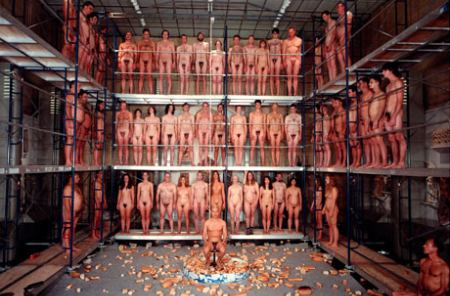
Mark Hudson on Zhang Huan: (Below, Zhang Huan's My America at the Seattle Art Museum in 1999, a performance that featured a wide array of Seattle writers, artists, collectors, curators, an art book editor (Joseph Newland) no critics and one art dealer, the late Linda Farris, who was the ultimate game girl.) To judge from Hudson's piece, Zhang might be better known in the States than in London.
Kenneth Baker on Jenny Bloomfield and Jennie Ottinger: The S.F. Chronicle's art critic doesn't write a lot and can be disengaged and/or cranky, but when he's on, he's one of the best in the newspaper realm:You may not have heard of Zhang Huan, but he appears poised to be the first non-Western artist to become a truly global name -- on a par with Damien Hirst, Jeff Koons or even Andy Warhol. And the central element in an oeuvre encompassing painting, performance, installation and sculpture is his own extraordinary physical presence: the shaven head and stoic, monk-like features that have appeared in everything from wince-makingly uncomfortable performances to vast sculptures, such as Three Legged Buddha which filled the Royal Academy's forecourt in 2007. (more)
Even a generation ago, abstract painters might still view their discipline as an arena of struggle. Struggle with the inertia of materials, struggle for authentic expression within the tainted matrix of pop culture, struggle for originality with so many possibilities exhausted.Today, on the downslope of postmodernism, such ambitions seem more self-dramatizing than responsive to the realities.
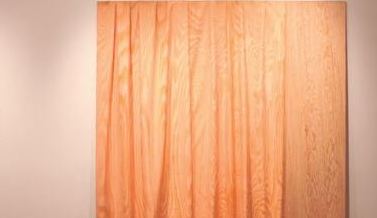
British-born Bay Area painter Jenny Bloomfield stands out against this dispiriting background, making abstraction look alive again without nostalgia, triviality or bombast. Those who think this sounds easy ought to give it a try. (more)
Finally, offered as a small, charming note, Maira Kalman explains through drawings the history of life on Earth: Evolution to Irving Berlin.

Instead, wrote Maroney, Wood was only pretending to be narrow because he was gay and hiding it. Maroney's essay here.
From his email:
Your views on his art and his politics are essentially shared by virtually everyone in the art world including his biographers and unfortunately they are entirely wrong. Wood was not an "America first Bread basket regionalist" whatever that is. He was a swinging, Herbert Hoover, prohibition hating lefty. The man you think he was was his public persona, which he put up for his survival and which was so successful, the real Grant Wood remains hidden to this day.To repeat, my views of Wood's work are entirely appreciative. The only reason anyone might care if Wood were wide in his personal views or narrow is the quality of his work, which, after reading Maroney's essay, I'm not as certain as he contain so many clues to secrets of a personal nature.
Also, even if Maroney's premise is sound, few would agree with his apparent contention that being a closet case implies the (hidden) existence of empathy for others.
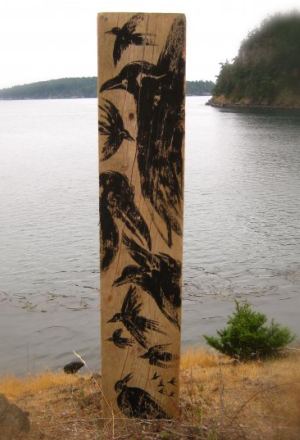
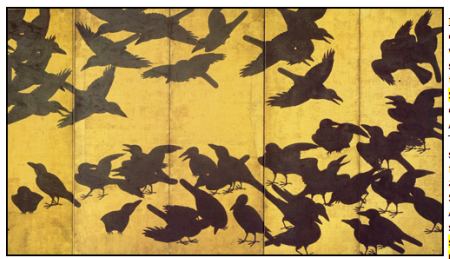
I found an old piece of driftwood, lay it down and painted some ravens on it. Standing, straddling the roughened board, 2x12", I stood it up -- balanced in the dried grasses, of a hillock overlooking the south reaches of Lopez Island. Watching them, a gathering, a murder -- as they are called, they study what's happening, all day...Girvin paints ravens not just because they're there but because he lives in Seattle, where a 17th century, six-panel, ink-and-gold-on-paper Japanese crow screen is a highlight at the Seattle Asian Art Museum.
I'm impressed that the Dispatch posted his remarkable essay and left it up on its site. I don't think the newspaper where I toiled till it ceased production would have done the same. Hell, I'm sure of it.
Bonetti:
As some of you might have heard, I am leaving the Post-Dispatch. Today is my last day and this will be my last Culture Club post. Although some of the Cherokee Street clique would like to think that I was fired by an enlightened management that wants reviews of inept artists showing their woeful attempts at self-expression in vanity galleries, that is not the case. I took advantage of advanced age and a benefits package and decided to retire...
I would be the first to admit that St. Louis and I were not a match made in heaven. Indeed, my editor Christy Bertelson for the past unhappy year and a half accused me of hating St. Louis. I do hate things about St. Louis: the willed ignorance, the racism, the smugness of the self-appointed social and cultural elite, the stupidity of the political class, etc. But it is hard to hate a city where you've lived for more than six years. Affection grows in spite of yourself.
He goes on to list 5 things he'll miss. Lots of drinking is one. There's not a single artist on his list, a single gallery, nonprofit space or art museum. He won't miss the Beckmanns at the St. Louis Art Museum? That can't be true. Obviously, he wrote this piece in a scorched-earth mood. Bonetti plans to move to Boston. I hope he keeps writing, because he's good.
Jonathan Middleton, director of the Or Gallery, said today that government funding cuts are "devastating" the Vancouver arts scene.
The liberal party has had a reasonably good history of supporting art in the past. During the last election, it promised to keep the deficit to $400 million. It's currently $3 billion. The government is cutting wherever it can. Arts funding came for a gaming tax, which is not out of the general fund. There was the idea that the social cost of gambling might be offset with charitable contributions, including to the arts.
Nonprofits have relied on this money for years and had no prior notice of cancellation. Instead, we were told we could continue to count on it. It wasn't a cut could could have contemplated.
Or Gallery lost $30,000, which is 15.6 percent of its annual budget. (The gallery canceled its November/December exhibit, which was to be on the theme of humor in art.) Helen Pitt Gallery lost 40 percent of its funding. Helen Pitt is going to lose its space. I don't know if it can continue to pay a director or continue programming. The irony is, the government has talked for years about the benefits of arts to the economy, that arts bring in $1.39 for every dollar spent.
BC Arts Council defends the cuts, which it says it regrets. The opposition is organizing, including here.
Sophie: A new authoring tool for multimedia developed by the Institute for Multimedia Literacy that suggests new possibilities for presenting critical response.
Indianapolis Museum of Art: With its Art Babble and Dashboard, the IMA is an example of a cultural institution extending its reach into areas that have traditionally been the province of journalism.
InstantEncore.com: An example of an aggregator attempting to gather up everything about an art form (in this case classical music) and making it accessible in one place.
NPR Music: An example of a traditional big media company that is reinventing itself across platforms. NPR Music blurs the lines between journalism, curation, presenting and producing.
Gazette Communications, Cedar Rapids Iowa: An example of a local media company trying to reinvent the idea of what it considers news and how it might be gathered and presented to a local community.
Taken together, I found the proposals heartening, even though few are financially robust. At best, they point the way towards a future that might achieve real jobs but are far from doing so now.
The Brookyn Rail does not pay its contributors. Living on air gets thin. Other favorites from the visual art category include:
Art Fag City, Triple Canopy, Departures, Big, RED & Shiny, Bad At Sports, Dinosaurs & Robots, Idaho Arts Quarterly, Glasstire, Of Note, Kung Fu Art Critic and a site under construction, East of Borneo, which will be edited by Thomas Lawson.
There are flashier sites on the list, most prominently, FLYP Media, which is gorgeous and technically inventive. Good luck to FLYP, which seems to be aiming for an undifferentiated audience, one that will be impressed by the site's click power and not put off by soft, feature-style arts writing.
People already in the game, on the other hand, aren't likely to want to read what they already know, even though production values are stellar. As a bridge builder between the art audience and everybody else, FLYP serves the purpose. Its texts are elementary, but its mainstream taste is reliable. If you've never heard of John Baldessari, this site's for you.
Nonprofits carry enormous weight, such as Or Gallery, Presentation House, Helen Pitt, Artspeak, the Contemporary Art Gallery and of course, the Vancouver Art Gallery.
According to BC's Alliance for Arts and Culture, 80 percent of public arts funding in the province has disappeared from the budget. If this money is not restored, the effect could be catastrophic. Story here. More to come.
Yoko Ott, freelance curator and laid-off member of the Frye curatorial team (heading a terrific program she originated for children's art engagement at the Frye) is going to be director of exhibitions at Open Satellite. (Review of current show here.) The founding director, Abigail Guay, is moving to the Henry to reopen a collections study center, which closed at the Henry more than a decade ago.
Guay will make artwork in the Henry collection available to students, scholars, critics and researchers. While it's good news about the reopening of the center, the job at first hearing doesn't sound as if it will be a good enough platform for Guay's talents. What shows will she curate?
Ott will get a real chance to shine at Open Satellite, which functions as a kind of Peace Corps for contemporary art in Bellevue. It's a go-forth-and-share-with-suburbanites aesthetic imperative. Funded chiefly by developer John Su, OS is applying for nonprofit status, which is reasonable. The profits reaped there are not financial.
No word yet on whether Ott will also continue to curate the lobby space at the Lee Center, or her job at 826 Seattle. Ott likes to do a lot of things at once, but even for her, handling all three assignments might be a stretch.
David Shrigley
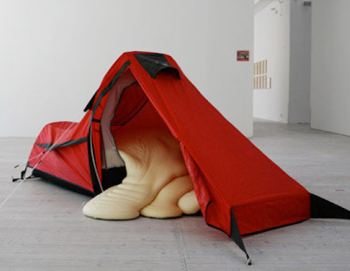 Dan Webb - Real Disguise, detail
 Eakins & Dombrosky
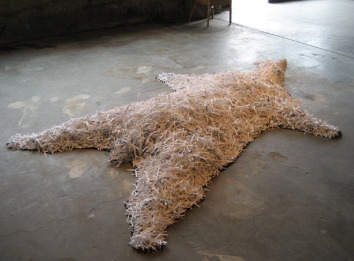 Dave Ellis
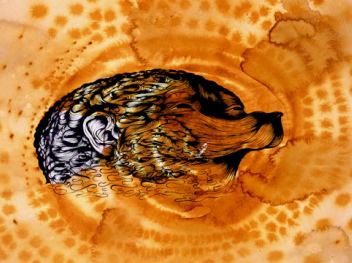 Karen Ganz (at Howard House till Sept. 26)
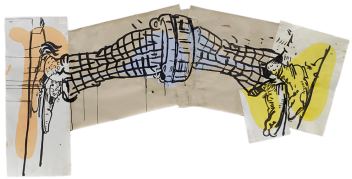 Will Ryman
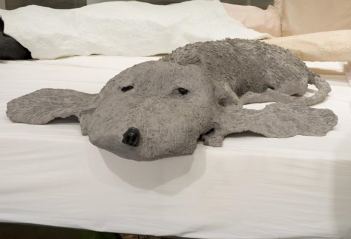 Nayland Blake- The Big One
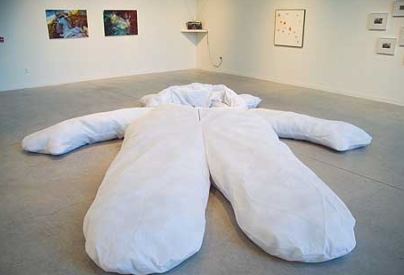 Jon Haddock- The Activist
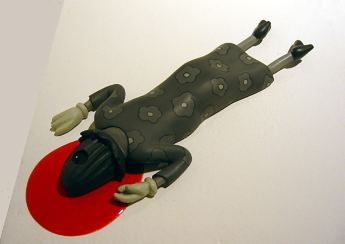 Tom Friedman
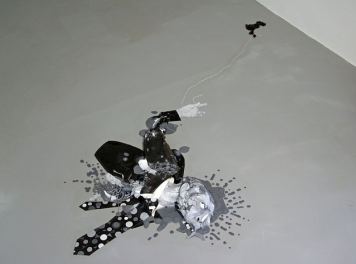 Sean Duffy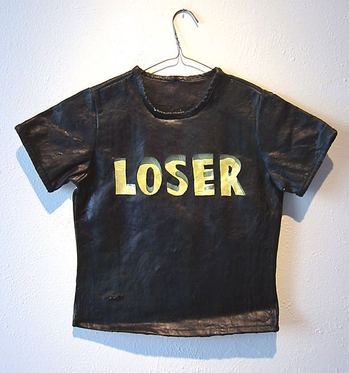
Ruth Wallen
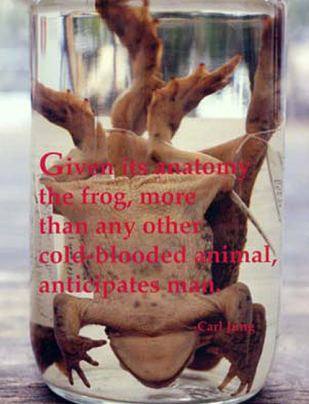 Fred Muram
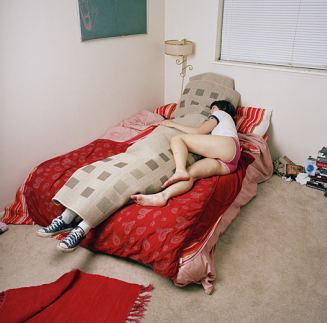 Finally, for kicking the stuffing out of an advertising slogan, there's Chrissie White, a high school sophomore in the Seattle area. Her Flickr page here.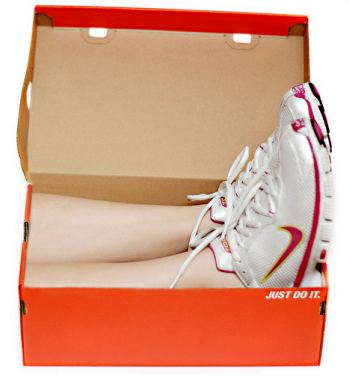
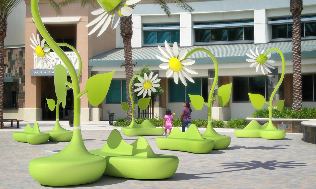 The coy blooms came to town to promote the launch of the 2010 Prius. Seattle park administrators carefully scrutinize any projects artists want to install in a city park. Did a car company receive the same scrutiny? The good news is, the dippy flowers have a short shelf life. Jen Graves called them terrible, which just about covers it.
 Looking at the YouTube video below, however, featuring the Michael Clark Company, I know one thing that could have saved the day. Dancers. Check the stage set. It's a Solar Seating Power twin.
(Thanks for the video link to Tim Marsden, who described the piece as "Beckett meets German Expressionism via the unlikely route of Post Punk and classical ballet.")
Large forest fires have occurred more frequently in the western United States since the mid-1980s as spring temperatures increased, mountain snows melted earlier and summers got hotter, according to new research.Michael Brophy
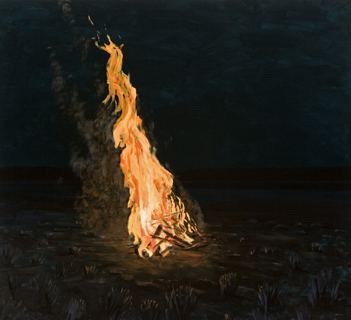
Almost seven times more forested federal land burned during the 1987-2003 period than during the prior 17 years. In addition, large fires occurred about four times more often during the latter period. (more)Brophy again:
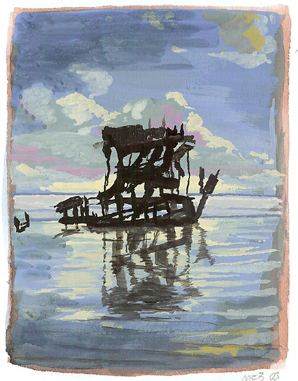
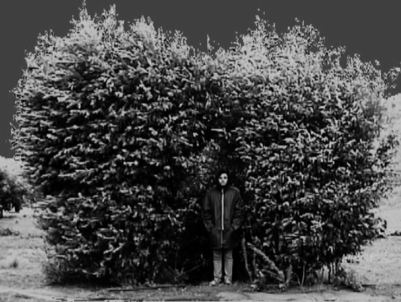
Say your life broke down. The last good kissBuddy Bunting, Victorville, California, 2009, ink on paper.
you had was years ago. Richard Hugo
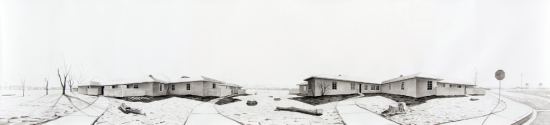 Detail: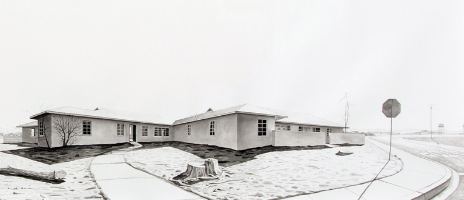
At Soil through Sept. 26
Bunting:
Late one night in the summer of 2005, while driving south on U.S. route 395 towards Los Angeles, I passed through the town of Victorville, California. At the time I was unaware of the new Federal Prison there, but approaching the town from the desert its presence was made clear by the distinctive illumination of prison lights visible on the edge of town.
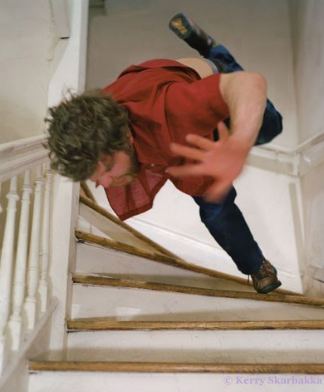
Scott Reeder, Cops Ascending Staircase, 2009
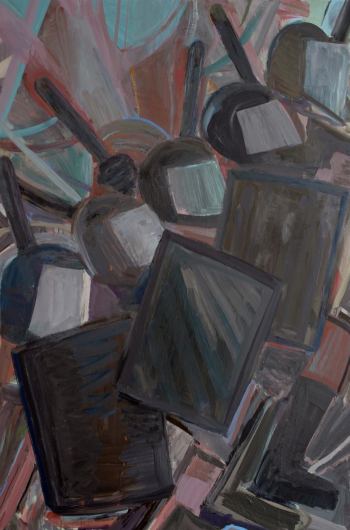
Dan Webb, Heads Up! (detail), 2005
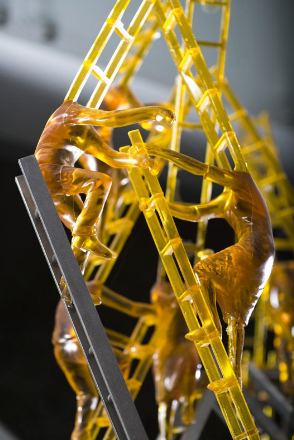 Heads Up!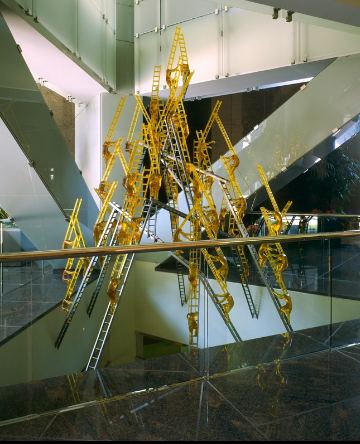
Thanks to the Depression, Hoover was one of the most despised men in America, but not by an America First, bread-basket regionalist like Wood.
 In
the end, his celebrations of his region transcended it. He might have
been a narrow man, but as a painter, the fine-lined, lyrical urbanity
of his landscapes remains a marvel. With a paint brush in his hand,
Wood had rhythm, and Wood had swing.
In
the end, his celebrations of his region transcended it. He might have
been a narrow man, but as a painter, the fine-lined, lyrical urbanity
of his landscapes remains a marvel. With a paint brush in his hand,
Wood had rhythm, and Wood had swing.Within the utter control of Wood's manicured grounds is an antic spirit. If Betty Boop came out the back door of his happy Hooverville to sing on the lawn and all the trees and shrubs swayed in chorus, who would be surprised?
Artists honor the past by improvising on it in the present. Currently at Punch Gallery are Nathan DiPietro's small paintings in a series titled, Neo-Suburban Palouse, an exploration of Wood's duality painted in the round on egg tempera on panel.
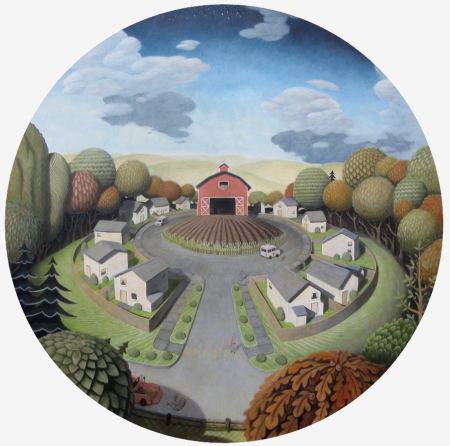 The
fantasy
The
fantasy (DiPietro detail)
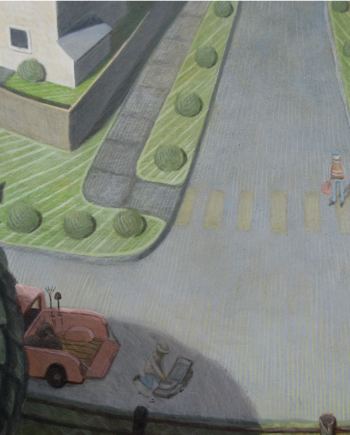 "Give
me liberty or give me death," said Patrick Henry. Why is it that the
right who treat Henry as a saint seem to long for surveillance? Its
members can't wait to knuckle under, to be vulnerable to wiretap
without warrant, told what they can read, whom they can (and can't)
sleep with and when they have to have children.
"Give
me liberty or give me death," said Patrick Henry. Why is it that the
right who treat Henry as a saint seem to long for surveillance? Its
members can't wait to knuckle under, to be vulnerable to wiretap
without warrant, told what they can read, whom they can (and can't)
sleep with and when they have to have children.From the point of view of its proponents, what would a society regulated by the right look like? Wild nature would be gone, but tidy plots and man-made lakes would shine in the sun.
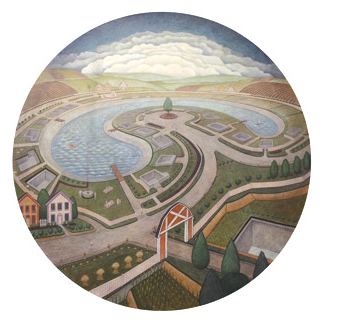 (Above, DiPietro's Lakeside. )
Another Wood link: Wood loved the pre-Renaissance Italian painters, especially Duccio, who modeled his mountains on rocks in his studio and populated his ground with strange little trees. There's more of the Duccio feeling in DiPietro than in Wood. It's only a matter of time before DiPietro paints Jesus in the Suburbs. Through Sept 26.
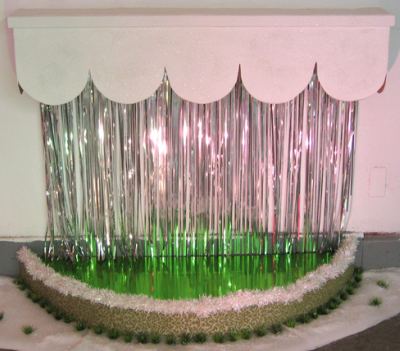
 Tonya Solley Thornton, a disco waterfall:
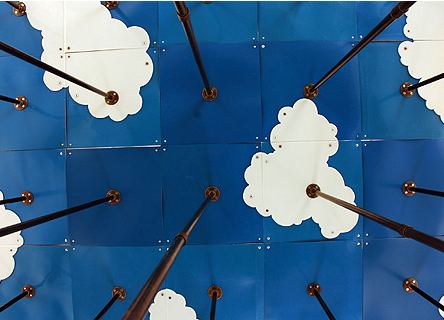
 Jesse Edwards, waterfall during an explosion or just after:
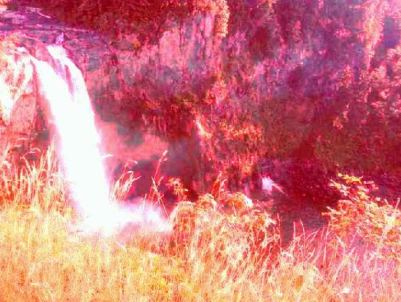 Claude Zervas, a river of light ("Nooksack"):
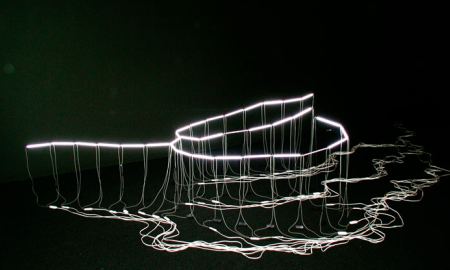 Joy Garnett, a river of flesh, flesh being, as de Kooning once said, the reason oil paint was invented:
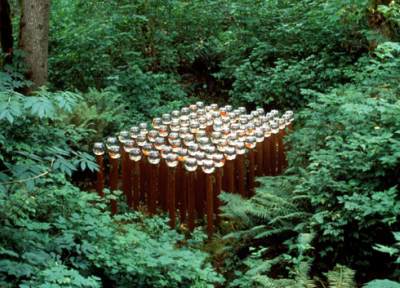
 SuttonBeresCuller, a pond of goldfish (no goldfish were harmed in the making of this pond):
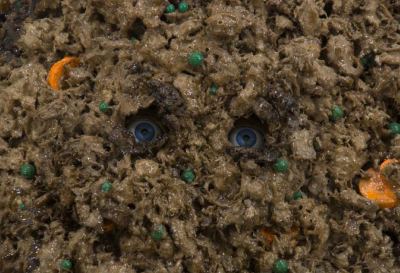
 Mike Simi, a movable mountain of beef stew (custom fabricated robotics and software program) ...
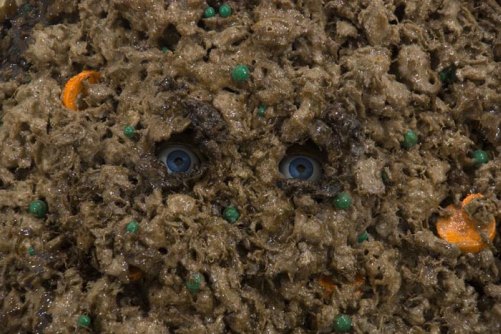 as a self-portrait. (I'd know those blue eyes anywhere.)
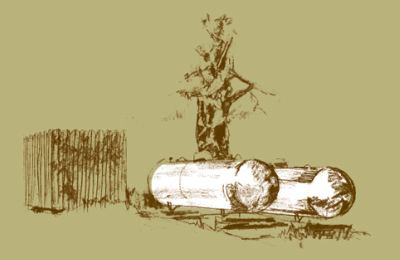
 Gretchen Bennett, the spread of nature though stickers:
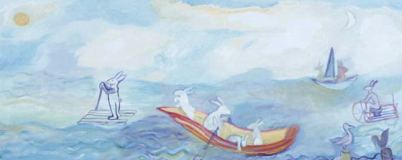
Created from drawings of hybridized landscapes from the Pacific Northwest, these stickers have been placed in Brooklyn, supplanting cement and brick with scenes of propane tanks draped by coniferous trees. In turn, images from the East Coast, such as junk yard dogs, are brought back to the Seattle-Portland area in the form of stickers, ultimately collapsing the space between the landscapes of the two coasts. The stickers can be downloaded and printed, spreading mongrel bits of landscape far and wide, continuing their viral migration to cereal box state lampposts, Canadian kiosks and Prague stucco.Elizabeth Sandvig, Rabbits at Sea, because we're so mean to them on land:
 Vaughn Bell, Your own Mt. Rainier. You can take it for a walk.
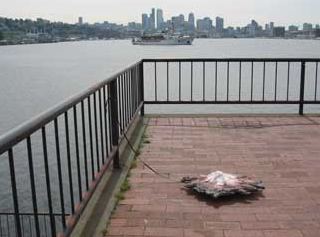 And speaking of mountains, Alex Schweder: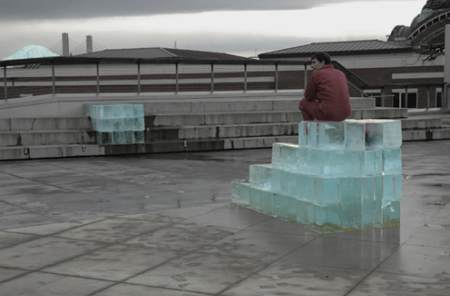
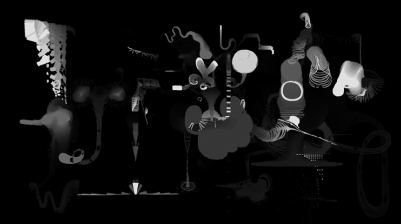
Is Murata moving through the history of art? Homestead Grays (below, 2008 still from video via) is pixilated Cubism.
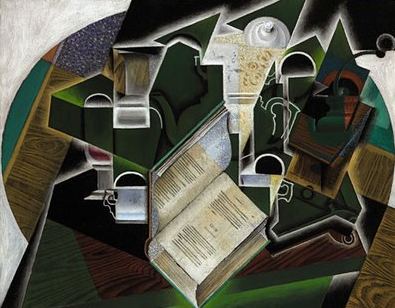
Juan Gris, Book, Pipe and Glasses, 1915
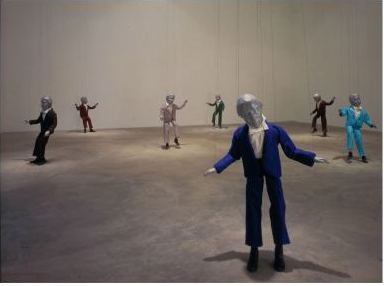
Take, for instance, Dennis Oppenheim's Theme for a Major Hit (1974).
To answer his own question - how to make performance art without being there? - he created a cadre of his own mini-me's. Dressed in hip suits, they assume various unruffled positions till a timer goes off and they dance.
Puppets are rarely cool. They're fall guys who are beat on the head but rise again, bits of their stuffing clinging to the cudgel. Oppenheim's make Andre Benjamin look awkward. They're light on their feet, with a heavy-metal gleam in their gun-gray eyes. (more here)
 Free admission.
The consolation of things. McMakin and Jeffry Mitchell became friends 15 years ago over their mutual love of furniture, found objects, the shiny new and the well-worn, the turn of a phrase, art history. Both are devotees of fluid conjunctions and make work in their overlaps.
Earlier this year, they went shopping in Centralia (droopy lumber town rich in castoffs) and purchased 30 objects which they winnowed down to 12. Each created an object in response to the found one, all of which became an exhibit at Pulliam Gallery in Portland, titled, by exchanging the letters of their first names, Joy and Reffry.
The show is beautifully but not literally hung. The audience is free to group found object and responses as it chooses, turning observers into collaborators. Each set of three assembled by collector is for sale for $3,600, $1,200 each to Mitchell, McMakin and the gallery.
Below, three sets assembled by me, with an extra, eight-legged found object.
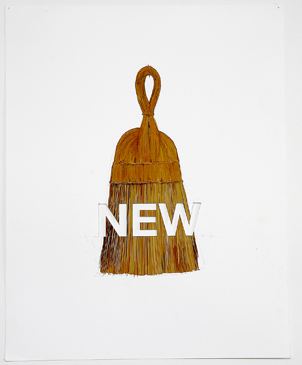
1. The
 McMakin made it (relatively) new again, a new broom sweeping clean.
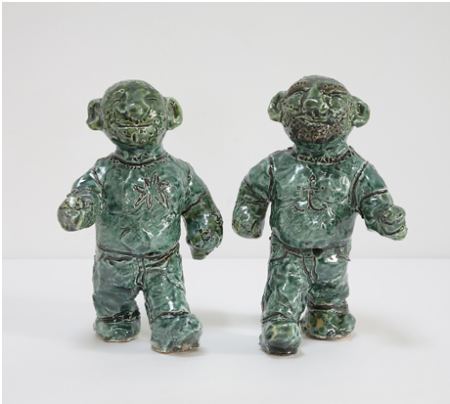
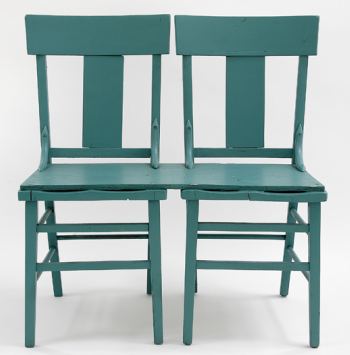
 Mitchell's ceramic pair of guys who beam with fresh confidence is titled, The handsomest men in the world.
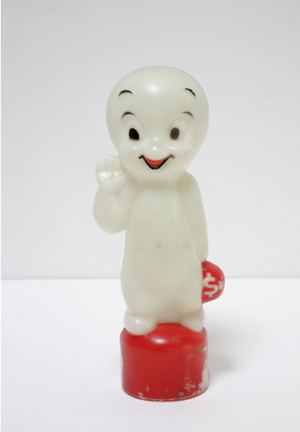
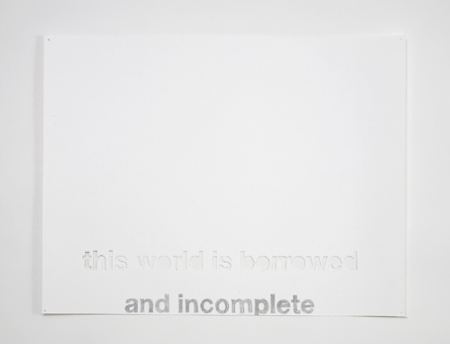
 2. This happy ghost bank has seen better days. Although not evident in the photo, someone cracked open its base to get its undoubtedly meager store of cash.
 Mitchell's Ghost is a thin wash of white that rests on its own eyeballs.
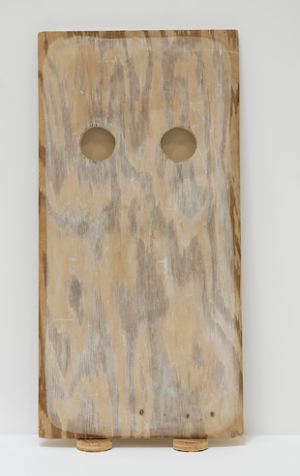 McMakin conceived of a ghost as a loss. The words in cut out and pencil lettering, are, "This world is borrowed and incomplete," from the lyrics of a Tift Merritt song.
 3. Tea pot as air freshner, once the scent is gone, and inset with a mirror.
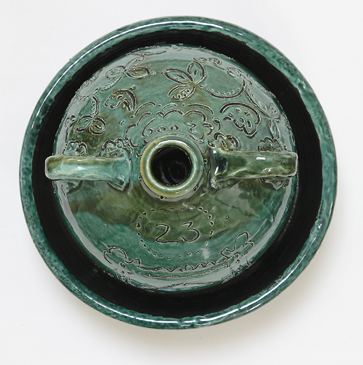
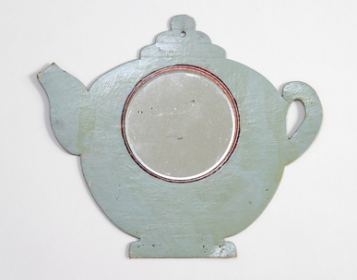 Mitchell turned the mirror into an absence, the open mouth of a jar.
 Classic McMakin word play: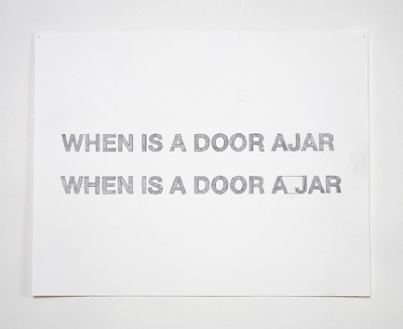
One more image, which I believe is the real model for Mitchell's Handsomest Men in the World. Anyone at all familiar with McMakin's furniture will marvel that he found these chairs in a junk shop. It's his work on the shabby cheap.
 John Baldessari once observed that he shared large chunks of McMakin's vision:
A love of minimalism (while slightly poking fun at it), a Mattisean love of color, a goal of keeping others off balance, and a love of removal/absence, a quest for the paradox of simplicity and complexity. But overall, a mission to sharpen perception, it's a significant accomplishment to get one to really see and understand a chair (and not feel self-conscious in sitting on it). I don't think Roy has designed an ironing board yet, but I'm sure it would double as a painting. (from profile here.)About Mitchell, I've written, in various places:
Hairless bears in creamy slips...generosity and grace... conjunctions of feeling and form.... fusion of history and fleeting moment...His great gift is an ability to turn a chaos of sources into a coherent visual stream, what 16th-century Italian Baldassare Castiglione identified in "The Courtier" as a nobleman's highest grace, to have "sprezzatura," a casual manner of doing a difficult thing well... Mitchell's casual grace masks bountiful skill. He drapes the shaggy world in silks and puts a top hat on the tawdry... He's is a potter, but he's also a painter and faux-fur sculptor. He works in clay, oil paint, watercolor, glass, latex, plaster, monoprints, paper, paper cutouts and wood.
There's a two-part catalog from Publication Studio available through the gallery.
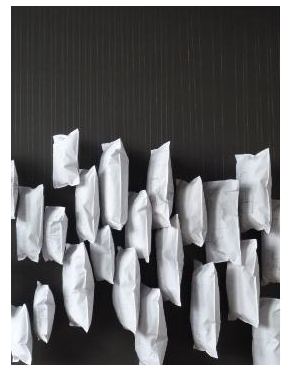
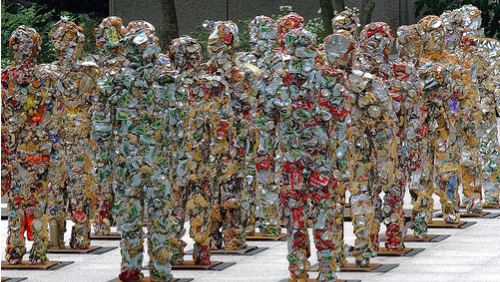
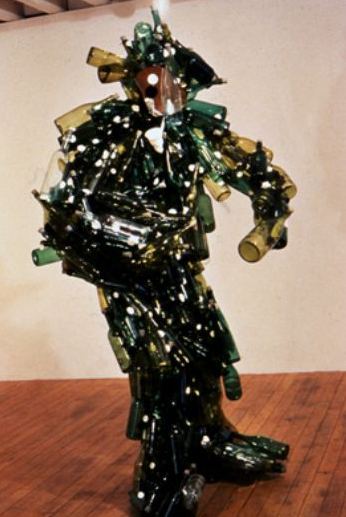
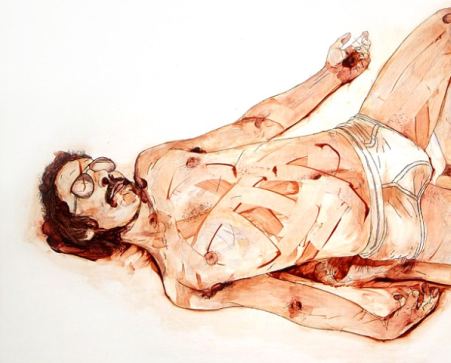
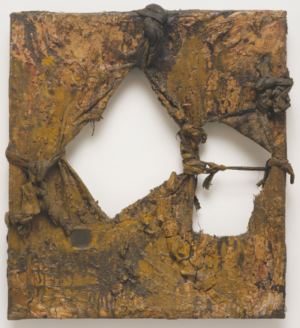
By contemplating the Stations of the Cross
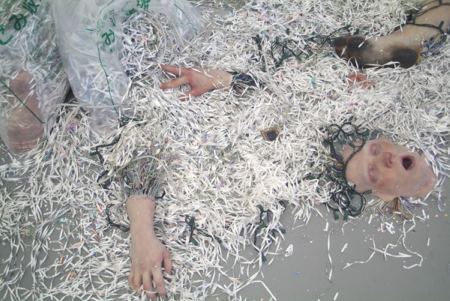
 By shredder
 By spontaneous liquidation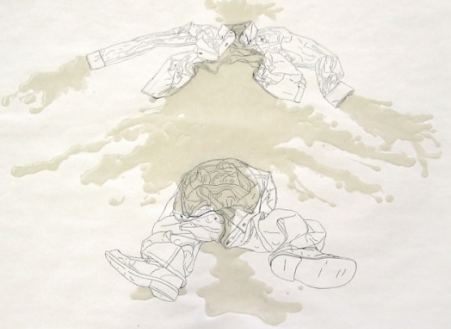
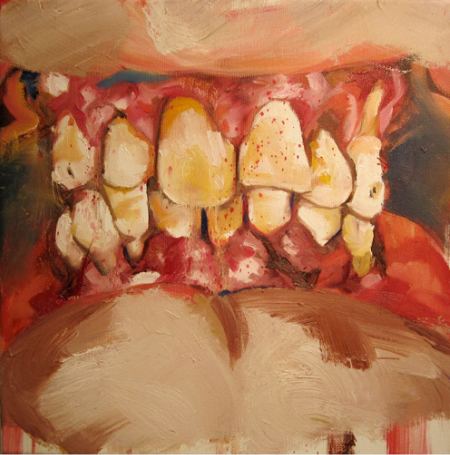
(Otto Muehl)
 Douglas Britt, art critic of the Houston Chronicle, contributed three silent videos on the HC's entertainment blog, here, here and here. Jen Graves review here. Emily Pothast on Translinguistic Other here.
 My reviews here, here, here, here, here and here. This is the most important contemporary art exhibit in the history of the Seattle Art Museum. Why it is not traveling is beyond me.
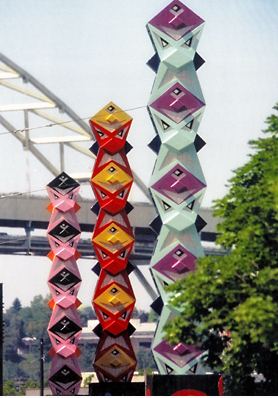
If none of that appeals, you're safe with a totem pole, even though the tribes that created the original models never lived that far south.
Kenny Scharf made a smashing success of the last option. Starting with a cliche isn't a problem. It's where you end up that matters.
Say it, no ideas but in things. Patterson, William Carlos WilliamsIn Jameson Park at the edge of the Pearl District, New York Pop Shop tribalism:
 Detail, via
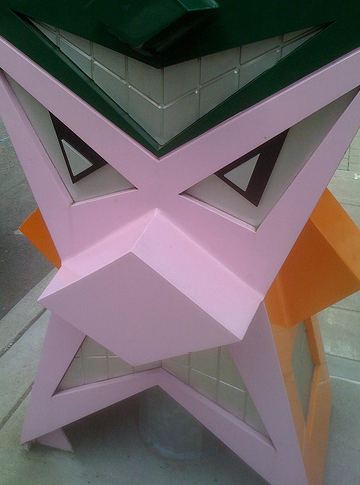 Detail, via: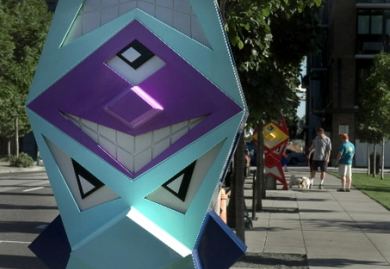
It's
Only artists who know their way around the weird can hope to win the 2009 Metropolis Art Prize: $20,000, a dedicated artist channel on Babelguym's Metropolis and a screening in Times Square. There are other cash prizes with a Times Square spotlight, including one for "best street art video." (Info on Two Coats of Paint)
Jurors say they want to be "inspired, challenged, excited, awed, moved, intrigued and weirded-out." Open to artists in all visual media, but entries have to be submitted on video.
Northwest artists who should put a video together (or use one they've already made) include:
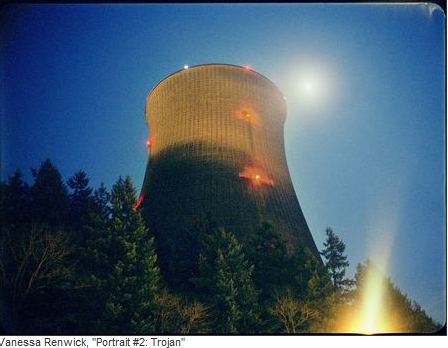
Vanessa Renwick
Matt McCormick, detail from The Subconscous Art of Graffiti Removal
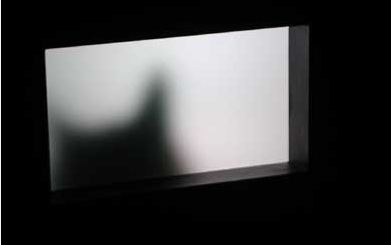
Laura Fritz (The cat, Laura. Put a stamp on it and slide it into a mail box.)
Tivon Rice (Osteotmy)
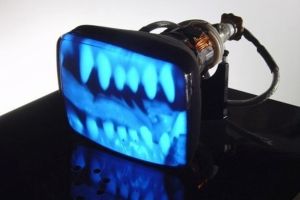
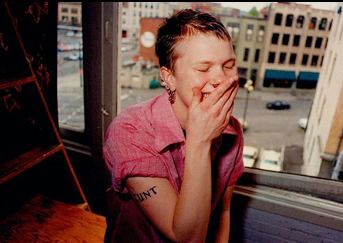
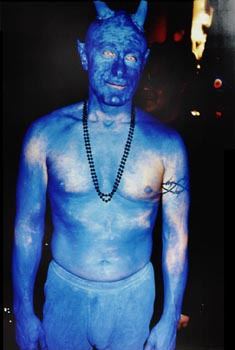 Dan Webb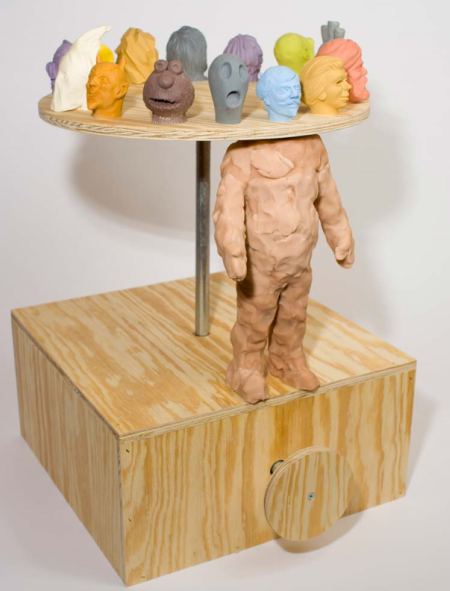
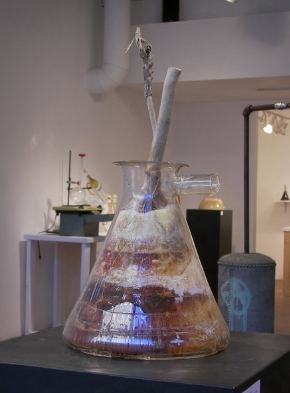
The Northwest has a rich vein of the strange to tap, and I've only just begun. I'll end with a glass artist.
Eli Hansen, Jack Pepsi
 For the category of best street video, nobody's going to top Jessica Jobaris dancing as if she'd been shot.
 Street
pigeons have few friends, but one of them is a scientist. He claims
they can be taught to discriminate between Chagall, Van Gogh and
Picasso, here. The same scientist came to the same conclusion a decade earlier, here.
Street
pigeons have few friends, but one of them is a scientist. He claims
they can be taught to discriminate between Chagall, Van Gogh and
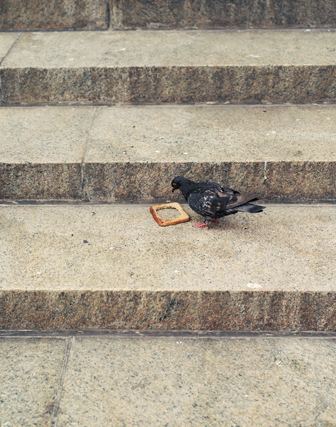
Picasso, here. The same scientist came to the same conclusion a decade earlier, here.Maybe he repeats himself because the first time around, he failed to raise their status. In the photo below by Regine Petersen, the bird pauses as it eats the soft center of a piece of bread. Once you know about its visual skills, doesn't the image also look as if the animal is contemplating the interior of a frame?
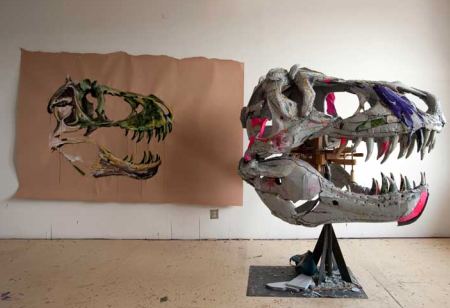
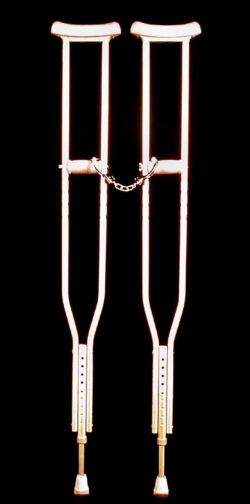 And once true romance is gone:
Heidi Schwegler
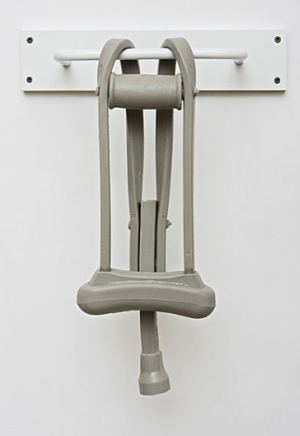 Mike Simi (for the serial dater)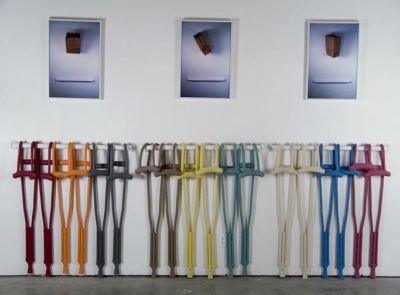
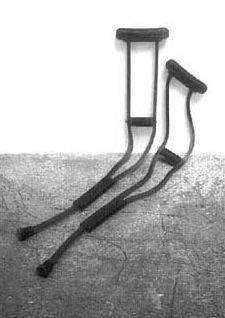
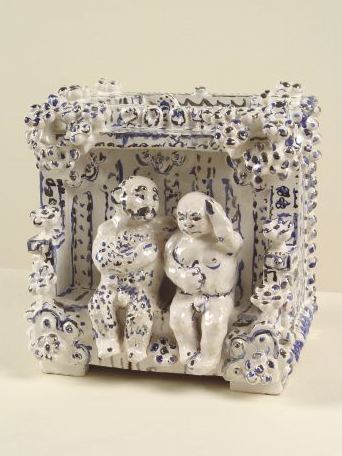
If Unzipped decides to give art within its theme a longer run, here's two more suggestions from Seattle:
Jeffry Mitchell (Good Counsel)
 Steven Miller (Proof of Homosexuality in Nature)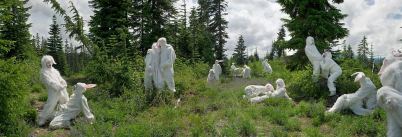
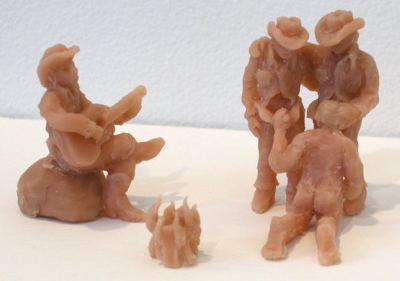
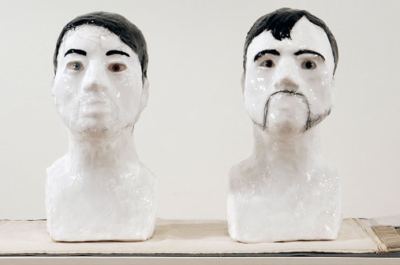
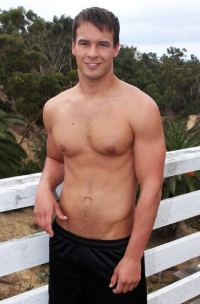 This is the body soon to be featured in a piece written by the peerless Dave White.
 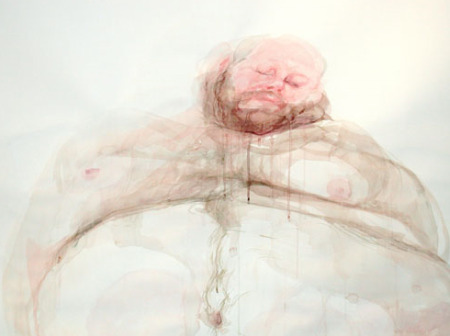 Have
devotees of the rock hard decided to lighten up on their
fat phobia? It's better than that. Their putting their phobias aside to
embrace art. Unzipped wants to add more substantial content to its theme, starting with Brian Murphy's self-portraits.
Have
devotees of the rock hard decided to lighten up on their
fat phobia? It's better than that. Their putting their phobias aside to
embrace art. Unzipped wants to add more substantial content to its theme, starting with Brian Murphy's self-portraits.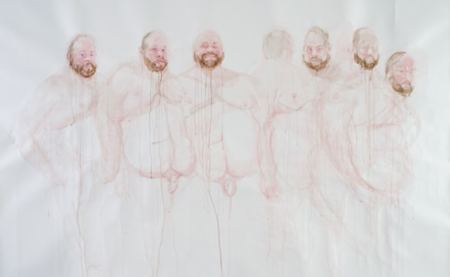 In a culture that fears fat the way ship captains
fear fatal storms, Murphy celebrates his bountiful flesh, turning his
face into a moon squashed against the picture plane and his torso into
a sky, with drifts of himself floating by.
In a culture that fears fat the way ship captains
fear fatal storms, Murphy celebrates his bountiful flesh, turning his
face into a moon squashed against the picture plane and his torso into
a sky, with drifts of himself floating by.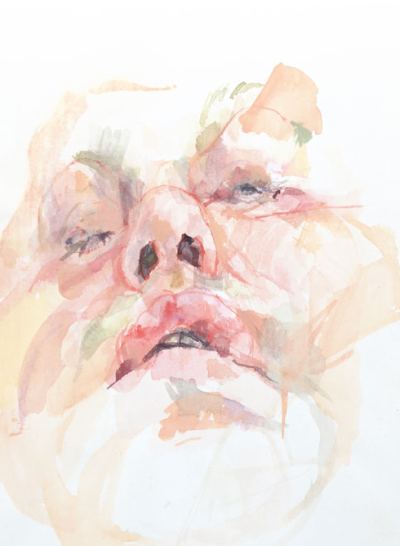 Within his theme, his range extends beyond the celebratory. He can render
versions of his body with the tender exactitude Kafka used to describe
Gregor Samsa after his metamorphosis.
Within his theme, his range extends beyond the celebratory. He can render
versions of his body with the tender exactitude Kafka used to describe
Gregor Samsa after his metamorphosis.Jenny Saville paints opalescent mounds of fleshy female (and pig) torsos, sometimes but not always attached to fleshy heads. She works from photos; he works from life. To paint himself, he peers into a small, hand-held mirror, memorizing as much of the results as he can carry in his head, painting that and repeating the process. Saville works with a grid. Murphy's internal balances are far more precarious. Saville paints slabs of meat; Murphy paints pieces of sky. His flesh floats. It's a massive volume with no weight, a pageant ready to melt into colored air.


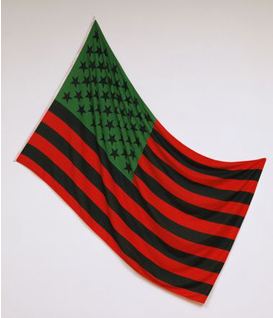

Debra Baxter
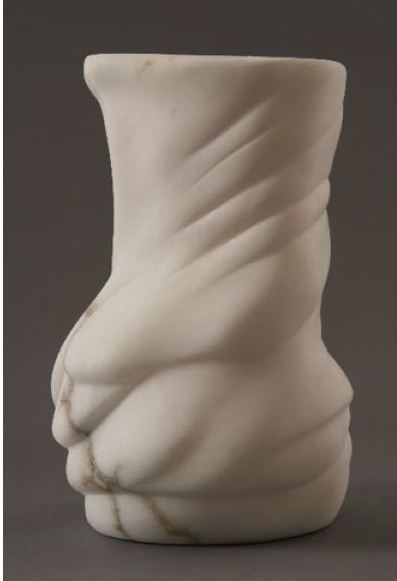
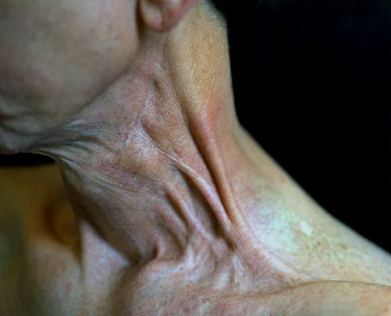
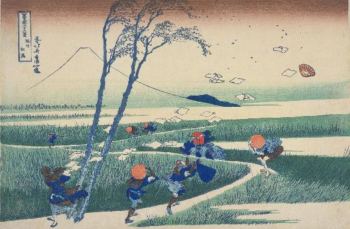
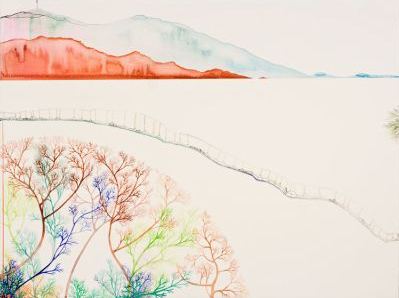 inspired by Hokusai's 36 Views of Mount Fuji.
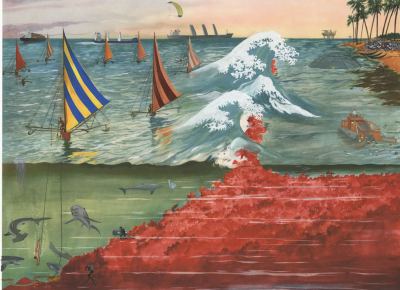
 Inka Essenhigh, Blue Wave...
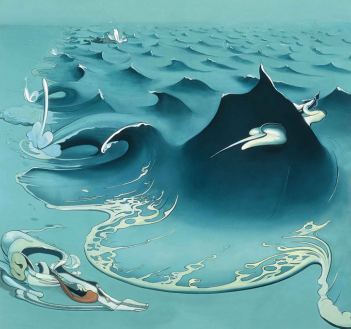 inspired by Hokusai's The Great Wave.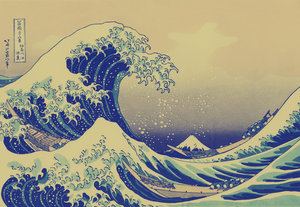

AJ Ads
AJ Arts Blog Ads
Now you can reach the most discerning arts blog readers on the internet. Target individual blogs or topics in the ArtsJournal ad network.
Advertise Here
AJ Blogs
AJBlogCentral | rssculture
Terry Teachout on the arts in New York City
Andrew Taylor on the business of arts & culture
rock culture approximately
Laura Collins-Hughes on arts, culture and coverage
Richard Kessler on arts education
Douglas McLennan's blog
Dalouge Smith advocates for the Arts
Art from the American Outback
For immediate release: the arts are marketable
No genre is the new genre
David Jays on theatre and dance
Paul Levy measures the Angles
Judith H. Dobrzynski on Culture
John Rockwell on the arts
Jan Herman - arts, media & culture with 'tude
dance
Apollinaire Scherr talks about dance
Tobi Tobias on dance et al...
jazz
Howard Mandel's freelance Urban Improvisation
Focus on New Orleans. Jazz and Other Sounds
Doug Ramsey on Jazz and other matters...
media
Jeff Weinstein's Cultural Mixology
Martha Bayles on Film...
classical music
Fresh ideas on building arts communities
Greg Sandow performs a book-in-progress
Exploring Orchestras w/ Henry Fogel
Harvey Sachs on music, and various digressions
Bruce Brubaker on all things Piano
Kyle Gann on music after the fact
Greg Sandow on the future of Classical Music
Norman Lebrecht on Shifting Sound Worlds
publishing
Jerome Weeks on Books
Scott McLemee on books, ideas & trash-culture ephemera
theatre
Wendy Rosenfield: covering drama, onstage and off
Chloe Veltman on how culture will save the world
visual
Public Art, Public Space
Regina Hackett takes her Art To Go
John Perreault's art diary
Lee Rosenbaum's Cultural Commentary
Tyler Green's modern & contemporary art blog




Recent Comments