

« April 2011 | Main | June 2011 »
May 31, 2011
TT: Into the woods
In theory, Mrs. T and I divide our time between New York City and an old farmhouse deep in the woods near Storrs, a college town located in the quiet corner of Connecticut. Alas, this theory has taken a beating of late. We flew down to Florida in January so that I could put in my annual stint as a scholar-in-residence at Rollins College, our new home away from home, and I didn't set foot in Storrs again for the better part of five months. No sooner did I return to Manhattan than I got stuck on Broadway, reviewing show after show, and in Philadelphia, seeing Danse Russe onto the stage. Not until Memorial Day was I able to pack a bag, rent a car, drive to northeast Connecticut, and rejoin Mrs. T at our little place on Chaffeeville Road.
New York is...well, it is what it is and then some, and if that's what you want, you know what to do. I've lived there for a quarter-century and find it hugely stimulating. Most of the time I love catching cabs and sitting on the aisle and seeing my beloved friends whenever I please. But regular readers of this blog don't need to be reminded that I'm a small-town boy from way back, and New York, for all its self-evident splendors, does have a sneaky way of grinding you down.

Not so Storrs, which is as tranquil as a cloud study by Constable, so much so that longtime residents not infrequently refer to the town as "Snores," sometimes affectionately and sometimes wryly. Mrs. T, as it happens, was born near Storrs and moved back to her old home town many years later, and when I visited her for the first time five years ago, I knew that I wanted to spend as much time there as I could.
I sleep better in Storrs, flinging my bedroom window open to hear the gentle sounds of the night, and I write better, too, no doubt because of the near-complete lack of opportunities for distraction. In New York I have to be constantly on guard in order to get anything done. In Storrs, by contrast, I can sit down at my desk secure in the knowledge that nobody is likely to bother me.

Needless to say, I didn't plan to spend the whole spring in Manhattan, and by the time I finally managed to hit the road on Monday, I was well and truly frazzled, in part because I'd spent virtually all of Sunday writing a 2,500-word essay from scratch. But no sooner did I cross the state line than I felt my cares melting away, and when I pulled into our driveway, smelled the deep-green scent of the meadow across the way, and heard the neighborhood rooster, who has the confusing but endearing habit of crowing not at sunrise but whenever he pleases, I knew I was home again.

I hasten to point out that I'm not--repeat, not--on vacation. I have to write and file two Wall Street Journal columns this week, and once they're done, I have plenty of other work to do before we go back to New York on Friday to see the Mint Theater Company's revival of Rachel Crothers' A Little Journey. But I don't have to start writing until Wednesday, so Mrs. T and I plan to take today off. We're going to sleep late, have lunch at the Vanilla Bean Café, then go for a nice long drive to nowhere in particular. Come evening we'll eat a home-cooked supper, curl up on the couch, and watch a movie.
That sounds to me like the best of all possible days, spent in the company of the best of all possible wives. So if you'll excuse me, I've got plenty of nothing to do, and I need to get started.
* * *
Mildred Bailey and the Delta Rhythm Boys sing Alec Wilder's "It's So Peaceful in the Country" in 1941:
Posted May 31, 12:00 AM
TT: Almanac
"Any book born of a grudge is built on sand."
Wesley Stace, Charles Jessold, Considered as a Murderer
Posted May 31, 12:00 AM
May 30, 2011
TT: In memoriam
Herbert von Karajan conducts the first movement of Verdi's Requiem at La Scala in 1967. The soloists are Leontyne Price, Fiorenza Cossotto, Luciano Pavarotti, and Nicolai Ghiaurov:
Posted May 30, 12:00 AM
TT: Almanac
"Courage is almost a contradiction in terms. It means a strong desire to live taking the form of a readiness to die."
G.K. Chesterton, Orthodoxy
Posted May 30, 12:00 AM
May 27, 2011
HAVE OUR CULTURAL STEWARDS ABANDONED ONE OF THEIR OWN?
"It strikes me that instead of being 'cautious' not to 'impose' American values on a foreign culture, the museums of America should acknowledge that they have a unique responsibility to speak out on behalf of Ai Weiwei. They are, after all, trustees of the cultural heritage of mankind, which makes them by definition guardians of the universal values of civilization. Yet most of them are carefully looking the other way while China thumbs its nose at those same values by unlawfully imprisoning an artist. That's not caution, it's cowardice...."Posted May 27, 10:58 AM
TT: The church on Catfish Row
In today's Wall Street Journal I file the first of two reports on my recent visit to Chicago. This week I review the Court Theatre's Porgy and Bess and TimeLine Theatre's The Front Page, both of which are sensationally good. Here's an excerpt.
* * *
Nowadays most people think of "Porgy and Bess" as an opera, but it began life on Broadway, and there's a strong case to be made for performing the American "Carmen" (which is what "Porgy" is) not as a big-house opera but as a straight-from-the-shoulder music drama (which is what "Carmen" is). That's what Charles Newell has done in his soul-stirring revival, a radical rethinking of George Gershwin's rambling masterpiece that transforms it into a concise two-act chamber opera for 15 singers and six instrumentalists. Though it's nothing like the "Porgy" that Gershwin and his collaborators envisioned, Mr. Newell's new version is so emotionally true to the spirit of the piece that any lingering reservations you may have about its modest scale will quickly be swept away.
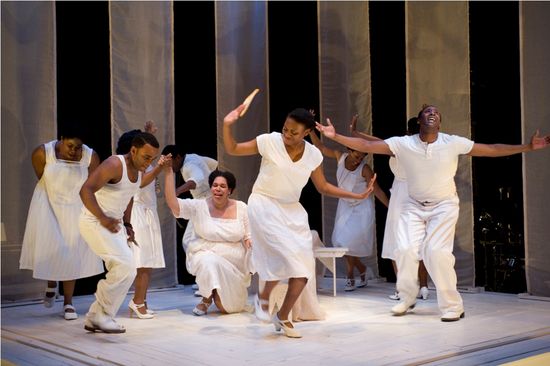
No sooner do you walk into the 250-seat Court Theatre than you see what Mr. Newell and his production team are up to. The set, designed by John Culbert, is a wooden platform whose bleached planks evoke a one-room country church. The cast is dressed in white (the only splash of color is the blood-red negligée that Porgy buys for Bess) and the atmosphere is that of a revival meeting. One might almost be present at the evangelical equivalent of a 13th-century liturgical drama, a latter-day "Play of Porgy" in which the timeless tale of a crippled Catfish Row beggar (Todd M. Krygar) who falls for a cocaine-snorting tramp with a heart of gold (Alexis J. Rogers, who is devastatingly sexy) is enacted before the altar.
This is not, in other words, a stripped-down Broadway-style "Porgy" but a genre-transcending theatrical experience staged in such a way as to shift the emphasis from Gershwin's score to DuBose Heyward's often-underrated libretto....
Just as "Porgy and Bess" is now best known as an opera, so is "The Front Page" now best known as a movie. In the original 1928 stage version, Ben Hecht and Charles MacArthur introduced Broadway audiences to the scoop-hungry crime reporters who covered Chicago in the age of Al Capone. But when Howard Hawks made "His Girl Friday" in 1940, he turned Hildy Johnson, the tough-guy reporter of "The Front Page," into a woman, in the process changing a hard-nosed farce about journalism in America into a screwball comedy about the perils of workplace romance. The results were so funny that no one complained, but the play got lost in the shuffle, and revivals are now as scarce as evening papers.
All praise, then, to Chicago's TimeLine Theatre for resurrecting "The Front Page" and giving it a staging so full of brassy brio that you'll wonder why you ever settled for less. Performed in the round in the company's 99-seat theater, it puts you so close to the action that you can actually smell the ketchup on the hamburgers eaten by the characters in the first act. The acting fizzes with outrageous, nose-thumbing vitality--PJ Powers and Terry Hamilton couldn't be better as Hildy Johnson and Walter Burns, Hildy's unscrupulous boss--and the ultra-realistic set, designed by Collette Pollard, is so suitably grubby that you'll want to grab a broom and start sweeping....
* * *
Read the whole thing here.
Posted May 27, 12:00 AM
TT: Have our cultural stewards abandoned one of their own?
My "Sightings" column in today's Wall Street Journal is about Ai Weiwei. Here's an excerpt.
* * *
China locked up best-known artist nearly two months ago. Ai Weiwei, who is both a widely admired conceptual artist and a fearless human-rights activist, has been on the bad side of the Chinese government for years. Officials claim that he was imprisoned for tax evasion, but given China's notorious intolerance of dissent, it's an ultra-safe bet that his real "offense" was that he dared to criticize the tyrannical bureaucrats who run his native land, not just once but repeatedly....
And what is the art world doing about it? Not much.
To be sure, numerous protests have taken place since Mr. Ai and members of his staff were imprisoned on Apr. 3, one of which was mounted by the Museum of Contemporary Art San Diego. "We are aghast that this has happened and intend to protest as best we can," MCASD director Hugh Davies told artblogger Tyler Green. But no other major museum in America has taken a similar step (though several museum directors have individually signed an online petition circulated by the Guggenheim Museum that calls for his release). What's more, the Milwaukee Art Museum and the Virginia Museum of Fine Arts are preparing to open exhibitions of Chinese art organized in cooperation with the Chinese government. To date Mr. Ai's plight has not led either institution to alter its plans....
In situations like these, of course, it's worth recalling the precept that every budding doctor learns in medical school: "First, do no harm." It might well be that the Milwaukee Art Museum would plunge Mr. Ai into hotter water by protesting his imprisonment--but it's hard to see how that could make his situation any worse. On the other hand, such a protest might also persuade China's leaders that they can't expect to keep on doing business as usual with the U.S. unless they release Mr. Ai forthwith.
It strikes me that instead of being "cautious" not to "impose" American values on a foreign culture, the museums of America should acknowledge that they have a unique responsibility to speak out on behalf of Ai Weiwei. They are, after all, trustees of the cultural heritage of mankind, which makes them by definition guardians of the universal values of civilization. Yet most of them are carefully looking the other way while China thumbs its nose at those same values by unlawfully imprisoning an artist....
* * *
Read the whole thing here.
Posted May 27, 12:00 AM
TT: Almanac
"No education is worth having that does not teach the lesson of concentration on a task, however unattractive. These lessons, if not learnt early, will be learnt, if at all, with pain and grief in later life."
Cyril Connolly, Enemies of Promise
Posted May 27, 12:00 AM
May 26, 2011
TT: So you want to see a show?
Here's my list of recommended Broadway, off-Broadway, and out-of-town shows, updated weekly. In all cases, I gave these shows favorable reviews (if sometimes qualifiedly so) in The Wall Street Journal when they opened. For more information, click on the title.
BROADWAY:
• Anything Goes (musical, G/PG-13, mildly adult subject matter that will be unintelligible to children, closes Jan. 8, reviewed here)
• Born Yesterday (comedy, G/PG-13, closes July 31, reviewed here)
• The House of Blue Leaves (serious comedy, PG-13, closes July 23, reviewed here)
• How to Succeed in Business Without Really Trying (musical, G/PG-13, perfectly fine for children whose parents aren't actively prudish, reviewed here)
• The Importance of Being Earnest (high comedy, G, just possible for very smart children, closes July 3, reviewed here)
• Million Dollar Quartet (jukebox musical, G, reviewed here)
• The Motherf**ker with the Hat (serious comedy, R, adult subject matter, closes July 17, reviewed here)
OFF BROADWAY:
• Avenue Q (musical, R, adult subject matter and one show-stopping scene of puppet-on-puppet sex, reviewed here)
• The Fantasticks (musical, G, suitable for children capable of enjoying a love story, reviewed here)
• Play Dead (theatrical spook show, PG-13, utterly unsuitable for easily frightened children or adults, reviewed here)
CLOSING SOON OFF BROADWAY:
• By the Way, Meet Vera Stark (comedy, PG-13, closes June 12, reviewed here)
• A Minister's Wife (serious musical, G, far too complicated for children, closes June 12, reviewed here)
CLOSING NEXT WEEK IN SAN DIEGO:
• Life of Riley (serious comedy, PG-13, closes June 5, reviewed here)
CLOSING SUNDAY OFF BROADWAY:
• The School for Lies (verse comedy, PG-13, impossible for children, reviewed here)
Posted May 26, 12:00 AM
TT: Almanac
"Literature is the art of writing something that will be read twice; journalism what will be grasped at once, and they require separate techniques."
Cyril Connolly, Enemies of Promise
Posted May 26, 12:00 AM
May 25, 2011
TT: Snapshot
Benno Moiseiwitsch plays Franz Liszt's transcription of Wagner's Tannhauser Overture:
(This is the latest in a weekly series of arts-related videos that appear in this space each Wednesday.)
Posted May 25, 12:00 AM
TT: Almanac
"To make progress, you have to make a mess."
Peggy Lee (quoted in George Simon, "Hooray for Love!," Metronome, December 1948)
Posted May 25, 12:00 AM
May 24, 2011
TT: Almanac
"I always felt that people who are really stars, they have a secret."
Marge Champion (quoted in Peter Richmond, Fever: The Life and Music of Miss Peggy Lee)
Posted May 24, 12:00 AM
May 23, 2011
TT: If it's Monday, I don't know where we are
Depending on when you get around to reading these words, Mrs. T and I will either be in Chicago, in Washington, D.C., or somewhere in between. We're flying to Washington this afternoon to see Stephen Sondheim's Follies at the Kennedy Center on Tuesday and the Shakespeare Theatre Company's production of Harold Pinter's Old Times on Thursday, and I plan to spend my afternoons rooting around in the Smithsonian Institution's Duke Ellington Collection. I'll also be knocking out a couple of columns in our hotel room when not otherwise occupied.
This is not, in other words, a vacation, though our travels very often have a carefree air, mainly because we spend so much time seeing plays and musicals. We saw, for instance, three shows in Chicago and its environs over the weekend, The Front Page, Porgy and Bess, and Heartbreak House, about which I'll be saying my say in The Wall Street Journal starting on Friday. It happens that both The Front Page and Heartbreak House were performed in the round in tiny theaters, and the Court's Porgy and Bess was a small-scale production (fifteen actors, six instrumentalists) mounted in a 250-seat house. I like a really big show as much as the next guy, but having just spent the past two months seeing virtually nothing but Broadway shows, with visits to Carnegie Hall and the New York State Theater thrown in for good measure, it was a pleasure--almost a relief--to spend the weekend in such intimate surroundings.
In addition, we finally visited the fancy new modern wing of the Art Institute of Chicago, which was designed by Renzo Piano. It's as gorgeous as you've heard, though I haven't spent nearly enough time there to be able to say with confidence whether it's a good place in which to look at art. (You have to live with a new museum building to get a clear sense of its strengths and weaknesses.) I gather that the new wing doesn't provide the museum with a significant increase in display space, but I did encounter some paintings that were new to me on Friday, including a very late canvas by Edouard Vuillard called Vuillard's Room at the Château des Clayes (it dates from 1932) that I can't recall having seen hanging at the Art Institute or anywhere else.
Our Girl in Chicago, logically enough, joined us for our wanderings through Chicagoland, and it was a joy to be with her again after a too-long separation. The three of us ate splendidly well at a pair of favorite haunts, Wrigleyville's Uncommon Ground and Glencoe's Prairie Grass Café. I hope we do as well for ourselves in Washington!
Mrs. T departs on Thursday, I on Friday. I've got things to do in Manhattan over the weekend, but on Monday I'll rejoin her at our place in Connecticut, which I haven't seen since we flew down to Florida in January. It'll be nice to be in the country again, both for its own sake and because I find it easier to write there than in hotel rooms or departure lounges. I have some revisions to do on Satchmo at the Waldorf, my Louis Armstrong play, and I long to resume work on my Ellington biography. (I blush to say that it's been on ice ever since I returned to New York in March and embarked on the Great Broadway Marathon of 2011.) Come next Saturday, though, we'll be off and running yet again.
Such is our summer routine, and most of the time, today included, I wouldn't have it any other way.
Posted May 23, 12:00 AM
TT: Almanac
"If one simply wants to make a living by putting words on paper, then the BBC, the film companies and the like are reasonably helpful. But if one wants to be primarily a writer, then, in our society, one is an animal that is tolerated but not encouraged--something rather like a house sparrow--and one gets on better if one realises one's position from the start."
George Orwell, "The Cost of Letters" (Horizon, September 1946)
Posted May 23, 12:00 AM
May 20, 2011
TT: Portrait of an invisible man
I began this year's summer travels for The Wall Street Journal with a trip to San Diego, where I saw the U.S. premiere of Life of Riley, Alan Ayckbourn's latest play. It's terrific, and so is the production. Here's an excerpt.
* * *
Prolific artists tend to get taken for granted. Alan Ayckbourn, for instance, has written 74 plays (with a seventy-fifth now being readied for its premiere in September). This figure, coupled with the fact that most of his plays are comedies of one sort or another, leads a great many people to wrongly suppose that he must be a lightweight. But Mr. Ayckbourn is in truth one of the half-dozen greatest living playwrights in the English-speaking world, and "Life of Riley," his latest effort, is outstanding in every way. That it has received its U.S. premiere not on Broadway but at San Diego's Old Globe is yet another nail in the coffin of New York's fast-waning reputation as the vital center of theater in America.
Though the plot of "Life of Riley" is simpler than is Mr. Ayckbourn's wont, it contains a typical twist: The title character is neither seen nor heard, only talked about. When George Riley, a suburban schoolteacher, learns that he has a terminal illness that will kill him in a matter of months, his approaching fate becomes the subject of passionate interest to three people: Monica (Nisi Sturgis), his ex-wife, and Kathryn (Henny Russell) and Tamsin (Dana Green), two married women who have taken a more than friendly interest in him. Stir in Colin (Colin McPhillamy) and Jack (Ray Chambers), the not-at-all-complaisant husbands of Kathryn and Tamsin, and Simeon (David Bishins), the farmer with whom Monica is now living, and you've got a sure-fire recipe for a frenetically complicated farce.
That, however, is where things start to get really interesting, for Mr. Ayckbourn specializes in sad comedies whose laughter is tinged with regret, and "Life of Riley," like "The Norman Conquests" before it, is not a standard-issue farce but a darkly shadowed portrait of three middle-class marriages that have been steeped in the sour brine of chronic disappointment....
American directors and actors sometimes make the mistake of overegging Mr. Ayckbourn's comic puddings, trolling for easy laughs instead of playing his scripts straight down the middle and letting the audience draw its own conclusions. Not so Richard Seer, who has staged "Life of Riley" with particular subtlety, striking an impeccable balance between cleverness and seriousness. As usual, the Old Globe has fielded an exceptional cast, only one of whose members, surprisingly enough, is English. (All praise to Jan Gist, the dialect coach, who has evidently done yeoman service.) Mr. McPhillamy, the lone Englishman, is ideal as the latest in Mr. Ayckbourn's long line of unhappily oblivious husbands of a certain age...
* * *
Read the whole thing here.
Posted May 20, 12:00 AM
TT: Almanac
"It seems to me that a prig is someone who judges people by his own, rather than by their, standards; criticism only becomes useful when it can show people where their own principles are in conflict."
Evelyn Waugh, Remote People
Posted May 20, 12:00 AM
May 19, 2011
TT: So you want to see a show?
Here's my list of recommended Broadway, off-Broadway, and out-of-town shows, updated weekly. In all cases, I gave these shows favorable reviews (if sometimes qualifiedly so) in The Wall Street Journal when they opened. For more information, click on the title.
BROADWAY:
• Anything Goes (musical, G/PG-13, mildly adult subject matter that will be unintelligible to children, closes Jan. 8, reviewed here)
• Born Yesterday (comedy, G/PG-13, closes July 31, reviewed here)
• The House of Blue Leaves (serious comedy, PG-13, closes July 23, reviewed here)
• How to Succeed in Business Without Really Trying (musical, G/PG-13, perfectly fine for children whose parents aren't actively prudish, reviewed here)
• The Importance of Being Earnest (high comedy, G, just possible for very smart children, closes July 3, reviewed here)
• Million Dollar Quartet (jukebox musical, G, reviewed here)
• The Motherf**ker with the Hat (serious comedy, R, adult subject matter, closes July 17, reviewed here)
OFF BROADWAY:
• Avenue Q (musical, R, adult subject matter and one show-stopping scene of puppet-on-puppet sex, reviewed here)
• By the Way, Meet Vera Stark (comedy, PG-13, closes June 12, reviewed here)
• The Fantasticks (musical, G, suitable for children capable of enjoying a love story, reviewed here)
• A Minister's Wife (serious musical, G, far too complicated for children, closes June 12, reviewed here)
• Play Dead (theatrical spook show, PG-13, utterly unsuitable for easily frightened children or adults, reviewed here)
CLOSING NEXT WEEK OFF BROADWAY:
• The School for Lies (verse comedy, PG-13, impossible for children, extended through May 29, reviewed here)
CLOSING SUNDAY ON BROADWAY:
• Lombardi (drama, G/PG-13, a modest amount of adult subject matter, reviewed here)
Posted May 19, 12:00 AM
TT: Just because
Marian Anderson appears as the mystery guest on What's My Line? in 1965:
Posted May 19, 12:00 AM
TT: Almanac
"There are many who dare not kill themselves for fear of what the neighbours will say."
Cyril Connolly, The Unquiet Grave
Posted May 19, 12:00 AM
May 18, 2011
TT: From ocean to ocean, forever
Perhaps because I didn't do much traveling until I reached adulthood, I still find it disorienting to fly from the East Coast to the West Coast in a single day. I almost always spend the better part of the trip seated by a window, goggling at the changing landscape far below me. How is it possible that one can fly over farmland and mountains and deserts in the course of five hours, looking down at the Atlantic Ocean in the morning and the Pacific in the afternoon? Just five years before I was born, Edward R. Murrow launched See It Now, the first weekly TV newsmagazine, with a sequence in which he showed live pictures of New York and San Francisco on a split screen. Once it was a miracle. Now it's a cliché.
I confess, however, to relishing my own naïvete, because it means that I never take for granted the often-problematic joys of travel. Evelyn Waugh, that most curmudgeonly of curmudgeons, owned a pair of canvases by the Victorian artist Robert Musgrave Joy called "The Pleasures of Travel: 1751 and 1851" that contrasted coach and rail voyages in the eighteenth and nineteenth centuries, the first terrifying (a highwayman was holding up the passengers) and the second sedate. In 1951 Waugh commissioned a macabre companion piece that showed the interior of an aircraft whose terrified occupants were all too clearly plunging towards disaster.
Me, I don't like flying, but I adore the things that it makes it possible for me to do. On Monday morning Mrs. T and I clambered aboard a miserably cramped Continental jet, and that same evening we were dining with friends in San Diego, a small-townish city whose straightforward virtues are near to our hearts. Tomorrow we'll be flying from San Diego to Chicago, which we love, if possible, even more, and come Monday we'll be in Washington, D.C. What's not to like?
The answer, of course, is plenty. Travel can be madly exasperating, especially if you write for a living. One of the reasons why Mrs. T and I tend to gravitate to familiar lodgings when on the road is that, like most writers, I prefer to work in familiar surroundings. If I can't write at home, I like at the very least to do it in a place that isn't entirely anonymous. Hence our near-reflexive decision to spend our three-day stay in San Diego at Park Manor Suites, a wonderfully grand and shabby old place that is our favorite non-fancy hotel in America. Park Manor may not be home, but it's homey, and it has the advantage of being all but equidistant from the Old Globe, the theater where we saw Alan Ayckbourn's Life of Riley last night, and El Zarape, the hole-in-the-wall taqueria where we'll be lunching on the best scallop burritos in the world.
To get away, you have to go away, and in middle age I find that I love getting away from New York, where most of my paths are well and truly beaten, and exploring a country whose myriad wonders continue to excite me after some five years of near-nonstop theater-related travel. No doubt a time will come when I've had enough, but it hasn't come yet, and until it does, I mean to make the most of it. If that means I have to put up with the quotidian horrors of modern air travel, that's O.K. by me. There are worse fates than spending a few unpleasant hours nibbling on cheap pretzels and listening to noisy babies--and it's a small price to pay for Alan Ayckbourn and scallop burritos.
* * *
The opening of the first episode of See It Now, telecast by CBS on November 18, 1951:
Posted May 18, 2:17 PM
TT: Snapshot
Cantor Josef Rosenblatt's on-screen appearance in The Jazz Singer, starring Al Jolson:
(This is the latest in a weekly series of arts-related videos that appear in this space each Wednesday.)
Posted May 18, 12:00 AM
TT: Almanac
"Remember that, however patient your study, you will never in adult life learn any language perfectly; the best you can hope for is to be a bore."
Evelyn Waugh, "The Tourist's Manual"
Posted May 18, 12:00 AM
May 17, 2011
TT: Almanac
"Editing a magazine is perhaps the only occupation in which my lack of belief in anything or anyone, and my ambivalence, my passionate belief in the BOTH, can be turned to advantage. In a writer this causes sterility, in an editor it is called 'readiness to give the other side a hearing.' I believe in god the Either, god the Or, and god the Holy Both."
Cyril Connolly, unpublished notebook entry (1941)
Posted May 17, 12:00 AM
May 16, 2011
TT: Off and running
By the time most of you get around to reading this, Mrs. T and I will be in the air somewhere between New York and San Diego, the first stop on our summer-long sprint through the theaters of America. We'll be seeing the American premiere of Alan Ayckbourn's Life of Riley tomorrow night at the Old Globe. On Thursday we head from there to Chicago, about which more in due course.
I'll be checking in at regular intervals throughout our travels, so watch this space to find out where we are and what we're doing.
Posted May 16, 12:00 AM
TT: Out of water
Now that I spend so much time seeing plays in New York and elsewhere, I have that much less time left over to do anything else. Prior to Saturday afternoon, Mrs. T and I had been to exactly one movie together in the past three years, and I can't remember the last time I went to Carnegie Hall or the New York State Theater for any reason whatsoever. (The joke in our family is that the only operas I see these days are the ones that I write.) Because so many shows opened on Broadway in March and April, I didn't have time to do much of anything else but see and write about them. So when I realized that we were going to have four "dark" days prior to leaving for San Diego this morning, I decided that we'd better take full advantage of the hole in our schedule, and we spent a sizable chunk of those four days making up for lost time.
Mrs. T couldn't get to New York to see New York City Ballet's premiere of Lynne Taylor-Corbett's Seven Deadly Sins on Thursday, so I went by myself. This ended up being a good idea, since it allowed me to be alone with my thoughts. Once I went to the ballet as often as I now go to the theater, but that period of near-total immersion, which led to my becoming a dance critic, ended when I published a biography of George Balanchine in the summer of 2004, a little more than a year after I started covering theater for The Wall Street Journal. After I started writing about out-of-town shows as well as Broadway and off-Broadway openings, I had no nights to spare for dance, and though I didn't love it any less, I stopped going to performances save on extra-special occasions.
Visiting the New York State Theater on Thursday was something of a jolt, for I hadn't been there since the auditorium was remodeled two years ago and renamed the David H. Koch Theater (a change that I am no more capable of taking in at this point in my life than I am capable of referring to the Triborough Bridge or Shea Stadium by their new names). I was amazed to see that two aisles now run down either side of the orchestra seats and that the public areas of the theater have been slicked up extensively. Nor was I quite ready to confront a stageful of dancers who were still in school back in the days when I was getting to know the ballets of Balanchine and Jerome Robbins.
The sad truth is that I felt rather like a ghost at the party, looking at Maria Kowroski in Vienna Waltzes and remembering Suzanne Farrell's farewell performance in the same ballet twelve years ago. Of course I was more than glad to see The Seven Deadly Sins and to hear Patti LuPone singing the music of Kurt Weill with her usual ferocious pungency, but I knew long before the evening was over that I no longer felt altogether at home in the world of ballet, and it wasn't until I left the theater that I regained my equilibrium and was myself again.
Carnegie Hall seemed almost as strange to me the next night, but the auditorium was full of familiar faces, making it easier for me to keep my psychic footing. The occasion was the New York premiere of Carlos Drummond de Andrade Stories, an orchestral song cycle that my old friend Maria Schneider had composed for Dawn Upshaw and the St. Paul Chamber Orchestra, and seeing Maria conducting the orchestra on stage was still more reassuring. Or perhaps it was just the fact that music is naturally more central than ballet to my sense of self: I love dance passionately, but only as a spectator, whereas I am as much a musician as anything else. Whatever the reason, sitting down in my aisle seat with Mrs. T at my side felt like pulling on a beloved old pair of slippers.
I felt almost as comfortable the following afternoon when we popped into two midtown galleries, Tibor de Nagy and Michael Rosenfeld, to look at a pair of exhibitions by Jane Freilicher and Romare Bearden. Freilicher is near to my heart--I've written about her work on many occasions, and Mrs. T and I own one of her aquatints--and I've spent more hours at Tibor de Nagy Gallery than I can count. Thus it was a wholly uncomplicated pleasure for us to wander through a roomful of her latest paintings and wrangle companionably over which ones we liked best (I was especially taken with a small urban landscape called "City at Twilight").
If anything, Mrs. T was even more excited by Bearden's collages, for his work is largely unfamiliar to her, and I knew that he'd be right up her alley. Not surprisingly, Bearden's fractured scenes from the world of jazz rank high among my favorite works of modern art, and "Collage: A Centennial Celebration" contains several examples that the two of us coveted mutually and fiercely. And even though I don't hit the galleries nearly as often as I did in the days when I was putting together the Teachout Museum, the fact that our apartment is full of works on paper by our favorite American artists means that no matter how long I go without visiting a gallery or a museum, I never feel disconnected from the world of visual art.
Not so movies: I stopped writing about film five years ago, and I can count on the fingers of one hand the number of first-run releases that I've seen in a theater since then. This vexes Mrs. T no end, and after we saw The King's Speech in Florida two months ago, I promised her that we'd do it again soon. On Saturday afternoon I redeemed my promise by taking her to see Tom McCarthy's Win Win. It was a joy to do so: Our Girl in Chicago had already told me that it was a must-see film, and everything she said was on the nose. Not that it was a hard sell, for Mrs. T and I both loved McCarthy's The Station Agent, and Win Win is as poignant and ideally cast as that lovely little film. For me it was a special pleasure to see Nina Arianda and Bobby Cannavale on screen, having seen them both on stage a couple of weeks ago, and though the trailers that preceded the feature were uniformly fatuous and depressing, I went home determined yet again to make more room for movies in my life.
Time was when it would have seemed silly for me to feel the need to make such a resolution. I used to be the quintessential cultural boulevardier, so much so that I wrote a column for the Washington Post in which I reported each month about my widely varied doings about town. But I've been so deeply involved with theater for the past eight years that I've found it increasingly difficult to carve out space for anything else, and now that I not only review theatrical performances but help to create them, it's become harder still. Add to that my parallel life as a biographer and you can see why I've had to pull my head partway into my shell.
That said, I found the events of last week so exciting that I'm all the more determined to repeat them as soon as possible. We'll see whether this newfound resolve survives the grueling test of summer travel, but there'll be plenty of opportunities to visit museums as Mrs. T and I make our way from San Diego to Chicago to Washington, and it's usually possible to squeeze in a movie between shows if you put your mind to it.
I'd almost forgotten how aesthetically stimulating it is to explore the whole world of art rather than just a piece of it, even one as all-encompassing as theater. I wasn't born to be a specialist--the whole point of my career as a critic has been my determination not to be limited to a single field--and I believe devoutly in the truth of the slightly overripe but nonetheless sincere speech that Gary Merrill delivers in All About Eve:
The Theatuh, the Theatuh--what book of rules says the Theater exists only within some ugly buildings crowded into one square mile of New York City? Or London, Paris or Vienna? Listen, junior. And learn. Want to know what the Theater is? A flea circus. Also opera. Also rodeos, carnivals, ballets, Indian tribal dances, Punch and Judy, a one-man band--all Theater. Wherever there's magic and make-believe and an audience--there's Theater. Donald Duck, Ibsen, and The Lone Ranger, Sarah Bernhardt, Poodles Hanneford, Lunt and Fontanne, Betty Grable, Rex and Wild, and Eleanora Duse. You don't understand them all, you don't like them all, why should you? The Theater's for everybody--you included, but not exclusively--so don't approve or disapprove. It may not be your Theater, but it's Theater of somebody, somewhere.
I don't claim to understand them all, but throughout my life I've tried to appreciate and learn from as many of them as possible, and I don't plan to stop now.
* * *
Fred Astaire, Jack Buchanan, Nanette Fabray, and Oscar Levant sing "That's Entertainment" in The Band Wagon:
Posted May 16, 12:00 AM
TT: Almanac
"Art occupies in society the equivalent of one of those glands the size of a pea on which the proper functioning of the body depends, and whose removal is as easy as it is fatal."
Cyril Connolly, The Condemned Playground
Posted May 16, 12:00 AM
May 15, 2011
BOOK
Ricky Riccardi, What a Wonderful World: The Magic of Louis Armstrong's Later Years (Pantheon, $28.95, out June 21). I can't do any better than to repeat my dust-jacket blurb: "The later years of Louis Armstrong are one of the most fascinating untold tales in the history of jazz. What a Wonderful World is indispensable to anyone with a serious interest in the greatest jazz musician of the twentieth century." If you liked Pops, you need to read this book (TT).Posted May 15, 9:20 PM
MUSICAL
A Minister's Wife (Mitzi Newhouse Theater, Lincoln Center, closes June 12). The most important new musical since The Light in the Piazza, a near-operatic version of George Bernard Shaw's Candida that improves on the original (TT).Posted May 15, 9:13 PM
GALLERY
Jane Freilicher: Recent Paintings and Prints (Tibor de Nagy, 724 Fifth Ave., up through June 3). Ten new paintings and works on paper--including an affordable color lithograph--by the American Bonnard, an artist of deceptive simplicity and uncanny sensitivity whose work grows ever more lyrical with each passing year (TT).Posted May 15, 9:11 PM
May 13, 2011
GET TO THE GOOD PART
"Force a writer to be brief and you force him to think clearly--if he can. No, I don't think that War and Peace would have profited from being written in 140-character tweets. But I do think that our impatient age might just be getting the best out of a great many artists and thinkers who, left to their own devices, would never have learned how to cut to the chase..."Posted May 13, 11:39 AM
TT: Improving on Shaw
In today's Wall Street Journal drama column I rave about the New York transfer of A Minister's Wife and say a few tepid words about the much-ballyhooed King Lear currently playing at Brooklyn's BAM Harvey Theater. Here's an excerpt.
* * *
The most important new musical since "The Light in the Piazza" has come to New York. "A Minister's Wife," in which Austin Pendleton, Joshua Schmidt and Jan Levy Tranen took a classic play by George Bernard Shaw and made it better, opened two years ago at Chicago's Writers' Theatre, one of America's half-dozen top regional companies. Now this exquisite musical version of "Candida" has transferred to the Mitzi E. Newhouse Theater, Lincoln Center Theater's smaller downstairs house, in a production staged with immaculate grace by Michael Halberstam, who conceived the show and directed its original Chicago production. To say that you mustn't miss it is to grossly understate the case.
Comparisons with "My Fair Lady," the other Shaw musical, are interesting but irrelevant: "My Fair Lady" is a Broadway operetta, while "A Minister's Wife" balances on a knife-edge between post-Sondheim musical comedy and full-fledged opera. A one-act show performed on a single set by five singing actors and accompanied by four virtuoso instrumentalists, it takes one of Shaw's talkiest plays, a study of what in 1894 would have been called a "modern" marriage, and transfuses it with the hot blood of pure lyricism....
This has been a frightful year for new musicals, which makes the arrival of "A Minister's Wife" all the more satisfying. Needless to say, it's not for everyone, and especially not for those who judge a musical solely by its decibel level and sequin tonnage. If you belong in that category, stuff your wallet full of cash and head for Times Square. If, on the other hand, you believe that a musical can be as smart, poignant and provocative as a first-rate play, then "A Minister's Wife" will thrill you to the marrow....
You can't get into the Donmar Warehouse's production of "King Lear," whose entire run at Brooklyn's BAM Harvey Theater is sold out. Don't sweat it, though: This "Lear," directed by Michael Grandage, is very good but by no means great, and Derek Jacobi's performance of the towering title role is interesting, which is a polite way of saying odd. Mr. Jacobi's take on the mad monarch is essentially comic, a now-flamboyant, now-whiny medley of hoots and squeaks such as might be emitted by a gifted character actor trying to play a role that's two sizes too large for him. The production itself is direct to the point of baldness....
* * *
Read the whole thing here.
Posted May 13, 12:00 AM
TT: Longer than Twitter, shorter than Kushner
In my "Sightings" column for today's Wall Street Journal, I write in praise of shorter attention spans. Here's an excerpt.
* * *
Take a look at any TV sitcom of the '50s and '60s and compare it to modern-day televised fare. It's startling to see how slow-moving those old shows were. The same thing is true of live theater. The leisurely expositions of yesteryear, it turns out, aren't necessary: You can count on contemporary audiences to get the point and see where you're headed, and they don't want to wait around for you to catch up with them.
Does this mean that the discursive masterworks of the past are no longer accessible? Yes and no. A great work of art that is organically long, like "The Marriage of Figaro" or "Remembrance of Things Past," will never lack for audiences. But just as most of Shakespeare's plays can and should be cut in performance, so should today's artists always keep in mind that most of us are too busy to watch as they circle the airport, looking for a place to land.
"The Intelligent Homosexual's Guide to Capitalism and Socialism With a Key to the Scriptures," the new Tony Kushner play that opened in New York last week, is three hours and 40 minutes long--a half-hour longer than the Donmar Warehouse production of Shakespeare's "King Lear" that is currently playing in Brooklyn. Even if "The Intelligent Homosexual's Guide" were 15% better than "Lear," Mr. Kushner's play would still have profited from being stripped of its lengthy digressions and superfluous subplots, most of which serve only to obscure the play's good parts.
Anyone who doubts the virtues of brevity should dip into Oxford University Press' "Very Short Introduction" series, in which celebrated experts write with extreme concision about their areas of expertise. Each volume in the series is about 140 pages long and runs to roughly 35,000 words of text. (Most serious biographies, by contrast, run to between 150,000 and 200,000 words.)
How much can you say about a big subject in 35,000 words? Plenty, if you're Harvey C. Mansfield writing about Alexis de Tocqueville or Kenneth Minogue writing about politics. These "Very Short Introductions" are models of their kind, crisp, clear and animated by a strong point of view. They are terse but not anonymous: Both men express themselves not in the blandly corporate tones of an encyclopedia entry but in their own distinctive voices....
* * *
Read the whole thing here.
Posted May 13, 12:00 AM
TT: Almanac
"I came to the conclusion many years ago that almost all crime is due to the repressed desire for aesthetic expression."
Evelyn Waugh, Decline and Fall
Posted May 13, 12:00 AM
May 12, 2011
TT: See me, hear me
I'm one of the panelists on this week's episode of Working in the Theatre, a discussion called "Theatre Journalism: Online and Off" that will be telecast by CUNY-TV on Sunday at five p.m. ET. Joining me are Scott Heller, the theater editor of the New York Times, and stagebloggers Chris Caggiano, David Loehr, and Jan Simpson. The host is Howard Sherman. I really enjoyed taping this program, and I hope the results are as much fun to watch as they were to make.
For more information, or to download a podcast of the show, go here.
Here's a snippet in which I talk about artblogging and the old media:
Posted May 12, 12:00 AM
TT: So you want to see a show?
Here's my list of recommended Broadway, off-Broadway, and out-of-town shows, updated weekly. In all cases, I gave these shows favorable reviews (if sometimes qualifiedly so) in The Wall Street Journal when they opened. For more information, click on the title.
BROADWAY:
• Anything Goes (musical, G/PG-13, mildly adult subject matter that will be unintelligible to children, closes Jan. 8, reviewed here)
• Born Yesterday (comedy, G/PG-13, closes July 31, reviewed here)
• The House of Blue Leaves (serious comedy, PG-13, closes July 23, reviewed here)
• How to Succeed in Business Without Really Trying (musical, G/PG-13, perfectly fine for children whose parents aren't actively prudish, reviewed here)
• The Importance of Being Earnest (high comedy, G, just possible for very smart children, closes July 3, reviewed here)
• Million Dollar Quartet (jukebox musical, G, reviewed here)
• The Motherf**ker with the Hat (serious comedy, R, adult subject matter, extended through July 17, reviewed here)
OFF BROADWAY:
• Avenue Q (musical, R, adult subject matter and one show-stopping scene of puppet-on-puppet sex, reviewed here)
• By the Way, Meet Vera Stark (comedy, PG-13, extended through June 12, reviewed here)
• The Fantasticks (musical, G, suitable for children capable of enjoying a love story, reviewed here)
• Play Dead (theatrical spook show, PG-13, utterly unsuitable for easily frightened children or adults, reviewed here)
CLOSING NEXT WEEK OFF BROADWAY:
• The School for Lies (verse comedy, PG-13, impossible for children, closes May 22, reviewed here)
CLOSING NEXT WEEK ON BROADWAY:
• Lombardi (drama, G/PG-13, a modest amount of adult subject matter, closes May 22, reviewed here)
CLOSING SATURDAY IN LOS ANGELES:
• God of Carnage (serious comedy, PG-13, Los Angeles remounting of Broadway production with original cast, adult subject matter, Broadway run reviewed here)
Posted May 12, 12:00 AM
TT: Just because
A rare kinescope (in two parts) of Peter Pears and Benjamin Britten performing Britten's Seven Sonnets of Michelangelo on Japanese television in 1956:
Posted May 12, 12:00 AM
TT: Almanac
"There is a natural connection between the teaching profession and a taste for totaliarian government; prolonged association with the immature--fanatical urchins competing for caps and blazers of distinguishing colours--the dangerous pleasure of over-simple exposition, the scars of the endless losing battle for order and uniformity which rages in every classroom, dispose even the most independent minds to shirt-dipping and saluting."
Evelyn Waugh, "For Schoolboys Only"
Posted May 12, 12:00 AM
May 11, 2011
TT: Snooky Young, R.I.P.
Trumpeter Snooky Young sings and plays "Tain't What You Do (It's the Way That You Do It)" with Doc Severinsen and the Tonight Show Orchestra:
Posted May 11, 7:06 PM
TT: Partial portrait
Today's Google Doodle is an animated tribute to Martha Graham:
The Washington Post has a posting about Ryan Woodward, the animator, on its "Comic Riffs" blog. The author of the posting quotes from an essay that I wrote about Graham for Time in 1998. If you'd like to read the whole thing--which isn't quite so laudatory as the quote suggests--go here.
Posted May 11, 10:50 AM
TT: Arthur Laurents, R.I.P.
Everybody's having his or her say about Arthur Laurents, who wrote the books for Gypsy and West Side Story and who died the other day at the age of ninety-three. Much of what's being said about him is a bit on the sanctimonious side, which is mildly amusing. The truth is that Laurents was one of the most detested people in the theater business, a genuinely nasty man about whom more than a few of his famous ex-friends had nothing good to say, just as he had nothing good to say about them. I suspect that his nastiness was rooted in the fact that he never succeeded in writing anything of lasting interest other than Gypsy and West Side Story, and resented his better-known collaborators for having made possible his own success, such as it was.
For my part, I wrote nothing about Laurents' death because I'd already said my piece about him in a Wall Street Journal review of Original Story By, his 2000 autobiography. Laurents spewed venom all over a long list of people, Jerome Robbins in particular, in Original Story By, which explains the last paragraph of my review:
Jerome Robbins was one of the twentieth century's greatest choreographers, while Arthur Laurents will in the not-so-long run be remembered solely for having collaborated with his artistic betters, Robbins very much included. Small wonder, then, that Original Story By leaves a rancid taste in the mouth. For all its irresistible readability, too much of it stinks of smugness and spite--and envy.
So it did, and does.
Posted May 11, 8:43 AM
TT: Slaves of the past
In today's Wall Street Journal drama column I review the last two openings of the current New York season, Lynn Nottage's By the Way, Meet Vera Stark and Tony Kushner's The Intelligent Homosexual's Guide to Capitalism and Socialism with a Key to the Scriptures. The first is good, the second long. Here's an excerpt.
* * *
Fame caught up with Lynn Nottage when she won a Pulitzer for "Ruined," but by then she was already known in the world of theater as a writer of real quality. One of her most noteworthy talents is the ability to write "political" plays in which the focus is not on abstract ideas but on ordinary people whose lives have been shaped--or twisted--by those ideas. "By the Way, Meet Vera Stark," a portrait of a black film actress of the '30s, is a choice example of her method. In the hands of a less accomplished artist, it could easily have become a droning study of Discrimination in Action. Instead, Ms. Nottage has given us a sharp-toothed comedy that makes its points through indirection rather than with self-righteous indignation. As ingeniously constructed as it is amusing, "Vera Stark" is a worthy successor to "Ruined," and though Second Stage's production doesn't do justice to the play's multi-layered subtleties, you should see it anyway.
In the first act, set in 1933, we meet the title character, a spunky young black woman (Sanaa Lathan) who works as a maid for a white film star (Stephanie J. Block) but longs to break into the movies herself. When Gloria, Vera's employer, gets a shot at the lead role in a high-calorie weeper called "The Belle of New Orleans" that also has a small but choice part for a slave, Vera contrives through elaborately silly means to audition for the part. Then we flash forward to 2003 and learn that she not only got it but became one of the most successful black actresses in Hollywood--though she was never allowed to play anything other than slaves and maids. The second act is set at an academic colloquium called "Rediscovering Vera Stark" in which three pseudo-hip film-studies professors (Daniel Breaker, Kimberly Hébert Gregory and Karen Olivo) wrangle over the meaning of Vera's career and show a clip of a 1973 talk-show appearance in which she and Gloria are reunited for the first time in years.
This too-tight précis only hints at the barbed irony with which Ms. Nottage sketches the proliferating complexities of Vera's life. Desperate to become a star, she learns that Hollywood stardom is a better-paid form of enslavement in which stereotypes are the shackles....
If you think that Tony Kushner is a genius, then you're likely to be surprised and disappointed by "The Intelligent Homosexual's Guide to Capitalism and Socialism with a Key to the Scriptures," which is a garrulous, rambling mess. If, on the other hand, you think that Mr. Kushner is a flawed artist who's never learned how to make fully effective use of his gifts, then you're more likely to see "The Intelligent Homosexual's Guide" as all of a piece with his earlier plays. Like "Angels in America" and "Homebody/Kabul" before it, "The Intelligent Homosexual's Guide" is too long--three hours and 40 minutes, to be exact--and too diffuse to be easily endured by anyone lacking the patience of a secular saint....
* * *
Read the whole thing here.
Posted May 11, 12:00 AM
TT: Snapshot
Evelyn Waugh talks to Elizabeth Jane Howard about the modern novel on Monitor, originally telecast by the BBC in 1964:
(This is the latest in a weekly series of arts-related videos that appear in this space each Wednesday.)
Posted May 11, 12:00 AM
TT: The whole eight minutes
If you're curious, the complete text of the commencement address I delivered last Saturday at Rollins College is here.
Posted May 11, 12:00 AM
TT: Almanac
"I have lately been reading both Joyce and Proust with considerable disappointment; they both seem to me very sick men, giant invalids who, in spite of enormous talent, were crippled by the same disease, elephantiasis of the ego. They both attempted titanic tasks, and both failed for lack of that dull but healthy quality without which no masterpiece can be contrived, a sense of proportion."
Cyril Connolly, "Comment" (Horizon, May 1941)
Posted May 11, 12:00 AM
May 10, 2011
TT: The beginning of the end of the beginning (or vice versa)
I'm just about to wrap up my New York-based duties for the 2010-11 season. I finally caught up with Tony Kushner's The Intelligent Homosexual's Guide to Capitalism and Socialism with a Key to the Scriptures on Sunday afternoon, and last night I saw Lynn Nottage's By the Way, Meet Vera Stark. I have three Wall Street Journal columns to write this week. On Thursday I'm seeing New York City Ballet dance The Seven Deadly Sins, Lynne Taylor-Corbett's new Brecht-Weill ballet. On Friday Mrs. T and I go to Carnegie Hall to see Dawn Upshaw and the St. Paul Chamber Orchestra give the New York premiere of Maria Schneider's Carlos Drummond de Andrade Stories, conducted by the composer. We'll see an exhibition of Jane Freilicher's new paintings and prints on Saturday, and on Sunday we're going to try to catch Win Win.
Come Monday morning we'll jump on a plane, fly to San Diego, and start our summer travels. Our first two weeks on the road are going to be fairly hectic: we're seeing Alan Ayckbourn's new play in San Diego, The Front Page, Porgy and Bess, and Heartbreak House in Chicago, and Stephen Sondheim's Follies at the Kennedy Center in Washington, D.C. Then we return to New York via Amtrak and take a few days off, the first real stretch of downtime that I've had in longer than I can easily recall.
I almost never plan to be as busy as I end up getting. I knew, for instance, that Danse Russe would be premiered at the tail end of the Broadway season, but it never occurred to me that the first half of the season would be so disastrous that the second half would be unnaturally hectic. Virtually all the shows that I reviewed in the fall had closed by the end of January and had to be replaced by new ones, not a few of which were rushed into Broadway theaters in order to qualify for this year's Tony Awards. Hence I saw five shows during one week in April, two of them (both musicals and bouh lousy) in one day. Had I known how crazy things would be in April, I would have made a point of taking two weeks off in May.
I didn't, though, so I mean to approach the next two weeks with the best possible attitude. It helps--a lot--that I expect to enjoy all five of the shows that Mrs. T and I will be seeing. It helps, too, that we're visiting three cities that we both find highly agreeable, and since I have to set aside enough time along the way to write and file reviews for the Journal, we'll be sitting down in each city long enough to relax a bit, see a few sights, eat some good meals, and visit with an assortment of old friends, including our beloved Our Girl in Chicago.
As usual, you'll be hearing from me along the way, so watch this space to keep up with the unfolding saga of the Traveling Teachouts.
Posted May 10, 12:00 AM
TT: And all must have prizes
The New York Drama Critics' Circle voted on its annual awards yesterday, and announced the results immediately after the meeting. To find out who won what and how we all voted, go here.
Two items for the record:
• I didn't vote for any of the winners.
• Our bylaws specify that after the first ballot, each member must vote for three shows in each category, regardless of whether that member believes there to be three shows worthy of a prize. Therein lies a dilemma: if you don't vote for three different shows, your vote(s) for the show(s) you did support won't be counted. Hence I "voted" for second- and third-place shows in the Best Foreign Play and Best Musical categories that I did not in fact support.
If you should go to the NYDCC website and look at the balloting, please don't draw any mistaken conclusions from my "votes" on the later ballots.
Posted May 10, 12:00 AM
TT: Almanac
"He had no wish to obliterate anything he had written, but he would dearly have liked to revise it, envying painters, who are allowed to return to the same theme time and time again, clarifying and enriching until they have done all they can with it. A novelist is condemned to produce a succession of novelties, new names for characters, new incidents for his plots, new scenery; but, Mr. Pinfold maintained, most men harbour the germs of one or two books only; all else is professional trickery of which the most daemonic of the masters--Dickens and Balzac even--were flagrantly guilty."
Evelyn Waugh, The Ordeal of Gilbert Pinfold
Posted May 10, 12:00 AM
May 9, 2011
TT: Pride, hope, and bagpipes
Over the weekend I flew down to Winter Park, Florida, to deliver the commencement address at Rollins College's Hamilton Holt School. Having spent the past two winters as a scholar-in-residence at the Winter Park Institute and given a half-dozen lectures and other public presentations at Rollins, I've become a modestly familiar face on campus, and Mrs. T and I now feel very much at home there. This, however, was the first time that I'd taken part in an official college function. It was also my first stint as a commencement speaker, as well as the first time that I'd been present at a graduation since I received my own college diploma some thirty-two years ago. Rollins, I found, puts on quite a show: not only was I decked out in full academic regalia, but the dignitaries with whom I shared the platform marched from the president's office to the auditorium, accompanied by a pair of kilted pipers. Rarely have I felt so regal.
My seat was directly behind that of Lewis Duncan, the president of Rollins College. This meant that I got a good look at all the students who received diplomas. I had no idea how moving an experience this would prove to be. The Holt School is Rollins' night-school division, the place where you go if you want to earn a college degree while holding down a full-time job. The men and women to whom I spoke ranged widely in age--one was in his seventies--but most of them were young enough to look like ordinary college graduates. Appearances, however, can be deceiving, for you have to work fearfully hard to get a diploma after hours, and each and every person to whom President Duncan said "Well done!" on Saturday morning had in fact done something for which the word "extraordinary" is far too mild. I've never seen so many proud and hopeful faces lined up in a row. I don't mind admitting that I teared up more than once as I listened to the cheers of the friends and family members who had come to celebrate their collective achievement.
What can you possibly say to such remarkable people on so auspicious an occasion? Here's part of what I told them. They seemed to like it, and I hope you do, too.
* * *
One more story and I'm done. Since I'm a drama critic, I'll make it a Broadway story. It's about Leland Hayward, who used to be a big Broadway producer. He was going to put on a play by Maxwell Anderson called Anne of the Thousand Days, and he asked Anderson who should play Henry VIII. Anderson gave it some thought, then he played it safe and suggested a good, solid actor with no flair, no panache.
Hayward got red in the face, banged on the desk, and said, "No, no, Max! Suppose there were absolutely no problems in getting anyone in the world you wanted. Who would you pick?"
Anderson didn't hesitate for a moment. He said, "Rex Harrison--but you'll never get him."
And Hayward grinned and said, "Why not ask him?" He picked up the phone and started placing calls, and an hour later, Rex Harrison had agreed to play Henry VIII.
Then Hayward hung up, grinned again, and said, "There's a lesson in this, Max. Never start out asking for someone you'd eventually settle for."
You see the point. If there's ever a time in life for you to shoot high, it's now. So take a long, cool look at yourself and say, What do I really want out of life? What would keep me interested until the day I die? Do I have a realistic chance to get it? And if you think you do, then go for it. Work as hard to get it as you worked to get your degree here. Settle later, if you must--but don't spend the rest of your life eating your heart out because you didn't give it your very best shot right now.
Posted May 09, 12:00 AM
TT: Almanac
"I read the newspapers with lively interest. It is seldom that they are absolutely, point-blank wrong. That is the popular belief, but those who are in the know can usually discern an embryo truth, a little grit of fact, like the core of a pearl, round which have been deposited the delicate layers of ornament."
Evelyn Waugh, Scoop
Posted May 09, 12:00 AM
May 6, 2011
TT: Flying couplets and flying canapés
David Ives and the Classic Stage Company have a hit on their hands with The School for Lies, which I review in today's Wall Street Journal. Here's an excerpt.
* * *
When not writing plays of his own, David Ives writes plays based on the works of other men. Sometimes, as in his English-language version of Georges Feydeau's "A Flea in Her Ear" or the many musical-comedy books that he has freshened up for City Center's "Encores!" series, these are more or less straightforward adaptations meant to make the works on which they are based more accessible to modern audiences. "The School for Lies" is something else again, an uncategorizable rewrite of Molière's "The Misanthrope" in which Mr. Ives has done the seemingly impossible: He has taken a beloved masterpiece of Western theater and created a parallel version which, though unmistakably based on the original, is both wholly personal in tone and similarly dazzling in effect.
At the center of both plays is a disillusioned curmudgeon (called Alceste by Molière and Frank--a nice touch--by Mr. Ives) who has resolved to tell the truth to everyone he meets, no matter how disconcerting or offensive they may find it. This being a comedy, Frank (Hamish Linklater) is diverted from his high-minded path by his love for Celimene (Mamie Gummer), an aristocrat with an equally sharp tongue. In "The School for Lies," though, Mr. Ives transplants into "The Misanthrope" the fully articulated plot that Molière eschewed, showing how Frank and Celimene fell for one another in the first place, in the process transforming what began life as a high comedy of bad manners into a slapstick-laden farce whose flavor is more Anglo-Saxon than French.
All this is far more than clever enough--one expects no less from so accomplished a farceur--but what makes "The School for Lies" so memorable is its author's virtuosic use of language. Like "The Misanthrope," "The School for Lies" is written in rhyming couplets, and Mr. Ives, an amateur poet of no mean accomplishment, has got a million of 'em. What's more, it was his ingenious conceit to write his play not in a pastiche of pseudo-French circa 1666 (the year in which "The Misanthrope" was written and "The School for Lies" is set) but in a completely contemporary English that derives much of its sparkling charm from being pressed into the incongruously tight mold of iambic pentameter....
Brilliant though "The School of Lies" is, it's Walter Bobbie's apply-foot-A-to-banana-peel-B staging that makes the play take wing. Mr. Bobbie, who speaks Mr. Ives' idiosyncratic theatrical language fluently, is very much in tune with the high-low contrasts that drive "The School of Lies," and has put together a cast that pushes every comic button at all the right moments. Mr. Linklater froths with the violent hauteur of a man who does nothing but suffer fools all day long...
* * *
Read the whole thing here.
Posted May 06, 12:00 AM
TT: Almanac
"Writers are idolized not because they love their fellow men, which is never a recommendation and in extreme instances leads to crucifixion, but because their self-love is in tune with current fears and desires, and in giving it expression they are speaking for an inarticulate multitude."
Hugh Kingsmill, The Progress of a Biographer
Posted May 06, 12:00 AM
May 5, 2011
TT: So you want to see a show?
Here's my list of recommended Broadway, off-Broadway, and out-of-town shows, updated weekly. In all cases, I gave these shows favorable reviews (if sometimes qualifiedly so) in The Wall Street Journal when they opened. For more information, click on the title.
BROADWAY:
• Anything Goes (musical, G/PG-13, mildly adult subject matter that will be unintelligible to children, closes Jan. 8, reviewed here)
• Born Yesterday (comedy, G/PG-13, closes July 31, reviewed here)
• The House of Blue Leaves (serious comedy, PG-13, closes July 23, reviewed here)
• How to Succeed in Business Without Really Trying (musical, G/PG-13, perfectly fine for children whose parents aren't actively prudish, reviewed here)
• The Importance of Being Earnest (high comedy, G, just possible for very smart children, closes July 3, reviewed here)
• Million Dollar Quartet (jukebox musical, G, reviewed here)
• The Motherf**ker with the Hat (serious comedy, R, adult subject matter, closes June 26, reviewed here)
OFF BROADWAY:
• Avenue Q (musical, R, adult subject matter and one show-stopping scene of puppet-on-puppet sex, reviewed here)
• The Fantasticks (musical, G, suitable for children capable of enjoying a love story, reviewed here)
• Play Dead (theatrical spook show, PG-13, utterly unsuitable for easily frightened children or adults, reviewed here)
CLOSING SOON ON BROADWAY:
• Lombardi (drama, G/PG-13, a modest amount of adult subject matter, closes May 22, reviewed here)
CLOSING NEXT WEEK IN LOS ANGELES:
• God of Carnage (serious comedy, PG-13, Los Angeles remounting of Broadway production with original cast, adult subject matter, closes May 15, Broadway run reviewed here)
Posted May 05, 12:00 AM
TT: Almanac
"The reward of renunciation is some good greater than the thing renounced. To renounce with no vision of such a good, from fear or in automatic obedience to a formula, is to weaken the springs of life, and to diminish the soul's resistance to this world."
Hugh Kingsmill, Matthew Arnold
Posted May 05, 12:00 AM
May 4, 2011
TT: Snapshot
A rare kinescope of the séance scene from Noël Coward's Blithe Spirit, originally telecast live on CBS in 1956. The cast includes Coward, Lauren Bacall, and Claudette Colbert:
(This is the latest in a weekly series of arts-related videos that appear in this space each Wednesday.)
Posted May 04, 12:00 AM
TT: Almanac
"A melancholy lesson of advancing years is the realisation that you can't make old friends."
Christopher Hitchens, Hitch-22
Posted May 04, 12:00 AM
May 3, 2011
TT: Just because
Josh White sings "Nobody Knows You When You're Down and Out":
Posted May 03, 12:00 AM
TT: Almanac
"It is only those who hope to transform human beings who end up by burning them, like the waste product of a failed experiment."
Christopher Hitchens, Hitch-22
Posted May 03, 12:00 AM
May 2, 2011
TT: Last words
Perfection, of a kind, was what he was after,
And the poetry he invented was easy to understand;
He knew human folly like the back of his hand,
And was greatly interested in armies and fleets;
When he laughed, respectable senators burst with laughter,
And when he cried the little children died in the streets.
W.H. Auden, "Epitaph on a Tyrant" (courtesy of A Commonplace Blog)
Posted May 02, 10:12 AM
TT: All done (for now)
Philadelphia's Center City Opera Theater gave its final performance of Danse Russe on Saturday night. The next day I was in New York and on the aisle again, attending a matinée preview of David Ives' new play, The School for Lies. Later this week I'll be seeing Derek Jacobi's King Lear, the world premiere of Tony Kushner's The Intelligent Homosexual's Guide to Capitalism and Socialism with a Key to the Scriptures, and the New York premiere of A Minister's Wife, a musical version of George Bernard Shaw's Candida that I saw and loved when it opened in Chicago two years ago. On Friday I fly down to Florida to give a commencement address--my first--and on Saturday I fly back to New York to see Lynn Nottage's new play.
Do I need a rest? Very much so. Am I going to get one? Not for a while. Do I care? Only a little bit. Not only do I love to go to the theater, but the premiere of Danse Russe was pleasing in every possible way. For openers, Paul Moravec and I were exceedingly fortunate in our collaborators, starting with Paul Corujo, Christopher Lorge, Corinn Kopczynski, Matt Maness, Lincoln Miller, and Jason Switzer, the members of our cast, who brought our characters to life with absolute skill and professionalism. The production, directed and designed by Leland Kimball, was completely successful--I learned a vast amount from watching Lee at work--and I was delighted by Amy Chmielewski's clever costumes and Dominic Chacon's atmospheric lighting. As for Andrew Kurtz, who runs Center City Opera Theater and who conducted the premiere of Danse Russe, Paul and I couldn't be more grateful to him for making it possible for us to write our second opera, and for bringing it to the stage with such flair.
The only thing that went wrong was that I took a spectacular pratfall backstage on opening night just before Paul and I got the cue for our curtain call: I put a foot wrong, got an arm tangled in the rigging, bruised my right hand, and tore the heel off one of my shoes. None of this stopped me from appearing on stage moments later to take a bow, but it did amuse my colleagues, who had yet to discover how preternaturally clumsy I am. Otherwise, all was bliss, and judging by the enthusiastic applause at the end of each performance, our audiences felt the same way.
It's disorienting to sit in a theater and watch your own words being sung and spoken from the stage. Throughout the opening night of Danse Russe, I was completely preoccupied with the audience's response, so much so that I seemed to feel nothing in my own right, and I was astonished to notice when I went out into the lobby after the show that my shirt was was wet with sweat. On Saturday I was able to pay closer attention to the work itself, but my feelings remained oddly impersonal, almost like an out-of-body experience. It never really seemed as though I'd written the piece that was being performed. (The same thing happened to me during the opening night of The Letter.) I was so detached from any sense of personal authorship that I actually got chills at the end of the opera when Diaghilev's ghost doffed his hat and bowed to Stravinsky. That was when I knew that Paul and I had done what we set out to do.
Would that Danse Russe could run forever, but even if it could, I'd still have had to return to New York on Sunday and resume my day job. Such, alas, is theatrical life. You hurl yourself into the magical backstage world of a new show and make wonderful new friends...and then the set is struck, the sun comes up, and it's all over. Perhaps that very transience is an essential part of the fun, but I already miss the world of Danse Russe more than I can say, and experience has taught me that there's no cure for the resulting emptiness other than to write a new show. May it happen soon!
Posted May 02, 12:00 AM
TT: Just because
Louis Armstrong and the All Stars play "Muskrat Ramble" on TV in 1958. The band includes Edmond Hall on clarinet, Trummy Young on trombone, Billy Kyle on piano, Mort Herbert on bass, and Danny Barcelona on drums:
Posted May 02, 12:00 AM
TT: Almanac
"It is essential for people who practice no regular profession to take long holidays from their own lives. A man who goes regularly to work is in a strong position. From the moment he leaves his home in the morning until he returns there at night he is completely free from his domestic and social life. He is living among other men and business associates and absorbed in a pursuit quite alien to his family and personal interests. But men of leisure and writers are alike in this, that they never have a separation of interests. Their relationship with friends and relations and the routine of their day are invariable and interconnected. The more irritable have to get away or go off their heads."
Evelyn Waugh, "Traveland Escape from Your Friends"
Posted May 02, 12:00 AM