
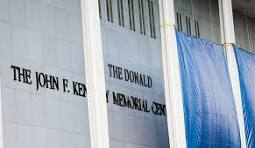
Today’s “Arts Fuse” publishes my latest thoughts about the Kennedy Center:
With the fate of the Kennedy Center for the Performing Arts – for the moment, no longer the Trump Kennedy Center – unknowable, it’s tantalizing to inquire what it might become. A related question is whether it became all it could have been in the first place.
When Jackie Kennedy urged Leonard Bernstein to become the first artistic director of the Kennedy Center, what was on her mind? Did she phone him because he was a famous and dynamic American musician with whom she happened to be well acquainted? Or was she thinking that he was a famous and dynamic American musician dedicated to curating the American musical past and charting an American musical future? All we know (from Jamie Bernstein’s memoir) is that he answered the call, said yes, and then changed his mind because he could not see himself dedicating time to the job.
What became the Kennedy Center was envisioned as a showcase for both American and “global” performing arts when President Eisenhower signed the National Cultural Center Act in 1958. The specific form this might take was secondary to a prolonged fund-raising effort that surged after the Kennedy assassination. What eventually resulted is and is not a “national cultural center.” Its National Symphony has never aspired to be a national symphony. It is the Washington, D.C., Symphony, which is a perfectly legitimate thing to be. That said: we really do need a national symphony, because our native musical inheritance, in the concert hall, remains largely unattended. For that matter, American cultural memory is notoriously short, and never more than today. Imagine a national cultural center with national music, theater, and dance companies. It’s a pipedream, but it’s informative.
Bernstein is a wild card in this narrative. He enjoyed a dynamic rapport with JFK and the First Lady. The day of the assassination, the first edition of the New York Times announced the coming appointment of Richard Goodwin, a Kennedy insider, as the President’s advisor on the arts. The impending Bernstein/Kennedy partnership might have taken many forms. Very possibly it could have included a bone fide national symphony at the “national cultural center” that was being planned and promoted with Bernstein’s help.
Something like a national symphony was in fact created four years after the Kennedy Center opened in 1971. This was the American Composers Orchestra, which during its initial decades commanded the resources to regularly perform at Carnegie Hall. But it was crippled by a programing formula (often attributed to the composer Francis Thorne) that created eclectic concerts, sampling American works from different periods. Alternatively, it could have programed thematically – that’s how to most potently curate repertoire – in collaboration with historians and music historians.
When I was invited by the Pacific Symphony to help create a West Coast equivalent to the ACO, we thematically surveyed a lot of important American music that remains neglected. But in Orange County, California, we had no national impact. D.C.’s PostClassical Ensemble, during the years I helped to run it, was dedicated to curating American repertoire. Our concerts, CDs, DVDs, and broadcasts championed Louis Moreau Gottschalk, William Levi Dawson, Harry Burleigh, Arthur Farwell , Lou Harrison, Silvestre Revueltas, Virgil Thomson (his film scores), Aaron Copland (the music not heard: The City with film; the Piano Fantasy), Zhou Long, Charles Ives, John Adams, the American Dvorak, Weill, & Schoenberg, etc.
But the closest thing to a national symphony was Bernstein’s New York Philharmonic, especially in its earliest phase. Correction: it was a national symphony. His first subscription program, on October 2, 1958, proclaimed a template: William Schuman: American Festival Overture/Charles Ives: Symphony No. 2/Beethoven: Symphony No. 7. Bernstein’s repertoire explorations were systematic. They included Mahler and subsequent twentieth century symphonists little played or otherwise marginalized. They included programs dedicated to specific periods of American composition, and to specific styles of American composition.
In the realm of symphonic music, Charles Ives is our supreme creative genius. Bernstein’s Ives advocacy, with the Philharmonic, figured crucially in the belated discovery that Ives is a composer who singularly enriches American cultural memory; he keys on the Transcendentalists and the Civil War. As a matter of course, Bernstein prominently participated in the Ives Centenary in 1974. But the recent Ives Sesquicentenary was wholly unmarked by our most prominent orchestras. It also passed unnoticed at the Kennedy Center. What form of arts leadership might Bernstein have furnished in DC? His tenaciously American odyssey, embracing both Broadway and the concert hall, testifies that he would have pursued a mandate passionately weighted toward New World achievement.
An informative footnote to this tale is the candidacy of Nicolas Nabokov. He lobbied hard for the Kennedy Center job and was supported by Arthur Schlesinger, Jr., once Kennedy’s intellectual aide de camp. As secretary general of the Congress for Cultural Freedom (covertly funded by the CIA), Nabokov was a crucial figure in the cultural Cold War. His output included high-profile arts festivals abroad. The biggest and most ambitious, in Paris in 1952, showcased orchestras and opera companies from London and Vienna, and orchestras from Boston, Paris, Geneva, Berlin, and Rome. Nabokov was not especially knowledgeable about the American arts. He was a Russo/European intellectual based in France. His rolodex was famous – he could have conceivably turned the Kennedy Center into something like an American Edinburgh Festival.
Nabokov visited the Kennedy White House in 1962 for a dinner (which he helped to plan) honoring Igor Stravinsky. His impressions of the First Lady (reported in my book The Propaganda of Freedom) were not especially flattering. Perhaps this disaffection was returned. In any event, it was the American baritone George London who served as the Kennedy Center’s first executive director, overseeing artistic planning. The center never attained the international prestige Nabokov would have craved. It never attained the New World focus Bernstein would have pursued.
What might the Kennedy Center hypothetically become? We could also use a national theater with a gifted dramaturg. Right now, it might pertinently curate the important political theater works of the thirties. A play like Clifford Odets’ Waiting for Lefty (1935) might be a poor bet in a commercial theater today. But it once electrified America. We should have an opportunity to remember why and how. In the world of ballet, we actually possess a national company once indirectly linked to the Kennedy Center. Thanks to George Balanchine and Lincoln Kirstein, the New York City Ballet Americanized classical ballet and more bravely explored American repertoire – going all the way back to Gottschalk and Sousa — than any present-day orchestra I can think of. The Suzanne Farrell Ballet, an offshoot of City Ballet, was the Kennedy Center’s resident ballet company from 2000 to 2017.
ArtsJournal’s Doug McLennan, in an important recent blog, pertinently adds: “When the Kennedy Center opened in 1971 as a living memorial, it became the closest thing America has to a national stage. That matters more here than it does in many other countries, because the United States never built a culture ministry, never funded the arts the way peer countries do, and never decided as a country that culture was important infrastructure. The Kennedy Center, then, was more a symbol or a gesture.”
In New York City, Lincoln Center for the Performing Arts hosts an orchestra, an opera company, a ballet company, and a theater company. But the artistic synergies once vaguely envisioned, binding the constituents, never materialized. They could do so at a bona fide national cultural center stocked with scholars, dedicated to preserving and applying American cultural memory.
Imagine a scenario in which Bernstein and the Kennedys – John and Jackie both – bequeathed a proactive White House arts component prioritizing American achievement, past and present. It would have shaped the goals of the envisioned national cultural center. It almost happened.
To read a related blog on “Trump and the Arts,” click here.
To read a sequel blog, click here.
This is very good. Great history, and further evidence that America can’t get out of its own way in curating its own art. Exceptions might be painting (which only needs walls) and poetry (which is singularly created for a singular reader, without need for critical mass.) Music of the past goes unplayed. Historical theatre pieces not staged. Classic films lost through decomposition. Radio and television lost in the ether. Novels out of print and dumped by libraries. Indigenous music unrecorded.
The Kennedy Center built oversized concert halls and stages, but had no endowment to shore up the deficit between production and ticket revenue.
If the music of George Templeton Strong were to become a two-week festival, the Kennedy Center would need a good symphonic stage and 800 seats for a limited audience. Tickets would be scarce. Buzz and critical assessment would make it a hot ticket. It could add performances if demand warranted.
But the Kennedy Center wound up with bloated halls like almost every American city.
And this gnashing of teeth over the dismissal of the previous regime irritates me. Trump took something uncreative and sleepy and made it worse. And I have no doubt that there are deferred maintenance issues long unaddressed. Again, on every rare occasion where Trump is right, it’s for the wrong reason.
The KC should be the place where Americans make pilgrimages to gather in a space to experience the art that America has created and continues to create. The Kennedy Center should bring the South Dakota Symphony to be in residence every other year, could have helped fund the recent production of Douglas Moore’s Pulitzer-winning “Giants in the Earth” and brought it to DC. The current model negates that possibility as it competes with moribund resident companies that look like all the other companies in America.
A fine arts administrator summed up the Trump takeover perfectly: “The Kennedy Center has never been as culturally relevant as it is now.” By having to define and defend its very need to exist.
Joe – you’re right on about the compromise of the original intention for the KC as a national and international showcase for the best art the world has to offer.
Is the Kennedy Center really America’s showcase in its recent form? It’s Washington’s performing arts center. But Carnegie Hall is more prestigious. Lincoln Center has more artistic oomph. Do Americans look to the Kennedy Center for a particular vision of culture? I’m not so sure. And these days as culture has fragmented and reassembled in versions far removed from the time when the KC was created, is there even such a vision that could be coherent? Just the fact this is a real question suggests that a KC artistic vision hasn’t been articulated in a compelling enough way.
Is the KC a complex of buildings or is it an idea? What do the component parts really add up to? And does this offer something unique or worthwhile? Nonetheless, it is enormously symbolic, and, along with the NEA and NEH, is America’s primary way American government expresses support for the arts.
But I think it’s unfair, as Anonymous does, to characterize the Kennedy Center’s former incarnation as “uncreative and sleepy.” The KC ran some 2000 programs and productions per year and made significant and substantial efforts on behalf of the arts. Many hard-working, creative and dedicated people worked at the Kennedy Center to bring artists to work and be presented there.
But the model is problematic. And I think, oddly enough, perhaps the practicalities of real estate may have compromised the opportunity for larger vision and leadership. Why are these resident organizations cohabiting a space? What’s the artistic reason? Yes, share resources and branding and the backend. But do they share a common vision that is enhanced by being in the same complex? Or are they competing with one another for space and resources?
Worse — in a big unwieldy structure, with many mouths to feed and competition for resources, the whole can end up constricting the pieces and making the messaging and branding generic, corporate. Everything is Kennedy Center. The National Symphony, for example, doesn’t raise its own money, and doesn’t even operate its own website. Does central planning really promote the most creativity or artistic risk?
Perhaps this is a wakeup call for arts leadership in America. An opportunity to rethink the model. To organize around an idea of what culture could be, what an *American* culture could be. Not to dictate, but to explore and encourage and experiment and showcase. It takes leadership.
Brilliant summary and statement, Joe. I’ll always remember my first visit to. that beautifully sited gigantic shoebox. I had a personal tour and I couldn’t imagine much of anything filling those large capacity performance spaces given the potential audience of mostly culturally ignorant elected officials. and their staffs and the folks who people D.C.’s major industry, lobbyists and lobbyers. (Bribeists and bribers). It might have helped if the center had a Broadway musical-style theater, but one might assume that the Warner Theatre’s powers that be didn’t take that idea too well. What’s truly apparent, is that a Coliseum featuring daily (non-deadly) gladiatorial competitions would offer the hottest tickets in town.