
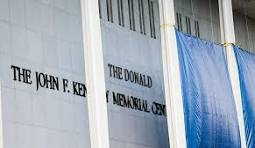
The following article is an abridged adaptation of my January 22 NPR report on recent developments in government and the arts — at the NEA, the NEH, and the Kennedy Center — under President Donald J. Trump. I write: “The arts sector feels invaded by aliens. The incursion is so abrupt, so rude, that it parallels the startling empowerment of Trump loyalists like Kristi Noem and Pete Hegseth. John F. Kennedy and Leonard Bernstein, who once jointly promised a more civilized America, have become ghosts hovering above a scene of chaos.” I also recall the arts advocacy of Franklin Delano Roosevelt and John F. Kennedy, and take a trans-Atlantic look at a pertinent controversy at the Arts Council England. My “More than Music” program was broadcast via the daily newsmagazine “1A.” I’ve bold-faced some of my findings and assertions. To hear the show, click here.
Last December 7, Donald J. Trump became the first President to present the Kennedy Center Honors. He also played a dominant role in choosing the honorees. Around the same time, the Kennedy Center was renamed the Donald J. Trump – John F. Kennedy Memorial Center for the Performing Arts. Prior to that, President Trump replaced the Kennedy Center board with his appointees and named himself chairman. Richard Grenell, Trump’s onetime Ambassador to Germany, was named the Center’s new President. More recently, the Trump-Kennedy Center and the Washington National Opera, resident at the Kennedy Center since 1971, jointly announced their disaffiliation.
On top of all that, grants and jobs were abruptly cancelled at the National Endowment for the Arts and the National Endowment for the Humanities by Elon Musk’s DOGE task force. A substantial re-allocation of funds was directed toward a National Garden of Heroes. And the latest round of NEH grants included projects awarded non-competitively, and serving a conservative ideological agenda.That’s a radical departure from past practice, a departure that’s provoked Representative Chelie Pingree of Maine to accuse the Trump administration of turning the NEH into a “slush fund.”
These developments have sent shockwaves through the arts community. While no one can predict what will happen next, the unifying feature of this story is a culture clash – mutual disaffection. The arts sector feels invaded by aliens. The incursion is so abrupt, so rude, that it parallels the startling empowerment of Trump loyalists like Kristi Noem and Pete Hegseth. John F. Kennedy and Leonard Bernstein, who once jointly promised a more civilized America, have become ghosts hovering above a scene of chaos.
As someone who has worked in the arts for more than half a century — who has run a couple of orchestras, who has received innumerable grants from the NEH and the NEA, who has produced concerts at the Kennedy Center – I bring to bear countless personal experiences. Until recently I directed “Music Unwound,” funded four times by the NEH. The last grant, for $400,000, was terminated by DOGE, without explanation, before it was fully expended. In fact, the grant category was eliminated, so there’s no possibility of renewal. According to a notification from the NEH, the termination of Music Unwound represented “an urgent priority for the administration.” It was ended “to safeguard the interests of the federal government, including its fiscal priorities.” A crowning irony is that in a moment when the White House is emphasizing “America 250” – the celebration of American virtues on the occasion of our 250th birthday – it would be hard to find a better example than the NEH Music Unwound project that now no longer exists.
The goal of Music Unwound was to infuse the humanities into the symphonic experience. We mounted thematic orchestral festivals – many dozens of them, in all parts of the United States — that linked to high schools and universities. All the themes asked what it means to be American. There were festivals about Aaron Copland in Mexico, about Antonin Dvorak in New York, about the legacy of Charles Ives. The sleeper turned out to be “Kurt Weill’s America.” It was a story of immigration – how a famous German Jewish composer, fleeing Hitler, turned himself into a leading Broadway composer.
The biggest impact was in El Paso, Texas, where the participating partners were the El Paso Symphony, the University of Texas/El Paso, and the El Paso public schools. One of those schools – East Lake High School – was located in a semi-rural “colonia” in which the vast majority of the residents are categorized as “economically disadvantaged.” Because East Lake High had participated in previous Music Unwound festivals, the groundwork was in place when I showed up to talk about Kurt Weill. Three hundred students assembled in the auditorium. Though very possibly none of them had ever heard of Kurt Weill, I have never known a hungrier audience. Weill was a man who insisted on speaking English from the day he docked in Manhattan in 1935. He revisited Europe once after World War II and reported: “Every time I found decency and humanity, it reminded me of America.”
I shared with the students a film clip of FDR declaring war and played a recording of a song Kurt Weill composed, setting Walt Whitman, in response to Pearl Harbor. It’s called “A Dirge for Two Veterans.” A girl raised her hand to tell us that she had wept twice during the song, at the two places where Whitman and Weill describe moonlight shining on the twin graves of two Civil War soldiers, a father and son. Other songs and stories were shared. When the assembly was over, students crowded the stage. It turned out that the East Lake Chorus wanted to sing for me. They chose “The Star-Spangled Banner.” (You can see and hear that here.)
My visit to East Lake High School was arranged by Lorenzo Candelaria, at that time an Associate Provost at the University of Texas El Paso. It was he who secured the festival partnerships, who arranged for hundreds of high school and university students, and their parents, to attend an El Paso Symphony concert for the first time, who initiated supplementary events – lots of them, in multiple departments – on the university campus. It bears mentioning that the student body at UTEP is 88 per cent Hispanic. More than 90 per cent of the students are local. Anyone with a high school diploma is guaranteed admission.
After the NEH Weill festival, Candelaria invited students to submit written testimonials. One said that she had acquired “a new perspective on my citizenship. I need to be doing way more for my country and its music. I have no excuse, because Weill, an immigrant, devoted his life to it.” Candelaria was reminded of John Kennedy’s iconic admonition: “Ask not what your country can do for you, but what you can do for your country.” He told me: “What was really amazing about that student’s comment is that it arose without any prompting or exhortation. It’s something that sprung up very naturally.”
Another Music Unwound topic was “Copland and Mexico.” It tracked Aaron Copland to Mexico in the 1930s, exploring the Mexican Revolution and the cultural efflorescence it inspired. Other Americans seduced by Mexico in those years – by the Mexico of Diego Rivera and Frida Kahlo – included John Steinbeck and Langston Hughes. The festival – which was mounted in El Paso as well as North Carolina, Texas, Kentucky, Nevada, and upstate New York – also served to celebrate a great Mexican composer, still little known in the United States: Silvestre Revueltas. The audience included more than 650 members of Sioux Falls’s Hispanic community, who received free tickets subsidized by the NEH. Many of them – high school students new to symphonic music — created art projects about the Mexican Revolution. They were displayed in the lobbies of the concert hall. Candelaria commented: “That trip to Mexico was such a transformational experience for Copland. For the students, it’s a story of crossing the border in the other direction for artistic betterment, for intellectual growth. It’s a very important story for them to have heard and learned and experienced. The arts bring people together the way nothing else can. The arts are where people meet.” (You can see an excerpt from “Copland and Mexico” here.)
Another longstanding NEH project, terminated by DOGE, was MUSA — Music of the United States. It’s administered by the American Musicological Society, and to date it’s funded 41 scholarly editions of American music of all kinds – a New World cacophony including spirituals and Native American songs, blackface minstrelsy, early American symphonies and choral works, transcriptions of piano solos by Fats Waller and Earl Hines, and you name it. MUSA began with the American Bicentennial in 1976, which triggered a surge of interest in American music of all kinds among American musicologists who, habitually, had focused on European classical music. That led to a planning conference, funded by the NEH, out of which MUSA was born in 1988. MUSA was the recipient of seventeen consecutive NEH grants, covering half its costs. Individual MUSA editions are elaborately annotated to link to a larger American historical narrative. And of course they make the music itself readily available for performance. A 2018 MUSA edition of Joseph Rumshinsky’s Di Goldene Kale resuscitated a 1923 Yiddish musical, subsequently staged by New York’s National Yiddish Theater – the first complete performance of a Yiddish musical in over half a century. A forthcoming MUSA edition restores the original orchestral score for D. W. Griffith’s 1920 classic silent film Way Down East. The premiere screening with live orchestra will take place at New York’s Museum of Modern Art this coming August.
NEH grants are now up and running again. What happens next? The most recent funding round included a flurry of grants to classical humanities institutes and civic leadership programs positioned to counteract liberal bias in higher education. Mark Clague, the current editor-in-chief of MUSA at the University of Michigan, told me: “For a long time the NEH has been a premier funding source for studying American culture. The shake-up and the cancellation have created uncertainty and ambiguity — a lack of trust in the money, where it’s coming from, how it’s coming, what the purpose is. It’s shaken confidence in the National Endowment for the Humanities.”
Many at the NEH have been let go. One prominent former staff member describes the incursion of DOGE last April as a “bloodbath.” The logic behind it – if any, other than saving money – remains unclear. Over at the NEA, a similar scenario transpired: of staff departures and of cancelled grants – not only of grant applications and grant offers, but, remarkably, of funded grants in mid-cycle. It’s the NEA that, for instance, annually supports institutions of performance like orchestras, theaters, and opera companies. These grants are not large, but for a small orchestra with a budget of $300,000, they can be vital – they can represent up to 10 per cent of an orchestra’s annual income.
As at the NEH, NEA grant opportunities have been reinstated . A complicating consideration is the Administration’s campaign against woke – its rejection of ideological emphasis on diversity, equity, and inclusivity. The language in play can seem chauvinistic, as in a Presidential Action a year ago for “ending radical indoctrination in K-12 Schooling.” “Patriotic education,” it reads, is “grounded in a unifying, inspiring and ennobling characterization of America’s founding and foundational principles, and a clear examination of how the United States has admirably grown closer to its noble principles throughout its history.” That is: grant applicants, right now, feel encouraged to undertake patriotic projects. But some patriotic projects risk seeming insufficiently patriotic.
Typically – up to now – NEH and NEH grants have been adjudicated by panelists. Judging from the latest round of NEH awards, that’s changing. The idea – in the past – has been to insulate the process from political interference. The panelists are picked by the NEH and NEA chairmen and staff members, and – as anyone with experience dealing with NEA and NEH panel comments knows – they can vary widely in expertise and disposition. In the symphonic field, always financially strapped, the climate of anxiety is thick – and it’s difficult to find anyone – any conductor or orchestra administrator – willing to speak out publicly.
An exception, over in Opera, is Francesca Zambello, one of the nation’s most prominent opera directors. In fact, she happens to be the artistic director of the Washington National Opera. As that’s been the resident opera company of the Kennedy Center – now renamed the Trump Kennedy Center – she’s facing an immense challenge. In November, Zambello told The Guardian, in the UK, that donor confidence in the Washington National Opera had been – quote — “shattered,” that the building itself was “tainted,” that patrons were returning shredded season brochures with notes vowing not to return to the Kennedy Center so long as President Trump was in office. Then, on January 9, the Washington National Opera, which annually produces 100 Kennedy Center events, announced that it was disaffiliating and relocating elsewhere. Though both the Opera and the Center said they were parting ways “amicably,” everyone knows there is mutual disaffection, with the Kennedy Center insisting that the relationship had become fundamentally untenable — financially. Working out the details will be immensely complicated, because the affiliation agreement in place since 2011 established that the Center would handle marketing, fund-raising, and public relations for the Opera. There is also the matter of the Opera’s endowment – and who gets that.
Richard Grenell, appointed President of the Kennedy Center last February 10, is a former US Ambassador to Germany without previous experience in arts management. He has been outspoken in the face of the present upheaval. Grenell is critical of what he calls the center’s “previous far left leadership” “Their actions,” he has said, were “more concerned about booking far left political activists rather than artists willing to perform for everyone regardless of their political beliefs.” Above all, Richard Grenell has stressed that he’s inherited a Kennedy Center in financial trouble, that the Center must opt for more popular, less “woke” programs – programs that will excite donors. Retaining the current partnership with the Washington National Opera, in his opinion, would not be “financially smart” for the Kennedy Center. He also maintains that the Opera has long been financially weak, that that’s why it affiliated with the Kennedy Center in the first place, and that it finished fiscal 2025 with a $7.2 million deficit.
His formal statement to the press read: “The Trump Kennedy Center has made the decision to end the EXCLUSIVE partnership with the Washington Opera so that we can have the flexibility and funds to bring in operas from around the world and across the U.S. Having an EXCLUSIVE relationship has been extremely expensive and limiting in choice and variety. We approached the Opera leadership last year with this idea, and they began to be open to it.”
Francesca Zambello denies that the Washington Opera was running a deficit. She also says that the Kennedy Center had not previously impacted on casting and repertoire at the Opera. Like others in the arts sector, she questions Richard Grenell’s repeated insistence on “revenue neutral” programing that will not run a deficit. “He is using a term that we don’t traditionally use. I don’t think that Ambassador Grenell really has taken on board how not-for-profit sector works for the performing arts at the Kennedy Center. The model that he’s proposing does not accommodate our artistic mission, where we balance popular works with lesser known operas. Revenue from major productions traditionally subsidizes the smaller, let’s say, more innovative works. And that has been our model since I have been at the Kennedy Center for 14 years.
“We found that our audiences and our donors dropped off significantly since the management change. And so when you’re losing 40% of your audience or 50% and your contributions are down as much, of course, it’s very difficult to sustain the model. Also, the development staff of the Kennedy Center was greatly depleted, as was PR and marketing. So if you don’t have that staff, it’s very hard to fundraise. But in the end, all performing arts organizations rely on their audiences. And if your audience is there, they are there to support you. And if they’re not there, then you have to change your model.”
Meanwhile, the National Symphony Orchestra, the Kennedy Center’s most prominent constituent, is also experiencing plunging ticket sales. Grenell has instructed the orchestra to begin every concert with the Star-Spangled Banner in celebration of “America 250.” And the National Symphony has done so, usually without a conductor. Many would consider prefacing a Mahler symphony or Brahms concerto with the national anthem an aesthetic gaffe. Meanwhile, the Kennedy Center is being hit with cancellations – artists who have decided not to perform there. Washington Performing Arts – the city’s biggest classical music presenter, aside from the Opera and the Symphony – is also taking its concerts to other venues.
If there’s a positive spin here, it’s that the new management of the Kennedy Center has demonstrated impressive access to corporate and individual wealth, including $23 million raised by the Trump Kennedy Center Honors and a gala for the National Symphony, with 450 attendees, that raised $3.45 million. Many new donors, the Center says, are newcomers excited by – quote – “commonsense” reforms. According to Richard Grenell, the implications for programing are significant.
***
A rather famous sentence from President John F. Kennedy’s most celebrated address extolling the American arts, delivered at Amherst College mere weeks before he died, reads: “ I look forward to an America which commands respect throughout the world not only for its strength but for its civilization as well.”
Kennedy was an eloquent advocate for the arts – and this feature of his Presidency was gathering momentum at the very moment he died. He was about to name Richard Goodwin – a young activist, part of the inner circle of Kennedy’s New Frontier – his arts advisor. And the First Lady, Jackie Kennedy, was herself a passionate and influential enthusiast for the performing arts. The topic is complicated, because Kennedy himself, though an avid reader and an impressive thinker, was no aesthete. And he was ideologically disposed to oppose government arts grants. Instead – remember, this was during the Cold War – he emphasized the achievements of free artists in free societies. In his view, the artist was ideally autonomous, unencumbered, not beholden to government or any other external impingement on the creative act.
Fredrik Logevall is midway through a landmark Kennedy biography. I asked him to speculate what a full-term Kennedy presidency might have meant for the nation’s cultural life. “We know he was proud of that Amherst speech. In my view, the arts would likely have been elevated in the remainder of his first term. He had a lifelong interest in poetry, in literature, in the spoken word. He was a voracious reader. Jackie often marveled at his incessant love of reading. Even though he wasn’t somebody who loved, say, classical music or art per se, he understood the importance of it.” Logevall speculates that Kennedy would have changed his mind about opposing direct government arts subsidies. And he stresses Richard Goodwin’s eloquence as a speechwriter, and the energy that Goodwin had brought to the Administration’s Latin America policy. Goodwin would have made a difference. The Goodwin appointment, which the New York Times reported the day Kennedy was shot, is a wild card in any American narrative tracking government and the arts. The reason it looms immensely is that, after Kennedy, no President undertook a comparable initiative to integrate arts policy as a White House priority.
And today the American arts are in crisis. The crisis has many aspects. One is the shortness of American memory – a condition of pastlessness, never more pronounced than today, that stifles lineage. Creative achievement feeds on past achievement, on roots and tradition. More prosaically, there is a funding crisis little known or understood outside the arts sector. There was a time when wealthy philanthropists subsidized American orchestras and museums as a matter of course – it was part of their lifestyle. And there was a time, after that, when American corporations fulfilled a similar opportunity. And then there came a time when the major national charitable foundations – like the Ford Foundation when it gave over $80 million to 61 American orchestras in the 1960s – undertook to fund innovation in the arts.
To a remarkable degree, those times are behind us now. Young Americans of vast wealth are less likely to support orchestras and museums. And over the past decade the foundation community has emphasized social justice initiatives over arts institutions. These are developments that logically mandate a bigger role – even a much bigger role – for government. But nothing of the kind seems remotely imminent.
To glimpse the magnitude of this sea change, consider the case of Henry Higginson. It was his life ambition to create a permanent orchestra for the city of Boston. He went into banking, and at the moment he could afford it, in 1881, he announced the creation of the Boston Symphony Orchestra. Because Higginson happened to be musically trained – in Vienna, no less – he could do everything himself – he chose and hired the conductors. He paid the musicians. He made up the deficits. He also built Boston’s Symphony Hall. There was no board of directors. This colossal achievement stands alone. It is something unthinkable today.
Here’s another story. In the early days of commercial television, the CBS network notably produced a series of arts showcases beginning with Omnibus in 1952. That was how Leonard Bernstein first wound up on national TV. Its successors were Ford Presents and Lincoln Presents – arts programing, paid for by the Ford Motor Company, in which Bernstein continued to play a featured role. Bernstein was at the same time touring with the New York Philharmonic as a cultural ambassador. Charles Moore, a vice president of the Ford Motor Company, happened to visit Berlin, where he decided that the United States would be inadequately represented at the forthcoming West Berlin Music, Drama, and Arts Festival. At the time, West Berlin a crucial Cold War outpost, a fraught West German island surrounded by Communist East Germany. As Ford was the ongoing sponsor of Bernstein’s TV specials, and as Bernstein was now an accredited diplomat, Ford put up $150,000 to send Bernstein and the Philharmonic to Germany.
When he returned home, Bernstein said: “I think government support of the arts is on the way, and I’m all for it. Meanwhile, it is the responsibility of the wealthy corporations to support our artistic institutions privately – that is, until generous government support, with a minimum of strings attached, is forthcoming. Someone has to do the work the government should do, otherwise we’ll be in an arts vacuum.” Bernstein’s Berlin visit also generated a 1959 “Ford Presents” special on CBS.
So here we are 66 years later. We now have government support for the arts. But it could not be described as “generous,” and whether there’s still “a minimum of strings attached” is suddenly open to question. It bears remembering that the NEA and the NEH, signed into law by Lyndon Johnson two years after John Kennedy died, were not the first direct US Government arts subsidies. During Franklin D. Roosevelt’s New Deal, the Works Progress Administration – the WPA – undertook to employ writers, composers, visual artists, and performers via Art, Music, and Theater Projects. The Music Project alone gave 225,000 free or popularly priced performances, attended by 150 million people, many of whom had been strangers to live concert music. American music was stressed. Among the many orchestras started under WPA sponsorship was today’s Utah Symphony.
Then, following the Great Depression, came World War II. What might have happened to New Deal arts subsidies had Roosevelt survived the war and completed his fourth term? Might government support of the arts have resumed? I asked David Woolner, who’s an historian of the New Deal. “I think it’s quite possible,” he said. “Roosevelt was a great lover of history and a great lover of culture. He was the one who came up with this idea of putting murals in public places, and there was a wonderful program involved in having murals painted on post offices across the country by local artists, which would depict the local history of the community.”
Woolner contrasted the WPA’s dedication to documenting American life with the current Administration’s emphasis on celebrating American greatness: “I think there’s a great differences between an ideological use of history as a means for promoting a particular political point of view and what was happening in the 1930s. The government was asking the Farm Security Administration photographers to go out and photograph terrible conditions so as to help propel reforms that would alleviate poverty in the United States. That’s quite different than saying to the Smithsonian Museum, ‘Your depiction of slavery is too harsh.’”
For a final perspective on what’s going on, I talked to Nicolas Kenyon. He’s been a seminal figure in British musical life. He’s run the BBC Proms. He’s run London’s Barbican Center. Britain has been weathering a volatile arts crisis of its own, focused on the body that oversees government arts funding: the Arts Council England. And the outcome of that crisis, to date, seems instructive, not least for the United States. Here’s what Nick told me about the Arts Council:
“It’s supposed to make its own decisions, it’s supposed to be answerable to government, of course, for the money that it spends, but it is not meant to be something which the government instructs. And that was called into question a couple of years ago now by a very conservative Secretary of State for Culture, Nadine Dorris, who started telling the Arts Council what it ought to be spending its money on. And that’s an immediate red flag here. And the principle that she was trying to instruct them to follow wasn’t something that was necessarily a bad thing. She wanted more of the Arts Council’s money to be spent out of London, around the UK, offering more opportunities for more people who were not in the big metropolitan centers to encounter the arts. Absolutely fine, but what happened as a result was a complete shambles of peremptory withdrawing of grants to, say, Glyndebourne Touring Opera, or Welsh National Opera, or English National Opera in London, which was told overnight that they would lose their grant unless they moved from London to Manchester. A very worthy aim, no doubt, but something impossible to achieve overnight and something that should have been consulted on, planned, and considered carefully before making any decisions.
“So that was a moment for the UK to get very concerned about where government funding of the arts was going, particularly since those funds themselves had, like so many other areas in so many other countries, been diminishing over the years. So each pound was more precious, if you like. And that gave rise to a real lack of faith by arts bodies in the Arts Council. And in the end, the government had to order a review of the Arts Council.
“Now, in between these two events, the government had changed from Conservative to Labour. So it was a different Department of Culture ordering this investigation into what had gone wrong at the Arts Council. And that was undertaken by a very experienced lady called Dame Margaret Hodge, who reported just before Christmas. So we’re talking just a couple of weeks ago and produced a pretty devastating report on the state of the Arts Council.”
Kenyon went on to say that the Hodge Report turns out to be, in his opinion, a very good thing. Not only does it frankly criticize the Arts Council for the way it’s been spending money; it’s full of constructive suggestions, including new strategies to incentivize corporate and philanthropic giving. The analogies here to what’s happened at the NEA and NEH, and at the Kennedy Center, couldn’t be louder – the peremptory decisions, the loss of confidence. And the kicker, more important, is: the British government ordered a considered follow-up: an honest inquiry into what went wrong, how to fix it, and more generally how to attend to growing concerns about funding the arts – and the place of government.
It all brings back to mind John Fitzgerald Kennedy’s advocacy of the arts, and his pending appointment of Richard Goodwin to be his arts advisor. That appointment – something I didn’t mention before – was the result of a 36-page report, “The Arts and the National Government” commissioned by Kennedy. Everything was in place for a comprehensive attempt to figure out, for the first time, how the various agencies of the federal government impact on the arts, to assess that, and to plot strategies for the future. It never happened.
The entire saga of government and the arts, as it’s unfolded in the United States beginning with the New Deal, is partly a saga of leadership. FDR and JFK were leaders who cared about the arts. So did Nelson Rockefeller, when the New York State Council of the Arts, a precursor to the NEA, was created during his governorship. Kennedy had a partner in arts advocacy who must also be mentioned. It was Leonard Bernstein, for whom the Kennedy White House signified the more civilized America the President anticipated. Kennedy and Bernstein bonded; they were incipient comrades in arms. For Bernstein, the Kennedy assassination was a linchpin event in American decline. But he maintained a close relationship with Jackie Kennedy, who urged him to take over the Kennedy Center. Bernstein thought that job was not for him – but he did agree to compose something for the opening, in 1971. It turned out to be an anti-war, anti-Vietnam Mass.
Bernstein embodied a style of fearless arts leadership unknown in the United States today. It was first apparent when he took his New York Philharmonic to Soviet Russia in 1959, and refused to do the Russians’ bidding. Were he around now, he would be speaking up about the cancellation of arts grants. He would be apoplectic about the renaming of the Kennedy Center.
Another matter, however, are accusations – from Richard Grenell and many others – that the endowments and the Kennedy Center are too “woke.” In my world of classical music, no one disputes the validity of the goals: diversity, equity, inclusivity. But many feel – privately – that implementation is too often ill-informed. As for the endowments – in my experience, as a frequent applicant and recipient going back to the 1980s, as someone who’s dealt for decades with staff members and who’s read countless panel reports adjudicating grants – I think the NEA and NEH are less distorted by so-called wokeness than our major charitable foundations, which used to generously fund orchestras and were a crucial support for innovation in a very conservative field. The tipping point was in 2011, when a 40-page position paper persuaded philanthropists that the arts, historically, are essentially instruments of social justice.
“Music Unwound” as in El Paso, cancelled by DOGE, showed how the arts can be a unique instrument for mutual understanding, for personal identity and national identity. It aspired to curate the American past without special pleading to the left or right, to celebrate America honestly.
When the Kennedy Center decreed that every National Symphony Orchestra performance begin with the Star-Spangled Banner, that was a top-down edict. It tarnished the gesture. When, during a Kurt Weill festival supported by the NEH, the student chorus at El Paso’s semi-rural East Lake High School mounted their auditorium stage to sing the Star-Spangled Banner for me, that was a spontaneous affirmation of gratitude for the opportunities they enjoyed as Americans. It wasn’t scripted. It was utterly sincere.
My book on government and the arts is “The Propaganda of Freedom: JFK, Shostakovich, Stravinsky, and the Cultural Cold War“
Joe Horowitz’s vigorous and forthright championship of arts activism at the federal level is necessarily urgent. We need to pull out all the stops.
U.S. presidents throughout our 250-year history have been arts activists and enthusiasts much more frequently than is generally known: https://newmusicusa.org/nmbx/a-federal-case-for-the-arts/ It couldn’t be more American.