
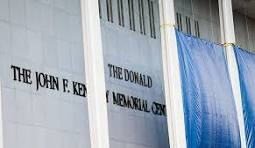
I’ve received three memorable responses to my recent blog – also posted on Arts Fuse — pondering whether the Kennedy Center might become, or might have become, a genuine “national cultural center.”
The first, from a prominent arts administrator in mid-America, simply reads: “It all comes down to leadership.”
The second, from Douglas McLennan of ArtsJournal, concludes: “Perhaps this is a wakeup call for arts leadership in America. An opportunity to rethink the model. To organize around an idea of what culture could be, what an *American* culture could be. Not to dictate, but to explore and encourage and experiment and showcase. It takes leadership.” It’s appended it below.
The third response, again anonymous, concludes: ”A fine arts administrator summed up the Trump takeover perfectly: ‘The Kennedy Center has never been as culturally relevant as it is now. By having to define and defend its very need to exist.’” It’s also appended below
The third writer’s resounding reference to George Templeton Strong bears some explication. Strong’s programmatic “Sintram” Symphony is to my knowledge the only notable late Romantic American symphony in the Lisztian/Wagnerian mode. It was premiered to acclaim by Anton Seidl and the New York Philharmonic in 1893. I don’t believe it has since been performed in the US. In 1897, Strong moved to Switzerland – where Ernest Ansermet championed this hour-long work. Joseph Szigeti also performed Strong’s music abroad. The only recording, on Naxos, features a Swiss conductor and a Russian orchestra. Only in the US could a native symphony of such stature be forgotten.
I once had a pertinent conversation with the Estonian conductor Neeme Jarvi, who championed late-nineteenth century American works more than any American. Jarvi told me that he considered the Andante cantabile from George Chadwick’s Third Symphony (1894) the most beautiful slow movement from any American work. (You can hear his recording here.) I countered with the Langsam of the “Sintram” Symphony. Jarvi listened to it and reported that he agreed with me. You can listen to that right here.
Were a major American orchestra to perform and record the “Sintram” Symphony, and if those efforts were properly contextualized, they would be noticed. It would be an event.
Outside of Jarvi, Chadwick’s foremost recent proponent has been Jose Serebrier – born in Uruguay. Like Jarvi, he comes to Chadwick without prejudice. We Americans were sold on what I’ve called the modernist “standard narrative,” which holds that American classical music begins around 1910. That confusion is the central topic of my book Dvorak’s Prophecy and the Vexed Fate of Black Classical Music.
Here’s the anonymous post:
This is very good. Great history, and further evidence that America can’t get out of its own way in curating its own art. Exceptions might be painting (which only needs walls) and poetry (which is singularly created for a singular reader, without need for critical mass.) Music of the past goes unplayed. Historical theatre pieces not staged. Classic films lost through decomposition. Radio and television lost in the ether. Novels out of print and dumped by libraries. Indigenous music unrecorded.
The Kennedy Center built oversized concert halls and stages, but had no endowment to shore up the deficit between production and ticket revenue.
If the music of George Templeton Strong were to become a two-week festival, the Kennedy Center would need a good symphonic stage and 800 seats for a limited audience. Tickets would be scarce. Buzz and critical assessment would make it a hot ticket. It could add performances if demand warranted.
But the Kennedy Center wound up with bloated halls like almost every American city.
And this gnashing of teeth over the dismissal of the previous regime irritates me. Trump took something uncreative and sleepy and made it worse. And I have no doubt that there are deferred maintenance issues long unaddressed. Again, on every rare occasion where Trump is right, it’s for the wrong reason.
The KC should be the place where Americans make pilgrimages to gather in a space to experience the art that America has created and continues to create. The Kennedy Center should bring the South Dakota Symphony to be in residence every other year, could have helped fund the recent production of Douglas Moore’s Pulitzer-winning “Giants in the Earth” and brought it to DC. The current model negates that possibility as it competes with moribund resident companies that look like all the other companies in America.
A fine arts administrator summed up the Trump takeover perfectly: “The Kennedy Center has never been as culturally relevant as it is now.” By having to define and defend its very need to exist.
And here’s the post from Doug McLennan:
Joe – you’re right on about the compromise of the original intention for the KC as a national and international showcase for the best art the world has to offer.
Is the Kennedy Center really America’s showcase in its recent form? It’s Washington’s performing arts center. But Carnegie Hall is more prestigious. Lincoln Center has more artistic oomph. Do Americans look to the Kennedy Center for a particular vision of culture? I’m not so sure. And these days as culture has fragmented and reassembled in versions far removed from the time when the KC was created, is there even such a vision that could be coherent? Just the fact this is a real question suggests that a KC artistic vision hasn’t been articulated in a compelling enough way.
Is the KC a complex of buildings or is it an idea? What do the component parts really add up to? And does this offer something unique or worthwhile? Nonetheless, it is enormously symbolic, and, along with the NEA and NEH, is America’s primary way American government expresses support for the arts.
But I think it’s unfair, as Anonymous does, to characterize the Kennedy Center’s former incarnation as “uncreative and sleepy.” The KC ran some 2000 programs and productions per year and made significant and substantial efforts on behalf of the arts. Many hard-working, creative and dedicated people worked at the Kennedy Center to bring artists to work and be presented there.
But the model is problematic. And I think, oddly enough, perhaps the practicalities of real estate may have compromised the opportunity for larger vision and leadership. Why are these resident organizations cohabiting a space? What’s the artistic reason? Yes, share resources and branding and the backend. But do they share a common vision that is enhanced by being in the same complex? Or are they competing with one another for space and resources?
Worse — in a big unwieldy structure, with many mouths to feed and competition for resources, the whole can end up constricting the pieces and making the messaging and branding generic, corporate. Everything is Kennedy Center. The National Symphony, for example, doesn’t raise its own money, and doesn’t even operate its own website. Does central planning really promote the most creativity or artistic risk?
Perhaps this is a wakeup call for arts leadership in America. An opportunity to rethink the model. To organize around an idea of what culture could be, what an *American* culture could be. Not to dictate, but to explore and encourage and experiment and showcase. It takes leadership.
Why Was the Kennedy Center Built?
After all, the National Symphony played at Constitution Hall, and the Opera Society of Washington and the local Ballet company played at Lisner Auditorium. But the city and regional elites wanted a fancy place, a local Lincoln Center.
How to pay for our local Lincoln Center? The answer was to call it the National Cultural Center and get Congress to pay for it, especially the on-going maintenance and upkeep of the Center.
And since suburban patrons were needed to fill the performance halls, it was decided to build the Center at the edge of the city so that suburban patrons could drive in, park under the Center, and not have to deal with a perceived dangerous city.
The “National Cultural Center” was a marketing concept to sell the idea to Congress. And it worked.
“Only in the US…..” Try Poland. Huge quantities of 19th and early 20th century music has been forgotten or under promoted. In Britain, performing rights have put most 20th century music beyond the reach of many concert givers. It’s not just the US even if it is convenient to think so.
After the Kennedy Center opened in 1971 with the “Mass” by Leonard Bernstein, what happened next?
The National Symphony Orchestra moved from the 4000 seat Constitution Hall to the 2600 seat Kennedy Center Concert Hall. Other U. S. and foreign orchestras were invited to perform there.
Since there were no local opera or ballet companies that could fill the Kennedy Center Opera House year round, the Center management imported New York performing arts groups – the New York City Opera, the American Ballet Theater, the New York City Ballet, each for two or more weeks at a time to fill weeks in the Kennedy Center Opera House.
The Kennedy Center also imported Broadway musicals to perform in the Opera House when the local Washington groups were not performing there. And the smaller Eisenhower Theater (named for former President Dwight Eisenhower, to demonstrate bipartisanship) was also used for touring Broadway shows.
Later foreign performing organizations were invited – La Scala and the Bolshoi during the 1976 bicentennial year. The Kirov Opera was signed up for an annual residency.
Sometimes the Kennedy Center even produced their own shows, but it is just one of the many Washington, DC venues for music and theater, and in no way a “National Cultural Center.”