
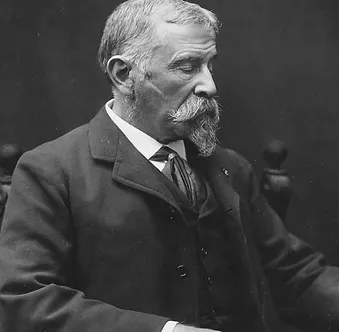
The current Boston “Arts Fuse” carries my thoughts about the pertinence today of Henry Higginson, who invented, owned, and operated the Boston Symphony until 1919. You can access the full article here. Excerpts follow:
About a dozen years ago I was invited, impromptu, to address a gifted youth orchestra at Boston’s Symphony Hall. I mounted the podium and asked how many people had heard of Henry Higginson. I was unsurprised to discover his name wholly unknown. He invented the Boston Symphony in 1881, I explained. He built this hall 19 years later. It could have been called Higginson Hall, but he vetoed that. The exposed wood, the absence of boxes, the thin upholstery, the spare New England ambience – all Higginson, I said. I added that he also decided to reserve 25-cent non-subscription seats for all concerts, and to offer public rehearsals for which all seats cost a quarter.
With today’s Boston Symphony in an uproar, lacking direction, some attention should be paid to Henry Higginson. He knew what he was doing. He knew how to scout and hire conductors. He knew what music he wanted played. He knew what the orchestra was for.
In my books, I call Higginson and Theodore Thomas the two most “colossal” figures in the history of American classical music. More than anyone else, they made the concert orchestra an American specialty, in contradistinction to the pit orchestras abroad. Thomas’s very credo was: “A symphony orchestra shows the culture of the community, not opera.” His was the first world-class American orchestra. It was itinerant, plying the “Thomas Highway” from coast to coast beginning in the 1860s. He was ultimately the founding music director of the Chicago Orchestra (now the Chicago Symphony) in 1891. . . .
Incredibly, there is no biography of Henry Higginson. The fullest treatment is my own: a 56-page chapter in Moral Fire: Musical Portraits from America’s Fin de Siecle (2012). Here’s an excerpt:
“As an embodiment of what was best about Boston, Higginson’s symphony was quicker to acquire a fully appropriate home than a fully appropriate conductor. . . . But Higginson did manage to place two great names on his Boston podium. These were Arthur Nikisch and Karl Muck . . .
“Like the creation of the Boston Symphony Orchestra, like the building of Symphony Hall, the process by which Higginson acquired Karl Muck – the conductor he ultimately favored above all others – illustrates the singular modus operandi of a useful citizen who knew what he wanted and how to obtain it. . . . Higginson instigated a conductor search. The orchestra’s manager, Charles Ellis, and the composer George Chadwick were Higginson’s agents abroad. He also conferred frequently with his Viennese friend Julius Epstein [an eminent pianist whom Higginson knew from the Vienna Conservatory], with the singer Milka Ternina, and with two key members of his orchestra who knew the European scene: Kneisel, the concertmaster . . . and Charles Martin Loeffler, who also happened to be one of America’s leading composers. A list of twenty-five candidates was assembled – a virtual who’s who of Germanic podium talent. Higginson quickly weeded out Gustav Mahler and Willem Mengelberg, whose restless interpretive predilections and progressive repertoire choices he recognized. He had no compunction about considering the Jewish Bruno Walter but felt that at thirty Walter was probably too young. He eventually narrowed the field to four reckonable names: Niksich [again], Muck, Hans Richter, and Felix Mottl.
“The ensuing negotiations were direct and business like. The conductors had no agents. Higginson’s assessments characteristically weighted personal integrity alongside artistic prowess. . . .
“Other than Theodore Thomas’s itinerant band, Higginson’s was the first American orchestra to acquire an international reputation. As early as 1902 Richard Strauss called it “the most marvelous in the world.” . . .The city’s prominent composers – Chadwick and Loeffler, Arthur Foote and Amy Beach – were regularly performed. Chadwick sometimes conducted; Loeffler, Foote, and Beach appeared as soloists. . . .
“Higginson seized the opportunities at hand with surgical precision. He replaced existing local orchestras with a single, exemplary band, fortified with imported talent and iron discipline. He replaced existing concert facilities with a single, exemplary hall, whose plainness of democratic décor supported a demonstrative communal exercise. He replaced existing musical leaders with a Berlin conductor not selected for his name or reputation or for any considerations expedient or financial, but because he fit specific Boston needs. His Symphony Orchestra both embodied and led the community of culture that it served.”
I first explored the genius of Henry Higginson in Classical Music in America: A History of Its Rise and Fall (2005). On that occasion, I was invited by the BSO to give a talk. I have a big mouth, and seized the occasion to suggest to the BSO’s Managing Director, Mark Volpe (who would graciously furnish a jacket endorsement for Moral Fire), that a strong topic for a BSO festival would be “Stravinsky in Boston.” I made the same suggestion at Harvard, which I also visited. Stravinsky had delivered his famous Norton Lectures at Harvard in 1939-40. Concurrently, the Boston Symphony’s Serge Koussevitzky was by far his greatest champion among American orchestra leaders. A Harvard/BSO collaboration around this topic, with participating scholars, seemed a nifty idea to me. It still seems a nifty idea to me.
In general, I have long believed that the Boston Symphony, with the most august history of any American musical institution, should celebrate and explore its own astonishing past. Bostonians today have no idea how distinguished Boston’s composers once were. A piece like George Chadwick’s Jubilee (1895) deserves to be as well-known to American audiences as John Philip Sousa’s contemporaneous The Stars and Stripes Forever. Chadwick was also the director of the New England Conservatory. Chadwick cuts a bigger swath in Classical Music in America than Aaron Copland. He’s also the topic of one of my NPR “More than Music” shows, about musical Boston. This season’s BSO programs purport to celebrate “America 250.” They barely go through the motions. . . .
What’s happening now is anyone’s guess. The administration and board have parted company with Andris Nelsons. The musicians are loudly calling for him to stay. Time is up: the orchestra needs to chart an explicit and considered new course. It needs to define a Boston mission and, within that, a Boston-based role for Nelsons’ successor. It’s nothing less than what Henry Higginson undertook, courageously, for four decades.
P.S. – You can find on youtube a splendid performance of the New World Symphony with a very young Andris Nelsons leading the Bavarian Radio Orchestra – a better performance, with a better orchestra, than the one I heard from Nelsons at Carnegie Hall last Thursday.
I wonder if some of the BSO’s problems are related to the absence of a permanent concertmaster a few seasons ago. That, plus podium issues, can take a toll.