
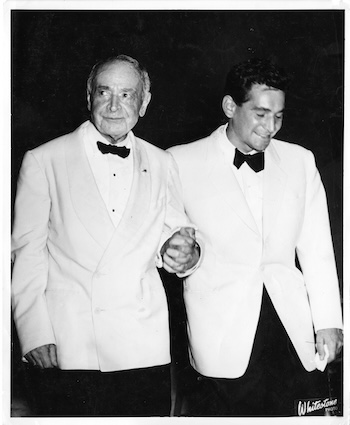
Today’s Boston’s “The Arts Fuse” carries an investigative piece of mine exploring how the Boston Symphony trustees decided not to hire Leonard Bernstein as the orchestra’s Music Director in 1949 even though he was the chosen successor of Serge Koussevitzky. This story is not irrelevant to the current controversy over the termination of Andris Nelsons, or the Chicago Symphony’s decision to engage Klaus Makela. I append an excerpt from my piece (itself excerpted from a book-in-progress on Leonard Bernstein and cultural leadership). You can read the whole thing here.
The current controversy over the termination of Andris Nelsons as Music Director of the Boston Symphony Orchestra – an immensely consequential decision — . . . brings to mind an even more consequential decision by the BSO leadership, a decision that has never been scrutinized. In 1949, Serge Koussevitzky — who had led the orchestra for 25 years, had created the Tanglewood summer festival as a singular American musical laboratory, had consolidated a mission and identity unique in the symphonic world — wished to pass the baton to his 31-year-old protégé Leonard Bernstein. But the board opted for Charles Munch, a stranger to American music and a poor fit for Tanglewood as Koussevitzky – a visionary – had envisioned it. . . .
The logic of a Bernstein appointment seemed apparent. With the Boston Symphony already committed to the American composer, Bernstein could pick up where Koussevitzky left off – and in the process add composers like Ives and Gershwin not to Koussevitzky’s taste. Compared to Koussevitzky’s orchestra, the New York Philharmonic, where Bernstein would wind up, was an inferior instrument, defective in polish and morale (and Bernstein was not an orchestra builder). Its eventual hall, at Lincoln Center, was inferior to Boston’s. Its audience was less attentive. Its artistic identity was erratic and vague. And it did not possess a summer home, let alone a Tanglewood. . . .
Henry Higginson, who invented the Boston Symphony in 1881, was a trained musician, schooled in Vienna. When he went shopping for a conductor during his 38 years operating the orchestra (there was no board), Higginson relied on trusted scouts abroad. The lists of candidates that he compiled were comprehensive and shrewd. Eavesdropping on the BSO board privately mulling Koussevitzky’s successor, one encounters a startling insularity – Cabot and the others evinced no knowledge of European musical life. . . .
In Boston, Leonard Bernstein might have sustained Serge Koussevitzky’s bold adventure – and changed the course of American classical music. Today’s Boston Symphony is adrift.
P.S. — Stay tuned for a blog about Henry Higginson and how to hire a Music Director.
All due respect Joe, I think Bernstein would not have been the right man. He never promoted new composers with the frequency or integrity of Dmitri Mitropoulos, and apparently he basically blocked the appointment by telling Koussevitzky Mitropoulos was gay. Mitropoulos would have changed the basic sound, but he would have continued Koussevitzky’s mission, and he thought he was a shoo-in and cried when he didn’t get the job (you may know all this…). I dare say Stokowski or Erich Kleiber would have been righter for the job than Bernstein too.
Lenny would never have become Lenny in Boston. He might have been a failure like Kubelik in Chicago, regarded as too young and unready for such a huge responsibility, and even if he succeeded, we would never have gotten Candide or West Side Story. In New York Bernstein had the one thing he never could have gotten in Boston, TV, and that is what made Lenny the Lenny we remember.
Ultimately, I think Lenny should never have taken an MD job. One has the sense that neither Koussy nor Copland thought much of Lenny as a composer, and they certainly poo-poohed his Broadway excursions. It’s a shame, Bernstein was probably a more gifted composer than Copland, but he realized the real blood in American music was lower brow than the concert hall. Had he devoted his energies to making shows, we might have gotten a dozen more works on the level of West Side Story and he would have had influence on the world that dwarfed what he was able to do on the podium. Between him and Sondheim, we might have a true American operatic tradition by now.