
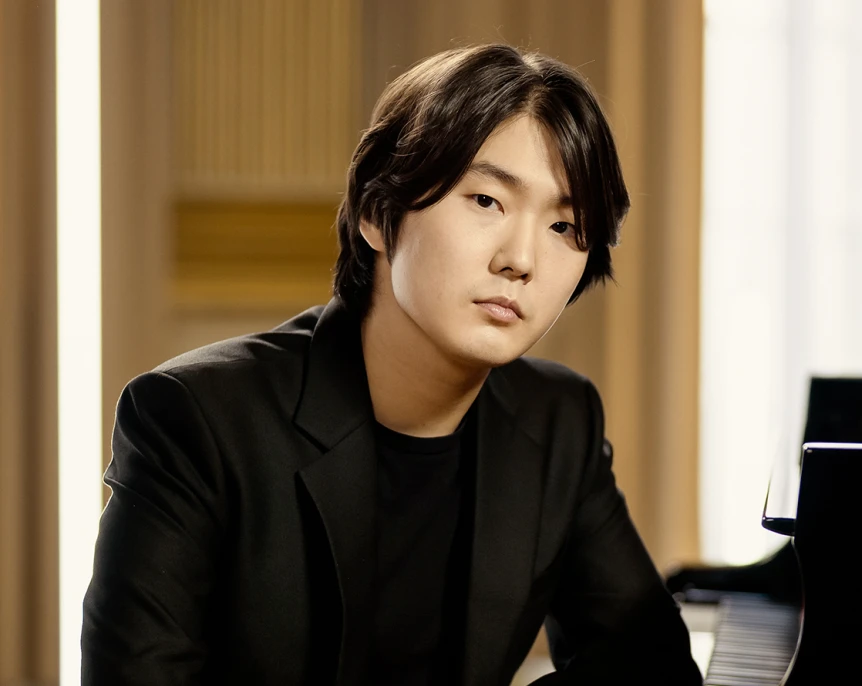
That Chopin’s 24 Preludes are commonly performed as a set makes sense. They are individually short and concise, they vary greatly in mood and texture, they suggest a trajectory beginning with a clearing of the throat and ending with a firestorm.
That Chopin’s waltzes are not commonly performed as a set makes equal sense. Individually, they are more repetitious than the preludes. They vary in mood, but only so much. Composed over a quarter century, they comprise no sequence.
Last Sunday afternoon at Carnegie Hall, Seong-Jin Cho performed all fourteen of the Chopin waltzes we know best (there are others). He devised an ingenious ordering and extrapolated a narrative. His readings were deft and deeply felt. They did not resemble – to name three disparate but iconic Chopin waltz purveyors – a Cortot, Lipatti, or Rubinstein. They were original but never eccentric. In short: it was a triumph.
The fourteen waltzes were bound; most began attacca. Cho began with three quick ones: E minor, F major, D-flat major (the “Minute Waltz”). He eased his way into the slower, simpler A-flat major Waltz by initially retaining some of the energy he’d accumulated. Midway through, he paused a long time – a calibrated silence – before confiding the saddest, quietest waltz, in A minor. It became a fulcrum event. The waltzes with the most repetition acquired ornamentation. The expressive high point, for me, was the pianissimo shift to B major in the B minor Waltz: a shaft of transfigurative radiance. Mainly, however, it was the seamless continuity of Cho’s waltz adventure that told.
The first half of his recital comprised Bach’s B-flat major Partita, Schoenberg’s non-tonal Suite (Op. 25), and Schumann’s Faschingsschwank aus Wien. The Bach, with its many repeats, so naturally acquired a gradual efflorescence of ornamentation that it was impossible to guess which were learned and which spontaneous. The Schoenberg and Schumann pieces mounted to tornado intensity. And yet Cho’s playing maintains a paradoxical liquid sheen, a governing equipoise in which the high polish of his pianism is a necessary ingredient. The velocity of his musical intelligence is astonishing, ever eventful, ever inventive.
Last December, extolling Cho’s performance of Rachmaninoff Rhapsody on the Theme by Paganini, I found myself pondering the possibilities of twenty-first century keyboard readings lying outside lineage and tradition; Cho’s Rachmaninoff did not resemble any Rachmaninoff style known to me. Sampling his Ravel on CD, I miss the French aesthetic rigor of Jean-Efflam Bavouzet. But Cho’s sensational final encore last Sunday, Alfred Grünfeld’s Soirée de Vienne, was Romantic in the grand manner.
A word about the ambience of the hall. The Metropolitan Opera, these days, has seemingly replaced its previous audience with newcomers well disposed to just about anything without getting too excited about any of it. At the close of the big A-flat Major Waltz (Op. 42), Cho – anticipating the next waltz to come – switched the dynamic of the final sally from fortissimo to pianissimo. It was a stroke of wit many in the audience acknowledged with titters of surprise. We are living in 2026, during which every day seems to disclose new atrocities of American behavior. To discover so discerning a response from a mass of New York listeners seemed reassuring. And so does the fame and popularity of Seong-Jin Cho, age 31.
This young man is a miracle.
If he really wants to show off he should program Ligeti’s “Preludes”, which needs more champions. Aimard does them welol.