
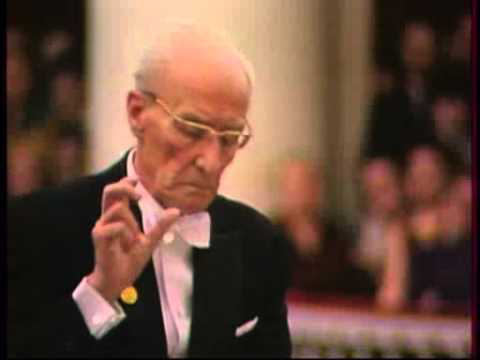
I find myself still gorging on live recorded performances by the greatest orchestra I ever encountered – Yevgeny Mravinsky’s Leningrad Philharmonic. Last night, it was Bartok’s Music for Strings, Percussion, and Celesta – a 1965 reading more intensely engaged than what you’ll hear today from any American orchestra known to me.
My previous blog has attracted many thousands of readers, and the response remains ongoing. Who these readers are I have no idea. Perhaps they are Russians who know and remember. Perhaps they are lovers of symphonic music who realize something has gone wrong. The public comments raise a question I have been pondering for some time in this space: is today’s disappointment the conductors or the players?
I recently attended a listless La traviata at the Metropolitan Opera, weakly cast (I went expecting more from the baritone). Nothing much was happening in the pit. The Prelude in the high strings was sung with perfect intonation, yet conveyed no tenderness. The eruptions in act two were dispatched with precise rhythm and ensemble, yet conveyed no fury. I was left wondering if the players (mainly young) had ever heard a great opera orchestra in Verdi. They need look no further than the Metropolitan Opera Orchestra broadcasts of the 1930s and ‘40s, when the Italian repertoire was superintended by a conductor of genius: Ettore Panizza.
I last wrote about Panizza’s Verdi, in some detail, in the New York Review of Books. My point of reference was the Aida broadcast of February 6, 1937. In the case of Traviata, we have readily at hand an even more extraordinary broadcast, a famous broadcast, from January 5, 1935. The Violetta is Rosa Ponselle. The Germont – a benchmark reading – is Lawrence Tibbett. The Alfredo is Frederick Jagel. Remarkably (as Milton Cross notes, in his broadcast introduction), all three were Americans.
I have never encountered a more eloquent impersonation of Germont’s enlightenment – he is the character in the drama who most changes – than Tibbett’s on this occasion. To begin with, his signature aria – “Di provenza” – is itself a classic performance. But his dramatic engagement, gradually absorbing Violetta’s strength of character, is equally notable. In this gripping personal saga, the orchestra is a full partner. When in act two, just before Alfredo’s father suddenly appears, the urgency of the orchestra’s prefatory chords (go to 36:02) galvanizes both Violetta and ourselves. Germont’s self-introduction (“I am Alfredo’s father!”) is supported by long, vigorous bow strokes (36:45): we know in an instant who he is and what he is feeling. The interaction quickly gathers heat: he is asking that Violetta give up his son. Her pleas are partnered by whipped, furiously accelerating rhythms (not in Verdi’s score) calibrating her desperation (41:52). Never mind that the orchestra is now not perfectly together – it’s not programed; rather, it is listening, instantaneously responding, moment to moment. “Morrò!” Violetta exclaims. “I will die!” The accompanying march tread (53:50) is taut yet flexible, building toward a climax ever more foreseeable.
So who is most responsible for this scorching rendition? It’s not just the singers and the conductor; it’s equally the players in the pit. Who are they? Not so many years ago, it was possible to visit the Met archives and find out. I am now told that orchestra rosters are in storage and “irretrievable” (what’s an archive for?). But I do recall that ca. 1930 most of the names were Italian. Plainly, audibly, these musicians knew La traviata. They loved La traviata.
As I am no longer a regular opera-goer, I cannot report with any authority when the collapse occurred. The last time I heard a world-class opera orchestra in the Metropolitan Opera pit was 2013. The opera was Parsifal and the conductor was Daniele Gatti. The orchestra’s response – its fullness of texture and sureness of purpose – was beyond praise. I regret that I did not hear any of Carlos Kleiber’s Met performances, or Leonard Bernstein’s. I did hear Herbert von Karajan conduct Das Rheingold and Die Walkure – and achieve the same sheen that distinguishes his Berlin Philharmonic recordings of these operas. In Die Walkure, Karajan had a better cast at the Met than on DG, with Regine Crespin’s Sieglinde opposite Jon Vickers’ Siegmund, and Birgit Nilsson as Brunnhilde; the first act erupted. I also remember the vivid aroma of the Bolshoi Opera Orchestra emanating from the Met pit in 1975, and the dark majesty of Valery Gergiev’s Mariinski Orchestra when it visited the Met. Both attained a high standard of purposeful engagement.
I ended my Mravinsky blog with a prediction and a conundrum: “There will be no rebirth of the Leningrad Philharmonic or of other singular ensembles from another era. . . . As for Viktor Liberman’s Leningrad violins – they weren’t just a product of Mravinsky’s tyranny. The music was in their blood, in centuries of culture building upon itself. Today we have social media and artificial intelligence. It is a challenge we are summoned to ponder and confront.”
To read about Daniele Gatti’s “Parsifal” at the Met, and its subsequent fate, click here and here.
To read about Artur Bodanzky – who magnificently presided over the Met’s German wing during Panizza’s New York seasons – click here.
To read about Lawrence Tibbett, the supreme homegrown American opera singer, click here. For my pertinent NPR show, click here.
To read further ponderings about the fate of classical music in performance as we lose touch with the past, click here.
I have completely fallen in love with the Berlin Philharmonic’s Digital Concert Hall. Seeing the performers in detail – especially their facial expressions and execution of the music deepens my love and understanding of classical orchestral music. I’ve heard many live symphony performances and have thousands of CDs since I started listening in the golden age of the 60’s and 70’s. The Berlin Philharmonic is an incredible orchestra.
I was also at Gatti’s Parsifal (which sounded beautiful but was very slow) and have heard a few great performances at the Met. There’s a difference between “very good” (e.g. Oksana Lyniv’s Turandot from last week) and “great”. In opera, the singers make most of the difference, but in symphonic music, it’s the conductors.
I would be remiss if I didn’t sing the praises of Mravinsky’s Sibelius 7th, the 1960s recording. For me it’s the most sublime and intense performance I have ever heard. Many do this piece well (Beecham, Stokowski, Colin Davis etc) but nobody comes close to Mravinsky’s intensity. There is also a trombone solo that has to be heard to be believed – a braying, haunting tone, you will either love it or hate it. Recommended to all.
https://www.youtube.com/watch?v=VzBZigknCOE&list=RDVzBZigknCOE&start_radio=1
I have followed Mr Horowitz’s writings for years. Once he wrote so eloquently about Stoki’s Philadelphia Beethoven 5th slow movement (“no bar lines!:) I thought “here’s someone who listens like I listen.” He is always interesting and provocative.