
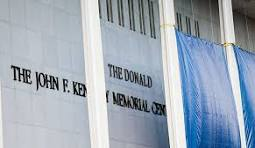
Having written a book – The Propaganda of Freedom – exploring the relationship between JFK and the arts, and having finished in manuscript a subsequent study of Leonard Bernstein and cultural leadership, I find myself responding to the Trump-Kennedy Center and kindred developments by looking backward at what might have been.
Trump uses his bully pulpit to go after nations, institutions, and individuals. Whatever one makes of these blunt initiatives, and whatever their ultimate outcome, they are typically met by vigorous counter-assaults — sometimes by diplomats and politicians, sometimes by jurists not excluding the Chief Justice of the Supreme Court. A couple of conspicuous exceptions are Trump’s evisceration of the National Endowment of the Humanities (including the recent abandonment of the peer-review process shielding applications from direct political intervention), and the abrupt termination of grants and grant applications both at the NEH and the National Endowment of the Arts. Insufficiently explained or justified, these actions have largely transpired in a void. Opposition to the take-over of the Kennedy Center has been tangible but ineffectual. Prominent, proactive spokespersons for the arts are little in evidence. And yet the President is mercurial: he is known to change his mind.
As I have repeatedly emphasized in this space: the morning John F. Kennedy was assassinated, the earliest edition of the New York Times disclosed that a New Frontier activist, Richard Goodwin, was about to be appointed the President’s advisor on the arts. Waiting in the wings was the Music Director of the New York Philharmonic: Leonard Bernstein.
The Goodwin appointment was dropped from subsequent editions of the Times and vanished without a trace. In an Executive Order establishing a National Council on the Arts that Goodwin would have administered, the President had claimed: “For the first time, the Arts will have some formal government body which will be specifically concerned with all aspects of the Arts.” In her recent memoir, An Unfinished Love Story, Doris Kearns Goodwin recalls that her late husband, having served as Deputy Assistant Secretary of State for Inter-American Affairs, was asked by the First Lady to propose an arts advisor for the White House. He recommended “a vigorous young man rather than a big, but doddering name.” Jackie exclaimed: “What a perfect description of you!” – and the die was cast. When asked by his wife why he took the job, Goodwin answered: “I wanted to be back in the magic circle, back in the White House. Kennedy prized versatility. . . . Anything was possible. Anything could happen.” Like the Kennedys, he considered the arts “a necessary and integral ingredient of a healthy society.”
Had it happened, the Goodwin appointment would have accelerated a crescendo of activity beginning with President Eisenhower’s endorsement of a “national cultural center.” President Kennedy seconded this aspiration in a speech delivered shortly before he hosted Igor Stravinsky at a White House dinner. He cited Aeschylus, Plato, Dante, and Goethe, then proclaimed: “It was Pericles’ proudest boast that politically Athens was the school of Hellas. If we can make our country one of the great schools of civilization, then on that achievement will surely rest our claim to the ultimate gratitude of mankind.”
A fund-raising gala for the proposed cultural center was hosted by Leonard Bernstein. Not only did Bernstein enjoy a privileged relationship with the White House – he was already an experienced cultural diplomat. In 1958, the State Department had sponsored his seven-week tour of Latin America with the New York Philharmonic. Bernstein’s subsequent ten-week tour to Europe, the Middle East, and the Soviet Union included a televised Moscow concert in which he juxtaposed music by Copland and Shostakovich to discover fundamental similarities mirroring “the similarity of our two great peoples.” Bernstein next took the Philharmonic to West Berlin in 1960. He proved a proactive ambassador who in Russia defied restrictions the Soviets attempted to impose – and grandly got away with it (a story I tell in detail in The Propaganda of Freedom). He would return home from his missionary adventures triumphantly exhorting government involvement in the arts, including direct federal subsidies. In Israel, as well, Bernstein – a frequent conductor of the Israel Philharmonic — had since 1947 experienced the frisson of political engagement and the potency of classical music as a bonding agent.
The impact of the Kennedy assassination on Bernstein’s dreams for a riper America can hardly be exaggerated. He and his family had been guests at the White House. He had found the President both glamorous and approachable. He was charmed and inspired by the First Lady. He had doubtlessly envisioned a vibrant partnership, with himself and the President comrades in arms. The assassination paradoxically accelerated fund-raising for the envisioned cultural center, now become the “Kennedy Center.” Mrs. Kennedy invited Bernstein to be artistic director. Bernstein considered the job wrong for him, but agreed to compose something for the gala opening. This turned out to be an anti-war Mass boycotted by President Richard Nixon.
Bernstein, post-Kennedy, was increasingly estranged from a New World he had once celebrated for its artistic promise. He gradually relocated his musical home to Vienna. When in 1977 he was invited to testify before a House Subcommittee in favor of a White House conference on the arts, he instead testified: “We are still an uncultured nation, and no amount of granting or funding is ever going to change that” – unless the arts, including musical literacy, were prioritized in early public education. It is a priority Bernstein would have impressed on Kennedy. Had he witnessed the current fate of the endowments, his protests would have resonated. Had he witnessed the renaming of the Kennedy Center, he would have been apoplectic.
Fredrik Logevall, Kennedy’s current biographer, plausibly imagines that the arts would have become a White House priority had Kennedy served as second term. In any case, like the war in Vietnam, the relationship of government to the arts would have differently unfolded had John Kennedy not been shot that November afternoon in Dallas.
For my NPR report on this topic, click here.
Leave a Reply