• Home
  • About
    • Jumper
    • Diane Ragsdale
    • Contact
  • AJBlogs
  • ArtsJournal

Jumper

Diane Ragsdale on what the arts do and why

Archives for February 2017

On Entrepreneurialism and Publicness (or Whose Theatre is it, Really?)

This essay was originally published in Artivate: A Journal of Entrepreneurship in the Arts by the Pave Program in Arts Entrepreneurship at Arizona State University. Many thanks to Linda Essig for permission to syndicate it on Jumper.
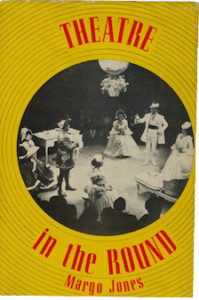
On Entrepreneurialism and Publicness (or Whose Theater Is It, Really?) by Diane Ragsdale

But democratic society — in it, the highest duty of the writer, the composer, the artist is to remain true to himself and to let the chips fall where they may. In serving his vision of the truth, the artist best serves his nation. 

President John F. Kennedy (Remarks at Amherst College, 1963)

In his paper on the creative industries and cultural entrepreneurship Richard Swedberg examines “the parallels between the entrepreneur and the artist, according to the young [Joseph] Schumpeter” (Swedberg, 2006, p. 250). Swedberg conveys that, among other characteristics, the artist/entrepreneur (as contrasted with the static majority) “puts together new combinations,” “battles resistance to his actions,” and is “motivated by power and joy in creation.” I was disquieted when I encountered this discussion of cultural entrepreneurship a few years ago; however, it took completing a case study on the Margo Jones Theatre last year for me to identify the source of my unease.

Margo Jones is generally credited by theater historians with having founded the prototypical nonprofit-but-professional resident theater in Dallas, Texas in 1947. Among a handful of “pattern-setting elements” attributed to Jones’s theater, her adoption of the nonprofit form is said to have had “the most far-reaching effects” on regional theater in America (Berkowitz, 1982, p. 58). It is difficult to refute the statement if one considers that before 1950 there were almost no examples of professional (read: unionized) theaters organized as nonprofit corporations and that today there are hundreds. Nevertheless, it is ironic that one of the few enduring dimensions of Jones’s unique theater model—which combined elements of the community, academic, art, and commercial theater—was its nonprofit status.

While Jones founded her theater as a nonprofit “civic venture” (Jones, 1951, p. 67) there is considerable evidence that she didn’t actually run it like one. Jones is said to have “believed firmly that the head of a theatre must of necessity be an autocrat—which [she] unquestionably was” (Larsen, 1982, p. 123). Likewise, her biographer relays that when the business chairman of the board “expressed a desire to have more authority over how money was spent and accounted for,” Jones declared, “I will not be confined!” and “demanded 100 percent artistic and financial control” (Sheehy, 1989, p. 236). In return, the board of directors gave Jones a “free hand” and “unquestioning support” (Wilmeth, 1989, p. 365). Evidently, it “was not disposed to refusing her whatever she wanted” (Larsen, 1982, p. 183). Jones was able to dominate the theater in part because the economics of the arena-style venue she created enabled “the organization to depend solely on ticket sales for operating expenses” (Wilmeth, 1965, p. 269). Moreover, Jones actively avoided soliciting donations from the community, beyond the $40,000 (in 1946 dollars) she raised to convert a found space into a theater and produce her first season.

In her manifesto-handbook, Theatre-in-the-Round, Jones suggests three business forms that a resident theater might take: nonprofit, sole proprietorship, or stock company funded with investments from shareholders (Jones, 1951, p. 66-67). One of Jones’s so-called followers—though a maverick in her own right—was Zelda Fichandler, who co-founded the Arena Stage in Washington, DC in 1950 as a stock company utilizing shareholder investments. It sustained itself on box office income and converted to the nonprofit form only when doing so became a condition of a significant grant from the Ford Foundation. For years after the conversion, Fichandler expressed concerns about the potential influence of the public on the institution—a worry captured and explained in this poetic passage (Fichandler, 1970, p. 110):

I am not very strong on community giving, except perhaps when it represents only a small percentage of the total. I think we could well do without the hand that rocks the cradle, for the hand that rocks the cradle will also want to raise it in a vote and mix into the pie with it. For while a theatre is a public art and belongs to its public, it is an art before it is public and so it belongs first to itself and its first service must be self-service. A theatre is part of its society. But it is a part which must remain apart since it is also chastiser, rebel, lightning rod, redeemer, irritant, codifier, and horse-laughter.

The Milwaukee Repertory Theater—another organization that consulted with Jones before opening—was founded in 1954 as a hybrid nonprofit-stock company. It solicited donations from the community, which it combined with investments by its founder, Mary Widrig John, who held a majority of shares in the stock corporation. This unorthodox pairing reflected John’s desire (akin to that of Margo Jones) to involve the community financially in raising a theater from the ground, but to exercise control over its direction once raised. According to one chronicler, there was “growing dissension among the staff and board of directors regarding John’s authority. The crucial question to be answered was whether the theatre belonged to John or to the public” (Pinkston, 1989, p. 377). The matter eventually went to court and a judge ruled that the theater could not be nonprofit and have shareholders. It became a non-stock nonprofit corporation and John departed.

One imagines that if Certified B Corporations or Low-Profit Limited Liability Corporations had been in existence at the time either one would have been a preferable legal structure for these theaters, given the goals of their entrepreneurial leaders. It is no coincidence that we are witnessing the creation and adoption of hybrid forms of organization alongside the emergence of social, cultural, creative, and arts entrepreneurs. Such forms are ideally suited to those who want to do work that benefits society but don’t want to relinquish ownership or control over their enterprises to do so.

And this brings me to the source of my unease. For all intents and purposes, the Margo Jones Theatre (née Theatre ’47) was operated by Jones as if it were a sole proprietorship (i.e. a private enterprise). Put another way, in terms of funding and control, Jones’s theater was, to a great extent, lacking in publicness (see e.g. Andrews, R., Boyne, G. A. & Walker, R. M., 2011). Moreover, the characteristics that made Jones a highly successful artist/entrepreneur made it nearly impossible for the board of the nonprofit theater (owned by no one and therefore everyone) to exercise what is now generally taken to be good governance, including: oversight of the theater’s financial health, determination of the theater’s goals, and representation of the public’s interest in the theater. Tellingly, following Jones’s untimely death in 1955, the board of directors seized the power that had been denied them for years, dismantled many of Jones’s policies, and took the theater in a different (and ultimately fatal) direction.

As I ponder the motives, opportunities, and means of the three pioneering leaders highlighted in this essay, the parallel characteristics of the artist and entrepreneur as theorized by Schumpeter, and the emergence of new hybrid private/public organizational forms, a philosophical question emerges—in large part because I hear calls these days for nonprofit arts organizations to become both more entrepreneurial (i.e. innovative and self-sustaining) and more communal (i.e. responsive to, or representative of, the communities they ostensibly exist to serve).

Is there an inherent, underexamined, and perhaps necessarily unresolvable conflict between the autonomy or authority needed by the artist/entrepreneur and the publicness required of the 501c3 charitable nonprofit, in order for them effectively to fulfill their respective roles vis-à-vis society?

REFERENCES

Andrews, R., Boyne, G. A. & Walker, R. M. (2011). Dimensions of publicness and organizational performance: A review of the evidence. Journal of Public Administration Research and Theory, Volume 21(Issue Supplement 3), i301-i319.

Berkowitz, G. M. (1982). New Broadways: Theatre across America 1950-1980. Totowa, NJ: Rowan and Littlefield.

Fichandler, Z. (1970). Theatres or institutions? The American Theatre 1969-70: International Theatre Institute of the United States, Volume 3. New York: Charles Scribner’s Sons.

Jones, M. (1951). Theatre-in-the-Round. Westport, CT: Greenwood Press.

Kennedy, J. F. (1963). Remarks at Amherst College, October 26, 1963. Retrieved at: https://www.arts.gov/about/kennedy-transcript

Larsen, J. B. (1982). Margo Jones: A Life in the Theatre (Doctoral dissertation). Retrieved from ProQuest Dissertations and Theses. (Accession Order No. 8222956)

Pinkston, A. (1989). Milwaukee Repertory Theatre. In W. B. Durham (Ed.) American Theatre Companies, 1931-1986 (376-386). New York: Greenwood Press.

Sheehy, H. (1989/2005). Margo: The Life and Theatre of Margo Jones (1st paperback ed.) Dallas: Southern Methodist University Press.

Swedberg, R. (2006). The cultural entrepreneur and the creative industries: Beginning in Vienna. Journal of Cultural Economics, Volume 30(4), 243-261.

Wilmeth, D. B. (1965). A History of the Margo Jones Theatre (Doctoral dissertation). Retrieved from ProQuest Dissertations and Theses. (Accession Order No. 6503696)

Wilmeth, D. B. (1989). Margo Jones Theatre. In W. B. Durham (Ed.) American Theatre Companies, 1931-1986 (362-369). New York: Greenwood Press.


Is artistic leadership at America’s arts institutions lacking? Is this at the root of declining relevancy?

See article, What if art centers existed to ignite radical citizenship? by Deborah Cullinan.

Joe Horowitz has written a stirring essay on the Metropolitan Opera, New York City Ballet, and New York Philharmonic on the occasion of the 50th anniversary of Lincoln Center. In response, ArtsJournal has asked a number of people to consider the essay and to weigh in on a series of questions (paraphrased):

Is artistic leadership at America’s arts institutions lacking? Moreover, is this at the root of declining relevancy of the arts? Is something more, or better, needed from America’s arts institutions, particularly at this vexing and critical time?

This essay explores these questions through the lens of the American theater. At the heart of this essay rests the paradox of the Public Arts Institution—a paradox captured beautifully in this passage from a 1970 essay by Arena Stage co-founder, Zelda Fichandler, Theatres or Institutions?[1]

I am not very strong on community giving, except perhaps when it represents only a small percentage of the total. I think we could well do without the hand that rocks the cradle, for the hand that rocks the cradle will also want to raise it in a vote and mix into the pie with it. For while a theatre is a public art and belongs to its public, it is an art before it is public and so it belongs first to itself and its first service must be self-service. A theatre is part of its society. But it is a part which must remain apart since it is also chastiser, rebel, lightning rod, redeemer, irritant, codifier, and horse-laughter.

This is a paradox I also wrestled with in an essay published in the most recent issue of Artivate called On Entrepreneurialism and Publicness (or Whose Theatre is it, Really?). 

Part I: Are We Weeding, or Breeding, Artistic Leadership Out of the Field?

Joe Horowitz’s story is a tale of three organizations, only one of which (New York City Ballet) succeeded in changing the face of its art form. What made the difference at the Ballet? By my reading, there was first and foremost a will on the part of both Balanchine and his impresario, Kirstein, to do so; and second, conditions were ripe for these institutional entrepreneurs to make their move.

Last year I worked on a case study on the Margo Jones Theatre, founded in 1947 (in Dallas, Texas) and hailed by most theater historians as the prototypical modern resident theater. Jones produced exclusively new plays and classics. In an average season Jones produced 4-5 premieres and two classics; in contrast, of 23 resident theaters surveyed in 1965 by journalist Sandra Schmidt, 15 produced no new plays at all and four produced only one.[2] At the time, most resident theaters exemplified the vibrant museum model described in Horowitz’s essay.

Historians often chalk this up to a discomfort with new fare on the part of both institutional leaders and their audiences. Perhaps. It seems Jones overcame discomfort by reading a minimum of one new script every day of her life from her college days onward and, more importantly, she made her audience comfortable with new fare through the same process: repeated exposure.

Like Balanchine, Jones had a vision and the will to execute it. Importantly, she also had a business manager who supported her commitment to new plays and a board of directors that gave her free reign. Equally as important, resident theater in America was in its pioneer period. But the first condition is critical. Jones was devoted to playwrights and preached far and wide that nonprofit regional theaters had a moral duty to produce new plays being rejected by the commercial stage, in lieu of relying on Broadway revivals–fare favored by both commercial winter stock companies and community theaters at the time.

We seem to have few such zealots running American LORT theaters these days.

Why is that?

I don’t believe it’s because none exist.

Consider the driving emphasis on instilling arts institutional leaders with business skills since 1960; the now mandatory requirements of a track record of raising money and delivering box office hits (that will fill Broadway-sized venues) to attain the job of artistic director at a major theater; the lack of artists on nonprofit boards, or even many individuals with an aesthetic sensibility; and the dramatic power shift from artist-leaders to business-leaders, generally.

Maybe we have been breeding, or weeding, artistic leadership out of the field?

Margo Jones didn’t like to raise money from the community, she demanded 100% control of her theater, and she walked into the job interview saying to the board, in essence: Count me out if you are planning to be a theater of the past, “striving to exist on box-office hits,” as I am only interested in creating “a true playwright’s theatre, presenting original scripts and providing playwrights with an outlet for their work.”[3]

If Margo Jones were applying to run an American theater in the hinterlands of the US today she probably wouldn’t stand a chance.

Part II: Artists are Getting it Done … But Are Institutions Getting in the Way?

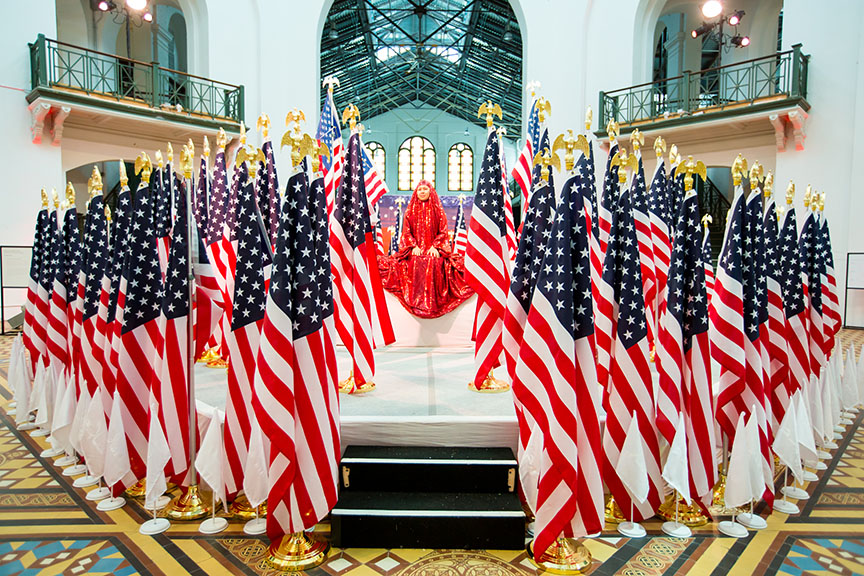
I recently had the privilege of attending a Salzburg Global Seminar called The Art of Resilience: Creativity, Courage and Renewal. Among many inspiring presentations was one by artist Anida Yoeu Ali, a first generation Muslim Khmer woman born in Cambodia and raised in Chicago. Anida talked about a number of her works, including a performance installation called The Red Chador: Thresholds, created for a 2016 Smithsonian event called Crosslines: A Culture Lab on Intersectionality. The work asked viewers: “Can we accept a Muslim woman as a patriotic woman?”

The Red Chador: Threshold, Washington DC, USA | May 28-29, 2016. Commissioned by Smithsonian Asian Pacific American Center. Performance by Anida Yoeu Ali.                               Photo Courtesy of Les Talusan

Over breakfast one morning I asked Anida, “So how would you respond to the question, ‘What is the role of the artist post-Trump?” and she said, “Same as always. No different. Get up and do the work.”

The day after the election Anida took to the streets of Seattle, where she is now based, wearing the red, glittering chador she created for the Smithsonian performance installation and holding a sign that on one side said, I AM A MUSLIM and, on the other, BAN ME.

The Red Chador: The Day After, Seattle, USA | Nov 9, 2016. Performance by Anida Yoeu Ali.  Photo courtesy of Studio Revolt.

What’s my point?

Artists are doing something about it, same as always.

However, most artists depend upon institutional outlets for protection, platforms, and resources for that something to be fully realized.

To this very point, the New York Times recently ran an article on a new play by Robert Schenkkan, written in a “white-hot fury” in one week. Characterized as a “disquieting response to the Trump era,” it’s called Building the Wall.  Schenkkan says in the article:

We no longer live in a world that is business as usual—Trump has made that very clear—and if theater is going to remain relevant, we must become faster to respond.

While the article goes on to mention that a group of theaters has committed to producing the play within the next few months, it’s worth noting that (a) this sort of response is exceedingly rare; and (b) the theaters that have stepped up are largely part of a small alliance of exemplary midsized theaters (the National New Play Network) that has fought the past decade or so to shift stultifying practices around new play development in the US.

Most institutions are not able to respond quickly to artists (doing something about it) in large part because artists exist outside of institutions rather than within them. While resident theaters were initially idealized as homes for actors, writers, and designers what they have become in reality is homes for administrators and technicians. Even when artists are in residence they quite often have minimal (if any) power within institutions, or influence on them. And we have had a number of instances of institutional cowardice (if not censorship) in recent years. (See, e.g. this article on the experience of Anida Yoeu Ali and Gregg Deal at the Smithsonian event mentioned above.)

I have heard playwrights say that they write for television these days not only because they make more money but because it is a more creative and validating environment than the nonprofit American theater. That is a sobering thought.

Perhaps any lack of courage, vision, or moral imagination in arts organizations is related to the extent to which arts leaders have managed risk by disempowering artists or placing them outside the institution?

Part III: Do arts leaders identify too much with their upper middle class donors?

I was at a conference a few weeks ago and heard a development staffer bemoaning over her morning croissant that she had spent the better part of the prior two weeks trying to learn everything she could about some Ultra-High-Net-Worth-Couple in her city so that her institution could launch a stealth courtship and, with any luck, land a major gift. She commented that, as far as anyone could tell, this couple had never stepped foot in the doors of the institution. She fretted over the fact that she was dedicating every working moment to deeply understanding two wealthy people with no relationship whatsoever to the institution; while nary a nanosecond was being expended trying to learn about the values, hopes, dreams, and challenges of the loyal patrons who were not in a position to make an extraordinary gift to the institution.

While donor research and cultivation has become a serious science, the ideology driving such behavior has been with us since the founding of the nonprofit-professional arts sector in the US. I am amazed that we are able to say with a straight face that America’s 20th century nonprofit-professional theater companies were largely established to serve the general public when many institutionalized a practice (at their inceptions) that would ensure they paid attention to the needs of the upper middle class at the expense of all others.

In the 1960s Danny Newman persuaded theaters that it was better (not just economically better, but morally better) to focus their time and resources on the 3% of the population that is inclined to subscribe and to ignore everyone else. Though some artistic directors rebelled mightily against this approach in the theater industry—Richard Schechner and Gregory Mosher were among the most vocal who noted that it was undemocratic and had a stultifying effect on programming—it was embraced wholeheartedly by a majority of institutions. This was in large part because it was strongly encouraged by the Ford Foundation and its proxy at the time, Theatre Communications Group.

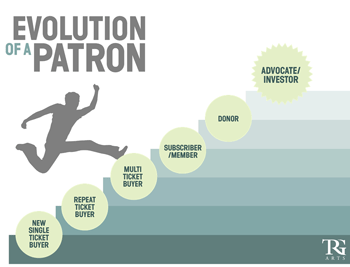
Today marketing firms promulgate customer relationship management models like this one promoted by TRG Arts. This sort of philosophy upheld over time will invariably orient an organization toward caring more about those who can buy more tickets and donate more money.

Arts institutions cannot uphold Zelda Fichandler’s notion of the theatre as belonging to the public but first belonging to itself if they are, essentially, social clubs for the upper middle class. The institution cannot be “chastiser, rebel, lightning rod, redeemer, irritant, codifier, and horse-laughter” if it has neither independence nor publicness.

Perhaps a driving focus on cultivating the patronage of the upper middle class has skewed the politics and purposes of arts institutions, and also has been a major factor in declining relevancy? On the most fundamental level nonprofit art institutions are among the cultural spaces that are able to bring people together across divides on equal terms—a vital function that is, at times like these, in and of itself a political act. However, it seems we have too gladly ceded that role to sports and (lately) to some exemplary libraries around the world (see, e.g., the library parks in Colombia) that have transformed their purposes for the 21st century.

Part IV: Good We Are Awake. Now, Can we Stay Awake?

Shortly after Trump was elected a particular a phrase from Tony Kushner’s masterpieces Angels in America, parts I and II began to appear on my Facebook feed, which is to a great extent populated by liberal arts types like me. That phrase: “The Great Work Begins.”

The statement, in turns hopeful and harrowing depending on its context in the plays, provoked two questions for me:

What is our Great Work in the arts? (which I addressed in this Jumper post); and

Why is this Great Work beginning only now, after Trump’s election?

Put another way, why does it so often take a crisis for those of us working in the arts, in the so-called civic sphere, to engage with the struggles, the pain, the hopes, the dreams, the fears … of our communities-at-large?

The extraordinary observer of the human condition, writer Rebecca Solnit, reflects in her beautiful book, Hope in the Dark:

Americans are good at responding to crisis and then going home to let another crisis brew.

She says this is, in part …

… because we tend to think that political engagement is something for emergencies rather than, as people in many countries (and Americans at other times) have imagined, as part and even a pleasure of everyday life.

“The problem” as she puts it, “seldom goes home.”

Unlike television (and libraries) the American theater didn’t use the Digital Revolution combined with the Great Recession as an opportunity to radically transform itself so as to become more relevant, more vibrant, more accessible, more vital—and yes, more economically sustainable.

It seems we have another shot as, for many in the arts sector, Trump seems to represent a wake-up call.

Perhaps now is the time to prioritize artistic vision over business skills; to grant artists primacy within the arts institution; and to shift attention from wealthy donors to the community-at-large. Perhaps now is the time to embrace the paradox of being Public Arts Institutions: a part of society—but a part which must remain apart in order to fulfill its multifaceted role as “chastiser, rebel, lightning rod, redeemer, irritant, codifier, and horse-laughter.”

Finally, perhaps engaging in public affairs for the next four years will remind arts institutions that this is not the Great Work we must do now, this is the everyday work–the doing something about it–we should have been doing the past 30 years and that we must continue to do post 2020.

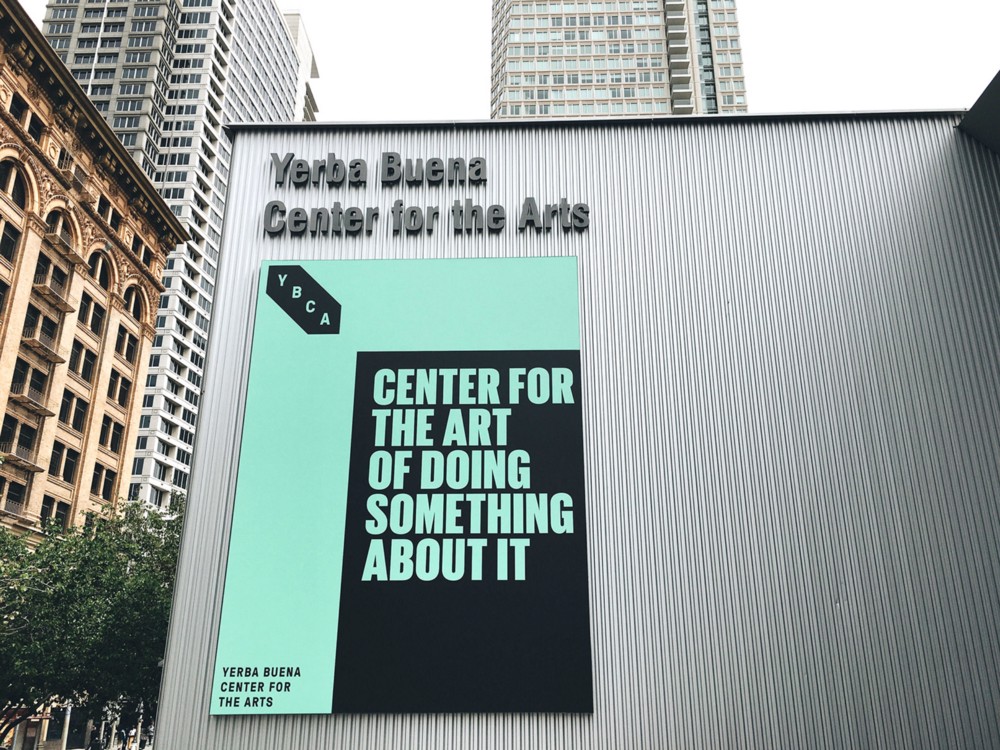
PS – Huge shout out to Deborah Cullinan at Yerba Buena Center for the Arts. I love her notion of art centers existing to ignite radical citizenship and I love the YBCA campaign that resulted in the tagline pictured in the photo at the top of this post, which was an inspiration for this piece. 

***

[1] Fichandler, Z. (1970). Theatres or Institutions? The American Theatre 1969-70: International Theatre Institute of the United States, Volume 3. (New York: Charles Scribner’s Sons), p. 110.

[2] Schmidt, S. (1965). The Regional Theatre: Some Statistics. The Tulane Drama Review, Vol. 10, No. 1 (Autumn, 1965), pp. 50-61.

[3] Sheehy, H. (1989). Margo: The Life and Theatre of Margo Jones. (Dallas: Southern Methodist University Press), p. 88.

Follow Us on FacebookFollow Us on TwitterFollow Us on RSS

@DERagsdale

Tweets by @DERagsdale

Recent Comments

  • Andrew Taylor on On a Strategy of Indeterminacy: Or, the Value of Creating Pathways to the Unforeseen: “Love this line of thinking, Diane! Although I also wonder about the many small, safe-to-fail ways you could explore randomness…” Feb 21, 22:54
  • Rick Heath on On a Strategy of Indeterminacy: Or, the Value of Creating Pathways to the Unforeseen: “Thanks Dianne Compelled and confused! (Not for the first time, and not entirely because of your words, but somewhat because…” Feb 5, 07:20
  • Diane Ragsdale on On a Strategy of Indeterminacy: Or, the Value of Creating Pathways to the Unforeseen: “Hi Ella! Thanks so much for taking the time to read and engage with the post. Thank you for reminding…” Feb 2, 18:19
  • Diane Ragsdale on On a Strategy of Indeterminacy: Or, the Value of Creating Pathways to the Unforeseen: “Caroline! Thanks so much for reading and sharing reflections. I am compelled by your idea to have an entire college…” Feb 2, 18:18
  • Diane Ragsdale on On a Strategy of Indeterminacy: Or, the Value of Creating Pathways to the Unforeseen: “Margaret, Thank you for taking the time to read and comment and for the warm wishes for my recovery. I…” Feb 2, 16:57

Archives

Subscribe to Jumper by Email

Enter your email address:

A Few Things I’ve Written

"Surviving the Culture Change", "The Excellence Barrier", "Holding Up the Arts: Can We Sustain What We've Creatived? Should We?" and "Living in the Struggle: Our Long Tug of War in the Arts" are a few keynote addresses I've given in the US and abroad on the larger changes in the cultural environment and ways arts organizations may need to adapt in order to survive and thrive in the coming years.

If you want a quicker read, then you may want to skip the speeches and opt for the article, "Recreating Fine Arts Institutions," which was published in the November 2009 Stanford Social Innovation Review.

Here is a recent essay commissioned by the Royal Society for the Encouragement of the Arts for the 2011 State of the Arts Conference in London, "Rethinking Cultural Philanthropy".

In 2012 I documented a meeting among commercial theater producers and nonprofit theater directors to discuss partnerships between the two sectors in the development of new theatrical work, which is published by HowlRound. You can get a copy of this report, "In the Intersection," on the HowlRound Website. Finally, last year I also had essays published in Doug Borwick's book, Building Communities Not Audiences and Theatre Bay Area's book (edited by Clay Lord), Counting New Beans.

Categories

  • artistic home
  • artistic processes and practices
  • Artistic Standards & Quality
  • arts and the pandemic
  • arts conferences
  • Arts Education
  • arts facilities
  • Asymmetric power dynamics
  • beauty
  • book recommendations
  • community
  • creative leadership
  • cultural leadership
  • Democratization of Culture
  • Economic Impact Studies
  • engagement
  • entrepreneurship
  • ethics
  • Funder Jargon
  • Innovation
  • institutionalism
  • interdependence
  • intrinsic value
  • leadership
  • nonprofit model
  • nonprofits and information disclosure
  • philanthropy
  • Pricing
  • purpose
  • subsidization of the arts
  • succession planning
  • Supply/Demand
  • sustainability
  • Uncategorized
  • Undercapitalization
Return to top of page

an ArtsJournal blog

This blog published under a Creative Commons license