• Home
  • About
    • Jumper
    • Diane Ragsdale
    • Contact
  • AJBlogs
  • ArtsJournal

Jumper

Diane Ragsdale on what the arts do and why

Archives for 2016

What is our “Great Work” in light of this election?

Several hours ago now, Donald J. Trump was elected the forty-fifth President of the United States. I haven’t slept in 36 hours. As the results of the election became clear, more than a few theater friends on my Facebook feed began to post the words: “The Great Work Begins”—a reference to a phrase in Tony Kushner’s Angels in America and Angels in America, Part Two: Perestroika. Fueled by confusion and concern, and with a desire to spur myself and others to both reflection and action, I offer this post (a combination of new thoughts and those I’ve generated elsewhere over the past two years). I hope I can enjoin others to engage in a practical and hopeful conversation about where we go from here and the perhaps “painful progress” that we in the arts need to make.[1]

By the way, I am honored and delighted to announce that I recently began a 15-month fellowship as a (mostly virtual) Arts Blogger/Writer in Residence at the Thomas S. Kenan Institute at North Carolina School of the Arts. In the coming months you may see some of my Jumper posts syndicated on the Kenan website and vice versa.
From the Wikipedia Commons

From the Wikipedia Commons

At 10:58 pm Eastern—before the game-ending number of electoral votes had been reached and while Hillary Clinton still had at least a few pathways to 270—columnist Paul Krugman posted:

We still don’t know who will win the electoral college, although as I write this it looks—incredibly, horribly—as if the odds now favor Donald J. Trump. What we do know is that people like me, like most readers of the New York Times, truly didn’t understand the country we live in.

From where I stand, those working in nonprofit professional cultural organizations across the US—we in the so-called Creative Class—are, without a doubt, among those who did not understand our country, its culture, or its values. If we are shocked and outraged by the election results this only seems to prove the point. And this lack of understanding is disappointing given that art can be—arguably, should be—the way we share with one another what it means to be human (a powerful and democratizing notion I first encountered in Bill Sharpe’s wonderful monograph, Economies of Life: Patterns of Health and Wealth).

Looking at the programming on our stages it seems that many of us have existed inside a bubble, utterly out of touch with the Trump-supporting working poor in America, among many others.

How did this happen?

Virginia Woolf writes in her book, Three Guineas:

If people are highly successful in their professions they lose their senses. Sight goes. They have no time to look at pictures. Sound goes. They have no time to listen to music. Speech goes. They have no time for conversation. They lose their sense of proportion—the relations between one thing and another. Humanity goes.

This statement is hauntingly resonant when I think about the arts and culture sector in the US. The price of success has been the loss of our humanity as organizations. We appear to have lost our senses.

I came to this realization in June 2014 at a residential training with the organization Common Cause, which seeks to encourage NGOs and others working in the social sectors to join up to advance a set of common values in society—values like A World of Beauty, Social Justice, Equality, A Sense of Belonging, Broadmindedness, A Meaningful Life.[2] At the first gathering, when we went around a circle and talked about why we had chosen to come on the training, I said something to this effect:

I’m here because I don’t know if I can continue to work on behalf of the arts if the arts are only interested in advancing themselves.

I’m here because I’m worried about things like growing income inequality and suspect that growing income inequality may actually benefit the arts. And what are we going to do about that? I’m here because I’m worried about cultural divides and that the arts perpetuate them more than they help to bridge them.

I believe the arts could be a force for good, but I believe we will need to change as leaders, and as organizations, in relationship to our communities, for them to be so.

I was despairing about my life working in the arts when I spoke these words and I felt that same despair this morning in the aftermath of the election. But it is incumbent upon us to move on from sorrow as there is important work to be done. Earlier this year, New York Times columnist David Brooks argued in this article that there are forces coursing through all modern societies that, while liberating for the individual, are challenging to social cohesion—meaning the willingness of members of a society to cooperate with each other in order to survive and prosper together.

Friends, this is our crisis today. And we need to wake up to it.

Do we really want to be #strongertogether? If so, who better than the arts to help repair the divides in our country? Who better than we to contribute to the fostering of social cohesion? And do we understand that, without this, many other aspects of society—including the economy—will continue to break down?

So how do we begin again?

Honestly, it feels impossible at the moment. Nonetheless, I’d like to suggest that we might start by borrowing a page out of the play book of a colleague in the UK, Andrew McIntyre. For the past few years Andrew has been leading workshops in which he guides arts organizations to write manifestos. He justifies this work saying:

If you just want to organize the world a little more efficiently, you’ll get away with just a business plan. But if you want to change the world, leave your artistic mark, make a cultural impact or have ever used the word transform, then nothing short of a manifesto will do. Manifestos are open letters of intent that are fundamental and defining. They terminate the past and create a vision of new worlds. They demand attention, inspire and galvanize communities around us and knowingly antagonize others. They provoke action.

As citizens of a country that feels dangerously unstable, incoherent, unmoored, precarious, and divided, I suggest we begin by tearing up the generally lifeless and useless corporate mission statements that currently guide many of our organizations. In their place let us compose manifestos grounded in the reality of the present moment. Here are some questions to get you started:

What are you laboring for that transcends your organization and position within it—what values, goals, or progress in the world? Indeed, what are we laboring for collectively? Do we have a common cause?

It’s a small way to begin.

In his 2014 keynote address for a reunion of Asian American alumni at Yale, Vijay Ayer remarked:

Now that I am hanging my hat each week at that other centuries-old corporation of higher learning, just up the road in Cambridge, I am more and more mindful of what the British-Nigerian artist Yinka Shonibare has called complicity with excess.

And as we continue to consider, construct and develop our trajectories as Americans, I am also constantly mindful of what it means to be complicit with a system like this country, with all of its structural inequalities, its patterns of domination, and its ghastly histories of slavery and violence.

Many of us are here because we’ve become successful in that very context. … Whether you attribute it to some mysterious triple package or to your own Horatio Alger story, to succeed in America is, somehow, to be complicit with the idea of America—which means that at some level you’ve made peace with its rather ugly past.

As we write our manifestos, let us do so cognizant of the possibility that the success of our institutions may be related to decades of “complicity with excess” and let us also temper any tendencies toward self-righteousness, bearing in mind the words of American feminist, author, speaker, and social and political activist, Courtney Martin.[3]  Perhaps, she says,

…our charge is not to save the world after all, it is to live in it, flawed and fierce, loving and humble.

If we are to fulfill our highest purposes as communal organizations—places where art can provide a way for people to share with one another what it means to be human—then it seems that we arts workers will need to let go of the notion upon which many nonprofit professional cultural organizations were founded: that we exist, essentially, to save the world with art (and, quite often, with Western European Bourgeois Art, specifically). Instead, it seems that our first charge is to live fully in our tragically divided country and participate fully in our tragically broken democracy. Fleeing physically, mentally, emotionally, or spiritually is to deny both our culpability and power to make a difference. (And, yes, in case you are wondering, I’m planning to move back to the US when I finish my dissertation.)

It’s time to walk out into our communities, with our senses wide open, and absorb “the relations between one thing and another.”

It’s time to find our humanity and help others to find theirs.

***

[1]  “The World only spins forward. We will be citizens. […] More Life. The Great Work Begins.” “Painful progress” is also from Kushner’s Angels in America, Part Two: Peristroika: “In this world, there is a kind of painful progress. Longing for what we’ve left behind, and dreaming ahead.”

[2] These values are taken from the research of Shalom Schwartz. You can read more about this at http://valuesandframes.org/handbook/

[3] From her book, Do It Anyway, as cited by Krista Tippet in the session: Parker Palmer and Courtney Martin – The Inner Life of Rebellion. http://www.onbeing.org/program/parker-palmer-and-courtney-martin-the-inner-life-of-rebellion/7122

[contextly_auto_sidebar]
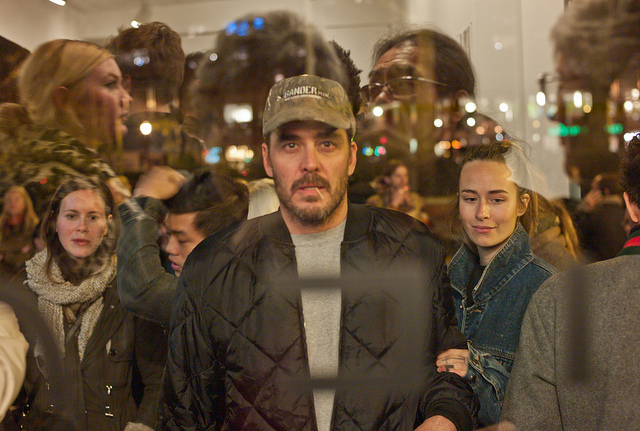
Insiders and Outsiders: Reflections on “The Art of Relevance” by Nina Simon

Flikr photo by Susan Sermoneta, "Outsiders and Insiders Reflected" - Some rights reserved.

Flikr photo by Susan Sermoneta, “Outsiders and Insiders Reflected” – Some rights reserved.

This past week I read Nina Simon’s new book, The Art of Relevance. I am a tremendous admirer of Simon and have many times used her transformation of the Santa Cruz Museum of Art & History from an object-oriented museum to a participatory museum as one example of how to make a permanently failing arts organization more broadly relevant. As I recently remarked in a keynote address:

Since Simon became executive director of her museum, attendance has tripled, membership has increased by 50 percent, and more than 4,000 local artists and community groups have collaborated on exhibitions and cultural events. The museum has gone from five years in the red to three years of significant budget growth and surpluses. Simon has led an institutional turnaround based on creative risk-taking, grassroots participation, and unexpected community partnerships. This is social enterprise at its best.

Simon uses the analogy of doors, locks, and keys as the driving metaphor for relevance, which she defines as “a key that unlocks meaning.” She elaborates on her metaphor (on p. 29):

Imagine a locked door. Behind the door is a room that holds something powerful—information, emotion, experience, value. The room is dazzling. The room is locked.

Relevance is the key to that door. Without it, you can’t experience the magic that room has to offer. With it, you can enter. The power of relevance is not how connected that room is to what you already know. The power is in the experiences the room offers … and how wonderful it feels to open the door and walk inside.

Simon is an accomplished blogger and from a structural standpoint her book feels like a series of blog posts riffing on one giant question: How can mission-driven organizations matter more to more people? It is divided into 43 small (2-5 page) sections bundled under five broad themes. It is also chock-full with vignettes—concrete examples from her personal life, from her experience at the Santa Cruz Museum of Art & History and elsewhere, and from other organizations (both cultural and not)—all aimed at demonstrating her points.

Simon also brings forward a bit of theory to support her anecdotes and propositions. She references cognitive scientists, Dan Sperber and Deirdre Wilson’s “theory of relevance”— which explains how people are successfully able to convey and receive meaning (i.e. understand one another). According to Sperber and Wilson, relevance is a function of effect and effort. The more positive cognitive effect you experience when processing new information, the more likely you are to perceive that information as relevant; at the same time, the more you have to work at understanding new information, the less likely you are to perceive that information as relevant. Simon asserts that Sperber and Wilson’s “criteria for relevance apply to both extraordinary and everyday experiences” and gives the following example to demonstrate the theory deployed in such a manner (on pp. 32-3):

Imagine you are considering going out to see a movie. You start seeking relevant information. You read a review that gets you excited about a particular film (a positive cognitive effect). You feel confident you’ll enjoy that movie. If it’s playing at convenient times at a theater nearby (low effort), you’re set. You buy a ticket.

But if the movie is not showing nearby (high effort), or the reviews you read are conflicting and full of muddled information (negative cognitive effect), you’re stuck. You don’t get the useful conclusions you seek. It takes too much effort to find the right key to the door. You stay home.

Simon has many admirers in the arts and culture sector and at least a few detractors—in large part because she is a courageous bucker of the status quo. The participatory strategies that Simon advocates for achieving the goal of “mattering more to more people” are not without controversy. Simon has taken heat from those who see the move toward “participation” as detrimental to the very purpose and nature of fine arts institutions. Simon deals with this head on in her book. In a terrific section called OUTSIDE IN on insiders, outsiders, and inside-outsiders, Simon first fesses up to her her own tendency toward “insider entitlement” when it comes not to art, but to wilderness areas. Simon admits that she tends to be turned off (revolted, even) by parks (like Yellowstone) that have worked hard to make themselves more accessible and that are now not only jammed up with people but spoiled by ice cream vendors, paved paths, and other amenities that destroy the experience for purists like Simon.

She demonstrates sympathy with “protectionist-insiders” in the arts and other realms writing:

We all have our own personal Yellowstones, the insider places we want to protect from change. Embrace your inner insider for a moment. Think of something you love just as it is. A restaurant. A fictional character. An art form. A park. Now imagine someone saying publicly, “We are going to make X relevant to new people. We’re going to make some changes and open it up to new folks. We need to be more inclusive.”

When you are on the inside, this doesn’t sound like inclusive language. It sounds threatening.  It sounds like the thing you hold dear being adulterated for public consumption.  … It looks like a shift away from what was. A dilution of services, a distortion of values. That shift means loss, not gain.

Simon then considers the situation from the perspective of those who might come if only they could see a door and if only they had a key to open it. Simon refers to these inclined outsiders as “almost comes” and suggests that organizations need to cultivate “open-hearted insiders … who are thrilled to welcome in new people.” She eventually concedes the value of making Yellowstone accessible to all, through recognition that the great national parks should be for everyone; that making parks relevant to more people helps to establish their value and justify investments in sustaining them; and that as an “elite park user” she has access to resources and “backcountry trails” where she can achieve the “natural” experience she is seeking.

When I read this section on insiders and outsiders I immediately thought of Center Stage, a professional resident theater in Baltimore that I have often referenced in talks. In the 1990s Center Stage’s artistic director, Irene Lewis, began programming many more plays by African American writers, or about the African American experience, or featuring African American actors—in an effort to become more relevant to her community, which was 67% African American. (Theretofore, like many resident theaters at the time, Center Stage tended to program white plays, featuring white actors, performed for white middle class subscribers.) In response to Lewis’s shift in programming a significant number of its subscribers walked out the door. Jon Moscone (now at the Yerba Buena Center for the Arts) tells a similar story (from his time at Cal Shakes) in the introduction to Simon’s book. He writes:

…in 2011, we presented a Shakespeare play, The Winter’s Tale, directed by and cast entirely with artists of color. Our longtime audience rebelled. It broke open a new conversation with key stakeholders and board members, who saw the shift in relevance away from them.

Simon’s Yellowstone analogy, as well as the examples at Center Stage and Cal Shakes, demonstrate that what makes an experience relevant for insiders can be at odds with what makes it relevant for outsiders. Making one’s organization more broadly relevant requires standing up for values like inclusivity even if they don’t sit well with current patrons. One of the lessons from Center Stage’s successful transformation—as well as that of the Santa Cruz Museum of Art & History—is that such transformations can take a long time. It took ten years for Center Stage to replace its lost subscribers with those who shared its new values and vision. Too many organizations wade a few steps into the water with these sorts of efforts and then retreat in haste when the initial response is a complaining patron base. This is not work for the faint of heart.

Simon’s book provides encouragement, arguments, and concrete examples for those trying to figure out how to make their organizations more broadly relevant – but it does something else that is perhaps more important. It is great fodder for a discussion on some of the most important questions that organizations can ask themselves: Who are we for and why? What is the long-term risk of catering to a declining patron base at the expense of broader relevance? And what do we lose if we set our sights on being for outsiders (or “almost comes”) and not just insiders?

A brief email exchange with the sculptor Carter Gillies (who recently wrote a guest post on intrinsic value) really brought home for me how much is at stake in the way organizations answer such questions. Carter shared with me a conceptualization of intrinsic value by the brilliant UK cultural policy wonk John Holden. Holden has lately taken to thinking of intrinsic value as having three deployments (i.e. ways in which we tend to use the concept). Taking some liberties, if I were to substitute “relevance” (or mattering) for “intrinsic value” Holden’s three deployments might look like this:

  1. A dance work matters because dance matters (you can’t express a dance idea without something called dance).
  2. A dance work matters to the extent that I (or you, or anyone else) attend dance and have an emotional or spiritual or intellectual response and think, “This matters to me – I get something out of this experience.”
  3. And a dance work matters to the extent that a group of art world experts/enthusiasts (or protectionist-insiders in Simon’s terms) say it matters.

Real-world experience and theory would suggest that this is contested terrain and that these three deployments have the potential to undermine or threaten the other. The more an arts experience matters to the masses in a personal/subjective way, the less it (often) matters to elites. At the same time, the more we emphasize that dance must matter to as many people as possible (in a personal subjective way) the more we may undermine the idea that dance (as a way of expressing an idea) matters even when a particular dance work matters to very few people, or none at all.

***

As I finished Nina’s book I was left with three thoughts:

First, as inspired as I was by the book the research scientist in me was yearning for some empirical studies (i.e. experiments) as well as some more robust theorizing. While Sperber and Wilson’s relevance theory seems to be a good starting point for understanding how one makes the choice to buy a ticket to the symphony or not, it may be limited in its capacity to explain relevance inside the concert hall, for instance. Aesthetic experiences don’t seem to be entirely akin to straight two-way communication. Anecdotally speaking, there are works of art (both visual and performative) that were quite off-putting to me at first (i.e. had a negative cognitive effect) and that required quite a bit of effort for me to grasp them, which ended up being incredibly rewarding (seeing Elevator Repair Service’s Gatz at the Walker Art Center in 2006 comes to mind). Moreover, the arts experience is constituted by more than the connection an individual may have with the art work itself. Simon addresses this in her book but Sperber and Wilson’s theory seems a bit overextended if used to explain how various elements (e.g. place, people, art, amenities, ancillary activities, past cultural experiences, trust in institutions, expectations) may combine to yield an experience that is perceived as relevant or not. For instance, perhaps being with people like you trumps an artwork you have to work hard to understand?

Second, and related to point one, considering that arts organizations are, in the main, in the business of creating aesthetic experiences one could argue that they should be much more well-versed in the nature of the aesthetic experience and the process of aesthetic development. All arts institutions (especially those with an educational mandate as 501c3s) need to be, as I believe Simon is, infinitely curious, willing, and eager to experiment with various ways of helping people connect with the art. As Simon says in her book, getting people to locate the door and walk through it is not enough—once they get to the other side the experience needs to be meaningful otherwise they won’t return. I would argue that, in particular, arts organizations should become experts in helping people cultivate an aesthetic sensibility–that is, helping them to expand and deepen their capacities to enjoy various types of aesthetic experiences.

Third, reading Simon’s Yellowstone analogy I was struck by Simon’s admission that she was able to let go of her “insider’s entitlement” with regard to Yellowstone (in part) because, as she put it, “as an elite park user, I have plenty of resources at my disposal, from maps to rangers to well-maintained backcountry trails.”  Yellowstone is able to cater to both casual park users looking for ice cream vendors and paved paths and benches and signs, as well as elite users looking to get off the beaten path and tramp around on the areas that newcomers would be unprepared to explore. If you extend the Yellowstone analogy to the arts it suggests that arts organizations might need to have different brands, experiences, and resources for insiders and outsiders; or that cultural institutions might need to specialize in one of these. Indeed, it’s an interesting question (from an ethical, aesthetic, and economic standpoint) whether diversification or specialization would be a better approach?

Simon’s book is a quick read and a must-read for mission-based organizations (most especially cultural organizations) that believe they could and should matter more to more people.

[contextly_auto_sidebar]

When communities become markets, citizens become consumers, and culture becomes an exploitable product

Photo by Duncan C, Flickr

Photo Chapman’s Homer, Christchurch by Duncan C, published on Flickr, Creative Commons License.***

A couple weeks back I had the privilege to give a talk in Christchurch, NZ at an event called The Big Conversation—hosted by Creative New Zealand, the major arts funding body for the country. The talk, Transformation or Bust: When Hustling Ticket Sales and Contributions is Just Not Cutting It Anymore (click on the link and it will take you to a transcript) was intended to address the general conference theme, Embracing Arts / Embracing Audiences. It was assembled on top of four cornerstone ideas:

  • Michael Sandel’s argument that we have shifted from having a market economy to becoming a market society in which, as he puts it, market relations and market incentives and market values come to dominate all aspects of life.
  • The notion that, paradoxically, the arts are facing a crisis of legitimacy (says John Holden) at the very moment when we have so much to potentially contribute as a remedy to the erosion of social cohesion that is resulting from global migration, economic globalization, a culture of autonomy, and the Internet (see the David Brooks op-ed, How Covenants Make Us).
  • The four futures for the social sectors predicted by NYU professor Paul Light in the wake of the 2008 economic crisis: (1) the unlikely scenario that nonprofits would be rescued by significant increases in contributions; (2) the more probable scenario that all nonprofits would suffer; (3) the most likely scenario that the largest, most visible, and best connected nonprofits would thrive while others would fold; and (4) the hopeful scenario that the sector would undergo positive transformation that would leave it stronger and more impactful, likely only if pursued deliberately and collectively by nonprofits and their stakeholders.
  • And a concept I encountered on Doug Borwick’s excellent blog: transformative engagement, by which Doug means engagement with the community that changes the way an organization thinks and what it does.

Building on these, I argue that in the US arts and culture sector we have for too long ignored or denied the costs of so-called progress in the arts–meaning, for instance, the costs of professionalization, growth, and the adoption of orthodox marketing practices including so-called customer relationship management and I suggest five ways that arts organizations may need to adapt their philosophies and practices in relationship to their communities if their goal is deeper, more meaningful engagement.

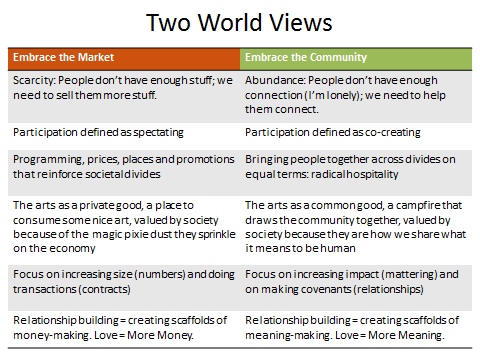
Ultimately, I pull the various threads of the talk together in a framework that seeks to conceptualize the difference between embracing the community and embracing the market. In setting this up, I build on Internet guru Seth Godin’s notion of, essentially, competing worldviews that inform the way companies approach marketing. In an interview with Krista Tippett on her NPR show, On Being, Godin remarks:

There’s one view of the world called the Wal-Mart view that says that what all people want is as much stuff as possible for as cheap a price as possible. … And that’s a world based on scarcity. I don’t have enough stuff. How do I get more stuff?… There’s a different view, which is the view based on abundance. [And] in an abundance economy the things we don’t have enough of are connection …and time.

Here’s the PPT slide of the framework I created that synthesizes the various ideas in my New Zealand talk:

worldviews

In many ways, this talk explores an idea that I first began to ponder when I wrote a blog post for the Irvine Foundation in response to its question: Is there an issue in the arts field more urgent than engagement? If so, what is it?

In my post, I answered the question in the affirmative and then offered the following as a more urgent issue:

While lack of meaningful engagement in the arts is indeed troubling, I would offer that a larger problem is that the nonprofit, professional arts have become, by-and-large, as commodified, homogeneous, transactional, and subject to market forces as every other aspect of American society. From where I sit, the most important issue in the arts field these days may be that the different value system that art represents no longer seems to be widely recognized or upheld — by society-at-large, or even within the arts field itself.

For the New Zealand talk I tried to explore the ramifications of the loss of this “different value system” (Jeanette Winterson) and how it relates to the issue of engagement.

Gap Filler: On Sustaining the Social Cohesion that Emerges out of Disasters

Because the conference took place in Christchurch (where two devastating earthquakes struck in 2010 and 2011) I reflected at the top of the talk on the solidarity and social cohesion that often arise in response to natural disasters. In his new book, Tribe,  Sebastian Junger introduces the seminal research of a man named Charles Fritz to explain why this is. Fritz asserts “that disasters thrust people into a more ancient, organic way of relating.” … “As people come together to face a threat,” Fritz argues, “class differences are temporarily erased, income disparities become irrelevant, race is overlooked, and individuals are assessed simply by what they are willing to do for the group” (Junger 2016, 53-54).

Yet, as Junger reports, all too often, these effects are temporary. One of the best parts of the conference in New Zealand was being introduced to some amazing organizations and projects here—including Gap Filler, an intiative that began with a few people asking how they could sustain the sense of fellowship, volunteerism, and community that arose out of the first earthquake. One of the co-founders of Gap Filler, Dr. Ryan Reynolds, gave a truly inspiring presentation at the conference. It struck me listening to his story that Gap Filler could be the poster child for Creative Placemaking.

gap filler

Gap Filler’s first ten-day project was launched in November 2010. It began because Reynolds and others wanted somehow to fill the gaps in the physical and metaphysical landscape of Christchurch left by the loss of hundreds of buildings, including dozens of bars, clubs, and restaurants. They had the idea to gather a group of volunteers together to transform the empty lot where a popular restaurant, South of the Border, once stood into a temporary space for citizens to once again come together and eat, drink and socialize. Over the course of ten days—and driven largely by citizens who showed up on their own initiative to contribute to and enjoy the temporary space—the site came to host a temporary garden café, live music, poetry readings, an outdoor cinema, and more. The success of this first project led to further initiatives including art installations, concerts, workshop spaces and eventually semi-permanent structures. You can read more about Gap Filler’s projects here. (And here is an article, written in 2013, about the revitalizing influence of the earthquake on the Christchurch arts scene.)

Gap Filler was only one of several remarkable organizations/projects I heard about at The Big Conversation.

In any event, if you read the talk, I hope you find it worthwhile and will share any responses to it on Jumper.

And speaking of things worth reading …

ninas book

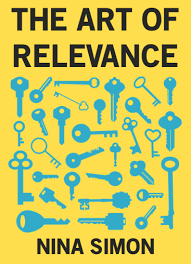
Nina Simon has a new book out! Those who have read Jumper for a while, or have heard me speak at conferences, know that the topic of matteringness or relevance is one I have been circling and diving into with some regularity for the past decade—and I am by no means alone in this. One of the greatest minds on this topic is Nina Simon at the Santa Cruz Museum of Art & History and she has a new book out—The Art of Relevance. I won’t be united with my copy until I’m back in the US next month, at which point I look forward to reading it and writing about it on Jumper. In the meantime, I strongly encourage anyone interested in the topics of relevance, engagement, or participation in the arts to buy it and read it, as well.

***This photo is of the stunning sculpture by Michael Parekowhai, On First Looking into Chapman’s Homer,  and it was taken at one of the many sites where the work was situated in Christchurch following its presentation at the 54th Venice Biennale. It is currently housed at the Christchurch Art Gallery and is considered to be a symbol of the resilience of the people of Christchurch following the earthquakes.

The Value of Intrinsic Value in the Arts: A Guest Post by Carter Gillies

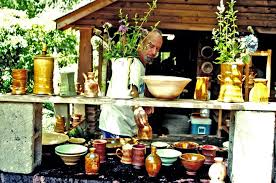
carter gilliesIn recent years an artist named Carter Gillies has written to me with some regularity in response to Jumper posts. I have always valued his letters, which are invariably insightful, provocative, warm, and encouraging. Recently, Carter dropped me a line and mentioned that he had come across a Facebook post by Clay Lord soliciting a better framing of the intrinsic/instrumental distinction.

Carter then shared that he had been rather astonished by the manner in which the word ‘intrinsic’ was being used by arts types posting comments as it was quite different from the ways that philosophers and psychologists have tended to use it. He wrote, “It was as if an entirely new word had replaced the one I was familiar with.”

He elaborated.

Inspired by his letter, I suggested that if he hadn’t already done so he should write a reflection on the topic and I said that if he did so I’d love to post it on Jumper. He agreed. I won’t preface what Carter has written beyond saying that I believe it is truly worthwhile for those occupied with understanding and articulating the value of the arts as it seems that there is something fundamental to this endeavor that many of us have either forgotten or abandoned for political expediency.

(BTW, if you are so occupied you may also want to check out the recently published report, Understanding the Value of Arts and Culture.)

Carter has a blog of his own, which you can check out here. I asked Carter for a bio that I could share to introduce him along with his post. Here’s what he sent me:

At some point during philosophy graduate studies Carter found himself with a lump of clay and a potters wheel and immediately knew he was intended for a life in the arts. It also turns out that the things most worth thinking clearly about are the ones we care about, and so he spends his days making pots and asking questions about the nature of art, beauty, and their place in the world.

This is a long post; but, hey, Jumper readers are used to that. 😉

So grab a coffee and enjoy!

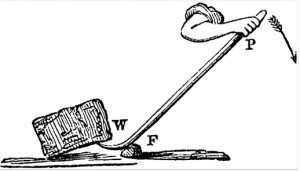
Engraving from Mechanic’s Magazine (cover of bound Volume II, Knight & Lacey, London, 1824). Courtesy of the Annenberg Rare Book & Manuscript Library, University of Pennsylvania, Philadelphia, USA. https://commons.wikimedia.org/wiki/File%3AArchimedes_lever.png

I sometimes look at the arts landscape and feel we have gotten our wires crossed. Its not always easy to define, but for me, at least, there is a pervading sense we are making correctable mistakes.

Difficult questions can often be solved by either moving up or down a level. The problem, it sometimes turns out, is in the manner we are addressing things. We find a new framework for measuring or by setting different parameters. Sometimes, also, it can be in a refining of our terms, scrapping some and replacing others. Sometimes its knowing the right questions to ask. Even a tentative answer to a good question is better than a great answer to a bad question. It just feels as though in the arts we are occasionally asking the wrong questions.

An apparent issue facing us is how we understand values. I’m not just talking about our own values as opposed to other people’s, but the role and function of values and where values actually fit in a person’s life. We often seem to talk about values without knowing what they are there for.

One problem I ran across recently was our use of the word ‘intrinsic’. This term has a long and storied history in the fields of philosophy and psychology, and yet when used in the arts we are often left dissatisfied.

I have seen too many references to ‘intrinsic benefits’ and ‘intrinsic impact’ not to be aware of at least one wrong turn we have taken. The distinction we use this term for in the arts is, in this instance, the difference between things that are good for us personally and wider social benefits. We take ‘intrinsic impact’ to refer to our own individual benefits, and ‘instrumental/extrinsic’ to refer to external social goods and the like.

The problem is that ‘benefit’ and ‘impact’ are already the language of instrumentality. They denote an effect, what something can be good for, the means to ends, utility, and this is precisely what is meant by instrumental. When we use the word this way we are not making a contrast with instrumentality as much as we are defining the way in which a thing is instrumental.

The way this term gets used in philosophy and psychology is to make plain the difference between things that are justified by something  outside themselves and things that are justified in themselves. It is specifically the difference between means and ends. A means is whatever thing benefits or impacts some other thing. The value is derived from being a means. It serves some other end. The end is not valuable in that way. It is that from which the means takes its value. It represents the value itself.

Think of it like this: We are measuring something and we wonder what measurement is justified. We take out a tape measure, hold it in place, and see that this here thing is two feet four inches. The operation of measuring has been successfully carried out.

But what exactly have we done? This is an important question. There are things in the world that we measure, and this becomes an empirical issue, but there is also the measure itself, the thing from which we derive measurements. That thing exists in the world too, but the role it has is different. It’s not thing being measured but that which does the measuring.

By Pink Sherbet Photography from USA [CC BY 2.0 (http://creativecommons.org/licenses/by/2.0)], via Wikimedia Common

‘Two feet four inches’ is how something else measures up, is justified, by our use of the measure. We question how things will be measured, but we do not have the same uncertainty about the measure itself. That stands in a different relation to what we do. It is the ground we assume when we evaluate things in the world. It’s not a question, even an empirical question, but a definition. It’s the standard itself. It is the logic that connects things.

That may take some time to process, but it absolutely relates to the distinction between intrinsic and extrinsic values. And this is crucial for us.

Consider: The world is full of things with instrumental/extrinsic value to us. There are plenty of means to our ends. But where does the value of our ends come from? If a means is valuable because it serves that end, where does the value of ends come from?

Ends function for us in much the same way as our yardsticks and tape measures do: The ends are that which measures the value of means. They are a logical aspect of the way we confront the world rather than an empirical question to be decided. Ends function for us by being accepted as intrinsic values, as things not needing to be justified. They are part of the definition. This is simply how we value the world. We deem these things worth holding onto. Its the scaffolding we hold in place to make sense of things.

And it turns out there are many such values. We put them in our important documents. “Life, liberty, and the pursuit of happiness” are not things we look to justify in some other way: They are the grounds upon which our actions are measured. Not every value is a means, and most others come to a place that requires no further justification: This is simply what we do. It describes a way of acting, a culture.

When we determine that something is beneficial for something else we have solved an empirical connection: “Yes, the arts are good for the economy!”. What we have not done, the thing we don’t always question, is what form of value the economy takes. The relationship we have proposed is that the arts are a means, and we are using the economy and its like to justify the arts.

But if we are saying the arts are important “because of their benefit to the economy” are we really saying that’s why the arts are important?

I don’t want to suggest that the arts are not worthy in this role, as the servant to other established goods. I simply question whether the arts are only that. We have given the arts as a means, but can we claim them also as an end? The role of servant is respectworthy, undoubtedly, but I know few in the arts who value the arts merely as the means to some further end. Additionally, perhaps yes, but not only on those terms.

There is a confusion here, and I’m not sure it is only by omission.

For most people in the arts the value of the arts does not need to be explained. The arts themselves are a measure of value. The arts are worthy in their own right. The arts have intrinsic value. They do not need to be justified.

But then, how is it we spend so much time talking about the instrumentality of the arts? Well, because not everyone gets it. Not every person values the arts as a centerpiece of how they think and behave in the world.

For many people the arts are not only incomprehensible but are entirely without value. So when we talk to these people we are talking to folks who do not yet have a meaningful role for the arts. It holds no significant place in how they look at the world. Its not a part of their scaffolding. It’s handing them a tape measure when they have no cultural practice of needing things measured.

How do we talk to them, even? How do we get them to see value in the arts? We know it as part of the foundation of our own values. How can we communicate that to others?

This is where advocacy steps in. And unfortunately these core values are not transferable in an immediate sense, like putting on a new coat. We are discussing the foundation of a person’s world view, so its not as simple as getting them to switch between metric and the US version. Its not a difference between two standards that do exactly the same thing. Its not just a matter of translating from one set of units to another. Rather, it’s the whole idea of measuring itself. And there is no simple translation for that. Core values are an integral part of who people are.

So how do we talk to people who are fundamentally different from us? Well, our intrinsic values are hidden from them, and theirs from us, but there are empirical connections between things in the world. And the arts have done a good job identifying where some of the overlap may exist.

The way we mostly talk to these people is we have found that our ends, the things we value in themselves, can be the means to their own ends. They value the economy? Well, the arts are good for the economy! They think that cognitive development is important? Well, the arts are good for cognitive development! We make our own ends the means to their ends.

But this never teaches them why we value the arts. It is not a conversation that discusses the arts the way we feel about them. Its not a picture of the intrinsic value of the arts, because in talking about instrumentality we always make the arts subservient. That’s never only what they are to us. Sometimes we just have to make the case for a lesser value as the expedient means to secure funding or policy decisions. It’s better than not making any sense at all.

The question, then, is whether discussing the arts this way is a path to truly persuading folks to our point of view, to appreciating the arts in themselves.

Why is this an important question? Well, we are trying to convert folks to our cause, that the arts are not extravagant, and it’s a legitimate question whether this can be done by the rational instrumental means we are offering.

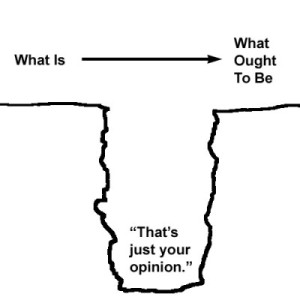
At some point in the 18th century Scottish philosopher David Hume rather conclusively argued that it cannot. You cannot simply derive an ought (intrinsic value) from what is (facts). You don’t become aware of the intrinsic value of the arts by pointing to the benefits they have. Things that measure value (oughts) have a different role from the things that are measured (what is). One is the foundation, the other what gets built from it. One is the definition, the other how that definition applies. Its a categorical distinction. And persuasion stumbles over even the best placed facts.

is-ought

In crafting the Ripple Effect report the folks at ArtsWave came to approximately this conclusion. As Margy Waller stated in a great guest post on Createquity, don’t try to change minds, change perspective:

Instead of reviving an old debate, we sought a new way to start the conversation – based on something we can all be for, instead of something we’re defending against an attack. And importantly, we aren’t trying to change people’s minds, but present the arts in a way that changes perspective……

Members of the public typically have positive feelings toward the arts, some quite strong. But how they think about the arts is shaped by a number of common default patterns that ultimately obscure a sense of shared responsibility in this area.

In other words, the arts may make folks feel good, but they are not thereby recognized as a good in themselves. The common default patterns are simply the mental habits that devalue the arts or cast them as at best merely means to other ends. Defending the arts with facts about the arts is not actually going to change people’s minds. Rather, what is needed is a new perspective in which the value of the arts are already seen as vital.

Arts Midwest published a report last year that also acknowledged the issue:

The public will building model posits that long-term change is accomplished by connecting an issue with the deeply held values of the audiences and stakeholders a movement seeks to engage. The theory is rooted in the understanding that people generally make decisions about what to think and do based on their core values and their assumptions about how the world works. They accept facts and data that support their existing worldview and values, and they tend to reject facts and data that stand in contradiction. To create—and sustain—public will for any issue, a movement needs to find the optimal values alignment that connects their audiences to the issue.

A few years ago there was an article in Mother Jones that explained “the science of why we don’t believe science.” The whole article is brilliant and insightful and well worth a read. The conclusion is this:

You can follow the logic to its conclusion: Conservatives are more likely to embrace climate science if it comes to them via a business or religious leader, who can set the issue in the context of different values than those from which environmentalists or scientists often argue. Doing so is, effectively, to signal a détente in what Kahan has called a “culture war of fact.” In other words, paradoxically, you don’t lead with the facts in order to convince. You lead with the values—so as to give the facts a fighting chance.

It is simply the case that the arts have been preoccupied in leading with the facts. As the ArtsWave and Arts Midwest reports demonstrate this is a gambit that plays for very low stakes. Its not a strategy that even remotely stands a chance of scoring on the level of fundamental values. Facts are disputable, despite the conviction with which we ourselves hold onto them. We find certain things obvious, and the reason we do is that the facts we hold dear always reflect our values. We ignore facts that don’t line up or contradict our core intrinsic values. Blame the human temptation for motivated reasoning. Instrumentality only gets us so far. It’s not the measure of value itself, but a fact aligning with some other value.

Studies the arts have conducted have barely begun describing the surface phenomena, and this is not yet an explanation. Yes the patient is sick, but we do not know the disease. We are confused about intrinsic and instrumental values so we blur the lines and fail to distinguish their radical difference. This is a category mistake, and not knowing this difference has too often blinded us.

I have heard it expressed that data and arguments in favor of the arts are like arrows we cast at the problems facing us: We hope some will stick. When the arrows fail we assume we just need better arrows, more armor piercing facts. The problem, unfortunately, isn’t the arrows but mistaking the target for a thing that can be reached in this way…..

Perhaps this is a better way of looking at it: In the third century BCE Archimedes said, “Give me a lever long enough and a fulcrum on which to place it and I shall move the world.” Facts are like levers, but they do not function to move things unless resting on a congenial foundation.

fulcrum

In the arts we have thrown facts together, constructing the longest possible lever, but have seemingly forgotten we also need somewhere to place it. Those facts need to rest on values that can act as a fulcrum. The facts without value, or the wrong value, will simply have no leverage. They will fail to motivate. Something needs to hold fast. A lever hung on a speck of dust won’t work. Facts without a decent fulcrum are not even a lever, just a wobbly stick…..

The arts have mustered plenty of cogent facts as to why the arts are amazing, and yet we spend too much time scratching our heads wondering why our efforts fall on deaf ears. What’s at stake for us is not facts about the arts but the value of the arts. The sooner we embrace this the sooner we avoid playing losing games and spinning our wheels without significant traction.

To turn the tables on what Margy suggested, perhaps it is WE who need a change in perspective. The confusion we are mired in is thinking that our difficulty is practical when in fact the impediment is structural. We need to better understand this to make appreciable headway. We can celebrate both the good art does and the good art is, a structural difference, the lever and the fulcrum. That is the value of intrinsic value for the arts.

***

Archimedes’ Lever: Engraving from Mechanic’s Magazine (cover of bound Volume II, Knight & Lacey, London, 1824). Courtesy of the Annenberg Rare Book & Manuscript Library, University of Pennsylvania, Philadelphia, USA. https://commons.wikimedia.org/wiki/File%3AArchimedes_lever.png

Tape Measure Photo Attribution: By Pink Sherbet Photography from USA [CC BY 2.0 (http://creativecommons.org/licenses/by/2.0)], via Wikimedia Commons

David Humes Is-Ought Attribution: From the Website John Ponders: https://johnponders.com/2012/11/15/humes-guillotine/

[contextly_auto_sidebar]

Irvine asks: Is there an issue in the arts field more urgent than engagement? My answer: Yes.

A couple weeks back the Irvine Foundation launched an online Q&A series, Are We Doing Enough?—aimed at “exploring tough questions about engagement practices and programming.” I was delighted and honored to be one of a small group of “outsiders” asked to provide some reflections in response to one of the Qs. The first two issues of the series (Part 1 and Part 2) featured a group of Irvine’s current grantees, as well as Irvine arts program director Josephine Ramirez, addressing such questions as: Should artists be responsible for creating art for the purpose of engaging communities? What purpose do “engagement events” serve if people don’t start showing up at the museum? and Are culturally and racially-specific organizations negatively affected when mainstream arts organizations offer diverse programming?

Clay Lord, Vu Lee, Karen Mack, Teresa Eyring and I were asked to address the question: Is there an issue in the arts field that is more urgent than engagement? You can read how we responded here. I want to use this post to elaborate on my response, the conclusion of which was this:

While lack of meaningful engagement in the arts is indeed troubling, I would offer that a larger problem is that the nonprofit, professional arts have become, by-and-large, as commodified, homogeneous, transactional, and subject to market forces as every other aspect of American society. From where I sit, the most important issue in the arts field these days may be that the different value system that art represents no longer seems to be widely recognized or upheld — by society-at-large, or even within the arts field itself.

As I’ve mentioned from time-to-time on Jumper, the topic of my dissertation is the evolving relationship between the commercial and nonprofit theater in America—how it has changed over time, why, and with what consequence. Some of the deeper questions motivating my research have been:

  1. What is nonprofit professional theater for?
  2. Are there clear differences between the way the theater that exists for the primary goal of making money relates to its employees, customers and market and the way the theater that exists to improve society through art relates to its front-line missionaries (i.e., staff and volunteers), beneficiaries (i.e., artists and audiences) and the community-at-large?
  3. If not, or if these have been eroding over time, is this cause for concern? Can and should we stem the tide? And if so, how?

In 2011 I helped to plan and document a meeting of nonprofit and commercial theater producers, who were gathered to discuss partnerships between them. Candidly, the room seemed rather stumped for an answer to a version of that first question. A few ideas were tossed out but nothing stuck–in large part because, as more than a few participants observed, nonprofits and commercial producers “are more and more the same in practice.” As I wrote in the report (available here in paperback or free e-file) anaylyzing the meeting:

Many noted that it is no longer evident what value nonrofits bring to the table, distinct from commercial producers. Some suggested that the interests of nonprofit and commercial producers are now aligned to the point where the shape of [their] intersection is less like a crossroads and more like two lanes merging on a highway.

And why is that?

Well, lots of reasons. But part of the issue seems to be that the 20th century witnessed not just the professionalization of the community arts but their corporatization. Once labors of love by amateurs, arts groups across the US incorporated as not-for-profit corporations but then put corporate leaders on their boards, hired staff with more corporate management skills, adopted corporate marketing techniques, and looked to major corporations like hospitals and universities for models on how to raise money and advance their institutions. Savvier arts nonprofits also opened for-profit subsdiaries, formed partnerships with commercial enterprises, or became real estate investors or developers … basically, they pursued any and all means of exploiting their assets. And, ironically but not surprisingly, much of this sort of activity was actively encouraged by private philanthropists and government agencies.

What’s been the cost?

In her book Three Guineas, Virginia Woolf writes:

If people are highly successful in their professions they lose their senses. Sight goes. They have no time to look at pictures. Sound goes. They have no time to listen to music. Speech goes. They have no time for conversation. They lose their sense of proportion—the relations between one thing and another. Humanity goes.

I don’t know about you, but I find this statement to be disturbingly resonant.

Here we are in the 21st century and it strikes me that the nonprofit arts have become increasingly dehumanized–which is ironic since arguably one of the primary benefits of the arts is that they stimulate the senses, awaken us to beauty, fill us with awe, connect us to others, and inspire us to be better humans. But as David Brooks seemed to be arguing in his January 15 column When Beauty Strikes Back (for which he took quite a bit of flack), the arts have forgotten or rejected this role and society is poorer for it. He writes:

These days we all like beautiful things. Everybody approves of art. But the culture does not attach as much emotional, intellectual or spiritual weight to beauty. We live, as Leon Wieseltier wrote in an essay for The Times Book Review, in a post-humanist moment. That which can be measured with data is valorized. Economists are experts on happiness. The world is understood primarily as the product of impersonal forces; the nonmaterial dimension of life explained by the material ones. …

The shift to post-humanism has left the world beauty-poor and meaning-deprived. It’s not so much that we need more artists and bigger audiences, though that would be nice.  It’s that we accidentally abandoned a worldview that showed how art can be used to cultivate the fullest inner life.

Perhaps the arts are losing a battle over the minds and souls of society in large part because we don’t seem to recognize that we have been fighting for the wrong side–don’t recognize it because, as Woolf says, we have lost our senses. We have been swept up in econometrics and CRM theory and funder logic models and we have lost our ability to see what is in front of us and to be distrubed. It now seems normal to us that some heads of nonprofit resident theater companies, for instance, earn hundreds of thousands of dollars a year while even great actors in America are leaving the industry because they just can’t bear living on the cliff’s edge of poverty year-upon-year–a circumstance that should be appalling to anyone running a nonprofit theater, if one recalls that a fundamental purpose for nonprofit professional resident theaters when they were envisioned in the mid-twentieth century was to provide a stable, living wage to actors.

That’s losing the relations between one thing and another … that’s losing your humanity.

***

Speaking of poverty, if you didn’t see the press a few days back, the Irvine Foundation made the major announcement that it will “begin work on a new set of grantmaking goals focused on expanding economic and political opportunity for families and young adults who are working but struggling with poverty.”

President Don Howard wrote in a blog post:

These are mutually reinforcing goals. If all Californians are to have real economic opportunity, their voices must be heard and their interests counted. Responsive and effective government shapes the policies that allow people the chance to earn a wage that can enable a family to live in a safe, healthy community, send their kids to school, and realize their potential. Conversely, if all Californians are to be heard, they cannot teeter on the precipice of poverty, lacking the time and the conviction to meaningfully participate.

This is Irvine’s evolving focus, and as the words suggest, the changes will occur over time. As many of you know, we are deeply engaged in important and successful grantmaking. We remain firmly committed to our current grants and initiatives, many of which are in the middle of multiyear plans driving toward specific impacts. We will see all of these current grants and initiatives through to their planned conclusions. And some will evolve to be part of our future work.

As I read the last paragraph I thought … Hmmm, I wonder how the arts program will fare in this evolution? Will it be one of the programs phased out?

What’s the case for the role of professional arts groups in expanding political or economic opportunity for families living in poverty? Venezuela created El Sistema. What have we created of late that comes close to having that scale of impact on the lives of the most impoverished? Has there been anything since the Works Progress Administration (a New Deal initiative under FDR), which gave us the remarkable Federal Theatre Project and related projects in other disciplines? The Federal Theatre Project, if you don’t know it, was a work-relief program that made significant funds available to cities and towns across the US to hire out-of-work artists. It resulted in a flowering of hundreds of new ad hoc companies that collectively brought vital, relevant theater—including The Living Newspaper, a form of theater aimed at presenting reflections on current social events to popular audiences—and other forms of art to millions of people who had never had such experiences. It was a short-term relief program intended to do two things: alleviate artist unemployment and awaken and inspire America as it struggled out of a Great Depression.

And it exemplified the extraordinary role art can play—when it is for the advancement of the many, rather than the few—in helping a nation that is struggling to find a way forward.


*The photo is of James Turrell’s Roden Crater and is mentioned in my post for the Irvine Foundation. (Here’s the link again!)

[contextly_auto_sidebar]

Follow Us on FacebookFollow Us on TwitterFollow Us on RSS

@DERagsdale

Tweets by @DERagsdale

Recent Comments

  • Andrew Taylor on On a Strategy of Indeterminacy: Or, the Value of Creating Pathways to the Unforeseen: “Love this line of thinking, Diane! Although I also wonder about the many small, safe-to-fail ways you could explore randomness…” Feb 21, 22:54
  • Rick Heath on On a Strategy of Indeterminacy: Or, the Value of Creating Pathways to the Unforeseen: “Thanks Dianne Compelled and confused! (Not for the first time, and not entirely because of your words, but somewhat because…” Feb 5, 07:20
  • Diane Ragsdale on On a Strategy of Indeterminacy: Or, the Value of Creating Pathways to the Unforeseen: “Hi Ella! Thanks so much for taking the time to read and engage with the post. Thank you for reminding…” Feb 2, 18:19
  • Diane Ragsdale on On a Strategy of Indeterminacy: Or, the Value of Creating Pathways to the Unforeseen: “Caroline! Thanks so much for reading and sharing reflections. I am compelled by your idea to have an entire college…” Feb 2, 18:18
  • Diane Ragsdale on On a Strategy of Indeterminacy: Or, the Value of Creating Pathways to the Unforeseen: “Margaret, Thank you for taking the time to read and comment and for the warm wishes for my recovery. I…” Feb 2, 16:57

Archives

Subscribe to Jumper by Email

Enter your email address:

A Few Things I’ve Written

"Surviving the Culture Change", "The Excellence Barrier", "Holding Up the Arts: Can We Sustain What We've Creatived? Should We?" and "Living in the Struggle: Our Long Tug of War in the Arts" are a few keynote addresses I've given in the US and abroad on the larger changes in the cultural environment and ways arts organizations may need to adapt in order to survive and thrive in the coming years.

If you want a quicker read, then you may want to skip the speeches and opt for the article, "Recreating Fine Arts Institutions," which was published in the November 2009 Stanford Social Innovation Review.

Here is a recent essay commissioned by the Royal Society for the Encouragement of the Arts for the 2011 State of the Arts Conference in London, "Rethinking Cultural Philanthropy".

In 2012 I documented a meeting among commercial theater producers and nonprofit theater directors to discuss partnerships between the two sectors in the development of new theatrical work, which is published by HowlRound. You can get a copy of this report, "In the Intersection," on the HowlRound Website. Finally, last year I also had essays published in Doug Borwick's book, Building Communities Not Audiences and Theatre Bay Area's book (edited by Clay Lord), Counting New Beans.

Categories

  • artistic home
  • artistic processes and practices
  • Artistic Standards & Quality
  • arts and the pandemic
  • arts conferences
  • Arts Education
  • arts facilities
  • Asymmetric power dynamics
  • beauty
  • book recommendations
  • community
  • creative leadership
  • cultural leadership
  • Democratization of Culture
  • Economic Impact Studies
  • engagement
  • entrepreneurship
  • ethics
  • Funder Jargon
  • Innovation
  • institutionalism
  • interdependence
  • intrinsic value
  • leadership
  • nonprofit model
  • nonprofits and information disclosure
  • philanthropy
  • Pricing
  • purpose
  • subsidization of the arts
  • succession planning
  • Supply/Demand
  • sustainability
  • Uncategorized
  • Undercapitalization
Return to top of page

an ArtsJournal blog

This blog published under a Creative Commons license