
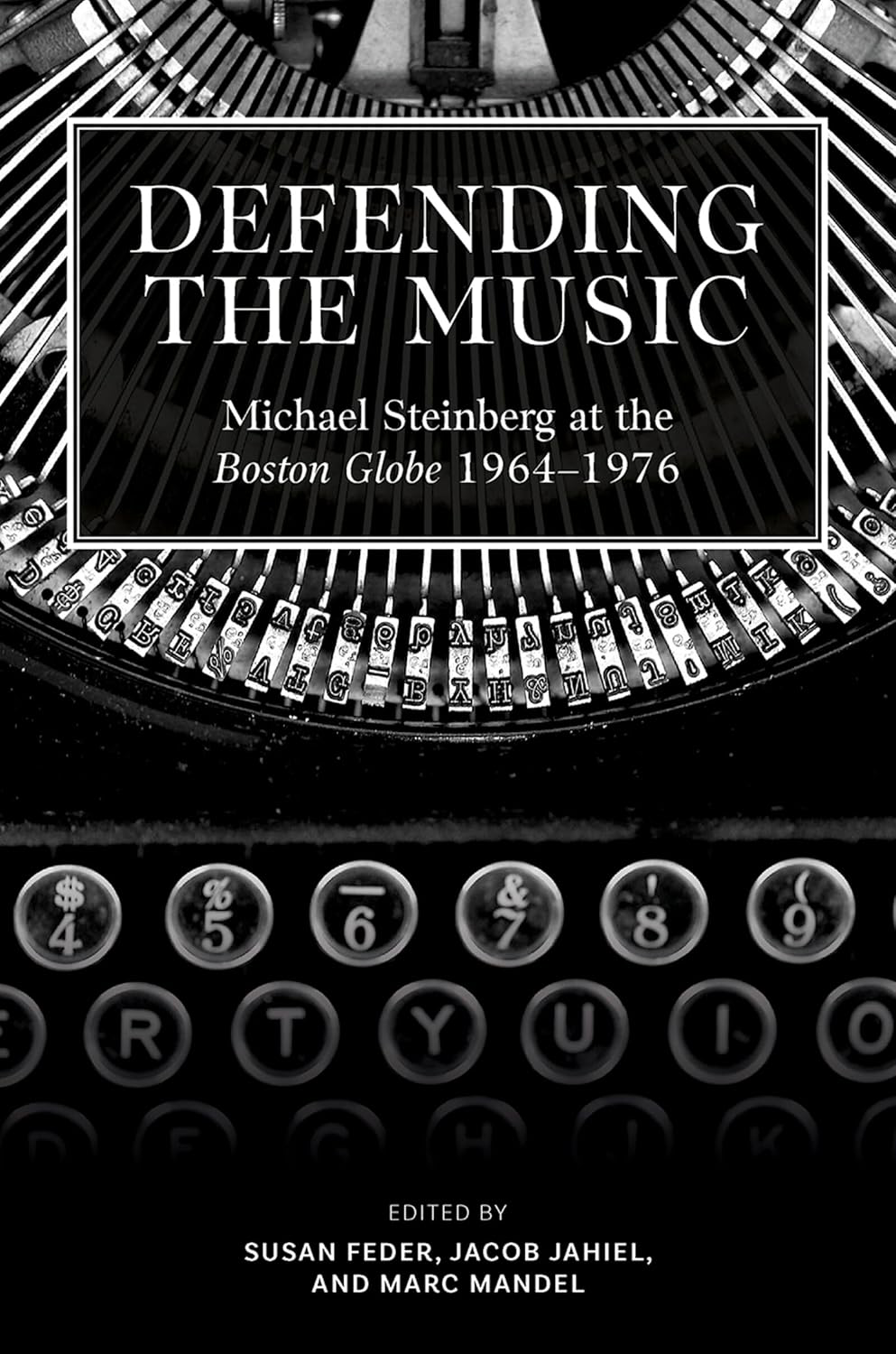
My review of “Defending Music: Michael Steinberg at the ‘Boston Globe’ — 1964-1976” (Oxford University Press) is today published online by “The American Scholar.” The kicker, at the end, reads: “Michael Steinberg was never intended to make a career writing concert reviews. He was ever courageously drawn to what would do the most good.” You can read the whole thing here. Excerpts follow:
When I arrived at the New York Times as a young music critic in 1976, “objectivity” had become a fetish. We were not to consort with musicians and administrators. We were never to perform. At the opposite extreme stood Michael Steinberg of The Boston Globe — a practitioner of maximum engagement. Steinberg’s range of local acquaintances was more catholic than [Virgil] Thomson’s. So was his knowledge and not just of music. His prose was impassioned. His decrees, take them or leave them, were fundamentally informed. Oblivious of reputation, he abjured the tug of mainstream taste. . . .
The new Steinberg anthology, Defending the Music, collects some 500 pages of Boston Globe reviews, interviews, and essays. Scrutinizing a city’s cultural life, Steinberg is a terrific companion. . . .
Steinberg had barely begun his first full season when on September 26, 1964, he threw down a gauntlet: “The 84th season of Boston Symphony concerts began greyly Friday afternoon, with Erich Leinsdorf conducting. The program consisted of the Brahms Academic Festival Overture, the Symphony No. 1 by Shostakovich, and Beethoven’s Pastoral Symphony.” Of the Shostakovich, he wrote “When it is serious, it is merely gross” – and continued, referencing the Beethoven: “Neither it nor the Brahms Overture was at all well performed, and for the reasons that often hamper Leinsdorf in the German classics. In the face of the expressive demands of certain kinds of music he becomes extremely inhibited – and he seems to fight off the inhibitions with an irresistible desire to interfere with the natural flow of things.” Citing half a dozen specific passages in the Pastoral Symphony, including an even more specific measure number, Steinberg diagnosed both “technical” and “musical” carelessness. The previous February, in his third Globe review, Steinberg had skewered Leinsdorf’s predecessor, Charles Munch, making a guest appearance in his specialty: Berlioz’s Symphonie fantastique. “He gave it much as he always did, coarse in sonority, frenzied in temper. . . All in all, I found it abominable.”
It was too much for the orchestra’s president, Henry B. Cabot, who in 1949 was the man most responsible for hiring Munch rather than Leonard Bernstein, Serge Koussevitzky’s protégé and anointed successor. An outraged letter to the editor ensued. Steinberg replied with an “open letter” of his own, writing in part:
“You say that ‘nobody in the field of musical criticism has a right to assume that he alone knows what is right and what is wrong.’ I object to your implication that I have assumed that about myself . . .
“You write about the possible ‘damage Steinberg can do to the musical situation here in Boston.’ You and I share deep concern for the musical welfare of the city. . . . Last September, . . . you made a speech in which you said . . . that since you did not wish to brag by claiming that the Boson Symphony was the best orchestra in the country, you would limit yourself to saying that there was none better.
“Now any musician would like to live in a city that has the best orchestra in the country, and I am no exception. But I do not believe we can have the best orchestra in the country simply by saying that we do.
“There was a time, under Koussevitzky, when Boston orchestral playing represented, along with that in Philadelphia and New York, the best in America. That is no longer so . . . I very much want Boston to regain the place it once held, but it is not likely to if no one points out what sometimes is wrong and if the only public statements are those which assume that our orchestra is the best around. . . . “
Of all the Michael Steinberg reviews and articles here collected, the most poignant are two dealing with Goeren Gentele, who was to succeed Rudolf Bing as general manager of the Metropolitan Opera in Fall 1972. Steinberg credibly adduced an institution in decline, in need of new repertoire and better conductors, and burdened with a gargantuan Lincoln Center auditorium insensible to a growing shortage of big voices. It was not only Steinberg to whom Gentele seemed a veritable deus ex machina. But Steinberg had also quite obviously bonded with Gentele the man. For his opening night Carmen, restoring the original recitatives, Gentele had lured Leonard Bernstein into the pit. He was to direct that new production, and also very possibly Alban Berg’s Lulu and Ferruccio Busoni’s Doktor Faust – major twentieth century operas never before staged in Manhattan. He appointed a seasoned Central European of high consequence, Rafael Kubelik, the Met’s music director – a position that did not previously exist. His most fundamentally far-sighted priority was a planned mini-Met. He told Steinberg:
“Yes, of course we must do contemporary opera, but you know, you really can’t count things like Wozzeck and Lulu and Rake’s Progress as ‘contemporary opera.’ I know it will not draw as well as Verdi and Puccini and so on, and it is depressing to do such things in a one-third empty house . . . but then why is it necessary to do them in this immense house? We must in any case have a small theater for chamber opera, experimental works, and so on . . . Lincoln Center is full of good theaters of different sizes, but of course I cannot yet speak of going to this or that one, to Juilliard or the Beaumont, with this or that work – it is very delicate and we are very early in our conversations. I think it is important that Lincoln Center works as a unit, that we take advantage of the possibilities.”
Three months later, Steinberg wrote:
“The death Tuesday night in an automobile-truck collision in Sardinia of Goeran Gentele was news to hear with shock and incredulity. The shock is perhaps greatest for us in the United States who stood just before the beginning of what we hoped and thought would be a long period of friendship and Gentele-watching. . . .
“Directing was Gentele’s profession, and he had done much of it, in opera, film, and theater, before becoming director of the Royal Swedish Opera in 1963. The Stockholm company was the most distinguished of the European ones – the others included those from Vienna, Moscow, and Milan – that showed their wares in Montreal at Expo ’67. They brought what for many was the operatic experience of a lifetime, Ingmar Berman’s production of Stravinsky’s Rake’s Progress, but also Gentele’s own productions of Blomdahl’s Aniara and Verdi’s Masked Ball, both profoundly intelligent, imaginative, and musical through and through. . . .
“Everyone in the music world has seen Gentele’s appointment as a promise of life and excitement. Where the Met will go is impossible even to guess at, either in long range of in immediate terms.”
Post-Gentele, Schuyler Chapin took over, then Anthony Bliss, Bruce Crawford, Joseph Volpe, and today’s Peter Gelb, not one of whom was or is an actual practitioner of operatic art. A mini-Met, more exigent than ever with ticket sales plunging, is no longer publicly discussed.
***
The hundreds of writings chronologically amassed in Defending Music track an eventual leavetaking. For one thing, they disclose an impatience for systemic reforms not in the offing. For another, they increasingly question the place of the critic. . . .
Steinberg’s new job, crossing over, was to write program notes for the Boston Symphony – in which capacity he also became an artistic advisor. He subsequently held the same dual position for the San Francisco Symphony and the Minnesota Orchestra. His program notes were also regularly used by the New York Philharmonic. He coached young musicians at festivals in Menlo Park, California, and Round Top, Texas. He continued to write. His entries for The New Grove Dictionary of Music and Musicians (1980) were typically personal – not really dictionary entries at all. The most notorious was “Vladimir Horowitz,” ending: “Horowitz illustrates than an astounding instrumental gift carries no guarantee about musical understanding.” (The subsequent Grove Dictionary of American Music [2013] carried a substitute Horowitz entry by Harold C. Schonberg.)
Steinberg’s Boston reviews bristle with insights into specific compositions – a contribution transcending the ephemera of the daily press. . . . And so three program note compendiums – The Symphony (1995), The Concerto (1998) , and Choral Masterworks (2005 – four years before his death) – constitute Steinberg’s most lasting achievement. These essays seamlessly combine musical analysis, cultural history, and sagacious personal experience and reflection. Compared to his Globe reviews, they are also less confrontational, more catholic in taste. Though they are (alas) today too sophisticated for what symphonic audiences have become, there exists no superior published guide to the standard symphonic repertoire.
Michael Steinberg was never intended to make a career writing concert reviews. He was ever courageously drawn to what would do the most good.
I was a participant in two music critic training seminars led by Michael Steinberg, one in 1981 and one in 1982, run by the Music Critics Association of N. America. There were about ten of us newer professional critics in each two-week session. We were writing daily concert reviews in these sessions, and then these were read aloud and critiqued by him each day in class, in front of our peers. Scary.
What do I recall? That Michael Steinberg was kind, that he was fostering to each of us, and that he wore his formidable intellect and cultivation so lightly we were hardly aware of it. He was like a sweet and lively learned uncle, who wanted the best for us as music critics. I wish I had had musicology profs like him.
Michael Steinberg loved classical music, and he appreciated anyone who wanted to serve music verbally: I remember him saying that he viewed music criticism as a form of translation. He had left newspaper criticism behind by then in his life, and part of him missed it and was even envious of us.
A wonderful man; a splendid critic. Thank you for bringing him back to mind.
Peter Kristian Mose
Toronto, Ontario
In some ways I very much agree with this, but my question is this: how is Steinberg taking Munch to task about reckless rawness different than someone like Howard Taubman taking Mitropoulos to task for the same? We have alternate critics like Martin Bookspan reviewing Munch in the SF in precisely the opposite manner.
Munch and Mitropoulos are two of my favorite conductors, with Mitropoulos ultimately getting the nod over Munch, and both of them, for all their trouble with the technical side of things were ultimately preferable live, and both of them were VASTLY preferable to Leinsdorf. There’s no question that Mitropoulos was the more responsible musical servant and would have been a better choice for any potential big five orchestra where he’d ended up (imagine Mitropuolos taking over for Stokowski when he first came to America, that was a terrible missed opportunity too).
There was the makings of great orchestral life continuing everywhere in the postwar era if the right people were hired: Stokowski, Kubelik, Fricsay, Mitropoulos, Bernstein, Horenstein, Scherchen, Rosbaud, E. Kleiber (assuming the rumor of his unnatural death was true…), Abravanel, Dorati, Markevitch, Paray, Monteux, pre-EMI Klemperer… These were not all equally great interpreters, but they were responsible musical servants who, had they gotten New York or Boston or Chicago or the Met, would have played all the music that was out there and most of them would have done proper community outreach. Instead, the country went for predictable precision in meat/potatoes repertoire of Toscanini and Szell and Ormandy. Obviously, the loss was incalculable, and we lost the love of the public when we could have still been competitive with jazz and rock.
It’s ultimately the fault of the moneymen: men like Judson, Wilford and Bing, who needed empty suits on the podium in order to justify their own power. Secondly, the faults of producers like Culshaw and Legge and Mohr who wanted ‘ultimate performances’ in stereo, and thirdly the fault of critics like Schonberg, who somehow loathed all the romanticism in orchestral performance that he loved on the piano.
…and then there’s Karajan….