
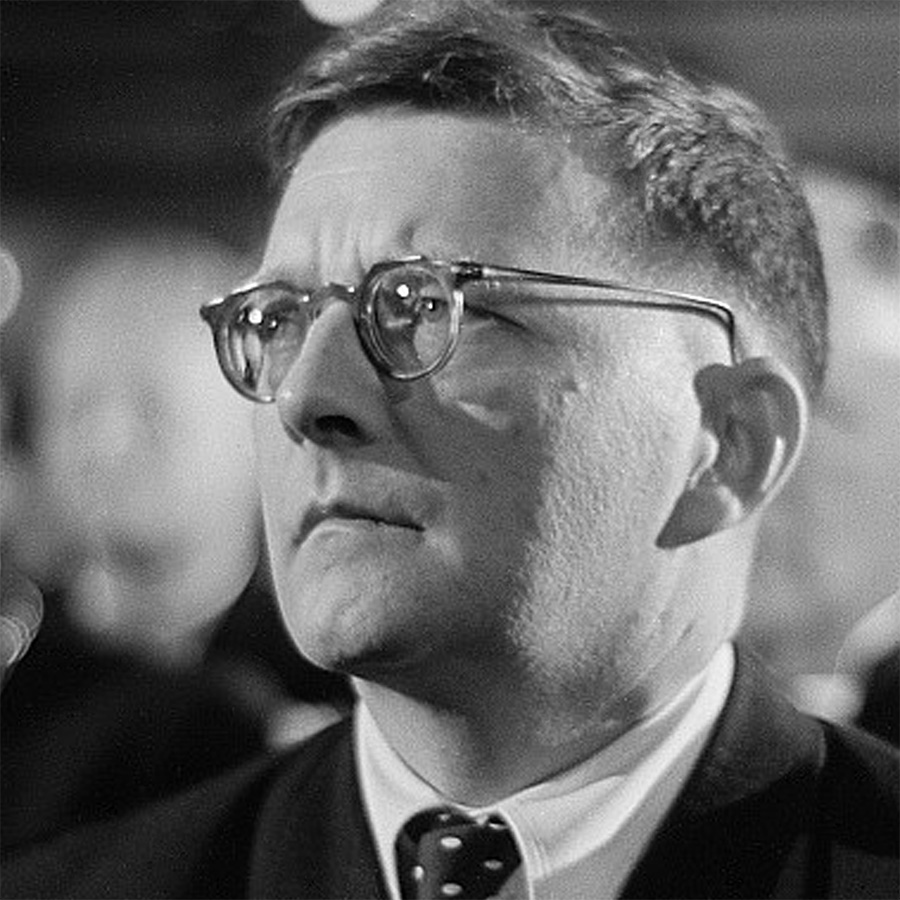
Leonard Bernstein celebrated Dmitri Shostakovich’s sixtieth birthday by proclaiming him “an authentic genius” – “and there aren’t too many of those around anymore.” That took courage in 1966, when Shostakovich – the leading Soviet musician — remained a Cold War cartoon of the stooge and simpleton. As Bernstein appreciated earlier than others, Shostakovich’s ultimate genius was to bear witness to terrible times: Stalinist terror, World War II.
No other composer has enjoyed a comparable surge in reputation since 1966 (I would nominate Sibelius for second place). I am now reading an upcoming compendium of Boston Globe reviews by Michael Steinberg – with Conrad L. Osborne (still going strong), the pre-eminent American music critic of his generation. Steinberg wrote in 1962: “We are faced at every turn with the legend that [Shostakovich] was a great talent destroyed, or at least hampered, by political oppression. A hearing of the First Symphony, written at nineteen, makes it perfectly clear that there is no reason to have expected Shostakovich to become a better composer than the one he in fact became.” Three decades later, in his incomparable volume of program notes (The Symphony: A Listener’s Guide), Steinberg recanted.
Encountering Steinberg’s revisionism, I am suddenly reminded of my own. Back in my New York Times days, I once reviewed a performance of Shostakovich’s Second Piano Trio by the Beaux Arts Trio – and took a swipe at the piece. Digging up my 1977 review online, I find that I wrote that it is music “that sounds older than it should, and asks to be taken more seriously than it deserves.” It was the Zeigeist, ruled by Igor Stravinsky. I am now the author of a book – The Propaganda of Freedom: JFK, Shostakovich, Stravinsky, and the Cultural Cold War – that according to a Russian musician of my acquaintance turns the tables by demonstrating that Shostakovich more greatly mattered.
Virgil Thomson’s Shostakovich putdowns were the most notorious: the Leningrad Symphony, he wrote, was “written for the slow-witted, the not very musical and the distracted.” Shostakovich had “deliberately diluted his matter, adapted it, by both excessive simplification and excessive repetition, to the comprehension of a child of eight” – an approach that “may even disqualify him from consideration as a serious composer.” A year later, Nicolas Nabokov, in Harper’s Magazine, called Shostakovich “old-fashioned,” “provincial,” “dreary and monotonous,” summarizing: “It is as difficult to describe the music of Shostakovich as to describe the form and color of an oyster . . . it is shapeless in style and form and impersonal in color” – a metaphor privately endorsed by Stravinsky in a congratulatory note. In 1951, Nabokov was named General Secretary of the Congress for Cultural Freedom, the CIA’s covert propaganda arm.
Looking back, one must inquire: What accounts for such a drastic re-consideration? Yes, it’s partly the end of the Cold War, partly the end of Stravinsky’s modernist regime. But it’s also because – as Bernstein would so grimly prophesize – the times have greatly changed. Shostakovich, alas, gauges the magnitude of our contemporary malaise. Once bearing witness to twentieth century Russian travail, he today bears witness to twenty-first century American travail.
Six weeks ago – in the wake of the christening of the “Trump-Kennedy Center” and an impending two-year shutdown — Gianandrea Noseda conducted his National Symphony Orchestra in Shostakovich’s Eighth Symphony, composed in 1943. Philip Kennicott wrote in the Washington Post that this hour-long symphony reflects “on the cost and absurdity of war. . . . It is about needless suffering caused by the recklessness and cynicism of people who are wanton with chaos, who know only how to destroy and tear down, not to build or nurture.”
Two weeks ago, the same Symphony No. 8 was performed by Delta David Gier and his South Dakota Symphony as part of a Shostakovich festival that I helped to plan as the orchestra’s scholar-in-residence. The concert began with a half-hour scripted exegesis with musical examples – the same approach we applied to the Leningrad Symphony two seasons ago. I have written and broadcast about the shattering impact of that performance.
Absent the story of the Nazi siege of Leningrad, the Eighth Symphony is a harder sell – and we did not know if we could repeat our success. Our script suggested that Shostakovich “learned three things” about bearing witness: “The first was that he could convey extra-musical messages in a wordless symphony. The second was that – because music is less explicit than words – these messages could actually be subversive, connecting with needs and beliefs that could not safely be spoken. The third was that he could become a true ‘people’s artist’ – not by serving an autocratic state, but by serving more profound human needs, groping for a common humanity more fundamental than any ideology.” We sampled the music, movement by movement. We also sampled some of what was said about Shostakovich’s Eighth during the interesting deliberations over whether to award Shostakovich a Stalin Prize for music so “difficult” and “pessimistic.” The eventual verdict was “no.”
Though there is no Kennedy Center debacle in Sioux Falls, Shostakovich’s Eighth was heard with such rapt attention one could actually track the audience’s immersion. As the long first movement progressed inexorably towards its seismic climaxes, scattered coughs and throat-clearings vanished. The pauses between movements were rapt: not a sound. The ending – as original and subversively serene as any in the symphonic literature – was greeted with what seemed a full minute of silence. The orchestra then joined in the ovation, with the players applauding one another. Listeners and musicians shared testimony during a one-hour post-concert discussion. Some wept. The present moment – the White House, the war in Iran – weighted the room.
Readers of this blog are doubtless tired of hearing about the South Dakota Symphony. We have at hand an exemplary American cultural institution, onstage and off. In a couple of blogs about Klaus Makela, I found myself reflecting on an intangible prerequisite in symphonic performance: “feeling it.” The South Dakota violins feel it.
How is it possible that this orchestra achieves a gravitas I do not experience from the upper strings of the Boston Symphony, the Chicago Symphony, or the New York Philharmonic? No one could claim that the South Dakota performances are more precise. But it is the most engaged professional orchestra I have ever encountered in the United States. Consider, for a start, its make-up. There are nine full-time salaried players, comprising a string quartet and a wind quintet, both first-class. These are the happiest orchestral musicians I know. They play more than 100 times a season – mainly as chamber musicians. Some of those performances take place on Indian reservations as part of the signature SDSO initiative: the Lakota Music Project. Others transpire in public schools, universities, and hospitals. The remainder of the roster is paid per-service. A large contingent comes from Minneapolis-St. Paul. They don’t come for the money, but for the experience. Talk to them, and they will speak about “the vibe” of the South Dakota Symphony, about the adventurous repertoire, about the feeling of camaraderie and mission. In other words: the musicians of this non-union orchestra are largely self-selected. Think about that.
I have been curating thematic festivals with orchestras since the 1990s. They prioritize exercises in contextualization that might take the form of talks from the stage with musical examples, or the use of a screen. Some musicians resent this intrusion. In South Dakota, the musicians are grateful because they appreciate that the audience is appreciative. That is what ultimately matters to them.
Nothing is more singular about the South Dakota Symphony than its educational outreach. For most American orchestras, education is a “cash cow” – a sparsely populated department mainly charged with producing young people’s concerts and enticing grants. Neither the music director nor the mainstream subscription concerts contribute. In South Dakota, thematic festivals on the main subscription series generate linkage to Sioux Falls high schools and to universities an hour away. For the recent Shostakovich festival, the main ancillary event was a screening with live music of The New Babylon – a classic 1929 Soviet silent film launching Shostakovich’s historic fifty-year relationship with the director Grigori Kozintsev. It was performed with live accompaniment – a 17-piece theater orchestra – at Augustana University in Sioux Falls and at South Dakota State University in Brookings (population 24,000). Compare that to the San Francisco Symphony’s current roster of films with music, including Vertigo, Barbie, Home Alone, Pirates of the Caribbean, and Crouching Tiger–Hidden Dragon.
A final factor: Delta David Gier, the SDSO music director since 2004. He oversees the orchestra’s myriad activities with a missionary zeal. He also possesses a rare gift for calibrating long-range musical structure. Next season’s programs include Beethoven’s rarely heard Missa solemnis (with the SDSO chorus), four world premieres, and an ambitious new installment of the Lakota Music Project (which may generate a documentary film).
The recent termination of Andris Nelsons as music director of the Boston Symphony (in addition to the Leipzig Gewandhaus Orchestra), the controversial engagement of 30-year-old Klaus Makela to lead the Chicago Symphony (in addition to Amsterdam’s Concertgebouw Orchestra), the impending New York Philharmonic music directorship of Gustavo Dudamel (who having resigned his position at the Paris Opera will have no overseas commitments) are in different ways pertinent to Gier’s exceptional tenure as a full-service music director residing for twenty years in Sioux Falls as a civic fixture. The “jet-set music director,” a witless 1960s invention of Ronald Wilford at Columbia Artists Management, may at last be waning. Or maybe not. Boston, San Francisco, Los Angeles, and Cleveland are all shopping for new leaders.
To read about the South Dakota Symphony and Shostakovich’s “Leningrad” Symphony, click here.
To read about Klaus Makela and the Chicago Symphony, click here.
To read about Esa-Pekka Salonen’s departure from the San Francisco Symphony, click here and here.
To read about the Boston Symphony “in trouble,” click here.
Thanks. An excellent and unusual piece which requires deep reflection.