
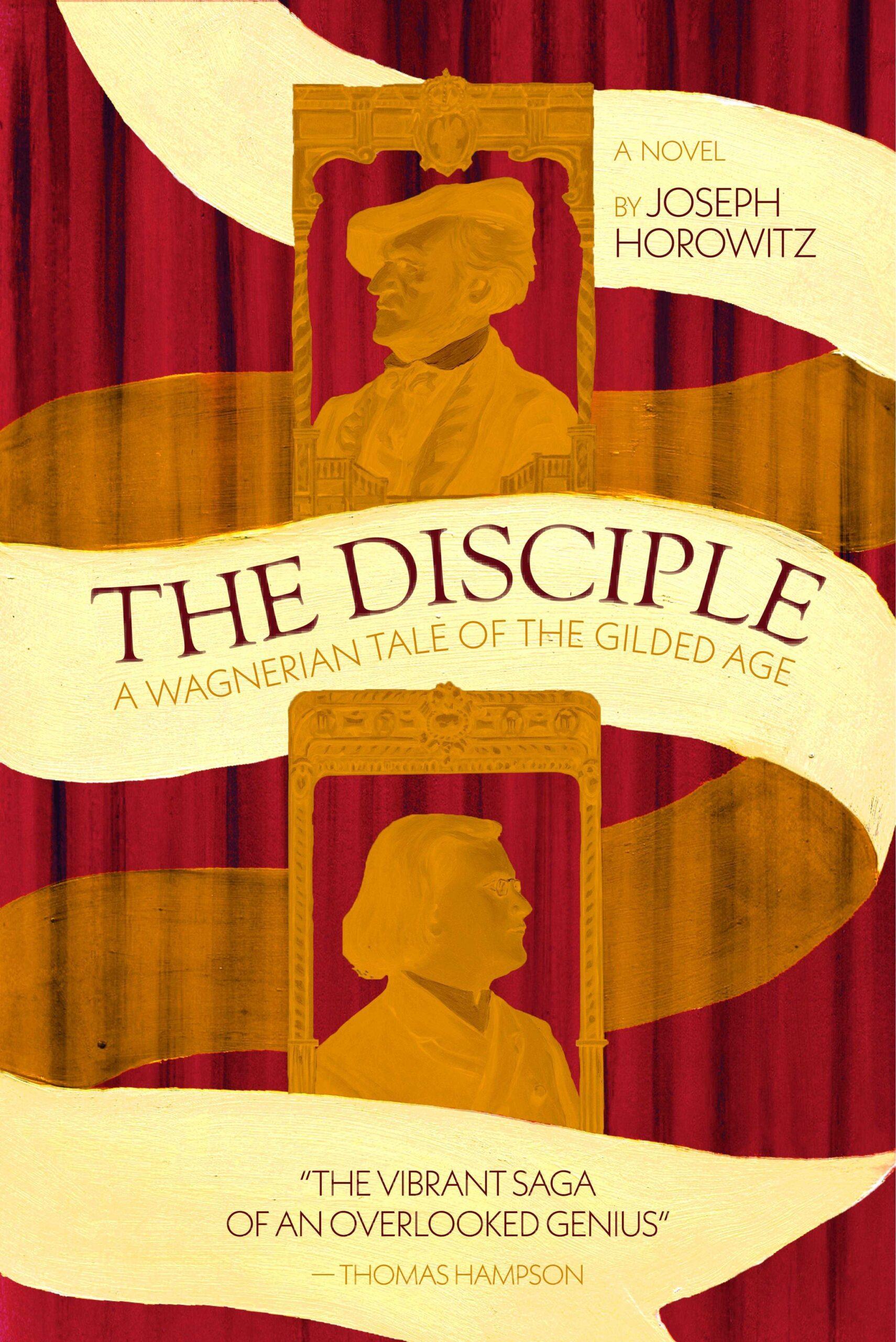
An early review of my forthcoming novel “The Disciple: A Wagnerian Tale from the Gilded Age,” by Hans Rudolf Vaget, appears in the current issue of “Wagner Notes” — the journal of the Wagner Society of New York (pp. 11-12). The book is already available for purchase (with a discount) here. Vaget writes in part:
For several decades, Joseph Horowitz has been our foremost chronicler of the vexed fate of American classical music, in particular of the wondrous story of Wagner-mania in Gilded Age Brooklyn and New York. Saturated with the heady potions extracted from years of archival work, he has at last given in to what, long ago, he was enticed to attempt in reaction to his discoveries. And that is to turn to the increasingly popular genre of historical fiction that molds together scholarship and fantasy. This has enabled the author to bring to life the protagonists on the musical scene of the 1880s and 1890s with all their missionary zeal and human foibles, providing, along the way, local color, historical nuance, irony, and ultimately pathos.
Horowitz chooses to focus on three very different personalities, related to each other through their love of Wagner. At the center of it all we find Anton Seidl, the charismatic and enigmatic conductor whose death, in 1898, at the early age of forty-eight, and whose elaborate memorial service provide a fittingly somber con- clusion to Horowitz’s tale. . . .
Seidl found an unlikely partner in Laura Langford, the energetic founder of the Seidl Society, which was reserved for women only. She came to preside over this unlikely intersection of Wagnerism and feminism, a constellation unique in all cultural history. . . .
And then there is Henry Krehbiel, the idealistic and longtime music critic of the New York Tribune. Of Krehbiel [Horowitz] observes that he could “neither think nor act without engaging in instruction.” . . .
Beyond conveying the interactions of Seidl, Langford, and Krehbiel, Horowitz’s canvas teems with topics and incidents of considerable cultural interest. . . . The Disciple is perhaps best viewed as a love letter to Gilded Age New York and its vibrant music scene. As such, it serves as a prequel to Horowitz’s earlier novel The Marriage, which revisits Gustav and Alma Mahler’s final sojourn in New York in 1910- 1911. To anyone interested in the history of music in New York, The Disciple and The Marriage are must-reads.
How does Joseph Horowitz blend historical scholarship with imaginative storytelling in his works on American classical music?