
As a sequel to my NPR show on Donald Trump’s incursions at the Kennedy Center, the NEH, and the NEA, here’s something Jimmy Kimmel said on TV the other night:
Trump says he’s closing the Kennedy center for roughly two years, so it can be rebuilt into the finest performing arts facility on earth, with a reopening that will rival and surpass anything that’s ever happened there. That’s the promise, the pitch, the Trump in infomercial voice. But what people are reacting to isn’t the construction logic, it’s the pattern. Because this isn’t just a renovation announcement, this is the Trump brand doing what it always does: take something that already works, treated like a stage for vanity, break the trust that made it work, then declared the only way to save it is to shut it down and make it about him. And, if that sounds familiar, it should. The man has a long résumé of slapping “Trump“ on things and watching them, crater. It’s not even an insult at this point. It’s a business model with a body count. Steak, vodka, board, games, mattresses, airlines, education scams, dresses, universities . . . all the branded nonsense that came and went like a parade of glossy failures. He’s basically a reverse king Midas. Everything he touches turns into a press release and a legal bill.
Now he’s doing the same thing to a place that isn’t supposed to be anybody’s personal merch table. The Kennedy Center isn’t a casino. It isn’t a steak line. It isn’t a limited edition cologne that smells like entitlement and bad decisions.
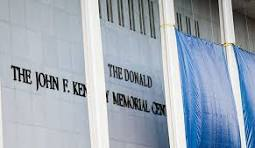
It’s the John F. Kennedy Memorial Center for the Performing Arts. It’s part memorial, part national cultural institution, an American symbol that was designed to be bigger than one party, one mood, one ego. And that’s why people reacted so sharply when Trump started calling it the “Trump Kennedy Center.” Not because Americans are allergic to construction. Because Americans can smell a desecration when it shows up wearing gold letters.
Here’s the timeline that matters. The Kennedy Center has been operating for decades. It opened in 1971 and the only major stoppage in modern memory was a short pause during the Covid era roughly spring into late summer of 2020, because the country was dealing with a public health emergency. That was necessity. That was reality. This is different. This is a shutdown driven by politics and vanity, and honestly, by rejection. Because what happened after Trump took over wasn’t a renaissance, it was upheaval. A wave of resignations, a wave of cancellations, performers, backing away, staff leaving, and not quietly, publicly, loudly, with moral clarity. The kind of “no thanks” you don’t get unless people feel their values are being trampled. At one point, the Kennedy Center brought in a new Head of Artistic Programming, Kevin Couch, and he reportedly quit after five days. Five days. That’s not a normal departure. That’s an evacuation.
Then you had high profile artists pulling out – Renée Fleming canceling appearances, Philip Glass pulling the premiere of a work tied to Abraham Lincoln, explicitly framing it as “a values conflict.” You have institutions and artists who’ve been part of the Kennedy Center’s ecosystem for years, saying “under this leadership, we’re not participating.“
And, if you’re watching this at home thinking, “wait, how do you lose the Kennedy Center’s confidence in record time?” the answer is: you don’t manage it like a cultural institution, you manage it like an ideological takeover. Because, what’s being described here isn’t just bad administration, it’s a purge mentality. A replacement of neutrality with partisanship, a rebranding of a national cultural space into a political trophy. And that’s why the cancellations matter. Not because they’re celebrity gossip, because they revealed the underlying issue. The Kennedy Center works when it’s a civic commons. When it’s a place where different. Americans can show up, sit in the same room, and share something that doesn’t require them to chant for one party or boo the other. Trump doesn’t understand that kind of space. He understands loyalty and branding. He understands applause and domination. He understands culture the way a developer understands a historic building: as a surface you can plaster your name on, and then charge admission.
So, when the artists and institutions refuse to play along, Trump doesn’t ask, “what did we do wrong?” He doesn’t recalibrate. He doesn’t show humility. He does what he always does when reality doesn’t clap. He threatens. He blames. And then he tries to bulldoze the problem. And now the solution is shutting the whole thing down. Think about the psychology of that. A thriving institution rejects your takeover, and instead of admitting you poisoned the atmosphere, you close the doors and announce a grand reopening that’s going to be incredible and majestic and bigger than ever, because nothing says I respect the arts like turning the nation’s cultural center into a vanity construction project with your name floating above it like a billboard.
And there’s an obvious question that the public keeps asking, because it’s the only question Trump‘s world never answers cleanly: who’s paying? because Trump is always revitalizing something with other people’s money. He doesn’t build, he leverages. He doesn’t invest, he shakes down. He doesn’t lead, he invoices. So when he says a massive rebuild is coming, people immediately wonder, is this public money? Private money? Political donor money? The kind of friend of the administration money that always seems to show up around Trump’s projects like a suspicious fog.
And, of course, he couches it in the most Trumpish language possible. Subject to board approval, after a review, after talking to contractors and experts, it’s the same vibe as every Trump pitch: “Trust me, I’ve got the best people. We’ve done a tremendous review. It will be the greatest.” It’s always the greatest. Even when the reality is smoldering behind him. And the reality here is smoldering because the arts community has been sending a clear signal. This isn’t about programming preferences, it’s about principle.
One of the most striking parts of what’s being discussed is the idea that the takeover is an authoritarian first step. Not because the Kennedy Center is the whole country, but because culture is one of the first places, authoritarian minded movements try to control. They don’t start by steamrolling the most powerful institutions on Day One. They start where they think the resistance will be easiest. The arts. Education. Public media. The places where expression happens and where narratives get formed. Because authoritarians hate two things more than anything: satire, and solidarity. Satire punctures the myth. Solidarity breaks the fear. The arts do both. The arts give people language. The arts make people feel connected. The arts remind people they’re not alone, that their private discomfort has a public shame.
That’s why the moment you politicize a cultural institution, you’re not just making changes, you’re sending a message: “we’re coming for the spaces where people speak freely. We’re coming for the places where stories get told without our permission.”
And, if you’re sitting there thinking, “OK, but this is just one building,” I get it. It’s easy to downplay. But symbols matter. Institutions matter. The civic commons matters. Because once you normalize the idea that everything public can be branded by the leader, once you accept the idea that memorials and national institutions are just trophies for a president’s ego, you’re training the country to accept something darker: the idea that the state belongs to one person. That’s not patriotism. That’s possession. And Trump’s entire second term has been about possession. Possessing institutions. Possessing narratives. Possessing the language of America so he can sell it back to you as a product.
This is why the Kennedy Center story hits so hard. It’s not just Trump closes a venue, it’s Trump doing what he always does when something doesn’t validate him: he tries to control it. When it still doesn’t validate him, he tries to punish it. A normal leader confronted with resignations and cancellations would ask, “how do we rebuild trust?” Trump asks, “how do I win?“ And if trust is the price of winning, he’ll burn the trust and call the smoke progress.
Now the most revealing part of this entire saga is that Trump didn’t need to do any of this. The Kennedy Center wasn’t begging to be saved by his ego. It was functioning. It had history. It had bipartisan spirit. It had a mission that outlasts any single administration. But Trump can’t stand institutions that outlast him, because they remind people that America isn’t supposed to be a one-man show. So he vandalizes the symbolism, at least in rhetoric, and then acts surprised when the country reacts like, “no, we’re not calling it that..” Americans are stubborn like that. We have our flaws, but one of our best features is we don’t like being ordered to participate in someone else’s fantasy.
And the arts community, in particular, is allergic to that kind of forced fantasy. Artists are literally paid, sometimes poorly, but paid, to notice what other people try to hide. They’re built to see manipulation. They smell propaganda the way firefighters smell smoke. So when Trump‘s people try to turn a cultural landmark into an ideological billboard, the artists do what they’ve always done: they withdraw. They speak. They refuse. And that refusal drives Trump insane, because it’s the one currency he can’t print. He can print press releases. He can print threats. He can print lawsuit letters. He can print merch. He can print nonsense, but he can’t print legitimacy. Legitimacy has to be earned. And he doesn’t earn it, he demands it.
So now we’re here. Temporary closing. Revitalization. Grand reopening. All wrapped up in Trump’s classic delusion of grandeur, while the underlying reality looks like a cultural institution being hollowed out because it wouldn’t bend the knee. And hovering in the background, you’ve got the larger national atmosphere documents, scandals, the Epstein story dominating headlines in ways that make everyone’s skin crawl, and a political ecosystem that keeps trying to distract, rebrand, and outrun accountability. That’s part of why this Kennedy Center move feels so cynical. Because in Trump world, everything becomes a diversion, and everything becomes a flex. A building. A policy. A headline. A human tragedy. It all gets repurposed as content.
And, if you want the simplest take away tonight, here it is. Trump didn’t save the Kennedy Center, he did what he always does. He turned it into a fight. Turned it into a brand. Turned it into a loyalty test. And then turned the consequences into a construction announcement. That’s the Trump presidency in miniature: break the thing, blame the thing, then shut the thing down and claim you’re the hero.
Wonderful clarity and truth. Thank you, Joe, for posting.
Now, when and how will the pushback happen? We have seen that as part of the Trump playbook in second term and how it can work. He will retreat with enough opposition. I hope that enough people stand up and say ‘no’ that the KC can be saved. I’ve loved it for 50+ years and hope for its survival and continuation of what it was.
DT’s next target is to change the voting system to rig the midterms so Dems cannot win a majority in Congress . If you believe in the founding idea of Democracy then this total ‘ take over ‘ must be stopped by the people who take it to the streets . F••k Fox News support of authoritarianism .
Under the heading of “sad but true” this ego driven drivel is shockingly not even shocking any more…
To quote from the great Bernstein “Mass” that opened the Kennedy Center with Maurice Peress on the podium: “How easily things get broken.”
I take solace in the flute solo that follows, the Pax Communion “Secret Songs.” Something that Trump and Trumpism knows nothing about.
Lauda, Lauda, Laude.
Dona nobis pacem!
This is really great! When did he air this on TV? Is there a link somewhere? I’ve searched for it but can’t find it.
I would love to see him deliver this speech. One for the ages!
Bid farewell to Edward Durells masterpiece. Trump is a vulgarian.
The KC is not an appropriate institution to be revised by Trump.. A better choice would be KFC.