
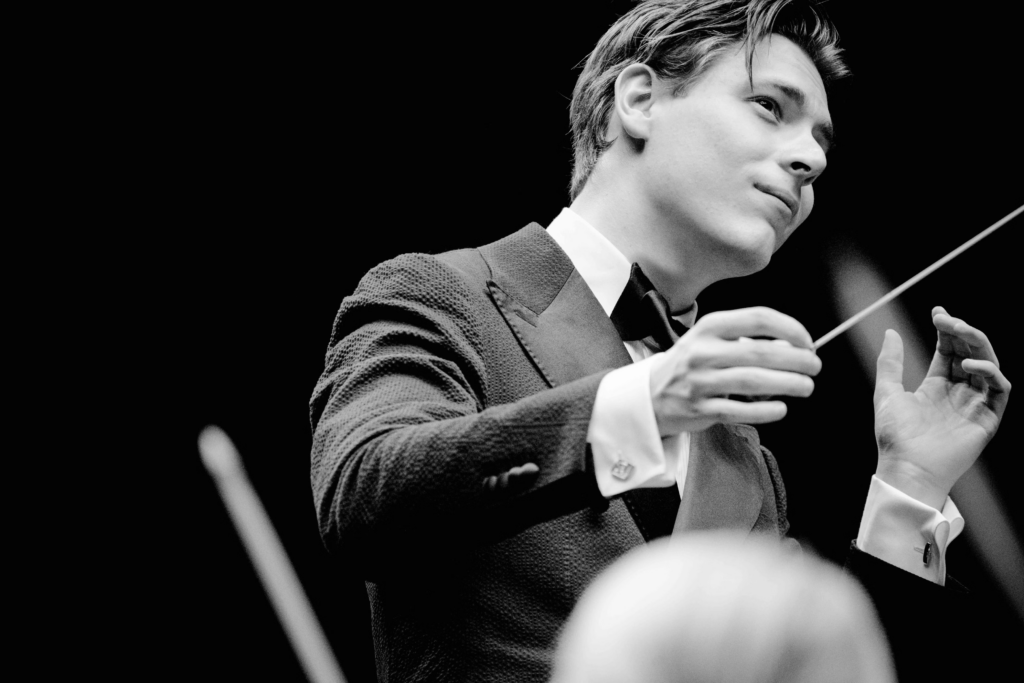
I wasn’t initially planning to write anything about Wednesday night’s Carnegie Hall concert by the Chicago Symphony under Klaus Makela, their 30-year-old impending music director. I’ve written about Makela quite enough. I have no doubt that he is immensely gifted. I have seen him ignite an orchestra with a rare exercise of spontaneous authority. But he seems to me too young for the job – let alone his two jobs, as he takes over Amsterdam’s Concertgebouw Orchestra in 2027 as well.
Processing this disappointing event, I remain plagued by the question: What’s gone wrong?
The program comprised Strauss’s Ein Heldenleben and Sibelius’s Four Legends from the Kalevala, a set including the famous Swan of Tuonela. Upon returning home, I listened to Leopold Stokowski’s 1929 recording of The Swan with his singular Philadelphia Orchestra. I was prepared to find the final reprise of the tune in the strings (at 5:15) more expressive than the Chicago performance. I was unprepared to also find the English horn solo more expressive – but so it was.
How to account for the difference? Well, the Philadelphia strings produced a warmer, fuller sound, and shaped the dolorous melody with portamento slides of a kind never heard nowadays. And Stokowski’s soloist played with a range of articulation and dynamics I did not hear Wednesday night. But this hardly seems an adequate explanation, comparing a compelling performance with an ineffectual facsimile.
I am reminded of a conversation I had in South Dakota with Derek Bermel, who had composed something remarkable for the Creekside Singers and the South Dakota Symphony. Derek told me that his clarinet teacher had been a member of the Metropolitan Opera Orchestra. I was fascinated to learn that – because broadcast Met performances from the 1930s and ‘40s document a caliber of intense orchestral collaboration unknown at the Met today. Derek had just auditioned the February 12, 1938, Otello – the greatest Verdi performance known to me, with Giovanni Martinelli, Lawrence Tibbett, and Elisabeth Rethberg conducted by Ettore Panizza – and reported back that it sounded “fundamentally different” from any Verdi he had previously heard. Seated in a hotel lobby – I think we were in Chamberlain (population 2,600) – Derek and I spent twenty minutes debating what made that 1938 performance so special. Was it the conductor? The orchestra? The singers? Stylistic authority?
Unbeknownst to us, the late Chris Eagle Hawk, a Lakota tribal elder I knew to be both wise and succinct, was a table away listening to it all. When there was a pause in our discussion, Chris said three words: “They felt it.”
That ended our conversation.
For a highly personalized reading of Sibelius’s Swan by a really famous exponent of the English horn, here is Louis Speyer with the Boston Symphony and Serge Koussevitzky, live in 1945.
To read more about Klaus Makela, click here.
To read about Verdi at the Met today, with comparisons to Ettore Panizza, click here.
To read about Derek Bermel and the South Dakota Symphony’s visionary Lakota Music Project click here.
“They felt it.” An excellent response! I’ve enjoyed some MET Wagner recordings from the 1930’s and 1940’s. They have a sense of spontaneity that is unheard of today. Thank you for your short review.
I agree that despite his gifts he’s too young for the job. Furthermore, I believe a better choice would have been a conductor who would have moved to Chicago and become a real presence in the city, much like the situation in South Dakota you’ve frequently cited. Here’s a suggestion: why don’t you interview members of the CSO and find out why they fell in love with Makela within 10 minutes of the first rehearsal and was their nearly unanimous choice to succeed Muti. Their perspective might help explain why the board chose Makela over much more experienced conductors who were under consideration. I’ll be hearing Makela and the CSO in Boston on Sunday.
Joseph Horowitz is, as usual, correct about judging performances. I believe that the English horn solo in the 1929 Swan of Tuonela recording was played by the great oboist Marcel Tabuteau, a master of tonal coloring and phrasing. His distinctive sound was a powerful influence in shaping the Philadelphia Orchestra as an ensemble.
I heard the CSO under Mäkelä Friday night, 2/27, in their Washington, DC area concert at The Music Center at Strathmore. The program was Beethoven’s Symphony No. 7 and Berlioz’ Symphonie Fantastique. I found him to be competent but nothing that special. The Beethoven didn’t really come alive until the final movement. The Berlioz was better, but again came alive really only from the third movement onward. As one might expect from the CSO, the brass were particularly strong and effective in the March to the Scaffold (4th) and Witches’ Sabbath (5th) movements. And though the rest of the orchestra played well, I came away underwhelmed. I don’t yet get a sense of guiding vision or throughline in Mäkelä’s performances.
I attended the CSO/Carnegie concert and have a few thoughts. First, it was interesting to me that they flipped the order of the program, opting to play the much lesser known Kalevala legends after intermission. Thinking about it after the concert, I thought it worked. To me the Heldenleben was a little on autopilot, even considering that this was Carnegie Hall. How many times has that orchestra played that piece? How often do they trot it out, like they have some proprietary claim on it going all the way back to Reiner’s 1954 recording, still a benchmark performance for many? By contrast, again to my ears, the orchestra seemed to “come alive” in the Sibelius, the playing was much more alert, the Finn Makela seemed more committed to making a case for some of his countryman’s neglected early music. I dare say that many if not most of the players had never performed all four pieces. I applaud him for bringing this music to Carnegie. On cue, you referenced a 1929 Stokowski recording of the Swan of Tuonela. That’s one of the problems of performing a lot of classical music. It’s forever being compared to the past, the field is haunted by the past.
Second, from the point of view of someone like you who is a very experienced and seasoned concert-goer who has written extensively (and continues to write) about the state of classical music in the U.S., yes, Makela is too young. And he’s spread way too thin. But I think the reasons that he was hired are quite obvious. Given the immense financial pressures on orchestras the level of Chicago, along with the dearth of conductors who can actually survive in front of them, Makela delivers on several fronts. First and perhaps foremost, he has buy-in from the players (crucial). Second, perhaps even more important, he is eminently “marketable.” He will engage subscribers, single ticket buyers (including younger ones!), donors, sponsors. He will help to raise money, to create “critical mass,” something that is unfortunately shrinking at many orchestras large and small in our post-pandemic world. The CSO management and board leapt at the chance to get Makela, as did Amsterdam and before that, Oslo and Paris. He brings energy and optimism. Look at orchestras like LA, San Francisco, Cleveland, and now Boston. They’re all under stress, they can’t afford to make a mistake. You’ve run a performing arts organization in the NYC market, you know what pressure is.
Anyway, that’s my two cents. I always enjoy reading your columns in Douglas McLennan’s Arts Journal feed.