
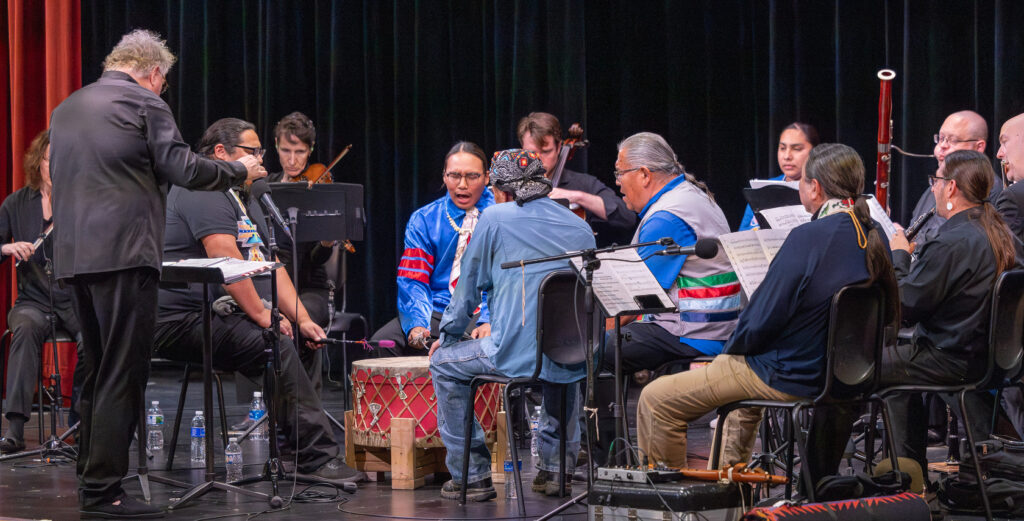
Delta David Gier conducts the Creekside Singers and members of the South Dakota Symphony in Derek Bermel’s “Lakota Refrains” [Photo credit: Dave Eggen/Inertia/South Dakota Symphony]
The topic of my latest “More than Music” program on NPR is the South Dakota Symphony’s Lakota Music Project.
The last military engagement between United States troops and Native Americans occurred on December 29, 1890, near Wounded Knee Creek in South Dakota. Almost 300 Lakota men, women, and children were killed, as were 25 American soldiers. Once known as the Battle of Wounded Knee, the encounter is today referred to as the Wounded Knee Massacre. The gunshot that began it will never be traced. The shooting instantly grew indiscriminate. Twenty US soldiers were subsequently awarded Medals of Honor.
During the Biden Administration, General Lloyd Austin, as Secretary of Defense, ordered an inquiry into Wounded Knee “to ensure no awardees were recognized for conduct inconsistent with the nation’s highest military honor.” In September 2025, current Secretary of Defense Peter Hegseth announced that those medals would not be rescinded. He praised the recipients as “brave soldiers” and added “We’re making it clear that they deserve those medals.”
Not long after Hegseth’s statement, President Donald Trump officially proclaimed October 13 “Columbus Day,” celebrating what he called Christopher Columbus’s “noble mission” to “spread the Gospel of Jesus Christ to distant lands” and “pave the way for the ultimate triumph of Western civilization.” Disavowing the widespread adoption of Indigenous People’s Day, the President denounced a “vicious and merciless campaign to erase our history, slander our heroes, and attack our heritage.”
I happened to be on the Pine Ridge reservation – the site of Wounded Knee – when the President issued his proclamation. I was in South Dakota to observe the fourth Lakota Music Project Tour, which brought members of the orchestra to the Pine Ridge and Rosebud reservations, and to other rural communities throughout the state. They made music in collaboration with Native American singers, drummers, and dancers — and with the celebrated Dakota wooden flutist Brian Akipa.
This initiative, now fully twenty years old, was conceived by SDSO Music Director Delta David Gier in consultation with Lakota and Dakota leaders throughout the state. It attempts to deploy music to promote mutual understanding where a climate of mistrust has long prevailed. Gier himself happens to be a devout Christian. He told me: “I find it absolutely bewildering that we’re at a point where my faith has been attached to a right-wing political viewpoint. It’s directly opposite to what Jesus Christ not only taught, but demonstrated with his acceptance of the other, his ministry to the other.”
At a time when Generation Z is widely perceived as rootless, I observed Lakotas, young and old, preserving the language and customs of their ancestors. I also encountered a couple of breakthrough compositions, by Derek Bermel and Jeffrey Paul, fusing Lakota and Dakota musical expression with the Western classical tradition.
For more on the Lakota Music Project, click here and here and here.
LISTENING GUIDE:
(To access the show, click here)
Part I:
3:00 – Emanuel Black Bear reacts to Hegseth and Trump
6:45 – Derek Bermel’s Lakota Refrains for the Creekside Singers, string quartet, and wind quintet
Part II:
15:30 – Jeffrey Paul’s Songbird and Goose for wooden flutist Brian Akipa, string quartet, and wind quintet
Part III:
22:00 – Chris Eagle Hawk on being sent to a government boarding school at the age of six
26:00 – The Black Pipe Singers (ages 8 to 10) on the Rosebud reservation
30:30 – South Dakota Symphony Music Director Delta David Gier on the history of the Lakota Music Project
40:00 – The processional Round Dance ending Bermel’s piece, during which audiences spontaneously arose and danced.
Leave a Reply