
 To hear the curators of “Inventing the Modern World: Decorative Arts at the World’s Fairs, 1851-1939” tell it, we have museums around the world to thank for preserving this slice of history. Otherwise, physical remains of these fairs are scant. And judging by the catalogue for the show, we are very lucky that they did. There’s a lot of eye candy, and there are even more items that made lasting impact, influencing future generations of designers and artists. Some, like the Thonet chair, a bentwood design by Michael Thonet, and Alvo Aalto’s Savoy vase, shown at the 1937 fair, are still in production.
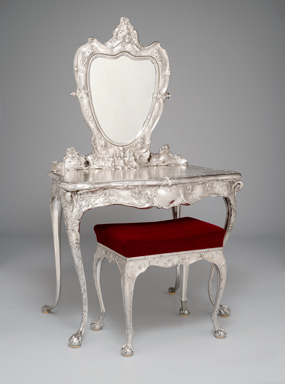
The years between the 1851 “Great Exhibition of the Works of Industry of all Nations” at the Crystal Palace in London and the New York World’s Fair of 1939 were the glory years for design, as the 200 objects in this exhibit — most not seen publicly since before World War II — demonstrate. Manufacturers used fairs to show off, to stir up excitement about their wares and to spark consumption (in general, as well as for these objects specifically). Carlo Bugatt’s “cobra chair” made its debut at a fair, as did a rocking chair demonstrating the bentwood technique. Westerners didn’t use jade or onyx in jewelry until they saw it in a Chinese mask at a fair. And take a look at the silver rococco dressing table here, made by Gorham for the 1900 fair, and now in the collection of the Dallas Museum of Art.Â
 Catherine Futter, the Nelson-Atkins curator who began work on this exhibit 15 years ago, when she was at the Minneapolis Institute of Arts, says she and co-curator Jason Busch, of the Carnegie Museum of Art (where the show goes next), looked at thousands of objects, narrowing them down to the ones that really demonstrated innovation. In general, she said, “I want people to get a sense of what world’s fairs were like for debuting new technology and new styles all in one place. It was the world on a stage.” Â
“This was where art meets industry,” she added. The exhibit stops when fairs became more about ideas and less about products.
The Nelson-Atkins is trying to make the show an experience, so visitors will see images of the fairs, hear period music, and have access to interactive elements that are supposed to provide virtual “hands-on†experiences — these things I have not seen, so I can’t really comment. It also, emulating the function of world’s fairs as technology and style incubators, mounted a design contest for a temporary pavilion for the interative elements that has been constructed at the mseum grounds for the exhibition; it was won by a company called Generator Studio which used solar panels and will re-use all of the materials in other projects when the exhibition ends — you can see a rendering and more info here.
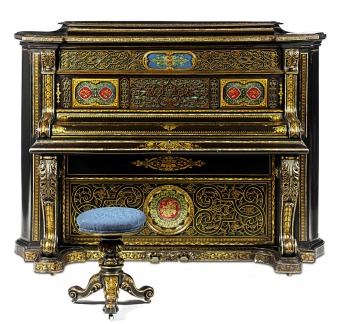
I have a short article with a bit more information (it’ll explain that papier mache piano above left, and shows an object illustrating the cross-cultural benefits of the fairs) in Saturday’s Wall Street Journal.
 And I’m happy to report is traveling beyond Kansas City and Pittsburgh to New Orleans and Charlotte, N.C., which is very good distribution nowaadays.
Photo Credits: Courtesy of the Nelson-Atkins (top) and the Carnegie Museum (bottom)