
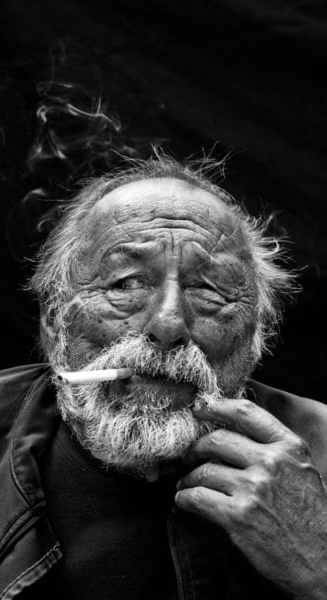
The South African poet Sinclair Beiles said that “poetry is a way of committing suicide.” It sounds extreme but has deep resonance for me. My own conviction is that great beauty from great despair unbends the mind. That is every poet’s goal, to “unbend the mind.” The late Jim Harrison — best known as novelist, short-story writer, foodie, woodsman, Michigander, screenwriter, and world-travelled bon vivant — always considered poetry his first calling. This poem first appeared in The Theory & Practice of Rivers, in 1986, and is included in his Complete Poems (Copper Canyon Press, 2021). I find it especially appealing, given what turned out to be his grandly successful career.
I owe the dentist nine hundred dollars.
This is more than I made on three
of my books of poems. But then I am gloriously
free. I can let my mouth rot and quit
writing poems. I could let the dentist
write the poems while I walked in the dark
with a tray of golden teeth I'd sculpt
for myself in the forms of shark's teeth,
lion's teeth, teeth of grizzly and python.
Watch me open my mouth as I wear these wondrous
teeth. The audience gross is exactly nine hundred!
The house lights dim. My lips part.
There is a glimpse of sun.

° ° ° ° °
I once met Jim Harrison over a three-day period, in 1968, when we were on a “little magazine” panel with Russell Banks, Anne Waldman, and Charles Newman. The editor of Partisan Review, William Phillips, led the panel as we chose that year’s grant winners for the Coordinating Council of Literary Magazines (CCLM). It was an all-expenses-paid gathering at Frank Lloyd Wright’s famous Wingspread prairie house in Racine, Wisconsin. Even then Harrison, was a “character,” a voluble personality who cut a figure — wore a rakish straw hat, a black patch on his blind left eye, and sported a hand-carved walking stick. Looking back, I see that I was the runt of the litter.