
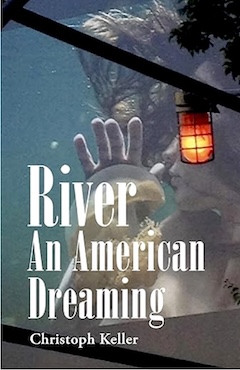
The Swiss author Christoph Keller has gained a devoted following with his novel, Every Cripple a Superhero, which he wrote in English. Now he has another novel (out as an ebook), River: An American Dreaming, also written in English.
For readers familiar with his work, it will come as no surprise that Keller’s prose in an adopted language has the idiomatic flare of a native speaker. Nor is it a surprise that much of his latest novel is again set in downtown Manhattan, where he once lived. Here, for example, is the opening of the second chapter:
Neema paid for her double latte, whizzed out of the shop, and headed down East Fourth toward Broadway. People were nothing but stones and rocks to her; she was the water, flashing around them in a fast-moving current. “I’m heading for the F on West Fourth—that’ll take me straight to your door, Shawna,” she howled into her cell, picking up her pace, latte balanced in one hand. “Would you care to hear a poem against Jesus?” a pale teenager in black asked as she cut through Washington Square Park. “No thanks,” Neema said, then, more gently, “No,” to a sad-looking girl in a Vermont-y dress offering hugs for a dollar. She resisted the urge to give one—and spilled half her latte down her T-shirt.”

As to the “river” of the novel, it has both an archeological and mythical presence in a story drawn from the history of the city dating back to the Native American Lenape tribe. Their hunting grounds led through what has become present-day Washington Square Park, and the central character of the novel — Kurt H. Adler, an archaeologist who, like Keller, is confined to a wheelchair — is digging up Lenape artifacts and causing a present-day problem.
Keller insists in a self-interview on his website that Adler is less of an autobiographical creature than an alter ego whom he can “use and abuse to do all the shit I don’t have the courage for.” So . . . yes . . . it really is difficult to separate author from character. In fact, the author can’t help informing us that Adler “sports my middle name” and “my disability — Spinal Muscular Atrophy Type 3” — as well as “my hunger for adventure.”
Keller is a witty writer, often dryly funny in conversation. I met him last year during a trip to St. Gallen, where he lives in Switzerland with his wife, the American poet Jan Heller Levi. She and I gave readings together with the Swiss poets Florian Vetsch and Clemens Umbricht. Keller himself read from his new work at St. Gallen’s annual literary festival. During his reading, and more so over dinner, I felt I had not actually left New York. Another excerpt from River gives you an idea why.
[H]e emerged at the top of the West Fourth Street subway stop, breathless but exhilarated. To Alvie, the subway was more than just a transit system; it was a giant, naked mole-rat with too many limbs. Riding the subway meant traveling through the beast’s stomach, its dark, humid tunnels teeming with Subpeople—bacteria-like commuters who digested and shat him out at his destination. Who really knew what lurked down there? Mole people? Sewer alligators? The remnants of New York’s lost gangs? Cannibalistic humanoid zombie vampires? Perhaps even Rip Van Winkle, wide awake and ready to remember. How he loved it—on a good day, at least! Being swallowed, digested, and expelled by the subway always left him feeling stronger, renewed. Rejuvenated. Reloaded with purpose. Especially on an evening as lovely as this, when the city buzzed with quiet anticipation.”
Keller has no trouble mixing fact and fiction — or advertising that he does. Consider the novel’s dedicatee, “the real Coco,” who happens to be the model for Adler’s “dream wife” Coco. As the novel reveals of the fictional pair, their first meeting was a coup de coeur and “a year later, they were living together in New York.” You can bet that’s what happened to Keller and Heller Levi in real life.
Leave a Reply