
(So many things that cross my mind I never blog about. Here are last week’s, though some are earlier…)
Evening music
I was driving last Thursday night, and listening to WNYC’s Evening Music show, aka the flagship classical program on New York public radio. (Which I’ve blogged about before.) Since they play so much new music, and also music that isn’t even classical, I’m ready for anything when I turn it on. I even once encountered a cheesy — delightfully cheesy — horror-movie score.
But on Thursday, Terrance McKnight, the host, was playing lieder. Chestnuts. Schubert’s Serenade, then Liszt’s “Oh quand je dors.” The music sounded like a lovely jewelbox, golden and untouchable.
Then came the very long Symphony No. 2, by Harri Vuori. Modernism Bleeps, skreeks, slides, and orchestral moans and screams. This was the kind of new classical music we’d all have sworn would never be on mainstream radio. But there it was. I had to like that, even if I didn’t love the piece.
Emotionally, the Vuori piece seemed tense and anxious. So here, with the lieder, we had two extremes, a lovely, distant jewelbox, and unremitting angst. Which offers a deadly critique of high-church classical programming, in which standard works alternate with modernist new music. Where’s the middleground? Where’s the music that’s contemporary, but offers a fuller view of life than screams alone can give? (There’s a lot of it, of course, both classical and pop.).
(Go here for last Thursday’s Evening Music playlist.)
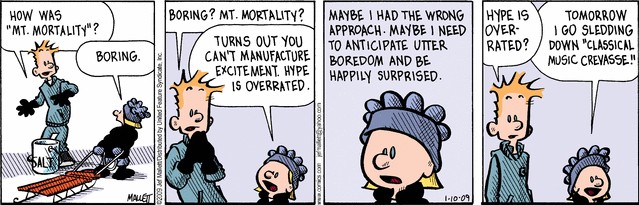
Classical music cravasse
I said people see classical music differently these days, not as stuffy, or elite, or boring, but simply as music. Not completely, though! Here’s the Frazz comic strip from Saturday:
Springsteen and metal
Saw The Wrestler, powerful, touching film that doesn’t at all go in the direction cynical moviegoers might expect.
And the Bruce Springsteen song — which comes in over the credits, and was written for the movie — made me think. The Wrestler takes place in Springsteen territory, New Jersey, with even a scene in Asbury Park. And it’s in Springsteen social and emotional territory, too, since it shows us working people whose lives haven’t worked out.
But the two leads in the film, Mickey Rourke and Marisa Tomei, aren’t listening to Springsteen. They’re into ’80s hard rock and metal. There’s a lovely scene where they each discover that about the other. “Nineties music sucks!” “Kurt Cobain ruined music!”
And it struck me that Springsteen — as far as I can remember — doesn’t deal with metal at all, either in his lyrics, or musically. Nearly all his songs, to my ear, come ultimately from two sources, folk music and mainstream pop from the ’50s through the ’70s. (With some Dylan detours in the early albums.)
But when he made albums in the ’80s, the people he sang about might well have been listening to hard rock, hair bands, and metal. Yet Springsteen doesn’t go there. I don’t mean this as any criticism of him. But the movie made me see a gap in his culture, so to speak, a place he doesn’t go. I’d never thought of that before.
One-painting shows
The director of the National Gallery in London likes museum shows with just one painting, and of course a reduced admission fee. He brought in a show from the National Galleries of Scotland, consisting of two Titians. People flocked to see it, he said, and stayed longer than they often do, looking at the paintings and debating them.
Can we imagine one-work concerts? Which might say, to the world at large, “Here’s something we really want you to listen to.”
Kitty Foiled
A Tom and Jerry cartoon, from 1948, which I ran into on TV, flipping channels. The score — so typical of old cartoons — is very classical, featuring classical quotes (the Barber of Seville overture), and even thematic development. Even the Rossini overture is developed, not just quoted.) And the score keeps changing, as it follows the action, just like an opera, or a symphonic poem.
This isn’t hard to listen to. This cartoon refutes any thought that nobody can follow classical music without special education. Anyone can hear how the music screeches to a halt when the chase scenes do, or trembles with anxiety when someone’s scared, or why (when someone seems to be in serious danger) the galloping Rossini overture suddenly turns sour.
If people can follow music doing these things in a cartoon, why can’t they hear them in the music alone? (Which is not to say that classical masterpieces might not be more subtle than the cartoon score, but then many people who watched the cartoon were also watching subtler movies, and reading sublter books. So why couldn’t they appreciate subtler music, too?)
Triumphlied
Brahms’s Stalinist piece, “Song of Triumph.” written to celebrate a German military victory. I’d never heard it till last week, and hope I never do again.
Quite literally it reminded me of Shostakovich’s Song of the Forests, a painful piece of Stalinist propaganda. Of course Brahms wrote Triumphlied without being forced. But it takes him to an overstuffed, forced, and unconvincing place. It’s Stalinist, in the sense that music’s being used as propaganda, even if Brahms’s Stalinism came from within.
Daniel Mendelssohn on Dr. Atomic
A long essay by the noted critic, in the New York Review (not yet available to read on their site). Like Ron Rosenbaum (whose critique I blogged about), he strongly doesn’t like the piece. It’s good news, bad news. Good news: a classical piece gets attention outside the classical world. Bad news: It doesn’t stand up well when looked at by serious journalistic and literary intellectuals.
Makes me wonder what Mendelssohn and Rosenbaum might say if they turned their attention to standard classical performances. (Mendelssohn did write about last year’s new Lucia at the Met, and devastated it.)
The end of the Amato Opera
New York’s tiny company, bad for generations, but lovable. Its onlie begetter, Anthony Amato, is 88, and it’s no dishonor if he can’t go on.
But still I’m sad. I made my debut there, when I was nine, in the children’s chorus in Carmen. I’d loved opera on records. Now I could not just see one live, but sing in it!
Where’s the music that’s contemporary, but offers a fuller view of life than screams alone can give?
Blame Adorno!
I only know the triumphlied through its piano 4 hands arrangement, and I think in that format its reasonably successful..
After 26 years programming classical music on radio I am still amazed that programmers/presenters still dont know that there are people LISTENING OUT THERE..Music that has the jewel box simplicity you talk of can be preserved by moving to something equally as febrile and simple. There are many symphonic pieces both old and new that can “fit” if the programmer just LISTENS….and also expands their mind in all forms of music. It’s called, in radio,”flow”…..
Sermon over.
I think, in regards to the Tom and Jerry piece, that the visuals contribute a great deal to the narrative intelligibility of the music. When I watch Tom and Jerry, I generally follow the narrative in terms of the visuals (now Jerry is sneaking past a mousetrap, now Tom is falling off a roof, etc) and the music provides a sort of emotional emphasis to the primarily visual narrative.
Without the visuals, I would have a hard time following the narrative of the music alone. That narrative is still there, but presented in terms of abstract ups and downs without the concrete ideas of “Tom” “Jerry” “The Old Lady” “The Dog” etcetera, the narrative is more abstract, and because of that I find it harder to follow along.
That’s my own experience with these cartoons, I don’t know if that is the norm, but I suspect it is out of the arrogant belief that most people’s experience is rather like my own.
Just a note about WNYC.
First, I am an addict, a WNYC fanatic and zealot, from about 1980, Tim Page, Sara Fishko, Steve Post, Stan David,etc.
Terrance: Terrance is a breath of fresh air. At first, I was nervous. George Preston and Brad Cresswell had labored so intensely to bring us wnyc2, and done such a great job programming music there (I am definitely a fan of New Music, I even bought some Golijov). This influence, mixing in a fair amount of New Music with the rest of the “500 years of new music”, “non-generic Classical Music, this influence carried over to Evening Music and the overnight.
Terrance will give us Bessie Smith next to Meredith Monk. What is this, but cool?
If one does not like a piece, well, it’s like New Jersey weather: wait a bit, it will be over and change.
All of the breast beaters (just take a look at some of blogs at insidethearts.com) in Public Radio should take lessons from WNYC.
To quote a previous post: “After 26 years programming classical music on radio I am still amazed that programmers/presenters still dont know that there are people LISTENING OUT THERE..”
Well, after 30 years doing the same, I can say that my awareness of my listeners would have prevented me from programming Vuori’s symphony. Not because it’s new, not because some individual listener might not like it. Because as I listened to it, I couldn’t easily imagine a listener turning on the radio when it was playing, and thinking: “What’s this? Cool! I’ve got to stay tuned!” No, the reaction I imagine is more like: “Oh, brother! Here we go again with the dissonant modern sounds!” That’s probably unfair to Vuori’s artistry, but that’s the way it goes, at least on the radio.
Now, most of the programming I do is daytime, which limits the selections somewhat. Still, I’m constantly on the lookout for new works with the capacity to reach out to the listener, to intrigue, to attract rather than repel. Whether it’s Nico Muhly or Eric Whitacre, or any number of current composers, I eagerly program them. If it’s a work that doesn’t seem like it wants to reach an audience, I feel no responsibility to provide an audience for it. Of course, my judgment is to an extent personal, and my choices are different from someone else’s. But I have the responsibility to choose, and to lead. So I do
Speaking to the one-concert comments…
I do believe that smaller, more concentrated concerts can have a mobilizing effect on audiences. Especially with new music. I know of two concert series that already have this format. One is run by Trumpeter Brian McWhorter, who is a professor in Oregon. He has a series of noon-time concerts that run a mere 12 minutes each. He has said that this is a very successful endeavor, and has a lot of buzz on his campus.
The other concert series is actually one that I co-run at Manhattan School of Music. It’s called the Tuesday Night Power Concert Series, and it is focused on 20 minute concerts at 10 pm. Our goal is to reach students and general audiences with a concentrated performance of contemporary music from the early 20th century to world premieres. Or idea has been to condition audiences to listen to new music more openly, and to eventually lead them to longer, fuller performances on their own. We have had good crowds, usually around 30 people, and up to 70 at times, for a concert of all world premiers. So there is much to be said for this option.
Hi.
True, Springsteen doesn’t write / perform metal now, but, before he ever signed a recording contract, he did write for and front a band or two which had a distinct metal sound – think Led Zepellin.
I’ve heard some of those songs, and they really are awesome.
Thanks.
Well, the tempo of the recording is ploddingly excruciating and the texture covers up what I always imagined as a light and lively first movement. I think if you listened to the piano 4 hands arrangement you might reassess the music… besides, wasn’t that a common complaint of his contemporaries, that his music sounded better at the piano?
“No, the reaction I imagine is more like: “Oh, brother! Here we go again with the dissonant modern sounds!” That’s probably unfair to Vuori’s artistry, but that’s the way it goes, at least on the radio.”
I would probably listen to the end to see who was the composer. Something I would not do if it sounded like a Haydn or early-Mozart symphony or like a lot of the endless baroque music that seems to always be playing on the air.