
In the spirit of my “Disconnected in the past” post, here’s an opera I’d like to write.
It would be based on a hardboiled thriller I’ve just read, The Money Shot, a piece of noir perfection by Christa Faust. This is the story of a former porn star, who now works as an agent for women in the sex industry and gets caught in the ripples from a truly ghastly business, run by people who import women from Eastern Europe and turn them into sex slaves.
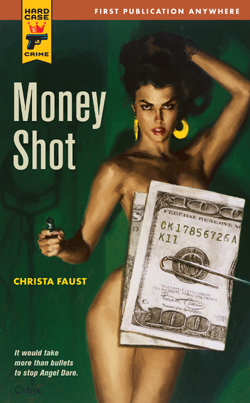 These people try to kill our heroine, whose (stage) name is Angel Dare, and whom we first meet left for dead in the trunk of an old car. She fights her way out, and embarks on a quest not only for justice, but for vengeance. That’s in the best Mickey Spillane tradition (though to my delight I noticed that Faust is a big fan of Richard S. Prather, whose Shell Scott novels are a cult guilty pleasure from the ’50s and the ’60s).
The story gets darker as it goes along. Here (in my dreamed-of operatic version) is the second act finale. Angel Dare forces one of the baddies to dig his own grave, and just when he thinks she’s going to bury him alive in it, she takes pity on him and shoots him in the head.
And here’s the third act finale, the end of the opera. The chief bad guy, a truly vicious sort, is watching dancers in a low-rent strip club. Angel, in disguise (a big-hair wig), gets up on stage, announces that her (stage) name is Vendetta — nobody catches on — and dances to an AC/DC song about blood, driving the bad guy wild. He takes her to a back room. She ties him up and gags him. Then she frees some of his sex slaves, brings them to the back room, and gives them a straight razor, which, believe me, they know how to use.
Too violent for opera? Too horrible? Well, the opera world now is as genteel as it every was — more so, really, because at least in the past some of the divas were pretty wild in their personal lives. But how about the world outside opera? How about Quentin Tarantino’s two Kill Bill films? Masterpieces, in my view. (Or really a single masterpiece in two parts.) But they make The Money Shot seem tame. If Kill Bill has a place in our world, and classical reflected all of our culture, then my opera would be possible. But as things stand, I don’t think anyone would produce it.
If I’m wrong, let’s talk! Though I don’t think I’d ever get the rights to use the book. Certainly if I were Christa Faust, I’d never give them to an opera composer. I’d hold out for a movie sale, which seems entirely likely. Tarantino, are you listening?
One challenge in an operatic adaptation would be to find the right music. I couldn’t use the AC/DC song, but wouldn’t it be fun to write something that could stand in its place! I’d want to make a rock band the core of my orchestra, and I think I’d work with musicial sounds that start with a range of rock styles, roughly classic rock, punk, and metal. Probably I wouldn’t write rock or punk or metal songs (except for the Vendetta climax), but there’s no reason I couldn’t write through-composed operatic music taking off from rock and punk and metal.
And what fun that would be. I wonder what the singing would be like. Maybe there wouldn’t be any, or at any rate not much. But still the music would carry the continuity, which in my view makes the piece an opera, no matter what people sing or don’t sing.
…maybe I’d have spoken dialogue, and the only singing (except for the finale) would be little shards of songs that flit through the characters’ minds, and which they tonelessly sometimes sing…songs I’d write, of course…which means I’d need a lyricist…and some Romanian lyrics, for the rock song in Romanian the women sing when they’re cutting up the bad guy…(they’d sing it offstage, because the final conclusion shows Angel freeing still more sex slaves, and then turning herself in to the police…so maybe in the opera’s absolutely final scene, we’d hear the women singing more and more wildly in Romanian, and the guy screaming, while Angel turns herself in)…
The best justification for such an opera wouldn’t necessarily be that it is doing something similar to what the more edgy side of popular film does, but that the material is in fact inherently operatic (It might very well be better as an opera than as a movie) —
Why? I think that one of the things that noir does so well is present the underbelly of a society (and the very worst elements of the underbelly, which on the whole isn’t always so bad) as though it were the central part of culture. Tarantino obviously plays with this in his movies, but film in general tends to obscure the difference between the personal and the cultural (this is why the most effective film epics can sometimes be intensely personal). And this is why Tarantino’s movies (or the 70s masterpieces his movies hearken back to), as shocking as they are, are able to give rise to a whole genre of films that intend to shock, but really don’t.
In contrast, in opera, it seems to me, what is represented is raised to the level of the extraordinary as an ontological principle (I am paraphrasing Nietzsche here, as we all ought to do as often as possible). What would this mean for noir? Well, it would continue to present the seamy underbelly of culture and would continue to act as though it mattered, but now it matters not because it is some ordinary, common truth but because it is extraordinary.
I movie of a few years back which I loved a lot, but which I think only I loved, was Francois Uzon’s 8 Women: Here, the basic principle is the same (except the genre being smuggled into the contemporary world is the musical rather than the opera and the subject matter is Agatha Christie, far tamer than real noir…) But the great thing is that the very irreality (indeed campiness) of the presentation leaves us unprepared for the recapiluation of an ancient tragic chorus at the end, which is actually quite effective.
It might be entirely proper that, done as opera, the story would be far more shocking, and better noir, than would be possible in any species of film-making in the American style.
Dear Greg,
A fascinating idea. I would love to see the opera should you ever manage to find some support for it.
Your mention of Tarantino in connection with the goal of having classical music ( or opera in this case) “reflect all of our culture” troubles me a bit for some reason. It may be just a personal and idiosyncratic response, as I have never cared for Tarantino (outside of the great Jackie Brown). I guess my question concerns the assumption that the formula “stylized violence +hip pop cultural references + sex+darkness=being in touch with the culture around us. I think what this discussion needs is more attention to the philosophical question of just what “our culture” amounts to and what role art has to play in reflecting and/or challenging it. To make the point a little more concrete, consider the difference between a Tarantino film and a Tarkovsky film. Both directors, I would contend, have made serious, challenging and relevant works that speak to our current culture. Their attitudes towards that culture, however, couldn’t be further apart. Tarantino revels in it while Tarkovsky forcefully and rigorously challenges it from the point of view of art and the spirit. I am not arguing for the superiority of one or the other as a filmmaker. My point is that it is possible to engage with the culture without accepting everything about it.
Jay
I propose not to hold back until you earn enough cash to buy different goods! You can take the loan or just term loan and feel yourself comfortable